
Request Free Sample ×

Kindly complete the form below to receive a free sample of this Report

* Please use a valid business email

Leading companies partner with us for data-driven Insights

clients tt-cursor
Hero Background
English
Chinese
French
Japanese
Korean
German
Spanish

Immersive Technology in Enterprise Market Size

ID: MRFR/ICT/10627-HCR
128 Pages
Ankit Gupta
March 2026

Immersive Technology in Enterprise Market Research Report: Information By Component (Hardware (Head-Mounted Display (HMD), Gesture Tracking Devices (GTD), Projectors & Display Walls (PDW)), Software/Platform, Services (Professional and Managed)), By Technology (Mixed Reality (MR), Virtual Reality (VR), Augmented Reality (AR) and 360 Film), By Application (Training & Learning, Emergency Services, Product Development and Sales & Marketing) And By Region (North America, Europe, Asia-Pacific, And Rest Of The World) –Market Forecast Till 2035.

Share:
Download PDF ×

We do not share your information with anyone. However, we may send you emails based on your report interest from time to time. You may contact us at any time to opt-out.

Immersive Technology in Enterprise Market Infographic
Purchase Options

Immersive Technology In Enterprise Size

Immersive Technology in Enterprise Market Growth Projections and Opportunities

Immersive technology in the enterprise sector have undergone a transformative shift in recent years, with a burgeoning demand for innovative solutions that enhance business processes. Immersive technologies, including virtual reality (VR) and augmented reality (AR), have evolved from niche applications to integral tools for businesses looking to gain a competitive edge. One key driver of this market surge is the growing recognition of the potential of immersive technology to revolutionize training and development programs within enterprises. The ability of VR and AR to create realistic, simulated environments allows employees to engage in immersive training experiences, improving learning outcomes and skill acquisition.

Moreover, the adoption of immersive technology in the enterprise sector is fueled by the need for more effective communication and collaboration. Virtual meetings, conferences, and collaborative workspaces facilitated by AR and VR technologies have become increasingly prevalent, especially with the rise of remote and hybrid work models. These immersive collaboration tools enable geographically dispersed teams to work together seamlessly, fostering a sense of presence and enhancing overall communication. As businesses strive to maintain productivity and connectivity in a distributed work environment, the demand for immersive collaboration solutions continues to grow.

Another driving force behind the market dynamics is the ongoing quest for operational efficiency and cost savings. Immersive technology finds applications in areas such as remote assistance, maintenance, and field support, where AR overlays digital information onto the physical world. This results in streamlined workflows, reduced downtime, and improved problem-solving capabilities. The ability of immersive technology to provide real-time information and guidance enhances the efficiency of various enterprise processes, contributing to overall operational excellence.

Furthermore, the entertainment and gaming industry's influence on immersive technology adoption cannot be overlooked. As consumer awareness and acceptance of VR and AR increase through gaming and entertainment applications, enterprises are more inclined to explore and integrate these technologies into their business operations. The crossover of technology from the consumer market to the enterprise sector has become a significant trend, leading to the development of more sophisticated and business-focused immersive solutions.
Immersive Technology in Enterprise Market Size Graph
Author
Author Profile
Ankit Gupta
Team Lead - Research

Ankit Gupta is a seasoned market intelligence and strategic research professional with over six plus years of experience in the ICT and Semiconductor industries. With academic roots in Telecom, Marketing, and Electronics, he blends technical insight with business strategy. Ankit has led 200+ projects, including work for Fortune 500 clients like Microsoft and Rio Tinto, covering market sizing, tech forecasting, and go-to-market strategies. Known for bridging engineering and enterprise decision-making, his insights support growth, innovation, and investment planning across diverse technology markets.

Leave a Comment

FAQs

What is the projected market valuation for Immersive Technology in the Enterprise Market by 2035?

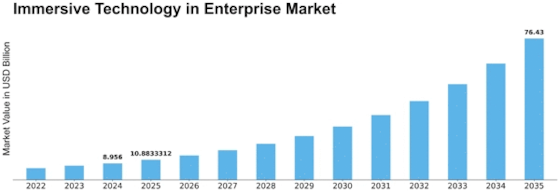
<p>The projected market valuation for Immersive Technology in the Enterprise Market is expected to reach 76.43 USD Billion by 2035.</p>

What was the market valuation for Immersive Technology in 2024?

<p>The overall market valuation for Immersive Technology in the Enterprise Market was 8.956 USD Billion in 2024.</p>

What is the expected CAGR for the Immersive Technology in Enterprise Market from 2025 to 2035?

<p>The expected CAGR for the Immersive Technology in Enterprise Market during the forecast period 2025 - 2035 is 21.52%.</p>

Which companies are considered key players in the Immersive Technology in Enterprise Market?

<p>Key players in the market include Meta Platforms, Microsoft, Google, Apple, NVIDIA, Unity Technologies, PTC, Magic Leap, Varjo Technologies, and HTC.</p>

What are the main components of the Immersive Technology market and their valuations?

<p>The main components include Hardware valued at 20.5 USD Billion, Software/Platform at 30.5 USD Billion, and Services at 25.43 USD Billion.</p>

How does the market for Virtual Reality compare to Augmented Reality in terms of valuation?

<p>In 2024, the market for Virtual Reality was valued at 25.0 USD Billion, whereas Augmented Reality was valued at 20.0 USD Billion.</p>

What applications are driving growth in the Immersive Technology market?

Key applications driving growth include Sales &amp; Marketing valued at 26.43 USD Billion and Training &amp; Learning at 20.0 USD Billion.

What is the valuation of Mixed Reality technology in the Immersive Technology market?

The valuation of Mixed Reality technology in the Immersive Technology market is 12.5 USD Billion.

How does the Services segment perform in the Immersive Technology market?

The Services segment is valued at 25.43 USD Billion, indicating a robust contribution to the overall market.

What trends are expected in the Immersive Technology market by 2035?

Trends suggest substantial growth across all segments, with particular emphasis on software and application development.

Market Summary

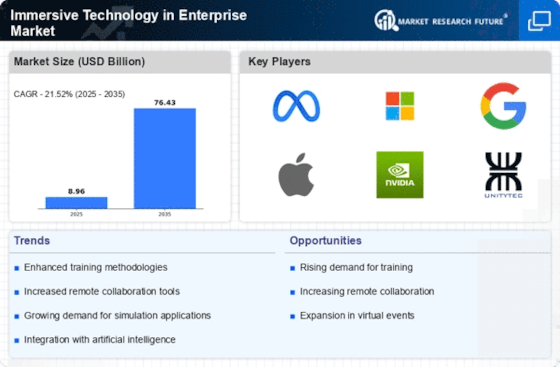
As per Market Research Future analysis, the Immersive Technology in Enterprise Market Size was estimated at 8.956 USD Billion in 2024. The Immersive Technology industry is projected to grow from 10.88 USD Billion in 2025 to 76.43 USD Billion by 2035, exhibiting a compound annual growth rate (CAGR) of 21.52% during the forecast period 2025 - 2035

Key Market Trends & Highlights

The Immersive Technology in Enterprise Market is experiencing robust growth driven by advancements in training and collaboration tools.

  • North America remains the largest market for immersive technology, showcasing a strong demand for innovative solutions. The Asia-Pacific region is emerging as the fastest-growing market, reflecting a surge in adoption rates across various industries. Hardware continues to dominate the market, while software and platform solutions are witnessing the fastest growth trajectory. Key market drivers include the increased demand for remote work solutions and a focus on employee training and skill development.

Market Size & Forecast

2024 Market Size 8.956 (USD Billion)
2035 Market Size 76.43 (USD Billion)
CAGR (2025 - 2035) 21.52%
Largest Regional Market Share in 2024 North America

Major Players

Meta Platforms (US), Microsoft (US), Google (US), Apple (US), NVIDIA (US), Unity Technologies (US), PTC (US), Magic Leap (US), Varjo Technologies (FI), HTC (TW)

Market Trends

The Immersive Technology in Enterprise Market is currently experiencing a transformative phase, characterized by the integration of advanced technologies such as virtual reality, augmented reality, and mixed reality into various business operations. This evolution appears to be driven by the increasing demand for enhanced training solutions, improved collaboration, and innovative customer engagement strategies. Enterprises are recognizing the potential of immersive technologies to create more engaging and effective experiences, which may lead to higher productivity and better outcomes. As organizations continue to explore these technologies, they are likely to invest in tailored solutions that align with their specific operational needs and objectives. Moreover, the landscape of the Immersive Technology in Enterprise Market is evolving rapidly, with a growing emphasis on user experience and accessibility. Companies are increasingly focusing on developing applications that are not only functional but also intuitive and user-friendly. This shift suggests a broader acceptance of immersive technologies across various sectors, including manufacturing, healthcare, and education. As the market matures, it may witness the emergence of new business models and partnerships, further driving innovation and adoption. The future of immersive technology in enterprises appears promising, with the potential to redefine how businesses operate and interact with their stakeholders.

Enhanced Training and Development

Organizations are increasingly adopting immersive technologies to revolutionize training and development programs. By utilizing virtual and augmented reality, companies can create realistic simulations that enhance learning experiences, allowing employees to practice skills in a safe environment. This trend indicates a shift towards more engaging and effective training methodologies.

Improved Collaboration Tools

The rise of immersive technology is fostering new collaboration tools that enable remote teams to work together more effectively. Virtual meeting spaces and collaborative environments are becoming commonplace, allowing employees to interact in a shared digital space. This trend suggests a move towards more integrated and interactive work experiences.

Innovative Customer Engagement

Businesses are leveraging immersive technologies to create unique customer engagement strategies. By offering interactive experiences, such as virtual showrooms or augmented reality applications, companies can enhance brand interaction and customer satisfaction. This trend highlights the potential for immersive technology to transform traditional marketing approaches.

Immersive Technology in Enterprise Market Market Drivers

Advancements in Hardware and Software

Technological advancements in hardware and software are propelling the growth of immersive technology in the enterprise market. Enhanced processing power, improved graphics, and more sophisticated software applications are making immersive experiences more accessible and effective. The enterprise market is witnessing a surge in the adoption of headsets and devices that support immersive technology, with projections indicating a compound annual growth rate (CAGR) of 30% through 2025. This growth is indicative of a broader trend where businesses are leveraging immersive technology to create more engaging training programs and interactive customer experiences, thereby enhancing overall operational efficiency.

Increased Demand for Remote Work Solutions

The rise of remote work has catalyzed a notable demand for immersive technology in the enterprise market. Companies are increasingly seeking innovative solutions to facilitate collaboration among distributed teams. Immersive technology in enterprise market provides tools such as virtual reality (VR) and augmented reality (AR) that enhance communication and engagement. According to recent data, the immersive technology market is projected to reach USD 300 billion by 2025, driven by the need for effective remote work solutions. This trend suggests that organizations are prioritizing investments in immersive technologies to maintain productivity and foster a cohesive work environment, even when employees are geographically dispersed.

Enhanced Customer Experience and Engagement

The integration of immersive technology in enterprise market is transforming customer experience and engagement strategies. Businesses are utilizing AR and VR to create interactive and personalized experiences that resonate with consumers. For instance, immersive product demonstrations and virtual showrooms are becoming commonplace, allowing customers to engage with products in a more meaningful way. Research indicates that companies employing immersive technology can increase customer engagement rates by up to 40%. This trend highlights the potential of immersive technology to not only attract customers but also to foster brand loyalty through memorable experiences.

Growing Investment in Research and Development

Investment in research and development (R&D) is a critical driver for the advancement of immersive technology in enterprise market. Companies are allocating substantial resources to explore innovative applications of immersive technology, from enhancing operational processes to developing new products. This focus on R&D is expected to yield breakthroughs that could redefine industry standards. Recent statistics indicate that R&D spending in the immersive technology sector is projected to grow by 25% annually, reflecting a commitment to harnessing the full potential of immersive solutions. As organizations continue to innovate, the landscape of immersive technology in enterprise market is likely to evolve rapidly.

Focus on Employee Training and Skill Development

Organizations are increasingly recognizing the value of immersive technology in enterprise market for employee training and skill development. Immersive training solutions, such as VR simulations, allow employees to practice real-world scenarios in a safe environment. This approach not only enhances learning retention but also reduces training costs. Data suggests that companies utilizing immersive training solutions can see a 70% improvement in training outcomes. As businesses strive to upskill their workforce in a rapidly changing environment, the integration of immersive technology into training programs is becoming a strategic priority.

Market Segment Insights

By Component: Hardware (Largest) vs. Software/Platform (Fastest-Growing)

Within the Immersive Technology in Enterprise Market, the component segment exhibits a diverse landscape with hardware, software/platform, and services contributing to its overall dynamics. Hardware has positioned itself as the largest segment due to its integral role in delivering immersive experiences, encompassing devices like VR headsets and AR glasses. Software and platforms, while smaller, are gaining traction as enterprises prioritize developing robust applications and solutions that integrate seamlessly with existing systems.

Hardware (Dominant) vs. Software/Platform (Emerging)

In the Immersive Technology landscape, hardware is currently the dominant force, comprising essential tools and devices that enhance interactive experiences for enterprises. This segment benefits from ongoing technological advancement, rendering devices more user-friendly and efficient. On the other hand, software/platform represents the emerging segment, responsible for driving innovation through tailored applications and platforms. As enterprises seek to leverage immersive technology for training, marketing, and customer engagement, the demand for flexible software solutions increases, highlighting its potential for future growth.

By Technology: Mixed Reality (Largest) vs. Virtual Reality (Fastest-Growing)

In the Immersive Technology in Enterprise Market, Mixed Reality (MR) holds the largest share as organizations increasingly adopt its capabilities for a blend of real and virtual experiences. This segment dominates due to applications in training, simulation, and collaborative work, making it highly appealing across various industries. Conversely, Virtual Reality (VR) is witnessing explosive growth, driven by advancements in hardware and software, leading to a surge in enterprise solutions, particularly in sectors like training and education. Growth in the Immersive Technology segment is propelled by increasing demand for innovative training solutions and enhanced customer engagement. Going forward, companies are focusing on integrating these technologies to create comprehensive digital experiences. As VR technology becomes more accessible and affordable, its rapid growth is expected to continue, positioning it as a key player in transforming enterprise processes and interactions.

Technology: Mixed Reality (Dominant) vs. Virtual Reality (Emerging)

<a title="Mixed Reality (MR)" href="https://www.marketresearchfuture.com/reports/mixed-reality-market-1766" target="_blank" rel="noopener">Mixed Reality (MR)</a> is characterized by its ability to merge the physical and digital worlds, allowing for interactive experiences that enhance productivity and collaboration. Its dominant position stems from its diverse applications, ranging from remote assistance to complex training scenarios, appealing particularly to industries such as manufacturing and healthcare. In contrast, Virtual Reality (VR) is emerging as a game-changer in enterprise training and simulation, offering immersive environments that facilitate effective skill development. As organizations increasingly recognize the importance of engaging learning methods, VR's potential to create realistic, risk-free training experiences positions it favorably amongst emerging technologies.

By Application: Training & Learning (Largest) vs. Emergency Services (Fastest-Growing)

In the Immersive Technology in Enterprise Market, the Training &amp; Learning application currently holds the largest market share due to its widespread adoption across various industries, including healthcare, education, and manufacturing. Organizations leverage immersive technologies such as virtual reality (VR) and augmented reality (AR) to enhance training programs, creating engaging and effective learning environments that lead to improved employee performance and retention rates. On the other hand, the Emergency Services application segment is emerging as the fastest-growing sector. There is an increased focus on improving response times and situational awareness through immersive training simulations. The adoption of AR and VR technologies in emergency response is driven by the need for realistic training that prepares responders for real-life scenarios, ultimately enhancing public safety and operational efficiency.

Training &amp; Learning (Dominant) vs. Product Development (Emerging)

Training &amp; Learning stands out as the dominant application of immersive technology in the enterprise market, revolutionizing the way employees are trained. The integration of VR and AR into training modules offers practical, hands-on experiences that traditional training methods simply cannot match. This segment helps organizations reduce costs associated with in-person training while improving knowledge retention and skill application. On the contrary, the Product Development segment is marked as emerging, with companies increasingly using immersive technologies to prototype and visualize products before they are created. This application allows for rapid iteration and feedback, thus streamlining the innovation process and reducing time-to-market, demonstrating significant potential for growth in the near future.

Get more detailed insights about Immersive Technology in Enterprise Market Research Report – Forecast till 2035

Regional Insights

North America : Innovation and Leadership Hub

North America is the largest market for immersive technology in the enterprise sector, holding approximately 45% of the global market share. The region's growth is driven by rapid technological advancements, increased investment in R&D, and a strong focus on digital transformation across industries. Regulatory support for innovation and technology adoption further fuels demand, making it a key player in the global landscape. The United States leads the charge, with major players like Meta Platforms, Microsoft, and Google driving innovation. The competitive landscape is characterized by a mix of established tech giants and emerging startups, all vying for market share. The presence of advanced infrastructure and a skilled workforce enhances the region's attractiveness for immersive technology applications, solidifying its position as a leader in the sector.

Europe : Emerging Market with Potential

Europe is witnessing significant growth in the immersive technology market, accounting for approximately 30% of the global share. The region's demand is driven by increasing adoption in sectors such as manufacturing, healthcare, and education. Regulatory frameworks promoting digital innovation and sustainability are also key catalysts for market expansion, creating a conducive environment for immersive technology solutions. Leading countries like Germany, the UK, and France are at the forefront of this growth, with a competitive landscape featuring both established firms and innovative startups. Companies such as Varjo Technologies and HTC are making strides in the market, contributing to a vibrant ecosystem. The European market is characterized by a strong emphasis on collaboration and partnerships, enhancing the development and deployment of immersive technologies.

Asia-Pacific : Rapid Growth and Adoption

Asia-Pacific is rapidly emerging as a significant player in the immersive technology market, holding around 20% of the global share. The region's growth is fueled by increasing investments in technology, a burgeoning startup ecosystem, and rising demand for immersive solutions in sectors like retail and entertainment. Government initiatives promoting digital innovation and smart city projects are also driving market expansion, making it a focal point for immersive technology development. Countries like China, Japan, and South Korea are leading the charge, with a competitive landscape that includes both local and international players. Companies such as Unity Technologies and PTC are actively expanding their presence in the region. The Asia-Pacific market is characterized by a high level of consumer engagement and a willingness to adopt new technologies, positioning it as a key area for future growth in immersive technology.

Middle East and Africa : Emerging Market with Opportunities

The Middle East and Africa region is gradually emerging in the immersive technology market, currently holding about 5% of the global share. The growth is driven by increasing investments in technology infrastructure, a young and tech-savvy population, and government initiatives aimed at fostering innovation. The region's diverse economic landscape presents unique opportunities for immersive technology applications across various sectors, including tourism and education. Countries like the UAE and South Africa are leading the way, with a growing number of startups and established companies exploring immersive solutions. The competitive landscape is evolving, with local firms collaborating with international players to enhance their offerings. The region's focus on digital transformation and smart city initiatives is expected to further boost the adoption of immersive technologies in the coming years.

Key Players and Competitive Insights

Leading market players are investing heavily in research and development in order to expand their product lines, which will help the Immersive Technology in Enterprise Market, grow even more. Market participants are also undertaking a variety of strategic activities to expand their footprint, with important market developments including new product launches, contractual agreements, mergers and acquisitions, higher investments, and collaboration with other organizations. To expand and survive in a more competitive and rising market climate, Immersive Technology in Enterprise industry must offer cost-effective items. Manufacturing locally to minimize operational costs is one of the key business tactics used by manufacturers in the Immersive Technology in Enterprise industry to benefit clients and increase the market sector. In recent years, the Immersive Technology in Enterprise industry has offered some of the most significant advantages to medicine. Major players in the Immersive Technology in Enterprise Market, including Acer Inc., Atheer, Inc., AVEVA Group PLC, Barco NV, Blippar Ltd., Carl Zeiss AG, CM Labs Simulations Inc., EON Reality, Inc., FAAC Incorporated, Google, LLC, HCL Technologies Limited, Honeywell International, Inc., HTC Corporation, Immersive Media Company, Immersive Technologies Pty Limited, Lockheed Martin Corporation, Magic Leap, Inc., NCTech Limited, Oculus (Facebook Technologies, LLC.), Samsung Group, Sony Corporation, Unity Software Inc., Varjo Technologies Oy, VI-grade GmbH, Zeality Inc. and others, are attempting to increase market demand by investing in research and development operations. Samsung Electronics Co Ltd (Samsung), a division of the Samsung Group, manufactures consumer electronics, information technology, mobile communications, and device solutions. The company's product line includes printers, monitors, computers, network systems, digital cameras, televisions, refrigerators, washing machines, air conditioners, medical devices, and more. It also manufactures LCD and LED panels, mobile phones, tablets, smartphones, and other accessories. The government, healthcare, financial, educational, retail, hotel, and transportation industries can all profit from Samsung's solutions. The Asia-Pacific region, the Americas, Europe, Africa, and the Middle East are all locations where the organization conducts business. Samsung's headquarters are in Seoul, South Korea. Technology firm Magic Leap Inc. (Magic Leap) creates software and user interfaces for computers. For virtual animations and virtual reality experiences, the business develops light field display technology. The magic leap one creator edition headset is offered. A cutting-edge computing platform called Magic Leap makes it possible to experience both the real world and the virtual one. It enables game creation and play, as well as spatial browsing and content extraction, for web developers. It works along with universities, tech companies, and companies that produce movies and television programs. The American retail, sports, healthcare, and entertainment industries. The US city of Plantation, Florida, is where Magic Leap is based.

Key Companies in the Immersive Technology in Enterprise Market include

Industry Developments

May 2022: The Magic Leap, Inc. announced a new strategic partnership with Globant, LLC to develop and deploy tailored software solutions for enterprise customers.

Future Outlook

Immersive Technology in Enterprise Market Future Outlook

The Immersive Technology in Enterprise Market is projected to grow at a 21.52% CAGR from 2025 to 2035, driven by advancements in AR/VR, increased demand for remote collaboration, and enhanced training solutions.

New opportunities lie in:

  • <p>Development of customized AR training modules for diverse industries. Integration of VR simulations in product design processes. Creation of immersive customer experience platforms for retail environments.</p>

By 2035, the market is expected to be robust, driven by innovative applications and widespread adoption.

Market Segmentation

Immersive Technology in Enterprise Market Component Outlook

  • Hardware
  • Software/Platform
  • Services

Immersive Technology in Enterprise Market Technology Outlook

  • Mixed Reality (MR)
  • Virtual Reality (VR)
  • Augmented Reality (AR)
  • 360 Film

Immersive Technology in Enterprise Market Application Outlook

  • Training & Learning
  • Emergency Services
  • Product Development
  • Sales & Marketing

Report Scope

MARKET SIZE 2024 8.956(USD Billion)
MARKET SIZE 2025 10.88(USD Billion)
MARKET SIZE 2035 76.43(USD Billion)
COMPOUND ANNUAL GROWTH RATE (CAGR) 21.52% (2025 - 2035)
REPORT COVERAGE Revenue Forecast, Competitive Landscape, Growth Factors, and Trends
BASE YEAR 2024
Market Forecast Period 2025 - 2035
Historical Data 2019 - 2024
Market Forecast Units USD Billion
Key Companies Profiled Meta Platforms (US), Microsoft (US), Google (US), Apple (US), NVIDIA (US), Unity Technologies (US), PTC (US), Magic Leap (US), Varjo Technologies (FI), HTC (TW)
Segments Covered Component, Technology, Application, Region
Key Market Opportunities Integration of augmented reality for enhanced training and collaboration in the Immersive Technology in Enterprise Market.
Key Market Dynamics Rising demand for immersive training solutions drives innovation and competition in the enterprise technology landscape.
Countries Covered North America, Europe, APAC, South America, MEA

FAQs

What is the projected market valuation for Immersive Technology in the Enterprise Market by 2035?

<p>The projected market valuation for Immersive Technology in the Enterprise Market is expected to reach 76.43 USD Billion by 2035.</p>

What was the market valuation for Immersive Technology in 2024?

<p>The overall market valuation for Immersive Technology in the Enterprise Market was 8.956 USD Billion in 2024.</p>

What is the expected CAGR for the Immersive Technology in Enterprise Market from 2025 to 2035?

<p>The expected CAGR for the Immersive Technology in Enterprise Market during the forecast period 2025 - 2035 is 21.52%.</p>

Which companies are considered key players in the Immersive Technology in Enterprise Market?

<p>Key players in the market include Meta Platforms, Microsoft, Google, Apple, NVIDIA, Unity Technologies, PTC, Magic Leap, Varjo Technologies, and HTC.</p>

What are the main components of the Immersive Technology market and their valuations?

<p>The main components include Hardware valued at 20.5 USD Billion, Software/Platform at 30.5 USD Billion, and Services at 25.43 USD Billion.</p>

How does the market for Virtual Reality compare to Augmented Reality in terms of valuation?

<p>In 2024, the market for Virtual Reality was valued at 25.0 USD Billion, whereas Augmented Reality was valued at 20.0 USD Billion.</p>

What applications are driving growth in the Immersive Technology market?

Key applications driving growth include Sales &amp; Marketing valued at 26.43 USD Billion and Training &amp; Learning at 20.0 USD Billion.

What is the valuation of Mixed Reality technology in the Immersive Technology market?

The valuation of Mixed Reality technology in the Immersive Technology market is 12.5 USD Billion.

How does the Services segment perform in the Immersive Technology market?

The Services segment is valued at 25.43 USD Billion, indicating a robust contribution to the overall market.

What trends are expected in the Immersive Technology market by 2035?

Trends suggest substantial growth across all segments, with particular emphasis on software and application development.

  1. SECTION I: EXECUTIVE SUMMARY AND KEY HIGHLIGHTS
    1. | 1.1 EXECUTIVE SUMMARY
    2. | | 1.1.1 Market Overview
    3. | | 1.1.2 Key Findings
    4. | | 1.1.3 Market Segmentation
    5. | | 1.1.4 Competitive Landscape
    6. | | 1.1.5 Challenges and Opportunities
    7. | | 1.1.6 Future Outlook
  2. SECTION II: SCOPING, METHODOLOGY AND MARKET STRUCTURE
    1. | 2.1 MARKET INTRODUCTION
    2. | | 2.1.1 Definition
    3. | | 2.1.2 Scope of the study
    4. | | | 2.1.2.1 Research Objective
    5. | | | 2.1.2.2 Assumption
    6. | | | 2.1.2.3 Limitations
    7. | 2.2 RESEARCH METHODOLOGY
    8. | | 2.2.1 Overview
    9. | | 2.2.2 Data Mining
    10. | | 2.2.3 Secondary Research
    11. | | 2.2.4 Primary Research
    12. | | | 2.2.4.1 Primary Interviews and Information Gathering Process
    13. | | | 2.2.4.2 Breakdown of Primary Respondents
    14. | | 2.2.5 Forecasting Model
    15. | | 2.2.6 Market Size Estimation
    16. | | | 2.2.6.1 Bottom-Up Approach
    17. | | | 2.2.6.2 Top-Down Approach
    18. | | 2.2.7 Data Triangulation
    19. | | 2.2.8 Validation
  3. SECTION III: QUALITATIVE ANALYSIS
    1. | 3.1 MARKET DYNAMICS
    2. | | 3.1.1 Overview
    3. | | 3.1.2 Drivers
    4. | | 3.1.3 Restraints
    5. | | 3.1.4 Opportunities
    6. | 3.2 MARKET FACTOR ANALYSIS
    7. | | 3.2.1 Value chain Analysis
    8. | | 3.2.2 Porter's Five Forces Analysis
    9. | | | 3.2.2.1 Bargaining Power of Suppliers
    10. | | | 3.2.2.2 Bargaining Power of Buyers
    11. | | | 3.2.2.3 Threat of New Entrants
    12. | | | 3.2.2.4 Threat of Substitutes
    13. | | | 3.2.2.5 Intensity of Rivalry
    14. | | 3.2.3 COVID-19 Impact Analysis
    15. | | | 3.2.3.1 Market Impact Analysis
    16. | | | 3.2.3.2 Regional Impact
    17. | | | 3.2.3.3 Opportunity and Threat Analysis
  4. SECTION IV: QUANTITATIVE ANALYSIS
    1. | 4.1 Information and Communications Technology, BY Component (USD Billion)
    2. | | 4.1.1 Hardware
    3. | | 4.1.2 Software/Platform
    4. | | 4.1.3 Services
    5. | 4.2 Information and Communications Technology, BY Technology (USD Billion)
    6. | | 4.2.1 Mixed Reality (MR)
    7. | | 4.2.2 Virtual Reality (VR)
    8. | | 4.2.3 Augmented Reality (AR)
    9. | | 4.2.4 360 Film
    10. | 4.3 Information and Communications Technology, BY Application (USD Billion)
    11. | | 4.3.1 Training & Learning
    12. | | 4.3.2 Emergency Services
    13. | | 4.3.3 Product Development
    14. | | 4.3.4 Sales & Marketing
    15. | 4.4 Information and Communications Technology, BY Region (USD Billion)
    16. | | 4.4.1 North America
    17. | | | 4.4.1.1 US
    18. | | | 4.4.1.2 Canada
    19. | | 4.4.2 Europe
    20. | | | 4.4.2.1 Germany
    21. | | | 4.4.2.2 UK
    22. | | | 4.4.2.3 France
    23. | | | 4.4.2.4 Russia
    24. | | | 4.4.2.5 Italy
    25. | | | 4.4.2.6 Spain
    26. | | | 4.4.2.7 Rest of Europe
    27. | | 4.4.3 APAC
    28. | | | 4.4.3.1 China
    29. | | | 4.4.3.2 India
    30. | | | 4.4.3.3 Japan
    31. | | | 4.4.3.4 South Korea
    32. | | | 4.4.3.5 Malaysia
    33. | | | 4.4.3.6 Thailand
    34. | | | 4.4.3.7 Indonesia
    35. | | | 4.4.3.8 Rest of APAC
    36. | | 4.4.4 South America
    37. | | | 4.4.4.1 Brazil
    38. | | | 4.4.4.2 Mexico
    39. | | | 4.4.4.3 Argentina
    40. | | | 4.4.4.4 Rest of South America
    41. | | 4.4.5 MEA
    42. | | | 4.4.5.1 GCC Countries
    43. | | | 4.4.5.2 South Africa
    44. | | | 4.4.5.3 Rest of MEA
  5. SECTION V: COMPETITIVE ANALYSIS
    1. | 5.1 Competitive Landscape
    2. | | 5.1.1 Overview
    3. | | 5.1.2 Competitive Analysis
    4. | | 5.1.3 Market share Analysis
    5. | | 5.1.4 Major Growth Strategy in the Information and Communications Technology
    6. | | 5.1.5 Competitive Benchmarking
    7. | | 5.1.6 Leading Players in Terms of Number of Developments in the Information and Communications Technology
    8. | | 5.1.7 Key developments and growth strategies
    9. | | | 5.1.7.1 New Product Launch/Service Deployment
    10. | | | 5.1.7.2 Merger & Acquisitions
    11. | | | 5.1.7.3 Joint Ventures
    12. | | 5.1.8 Major Players Financial Matrix
    13. | | | 5.1.8.1 Sales and Operating Income
    14. | | | 5.1.8.2 Major Players R&D Expenditure. 2023
    15. | 5.2 Company Profiles
    16. | | 5.2.1 Meta Platforms (US)
    17. | | | 5.2.1.1 Financial Overview
    18. | | | 5.2.1.2 Products Offered
    19. | | | 5.2.1.3 Key Developments
    20. | | | 5.2.1.4 SWOT Analysis
    21. | | | 5.2.1.5 Key Strategies
    22. | | 5.2.2 Microsoft (US)
    23. | | | 5.2.2.1 Financial Overview
    24. | | | 5.2.2.2 Products Offered
    25. | | | 5.2.2.3 Key Developments
    26. | | | 5.2.2.4 SWOT Analysis
    27. | | | 5.2.2.5 Key Strategies
    28. | | 5.2.3 Google (US)
    29. | | | 5.2.3.1 Financial Overview
    30. | | | 5.2.3.2 Products Offered
    31. | | | 5.2.3.3 Key Developments
    32. | | | 5.2.3.4 SWOT Analysis
    33. | | | 5.2.3.5 Key Strategies
    34. | | 5.2.4 Apple (US)
    35. | | | 5.2.4.1 Financial Overview
    36. | | | 5.2.4.2 Products Offered
    37. | | | 5.2.4.3 Key Developments
    38. | | | 5.2.4.4 SWOT Analysis
    39. | | | 5.2.4.5 Key Strategies
    40. | | 5.2.5 NVIDIA (US)
    41. | | | 5.2.5.1 Financial Overview
    42. | | | 5.2.5.2 Products Offered
    43. | | | 5.2.5.3 Key Developments
    44. | | | 5.2.5.4 SWOT Analysis
    45. | | | 5.2.5.5 Key Strategies
    46. | | 5.2.6 Unity Technologies (US)
    47. | | | 5.2.6.1 Financial Overview
    48. | | | 5.2.6.2 Products Offered
    49. | | | 5.2.6.3 Key Developments
    50. | | | 5.2.6.4 SWOT Analysis
    51. | | | 5.2.6.5 Key Strategies
    52. | | 5.2.7 PTC (US)
    53. | | | 5.2.7.1 Financial Overview
    54. | | | 5.2.7.2 Products Offered
    55. | | | 5.2.7.3 Key Developments
    56. | | | 5.2.7.4 SWOT Analysis
    57. | | | 5.2.7.5 Key Strategies
    58. | | 5.2.8 Magic Leap (US)
    59. | | | 5.2.8.1 Financial Overview
    60. | | | 5.2.8.2 Products Offered
    61. | | | 5.2.8.3 Key Developments
    62. | | | 5.2.8.4 SWOT Analysis
    63. | | | 5.2.8.5 Key Strategies
    64. | | 5.2.9 Varjo Technologies (FI)
    65. | | | 5.2.9.1 Financial Overview
    66. | | | 5.2.9.2 Products Offered
    67. | | | 5.2.9.3 Key Developments
    68. | | | 5.2.9.4 SWOT Analysis
    69. | | | 5.2.9.5 Key Strategies
    70. | | 5.2.10 HTC (TW)
    71. | | | 5.2.10.1 Financial Overview
    72. | | | 5.2.10.2 Products Offered
    73. | | | 5.2.10.3 Key Developments
    74. | | | 5.2.10.4 SWOT Analysis
    75. | | | 5.2.10.5 Key Strategies
    76. | 5.3 Appendix
    77. | | 5.3.1 References
    78. | | 5.3.2 Related Reports
  6. LIST OF FIGURES
    1. | 6.1 MARKET SYNOPSIS
    2. | 6.2 NORTH AMERICA MARKET ANALYSIS
    3. | 6.3 US MARKET ANALYSIS BY COMPONENT
    4. | 6.4 US MARKET ANALYSIS BY TECHNOLOGY
    5. | 6.5 US MARKET ANALYSIS BY APPLICATION
    6. | 6.6 CANADA MARKET ANALYSIS BY COMPONENT
    7. | 6.7 CANADA MARKET ANALYSIS BY TECHNOLOGY
    8. | 6.8 CANADA MARKET ANALYSIS BY APPLICATION
    9. | 6.9 EUROPE MARKET ANALYSIS
    10. | 6.10 GERMANY MARKET ANALYSIS BY COMPONENT
    11. | 6.11 GERMANY MARKET ANALYSIS BY TECHNOLOGY
    12. | 6.12 GERMANY MARKET ANALYSIS BY APPLICATION
    13. | 6.13 UK MARKET ANALYSIS BY COMPONENT
    14. | 6.14 UK MARKET ANALYSIS BY TECHNOLOGY
    15. | 6.15 UK MARKET ANALYSIS BY APPLICATION
    16. | 6.16 FRANCE MARKET ANALYSIS BY COMPONENT
    17. | 6.17 FRANCE MARKET ANALYSIS BY TECHNOLOGY
    18. | 6.18 FRANCE MARKET ANALYSIS BY APPLICATION
    19. | 6.19 RUSSIA MARKET ANALYSIS BY COMPONENT
    20. | 6.20 RUSSIA MARKET ANALYSIS BY TECHNOLOGY
    21. | 6.21 RUSSIA MARKET ANALYSIS BY APPLICATION
    22. | 6.22 ITALY MARKET ANALYSIS BY COMPONENT
    23. | 6.23 ITALY MARKET ANALYSIS BY TECHNOLOGY
    24. | 6.24 ITALY MARKET ANALYSIS BY APPLICATION
    25. | 6.25 SPAIN MARKET ANALYSIS BY COMPONENT
    26. | 6.26 SPAIN MARKET ANALYSIS BY TECHNOLOGY
    27. | 6.27 SPAIN MARKET ANALYSIS BY APPLICATION
    28. | 6.28 REST OF EUROPE MARKET ANALYSIS BY COMPONENT
    29. | 6.29 REST OF EUROPE MARKET ANALYSIS BY TECHNOLOGY
    30. | 6.30 REST OF EUROPE MARKET ANALYSIS BY APPLICATION
    31. | 6.31 APAC MARKET ANALYSIS
    32. | 6.32 CHINA MARKET ANALYSIS BY COMPONENT
    33. | 6.33 CHINA MARKET ANALYSIS BY TECHNOLOGY
    34. | 6.34 CHINA MARKET ANALYSIS BY APPLICATION
    35. | 6.35 INDIA MARKET ANALYSIS BY COMPONENT
    36. | 6.36 INDIA MARKET ANALYSIS BY TECHNOLOGY
    37. | 6.37 INDIA MARKET ANALYSIS BY APPLICATION
    38. | 6.38 JAPAN MARKET ANALYSIS BY COMPONENT
    39. | 6.39 JAPAN MARKET ANALYSIS BY TECHNOLOGY
    40. | 6.40 JAPAN MARKET ANALYSIS BY APPLICATION
    41. | 6.41 SOUTH KOREA MARKET ANALYSIS BY COMPONENT
    42. | 6.42 SOUTH KOREA MARKET ANALYSIS BY TECHNOLOGY
    43. | 6.43 SOUTH KOREA MARKET ANALYSIS BY APPLICATION
    44. | 6.44 MALAYSIA MARKET ANALYSIS BY COMPONENT
    45. | 6.45 MALAYSIA MARKET ANALYSIS BY TECHNOLOGY
    46. | 6.46 MALAYSIA MARKET ANALYSIS BY APPLICATION
    47. | 6.47 THAILAND MARKET ANALYSIS BY COMPONENT
    48. | 6.48 THAILAND MARKET ANALYSIS BY TECHNOLOGY
    49. | 6.49 THAILAND MARKET ANALYSIS BY APPLICATION
    50. | 6.50 INDONESIA MARKET ANALYSIS BY COMPONENT
    51. | 6.51 INDONESIA MARKET ANALYSIS BY TECHNOLOGY
    52. | 6.52 INDONESIA MARKET ANALYSIS BY APPLICATION
    53. | 6.53 REST OF APAC MARKET ANALYSIS BY COMPONENT
    54. | 6.54 REST OF APAC MARKET ANALYSIS BY TECHNOLOGY
    55. | 6.55 REST OF APAC MARKET ANALYSIS BY APPLICATION
    56. | 6.56 SOUTH AMERICA MARKET ANALYSIS
    57. | 6.57 BRAZIL MARKET ANALYSIS BY COMPONENT
    58. | 6.58 BRAZIL MARKET ANALYSIS BY TECHNOLOGY
    59. | 6.59 BRAZIL MARKET ANALYSIS BY APPLICATION
    60. | 6.60 MEXICO MARKET ANALYSIS BY COMPONENT
    61. | 6.61 MEXICO MARKET ANALYSIS BY TECHNOLOGY
    62. | 6.62 MEXICO MARKET ANALYSIS BY APPLICATION
    63. | 6.63 ARGENTINA MARKET ANALYSIS BY COMPONENT
    64. | 6.64 ARGENTINA MARKET ANALYSIS BY TECHNOLOGY
    65. | 6.65 ARGENTINA MARKET ANALYSIS BY APPLICATION
    66. | 6.66 REST OF SOUTH AMERICA MARKET ANALYSIS BY COMPONENT
    67. | 6.67 REST OF SOUTH AMERICA MARKET ANALYSIS BY TECHNOLOGY
    68. | 6.68 REST OF SOUTH AMERICA MARKET ANALYSIS BY APPLICATION
    69. | 6.69 MEA MARKET ANALYSIS
    70. | 6.70 GCC COUNTRIES MARKET ANALYSIS BY COMPONENT
    71. | 6.71 GCC COUNTRIES MARKET ANALYSIS BY TECHNOLOGY
    72. | 6.72 GCC COUNTRIES MARKET ANALYSIS BY APPLICATION
    73. | 6.73 SOUTH AFRICA MARKET ANALYSIS BY COMPONENT
    74. | 6.74 SOUTH AFRICA MARKET ANALYSIS BY TECHNOLOGY
    75. | 6.75 SOUTH AFRICA MARKET ANALYSIS BY APPLICATION
    76. | 6.76 REST OF MEA MARKET ANALYSIS BY COMPONENT
    77. | 6.77 REST OF MEA MARKET ANALYSIS BY TECHNOLOGY
    78. | 6.78 REST OF MEA MARKET ANALYSIS BY APPLICATION
    79. | 6.79 KEY BUYING CRITERIA OF INFORMATION AND COMMUNICATIONS TECHNOLOGY
    80. | 6.80 RESEARCH PROCESS OF MRFR
    81. | 6.81 DRO ANALYSIS OF INFORMATION AND COMMUNICATIONS TECHNOLOGY
    82. | 6.82 DRIVERS IMPACT ANALYSIS: INFORMATION AND COMMUNICATIONS TECHNOLOGY
    83. | 6.83 RESTRAINTS IMPACT ANALYSIS: INFORMATION AND COMMUNICATIONS TECHNOLOGY
    84. | 6.84 SUPPLY / VALUE CHAIN: INFORMATION AND COMMUNICATIONS TECHNOLOGY
    85. | 6.85 INFORMATION AND COMMUNICATIONS TECHNOLOGY, BY COMPONENT, 2024 (% SHARE)
    86. | 6.86 INFORMATION AND COMMUNICATIONS TECHNOLOGY, BY COMPONENT, 2024 TO 2035 (USD Billion)
    87. | 6.87 INFORMATION AND COMMUNICATIONS TECHNOLOGY, BY TECHNOLOGY, 2024 (% SHARE)
    88. | 6.88 INFORMATION AND COMMUNICATIONS TECHNOLOGY, BY TECHNOLOGY, 2024 TO 2035 (USD Billion)
    89. | 6.89 INFORMATION AND COMMUNICATIONS TECHNOLOGY, BY APPLICATION, 2024 (% SHARE)
    90. | 6.90 INFORMATION AND COMMUNICATIONS TECHNOLOGY, BY APPLICATION, 2024 TO 2035 (USD Billion)
    91. | 6.91 BENCHMARKING OF MAJOR COMPETITORS
  7. LIST OF TABLES
    1. | 7.1 LIST OF ASSUMPTIONS
    2. | | 7.1.1
    3. | 7.2 North America MARKET SIZE ESTIMATES; FORECAST
    4. | | 7.2.1 BY COMPONENT, 2025-2035 (USD Billion)
    5. | | 7.2.2 BY TECHNOLOGY, 2025-2035 (USD Billion)
    6. | | 7.2.3 BY APPLICATION, 2025-2035 (USD Billion)
    7. | 7.3 US MARKET SIZE ESTIMATES; FORECAST
    8. | | 7.3.1 BY COMPONENT, 2025-2035 (USD Billion)
    9. | | 7.3.2 BY TECHNOLOGY, 2025-2035 (USD Billion)
    10. | | 7.3.3 BY APPLICATION, 2025-2035 (USD Billion)
    11. | 7.4 Canada MARKET SIZE ESTIMATES; FORECAST
    12. | | 7.4.1 BY COMPONENT, 2025-2035 (USD Billion)
    13. | | 7.4.2 BY TECHNOLOGY, 2025-2035 (USD Billion)
    14. | | 7.4.3 BY APPLICATION, 2025-2035 (USD Billion)
    15. | 7.5 Europe MARKET SIZE ESTIMATES; FORECAST
    16. | | 7.5.1 BY COMPONENT, 2025-2035 (USD Billion)
    17. | | 7.5.2 BY TECHNOLOGY, 2025-2035 (USD Billion)
    18. | | 7.5.3 BY APPLICATION, 2025-2035 (USD Billion)
    19. | 7.6 Germany MARKET SIZE ESTIMATES; FORECAST
    20. | | 7.6.1 BY COMPONENT, 2025-2035 (USD Billion)
    21. | | 7.6.2 BY TECHNOLOGY, 2025-2035 (USD Billion)
    22. | | 7.6.3 BY APPLICATION, 2025-2035 (USD Billion)
    23. | 7.7 UK MARKET SIZE ESTIMATES; FORECAST
    24. | | 7.7.1 BY COMPONENT, 2025-2035 (USD Billion)
    25. | | 7.7.2 BY TECHNOLOGY, 2025-2035 (USD Billion)
    26. | | 7.7.3 BY APPLICATION, 2025-2035 (USD Billion)
    27. | 7.8 France MARKET SIZE ESTIMATES; FORECAST
    28. | | 7.8.1 BY COMPONENT, 2025-2035 (USD Billion)
    29. | | 7.8.2 BY TECHNOLOGY, 2025-2035 (USD Billion)
    30. | | 7.8.3 BY APPLICATION, 2025-2035 (USD Billion)
    31. | 7.9 Russia MARKET SIZE ESTIMATES; FORECAST
    32. | | 7.9.1 BY COMPONENT, 2025-2035 (USD Billion)
    33. | | 7.9.2 BY TECHNOLOGY, 2025-2035 (USD Billion)
    34. | | 7.9.3 BY APPLICATION, 2025-2035 (USD Billion)
    35. | 7.10 Italy MARKET SIZE ESTIMATES; FORECAST
    36. | | 7.10.1 BY COMPONENT, 2025-2035 (USD Billion)
    37. | | 7.10.2 BY TECHNOLOGY, 2025-2035 (USD Billion)
    38. | | 7.10.3 BY APPLICATION, 2025-2035 (USD Billion)
    39. | 7.11 Spain MARKET SIZE ESTIMATES; FORECAST
    40. | | 7.11.1 BY COMPONENT, 2025-2035 (USD Billion)
    41. | | 7.11.2 BY TECHNOLOGY, 2025-2035 (USD Billion)
    42. | | 7.11.3 BY APPLICATION, 2025-2035 (USD Billion)
    43. | 7.12 Rest of Europe MARKET SIZE ESTIMATES; FORECAST
    44. | | 7.12.1 BY COMPONENT, 2025-2035 (USD Billion)
    45. | | 7.12.2 BY TECHNOLOGY, 2025-2035 (USD Billion)
    46. | | 7.12.3 BY APPLICATION, 2025-2035 (USD Billion)
    47. | 7.13 APAC MARKET SIZE ESTIMATES; FORECAST
    48. | | 7.13.1 BY COMPONENT, 2025-2035 (USD Billion)
    49. | | 7.13.2 BY TECHNOLOGY, 2025-2035 (USD Billion)
    50. | | 7.13.3 BY APPLICATION, 2025-2035 (USD Billion)
    51. | 7.14 China MARKET SIZE ESTIMATES; FORECAST
    52. | | 7.14.1 BY COMPONENT, 2025-2035 (USD Billion)
    53. | | 7.14.2 BY TECHNOLOGY, 2025-2035 (USD Billion)
    54. | | 7.14.3 BY APPLICATION, 2025-2035 (USD Billion)
    55. | 7.15 India MARKET SIZE ESTIMATES; FORECAST
    56. | | 7.15.1 BY COMPONENT, 2025-2035 (USD Billion)
    57. | | 7.15.2 BY TECHNOLOGY, 2025-2035 (USD Billion)
    58. | | 7.15.3 BY APPLICATION, 2025-2035 (USD Billion)
    59. | 7.16 Japan MARKET SIZE ESTIMATES; FORECAST
    60. | | 7.16.1 BY COMPONENT, 2025-2035 (USD Billion)
    61. | | 7.16.2 BY TECHNOLOGY, 2025-2035 (USD Billion)
    62. | | 7.16.3 BY APPLICATION, 2025-2035 (USD Billion)
    63. | 7.17 South Korea MARKET SIZE ESTIMATES; FORECAST
    64. | | 7.17.1 BY COMPONENT, 2025-2035 (USD Billion)
    65. | | 7.17.2 BY TECHNOLOGY, 2025-2035 (USD Billion)
    66. | | 7.17.3 BY APPLICATION, 2025-2035 (USD Billion)
    67. | 7.18 Malaysia MARKET SIZE ESTIMATES; FORECAST
    68. | | 7.18.1 BY COMPONENT, 2025-2035 (USD Billion)
    69. | | 7.18.2 BY TECHNOLOGY, 2025-2035 (USD Billion)
    70. | | 7.18.3 BY APPLICATION, 2025-2035 (USD Billion)
    71. | 7.19 Thailand MARKET SIZE ESTIMATES; FORECAST
    72. | | 7.19.1 BY COMPONENT, 2025-2035 (USD Billion)
    73. | | 7.19.2 BY TECHNOLOGY, 2025-2035 (USD Billion)
    74. | | 7.19.3 BY APPLICATION, 2025-2035 (USD Billion)
    75. | 7.20 Indonesia MARKET SIZE ESTIMATES; FORECAST
    76. | | 7.20.1 BY COMPONENT, 2025-2035 (USD Billion)
    77. | | 7.20.2 BY TECHNOLOGY, 2025-2035 (USD Billion)
    78. | | 7.20.3 BY APPLICATION, 2025-2035 (USD Billion)
    79. | 7.21 Rest of APAC MARKET SIZE ESTIMATES; FORECAST
    80. | | 7.21.1 BY COMPONENT, 2025-2035 (USD Billion)
    81. | | 7.21.2 BY TECHNOLOGY, 2025-2035 (USD Billion)
    82. | | 7.21.3 BY APPLICATION, 2025-2035 (USD Billion)
    83. | 7.22 South America MARKET SIZE ESTIMATES; FORECAST
    84. | | 7.22.1 BY COMPONENT, 2025-2035 (USD Billion)
    85. | | 7.22.2 BY TECHNOLOGY, 2025-2035 (USD Billion)
    86. | | 7.22.3 BY APPLICATION, 2025-2035 (USD Billion)
    87. | 7.23 Brazil MARKET SIZE ESTIMATES; FORECAST
    88. | | 7.23.1 BY COMPONENT, 2025-2035 (USD Billion)
    89. | | 7.23.2 BY TECHNOLOGY, 2025-2035 (USD Billion)
    90. | | 7.23.3 BY APPLICATION, 2025-2035 (USD Billion)
    91. | 7.24 Mexico MARKET SIZE ESTIMATES; FORECAST
    92. | | 7.24.1 BY COMPONENT, 2025-2035 (USD Billion)
    93. | | 7.24.2 BY TECHNOLOGY, 2025-2035 (USD Billion)
    94. | | 7.24.3 BY APPLICATION, 2025-2035 (USD Billion)
    95. | 7.25 Argentina MARKET SIZE ESTIMATES; FORECAST
    96. | | 7.25.1 BY COMPONENT, 2025-2035 (USD Billion)
    97. | | 7.25.2 BY TECHNOLOGY, 2025-2035 (USD Billion)
    98. | | 7.25.3 BY APPLICATION, 2025-2035 (USD Billion)
    99. | 7.26 Rest of South America MARKET SIZE ESTIMATES; FORECAST
    100. | | 7.26.1 BY COMPONENT, 2025-2035 (USD Billion)
    101. | | 7.26.2 BY TECHNOLOGY, 2025-2035 (USD Billion)
    102. | | 7.26.3 BY APPLICATION, 2025-2035 (USD Billion)
    103. | 7.27 MEA MARKET SIZE ESTIMATES; FORECAST
    104. | | 7.27.1 BY COMPONENT, 2025-2035 (USD Billion)
    105. | | 7.27.2 BY TECHNOLOGY, 2025-2035 (USD Billion)
    106. | | 7.27.3 BY APPLICATION, 2025-2035 (USD Billion)
    107. | 7.28 GCC Countries MARKET SIZE ESTIMATES; FORECAST
    108. | | 7.28.1 BY COMPONENT, 2025-2035 (USD Billion)
    109. | | 7.28.2 BY TECHNOLOGY, 2025-2035 (USD Billion)
    110. | | 7.28.3 BY APPLICATION, 2025-2035 (USD Billion)
    111. | 7.29 South Africa MARKET SIZE ESTIMATES; FORECAST
    112. | | 7.29.1 BY COMPONENT, 2025-2035 (USD Billion)
    113. | | 7.29.2 BY TECHNOLOGY, 2025-2035 (USD Billion)
    114. | | 7.29.3 BY APPLICATION, 2025-2035 (USD Billion)
    115. | 7.30 Rest of MEA MARKET SIZE ESTIMATES; FORECAST
    116. | | 7.30.1 BY COMPONENT, 2025-2035 (USD Billion)
    117. | | 7.30.2 BY TECHNOLOGY, 2025-2035 (USD Billion)
    118. | | 7.30.3 BY APPLICATION, 2025-2035 (USD Billion)
    119. | 7.31 PRODUCT LAUNCH/PRODUCT DEVELOPMENT/APPROVAL
    120. | | 7.31.1
    121. | 7.32 ACQUISITION/PARTNERSHIP
    122. | | 7.32.1

Information and Communications Technology Market Segmentation

Information and Communications Technology By Component (USD Billion, 2025-2035)

  • Hardware
  • Software/Platform
  • Services

Information and Communications Technology By Technology (USD Billion, 2025-2035)

  • Mixed Reality (MR)
  • Virtual Reality (VR)
  • Augmented Reality (AR)
  • 360 Film

Information and Communications Technology By Application (USD Billion, 2025-2035)

  • Training & Learning
  • Emergency Services
  • Product Development
  • Sales & Marketing
Infographic

Free Sample Request

Kindly complete the form below to receive a free sample of this Report

Get Free Sample

Customer Strories

Compare Licence

×
Features License Type
Single User Multiuser License Enterprise User
Price $4,950 $5,950 $7,250
Maximum User Access Limit 1 User Upto 10 Users Unrestricted Access Throughout the Organization
Free Customization
Direct Access to Analyst
Deliverable Format
Platform Access
Discount on Next Purchase 10% 15% 15%
Printable Versions