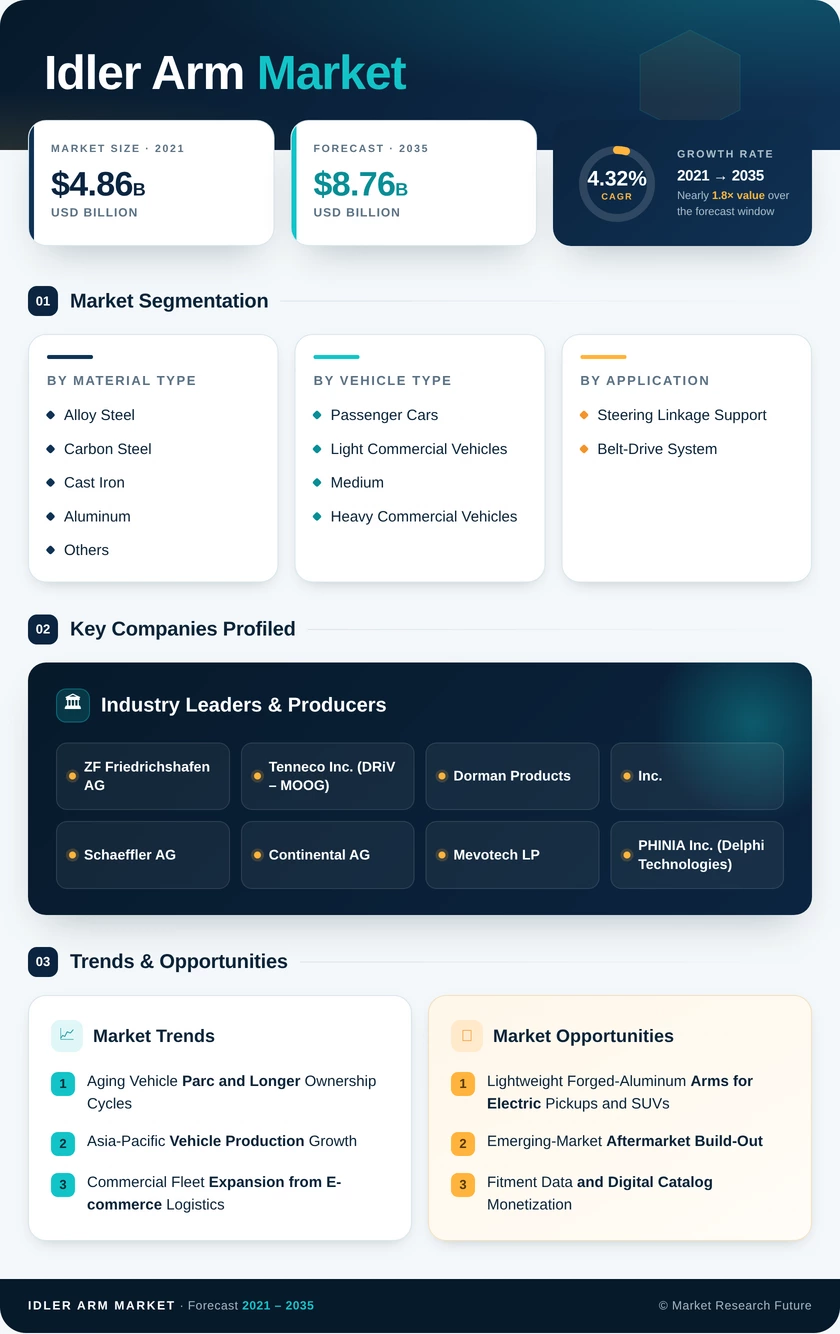
Idler Arm Market (2026 - 2035)

ID: MRFR/AT/7151-HCR 100 Pages Triveni Bhoyar Last Updated: October 09, 2026
Idler Arm Market Research Report By Material Type (Alloy Steel, Carbon Steel, Cast Iron, Aluminum, Others), By Vehicle Type (Passenger Cars, Light Commercial Vehicles, Medium and Heavy Commercial Vehicles), By Application (Steering Linkage Support, Belt-Drive System), By Sales Channel (OEM, Aftermarket) - Forecast to 2035
Idler Arm Market
Market Size
Forecast Period2026-2035
CAGR (2026-2035)4.32%
2025 Market SizeUSD 5.74 Billion
2035 Market SizeUSD 8.76 Billion
Key Players
ZF Friedrichshafen AG
Tenneco Inc.
Dorman Products, Inc.
Schaeffler AG
Continental AG
Mevotech LP
Opportunities
  • Lightweight Forged-Aluminum Arms for Electric Pickups and SUVs
  • Emerging-Market Aftermarket Build-Out
  • Fitment Data and Digital Catalog Monetization
  1. 1 Market Summary | |
  2. 2 Key Report Takeaways | |
    1. 2.1 By Material Type | |
    2. 2.2 By Vehicle Type | |
    3. 2.3 By Application | |
    4. 2.4 By Sales Channel | |
    5. 2.5 By Region | |
  3. 3 Market Size and Forecast (2021–2035) | |
  4. 4 Driver Impact Analysis | |
    1. 4.1 Aging Vehicle Parc and Longer Ownership Cycles | |
    2. 4.2 Asia-Pacific Vehicle Production Growth | |
    3. 4.3 Commercial Fleet Expansion from E-commerce Logistics | |
    4. 4.4 Electrified Accessory Belt Drives in Hybrids and EVs | |
    5. 4.5 Lightweighting Mandates and Fleet CO2 Targets | |
    6. 4.6 Right-to-Repair Rules and Digital Parts Catalogs | |
    7. 4.7 India Auto Component Manufacturing Incentives | |
  5. 5 Restraints Impact Analysis | |
    1. 5.1 Shift to Rack-and-Pinion and Electric Power Steering | |
    2. 5.2 Steel and Aluminum Price Volatility and Tariffs | |
    3. 5.3 Counterfeit and Low-Grade Aftermarket Parts | |
    4. 5.4 Plateauing Global Light-Vehicle Production | |
    5. 5.5 Carbon Border and End-of-Life Compliance Costs | |
  6. 6 Opportunities | |
    1. 6.1 Lightweight Forged-Aluminum Arms for Electric Pickups and SUVs | |
    2. 6.2 Emerging-Market Aftermarket Build-Out | |
    3. 6.3 Fitment Data and Digital Catalog Monetization | |
    4. 6.4 Remanufacturing and Circular Supply Programs | |
    5. 6.5 Heavy-Duty Assemblies for Autonomous Shuttles and Yard Tractors | |
  7. 7 Regional Market Share and Country-Level Analysis | |
    1. 7.1 North America | | |
      1. 7.1.1 US | | |
      2. 7.1.2 Canada | | |
      3. 7.1.3 Mexico | |
    2. 7.2 Europe | | |
      1. 7.2.1 Germany | | |
      2. 7.2.2 UK | | |
      3. 7.2.3 France | | |
      4. 7.2.4 Italy | | |
      5. 7.2.5 Spain | | |
      6. 7.2.6 Nordic Countries | | |
      7. 7.2.7 Russia | | |
      8. 7.2.8 Rest of Europe | |
    3. 7.3 Asia-Pacific | | |
      1. 7.3.1 China | | |
      2. 7.3.2 India | | |
      3. 7.3.3 Japan | | |
      4. 7.3.4 South Korea | | |
      5. 7.3.5 ASEAN | | |
      6. 7.3.6 Rest of Asia-Pacific | |
    4. 7.4 South America | | |
      1. 7.4.1 Brazil | | |
      2. 7.4.2 Argentina | | |
      3. 7.4.3 Rest of South America | |
    5. 7.5 Middle East & Africa | | |
      1. 7.5.1 Saudi Arabia | | |
      2. 7.5.2 UAE | | |
      3. 7.5.3 South Africa | | |
      4. 7.5.4 Egypt | | |
      5. 7.5.5 Rest of MEA | |
  8. 8 Future Outlook (2026–2035) | |
    1. 8.1 Steering Architecture Redesign | |
    2. 8.2 Electrification and Accessory-Drive Complexity | |
    3. 8.3 Connected Diagnostics and Predictive Maintenance | |
    4. 8.4 Low-Carbon Steel and Circular Materials | |
  9. 9 Segmentation Analysis | |
    1. 9.1 By Material Type | | |
      1. 9.1.1 Alloy Steel | | |
      2. 9.1.2 Carbon Steel | | |
      3. 9.1.3 Cast Iron | | |
      4. 9.1.4 Aluminum | | |
      5. 9.1.5 Others | |
    2. 9.2 By Vehicle Type | | |
      1. 9.2.1 Passenger Cars | | |
      2. 9.2.2 Light Commercial Vehicles | | |
      3. 9.2.3 Medium and Heavy Commercial Vehicles | |
    3. 9.3 By Application | | |
      1. 9.3.1 Steering Linkage Support | | |
      2. 9.3.2 Belt-Drive System | |
    4. 9.4 By Sales Channel | | |
      1. 9.4.1 OEM | | |
      2. 9.4.2 Aftermarket | |
  10. 10 Competitive Landscape | |
    1. 10.1 Market Concentration Analysis | |
    2. 10.2 Competitive Benchmarking | |
  11. 11 Recent News & Developments | |
  12. 12 Report Scope and Methodology | |
  13. 13 Detailed Sources and Citations | |
  14. 14 Frequently Asked Questions (FAQs) | | LIST OF TABLES | |
  15. TABLE 1 Market Snapshot, 2025 and 2035 | |
  16. TABLE 2 Global Market Size and Forecast, 2021–2035 (USD Billion) | |
  17. TABLE 3 Driver Impact Analysis | |
  18. TABLE 4 Restraints Impact Analysis | |
  19. TABLE 5 Regional Market Share Summary, 2025 | |
  20. TABLE 6 North America Country-Level Analysis | |
  21. TABLE 7 Europe Country-Level Analysis | |
  22. TABLE 8 Asia-Pacific Country-Level Analysis | |
  23. TABLE 9 South America Country-Level Analysis | |
  24. TABLE 10 Middle East & Africa Country-Level Analysis | |
  25. TABLE 11 Segmentation by Material Type | |
  26. TABLE 12 Segmentation by Vehicle Type | |
  27. TABLE 13 Segmentation by Application | |
  28. TABLE 14 Segmentation by Sales Channel | |
  29. TABLE 15 Competitive Benchmarking Table | |
  30. TABLE 16 Report Scope and Methodology | |
  31. TABLE 17 Detailed Sources and Citations | |
  32. TABLE 18 Segmentation Quick Reference | |
  33. TABLE 19 Market Segmentation Overview — Material Type | |
  34. TABLE 20 Market Segmentation Overview — Vehicle Type | |
  35. TABLE 21 Market Segmentation Overview — Application | |
  36. TABLE 22 Market Segmentation Overview — Sales Channel | | LIST OF FIGURES | |
  37. FIGURE 1 Market Dynamics Overview (Drivers, Restraints, Opportunities) | |
  38. FIGURE 2 Industry Value Chain Analysis | |
  39. FIGURE 3 Porter's Five Forces Analysis | |
  40. FIGURE 4 Global Market Size Trend, 2021–2035 (USD Billion) | |
  41. FIGURE 5 Market Share by Material Type, 2025 | |
  42. FIGURE 6 Market Share by Vehicle Type, 2025 | |
  43. FIGURE 7 Market Share by Application, 2025 | |
  44. FIGURE 8 Market Share by Sales Channel, 2025 | |
  45. FIGURE 9 Regional Market Share, 2025 | |
  46. FIGURE 10 Asia-Pacific Country Share, 2025 | |
  47. FIGURE 11 Estimated Revenue Share Ranges of Key Players | |
  48. FIGURE 12 Competitive Positioning Matrix

Segmentation Quick Reference

DimensionSub-SegmentsDominant SegmentFastest Growing Segment
By Material TypeAlloy Steel, Carbon Steel, Cast Iron, Aluminum, OthersAlloy Steel (40.1% share)Aluminum (6.45% CAGR)
By Vehicle TypePassenger Cars, Light Commercial Vehicles, Medium and Heavy Commercial VehiclesPassenger Cars (52.0% share)Medium and Heavy Commercial Vehicles (5.22% CAGR)
By ApplicationSteering Linkage Support, Belt-Drive SystemSteering Linkage Support (60.1% share)Belt-Drive System (5.55% CAGR)
By Sales ChannelOEM, AftermarketAftermarket (61.0% share)Aftermarket (61.0% share)
By RegionNorth America, Europe, Asia-Pacific, South America, Middle East & AfricaAsia-Pacific (38.4%)Asia-Pacific (5.1% CAGR)


Market Segmentation Overview

By Material Type

Sub-SegmentKey Trend
Alloy SteelDefault material for commercial and heavy-duty arms, valued for fatigue strength
Carbon SteelLow-cost replacement parts for older vehicles
Cast IronLegacy designs in emerging-market vehicle models; share declining
AluminumForged designs adopted for pickup, crossover, and EV weight reduction
OthersComposite-bushing hybrids gaining ground in Europe


Alloy Steel leads because commercial fleets and heavy pickups need its fatigue resistance under repeated full-lock loads. Aluminum grows fastest as OEMs try to offset battery mass on electric pickups and SUVs. This growth is limited by stricter forging and inspection requirements. Cast Iron and Carbon Steel survive mainly where replacement price matters more than weight.

By Vehicle Type

Sub-SegmentKey Trend
Passenger CarsDemand concentrated in SUVs and older sedans as compact cars adopt rack-and-pinion
Light Commercial VehiclesLast-mile delivery vans keep linkage replacement steady
Medium and Heavy Commercial VehiclesElectrified trucks and higher mileage accelerate wear


Passenger Cars remain the largest group by volume. However, demand is shifting toward SUVs and aging vehicles that still use parallelogram steering. Medium and Heavy Commercial Vehicles grow fastest because heavier electrified chassis and long daily duty cycles wear out linkage pivots sooner. Light Commercial Vehicles sit between the two, supported by e-commerce delivery fleets.

By Application

Sub-SegmentKey Trend
Steering Linkage SupportCore function in parallelogram and heavy-duty steering systems
Belt-Drive SystemLightweight idlers for hybrid and EV accessory belts


Steering Linkage Support dominates because every parallelogram system needs an idler arm to keep the center link level. Belt-Drive System applications grow faster as hybrids keep combustion-engine accessories while adding electric pumps and compressors. This requires more precise belt routing and lighter cast-aluminum idlers.

By Sales Channel

Sub-SegmentKey Trend
OEMFollows vehicle assembly volumes and platform validation cycles
AftermarketGrows with average vehicle age and VIN-level digital catalogs


Aftermarket leads and also outgrows OEM because idler arms are wear parts and the average vehicle in service keeps getting older. Right-to-repair rules and accurate fitment data further support aftermarket growth. OEM revenue depends on assembly schedules, which remain flat in Europe and Japan. To secure steadier volumes, OEM suppliers are signing fleet service agreements.




Download PDF ×

We do not share your information with anyone. However, we may send you emails based on your report interest from time to time. You may contact us at any time to opt-out.