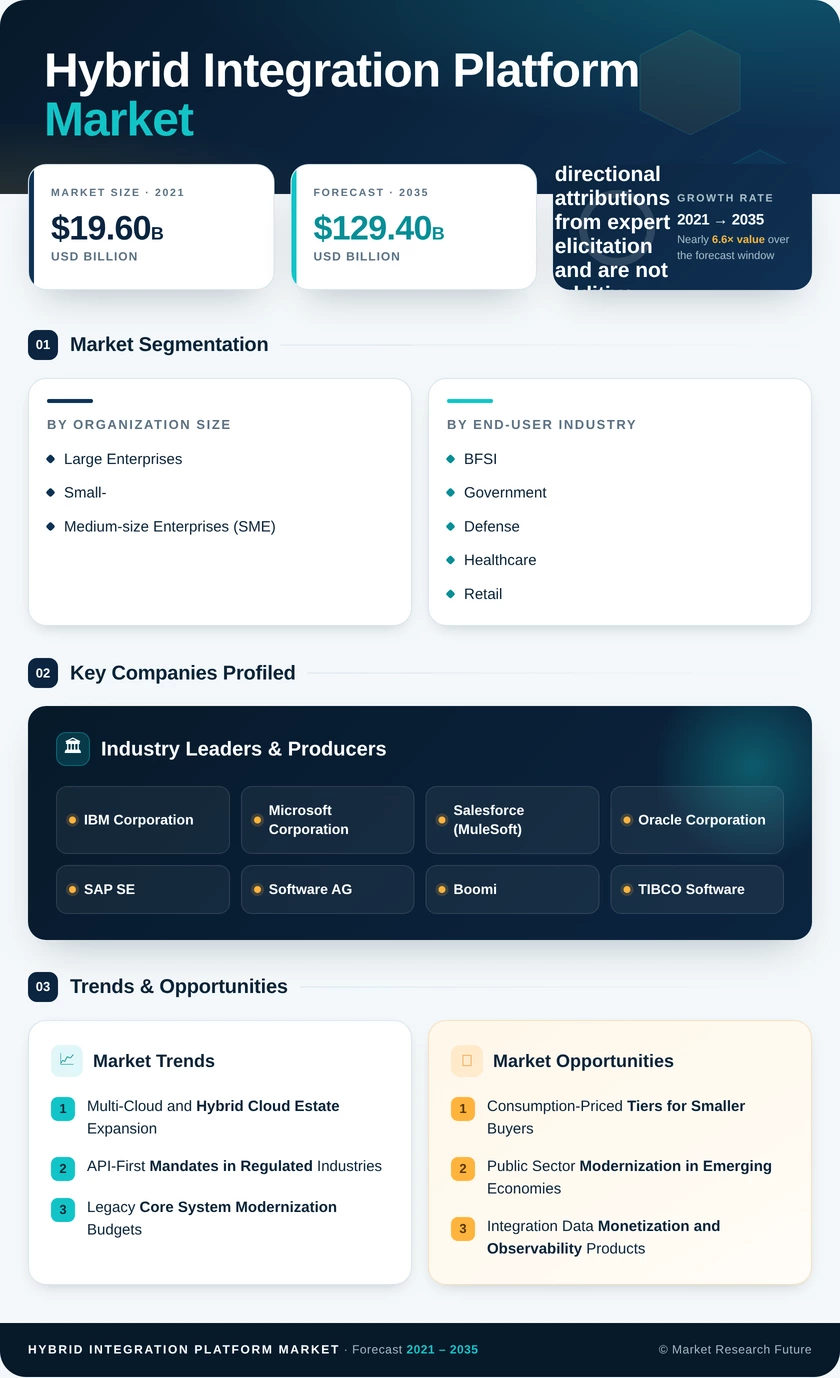
Segmentation Quick Reference
| Dimension | Sub-Segments | Dominant Segment | Fastest Growing Segment |
| By Organization Size | Large Enterprises; Small- and Medium-size Enterprises (SME) | Large Enterprises (71.4% share, 2025) | Small- and Medium-size Enterprises (SME) (17.1% CAGR) |
| By End-User Industry | BFSI; Government and Defense; Healthcare; Retail; IT and Telecom; Other End-User Industries | BFSI (USD 9.6 Billion, 2025) | Healthcare (16.9% CAGR) |
Market Segmentation Overview
By Organization Size
| Sub-Segment | Key Trend |
| Large Enterprises | Parallel-run architectures that keep systems of record on-premises while front-end services move to cloud |
| Small- and Medium-size Enterprises (SME) | Per-execution pricing and prebuilt vertical templates removing the need for in-house integration architects |
Large Enterprises lead this dimension at 71.4% of 2025 revenue because they own the mainframe cores, custom middleware, and regulatory audit obligations that make governed hybrid connectivity unavoidable rather than optional. Small- and Medium-size Enterprises (SME) grow fastest at 17.1% as vendors strip out the architectural prerequisites that once made these platforms inaccessible below a certain IT headcount. The two segments buy differently: enterprise deals hinge on legacy protocol support and lineage auditability, while smaller firms select on template coverage for common SaaS combinations and on predictable monthly cost.
By End-User Industry
| Sub-Segment | Key Trend |
| BFSI | Open banking and instant payment mandates forcing API layers over mainframe ledgers |
| Government and Defense | Cross-agency data sharing built on registries that cannot be migrated |
| Healthcare | Clinical data exchange rules requiring record access without moving clinical systems |
| Retail | Omnichannel order and inventory orchestration across store, warehouse, and marketplace systems |
| IT and Telecom | Consolidation of overlapping billing, provisioning, and network operations stacks |
| Other End-User Industries | Manufacturing and logistics partner onboarding replacing legacy value-added networks. |
BFSI is the largest vertical at USD 9.6 billion in 2025, because regulatory API deadlines arrived at institutions whose transaction ledgers still run on systems with no native modern interface — the compliance clock, not the architecture roadmap, sets the spend. Healthcare grows fastest at 16.9%, where information-blocking rules compel record exposure while patient data stays in on-premises clinical systems for latency and liability reasons. IT and Telecom sits between them on volume, driven by post-merger stack rationalization rather than external mandate, which makes its demand steadier but less deadline-compressed than BFSI's.


 Noah Malgeri
Co-Founder

 Peter Groot koerkamp
Account and Business Manager

 Younghwan Choi
Senior Retail Manager

 Mark Irwin
Management Consultant

 Akif Moroglu
Strategy & Business Development Director

 Guilherme Gomes Martins
Product Management Director

 Joseph Aguayo
Sales Operations & Pricing Manager

 La Terria Dodd
Program Support Specialist

 Rob Kooiker
Group Product Manager HVAC & Fire Protection GMA