×
Request Free Sample ×

Kindly complete the form below to receive a free sample of this Report

* Please use a valid business email

Leading companies partner with us for data-driven Insights

clients tt-cursor
Hero Background
English
Chinese
French
Japanese
Korean
German
Spanish

Hot Water Circulator Pump Market Analysis

ID: MRFR/EnP/3473-CR
98 Pages
Chitranshi Jaiswal
October 2020

Hot Water Circulator Pump Market Research Report Information By Type (Single-Stage Pump and Multistage Pumps), And By Application (Residential, Commercial, and Industrial), And By Region (North America, Europe, Asia-Pacific, And Rest Of The World) – Market Forecast Till 2035

Share:
Download PDF ×

We do not share your information with anyone. However, we may send you emails based on your report interest from time to time. You may contact us at any time to opt-out.

Hot Water Circulator Pump Market Infographic
Purchase Options

Market Analysis

In-depth Analysis of Hot Water Circulator Pump Market Industry Landscape

The Hot Water Circulator Pump market is experiencing dynamic shifts driven by various factors that influence its market dynamics. As a critical component in heating systems, these pumps play a crucial role in ensuring efficient circulation of hot water, contributing to energy savings and enhanced comfort. One of the key drivers shaping the market is the increasing focus on energy efficiency in residential and commercial buildings. With a growing awareness of environmental concerns and the need to reduce energy consumption, consumers are seeking energy-efficient solutions, propelling the demand for advanced hot water circulator pumps.

Moreover, technological advancements are influencing the market dynamics significantly. Manufacturers are investing in research and development to introduce innovative features such as smart controls, variable speed options, and improved motor efficiency. These technological upgrades not only enhance the performance of hot water circulator pumps but also align them with the broader trend of smart and sustainable building solutions. As a result, the market is witnessing a transition from traditional pumps to more sophisticated and eco-friendly alternatives.

Additionally, government regulations and initiatives are playing a pivotal role in shaping the Hot Water Circulator Pump market dynamics. Many countries are implementing stringent energy efficiency standards and promoting the use of energy-efficient appliances, including circulator pumps, through various incentives and rebates. This regulatory push is driving both manufacturers and consumers towards adopting more energy-efficient solutions, contributing to the overall growth of the market.

Competitive factors are also influencing the market dynamics as manufacturers strive to gain a competitive edge. The market is characterized by the presence of both established players and new entrants, leading to intense competition. Product differentiation, pricing strategies, and after-sales services are becoming critical elements for companies aiming to capture a larger market share. This competitive landscape is fostering innovation and driving manufacturers to focus on improving the overall efficiency and durability of their hot water circulator pump offerings.

Furthermore, changing consumer preferences and lifestyle patterns are impacting the market dynamics. As consumers become more conscious of their carbon footprint and seek sustainable living solutions, there is a growing demand for products that align with these values. Hot water circulator pumps that are not only energy-efficient but also environmentally friendly are gaining popularity among consumers who prioritize sustainability.

The global economic landscape also plays a role in shaping the market dynamics of hot water circulator pumps. Economic fluctuations, inflation rates, and currency exchange rates can influence manufacturing costs, pricing strategies, and overall market demand. Manufacturers need to adapt to these economic variables to maintain competitiveness and cater to the diverse needs of consumers in different regions.

In conclusion, the Hot Water Circulator Pump market is experiencing dynamic changes driven by a combination of factors such as energy efficiency trends, technological advancements, government regulations, competitive strategies, consumer preferences, and economic conditions. The evolving nature of these dynamics presents both challenges and opportunities for industry players. As the market continues to evolve, staying attuned to these dynamics is crucial for manufacturers, suppliers, and other stakeholders to navigate the changing landscape successfully.

Author
Chitranshi Jaiswal
Research Analyst Level I

In her 3 years of experience in the market research field, she has handled critical cross-domain projects. She has an in-depth knowledge of market estimation & analysis, problem-solving, primary as well as secondary research, and team management.She holds an engineering degree and is an MBA professional from a well-known university, capable of evaluating the market and competitive conditions. An exceptional strategist with excellent communication skills and a passion for delivering cutting-edge & practical insights for the market. Proficient in multi-tasking, and can successfully deal with competing demands, while maintaining complete confidentiality. Generated business through active client and project development, networking, and high-quality responses. Her knowledge and skills have helped in making solid business decisions, securing funding from investors, and avoiding business failures.

Leave a Comment

FAQs

How much is the hot water circulator pump market?

The hot water circulator pump market size was valued at USD 2.7 Billion in 2022.

What is the growth rate of the hot water circulator pump market?

The market is projected to grow at a CAGR of 5.30% during the forecast period, 2025-2034.

Which region held the largest market share in the hot water circulator pump market?

North America had the largest share of the market.

Who are the key players in the hot water circulator pump market?

The key players in the market are Xylem Inc (U.S.), Flowserve Corporation (U.S.), Grundfos (Denmark), Armstrong Fluid Technology (Canada), BacoEngineering (U.K.), Calpeda S.p. (Italy), Taco (U.S.), Emile Egger & Cie S.A. (Switzerland).

Which type led the hot water circulator pump market?

The single-stage pump type category dominated the market in 2022.

Which application had the largest market share in the hot water circulator pump market?

The residential had the largest share of the market.

Market Summary

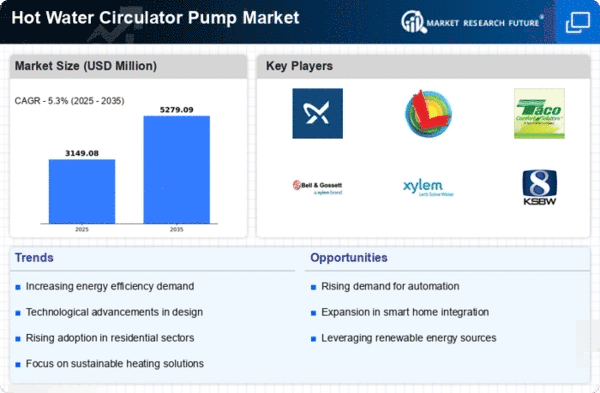
As per MRFR analysis, the Hot Water Circulator Pump Market Size was estimated at 2990.58 USD Million in 2024. The Hot Water Circulator Pump industry is projected to grow from 3149.14 in 2025 to 5279.09 by 2035, exhibiting a compound annual growth rate (CAGR) of 5.3 during the forecast period 2025 - 2035.

Key Market Trends & Highlights

The Hot Water Circulator Pump Market is experiencing a dynamic shift towards energy efficiency and smart technologies.

  • Technological advancements are driving innovation in the hot water circulator pump market, enhancing performance and efficiency. The North American region remains the largest market, while the Asia-Pacific region is recognized as the fastest-growing area for hot water circulator pumps. In the residential segment, hot water circulator pumps dominate, whereas the industrial segment is witnessing rapid growth. Key market drivers include the increasing demand for energy efficiency and the growing adoption of smart home technologies.

Market Size & Forecast

2024 Market Size 2990.58 (USD Million)
2035 Market Size 5279.09 (USD Million)
CAGR (2025 - 2035) 5.3%
Largest Regional Market Share in 2024 North America

Major Players

Grundfos (DK), Wilo (DE), Taco Comfort Solutions (US), Bell & Gossett (US), Xylem (US), KSB (DE), Ebara (JP), DAB Pumps (IT), Aquatech (US)

Market Trends

The Hot Water Circulator Pump Market is currently experiencing a notable transformation driven by advancements in technology and increasing consumer awareness regarding energy efficiency. As households and commercial establishments seek to optimize their heating systems, the demand for high-performance circulator pumps is on the rise. These pumps are designed to enhance the efficiency of hot water distribution, thereby reducing energy consumption and operational costs. Furthermore, the growing emphasis on sustainable practices and the adoption of smart home technologies are influencing purchasing decisions, leading to a shift towards more innovative and eco-friendly solutions in the hot water circulator pump market.

In addition, regulatory frameworks aimed at promoting energy efficiency are likely to shape the hot water circulator pump market analysis over the coming years . Manufacturers are increasingly focusing on developing products that comply with stringent energy standards, which may enhance their market competitiveness. The integration of smart technologies, such as IoT-enabled pumps, is also gaining traction, as these systems offer improved monitoring and control capabilities. Overall, the hot water circulator pump market trends appears poised for growth, driven by technological advancements, regulatory support, and a shift towards energy-efficient solutions.

Technological Advancements

The Hot Water Circulator Pump Market is witnessing a surge in technological innovations, particularly in the realm of smart pumps. These advanced systems offer features such as remote monitoring and automated controls, enhancing user convenience and energy efficiency. As consumers increasingly prioritize smart home integration, the demand for technologically advanced circulator pumps is likely to rise.

Sustainability Focus

There is a growing emphasis on sustainability within the Hot Water Circulator Pump Market, as consumers and businesses alike seek to reduce their carbon footprints. Manufacturers are responding by developing energy-efficient pumps that comply with stringent environmental regulations. This trend not only addresses consumer concerns but also aligns with global efforts to promote eco-friendly practices.

Market Diversification

The Hot Water Circulator Pump Market is experiencing diversification in product offerings, catering to a wide range of applications from residential to commercial use. This trend indicates a shift towards specialized solutions that meet specific heating needs, allowing for greater customization and efficiency in hot water delivery systems.

Hot Water Circulator Pump Market Market Drivers

Expansion of Smart Home Technologies

The Global Hot Water Circulator Pump Market Industry is significantly influenced by the rapid expansion of smart home technologies. As consumers increasingly adopt smart devices, the integration of circulator pumps with home automation systems becomes more prevalent. Smart hot water circulator pumps offer enhanced control and monitoring capabilities, allowing users to optimize energy usage and improve comfort. This trend aligns with the broader movement towards connected home solutions, which is expected to drive market growth. The increasing consumer preference for convenience and efficiency in home heating systems suggests a promising future for smart circulator pump technologies.

Growing Demand for Energy Efficiency

The Global Hot Water Circulator Pump Market Industry experiences a notable surge in demand for energy-efficient solutions. As consumers and businesses alike seek to reduce energy consumption, the adoption of hot water circulator pumps, which optimize heating systems, becomes increasingly prevalent. These pumps can significantly lower energy bills by ensuring hot water is readily available without unnecessary heating. In 2024, the market is projected to reach 2.99 USD Billion, reflecting a growing awareness of energy conservation. This trend is likely to continue, as energy efficiency regulations become more stringent globally, further driving the adoption of advanced circulator pump technologies.

Increased Focus on Sustainable Practices

The Global Hot Water Circulator Pump Market Industry is witnessing a shift towards sustainable practices, driven by both regulatory frameworks and consumer preferences. Governments worldwide are implementing policies aimed at reducing carbon footprints, which encourages the adoption of energy-efficient technologies, including hot water circulator pumps. This growing emphasis on sustainability is likely to propel market growth, as businesses and homeowners seek to align with environmental standards. The market's trajectory suggests a robust growth rate, with a compound annual growth rate of 5.3% projected from 2025 to 2035, reflecting the increasing prioritization of eco-friendly solutions.

Technological Advancements in Pump Design

Technological innovations play a pivotal role in shaping the Global Hot Water Circulator Pump Market Industry. Recent advancements in pump design, such as variable speed motors and smart controls, enhance the efficiency and performance of circulator pumps. These innovations not only improve energy efficiency but also extend the lifespan of the pumps, reducing maintenance costs for users. As manufacturers invest in research and development, the market is expected to witness a proliferation of high-performance models. This trend aligns with the projected market growth, which is anticipated to reach 5.28 USD Billion by 2035, driven by the increasing integration of smart technologies.

Rising Residential and Commercial Construction

The Global Hot Water Circulator Pump Market Industry benefits from the ongoing expansion of residential and commercial construction activities. As new buildings are constructed, the demand for efficient heating systems, including circulator pumps, rises. This trend is particularly pronounced in developing regions, where urbanization is accelerating. The integration of hot water circulator pumps in new construction projects not only enhances energy efficiency but also meets modern consumer expectations for comfort and convenience. The anticipated growth in the construction sector is expected to contribute significantly to the market, as more properties incorporate advanced heating solutions.

Market Segment Insights

By Application: Residential (Largest) vs. Industrial (Fastest-Growing)

The hot water circulator pump market exhibits a diverse application landscape with significant contributions from residential, commercial, industrial, and agricultural sectors. Among these, the residential segment holds the largest market share, driven by the increasing demand for energy-efficient heating solutions in households. This has encouraged manufacturers to innovate and enhance the efficiency of hot water circulator pumps, catering to the growing consumer base seeking comfort and utility in their living environments. On the other hand, the industrial segment is recognized as the fastest-growing area within the market. The escalation in industrial activities, coupled with the need for reliable and efficient hot water management systems, has propelled the adoption of circulator pumps in factories, processing plants, and manufacturing facilities. This segment's upward trend can be attributed to heightened energy efficiency regulations and industrial automation advancements that demand efficient heating systems.

Residential (Dominant) vs. Industrial (Emerging)

The residential market for hot water circulator pumps is characterized by robust demand driven by home heating needs and energy efficiency preferences. Homeowners are increasingly investing in these systems to ensure hot water availability while reducing energy consumption. In contrast, the industrial segment is emerging rapidly as manufacturers aim to streamline operations and optimize energy use in large-scale applications. This sector focuses on innovative designs and technology integration, allowing for higher efficiency and better temperature control. As the industrial landscape evolves, the demand for advanced circulator pumps is expected to surge, bridging the gap between traditional heating methods and modern energy needs.

By Type: Circulating Pump (Largest) vs. Inline Pump (Fastest-Growing)

In the Hot Water Circulator Pump Market, the segment distribution showcases a diverse range of pump types. The Circulating Pump holds the largest market share, owing to its widespread applicability in residential and commercial hot water systems, providing efficient heating solutions. Conversely, the Inline Pump, while currently smaller in market share, is recognized as the fastest-growing segment due to increasing demand for compact and efficient systems that facilitate space-saving installations. The growth trends in this segment are primarily driven by technological advancements and rising energy efficiency standards. The demand for high-performance pumps that enhance heating systems' efficiency fuels the growth of Inline Pumps. Furthermore, the global push towards sustainable energy solutions has spurred innovation in pump technologies, leading to expanded applications and increased adoption of both Circulating and Inline Pumps in the market.

Circulating Pump (Dominant) vs. Submersible Pump (Emerging)

The Circulating Pump segment is characterized by its reliability and efficiency, making it the dominant choice for many residential and commercial applications in the Hot Water Circulator Pump Market. These pumps are designed to ensure continuous flow within heating systems, providing consistency and comfort. On the other hand, the Submersible Pump segment emerges as an exciting alternative, particularly in applications requiring submerged functionality. Submersible Pumps are gaining traction due to their efficiency in lifting water from low levels to high pressure, ideal for systems requiring elevated water delivery. While Circulating Pumps remain preferred for traditional heating systems, Submersible Pumps are carving a niche for themselves as innovation and versatility open new avenues for their application in various sectors.

By Power Source: Electric (Largest) vs. Solar (Fastest-Growing)

In the Hot Water Circulator Pump Market, the power source segment is primarily dominated by electric pumps, capturing the majority of market share due to their high efficiency and widespread availability. Electric pumps are favored for their ease of use and reliability, making them the go-to option for residential and commercial applications. On the other hand, the solar-powered segment, while currently smaller, is gaining traction as more consumers and businesses seek sustainable energy solutions. This shift is driven by increasing awareness of environmental issues and government incentives promoting renewable energy sources.

Electric (Dominant) vs. Solar (Emerging)

Electric hot water circulator pumps stand out in the market for their established presence and reliability. They are designed for both residential and commercial applications, providing consistent performance and efficiency. Electric pumps are typically easier to install and maintain compared to alternative energy sources. In contrast, solar hot water circulator pumps, while not yet mainstream, are on the rise due to advancements in solar technology and increasing energy costs. These emerging solutions attract eco-conscious consumers looking to reduce their carbon footprint. As solar technology continues to improve, its adoption for hot water circulation will likely accelerate, reflecting a significant shift towards sustainability in the energy sector.

By Material: Stainless Steel (Largest) vs. Bronze (Fastest-Growing)

In the Hot Water Circulator Pump Market, the material segment exhibits diverse characteristics driven by their distinct properties. Stainless Steel holds the largest market share due to its superior corrosion resistance and durability, making it the preferred choice for numerous applications in the industry. Following closely are Cast Iron and Plastic, widely recognized for their cost-effectiveness and lightweight nature. Bronze is emerging as a versatile option, appealing to segments focused on energy efficiency and sustainability, contributing to shifting preferences in consumer choices.

Stainless Steel (Dominant) vs. Bronze (Emerging)

Stainless Steel pumps dominate the Hot Water Circulator Pump Market owing to their exceptional durability, resistance to rust and unsympathetic environmental conditions. They are highly regarded in industrial and commercial settings where reliability is paramount. On the other hand, Bronze pumps, while currently emerging, offer unique advantages such as antimicrobial properties and superior wear resistance, making them increasingly popular in residential applications. This shift towards Bronze indicates a growing awareness of the benefits of material selection in energy efficiency and operational longevity, which could positively influence its market trajectory.

By Control Type: Automatic (Largest) vs. Smart Control (Fastest-Growing)

In the Hot Water Circulator Pump Market, the distribution among control types reveals that Automatic control pumps hold the largest share, reflecting their widespread adoption and reliability. Manual control pumps, while still significant, have seen a decline as consumers lean towards automated solutions. Smart Control systems, designed for higher efficiency and user convenience, are gaining traction, appealing particularly to tech-savvy customers seeking modern solutions in home and industrial applications.

Control Type: Automatic (Dominant) vs. Smart Control (Emerging)

Automatic control pumps dominate the Hot Water Circulator Pump Market, offering reliable performance with minimal user intervention. These pumps are equipped with features that ensure optimal temperature and flow automatically, making them the preferred choice for both residential and commercial use. In contrast, Smart Control pumps, while still emerging in the market, are rapidly gaining popularity due to their advanced connectivity features, such as integration with smart home systems and remote monitoring capabilities. This emerging technology appeals to consumers focused on energy efficiency and ease of use, indicating a significant shift in user preferences towards more automated and intelligent solutions.

Get more detailed insights about Hot Water Circulator Pump Market Research Report – Global Trends & Forecast to 2035

Regional Insights

North America : Market Leader in Innovation

North America is poised to maintain its leadership in the Hot Water Circulator Pump Market, holding a significant market share of 1195.29. The growth is driven by increasing energy efficiency regulations and a rising demand for sustainable heating solutions. The region's focus on smart home technologies and automation further propels market expansion, as consumers seek efficient and cost-effective heating options. The competitive landscape is robust, with key players like Taco Comfort Solutions, Bell & Gossett, and Xylem leading the charge. The U.S. remains the largest market, supported by a strong infrastructure and technological advancements. Companies are investing in R&D to innovate and meet the evolving needs of consumers, ensuring a dynamic market environment.

Europe : Sustainable Solutions Hub

Europe's Hot Water Circulator Pump Market is projected at €850.0, driven by stringent energy efficiency regulations and a strong push towards sustainable heating solutions. The European Union's commitment to reducing carbon emissions has catalyzed investments in energy-efficient technologies, making this region a leader in eco-friendly innovations. The demand for high-efficiency pumps is on the rise, aligning with the EU's Green Deal objectives. Germany and France are at the forefront, with companies like Wilo and KSB leading the market. The competitive landscape is characterized by a mix of established players and innovative startups, all vying for market share. The presence of regulatory bodies ensures compliance and fosters a culture of innovation, making Europe a dynamic market for hot water circulators.

Asia-Pacific : Emerging Market Potential

The Asia-Pacific region, valued at $750.0, is witnessing rapid growth in the Hot Water Circulator Pump Market, driven by urbanization and increasing disposable incomes. Countries like China and India are experiencing a surge in demand for efficient heating solutions, spurred by rising living standards and a growing middle class. Government initiatives promoting energy efficiency are also contributing to market expansion, making this region a focal point for investment. China is the largest market, with significant contributions from local manufacturers and international players like Ebara and DAB Pumps. The competitive landscape is evolving, with a mix of established brands and new entrants focusing on innovation and cost-effectiveness. As the region continues to develop, the demand for advanced heating solutions is expected to rise significantly.

Middle East and Africa : Untapped Market Opportunities

The Middle East and Africa region, with a market size of $195.29, presents untapped opportunities in the Hot Water Circulator Pump Market. Rapid urbanization and infrastructure development are key drivers, as countries invest in modern heating solutions to support growing populations. The demand for energy-efficient systems is increasing, driven by both residential and commercial sectors seeking to reduce energy costs and enhance sustainability. Countries like South Africa and the UAE are leading the charge, with investments in smart technologies and energy-efficient systems. The competitive landscape is gradually evolving, with both local and international players entering the market. As regulatory frameworks improve, the region is expected to attract more investments, fostering growth in the hot water circulator segment.

Key Players and Competitive Insights

The Hot Water Circulator Pump Market is currently characterized by a dynamic competitive landscape, driven by increasing demand for energy-efficient solutions and advancements in technology. Key players such as Grundfos (DK), Wilo (DE), and Taco Comfort Solutions (US) are strategically positioning themselves through innovation and regional expansion. Grundfos (DK) focuses on developing smart pump solutions that integrate IoT technology, enhancing operational efficiency and user experience. Meanwhile, Wilo (DE) emphasizes sustainability, aiming to reduce energy consumption across its product lines, which aligns with global environmental goals. Taco Comfort Solutions (US) is enhancing its market presence through strategic partnerships, particularly in North America, to leverage local expertise and distribution networks, thereby shaping a competitive environment that prioritizes efficiency and sustainability.The market structure appears moderately fragmented, with several players vying for market share. Key business tactics include localizing manufacturing to reduce costs and optimize supply chains, which is crucial in maintaining competitive pricing. The collective influence of these major players fosters a competitive atmosphere where innovation and operational efficiency are paramount, allowing them to respond swiftly to market demands and regulatory changes.
In November Grundfos (DK) announced the launch of its new range of energy-efficient circulator pumps designed for residential applications. This strategic move is significant as it not only reinforces Grundfos's commitment to sustainability but also positions the company to capture a larger share of the growing residential market, which is increasingly focused on energy efficiency. The introduction of these products is likely to enhance customer loyalty and brand reputation in a competitive landscape.
In October Wilo (DE) entered into a partnership with a leading technology firm to develop AI-driven pump management systems. This collaboration is pivotal as it allows Wilo to leverage cutting-edge technology to optimize pump performance and maintenance schedules, potentially reducing operational costs for end-users. Such innovations may set a new standard in the industry, compelling competitors to enhance their technological offerings.
In September Taco Comfort Solutions (US) expanded its manufacturing capabilities by opening a new facility in the Midwest. This expansion is strategically important as it not only increases production capacity but also enhances supply chain efficiency, allowing Taco to respond more effectively to regional demand fluctuations. This move may provide Taco with a competitive edge in terms of lead times and customer service.
As of December the competitive trends in the Hot Water Circulator Pump Market are increasingly defined by digitalization, sustainability, and the integration of AI technologies. Strategic alliances are becoming more prevalent, enabling companies to pool resources and expertise to innovate more rapidly. The shift from price-based competition to a focus on technological advancement and supply chain reliability is evident, suggesting that future competitive differentiation will hinge on the ability to deliver innovative, efficient, and sustainable solutions.

Key Companies in the Hot Water Circulator Pump Market include

Industry Developments

May 2023: Xylem Inc. has acquired Evoqua Water Products Corp. ("Evoqua"), a leader in mission-critical water treatment products and services, in an all-stock deal for around $7.5 billion. It has led to the availability of the most cutting-edge platform of capabilities worldwide to address the critical water demands of consumers and communities.

April 2023: The Ghana Water Initiative (GWI), one of the initiatives under SafeWater, a crucial business division under Grundfos, has announced the launch of SUREWATER mineral water. Through increased accessibility and the abolition of sachet water in Ghana, this new bottled water aims to increase water security.

Future Outlook

Hot Water Circulator Pump Market Future Outlook

The Hot Water Circulator Pump Market is projected to grow at a 5.3% CAGR from 2025 to 2035, driven by increasing energy efficiency demands and technological advancements.

New opportunities lie in:

  • <p>Expansion into smart home integration solutions Development of energy-efficient pump models Partnerships with renewable energy providers for sustainable systems</p>

By 2035, the market is expected to achieve robust growth, driven by innovation and strategic partnerships.

Market Segmentation

Hot Water Circulator Pump Market Type Outlook

  • Circulating Pump
  • Inline Pump
  • Submersible Pump
  • Multistage Pump

Hot Water Circulator Pump Market Material Outlook

  • Stainless Steel
  • Cast Iron
  • Plastic
  • Bronze

Hot Water Circulator Pump Market Application Outlook

  • Residential
  • Commercial
  • Industrial
  • Agricultural

Hot Water Circulator Pump Market Control Type Outlook

  • Manual
  • Automatic
  • Smart Control

Hot Water Circulator Pump Market Power Source Outlook

  • Electric
  • Solar
  • Gas
  • Hybrid

Report Scope

MARKET SIZE 2024 2990.58(USD Million)
MARKET SIZE 2025 3149.14(USD Million)
MARKET SIZE 2035 5279.09(USD Million)
COMPOUND ANNUAL GROWTH RATE (CAGR) 5.3% (2025 - 2035)
REPORT COVERAGE Revenue Forecast, Competitive Landscape, Growth Factors, and Trends
BASE YEAR 2024
Market Forecast Period 2025 - 2035
Historical Data 2019 - 2024
Market Forecast Units USD Million
Key Companies Profiled Grundfos (DK), Wilo (DE), Taco Comfort Solutions (US), Bell & Gossett (US), Xylem (US), KSB (DE), Ebara (JP), DAB Pumps (IT), Aquatech (US)
Segments Covered Application, Type, Power Source, Material, Control Type
Key Market Opportunities Integration of smart technology enhances efficiency and consumer appeal in the Hot Water Circulator Pump Market.
Key Market Dynamics Rising demand for energy-efficient solutions drives innovation and competition in the hot water circulator pump market.
Countries Covered North America, Europe, APAC, South America, MEA

FAQs

How much is the hot water circulator pump market?

The hot water circulator pump market size was valued at USD 2.7 Billion in 2022.

What is the growth rate of the hot water circulator pump market?

The market is projected to grow at a CAGR of 5.30% during the forecast period, 2025-2034.

Which region held the largest market share in the hot water circulator pump market?

North America had the largest share of the market.

Who are the key players in the hot water circulator pump market?

The key players in the market are Xylem Inc (U.S.), Flowserve Corporation (U.S.), Grundfos (Denmark), Armstrong Fluid Technology (Canada), BacoEngineering (U.K.), Calpeda S.p. (Italy), Taco (U.S.), Emile Egger &amp; Cie S.A. (Switzerland).

Which type led the hot water circulator pump market?

The single-stage pump type category dominated the market in 2022.

Which application had the largest market share in the hot water circulator pump market?

The residential had the largest share of the market.

  1. SECTION I: EXECUTIVE SUMMARY AND KEY HIGHLIGHTS
    1. EXECUTIVE SUMMARY
      1. Market Overview
      2. Key Findings
      3. Market Segmentation
      4. Competitive Landscape
      5. Challenges and Opportunities
      6. Future Outlook 2 SECTION II: SCOPING, METHODOLOGY AND MARKET STRUCTURE
    2. MARKET INTRODUCTION
      1. Definition
      2. Scope of the study
    3. RESEARCH METHODOLOGY
      1. Overview
      2. Data Mining
      3. Secondary Research
      4. Primary Research
      5. Forecasting Model
      6. Market Size Estimation
      7. Data Triangulation
      8. Validation 3 SECTION III: QUALITATIVE ANALYSIS
    4. MARKET DYNAMICS
      1. Overview
      2. Drivers
      3. Restraints
      4. Opportunities
    5. MARKET FACTOR ANALYSIS
      1. Value chain Analysis
      2. Porter's Five Forces Analysis
      3. COVID-19 Impact Analysis
    6. Energy & Power, BY Application (USD Million)
      1. Residential
      2. Commercial
      3. Industrial
      4. Agricultural
    7. Energy & Power, BY Type (USD Million)
      1. Circulating Pump
      2. Inline Pump
      3. Submersible Pump
      4. Multistage Pump
    8. Energy & Power, BY Power Source (USD Million)
      1. Electric
      2. Solar
      3. Gas
      4. Hybrid
    9. Energy & Power, BY Material (USD Million)
      1. Stainless Steel
      2. Cast Iron
      3. Plastic
      4. Bronze
    10. Energy & Power, BY Control Type (USD Million)
      1. Manual
      2. Automatic
      3. Smart Control
    11. Energy & Power, BY Region (USD Million)
      1. North America
      2. Europe
      3. APAC
      4. South America
      5. MEA
    12. Competitive Landscape
      1. Overview
      2. Competitive Analysis
      3. Market share Analysis
      4. Major Growth Strategy in the Energy & Power
      5. Competitive Benchmarking
      6. Leading Players in Terms of Number of Developments in the Energy & Power
      7. Key developments and growth strategies
      8. Major Players Financial Matrix
    13. Company Profiles
      1. Grundfos (DK)
      2. Wilo (DE)
      3. Taco Comfort Solutions (US)
      4. Bell & Gossett (US)
      5. Xylem (US)
      6. KSB (DE)
      7. Ebara (JP)
      8. DAB Pumps (IT)
      9. Aquatech (US)
    14. Appendix
      1. References
      2. Related Reports

Energy & Power Market Segmentation

Energy & Power By Application (USD Million, 2025-2035)

  • Residential
  • Commercial
  • Industrial
  • Agricultural

Energy & Power By Type (USD Million, 2025-2035)

  • Circulating Pump
  • Inline Pump
  • Submersible Pump
  • Multistage Pump

Energy & Power By Power Source (USD Million, 2025-2035)

  • Electric
  • Solar
  • Gas
  • Hybrid

Energy & Power By Material (USD Million, 2025-2035)

  • Stainless Steel
  • Cast Iron
  • Plastic
  • Bronze

Energy & Power By Control Type (USD Million, 2025-2035)

  • Manual
  • Automatic
  • Smart Control
Infographic

Free Sample Request

Kindly complete the form below to receive a free sample of this Report

Get Free Sample

Customer Strories

Compare Licence

×
Features License Type
Single User Multiuser License Enterprise User
Price $4,950 $5,950 $7,250
Maximum User Access Limit 1 User Upto 10 Users Unrestricted Access Throughout the Organization
Free Customization
Direct Access to Analyst
Deliverable Format
Platform Access
Discount on Next Purchase 10% 15% 15%
Printable Versions