
Request Free Sample ×

Kindly complete the form below to receive a free sample of this Report

* Please use a valid business email

Leading companies partner with us for data-driven Insights

clients tt-cursor
Hero Background
English
Chinese
French
Japanese
Korean
German
Spanish

Home Gym Equipment Market Trends

ID: MRFR/CG/7010-HCR
128 Pages
Snehal Singh
March 2026

Home Gym Equipment Market Size, Share, Industry Trend & Analysis Research Report Information By Equipment Type (Cardiovascular Training Fitness Equipment, Strength Training Equipment) and By Distribution Channel (Store-Based, Non-Store-Based) - Forecast to 2032

Share:
Download PDF ×

We do not share your information with anyone. However, we may send you emails based on your report interest from time to time. You may contact us at any time to opt-out.

Home Gym Equipment Market Infographic
Purchase Options

Market Trends

Key Emerging Trends in the Home Gym Equipment Market

In the fitness industry, the Home Gym Equipment Market has seen exponential growth, especially with the rise of home workouts and the increasing focus on health and wellness. Within this dynamic sector, companies deploy various strategies to capture market share and cater to consumers' desires for convenient and effective ways to stay fit.

One crucial strategy employed by companies in the Home Gym Equipment Market is product diversification and differentiation. With a plethora of equipment available, brands strive to distinguish their offerings by introducing unique features, designs, and functionalities. Whether it's compact multi-functional machines, innovative resistance bands, or high-tech smart fitness devices, these distinct elements help brands carve out their niche and attract consumers looking for specific workout experiences.

Pricing is another critical aspect of market positioning within the home gym equipment industry. Some companies position their products as premium options, pricing them higher to reflect superior quality materials, durability, and advanced features. These brands often target fitness enthusiasts and individuals willing to invest in top-of-the-line equipment for long-term use. Conversely, other companies focus on affordability, offering budget-friendly options without compromising too much on quality, making home gym equipment accessible to a broader audience.

Distribution channels play a significant role in reaching consumers and securing market share. Companies strategically expand their presence across various retail outlets, both physical and online, including sporting goods stores, department stores, and e-commerce platforms. Additionally, partnerships with fitness influencers, personal trainers, and health clubs can provide brands with greater visibility and access to new customer segments, thus bolstering their market share.

Marketing and branding efforts are instrumental in shaping consumer perceptions and driving market share within the home gym equipment industry. Companies invest in advertising campaigns to highlight the benefits of exercising at home, such as convenience, privacy, and time-saving. Social media platforms serve as powerful tools for engaging with consumers, sharing workout tips, and showcasing user testimonials to build trust and credibility.

Customer experience and satisfaction are paramount in retaining market share. Companies prioritize product quality, ease of assembly, and customer support to ensure a positive experience for users. By offering comprehensive warranties, easy-to-follow workout guides, and responsive technical assistance, brands can foster loyalty and encourage repeat purchases, thereby solidifying their position in the market.

Innovation is a driving force in market share positioning within the home gym equipment industry. Companies invest in research and development to introduce new technologies, ergonomic designs, and interactive features that enhance the workout experience. Whether it's integrating virtual coaching platforms, gamification elements, or AI-powered fitness trackers, innovation enables brands to stay ahead of the competition and capture the attention of health-conscious consumers.

Partnerships and collaborations can also provide strategic advantages in market positioning. Brands often team up with fitness influencers, celebrities, and athletes to endorse their products and reach new audiences. Collaborations with wellness brands, nutritionists, and lifestyle bloggers can generate buzz and excitement, driving sales and expanding brand reach across different consumer segments.

Ultimately, the success of market share positioning strategies in the Home Gym Equipment Market hinges on a deep understanding of consumer fitness goals, preferences, and lifestyles. By leveraging product differentiation, pricing strategies, distribution channels, marketing efforts, customer experience, innovation, and strategic partnerships, companies can carve out their place in this competitive landscape and empower individuals to achieve their fitness aspirations from the comfort of their own homes.


Author
Author Profile
Snehal Singh
Manager - Research

High acumen in analyzing complex macro & micro markets with more than 6 years of work experience in the field of market research. By implementing her analytical skills in forecasting and estimation into market research reports, she has expertise in Packaging, Construction, and Equipment domains. She handles a team size of 20-25 resources and ensures smooth running of the projects, associated marketing activities, and client servicing.

Leave a Comment

FAQs

What is the projected market valuation of The Global Home Gym Equipment by 2035?

<p>The projected market valuation for The Global Home Gym Equipment by 2035 is 11.6 USD Billion.</p>

What was the market valuation of The Global Home Gym Equipment in 2024?

<p>The overall market valuation of The Global Home Gym Equipment was 6.435 USD Billion in 2024.</p>

What is the expected CAGR for The Global Home Gym Equipment during the forecast period 2025 - 2035?

<p>The expected CAGR for The Global Home Gym Equipment during the forecast period 2025 - 2035 is 5.5%.</p>

Which segment of home gym equipment had the highest valuation in 2024?

<p>In 2024, the Strength Training Equipment segment had a valuation of 3.935 USD Billion.</p>

What is the projected valuation for Cardiovascular Training Equipment by 2035?

<p>The projected valuation for Cardiovascular Training Equipment is expected to reach 4.5 USD Billion by 2035.</p>

How does the market for store-based distribution channels compare to non-store-based channels in 2024?

<p>In 2024, the store-based distribution channel was valued at 3.5 USD Billion, while the non-store-based channel was valued at 2.935 USD Billion.</p>

Who are the key players in The Global Home Gym Equipment?

<p>Key players in The Global Home Gym Equipment include Peloton, Nautilus, Life Fitness, Technogym, and Bowflex.</p>

What is the projected growth for Strength Training Equipment from 2024 to 2035?

<p>The Strength Training Equipment segment is projected to grow to 7.1 USD Billion by 2035.</p>

What are the expected trends in The Global Home Gym Equipment distribution channels by 2035?

<p>By 2035, the non-store-based distribution channel is expected to grow to 5.4 USD Billion.</p>

How does the market for home gym equipment reflect consumer preferences in 2025?

<p>In 2025, the market for home gym equipment reflects a growing preference for both cardiovascular and strength training equipment, indicating diverse consumer interests.</p>

Market Summary

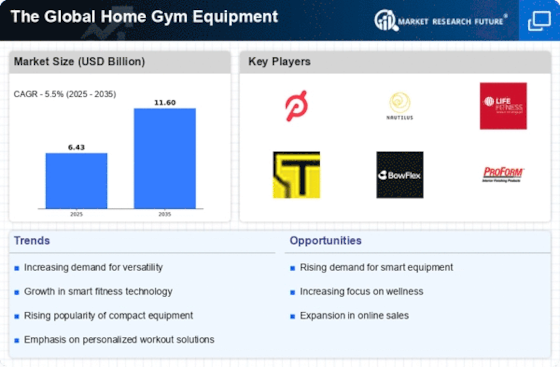
As per Market Research Future analysis, The Global Home Gym Equipment Market was estimated at 6.435 USD Billion in 2024. The home gym equipment industry is projected to grow from 6.789 USD Billion in 2025 to 11.6 USD Billion by 2035, exhibiting a compound annual growth rate (CAGR) of 5.5% during the forecast period 2025 - 2035

Key Market Trends & Highlights

The Global Home Gym Equipment Market is experiencing robust growth driven by technological advancements and changing consumer preferences.

  • North America remains the largest market for home gym equipment, reflecting a strong consumer base and established fitness culture. The Asia-Pacific region is emerging as the fastest-growing market, fueled by increasing urbanization and rising disposable incomes. Cardiovascular training equipment holds the largest market share, while strength training equipment is witnessing the fastest growth due to evolving fitness trends. Key market drivers include increased health awareness and the growing popularity of home workouts, which are reshaping consumer purchasing behavior.

Market Size & Forecast

2024 Market Size 6.435 (USD Billion)
2035 Market Size 11.6 (USD Billion)
CAGR (2025 - 2035) 5.5%
Largest Regional Market Share in 2024 North America

Major Players

Peloton (US), <a href="https://nautil.us/">Nautilus (US)</a>, Life Fitness (US), Technogym (IT), Bowflex (US), ProForm (US), <a href="https://www.cybex-online.com/en/us">Cybex (US)</a>, Matrix Fitness (US), Hammer Strength (US), Fitness First (AU)

Market Trends

The Global Home Gym Equipment is currently experiencing a notable transformation, driven by a growing emphasis on health and fitness among consumers. This shift appears to be influenced by various factors, including increased awareness of the benefits of regular exercise and the convenience of working out at home. As individuals seek to integrate fitness into their daily routines, the demand for diverse and innovative home gym equipment is likely to rise. Furthermore, advancements in technology may enhance the appeal of these products, as smart equipment becomes more prevalent, offering users personalized workout experiences and tracking capabilities. In addition to technological advancements, the market seems to be shaped by changing consumer preferences. There is a noticeable trend towards multifunctional equipment that maximizes space efficiency, catering to those with limited room for traditional gym setups. Moreover, the rise of online fitness communities and virtual training programs may further bolster the market, as individuals seek to replicate the gym experience at home. Overall, The Global Home Gym Equipment appears poised for continued growth, reflecting broader societal shifts towards health-conscious living and the increasing integration of fitness into everyday life.

Technological Integration

The incorporation of technology into home gym equipment is becoming increasingly prevalent. Smart devices that offer interactive features, such as virtual coaching and performance tracking, are gaining traction. This trend suggests that consumers are looking for more engaging and personalized workout experiences, which may enhance motivation and adherence to fitness routines.

Space-Efficient Solutions

As urban living spaces become more compact, there is a growing demand for space-efficient gym equipment. Products that combine multiple functions or can be easily stored are particularly appealing to consumers. This trend indicates a shift towards practicality, as individuals seek to optimize their home environments while maintaining their fitness goals.

Rise of Online Fitness Communities

The emergence of online fitness platforms and communities is reshaping how individuals approach their workouts. Many consumers are now participating in virtual classes and engaging with fitness influencers, which may drive the demand for home gym equipment. This trend highlights a shift towards social interaction in fitness, even when exercising at home.

Home Gym Equipment Market Market Drivers

Diverse Product Offerings

The availability of a wide range of home gym equipment options is a key driver for market growth. Consumers are presented with various choices, from compact machines to multifunctional equipment, catering to different fitness needs and preferences. This diversity is reflected in market data, which shows that the demand for versatile and space-efficient equipment is on the rise. The Global Home Gym Equipment Industry is likely to thrive as manufacturers continue to innovate and expand their product lines, ensuring that consumers have access to equipment that fits their specific workout goals and available space.

Increased Health Awareness

The rising consciousness regarding health and fitness among individuals appears to be a primary driver for the home gym equipment market. As more people recognize the importance of physical well-being, the demand for home gym equipment has surged. According to recent data, the fitness equipment market is projected to grow at a compound annual growth rate of approximately 4.5% over the next few years. This trend indicates that consumers are increasingly investing in home gym solutions to maintain their fitness routines. The Global Home Gym Equipment Industry is likely to benefit from this heightened awareness, as individuals seek to create personalized workout spaces at home, thereby enhancing their overall health and fitness levels.

Technological Advancements

Technological innovations in fitness equipment are transforming the home gym experience, serving as a crucial driver for the market. Smart equipment, which integrates features such as virtual coaching and performance tracking, is gaining traction among consumers. The Global Home Gym Equipment Industry is likely to see increased adoption of these advanced technologies, as they enhance user engagement and motivation. Market data indicates that the segment for smart fitness equipment is expected to grow significantly, potentially accounting for a substantial share of the overall market by 2025. This trend suggests that consumers are increasingly inclined to invest in high-tech solutions that offer personalized fitness experiences.

Convenience and Flexibility

The convenience of working out at home is a significant factor driving the home gym equipment market. Individuals often face time constraints due to busy schedules, making it challenging to visit traditional gyms. The ability to exercise at any time without commuting is appealing to many. This trend is reflected in the market data, which suggests that the home fitness equipment segment is expected to witness substantial growth, potentially reaching a valuation of over 10 billion dollars by 2026. The Global Home Gym Equipment Industry is thus positioned to capitalize on this demand for flexibility, as consumers prioritize convenience in their fitness routines.

Growing Popularity of Home Workouts

The trend of home workouts has gained momentum, significantly influencing the home gym equipment market. As more individuals opt for at-home fitness routines, the demand for various types of equipment has increased. This shift is supported by market data indicating that the home fitness segment is projected to expand, with a notable increase in sales of weights, resistance bands, and cardio machines. The Global Home Gym Equipment Industry is poised to benefit from this growing preference for home workouts, as consumers seek to replicate gym experiences in their own spaces, thereby driving sales and innovation in the sector.

Market Segment Insights

By Type: Cardiovascular Training Equipment (Largest) vs. Strength Training Equipment (Fastest-Growing)

<p>In The Global Home Gym Equipment, the distribution of market share between cardiovascular training equipment and <a href="https://www.marketresearchfuture.com/reports/strength-training-equipment-market-41830" target="_blank" title="strength training equipment">strength training equipment</a> presents a clear picture of consumer preferences. Cardiovascular training equipment, which includes treadmills, stationary bikes, and elliptical machines, holds the largest share due to its popularity among fitness enthusiasts and home workout adopters seeking efficient cardio solutions. Meanwhile, strength training equipment, encompassing weights, resistance bands, and multi-gyms, is gaining rapid traction, appealing to those focusing on muscle building and overall fitness.</p>

<p>Training Focus: Cardiovascular (Dominant) vs. Strength (Emerging)</p>

<p>Cardiovascular training equipment is widely regarded as the dominant category within The Global Home Gym Equipment, attracting consumers with its versatility and effectiveness in improving heart health and endurance. Equipment such as treadmills and exercise bikes are not only cherished for their workout efficiency but also for their accessibility in home settings. In contrast, strength training equipment is recognized as the emerging segment, driven by a growing trend towards strength and resistance training. This segment includes free weights and functional training tools that cater to a broad audience, particularly those focusing on muscle toning and weight management.</p>

By Distribution Channel: Store-based (Largest) vs. Non-store-based (Fastest-Growing)

<p>In The Global Home Gym Equipment, the store-based distribution channel holds the largest market share. This traditional distribution method remains favored due to consumers' preference for physical interaction with products before purchase. Customers appreciate the ability to test gym equipment, seek expert advice, and enjoy immediate product access. Conversely, non-store-based channels, which include online platforms, are gaining notable traction, particularly among younger demographics who value convenience and extensive product options.</p>

<p>Store-based (Dominant) vs. Non-store-based (Emerging)</p>

<p>Store-based distribution channels dominate The Global Home Gym Equipment by providing customers with a tactile and interactive buying experience. Retailers offering a wide selection of exercise equipment, expert staff assistance, and the benefits of immediate product access contribute significantly to customer satisfaction and retention. In contrast, non-store-based channels are emerging rapidly, driven by the increasing reliance on online shopping and e-commerce platforms. This segment captures consumers who prefer browsing extensive product catalogs and availing of home delivery options, reflecting changing consumer behaviors and technological advancements in the retail space.</p>

Get more detailed insights about Home Gym Equipment Market Research Report - Forecast till 2035

Regional Insights

North America : Fitness Innovation Hub

North America dominates The Global Home Gym Equipment, accounting for approximately 45% of the total share. The region's growth is driven by increasing health awareness, a shift towards home workouts, and technological advancements in fitness equipment. Regulatory support for health initiatives further fuels demand, making it a key player in the market. The U.S. is the largest market, followed by Canada, which contributes significantly to the overall growth.

Europe : Emerging Fitness Trends

Europe is witnessing a surge in the home gym equipment market, holding around 30% of the global share. The growth is propelled by rising disposable incomes, urbanization, and a growing trend towards fitness and wellness. Countries like Germany and the UK are leading this trend, supported by favorable regulations promoting physical health. The European market is characterized by a mix of established brands and innovative startups, enhancing competition.

Asia-Pacific : Emerging Powerhouse

Asia-Pacific is rapidly emerging as a significant player in the home gym equipment market, accounting for approximately 20% of the global share. The region's growth is driven by increasing urbanization, a rising middle class, and a growing awareness of health and fitness. Countries like China and India are at the forefront, with a burgeoning demand for affordable and innovative fitness solutions. The competitive landscape is evolving, with both local and international brands vying for market share.

Middle East and Africa : Untapped Market Potential

The Middle East and Africa represent an untapped market in the home gym equipment sector, holding about 5% of the global share. The growth is fueled by increasing health consciousness and government initiatives promoting fitness. Countries like South Africa and the UAE are leading the charge, with a growing number of fitness centers and home gym setups. The competitive landscape is still developing, with opportunities for both established and new entrants to capture market share.

Key Players and Competitive Insights

The Global Home Gym Equipment is currently characterized by a dynamic competitive landscape, driven by increasing consumer demand for fitness solutions that can be utilized in the comfort of home. Key players are actively engaging in strategies that emphasize innovation, digital transformation, and regional expansion to capture market share. Companies such as Peloton (US), Nautilus (US), and Technogym (IT) are at the forefront, leveraging their brand recognition and technological advancements to enhance user experience and engagement. This collective focus on integrating technology into fitness solutions not only shapes their operational strategies but also influences the overall market dynamics, fostering a competitive environment that prioritizes customer-centric offerings.

In terms of business tactics, companies are increasingly localizing manufacturing and optimizing supply chains to enhance efficiency and reduce costs. The market appears moderately fragmented, with several key players holding substantial shares while numerous smaller entities contribute to the competitive mix. This structure allows for a diverse range of products and services, catering to various consumer preferences and price points. The influence of major players is significant, as their strategic decisions often set trends that smaller companies may follow, thereby shaping the market's trajectory.

In August 2025, Peloton (US) announced a partnership with a leading health and wellness app to integrate personalized training programs into its platform. This strategic move is likely to enhance user engagement by providing tailored fitness solutions, thereby reinforcing Peloton's position as a leader in the home fitness space. The collaboration not only broadens Peloton's service offerings but also aligns with the growing trend of personalized fitness experiences, which could attract a wider audience.

In September 2025, Nautilus (US) launched a new line of smart home gym equipment that incorporates AI technology to provide real-time feedback and performance tracking. This innovation is indicative of Nautilus's commitment to enhancing user experience through technology. By integrating AI, Nautilus positions itself to meet the increasing consumer demand for interactive and data-driven fitness solutions, potentially setting a new standard in the home gym equipment market.

In July 2025, Technogym (IT) expanded its The Global Home Gym Equipment through a strategic partnership with a local distributor. This expansion is significant as it allows Technogym to tap into a rapidly growing consumer base that is increasingly investing in home fitness solutions. The partnership not only enhances Technogym's market presence but also reflects a broader trend of companies seeking growth opportunities in emerging markets, which may offer substantial returns in the coming years.

As of October 2025, the competitive trends in The Global Home Gym Equipment are increasingly defined by digitalization, sustainability, and the integration of advanced technologies such as AI. Strategic alliances are becoming more prevalent, as companies recognize the value of collaboration in enhancing their product offerings and market reach. Looking ahead, competitive differentiation is likely to evolve, shifting from traditional price-based competition to a focus on innovation, technological advancements, and supply chain reliability. This transition suggests that companies that prioritize these elements will be better positioned to thrive in an increasingly competitive landscape.

Key Companies in the Home Gym Equipment Market include

Industry Developments

  • In 2021, the North American region holds the largest market share in the home gym equipment industry in the global market and dominates in the global market.
  • In June 2021, a partnership has been declared between NovoFit (having fitness equipment business in Australia) with Amer Sports brand, Peecor to increase the strength by capturing a larger market in the global market.
  • In October 2021, the first Bowflex indoor cycling Bike was launched by Nautilus Inc. which can be affordable by middle-class range and has much less price than the Peloton Bike. It was launched to increase the fitness drive among all the peoples.
  • In April 2022, a new partnership has been seen between Ironman World Championship, Ironman Virtual Racing Series events, Ironman 70.3 World Championship, and Technogym SpA to provide indoor training to the athletes.


Future Outlook

Home Gym Equipment Market Future Outlook

The Global Home Gym Equipment is projected to grow at a 5.5% CAGR from 2024 to 2035, driven by increasing health awareness, technological advancements, and the rise of remote fitness solutions.

New opportunities lie in:

  • Development of smart home gym systems integrating AI for personalized training.
  • Expansion into subscription-based fitness programs offering virtual coaching.
  • Partnerships with health insurance companies to promote home fitness equipment.

By 2035, the market is expected to be robust, reflecting sustained growth and innovation.

Market Segmentation

Home Gym Equipment Market Type Outlook

  • Cardiovascular Training Equipment
  • Strength Training Equipment

Home Gym Equipment Market Distribution Channel Outlook

  • Store-based
  • Non-store-based

Report Scope

MARKET SIZE 20246.435(USD Billion)
MARKET SIZE 20256.789(USD Billion)
MARKET SIZE 203511.6(USD Billion)
COMPOUND ANNUAL GROWTH RATE (CAGR)5.5% (2024 - 2035)
REPORT COVERAGERevenue Forecast, Competitive Landscape, Growth Factors, and Trends
BASE YEAR2024
Market Forecast Period2025 - 2035
Historical Data2019 - 2024
Market Forecast UnitsUSD Billion
Key Companies ProfiledMarket analysis in progress
Segments CoveredMarket segmentation analysis in progress
Key Market OpportunitiesIntegration of smart technology enhances user engagement in The Global Home Gym Equipment.
Key Market DynamicsRising consumer preference for home fitness solutions drives innovation and competition in the home gym equipment sector.
Countries CoveredNorth America, Europe, APAC, South America, MEA

FAQs

What is the projected market valuation of The Global Home Gym Equipment by 2035?

<p>The projected market valuation for The Global Home Gym Equipment by 2035 is 11.6 USD Billion.</p>

What was the market valuation of The Global Home Gym Equipment in 2024?

<p>The overall market valuation of The Global Home Gym Equipment was 6.435 USD Billion in 2024.</p>

What is the expected CAGR for The Global Home Gym Equipment during the forecast period 2025 - 2035?

<p>The expected CAGR for The Global Home Gym Equipment during the forecast period 2025 - 2035 is 5.5%.</p>

Which segment of home gym equipment had the highest valuation in 2024?

<p>In 2024, the Strength Training Equipment segment had a valuation of 3.935 USD Billion.</p>

What is the projected valuation for Cardiovascular Training Equipment by 2035?

<p>The projected valuation for Cardiovascular Training Equipment is expected to reach 4.5 USD Billion by 2035.</p>

How does the market for store-based distribution channels compare to non-store-based channels in 2024?

<p>In 2024, the store-based distribution channel was valued at 3.5 USD Billion, while the non-store-based channel was valued at 2.935 USD Billion.</p>

Who are the key players in The Global Home Gym Equipment?

<p>Key players in The Global Home Gym Equipment include Peloton, Nautilus, Life Fitness, Technogym, and Bowflex.</p>

What is the projected growth for Strength Training Equipment from 2024 to 2035?

<p>The Strength Training Equipment segment is projected to grow to 7.1 USD Billion by 2035.</p>

What are the expected trends in The Global Home Gym Equipment distribution channels by 2035?

<p>By 2035, the non-store-based distribution channel is expected to grow to 5.4 USD Billion.</p>

How does the market for home gym equipment reflect consumer preferences in 2025?

<p>In 2025, the market for home gym equipment reflects a growing preference for both cardiovascular and strength training equipment, indicating diverse consumer interests.</p>

  1. SECTION I: EXECUTIVE SUMMARY AND KEY HIGHLIGHTS
    1. | 1.1 EXECUTIVE SUMMARY
    2. | | 1.1.1 Market Overview
    3. | | 1.1.2 Key Findings
    4. | | 1.1.3 Market Segmentation
    5. | | 1.1.4 Competitive Landscape
    6. | | 1.1.5 Challenges and Opportunities
    7. | | 1.1.6 Future Outlook
  2. SECTION II: SCOPING, METHODOLOGY AND MARKET STRUCTURE
    1. | 2.1 MARKET INTRODUCTION
    2. | | 2.1.1 Definition
    3. | | 2.1.2 Scope of the study
    4. | | | 2.1.2.1 Research Objective
    5. | | | 2.1.2.2 Assumption
    6. | | | 2.1.2.3 Limitations
    7. | 2.2 RESEARCH METHODOLOGY
    8. | | 2.2.1 Overview
    9. | | 2.2.2 Data Mining
    10. | | 2.2.3 Secondary Research
    11. | | 2.2.4 Primary Research
    12. | | | 2.2.4.1 Primary Interviews and Information Gathering Process
    13. | | | 2.2.4.2 Breakdown of Primary Respondents
    14. | | 2.2.5 Forecasting Model
    15. | | 2.2.6 Market Size Estimation
    16. | | | 2.2.6.1 Bottom-Up Approach
    17. | | | 2.2.6.2 Top-Down Approach
    18. | | 2.2.7 Data Triangulation
    19. | | 2.2.8 Validation
  3. SECTION III: QUALITATIVE ANALYSIS
    1. | 3.1 MARKET DYNAMICS
    2. | | 3.1.1 Overview
    3. | | 3.1.2 Drivers
    4. | | 3.1.3 Restraints
    5. | | 3.1.4 Opportunities
    6. | 3.2 MARKET FACTOR ANALYSIS
    7. | | 3.2.1 Value chain Analysis
    8. | | 3.2.2 Porter's Five Forces Analysis
    9. | | | 3.2.2.1 Bargaining Power of Suppliers
    10. | | | 3.2.2.2 Bargaining Power of Buyers
    11. | | | 3.2.2.3 Threat of New Entrants
    12. | | | 3.2.2.4 Threat of Substitutes
    13. | | | 3.2.2.5 Intensity of Rivalry
    14. | | 3.2.3 COVID-19 Impact Analysis
    15. | | | 3.2.3.1 Market Impact Analysis
    16. | | | 3.2.3.2 Regional Impact
    17. | | | 3.2.3.3 Opportunity and Threat Analysis
  4. SECTION IV: QUANTITATIVE ANALYSIS
    1. | 4.1 Consumer and Retail, BY Type (USD Billion)
    2. | | 4.1.1 Cardiovascular Training Equipment
    3. | | 4.1.2 Strength Training Equipment
    4. | 4.2 Consumer and Retail, BY Distribution Channel (USD Billion)
    5. | | 4.2.1 Store-based
    6. | | 4.2.2 Non-store-based
    7. | 4.3 Consumer and Retail, BY Region (USD Billion)
    8. | | 4.3.1 North America
    9. | | | 4.3.1.1 US
    10. | | | 4.3.1.2 Canada
    11. | | 4.3.2 Europe
    12. | | | 4.3.2.1 Germany
    13. | | | 4.3.2.2 UK
    14. | | | 4.3.2.3 France
    15. | | | 4.3.2.4 Russia
    16. | | | 4.3.2.5 Italy
    17. | | | 4.3.2.6 Spain
    18. | | | 4.3.2.7 Rest of Europe
    19. | | 4.3.3 APAC
    20. | | | 4.3.3.1 China
    21. | | | 4.3.3.2 India
    22. | | | 4.3.3.3 Japan
    23. | | | 4.3.3.4 South Korea
    24. | | | 4.3.3.5 Malaysia
    25. | | | 4.3.3.6 Thailand
    26. | | | 4.3.3.7 Indonesia
    27. | | | 4.3.3.8 Rest of APAC
    28. | | 4.3.4 South America
    29. | | | 4.3.4.1 Brazil
    30. | | | 4.3.4.2 Mexico
    31. | | | 4.3.4.3 Argentina
    32. | | | 4.3.4.4 Rest of South America
    33. | | 4.3.5 MEA
    34. | | | 4.3.5.1 GCC Countries
    35. | | | 4.3.5.2 South Africa
    36. | | | 4.3.5.3 Rest of MEA
  5. SECTION V: COMPETITIVE ANALYSIS
    1. | 5.1 Competitive Landscape
    2. | | 5.1.1 Overview
    3. | | 5.1.2 Competitive Analysis
    4. | | 5.1.3 Market share Analysis
    5. | | 5.1.4 Major Growth Strategy in the Consumer and Retail
    6. | | 5.1.5 Competitive Benchmarking
    7. | | 5.1.6 Leading Players in Terms of Number of Developments in the Consumer and Retail
    8. | | 5.1.7 Key developments and growth strategies
    9. | | | 5.1.7.1 New Product Launch/Service Deployment
    10. | | | 5.1.7.2 Merger & Acquisitions
    11. | | | 5.1.7.3 Joint Ventures
    12. | | 5.1.8 Major Players Financial Matrix
    13. | | | 5.1.8.1 Sales and Operating Income
    14. | | | 5.1.8.2 Major Players R&D Expenditure. 2023
    15. | 5.2 Company Profiles
    16. | | 5.2.1 Peloton (US)
    17. | | | 5.2.1.1 Financial Overview
    18. | | | 5.2.1.2 Products Offered
    19. | | | 5.2.1.3 Key Developments
    20. | | | 5.2.1.4 SWOT Analysis
    21. | | | 5.2.1.5 Key Strategies
    22. | | 5.2.2 Nautilus (US)
    23. | | | 5.2.2.1 Financial Overview
    24. | | | 5.2.2.2 Products Offered
    25. | | | 5.2.2.3 Key Developments
    26. | | | 5.2.2.4 SWOT Analysis
    27. | | | 5.2.2.5 Key Strategies
    28. | | 5.2.3 Life Fitness (US)
    29. | | | 5.2.3.1 Financial Overview
    30. | | | 5.2.3.2 Products Offered
    31. | | | 5.2.3.3 Key Developments
    32. | | | 5.2.3.4 SWOT Analysis
    33. | | | 5.2.3.5 Key Strategies
    34. | | 5.2.4 Technogym (IT)
    35. | | | 5.2.4.1 Financial Overview
    36. | | | 5.2.4.2 Products Offered
    37. | | | 5.2.4.3 Key Developments
    38. | | | 5.2.4.4 SWOT Analysis
    39. | | | 5.2.4.5 Key Strategies
    40. | | 5.2.5 Bowflex (US)
    41. | | | 5.2.5.1 Financial Overview
    42. | | | 5.2.5.2 Products Offered
    43. | | | 5.2.5.3 Key Developments
    44. | | | 5.2.5.4 SWOT Analysis
    45. | | | 5.2.5.5 Key Strategies
    46. | | 5.2.6 ProForm (US)
    47. | | | 5.2.6.1 Financial Overview
    48. | | | 5.2.6.2 Products Offered
    49. | | | 5.2.6.3 Key Developments
    50. | | | 5.2.6.4 SWOT Analysis
    51. | | | 5.2.6.5 Key Strategies
    52. | | 5.2.7 Cybex (US)
    53. | | | 5.2.7.1 Financial Overview
    54. | | | 5.2.7.2 Products Offered
    55. | | | 5.2.7.3 Key Developments
    56. | | | 5.2.7.4 SWOT Analysis
    57. | | | 5.2.7.5 Key Strategies
    58. | | 5.2.8 Matrix Fitness (US)
    59. | | | 5.2.8.1 Financial Overview
    60. | | | 5.2.8.2 Products Offered
    61. | | | 5.2.8.3 Key Developments
    62. | | | 5.2.8.4 SWOT Analysis
    63. | | | 5.2.8.5 Key Strategies
    64. | | 5.2.9 Hammer Strength (US)
    65. | | | 5.2.9.1 Financial Overview
    66. | | | 5.2.9.2 Products Offered
    67. | | | 5.2.9.3 Key Developments
    68. | | | 5.2.9.4 SWOT Analysis
    69. | | | 5.2.9.5 Key Strategies
    70. | | 5.2.10 Fitness First (AU)
    71. | | | 5.2.10.1 Financial Overview
    72. | | | 5.2.10.2 Products Offered
    73. | | | 5.2.10.3 Key Developments
    74. | | | 5.2.10.4 SWOT Analysis
    75. | | | 5.2.10.5 Key Strategies
    76. | 5.3 Appendix
    77. | | 5.3.1 References
    78. | | 5.3.2 Related Reports
  6. LIST OF FIGURES
    1. | 6.1 MARKET SYNOPSIS
    2. | 6.2 NORTH AMERICA MARKET ANALYSIS
    3. | 6.3 US MARKET ANALYSIS BY TYPE
    4. | 6.4 US MARKET ANALYSIS BY DISTRIBUTION CHANNEL
    5. | 6.5 CANADA MARKET ANALYSIS BY TYPE
    6. | 6.6 CANADA MARKET ANALYSIS BY DISTRIBUTION CHANNEL
    7. | 6.7 EUROPE MARKET ANALYSIS
    8. | 6.8 GERMANY MARKET ANALYSIS BY TYPE
    9. | 6.9 GERMANY MARKET ANALYSIS BY DISTRIBUTION CHANNEL
    10. | 6.10 UK MARKET ANALYSIS BY TYPE
    11. | 6.11 UK MARKET ANALYSIS BY DISTRIBUTION CHANNEL
    12. | 6.12 FRANCE MARKET ANALYSIS BY TYPE
    13. | 6.13 FRANCE MARKET ANALYSIS BY DISTRIBUTION CHANNEL
    14. | 6.14 RUSSIA MARKET ANALYSIS BY TYPE
    15. | 6.15 RUSSIA MARKET ANALYSIS BY DISTRIBUTION CHANNEL
    16. | 6.16 ITALY MARKET ANALYSIS BY TYPE
    17. | 6.17 ITALY MARKET ANALYSIS BY DISTRIBUTION CHANNEL
    18. | 6.18 SPAIN MARKET ANALYSIS BY TYPE
    19. | 6.19 SPAIN MARKET ANALYSIS BY DISTRIBUTION CHANNEL
    20. | 6.20 REST OF EUROPE MARKET ANALYSIS BY TYPE
    21. | 6.21 REST OF EUROPE MARKET ANALYSIS BY DISTRIBUTION CHANNEL
    22. | 6.22 APAC MARKET ANALYSIS
    23. | 6.23 CHINA MARKET ANALYSIS BY TYPE
    24. | 6.24 CHINA MARKET ANALYSIS BY DISTRIBUTION CHANNEL
    25. | 6.25 INDIA MARKET ANALYSIS BY TYPE
    26. | 6.26 INDIA MARKET ANALYSIS BY DISTRIBUTION CHANNEL
    27. | 6.27 JAPAN MARKET ANALYSIS BY TYPE
    28. | 6.28 JAPAN MARKET ANALYSIS BY DISTRIBUTION CHANNEL
    29. | 6.29 SOUTH KOREA MARKET ANALYSIS BY TYPE
    30. | 6.30 SOUTH KOREA MARKET ANALYSIS BY DISTRIBUTION CHANNEL
    31. | 6.31 MALAYSIA MARKET ANALYSIS BY TYPE
    32. | 6.32 MALAYSIA MARKET ANALYSIS BY DISTRIBUTION CHANNEL
    33. | 6.33 THAILAND MARKET ANALYSIS BY TYPE
    34. | 6.34 THAILAND MARKET ANALYSIS BY DISTRIBUTION CHANNEL
    35. | 6.35 INDONESIA MARKET ANALYSIS BY TYPE
    36. | 6.36 INDONESIA MARKET ANALYSIS BY DISTRIBUTION CHANNEL
    37. | 6.37 REST OF APAC MARKET ANALYSIS BY TYPE
    38. | 6.38 REST OF APAC MARKET ANALYSIS BY DISTRIBUTION CHANNEL
    39. | 6.39 SOUTH AMERICA MARKET ANALYSIS
    40. | 6.40 BRAZIL MARKET ANALYSIS BY TYPE
    41. | 6.41 BRAZIL MARKET ANALYSIS BY DISTRIBUTION CHANNEL
    42. | 6.42 MEXICO MARKET ANALYSIS BY TYPE
    43. | 6.43 MEXICO MARKET ANALYSIS BY DISTRIBUTION CHANNEL
    44. | 6.44 ARGENTINA MARKET ANALYSIS BY TYPE
    45. | 6.45 ARGENTINA MARKET ANALYSIS BY DISTRIBUTION CHANNEL
    46. | 6.46 REST OF SOUTH AMERICA MARKET ANALYSIS BY TYPE
    47. | 6.47 REST OF SOUTH AMERICA MARKET ANALYSIS BY DISTRIBUTION CHANNEL
    48. | 6.48 MEA MARKET ANALYSIS
    49. | 6.49 GCC COUNTRIES MARKET ANALYSIS BY TYPE
    50. | 6.50 GCC COUNTRIES MARKET ANALYSIS BY DISTRIBUTION CHANNEL
    51. | 6.51 SOUTH AFRICA MARKET ANALYSIS BY TYPE
    52. | 6.52 SOUTH AFRICA MARKET ANALYSIS BY DISTRIBUTION CHANNEL
    53. | 6.53 REST OF MEA MARKET ANALYSIS BY TYPE
    54. | 6.54 REST OF MEA MARKET ANALYSIS BY DISTRIBUTION CHANNEL
    55. | 6.55 KEY BUYING CRITERIA OF CONSUMER AND RETAIL
    56. | 6.56 RESEARCH PROCESS OF MRFR
    57. | 6.57 DRO ANALYSIS OF CONSUMER AND RETAIL
    58. | 6.58 DRIVERS IMPACT ANALYSIS: CONSUMER AND RETAIL
    59. | 6.59 RESTRAINTS IMPACT ANALYSIS: CONSUMER AND RETAIL
    60. | 6.60 SUPPLY / VALUE CHAIN: CONSUMER AND RETAIL
    61. | 6.61 CONSUMER AND RETAIL, BY TYPE, 2024 (% SHARE)
    62. | 6.62 CONSUMER AND RETAIL, BY TYPE, 2024 TO 2035 (USD Billion)
    63. | 6.63 CONSUMER AND RETAIL, BY DISTRIBUTION CHANNEL, 2024 (% SHARE)
    64. | 6.64 CONSUMER AND RETAIL, BY DISTRIBUTION CHANNEL, 2024 TO 2035 (USD Billion)
    65. | 6.65 BENCHMARKING OF MAJOR COMPETITORS
  7. LIST OF TABLES
    1. | 7.1 LIST OF ASSUMPTIONS
    2. | | 7.1.1
    3. | 7.2 North America MARKET SIZE ESTIMATES; FORECAST
    4. | | 7.2.1 BY TYPE, 2025-2035 (USD Billion)
    5. | | 7.2.2 BY DISTRIBUTION CHANNEL, 2025-2035 (USD Billion)
    6. | 7.3 US MARKET SIZE ESTIMATES; FORECAST
    7. | | 7.3.1 BY TYPE, 2025-2035 (USD Billion)
    8. | | 7.3.2 BY DISTRIBUTION CHANNEL, 2025-2035 (USD Billion)
    9. | 7.4 Canada MARKET SIZE ESTIMATES; FORECAST
    10. | | 7.4.1 BY TYPE, 2025-2035 (USD Billion)
    11. | | 7.4.2 BY DISTRIBUTION CHANNEL, 2025-2035 (USD Billion)
    12. | 7.5 Europe MARKET SIZE ESTIMATES; FORECAST
    13. | | 7.5.1 BY TYPE, 2025-2035 (USD Billion)
    14. | | 7.5.2 BY DISTRIBUTION CHANNEL, 2025-2035 (USD Billion)
    15. | 7.6 Germany MARKET SIZE ESTIMATES; FORECAST
    16. | | 7.6.1 BY TYPE, 2025-2035 (USD Billion)
    17. | | 7.6.2 BY DISTRIBUTION CHANNEL, 2025-2035 (USD Billion)
    18. | 7.7 UK MARKET SIZE ESTIMATES; FORECAST
    19. | | 7.7.1 BY TYPE, 2025-2035 (USD Billion)
    20. | | 7.7.2 BY DISTRIBUTION CHANNEL, 2025-2035 (USD Billion)
    21. | 7.8 France MARKET SIZE ESTIMATES; FORECAST
    22. | | 7.8.1 BY TYPE, 2025-2035 (USD Billion)
    23. | | 7.8.2 BY DISTRIBUTION CHANNEL, 2025-2035 (USD Billion)
    24. | 7.9 Russia MARKET SIZE ESTIMATES; FORECAST
    25. | | 7.9.1 BY TYPE, 2025-2035 (USD Billion)
    26. | | 7.9.2 BY DISTRIBUTION CHANNEL, 2025-2035 (USD Billion)
    27. | 7.10 Italy MARKET SIZE ESTIMATES; FORECAST
    28. | | 7.10.1 BY TYPE, 2025-2035 (USD Billion)
    29. | | 7.10.2 BY DISTRIBUTION CHANNEL, 2025-2035 (USD Billion)
    30. | 7.11 Spain MARKET SIZE ESTIMATES; FORECAST
    31. | | 7.11.1 BY TYPE, 2025-2035 (USD Billion)
    32. | | 7.11.2 BY DISTRIBUTION CHANNEL, 2025-2035 (USD Billion)
    33. | 7.12 Rest of Europe MARKET SIZE ESTIMATES; FORECAST
    34. | | 7.12.1 BY TYPE, 2025-2035 (USD Billion)
    35. | | 7.12.2 BY DISTRIBUTION CHANNEL, 2025-2035 (USD Billion)
    36. | 7.13 APAC MARKET SIZE ESTIMATES; FORECAST
    37. | | 7.13.1 BY TYPE, 2025-2035 (USD Billion)
    38. | | 7.13.2 BY DISTRIBUTION CHANNEL, 2025-2035 (USD Billion)
    39. | 7.14 China MARKET SIZE ESTIMATES; FORECAST
    40. | | 7.14.1 BY TYPE, 2025-2035 (USD Billion)
    41. | | 7.14.2 BY DISTRIBUTION CHANNEL, 2025-2035 (USD Billion)
    42. | 7.15 India MARKET SIZE ESTIMATES; FORECAST
    43. | | 7.15.1 BY TYPE, 2025-2035 (USD Billion)
    44. | | 7.15.2 BY DISTRIBUTION CHANNEL, 2025-2035 (USD Billion)
    45. | 7.16 Japan MARKET SIZE ESTIMATES; FORECAST
    46. | | 7.16.1 BY TYPE, 2025-2035 (USD Billion)
    47. | | 7.16.2 BY DISTRIBUTION CHANNEL, 2025-2035 (USD Billion)
    48. | 7.17 South Korea MARKET SIZE ESTIMATES; FORECAST
    49. | | 7.17.1 BY TYPE, 2025-2035 (USD Billion)
    50. | | 7.17.2 BY DISTRIBUTION CHANNEL, 2025-2035 (USD Billion)
    51. | 7.18 Malaysia MARKET SIZE ESTIMATES; FORECAST
    52. | | 7.18.1 BY TYPE, 2025-2035 (USD Billion)
    53. | | 7.18.2 BY DISTRIBUTION CHANNEL, 2025-2035 (USD Billion)
    54. | 7.19 Thailand MARKET SIZE ESTIMATES; FORECAST
    55. | | 7.19.1 BY TYPE, 2025-2035 (USD Billion)
    56. | | 7.19.2 BY DISTRIBUTION CHANNEL, 2025-2035 (USD Billion)
    57. | 7.20 Indonesia MARKET SIZE ESTIMATES; FORECAST
    58. | | 7.20.1 BY TYPE, 2025-2035 (USD Billion)
    59. | | 7.20.2 BY DISTRIBUTION CHANNEL, 2025-2035 (USD Billion)
    60. | 7.21 Rest of APAC MARKET SIZE ESTIMATES; FORECAST
    61. | | 7.21.1 BY TYPE, 2025-2035 (USD Billion)
    62. | | 7.21.2 BY DISTRIBUTION CHANNEL, 2025-2035 (USD Billion)
    63. | 7.22 South America MARKET SIZE ESTIMATES; FORECAST
    64. | | 7.22.1 BY TYPE, 2025-2035 (USD Billion)
    65. | | 7.22.2 BY DISTRIBUTION CHANNEL, 2025-2035 (USD Billion)
    66. | 7.23 Brazil MARKET SIZE ESTIMATES; FORECAST
    67. | | 7.23.1 BY TYPE, 2025-2035 (USD Billion)
    68. | | 7.23.2 BY DISTRIBUTION CHANNEL, 2025-2035 (USD Billion)
    69. | 7.24 Mexico MARKET SIZE ESTIMATES; FORECAST
    70. | | 7.24.1 BY TYPE, 2025-2035 (USD Billion)
    71. | | 7.24.2 BY DISTRIBUTION CHANNEL, 2025-2035 (USD Billion)
    72. | 7.25 Argentina MARKET SIZE ESTIMATES; FORECAST
    73. | | 7.25.1 BY TYPE, 2025-2035 (USD Billion)
    74. | | 7.25.2 BY DISTRIBUTION CHANNEL, 2025-2035 (USD Billion)
    75. | 7.26 Rest of South America MARKET SIZE ESTIMATES; FORECAST
    76. | | 7.26.1 BY TYPE, 2025-2035 (USD Billion)
    77. | | 7.26.2 BY DISTRIBUTION CHANNEL, 2025-2035 (USD Billion)
    78. | 7.27 MEA MARKET SIZE ESTIMATES; FORECAST
    79. | | 7.27.1 BY TYPE, 2025-2035 (USD Billion)
    80. | | 7.27.2 BY DISTRIBUTION CHANNEL, 2025-2035 (USD Billion)
    81. | 7.28 GCC Countries MARKET SIZE ESTIMATES; FORECAST
    82. | | 7.28.1 BY TYPE, 2025-2035 (USD Billion)
    83. | | 7.28.2 BY DISTRIBUTION CHANNEL, 2025-2035 (USD Billion)
    84. | 7.29 South Africa MARKET SIZE ESTIMATES; FORECAST
    85. | | 7.29.1 BY TYPE, 2025-2035 (USD Billion)
    86. | | 7.29.2 BY DISTRIBUTION CHANNEL, 2025-2035 (USD Billion)
    87. | 7.30 Rest of MEA MARKET SIZE ESTIMATES; FORECAST
    88. | | 7.30.1 BY TYPE, 2025-2035 (USD Billion)
    89. | | 7.30.2 BY DISTRIBUTION CHANNEL, 2025-2035 (USD Billion)
    90. | 7.31 PRODUCT LAUNCH/PRODUCT DEVELOPMENT/APPROVAL
    91. | | 7.31.1
    92. | 7.32 ACQUISITION/PARTNERSHIP
    93. | | 7.32.1

Consumer and Retail Market Segmentation

Consumer and Retail By Type (USD Billion, 2025-2035)

  • Cardiovascular Training Equipment
  • Strength Training Equipment

Consumer and Retail By Distribution Channel (USD Billion, 2025-2035)

  • Store-based
  • Non-store-based
Infographic

Free Sample Request

Kindly complete the form below to receive a free sample of this Report

Get Free Sample

Customer Strories

Compare Licence

×
Features License Type
Single User Multiuser License Enterprise User
Price $4,950 $5,950 $7,250
Maximum User Access Limit 1 User Upto 10 Users Unrestricted Access Throughout the Organization
Free Customization
Direct Access to Analyst
Deliverable Format
Platform Access
Discount on Next Purchase 10% 15% 15%
Printable Versions