Request Free Sample ×

Kindly complete the form below to receive a free sample of this Report

* Please use a valid business email

Leading companies partner with us for data-driven Insights

clients tt-cursor
Hero Background
English
Chinese
French
Japanese
Korean
German
Spanish

Healthcare Staffing Market Size

ID: MRFR/HC/10757-HCR
130 Pages
Vikita Thakur
March 2026

Healthcare Staffing Market Research Report: Size, Share, Trend Analysis By Service Type (Temporary Staffing, Permanent Staffing, Travel Nursing, Locum Tenens), By End Users (Hospitals, Clinics, Long-Term Care Facilities, Home Healthcare), By Healthcare Sector (Nursing, Allied Health, Physician Staffing, Administrative Staffing), By Staffing Model (Managed Services Provider, Recruitment Process Outsourcing, Contingent Workforce) and By Regional (North America, Europe, South America, Asia Pacific, Middle East and Africa) - Growth Outlook & Industry Forecast 2025 To 2035

Share:
Download PDF ×

We do not share your information with anyone. However, we may send you emails based on your report interest from time to time. You may contact us at any time to opt-out.

Healthcare Staffing Market Infographic
Purchase Options

Healthcare Staffing Size

Healthcare Staffing Market Growth Projections and Opportunities

Numerous variables affect the healthcare staffing industry, which in turn affects its dynamics and rate of growth. One of the main drivers is the continued need for skilled healthcare workers, which is fueled by issues including population aging, rising healthcare costs, and chronic global health concerns. The need for patient care is increasing in healthcare institutions, making flexible and responsive staffing options essential. Economic considerations are a major influence on the healthcare employment market. Adoption of staffing services varies by area due to differences in healthcare demand, financial restrictions, and labor shortages. The prevalence of locum tenens, travel nursing, and temporary staffing are all impacted by economic situations, and healthcare institutions modify their staffing patterns to meet changing patient demands while controlling costs. The dynamics of the market are influenced by technological developments in staffing platforms and healthcare. Healthcare workers may find employment prospects more quickly thanks to the recruiting and placement process being streamlined by digital platforms and artificial intelligence. Technology not only makes it easier to match abilities with job needs more quickly, but it also improves staffing resource management overall by real-time workforce optimization. The healthcare employment industry is significantly influenced by regulatory variables, such as licensing and certification requirements. Regulation adherence guarantees the caliber and competence of medical experts, which affects staffing companies' capacity to supply suitable applicants. Respecting regulatory requirements is crucial to building confidence with medical institutions, reducing legal risks, and preserving the moral fiber of the medical staff. The competitive environment in the healthcare staffing industry is defined by ongoing initiatives to draw in and keep elite talent. Staffing companies set themselves apart by providing chances for professional growth, competitive pay, and perks. A cycle of innovation is encouraged by the competitive environment, which pushes staffing firms to remain on the cutting edge of technology, market trends, and applicant preferences. Staffing issues are influenced by demographic considerations, including generational preferences and the aging of the workforce. There is a need for replacements when seasoned healthcare workers retire, and younger generations may have different expectations when it comes to flexibility, work-life balance, and career advancement. In order to comprehend and cater to the needs of healthcare workers, staffing companies need to maneuver through these demographic transitions. Market trends are influenced by the general public's knowledge of healthcare staffing services. The adoption and use of staffing solutions is rising as more healthcare institutions and professionals realize the advantages of these services. By raising awareness of the importance of staffing agencies in resolving workforce issues, educational initiatives help to create a more knowledgeable and responsive healthcare staffing market.
Healthcare Staffing Market Size Graph
Author
Author Profile
Vikita Thakur
Senior Research Analyst

She holds an experience of about 5+ years in market research and business consulting projects for sectors such as life sciences, medical devices, and healthcare IT. She possesses a robust background in data analysis, market estimation, competitive intelligence, pipeline analysis market trend identification, and consumer behavior insights. Her expertise lies in technical Sales support, client interaction and project management, designing and implementing market research studies, conducting competitive analysis, and synthesizing complex data into actionable recommendations that drive business growth.

Leave a Comment

FAQs

What is the current valuation of the Healthcare Staffing Market in 2025?

<p>The Healthcare Staffing Market is valued at approximately 42.82 USD Billion in 2024.</p>

What is the projected market size for the Healthcare Staffing Market by 2035?

<p>The market is expected to reach a valuation of 92.98 USD Billion by 2035.</p>

What is the expected CAGR for the Healthcare Staffing Market during the forecast period 2025 - 2035?

<p>The expected CAGR for the Healthcare Staffing Market during 2025 - 2035 is 7.3%.</p>

Which service type segment is projected to have the highest growth in the Healthcare Staffing Market?

<p>The Temporary Staffing segment is projected to grow from 15.0 USD Billion to 32.0 USD Billion by 2035.</p>

How does the Home Healthcare segment perform in terms of market valuation?

<p>The Home Healthcare segment is expected to increase from 6.88 USD Billion in 2024 to 14.98 USD Billion by 2035.</p>

What are the key players in the Healthcare Staffing Market?

<p>Key players include AMN Healthcare, Cross Country Healthcare, CHG Healthcare, and Aya Healthcare.</p>

Which end user segment shows significant growth potential in the Healthcare Staffing Market?

<p>The Hospitals segment is anticipated to grow from 17.13 USD Billion to 38.0 USD Billion by 2035.</p>

What is the projected growth for the Nursing sector within the Healthcare Staffing Market?

<p>The Nursing sector is expected to expand from 15.0 USD Billion to 35.0 USD Billion by 2035.</p>

How does the Contingent Workforce model perform in the Healthcare Staffing Market?

<p>The Contingent Workforce model is projected to grow from 19.97 USD Billion to 42.98 USD Billion by 2035.</p>

What is the expected growth trajectory for the Recruitment Process Outsourcing segment?

<p>The Recruitment Process Outsourcing segment is likely to increase from 10.0 USD Billion to 22.0 USD Billion by 2035.</p>

Market Summary

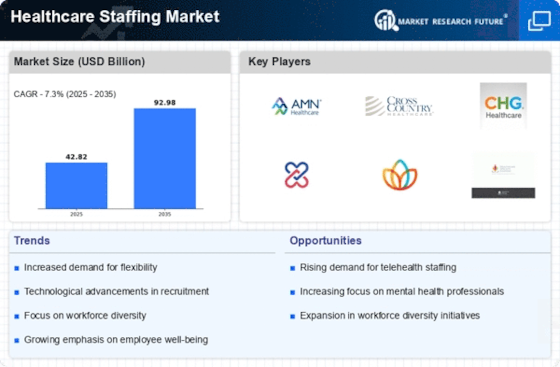
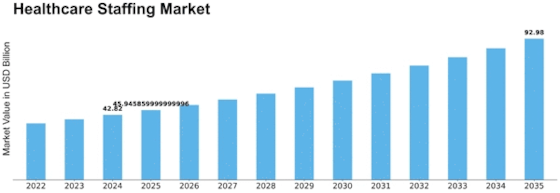
According to MRFR analysis, the Healthcare Staffing Market Size was valued at USD 42.82 Billion in 2024 and the market is projected to grow from USD 45.95 Billion in 2025 to USD 92.98 Billion by 2035, registering a CAGR of 7% during the forecast period (2025–2035).
 
The Healthcare Staffing Market is growing due to rising demand for skilled healthcare professionals and expanding healthcare services globally. Key trends include increased reliance on temporary and contract staffing solutions, adoption of digital staffing platforms, and growing focus on addressing workforce shortages to improve patient care and operational efficiency.

Key Market Trends & Highlights

The Healthcare Staffing Market is experiencing a dynamic shift towards specialized and flexible staffing solutions driven by technological advancements and demographic changes.

  • The demand for specialized skills in healthcare is increasing, particularly in North America, as providers seek to enhance patient care. Flexible staffing solutions are gaining traction, with temporary staffing emerging as the largest segment in the market. Technology integration in recruitment processes is transforming how healthcare professionals are sourced and hired, especially in the Asia-Pacific region. The aging population and rising healthcare expenditures are significant drivers of market growth, particularly in hospitals and home healthcare sectors.

Market Size & Forecast

2024 Market Size 42.82 (USD Billion)
2035 Market Size 92.98 (USD Billion)
CAGR (2025 - 2035) 7.3%
Largest Regional Market Share in 2024 North America

Major Players

Companies such as <a href="https://www.amnhealthcare.com/">AMN Healthcare</a> (US), Cross Country Healthcare (US), CHG Healthcare (US), Maxim Healthcare Services (US),<a href="https://www.ayahealthcare.com/healthcare-staffing-services/healthcare-staffing/"> Aya Healthcare</a> (US), Healthcare Staffing Services (US), Nursefinders (US), MedPro Healthcare Staffing (US) are some of the major participants in the global market.

Market Trends

The Healthcare Staffing Market is currently experiencing a dynamic evolution, driven by various factors that influence the demand for healthcare professionals. As the global population ages and the prevalence of chronic diseases rises, the need for skilled healthcare workers intensifies. This market appears to be adapting to the changing landscape, with an increasing emphasis on flexible staffing solutions that can respond to fluctuating patient needs. Moreover, technological advancements are reshaping recruitment processes, enabling healthcare facilities to streamline hiring and improve workforce management. In addition, the ongoing focus on quality patient care necessitates a well-trained and adequately staffed workforce. Healthcare organizations are likely to prioritize the recruitment of specialized professionals who can deliver high-quality services.

According to healthcare staffing news, this trend suggests a shift towards a more strategic approach in staffing, where organizations not only fill positions but also ensure that the right skills are matched to the right roles. Overall, the market seems poised for continued growth, reflecting the broader changes within the healthcare sector.

Increased Demand for Specialized Skills

The Healthcare Staffing Market is witnessing a notable shift towards the recruitment of specialized professionals. As healthcare becomes more complex, organizations are increasingly seeking individuals with specific expertise to address diverse patient needs. This trend indicates a growing recognition of the importance of specialized skills in delivering high-quality care.

The Biobanking Market is witnessing rapid technological innovations, including automation, artificial intelligence, and advanced sample storage systems that improve data analysis and specimen management. According to the Organisation for Economic Co-operation and Development, more than 500 large biobanks operate globally, supporting biomedical research through the storage and analysis of millions of biological samples.

Emphasis on Flexible Staffing Solutions

Healthcare staffing news suggest that the flexibility in staffing arrangements is becoming a prominent feature within the Healthcare Staffing Market. Organizations are exploring various models, such as temporary healthcare staffing and on-demand services, to adapt to changing patient volumes. This approach allows healthcare facilities to maintain operational efficiency while ensuring adequate coverage.

The growing emphasis on personalized medicine is significantly influencing the Biobanking Market. Biobanks play a crucial role in providing genetic and biological samples for precision medicine research. The National Institutes of Health All of Us Research Program aims to collect health data from over 1 million participants, highlighting the increasing reliance on biobanks to support tailored treatments and genomic studies.

Integration of Technology in Recruitment

As per the healthcare staffing news, the role of technology in the global market is expanding, particularly in recruitment processes. Advanced tools and platforms are being utilized to enhance candidate sourcing, streamline hiring, and improve overall workforce management. This trend suggests a move towards more efficient and effective staffing solutions.

Regulatory frameworks surrounding biobanking are evolving to ensure ethical sample collection and data protection. Organizations such as the World Health Organization emphasize global standards for biobank governance and data privacy, as over 70 countries have introduced regulations or guidelines related to biobanking and genomic data management, strengthening trust and international research collaboration.

Healthcare Staffing Market Market Drivers

Focus on Patient-Centered Care

The focus on patient-centered care is increasingly driving the Healthcare Staffing Market. Healthcare providers are shifting towards models that prioritize patient engagement and satisfaction. This transition requires a workforce that is not only skilled but also trained in communication and interpersonal skills.
 
As healthcare organizations strive to enhance patient experiences, they may need to hire additional staff or provide training for existing employees. This trend suggests a growing demand for healthcare professionals who can deliver compassionate and effective care. Consequently, the market is expected to grow as organizations seek to align their staffing strategies with the principles of patient-centered care.

Rising Healthcare Expenditures

Rising healthcare expenditures are a significant driver of the Healthcare Staffing Market. As countries allocate more resources to healthcare, the demand for skilled professionals increases correspondingly. Data suggests that healthcare spending is expected to rise, with estimates indicating a growth rate of approximately 5.4% annually over the next several years.
 
This increase in funding allows healthcare facilities to expand their services and hire additional staff to meet patient needs. Consequently, the market is poised for growth as organizations seek to recruit and retain qualified personnel to provide high-quality care in an increasingly competitive environment.

Technological Advancements in Healthcare

Technological advancements are reshaping the Healthcare Staffing Market by streamlining recruitment processes and enhancing operational efficiency. Innovations such as telemedicine, electronic health records, and artificial intelligence are transforming how healthcare providers deliver services. These technologies not only improve patient care but also create new roles that require specialized skills.
 
For instance, the integration of telehealth services has led to an increased demand for remote healthcare professionals. As healthcare organizations adopt these technologies, they require staffing solutions that can provide qualified personnel adept in these new systems. This trend indicates a potential for growth in the market as organizations seek to adapt to the evolving technological landscape.

Regulatory Changes and Compliance Requirements

Regulatory changes and compliance requirements are pivotal factors influencing the Healthcare Staffing Market. As healthcare regulations evolve, organizations must ensure that their staffing practices align with new standards. This often necessitates hiring additional staff to manage compliance and maintain quality care.
 
For instance, changes in licensure requirements or patient safety regulations can lead to an increased demand for qualified healthcare professionals. Organizations may seek staffing solutions that can provide personnel who are not only skilled but also knowledgeable about current regulations. Thus, the market is likely to expand as organizations adapt to these regulatory challenges.

Aging Population and Increased Healthcare Needs

The aging population is a primary driver of the Healthcare Staffing Market. As individuals age, they often require more medical attention, leading to a heightened demand for healthcare services. According to recent statistics, the proportion of individuals aged 65 and older is projected to reach 20% by 2030. This demographic shift necessitates a larger workforce in healthcare settings, thereby increasing the demand for staffing solutions.
 
Healthcare facilities are compelled to hire more professionals, including nurses, physicians, and allied health workers, to meet the growing needs of this population. Consequently, the market is likely to experience substantial growth as organizations seek to fill these critical roles to ensure quality care for an expanding elderly demographic.

Market Segment Insights

By Service Type: Temporary Staffing (Largest) vs. Travel Nursing (Fastest-Growing)

The global market is largely dominated by temporary healthcare staffing, accounting for the majority of the Healthcare Staffing Market share. This segment caters to the immediate needs of healthcare facilities that require staff on a short-term basis, allowing for flexibility and quick response to staffing shortages. Travel Nursing, while smaller in comparison, is rapidly gaining traction as healthcare organizations seek to address shortages in specific geographic areas, providing nurses with the opportunity to work in diverse locations for limited periods.

Temporary Staffing (Dominant) vs. Travel Nursing (Emerging)

Temporary healthcare staffing represents the backbone of the global market, providing essential short-term workforce solutions. It allows healthcare facilities to maintain operational efficiency by quickly filling gaps caused by sudden staff leaves or increased patient volume. On the other hand, Travel Nursing is an emerging segment that is witnessing rapid growth. It attracts <a title="registered nurses" href="https://www.marketresearchfuture.com/reports/registered-nurses-market-27110" target="_blank" rel="noopener">registered nurses</a> seeking adventure or new experiences by offering assignments in various locations, often coupled with attractive pay and benefits. This segment caters to both facilities in need of specialized skills in remote areas and nurses looking for flexibility, thus disrupting traditional staffing models.

By End User: Hospitals (Largest) vs. Home Healthcare (Fastest-Growing)

Hospitals hold the largest Healthcare Staffing Market share due to their continuous need for a wide variety of staff, including nurses, physicians, and administrative personnel. Healthcare staffing trends suggest that Clinics and long-term care facilities also represent significant portions of the market, but they generally require fewer specialized staff compared to hospitals. Home healthcare is becoming increasingly prevalent, driven by the growing preference for at-home care solutions among patients, particularly the elderly.

Hospitals (Dominant) vs. Home Healthcare (Emerging)

Hospitals remain the dominant end user in the healthcare staffing market as they offer a diverse range of services and cater to large populations, necessitating a constant influx of qualified healthcare professionals. They typically seek staffing solutions that can address various specialties, from emergency care to surgical staffing. On the other hand, home healthcare is emerging rapidly as an alternative to traditional facilities, fueled by technological advancements and a shift in patient preferences for more personalized care. This segment focuses on skilled nursing and therapy services delivered in patients' homes, making it a critical player in the evolving landscape of healthcare.

By Healthcare Sector: Nursing (Largest) vs. Allied Health (Fastest-Growing)

The market is characterized by significant diversification, with nursing, allied health, physician staffing, and administrative staffing being the primary segments. Nursing holds a substantial share, making it the largest segment, driven by the continuous demand for qualified nurses across various healthcare settings. Healthcare staffing trends suggest that Allied health, while smaller in current market share, is experiencing rapid growth, propelled by the increasing importance of specialists like physical therapists, radiographers, and laboratory technicians.

Nursing (Dominant) vs. Allied Health (Emerging)

Nursing staffing has long been the cornerstone of healthcare services, reflecting a consistent and high demand for healthcare professionals who can deliver bedside care. The segment benefits from strong educational pathways and regulatory support, establishing a stable workforce foundation. On the other hand, allied health sectors represent an emerging market motivated by evolving healthcare needs and technological advances. As healthcare systems increasingly recognize the value of allied health professionals in delivering comprehensive patient care, this segment is witnessing significant growth. This includes roles such as medical technologists and respiratory therapists, fostering a robust pipeline for future staffing needs.

By Staffing Model: Managed Services Provider (Largest) vs. Recruitment Process Outsourcing (Fastest-Growing)

The Healthcare Staffing Market is characterized by a diverse distribution of staffing models, with the Managed Services Provider (MSP) segment holding the largest share. MSPs are increasingly preferred by healthcare facilities due to their ability to streamline staffing processes and manage contingent workforce effectively. Meanwhile, healthcare staffing trends suggest that Recruitment Process Outsourcing (RPO) is gaining traction as organizations seek to focus on core competencies, thereby accelerating its growth in the healthcare staffing landscape. The contingent workforce model also plays a crucial role, supporting healthcare providers with flexible staffing solutions. In recent years, the demand for Managed Services Providers has surged, driven by the need for efficiency and compliance in staffing. The pressing requirement for skilled healthcare professionals further fuels the growth of RPO, as it allows organizations to adapt quickly to changes in staffing needs. As healthcare systems evolve, the integration of technology and data analytics in these staffing models is anticipated to enhance performance, indicating a transformative shift within the sector.

Managed Services Provider (Dominant) vs. Recruitment Process Outsourcing (Emerging)

Healthcare staffing industry trends suggest that the Managed Services Provider (MSP) segment has established itself as a dominant force in the market, primarily due to its comprehensive management of staffing processes for healthcare organizations. MSPs provide a centralized solution that integrates procurement, compliance, and <a title="workforce management" href="https://www.marketresearchfuture.com/reports/workforce-management-market-2388" target="_blank" rel="noopener">workforce management</a>, enabling healthcare facilities to optimize their staffing resources efficiently. On the other hand, the Recruitment Process Outsourcing (RPO) segment is emerging swiftly, offering innovative recruitment strategies and specialized staffing solutions. RPO providers focus on filling healthcare roles with speed and precision, catering to the unique needs of providers. Both segments demonstrate contrasting strengths; while MSPs excel in holistic management, RPOs focus on agile and targeted recruitment efforts, addressing the evolving dynamics of healthcare staffing.

Get more detailed insights about Healthcare Staffing Market Research Report 2035

Regional Insights

North America : Healthcare Staffing Market Leader

North America is the largest market for healthcare staffing, driven by an aging population, increased healthcare spending, and a growing demand for healthcare services. The U.S. holds approximately 75% of the market share, followed by Canada at around 15%. Regulatory support, such as the Affordable Care Act, has further catalyzed growth by expanding access to healthcare services.

The competitive landscape is characterized by major players like AMN Healthcare, Cross Country Healthcare, and CHG Healthcare, which dominate the market. The presence of these key players ensures a robust staffing network, addressing the increasing demand for qualified healthcare professionals. The U.S. market is also witnessing a rise in telehealth services, further influencing staffing needs.

Europe : Emerging Healthcare Staffing Market Hub

Europe is witnessing significant growth in the healthcare staffing market, driven by an aging population and increased healthcare expenditure. The largest markets include Germany and the UK, which together account for approximately 60% of the region's market share. Regulatory frameworks, such as the European Union's directives on healthcare services, are enhancing the demand for skilled healthcare professionals across member states.

Leading countries like Germany, France, and the UK are experiencing a surge in healthcare staffing needs, with a competitive landscape featuring both local and international players. Companies are adapting to the evolving healthcare landscape, focusing on specialized staffing solutions. The presence of key players like Adecco and Randstad is notable, as they expand their services to meet the growing demand for healthcare professionals.

Asia-Pacific : Rapidly Growing Market

Asia-Pacific is emerging as a rapidly growing market for healthcare staffing, driven by increasing healthcare needs and government initiatives to improve healthcare infrastructure. Countries like China and India are leading this growth, holding approximately 50% of the market share in the region. The demand for healthcare professionals is further fueled by rising chronic diseases and an expanding elderly population, prompting regulatory support for staffing solutions.

The competitive landscape is evolving, with local firms and international players vying for market share. Key players such as Max Healthcare and Healthcare Staffing Market Services are expanding their operations to meet the rising demand. The region is also witnessing a trend towards digital health solutions, which is reshaping staffing requirements and creating new opportunities for healthcare professionals.

Middle East and Africa : Emerging Healthcare Staffing Market

The Middle East and Africa region is experiencing a burgeoning market, driven by increasing investments in healthcare infrastructure and a growing population. The UAE and South Africa are the largest markets, collectively holding around 55% of the regional market share. Government initiatives aimed at improving healthcare access and quality are acting as catalysts for staffing demand, particularly in urban areas.

Countries like Saudi Arabia and Nigeria are also witnessing significant growth in healthcare staffing needs, with a competitive landscape that includes both local and international staffing agencies. Key players are focusing on specialized staffing solutions to address the unique challenges of the region. The presence of organizations like Mediclinic and Life Healthcare is notable as they expand their services to meet the rising demand for healthcare professionals.

Key Players and Competitive Insights

The Healthcare Staffing Market is currently characterized by a dynamic competitive landscape, driven by increasing demand for healthcare professionals and the ongoing evolution of healthcare delivery models. Key players such as AMN Healthcare (US), Cross Country Healthcare (US), and Aya Healthcare (US) are strategically positioning themselves through a combination of technological innovation, regional expansion, and partnerships.
 
These companies are not only focusing on enhancing their service offerings but are also investing in digital platforms to streamline operations and improve client engagement. This collective emphasis on innovation and adaptability appears to be shaping a competitive environment that is increasingly responsive to the needs of healthcare providers and patients alike. 
 
In terms of business tactics, companies are increasingly localizing their operations to better serve regional markets, which may enhance their responsiveness to local healthcare demands. The market structure is moderately fragmented, with several key players exerting considerable influence. This fragmentation allows for a variety of service offerings, yet the presence of dominant players like CHG Healthcare (US) and Maxim Healthcare Services (US) suggests a competitive hierarchy that could impact smaller firms' market share and operational strategies. 
 
In August 2025, AMN Healthcare (US) announced a strategic partnership with a leading telehealth provider to enhance its staffing solutions. This collaboration is likely to expand AMN's service capabilities, integrating telehealth into its staffing offerings, which could significantly improve patient care and operational efficiency. Such a move indicates a shift towards more comprehensive healthcare solutions, aligning with the growing trend of telemedicine. 
 
In September 2025, Cross Country Healthcare (US) launched a new AI-driven platform aimed at optimizing workforce management. This initiative appears to be a response to the increasing complexity of staffing needs in healthcare settings, suggesting that Cross Country is prioritizing technological advancements to enhance operational efficiency. The integration of AI into staffing processes may not only streamline operations but also improve the quality of care delivered by ensuring the right professionals are matched with the right roles. 
 
In July 2025, Aya Healthcare (US) expanded its international reach by entering into a partnership with a European healthcare staffing firm. This strategic move seems to reflect a growing trend of global collaboration in the healthcare staffing sector, potentially allowing Aya to tap into new markets and diversify its service offerings. Such international partnerships may enhance competitive positioning by leveraging global talent pools and addressing staffing shortages in various regions. 
 
As of October 2025, the competitive trends in the Healthcare Staffing Market are increasingly defined by digitalization, sustainability, and the integration of artificial intelligence. Strategic alliances are becoming more prevalent, as companies recognize the value of collaboration in enhancing service delivery and operational efficiency. Looking ahead, it appears that competitive differentiation will increasingly hinge on innovation and technology, rather than solely on price. The emphasis on supply chain reliability and the ability to adapt to changing healthcare demands will likely become critical factors in determining market leadership.

Key Companies in the Healthcare Staffing Market include

Industry Developments

Recent developments in the Global Healthcare Staffing Market indicate a robust recovery driven by the increasing demand for healthcare professionals, particularly in light of ongoing global health challenges. Companies such as AMN Healthcare and Cross Country Healthcare are expanding their services to meet the rising need for qualified staff. In October 2023, AMN Healthcare announced its investment in technology to enhance staffing solutions, thereby improving efficiency and response times. Furthermore, noteworthy mergers and acquisitions, such as Medical Staffing Network's acquisition by a private equity firm in September 2023, signal consolidation efforts within the industry.

Companies like Maxim Healthcare Services and Nursefinders are restructuring to optimize operations in a competitive market. Over the past two to three years, the market has seen significant growth, with the market valuation exceeding $25 billion by late 2022, as reported by the Global market Association. This growth is fueled by demographic shifts, technological advancements, and an increasing focus on healthcare quality, resulting in heightened competition among major players like Merritt Hawkins, BAYADA Home Health Care, and Kforce to maintain and expand their market presence.

Future Outlook

Healthcare Staffing Market Future Outlook

The Healthcare Staffing Market size is projected to reach USD 92.98 Billion by 2035, growing at a CAGR of 7.0%, driven by technological advancements, increasing demand for healthcare services, and workforce shortages.

New opportunities lie in:

  • <p>Development of AI-driven staffing solutions for enhanced efficiency. Expansion of <a href="https://www.marketresearchfuture.com/reports/telehealth-market-900">telehealth</a> staffing services to meet remote care demands. Creation of specialized training programs for emerging healthcare roles.</p>

By 2035, the Healthcare Staffing Market is expected to be robust, reflecting sustained growth and innovation.

Market Segmentation

Healthcare Staffing Market End User Outlook

  • Hospitals
  • Clinics
  • Long-Term Care Facilities
  • Home Healthcare

Healthcare Staffing Market Service Type Outlook

  • Temporary Staffing
  • Permanent Staffing
  • Travel Nursing
  • Locum Tenens

Healthcare Staffing Market Staffing Model Outlook

  • Managed Services Provider
  • Recruitment Process Outsourcing
  • Contingent Workforce

Healthcare Staffing Market Healthcare Sector Outlook

  • Nursing
  • Allied Health
  • Physician Staffing
  • Administrative Staffing

Report Scope

MARKET SIZE 2024 42.82(USD Billion)
MARKET SIZE 2025 45.95(USD Billion)
MARKET SIZE 2035 92.98(USD Billion)
COMPOUND ANNUAL GROWTH RATE (CAGR) 7.3% (2025 - 2035)
REPORT COVERAGE Revenue Forecast, Competitive Landscape, Growth Factors, and Trends
BASE YEAR 2024
Market Forecast Period 2025 - 2035
Historical Data 2019 - 2024
Market Forecast Units USD Billion
Key Companies Profiled AMN Healthcare (US), Cross Country Healthcare (US), CHG Healthcare (US), Maxim Healthcare Services (US), Aya Healthcare (US), Healthcare Staffing Services (US), Nursefinders (US), MedPro Healthcare Staffing (US)
Segments Covered Service Type, End Users, Healthcare Sector, Staffing Model, Regional
Key Market Opportunities Integration of artificial intelligence in recruitment processes enhances efficiency in the Healthcare Staffing Market.
Key Market Dynamics Rising demand for flexible staffing solutions drives innovation and competition in the healthcare staffing sector.
Countries Covered North America, Europe, APAC, South America, MEA

FAQs

What is the current valuation of the Healthcare Staffing Market in 2025?

<p>The Healthcare Staffing Market is valued at approximately 42.82 USD Billion in 2024.</p>

What is the projected market size for the Healthcare Staffing Market by 2035?

<p>The market is expected to reach a valuation of 92.98 USD Billion by 2035.</p>

What is the expected CAGR for the Healthcare Staffing Market during the forecast period 2025 - 2035?

<p>The expected CAGR for the Healthcare Staffing Market during 2025 - 2035 is 7.3%.</p>

Which service type segment is projected to have the highest growth in the Healthcare Staffing Market?

<p>The Temporary Staffing segment is projected to grow from 15.0 USD Billion to 32.0 USD Billion by 2035.</p>

How does the Home Healthcare segment perform in terms of market valuation?

<p>The Home Healthcare segment is expected to increase from 6.88 USD Billion in 2024 to 14.98 USD Billion by 2035.</p>

What are the key players in the Healthcare Staffing Market?

<p>Key players include AMN Healthcare, Cross Country Healthcare, CHG Healthcare, and Aya Healthcare.</p>

Which end user segment shows significant growth potential in the Healthcare Staffing Market?

<p>The Hospitals segment is anticipated to grow from 17.13 USD Billion to 38.0 USD Billion by 2035.</p>

What is the projected growth for the Nursing sector within the Healthcare Staffing Market?

<p>The Nursing sector is expected to expand from 15.0 USD Billion to 35.0 USD Billion by 2035.</p>

How does the Contingent Workforce model perform in the Healthcare Staffing Market?

<p>The Contingent Workforce model is projected to grow from 19.97 USD Billion to 42.98 USD Billion by 2035.</p>

What is the expected growth trajectory for the Recruitment Process Outsourcing segment?

<p>The Recruitment Process Outsourcing segment is likely to increase from 10.0 USD Billion to 22.0 USD Billion by 2035.</p>

  1. SECTION I: EXECUTIVE SUMMARY AND KEY HIGHLIGHTS
    1. | 1.1 EXECUTIVE SUMMARY
    2. | | 1.1.1 Market Overview
    3. | | 1.1.2 Key Findings
    4. | | 1.1.3 Market Segmentation
    5. | | 1.1.4 Competitive Landscape
    6. | | 1.1.5 Challenges and Opportunities
    7. | | 1.1.6 Future Outlook
  2. SECTION II: SCOPING, METHODOLOGY AND MARKET STRUCTURE
    1. | 2.1 MARKET INTRODUCTION
    2. | | 2.1.1 Definition
    3. | | 2.1.2 Scope of the study
    4. | | | 2.1.2.1 Research Objective
    5. | | | 2.1.2.2 Assumption
    6. | | | 2.1.2.3 Limitations
    7. | 2.2 RESEARCH METHODOLOGY
    8. | | 2.2.1 Overview
    9. | | 2.2.2 Data Mining
    10. | | 2.2.3 Secondary Research
    11. | | 2.2.4 Primary Research
    12. | | | 2.2.4.1 Primary Interviews and Information Gathering Process
    13. | | | 2.2.4.2 Breakdown of Primary Respondents
    14. | | 2.2.5 Forecasting Model
    15. | | 2.2.6 Market Size Estimation
    16. | | | 2.2.6.1 Bottom-Up Approach
    17. | | | 2.2.6.2 Top-Down Approach
    18. | | 2.2.7 Data Triangulation
    19. | | 2.2.8 Validation
  3. SECTION III: QUALITATIVE ANALYSIS
    1. | 3.1 MARKET DYNAMICS
    2. | | 3.1.1 Overview
    3. | | 3.1.2 Drivers
    4. | | 3.1.3 Restraints
    5. | | 3.1.4 Opportunities
    6. | 3.2 MARKET FACTOR ANALYSIS
    7. | | 3.2.1 Value chain Analysis
    8. | | 3.2.2 Porter's Five Forces Analysis
    9. | | | 3.2.2.1 Bargaining Power of Suppliers
    10. | | | 3.2.2.2 Bargaining Power of Buyers
    11. | | | 3.2.2.3 Threat of New Entrants
    12. | | | 3.2.2.4 Threat of Substitutes
    13. | | | 3.2.2.5 Intensity of Rivalry
    14. | | 3.2.3 COVID-19 Impact Analysis
    15. | | | 3.2.3.1 Market Impact Analysis
    16. | | | 3.2.3.2 Regional Impact
    17. | | | 3.2.3.3 Opportunity and Threat Analysis
  4. SECTION IV: QUANTITATIVE ANALYSIS
    1. | 4.1 Healthcare, BY Service Type (USD Billion)
    2. | | 4.1.1 Temporary Staffing
    3. | | 4.1.2 Permanent Staffing
    4. | | 4.1.3 Travel Nursing
    5. | | 4.1.4 Locum Tenens
    6. | 4.2 Healthcare, BY End User (USD Billion)
    7. | | 4.2.1 Hospitals
    8. | | 4.2.2 Clinics
    9. | | 4.2.3 Long-Term Care Facilities
    10. | | 4.2.4 Home Healthcare
    11. | 4.3 Healthcare, BY Healthcare Sector (USD Billion)
    12. | | 4.3.1 Nursing
    13. | | 4.3.2 Allied Health
    14. | | 4.3.3 Physician Staffing
    15. | | 4.3.4 Administrative Staffing
    16. | 4.4 Healthcare, BY Staffing Model (USD Billion)
    17. | | 4.4.1 Managed Services Provider
    18. | | 4.4.2 Recruitment Process Outsourcing
    19. | | 4.4.3 Contingent Workforce
    20. | 4.5 Healthcare, BY Region (USD Billion)
    21. | | 4.5.1 North America
    22. | | | 4.5.1.1 US
    23. | | | 4.5.1.2 Canada
    24. | | 4.5.2 Europe
    25. | | | 4.5.2.1 Germany
    26. | | | 4.5.2.2 UK
    27. | | | 4.5.2.3 France
    28. | | | 4.5.2.4 Russia
    29. | | | 4.5.2.5 Italy
    30. | | | 4.5.2.6 Spain
    31. | | | 4.5.2.7 Rest of Europe
    32. | | 4.5.3 APAC
    33. | | | 4.5.3.1 China
    34. | | | 4.5.3.2 India
    35. | | | 4.5.3.3 Japan
    36. | | | 4.5.3.4 South Korea
    37. | | | 4.5.3.5 Malaysia
    38. | | | 4.5.3.6 Thailand
    39. | | | 4.5.3.7 Indonesia
    40. | | | 4.5.3.8 Rest of APAC
    41. | | 4.5.4 South America
    42. | | | 4.5.4.1 Brazil
    43. | | | 4.5.4.2 Mexico
    44. | | | 4.5.4.3 Argentina
    45. | | | 4.5.4.4 Rest of South America
    46. | | 4.5.5 MEA
    47. | | | 4.5.5.1 GCC Countries
    48. | | | 4.5.5.2 South Africa
    49. | | | 4.5.5.3 Rest of MEA
  5. SECTION V: COMPETITIVE ANALYSIS
    1. | 5.1 Competitive Landscape
    2. | | 5.1.1 Overview
    3. | | 5.1.2 Competitive Analysis
    4. | | 5.1.3 Market share Analysis
    5. | | 5.1.4 Major Growth Strategy in the Healthcare
    6. | | 5.1.5 Competitive Benchmarking
    7. | | 5.1.6 Leading Players in Terms of Number of Developments in the Healthcare
    8. | | 5.1.7 Key developments and growth strategies
    9. | | | 5.1.7.1 New Product Launch/Service Deployment
    10. | | | 5.1.7.2 Merger & Acquisitions
    11. | | | 5.1.7.3 Joint Ventures
    12. | | 5.1.8 Major Players Financial Matrix
    13. | | | 5.1.8.1 Sales and Operating Income
    14. | | | 5.1.8.2 Major Players R&D Expenditure. 2023
    15. | 5.2 Company Profiles
    16. | | 5.2.1 AMN Healthcare (US)
    17. | | | 5.2.1.1 Financial Overview
    18. | | | 5.2.1.2 Products Offered
    19. | | | 5.2.1.3 Key Developments
    20. | | | 5.2.1.4 SWOT Analysis
    21. | | | 5.2.1.5 Key Strategies
    22. | | 5.2.2 Cross Country Healthcare (US)
    23. | | | 5.2.2.1 Financial Overview
    24. | | | 5.2.2.2 Products Offered
    25. | | | 5.2.2.3 Key Developments
    26. | | | 5.2.2.4 SWOT Analysis
    27. | | | 5.2.2.5 Key Strategies
    28. | | 5.2.3 CHG Healthcare (US)
    29. | | | 5.2.3.1 Financial Overview
    30. | | | 5.2.3.2 Products Offered
    31. | | | 5.2.3.3 Key Developments
    32. | | | 5.2.3.4 SWOT Analysis
    33. | | | 5.2.3.5 Key Strategies
    34. | | 5.2.4 Maxim Healthcare Services (US)
    35. | | | 5.2.4.1 Financial Overview
    36. | | | 5.2.4.2 Products Offered
    37. | | | 5.2.4.3 Key Developments
    38. | | | 5.2.4.4 SWOT Analysis
    39. | | | 5.2.4.5 Key Strategies
    40. | | 5.2.5 Aya Healthcare (US)
    41. | | | 5.2.5.1 Financial Overview
    42. | | | 5.2.5.2 Products Offered
    43. | | | 5.2.5.3 Key Developments
    44. | | | 5.2.5.4 SWOT Analysis
    45. | | | 5.2.5.5 Key Strategies
    46. | | 5.2.6 Healthcare Staffing Services (US)
    47. | | | 5.2.6.1 Financial Overview
    48. | | | 5.2.6.2 Products Offered
    49. | | | 5.2.6.3 Key Developments
    50. | | | 5.2.6.4 SWOT Analysis
    51. | | | 5.2.6.5 Key Strategies
    52. | | 5.2.7 Nursefinders (US)
    53. | | | 5.2.7.1 Financial Overview
    54. | | | 5.2.7.2 Products Offered
    55. | | | 5.2.7.3 Key Developments
    56. | | | 5.2.7.4 SWOT Analysis
    57. | | | 5.2.7.5 Key Strategies
    58. | | 5.2.8 MedPro Healthcare Staffing (US)
    59. | | | 5.2.8.1 Financial Overview
    60. | | | 5.2.8.2 Products Offered
    61. | | | 5.2.8.3 Key Developments
    62. | | | 5.2.8.4 SWOT Analysis
    63. | | | 5.2.8.5 Key Strategies
    64. | 5.3 Appendix
    65. | | 5.3.1 References
    66. | | 5.3.2 Related Reports
  6. LIST OF FIGURES
    1. | 6.1 MARKET SYNOPSIS
    2. | 6.2 NORTH AMERICA MARKET ANALYSIS
    3. | 6.3 US MARKET ANALYSIS BY SERVICE TYPE
    4. | 6.4 US MARKET ANALYSIS BY END USER
    5. | 6.5 US MARKET ANALYSIS BY HEALTHCARE SECTOR
    6. | 6.6 US MARKET ANALYSIS BY STAFFING MODEL
    7. | 6.7 CANADA MARKET ANALYSIS BY SERVICE TYPE
    8. | 6.8 CANADA MARKET ANALYSIS BY END USER
    9. | 6.9 CANADA MARKET ANALYSIS BY HEALTHCARE SECTOR
    10. | 6.10 CANADA MARKET ANALYSIS BY STAFFING MODEL
    11. | 6.11 EUROPE MARKET ANALYSIS
    12. | 6.12 GERMANY MARKET ANALYSIS BY SERVICE TYPE
    13. | 6.13 GERMANY MARKET ANALYSIS BY END USER
    14. | 6.14 GERMANY MARKET ANALYSIS BY HEALTHCARE SECTOR
    15. | 6.15 GERMANY MARKET ANALYSIS BY STAFFING MODEL
    16. | 6.16 UK MARKET ANALYSIS BY SERVICE TYPE
    17. | 6.17 UK MARKET ANALYSIS BY END USER
    18. | 6.18 UK MARKET ANALYSIS BY HEALTHCARE SECTOR
    19. | 6.19 UK MARKET ANALYSIS BY STAFFING MODEL
    20. | 6.20 FRANCE MARKET ANALYSIS BY SERVICE TYPE
    21. | 6.21 FRANCE MARKET ANALYSIS BY END USER
    22. | 6.22 FRANCE MARKET ANALYSIS BY HEALTHCARE SECTOR
    23. | 6.23 FRANCE MARKET ANALYSIS BY STAFFING MODEL
    24. | 6.24 RUSSIA MARKET ANALYSIS BY SERVICE TYPE
    25. | 6.25 RUSSIA MARKET ANALYSIS BY END USER
    26. | 6.26 RUSSIA MARKET ANALYSIS BY HEALTHCARE SECTOR
    27. | 6.27 RUSSIA MARKET ANALYSIS BY STAFFING MODEL
    28. | 6.28 ITALY MARKET ANALYSIS BY SERVICE TYPE
    29. | 6.29 ITALY MARKET ANALYSIS BY END USER
    30. | 6.30 ITALY MARKET ANALYSIS BY HEALTHCARE SECTOR
    31. | 6.31 ITALY MARKET ANALYSIS BY STAFFING MODEL
    32. | 6.32 SPAIN MARKET ANALYSIS BY SERVICE TYPE
    33. | 6.33 SPAIN MARKET ANALYSIS BY END USER
    34. | 6.34 SPAIN MARKET ANALYSIS BY HEALTHCARE SECTOR
    35. | 6.35 SPAIN MARKET ANALYSIS BY STAFFING MODEL
    36. | 6.36 REST OF EUROPE MARKET ANALYSIS BY SERVICE TYPE
    37. | 6.37 REST OF EUROPE MARKET ANALYSIS BY END USER
    38. | 6.38 REST OF EUROPE MARKET ANALYSIS BY HEALTHCARE SECTOR
    39. | 6.39 REST OF EUROPE MARKET ANALYSIS BY STAFFING MODEL
    40. | 6.40 APAC MARKET ANALYSIS
    41. | 6.41 CHINA MARKET ANALYSIS BY SERVICE TYPE
    42. | 6.42 CHINA MARKET ANALYSIS BY END USER
    43. | 6.43 CHINA MARKET ANALYSIS BY HEALTHCARE SECTOR
    44. | 6.44 CHINA MARKET ANALYSIS BY STAFFING MODEL
    45. | 6.45 INDIA MARKET ANALYSIS BY SERVICE TYPE
    46. | 6.46 INDIA MARKET ANALYSIS BY END USER
    47. | 6.47 INDIA MARKET ANALYSIS BY HEALTHCARE SECTOR
    48. | 6.48 INDIA MARKET ANALYSIS BY STAFFING MODEL
    49. | 6.49 JAPAN MARKET ANALYSIS BY SERVICE TYPE
    50. | 6.50 JAPAN MARKET ANALYSIS BY END USER
    51. | 6.51 JAPAN MARKET ANALYSIS BY HEALTHCARE SECTOR
    52. | 6.52 JAPAN MARKET ANALYSIS BY STAFFING MODEL
    53. | 6.53 SOUTH KOREA MARKET ANALYSIS BY SERVICE TYPE
    54. | 6.54 SOUTH KOREA MARKET ANALYSIS BY END USER
    55. | 6.55 SOUTH KOREA MARKET ANALYSIS BY HEALTHCARE SECTOR
    56. | 6.56 SOUTH KOREA MARKET ANALYSIS BY STAFFING MODEL
    57. | 6.57 MALAYSIA MARKET ANALYSIS BY SERVICE TYPE
    58. | 6.58 MALAYSIA MARKET ANALYSIS BY END USER
    59. | 6.59 MALAYSIA MARKET ANALYSIS BY HEALTHCARE SECTOR
    60. | 6.60 MALAYSIA MARKET ANALYSIS BY STAFFING MODEL
    61. | 6.61 THAILAND MARKET ANALYSIS BY SERVICE TYPE
    62. | 6.62 THAILAND MARKET ANALYSIS BY END USER
    63. | 6.63 THAILAND MARKET ANALYSIS BY HEALTHCARE SECTOR
    64. | 6.64 THAILAND MARKET ANALYSIS BY STAFFING MODEL
    65. | 6.65 INDONESIA MARKET ANALYSIS BY SERVICE TYPE
    66. | 6.66 INDONESIA MARKET ANALYSIS BY END USER
    67. | 6.67 INDONESIA MARKET ANALYSIS BY HEALTHCARE SECTOR
    68. | 6.68 INDONESIA MARKET ANALYSIS BY STAFFING MODEL
    69. | 6.69 REST OF APAC MARKET ANALYSIS BY SERVICE TYPE
    70. | 6.70 REST OF APAC MARKET ANALYSIS BY END USER
    71. | 6.71 REST OF APAC MARKET ANALYSIS BY HEALTHCARE SECTOR
    72. | 6.72 REST OF APAC MARKET ANALYSIS BY STAFFING MODEL
    73. | 6.73 SOUTH AMERICA MARKET ANALYSIS
    74. | 6.74 BRAZIL MARKET ANALYSIS BY SERVICE TYPE
    75. | 6.75 BRAZIL MARKET ANALYSIS BY END USER
    76. | 6.76 BRAZIL MARKET ANALYSIS BY HEALTHCARE SECTOR
    77. | 6.77 BRAZIL MARKET ANALYSIS BY STAFFING MODEL
    78. | 6.78 MEXICO MARKET ANALYSIS BY SERVICE TYPE
    79. | 6.79 MEXICO MARKET ANALYSIS BY END USER
    80. | 6.80 MEXICO MARKET ANALYSIS BY HEALTHCARE SECTOR
    81. | 6.81 MEXICO MARKET ANALYSIS BY STAFFING MODEL
    82. | 6.82 ARGENTINA MARKET ANALYSIS BY SERVICE TYPE
    83. | 6.83 ARGENTINA MARKET ANALYSIS BY END USER
    84. | 6.84 ARGENTINA MARKET ANALYSIS BY HEALTHCARE SECTOR
    85. | 6.85 ARGENTINA MARKET ANALYSIS BY STAFFING MODEL
    86. | 6.86 REST OF SOUTH AMERICA MARKET ANALYSIS BY SERVICE TYPE
    87. | 6.87 REST OF SOUTH AMERICA MARKET ANALYSIS BY END USER
    88. | 6.88 REST OF SOUTH AMERICA MARKET ANALYSIS BY HEALTHCARE SECTOR
    89. | 6.89 REST OF SOUTH AMERICA MARKET ANALYSIS BY STAFFING MODEL
    90. | 6.90 MEA MARKET ANALYSIS
    91. | 6.91 GCC COUNTRIES MARKET ANALYSIS BY SERVICE TYPE
    92. | 6.92 GCC COUNTRIES MARKET ANALYSIS BY END USER
    93. | 6.93 GCC COUNTRIES MARKET ANALYSIS BY HEALTHCARE SECTOR
    94. | 6.94 GCC COUNTRIES MARKET ANALYSIS BY STAFFING MODEL
    95. | 6.95 SOUTH AFRICA MARKET ANALYSIS BY SERVICE TYPE
    96. | 6.96 SOUTH AFRICA MARKET ANALYSIS BY END USER
    97. | 6.97 SOUTH AFRICA MARKET ANALYSIS BY HEALTHCARE SECTOR
    98. | 6.98 SOUTH AFRICA MARKET ANALYSIS BY STAFFING MODEL
    99. | 6.99 REST OF MEA MARKET ANALYSIS BY SERVICE TYPE
    100. | 6.100 REST OF MEA MARKET ANALYSIS BY END USER
    101. | 6.101 REST OF MEA MARKET ANALYSIS BY HEALTHCARE SECTOR
    102. | 6.102 REST OF MEA MARKET ANALYSIS BY STAFFING MODEL
    103. | 6.103 KEY BUYING CRITERIA OF HEALTHCARE
    104. | 6.104 RESEARCH PROCESS OF MRFR
    105. | 6.105 DRO ANALYSIS OF HEALTHCARE
    106. | 6.106 DRIVERS IMPACT ANALYSIS: HEALTHCARE
    107. | 6.107 RESTRAINTS IMPACT ANALYSIS: HEALTHCARE
    108. | 6.108 SUPPLY / VALUE CHAIN: HEALTHCARE
    109. | 6.109 HEALTHCARE, BY SERVICE TYPE, 2024 (% SHARE)
    110. | 6.110 HEALTHCARE, BY SERVICE TYPE, 2024 TO 2035 (USD Billion)
    111. | 6.111 HEALTHCARE, BY END USER, 2024 (% SHARE)
    112. | 6.112 HEALTHCARE, BY END USER, 2024 TO 2035 (USD Billion)
    113. | 6.113 HEALTHCARE, BY HEALTHCARE SECTOR, 2024 (% SHARE)
    114. | 6.114 HEALTHCARE, BY HEALTHCARE SECTOR, 2024 TO 2035 (USD Billion)
    115. | 6.115 HEALTHCARE, BY STAFFING MODEL, 2024 (% SHARE)
    116. | 6.116 HEALTHCARE, BY STAFFING MODEL, 2024 TO 2035 (USD Billion)
    117. | 6.117 BENCHMARKING OF MAJOR COMPETITORS
  7. LIST OF TABLES
    1. | 7.1 LIST OF ASSUMPTIONS
    2. | | 7.1.1
    3. | 7.2 North America MARKET SIZE ESTIMATES; FORECAST
    4. | | 7.2.1 BY SERVICE TYPE, 2025-2035 (USD Billion)
    5. | | 7.2.2 BY END USER, 2025-2035 (USD Billion)
    6. | | 7.2.3 BY HEALTHCARE SECTOR, 2025-2035 (USD Billion)
    7. | | 7.2.4 BY STAFFING MODEL, 2025-2035 (USD Billion)
    8. | 7.3 US MARKET SIZE ESTIMATES; FORECAST
    9. | | 7.3.1 BY SERVICE TYPE, 2025-2035 (USD Billion)
    10. | | 7.3.2 BY END USER, 2025-2035 (USD Billion)
    11. | | 7.3.3 BY HEALTHCARE SECTOR, 2025-2035 (USD Billion)
    12. | | 7.3.4 BY STAFFING MODEL, 2025-2035 (USD Billion)
    13. | 7.4 Canada MARKET SIZE ESTIMATES; FORECAST
    14. | | 7.4.1 BY SERVICE TYPE, 2025-2035 (USD Billion)
    15. | | 7.4.2 BY END USER, 2025-2035 (USD Billion)
    16. | | 7.4.3 BY HEALTHCARE SECTOR, 2025-2035 (USD Billion)
    17. | | 7.4.4 BY STAFFING MODEL, 2025-2035 (USD Billion)
    18. | 7.5 Europe MARKET SIZE ESTIMATES; FORECAST
    19. | | 7.5.1 BY SERVICE TYPE, 2025-2035 (USD Billion)
    20. | | 7.5.2 BY END USER, 2025-2035 (USD Billion)
    21. | | 7.5.3 BY HEALTHCARE SECTOR, 2025-2035 (USD Billion)
    22. | | 7.5.4 BY STAFFING MODEL, 2025-2035 (USD Billion)
    23. | 7.6 Germany MARKET SIZE ESTIMATES; FORECAST
    24. | | 7.6.1 BY SERVICE TYPE, 2025-2035 (USD Billion)
    25. | | 7.6.2 BY END USER, 2025-2035 (USD Billion)
    26. | | 7.6.3 BY HEALTHCARE SECTOR, 2025-2035 (USD Billion)
    27. | | 7.6.4 BY STAFFING MODEL, 2025-2035 (USD Billion)
    28. | 7.7 UK MARKET SIZE ESTIMATES; FORECAST
    29. | | 7.7.1 BY SERVICE TYPE, 2025-2035 (USD Billion)
    30. | | 7.7.2 BY END USER, 2025-2035 (USD Billion)
    31. | | 7.7.3 BY HEALTHCARE SECTOR, 2025-2035 (USD Billion)
    32. | | 7.7.4 BY STAFFING MODEL, 2025-2035 (USD Billion)
    33. | 7.8 France MARKET SIZE ESTIMATES; FORECAST
    34. | | 7.8.1 BY SERVICE TYPE, 2025-2035 (USD Billion)
    35. | | 7.8.2 BY END USER, 2025-2035 (USD Billion)
    36. | | 7.8.3 BY HEALTHCARE SECTOR, 2025-2035 (USD Billion)
    37. | | 7.8.4 BY STAFFING MODEL, 2025-2035 (USD Billion)
    38. | 7.9 Russia MARKET SIZE ESTIMATES; FORECAST
    39. | | 7.9.1 BY SERVICE TYPE, 2025-2035 (USD Billion)
    40. | | 7.9.2 BY END USER, 2025-2035 (USD Billion)
    41. | | 7.9.3 BY HEALTHCARE SECTOR, 2025-2035 (USD Billion)
    42. | | 7.9.4 BY STAFFING MODEL, 2025-2035 (USD Billion)
    43. | 7.10 Italy MARKET SIZE ESTIMATES; FORECAST
    44. | | 7.10.1 BY SERVICE TYPE, 2025-2035 (USD Billion)
    45. | | 7.10.2 BY END USER, 2025-2035 (USD Billion)
    46. | | 7.10.3 BY HEALTHCARE SECTOR, 2025-2035 (USD Billion)
    47. | | 7.10.4 BY STAFFING MODEL, 2025-2035 (USD Billion)
    48. | 7.11 Spain MARKET SIZE ESTIMATES; FORECAST
    49. | | 7.11.1 BY SERVICE TYPE, 2025-2035 (USD Billion)
    50. | | 7.11.2 BY END USER, 2025-2035 (USD Billion)
    51. | | 7.11.3 BY HEALTHCARE SECTOR, 2025-2035 (USD Billion)
    52. | | 7.11.4 BY STAFFING MODEL, 2025-2035 (USD Billion)
    53. | 7.12 Rest of Europe MARKET SIZE ESTIMATES; FORECAST
    54. | | 7.12.1 BY SERVICE TYPE, 2025-2035 (USD Billion)
    55. | | 7.12.2 BY END USER, 2025-2035 (USD Billion)
    56. | | 7.12.3 BY HEALTHCARE SECTOR, 2025-2035 (USD Billion)
    57. | | 7.12.4 BY STAFFING MODEL, 2025-2035 (USD Billion)
    58. | 7.13 APAC MARKET SIZE ESTIMATES; FORECAST
    59. | | 7.13.1 BY SERVICE TYPE, 2025-2035 (USD Billion)
    60. | | 7.13.2 BY END USER, 2025-2035 (USD Billion)
    61. | | 7.13.3 BY HEALTHCARE SECTOR, 2025-2035 (USD Billion)
    62. | | 7.13.4 BY STAFFING MODEL, 2025-2035 (USD Billion)
    63. | 7.14 China MARKET SIZE ESTIMATES; FORECAST
    64. | | 7.14.1 BY SERVICE TYPE, 2025-2035 (USD Billion)
    65. | | 7.14.2 BY END USER, 2025-2035 (USD Billion)
    66. | | 7.14.3 BY HEALTHCARE SECTOR, 2025-2035 (USD Billion)
    67. | | 7.14.4 BY STAFFING MODEL, 2025-2035 (USD Billion)
    68. | 7.15 India MARKET SIZE ESTIMATES; FORECAST
    69. | | 7.15.1 BY SERVICE TYPE, 2025-2035 (USD Billion)
    70. | | 7.15.2 BY END USER, 2025-2035 (USD Billion)
    71. | | 7.15.3 BY HEALTHCARE SECTOR, 2025-2035 (USD Billion)
    72. | | 7.15.4 BY STAFFING MODEL, 2025-2035 (USD Billion)
    73. | 7.16 Japan MARKET SIZE ESTIMATES; FORECAST
    74. | | 7.16.1 BY SERVICE TYPE, 2025-2035 (USD Billion)
    75. | | 7.16.2 BY END USER, 2025-2035 (USD Billion)
    76. | | 7.16.3 BY HEALTHCARE SECTOR, 2025-2035 (USD Billion)
    77. | | 7.16.4 BY STAFFING MODEL, 2025-2035 (USD Billion)
    78. | 7.17 South Korea MARKET SIZE ESTIMATES; FORECAST
    79. | | 7.17.1 BY SERVICE TYPE, 2025-2035 (USD Billion)
    80. | | 7.17.2 BY END USER, 2025-2035 (USD Billion)
    81. | | 7.17.3 BY HEALTHCARE SECTOR, 2025-2035 (USD Billion)
    82. | | 7.17.4 BY STAFFING MODEL, 2025-2035 (USD Billion)
    83. | 7.18 Malaysia MARKET SIZE ESTIMATES; FORECAST
    84. | | 7.18.1 BY SERVICE TYPE, 2025-2035 (USD Billion)
    85. | | 7.18.2 BY END USER, 2025-2035 (USD Billion)
    86. | | 7.18.3 BY HEALTHCARE SECTOR, 2025-2035 (USD Billion)
    87. | | 7.18.4 BY STAFFING MODEL, 2025-2035 (USD Billion)
    88. | 7.19 Thailand MARKET SIZE ESTIMATES; FORECAST
    89. | | 7.19.1 BY SERVICE TYPE, 2025-2035 (USD Billion)
    90. | | 7.19.2 BY END USER, 2025-2035 (USD Billion)
    91. | | 7.19.3 BY HEALTHCARE SECTOR, 2025-2035 (USD Billion)
    92. | | 7.19.4 BY STAFFING MODEL, 2025-2035 (USD Billion)
    93. | 7.20 Indonesia MARKET SIZE ESTIMATES; FORECAST
    94. | | 7.20.1 BY SERVICE TYPE, 2025-2035 (USD Billion)
    95. | | 7.20.2 BY END USER, 2025-2035 (USD Billion)
    96. | | 7.20.3 BY HEALTHCARE SECTOR, 2025-2035 (USD Billion)
    97. | | 7.20.4 BY STAFFING MODEL, 2025-2035 (USD Billion)
    98. | 7.21 Rest of APAC MARKET SIZE ESTIMATES; FORECAST
    99. | | 7.21.1 BY SERVICE TYPE, 2025-2035 (USD Billion)
    100. | | 7.21.2 BY END USER, 2025-2035 (USD Billion)
    101. | | 7.21.3 BY HEALTHCARE SECTOR, 2025-2035 (USD Billion)
    102. | | 7.21.4 BY STAFFING MODEL, 2025-2035 (USD Billion)
    103. | 7.22 South America MARKET SIZE ESTIMATES; FORECAST
    104. | | 7.22.1 BY SERVICE TYPE, 2025-2035 (USD Billion)
    105. | | 7.22.2 BY END USER, 2025-2035 (USD Billion)
    106. | | 7.22.3 BY HEALTHCARE SECTOR, 2025-2035 (USD Billion)
    107. | | 7.22.4 BY STAFFING MODEL, 2025-2035 (USD Billion)
    108. | 7.23 Brazil MARKET SIZE ESTIMATES; FORECAST
    109. | | 7.23.1 BY SERVICE TYPE, 2025-2035 (USD Billion)
    110. | | 7.23.2 BY END USER, 2025-2035 (USD Billion)
    111. | | 7.23.3 BY HEALTHCARE SECTOR, 2025-2035 (USD Billion)
    112. | | 7.23.4 BY STAFFING MODEL, 2025-2035 (USD Billion)
    113. | 7.24 Mexico MARKET SIZE ESTIMATES; FORECAST
    114. | | 7.24.1 BY SERVICE TYPE, 2025-2035 (USD Billion)
    115. | | 7.24.2 BY END USER, 2025-2035 (USD Billion)
    116. | | 7.24.3 BY HEALTHCARE SECTOR, 2025-2035 (USD Billion)
    117. | | 7.24.4 BY STAFFING MODEL, 2025-2035 (USD Billion)
    118. | 7.25 Argentina MARKET SIZE ESTIMATES; FORECAST
    119. | | 7.25.1 BY SERVICE TYPE, 2025-2035 (USD Billion)
    120. | | 7.25.2 BY END USER, 2025-2035 (USD Billion)
    121. | | 7.25.3 BY HEALTHCARE SECTOR, 2025-2035 (USD Billion)
    122. | | 7.25.4 BY STAFFING MODEL, 2025-2035 (USD Billion)
    123. | 7.26 Rest of South America MARKET SIZE ESTIMATES; FORECAST
    124. | | 7.26.1 BY SERVICE TYPE, 2025-2035 (USD Billion)
    125. | | 7.26.2 BY END USER, 2025-2035 (USD Billion)
    126. | | 7.26.3 BY HEALTHCARE SECTOR, 2025-2035 (USD Billion)
    127. | | 7.26.4 BY STAFFING MODEL, 2025-2035 (USD Billion)
    128. | 7.27 MEA MARKET SIZE ESTIMATES; FORECAST
    129. | | 7.27.1 BY SERVICE TYPE, 2025-2035 (USD Billion)
    130. | | 7.27.2 BY END USER, 2025-2035 (USD Billion)
    131. | | 7.27.3 BY HEALTHCARE SECTOR, 2025-2035 (USD Billion)
    132. | | 7.27.4 BY STAFFING MODEL, 2025-2035 (USD Billion)
    133. | 7.28 GCC Countries MARKET SIZE ESTIMATES; FORECAST
    134. | | 7.28.1 BY SERVICE TYPE, 2025-2035 (USD Billion)
    135. | | 7.28.2 BY END USER, 2025-2035 (USD Billion)
    136. | | 7.28.3 BY HEALTHCARE SECTOR, 2025-2035 (USD Billion)
    137. | | 7.28.4 BY STAFFING MODEL, 2025-2035 (USD Billion)
    138. | 7.29 South Africa MARKET SIZE ESTIMATES; FORECAST
    139. | | 7.29.1 BY SERVICE TYPE, 2025-2035 (USD Billion)
    140. | | 7.29.2 BY END USER, 2025-2035 (USD Billion)
    141. | | 7.29.3 BY HEALTHCARE SECTOR, 2025-2035 (USD Billion)
    142. | | 7.29.4 BY STAFFING MODEL, 2025-2035 (USD Billion)
    143. | 7.30 Rest of MEA MARKET SIZE ESTIMATES; FORECAST
    144. | | 7.30.1 BY SERVICE TYPE, 2025-2035 (USD Billion)
    145. | | 7.30.2 BY END USER, 2025-2035 (USD Billion)
    146. | | 7.30.3 BY HEALTHCARE SECTOR, 2025-2035 (USD Billion)
    147. | | 7.30.4 BY STAFFING MODEL, 2025-2035 (USD Billion)
    148. | 7.31 PRODUCT LAUNCH/PRODUCT DEVELOPMENT/APPROVAL
    149. | | 7.31.1
    150. | 7.32 ACQUISITION/PARTNERSHIP
    151. | | 7.32.1

Healthcare Market Segmentation

Healthcare By Service Type (USD Billion, 2025-2035)

  • Temporary Staffing
  • Permanent Staffing
  • Travel Nursing
  • Locum Tenens

Healthcare By End User (USD Billion, 2025-2035)

  • Hospitals
  • Clinics
  • Long-Term Care Facilities
  • Home Healthcare

Healthcare By Healthcare Sector (USD Billion, 2025-2035)

  • Nursing
  • Allied Health
  • Physician Staffing
  • Administrative Staffing

Healthcare By Staffing Model (USD Billion, 2025-2035)

  • Managed Services Provider
  • Recruitment Process Outsourcing
  • Contingent Workforce
Infographic

Free Sample Request

Kindly complete the form below to receive a free sample of this Report

Get Free Sample

Customer Strories

Compare Licence

×
Features License Type
Single User Multiuser License Enterprise User
Price $4,950 $5,950 $7,250
Maximum User Access Limit 1 User Upto 10 Users Unrestricted Access Throughout the Organization
Free Customization
Direct Access to Analyst
Deliverable Format
Platform Access
Discount on Next Purchase 10% 15% 15%
Printable Versions