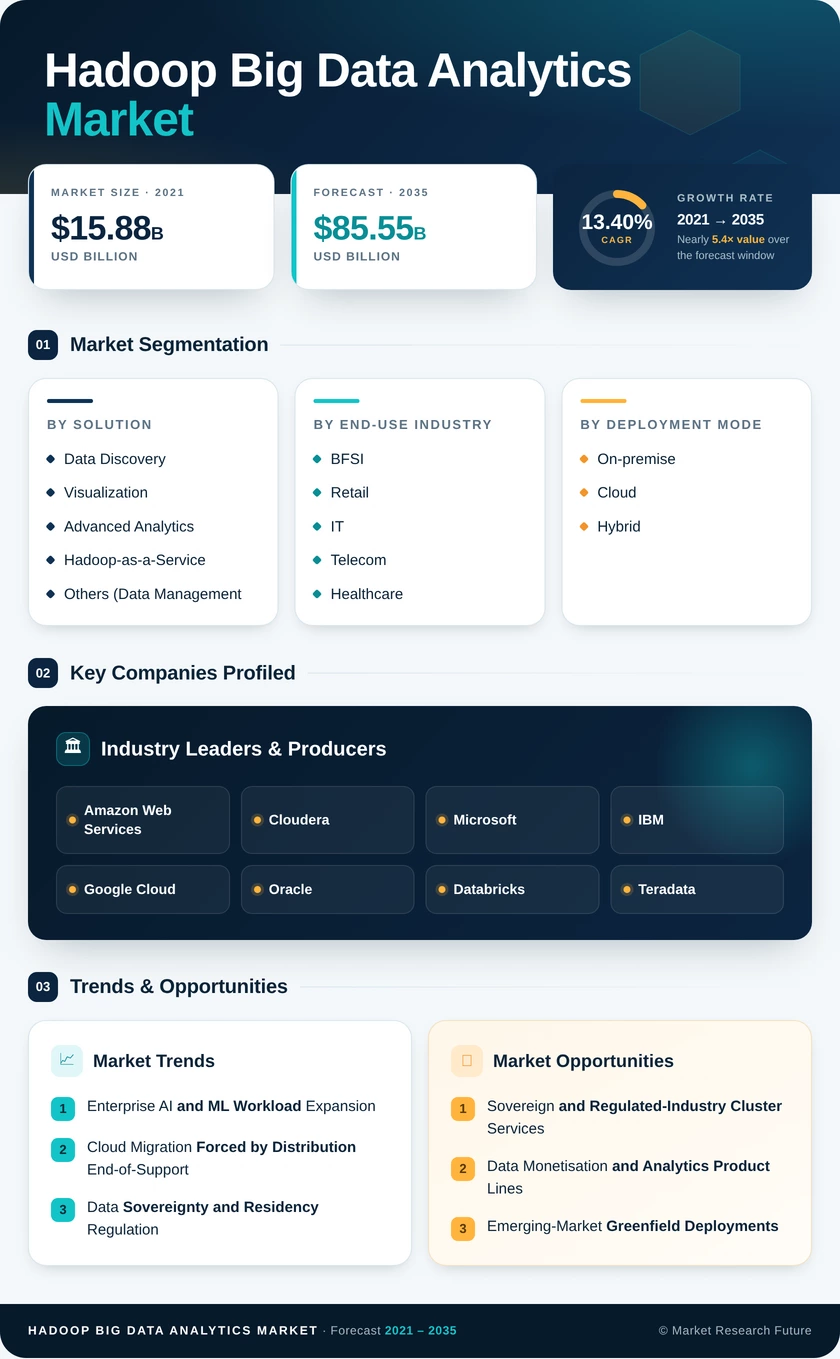
Segmentation Quick Reference
| Dimension | Sub-Segments | Dominant Segment | Fastest Growing Segment |
| By Solution | Data Discovery and Visualization; Advanced Analytics; Hadoop-as-a-Service; Others (Data Management, Performance Management) | Data Discovery and Visualization (39.5% share) | Hadoop-as-a-Service (14.4% CAGR) |
| By End-Use Industry | BFSI; Retail; IT and Telecom; Healthcare and Life Sciences; Others (Manufacturing, Government, Media) | IT and Telecom (25.9% share) | Healthcare and Life Sciences (13.9% CAGR) |
| By Deployment Mode | On-premise; Cloud; Hybrid | On-premise (58.6% share) | Cloud (14.7% CAGR) |
| By Organization Size | Large Enterprises; Small and Medium Enterprises | Large Enterprises (50.2% share) | Small and Medium Enterprises (14.5% CAGR) |
| By Region | North America; Europe; Asia-Pacific; South America; Middle East & Africa | North America (38.4% share) | Asia-Pacific (15.6% CAGR) |
Market Segmentation Overview
By Solution
| Sub-Segment | Key Trend |
| Data Discovery and Visualization | Business-user querying replaces engineering-mediated reporting cycles |
| Advanced Analytics | Feature engineering and model scoring consume growing cluster capacity |
| Hadoop-as-a-Service | Subscription orchestration removes patching and tuning from customer scope |
| Others (Data Management, Performance Management) | Lineage, cataloging and job-optimisation tooling bundled into platform tiers |
Data Discovery and Visualization leads this dimension at 39.5% of 2025 revenue because budget authority has moved to business units that measure value by query accessibility rather than cluster throughput. Hadoop-as-a-Service grows fastest at 14.4% CAGR, converting what was a specialist administration burden into a metered service that mid-market buyers can approve without hiring platform engineers. Advanced Analytics commands the highest revenue intensity per terabyte, but its growth is gated by model-operations maturity rather than by storage availability.
By End-Use Industry
| Sub-Segment | Key Trend |
| BFSI | Regulatory reporting and transaction surveillance make spending non-discretionary |
| Retail | Omnichannel personalisation joins clickstream with inventory and pricing data |
| IT and Telecom | Continuous network telemetry drives the largest retention requirements |
| Healthcare and Life Sciences | Genomics and imaging archives migrate onto distributed storage |
| Others (Manufacturing, Government, Media) | Industrial IoT and open-data mandates broaden the buyer base |
IT and Telecom holds 25.9% share because carrier telemetry arrives continuously and must be retained for capacity planning, fraud scoring, and regulatory obligations alike. Healthcare and Life Sciences expands fastest at 13.9% CAGR as sequencing output and interoperability mandates push petabyte-scale clinical corpora onto governed clusters with encryption controls aligned to HIPAA. BFSI remains the most defensive spender, since supervisory reporting deadlines do not pause during budget compression cycles.
By Deployment Mode
| Sub-Segment | Key Trend |
| On-premise | Residency rules and sunk capital sustain large regulated estates |
| Cloud | End-of-support milestones and native AI service attach accelerate migration |
| Hybrid | Policy-driven spillover keeps edge processing local while bursting to public capacity |
On-premise retains 58.6% of 2025 spending, but that majority reflects installed base inertia and sovereignty constraints rather than architectural preference among new buyers. Cloud grows fastest at 14.7% CAGR because expiring support for legacy distributions forced a decision point that most enterprises resolved in favour of managed runtimes with object-storage integration. Hybrid deployments occupy the regulated middle ground, keeping latency-sensitive processing on local nodes while policy engines route burst workloads outward.
By Organization Size
| Sub-Segment | Key Trend |
| Large Enterprises | Multi-petabyte, multi-jurisdiction estates require premium governance depth |
| Small and Medium Enterprises | Templated provisioning and pay-as-you-grow pricing remove entry barriers |
Large Enterprises account for 50.2% of 2025 revenue because their estates span several regulatory regimes and demand lineage, entitlement, and audit capability that carries a pricing premium. Small and Medium Enterprises grow faster at 14.5% CAGR from a smaller base, since self-service templates now deliver production-grade clusters with governance pre-configured in hours rather than quarters. Vendor training marketplaces attached to those subscriptions close the residual skills gap that historically stalled mid-market adoption.


 Noah Malgeri
Co-Founder

 Peter Groot koerkamp
Account and Business Manager

 Younghwan Choi
Senior Retail Manager

 Mark Irwin
Management Consultant

 Akif Moroglu
Strategy & Business Development Director

 Guilherme Gomes Martins
Product Management Director

 Joseph Aguayo
Sales Operations & Pricing Manager

 La Terria Dodd
Program Support Specialist

 Rob Kooiker
Group Product Manager HVAC & Fire Protection GMA