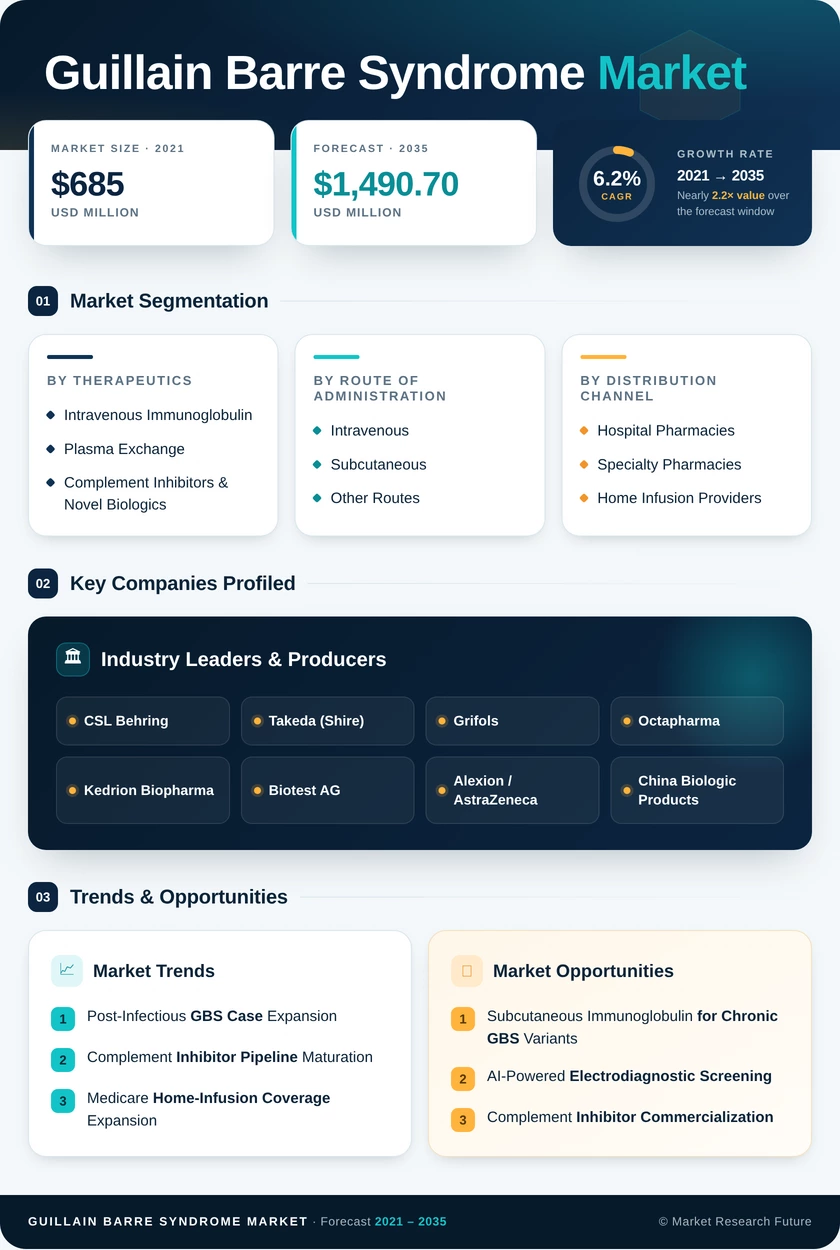
Guillain-Barre Syndrome Market (2025 - 2035)

ID: MRFR/Pharma/4286-HCR
90 Pages
Vikita Thakur
Last Updated: July 24, 2026
Guillain-Barre Syndrome Market Research Report, by Type (AIDP, MFS, AMAN), by Diagnosis (Lumbar Puncture), by Treatment (Plasmapheresis, Medication, Physical Therapy, Hydrotherapy), and by End-User (Hospitals, Diagnostic Centers) - Forecast Till 2035
Guillain-Barre Syndrome Market
Market Size
Forecast Period2025-2035
CAGR (2025-2035)6.2%
2025 Market SizeUSD 820.5 Million
2035 Market SizeUSD 1,490.7 Million
Key Players
CSL Behring
Takeda
Grifols
Octapharma
Kedrion Biopharma
Biotest AG
Opportunities
  • Subcutaneous Immunoglobulin for Chronic GBS Variants
  • AI-Powered Electrodiagnostic Screening
  • Complement Inhibitor Commercialization
  1. 1 Market Overview |
    1. 1.1 Study Assumptions & Market Definition |
    2. 1.2 Scope of the Study |
    3. 1.3 Research Methodology
  2. 2 Market Summary & Key Takeaways
  3. 3 Market Dynamics |
    1. 3.1 Market Drivers Analysis | |
      1. 3.1.1 Post-Infectious GBS Case Expansion | |
      2. 3.1.2 Complement Inhibitor Pipeline Maturation | |
      3. 3.1.3 Medicare/Medicaid Home-Infusion Mandates | |
      4. 3.1.4 Asia-Pacific Plasma Fractionation Investment | |
      5. 3.1.5 AI-Enabled Electrodiagnostic Screening | |
      6. 3.1.6 Subcutaneous Immunoglobulin Formulation Advances | |
      7. 3.1.7 National Rare-Disease Registry Mandates |
    2. 3.2 Market Restraints Analysis | |
      1. 3.2.1 Global Plasma Supply Dependency on US Donors | |
      2. 3.2.2 High Treatment Cost and Reimbursement Gaps | |
      3. 3.2.3 Diagnostic Misclassification and Delayed Referral | |
      4. 3.2.4 Regulatory Fragmentation for Biologic Approvals | |
      5. 3.2.5 Limited Clinical Trial Enrollment for Rare Variants |
    3. 3.3 Market Opportunity Analysis | |
      1. 3.3.1 Subcutaneous Immunoglobulin for Chronic GBS Variants | |
      2. 3.3.2 AI-Powered Electrodiagnostic Screening | |
      3. 3.3.3 Complement Inhibitor Commercialization | |
      4. 3.3.4 Emerging-Market Plasma Infrastructure | |
      5. 3.3.5 Real-World Data Monetization and Registry Analytics |
    4. 3.4 Industry Value Chain Analysis |
    5. 3.5 Porter's Five Forces Analysis
  4. 4 Global Guillain-Barré Syndrome Market Size & Forecast (2021–2035) |
    1. 4.1 Historical Market Size (2021–2025) |
    2. 4.2 Current & Forecast Market Size (2026–2035) |
    3. 4.3 Market Size by Revenue (USD Million) |
    4. 4.4 Year-over-Year Growth Analysis
  5. 5 Segmentation Analysis |
    1. 5.1 By Therapeutics | |
      1. 5.1.1 Intravenous Immunoglobulin | |
      2. 5.1.2 Plasma Exchange | |
      3. 5.1.3 Complement Inhibitors & Novel Biologics |
    2. 5.2 By Route of Administration | |
      1. 5.2.1 Intravenous | |
      2. 5.2.2 Subcutaneous | |
      3. 5.2.3 Other Routes |
    3. 5.3 By Distribution Channel | |
      1. 5.3.1 Hospital Pharmacies | |
      2. 5.3.2 Specialty Pharmacies | |
      3. 5.3.3 Home Infusion Providers |
    4. 5.4 By Patient Age Group | |
      1. 5.4.1 Pediatric (< 18) | |
      2. 5.4.2 Adults (18–64) | |
      3. 5.4.3 Geriatric (≥ 65) |
    5. 5.5 By Disease Variant | |
      1. 5.5.1 Acute Inflammatory Demyelinating Polyneuropathy (AIDP) | |
      2. 5.5.2 Acute Motor Axonal Neuropathy (AMAN) | |
      3. 5.5.3 Miller Fisher Syndrome & Other Variants
  6. 6 Regional Analysis |
    1. 6.1 North America | |
      1. 6.1.1 United States | |
      2. 6.1.2 Canada | |
      3. 6.1.3 Mexico |
    2. 6.2 Europe | |
      1. 6.2.1 Germany | |
      2. 6.2.2 United Kingdom | |
      3. 6.2.3 France | |
      4. 6.2.4 Italy | |
      5. 6.2.5 Spain | |
      6. 6.2.6 Nordic Countries | |
      7. 6.2.7 Russia | |
      8. 6.2.8 Rest of Europe |
    3. 6.3 Asia-Pacific | |
      1. 6.3.1 China | |
      2. 6.3.2 India | |
      3. 6.3.3 Japan | |
      4. 6.3.4 South Korea | |
      5. 6.3.5 ASEAN | |
      6. 6.3.6 Rest of Asia-Pacific |
    4. 6.4 South America | |
      1. 6.4.1 Brazil | |
      2. 6.4.2 Argentina | |
      3. 6.4.3 Rest of South America |
    5. 6.5 Middle East & Africa | |
      1. 6.5.1 Saudi Arabia | |
      2. 6.5.2 UAE | |
      3. 6.5.3 South Africa | |
      4. 6.5.4 Egypt | |
      5. 6.5.5 Rest of MEA
  7. 7 Competitive Landscape |
    1. 7.1 Market Share Analysis (2025) |
    2. 7.2 Competitive Benchmarking Matrix |
    3. 7.3 Company Profiles | |
      1. 7.3.1 CSL Behring | |
      2. 7.3.2 Takeda (Shire) | |
      3. 7.3.3 Grifols | |
      4. 7.3.4 Octapharma | |
      5. 7.3.5 Kedrion Biopharma | |
      6. 7.3.6 Biotest AG | |
      7. 7.3.7 Alexion / AstraZeneca | |
      8. 7.3.8 China Biologic Products | |
      9. 7.3.9 Fresenius Kabi | |
      10. 7.3.10 Terumo BCT
  8. 8 Future Outlook & Strategic Recommendations (2026–2035) |
    1. 8.1 Near-Term Outlook (2026–2028) |
    2. 8.2 Medium-Term Outlook (2029–2031) |
    3. 8.3 Long-Term Outlook (2032–2035)
  9. 9 Recent Developments & News
  10. 10 Frequently Asked Questions (FAQs)
  11. 11 Report Scope & Methodology |
    1. 11.1 Study Period & Base Year |
    2. 11.2 Data Sources & Citations |
    3. 11.3 Abbreviations
  12. 1 LIST OF TABLES |
  13. TABLE 1 Global Guillain-Barré Syndrome Market Size & Forecast, by Revenue (USD Million), 2021–2035 |
  14. TABLE 2 Global Guillain-Barré Syndrome Market – Year-over-Year Growth Analysis, 2021–2035 |
  15. TABLE 3 Global Guillain-Barré Syndrome Market – Driver Impact Analysis |
  16. TABLE 4 Global Guillain-Barré Syndrome Market – Restraint Impact Analysis |
  17. TABLE 5 Global Guillain-Barré Syndrome Market Size, by Therapeutics, 2021–2035 (USD Million) |
  18. TABLE 6 Global Guillain-Barré Syndrome Market Size, by Route of Administration, 2021–2035 (USD Million) |
  19. TABLE 7 Global Guillain-Barré Syndrome Market Size, by Distribution Channel, 2021–2035 (USD Million) |
  20. TABLE 8 Global Guillain-Barré Syndrome Market Size, by Patient Age Group, 2021–2035 (USD Million) |
  21. TABLE 9 Global Guillain-Barré Syndrome Market Size, by Disease Variant, 2021–2035 (USD Million) |
  22. TABLE 10 Global Guillain-Barré Syndrome Market Size, by Region, 2021–2035 (USD Million) |
  23. TABLE 11 North America Guillain-Barré Syndrome Market Size, by Country, 2021–2035 (USD Million) |
  24. TABLE 12 Europe Guillain-Barré Syndrome Market Size, by Country, 2021–2035 (USD Million) |
  25. TABLE 13 Asia-Pacific Guillain-Barré Syndrome Market Size, by Country, 2021–2035 (USD Million) |
  26. TABLE 14 South America Guillain-Barré Syndrome Market Size, by Country, 2021–2035 (USD Million) |
  27. TABLE 15 Middle East & Africa Guillain-Barré Syndrome Market Size, by Country, 2021–2035 (USD Million) |
  28. TABLE 16 Competitive Benchmarking Matrix – Global Guillain-Barré Syndrome Market, 2025 |
  29. TABLE 17 Company Profiles – Key Players, Global Guillain-Barré Syndrome Market |
  30. TABLE 18 Recent Developments & Strategic Announcements, 2023–2025 |
  31. TABLE 19 Report Scope & Methodology Summary |
  32. TABLE 20 Detailed Sources and Citations
  33. 2 LIST OF FIGURES |
  34. FIGURE 1 Guillain-Barré Syndrome Market Dynamics — Drivers, Restraints, and Opportunities |
  35. FIGURE 2 Industry Value Chain Analysis — Guillain-Barré Syndrome Market |
  36. FIGURE 3 Porter's Five Forces Analysis — Guillain-Barré Syndrome Market |
  37. FIGURE 4 Global Guillain-Barré Syndrome Market Size Trend (USD Million), 2021–2035 |
  38. FIGURE 5 Guillain-Barré Syndrome Market Share, by Therapeutics (2025) |
  39. FIGURE 6 Guillain-Barré Syndrome Market Share, by Route of Administration (2025) |
  40. FIGURE 7 Guillain-Barré Syndrome Market Share, by Distribution Channel (2025) |
  41. FIGURE 8 Guillain-Barré Syndrome Market Share, by Patient Age Group (2025) |
  42. FIGURE 9 Guillain-Barré Syndrome Market Share, by Disease Variant (2025) |
  43. FIGURE 10 Guillain-Barré Syndrome Market Share, by Region (2025) |
  44. FIGURE 11 North America Guillain-Barré Syndrome Market Size (USD Million), 2021–2035 |
  45. FIGURE 12 Europe Guillain-Barré Syndrome Market Size (USD Million), 2021–2035 |
  46. FIGURE 13 Asia-Pacific Guillain-Barré Syndrome Market Size (USD Million), 2021–2035 |
  47. FIGURE 14 South America Guillain-Barré Syndrome Market Size (USD Million), 2021–2035 |
  48. FIGURE 15 Middle East & Africa Guillain-Barré Syndrome Market Size (USD Million), 2021–2035 |
  49. FIGURE 16 Competitive Landscape — Market Share of Top 10 Players (2025)

Segmentation Quick Reference

DimensionSub-SegmentsDominant SegmentFastest Growing Segment
By TherapeuticsIntravenous Immunoglobulin, Plasma Exchange, Complement Inhibitors & Novel BiologicsIntravenous ImmunoglobulinComplement Inhibitors & Novel Biologics
By Route of AdministrationIntravenous, Subcutaneous, Other RoutesIntravenousSubcutaneous
By Distribution ChannelHospital Pharmacies, Specialty Pharmacies, Home Infusion ProvidersHospital PharmaciesHome Infusion Providers
By Patient Age GroupPediatric (< 18), Adults (18–64), Geriatric (≥ 65)Adults (18–64)Geriatric (≥ 65)
By Disease VariantAIDP, AMAN, Miller Fisher Syndrome & Other VariantsAIDPAMAN
By GeographyNorth America, Europe, Asia-Pacific, South America, Middle East & AfricaNorth AmericaAsia-Pacific


Market Segmentation Overview

By Therapeutics

Sub-SegmentKey Trend
Intravenous ImmunoglobulinContinued guideline dominance; biosimilar entries expected post-2030
Plasma ExchangeStable utilization in refractory cases; equipment modernization underway
Complement Inhibitors & Novel BiologicsFastest-growing tier; multiple Phase III readouts anticipated 2027–2029


Intravenous immunoglobulin remains the cornerstone therapeutic, supported by decades of clinical evidence and entrenched guideline positioning. Complement inhibitors are poised to reshape treatment paradigms as disease-specific agents move toward regulatory approval, offering the potential for improved long-term disability outcomes relative to current broad-spectrum immunomodulatory approaches.

By Route of Administration

Sub-SegmentKey Trend
IntravenousDominant in acute GBS treatment; high-dose rapid infusion protocols
SubcutaneousGrowing in maintenance and chronic GBS-spectrum conditions
Other RoutesInvestigational oral complement inhibitors in early-stage development


The acute clinical presentation of GBS necessitates rapid-onset intravenous delivery for initial treatment. Subcutaneous routes are gaining adoption for maintenance immunoglobulin therapy, enabling patient self-administration and reducing the burden on hospital infusion capacity.

By Distribution Channel

Sub-SegmentKey Trend
Hospital PharmaciesPrimary channel for acute GBS episodes; integrated with neurology wards
Specialty PharmaciesGrowing role in biologic dispensing and patient support programs
Home Infusion ProvidersFastest-growing channel; driven by payer site-of-care optimization


Hospital pharmacies handle the majority of acute GBS treatment dispensing due to the inpatient nature of initial care. Home infusion is the structural growth story, supported by Medicare mandates in the US and patient preference for outpatient recovery settings.

By Patient Age Group

Sub-SegmentKey Trend
Pediatric (< 18)Weight-adjusted dosing; long-term rehabilitation focus
Adults (18–64)Largest patient pool; occupational recovery drives treatment urgency
Geriatric (≥ 65)Fastest-growing segment; higher complication rates and longer hospital stays


Adults form the largest treatment cohort, while the geriatric segment is expanding rapidly as aging populations in developed markets face elevated GBS incidence and severity, necessitating more intensive immunomodulatory intervention.

By Disease Variant

Sub-SegmentKey Trend
AIDPPredominant Western variant; demyelinating pathology well-characterized
AMANFastest-growing; prevalent in Asia and Latin America, linked to Campylobacter
Miller Fisher Syndrome & Other VariantsImproved diagnostic differentiation expanding identified cases


AIDP accounts for the majority of GBS diagnoses globally and is the variant most extensively studied in clinical trials. AMAN prevalence is increasing alongside rising Campylobacter infection rates in Asia-Pacific and Latin America, driving demand for variant-specific treatment protocols and targeted biologic development.


Download PDF ×

We do not share your information with anyone. However, we may send you emails based on your report interest from time to time. You may contact us at any time to opt-out.