Request Free Sample ×

Kindly complete the form below to receive a free sample of this Report

* Please use a valid business email

Leading companies partner with us for data-driven Insights

clients tt-cursor
Hero Background
English
Chinese
French
Japanese
Korean
German
Spanish

Gold Bonding Wire for Semiconductor Packaging Market Trends

ID: MRFR/SEM/11103-HCR
128 Pages
Ankit Gupta
Last Updated: April 06, 2026

Gold Bonding Wire for Semiconductor Packaging Market Size, Share and Research Report: By Types (Ball Gold Bonding Wires and Stud Bumping Bonding Wires), By Application (Discrete Device, Integrated Circuit, and Others), And By Region (North America, Europe, Asia-Pacific, And Rest Of The World) –Industry Forecast Till 2035

Share:
Download PDF ×

We do not share your information with anyone. However, we may send you emails based on your report interest from time to time. You may contact us at any time to opt-out.

Gold Bonding Wire for Semiconductor Packaging Market Infographic
Purchase Options

Market Trends

Key Emerging Trends in the Gold Bonding Wire for Semiconductor Packaging Market

Market trends in the Gold Bonding Wire for Semiconductor Packaging Market reflect the evolving landscape of the semiconductor industry and consumer electronics. One prominent trend is the increasing demand for miniaturization in electronic devices. As consumers seek smaller and more compact gadgets, semiconductor manufacturers are under pressure to develop advanced packaging solutions. Gold bonding wire, with its excellent conductivity and reliability, is witnessing heightened adoption as a crucial component in the miniaturization trend. This trend aligns with the industry's pursuit of smaller and more efficient semiconductor packages for applications such as smartphones, wearables, and IoT devices.

The rise of 5G technology is another significant trend influencing the market for gold bonding wire. As 5G networks become more prevalent globally, there is a growing need for semiconductor packages that can support higher data transfer rates and increased connectivity. Gold bonding wire, known for its superior conductivity, is well-suited for high-frequency applications, making it a preferred choice for 5G-enabled devices. The deployment of 5G technology is driving innovation in semiconductor packaging, further boosting the demand for gold bonding wire in the market.

Environmental sustainability is emerging as a key trend in the semiconductor industry, and this is impacting the market for gold bonding wire. Manufacturers are increasingly focusing on eco-friendly practices, and gold, being a recyclable material, fits well into this sustainability trend. Companies are actively promoting the recyclability of gold bonding wire as part of their commitment to environmental responsibility. This trend reflects a broader industry shift towards green manufacturing practices and aligns with the growing preferences of consumers and businesses for sustainable electronic components.

The automotive industry's rapid transition towards electric vehicles (EVs) and autonomous driving technologies is influencing the market trends for gold bonding wire in semiconductor packaging. EVs rely heavily on sophisticated semiconductor components, and the demand for reliable and high-performance bonding wire is on the rise. Gold bonding wire's durability and conductivity make it well-suited for the demanding automotive environment. As automotive electronics become more complex, the trend towards EVs and advanced driver-assistance systems (ADAS) is expected to drive substantial growth in the market for gold bonding wire.

The market is also witnessing a trend towards advanced packaging technologies to meet the requirements of emerging applications. Flip-chip packaging, system-in-package (SiP), and wafer-level packaging are gaining traction, driven by the need for enhanced performance and miniaturization. Gold bonding wire, with its ability to meet the challenges posed by advanced packaging technologies, is becoming an integral part of these trends. Manufacturers are investing in research and development to create gold bonding wire solutions that cater to the specific requirements of these advanced packaging technologies.

Additionally, the market is experiencing a shift in focus towards Asia-Pacific as a key region for semiconductor manufacturing. Countries like China, Taiwan, and South Korea are playing a significant role in the global semiconductor supply chain. This regional shift is impacting the market trends for gold bonding wire, as manufacturers look to establish a strong presence in the Asia-Pacific region to capitalize on the growing semiconductor industry in these countries.

Author
Author Profile
Ankit Gupta
Team Lead - Research

Ankit Gupta is a seasoned market intelligence and strategic research professional with over six plus years of experience in the ICT and Semiconductor industries. With academic roots in Telecom, Marketing, and Electronics, he blends technical insight with business strategy. Ankit has led 200+ projects, including work for Fortune 500 clients like Microsoft and Rio Tinto, covering market sizing, tech forecasting, and go-to-market strategies. Known for bridging engineering and enterprise decision-making, his insights support growth, innovation, and investment planning across diverse technology markets.

Leave a Comment

FAQs

What is the current market valuation of Gold Bonding Wire for Semiconductor Packaging?

<p>The market valuation was 2.82 USD Billion in 2024.</p>

What is the projected market size for Gold Bonding Wire by 2035?

<p>The projected valuation for 2035 is 5.465 USD Billion.</p>

What is the expected CAGR for the Gold Bonding Wire market during 2025 - 2035?

<p>The expected CAGR during this period is 6.2%.</p>

Which companies are considered key players in the Gold Bonding Wire market?

<p>Key players include Amkor Technology, ASE Technology Holding Co, and STMicroelectronics.</p>

What are the main types of Gold Bonding Wires available in the market?

<p>The main types include Ball Gold Bonding Wires and Stud Bumping Bonding Wires.</p>

What was the market size for Ball Gold Bonding Wires in 2024?

<p>The market size for Ball Gold Bonding Wires was 1.4 USD Billion in 2024.</p>

What is the projected market size for Integrated Circuits using Gold Bonding Wire by 2035?

<p>The projected market size for Integrated Circuits is 3.0 USD Billion by 2035.</p>

How did the market for Stud Bumping Bonding Wires perform in 2024?

<p>The market for Stud Bumping Bonding Wires was valued at 1.42 USD Billion in 2024.</p>

What applications are driving the demand for Gold Bonding Wire?

<p>Demand is driven by applications in Discrete Devices, Integrated Circuits, and others.</p>

What is the expected growth trend for the Gold Bonding Wire market in the coming years?

<p>The market is expected to grow steadily, reaching 5.465 USD Billion by 2035.</p>

Market Summary

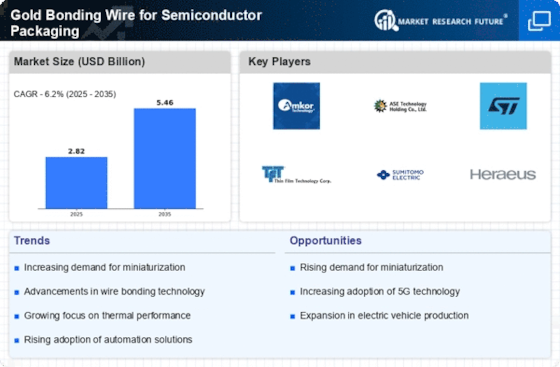
As per Market Research Future analysis, the Gold Bonding Wire for Semiconductor Packaging Market Size was estimated at 2.82 USD Billion in 2024. The Gold Bonding Wire industry is projected to grow from 2.994 USD Billion in 2025 to 5.465 USD Billion by 2035, exhibiting a compound annual growth rate (CAGR) of 6% during the forecast period 2025 - 2035

Key Market Trends & Highlights

The market for Gold Bonding Wire in Semiconductor Packaging is poised for growth driven by technological advancements and sustainability initiatives.

  • Technological advancements are enhancing the performance and efficiency of gold bonding wires, particularly in North America, the largest market. Sustainability initiatives are increasingly influencing production processes, with manufacturers focusing on eco-friendly materials and practices in the Asia-Pacific region. The demand for miniaturization is propelling the growth of stud bumping bonding wires, which are gaining traction in the fastest-growing segment. Rising demand for high-performance electronics and emerging markets are key drivers, particularly impacting the integrated circuit segment, which remains the largest.

Market Size & Forecast

2024 Market Size 2.82 (USD Billion)
2035 Market Size 5.465 (USD Billion)
CAGR (2025 - 2035) 6.2%
Largest Regional Market Share in 2024 North America

Major Players

Amkor Technology (US), ASE Technology Holding Co (TW), STMicroelectronics (FR), Nippon Thin Film Technology Co (JP), Sumitomo Electric Industries (JP), Heraeus Holding (DE), K&amp;S (DE), Mitsubishi Materials Corporation (JP), Dai-ichi Seiko Co (JP)

Market Trends

The market for The market for Gold Bonding Wire for Semiconductor Packaging Market is evolving, driven by advancements in technology and increasing demand for high-performance electronic devices. As the semiconductor industry continues to expand, the need for reliable and efficient interconnect solutions becomes paramount. Gold bonding wire, known for its excellent conductivity and mechanical properties, plays a crucial role in ensuring the performance and longevity of semiconductor packages. This sector appears to be influenced by various factors, including the miniaturization of electronic components and the growing trend towards automation in manufacturing processes. Moreover, the ongoing shift towards renewable energy sources and electric vehicles is likely to further propel the demand for Gold Bonding Wire for Semiconductor Packaging Market. As these technologies require sophisticated semiconductor solutions, the market is poised for growth. The increasing complexity of semiconductor designs necessitates innovative bonding materials that can meet stringent performance criteria. Consequently, manufacturers are focusing on enhancing the quality and reliability of gold bonding wires, which may lead to new product developments and improved production techniques. Overall, the landscape of Gold Bonding Wire for Semiconductor Packaging Market is characterized by rapid advancements and a strong emphasis on quality and performance.

Technological Advancements

The continuous evolution of technology in the semiconductor industry is driving the development of advanced gold bonding wires. Innovations in materials and manufacturing processes are enhancing the performance characteristics of these wires, making them more suitable for high-frequency applications.

Sustainability Initiatives

There is a growing emphasis on sustainability within the semiconductor sector, prompting manufacturers to explore eco-friendly alternatives and practices. This trend may lead to the development of gold bonding wires that not only meet performance standards but also align with environmental goals.

Increased Demand for Miniaturization

As electronic devices become smaller and more compact, the demand for gold bonding wires that can accommodate these changes is rising. This trend indicates a shift towards finer wire diameters and improved bonding techniques to ensure reliability in densely packed semiconductor packages.

Gold Bonding Wire for Semiconductor Packaging Market Market Drivers

Emerging Markets and Economic Growth

Emerging markets are experiencing rapid economic growth, which appears to be a driving force for the Gold Bonding Wire for Semiconductor Packaging Industry. Countries in Asia, Latin America, and Africa are witnessing increased investments in technology and infrastructure, leading to a heightened demand for semiconductor devices. As these regions expand their technological capabilities, the need for reliable semiconductor packaging solutions, including gold bonding wires, is expected to rise. The semiconductor industry in these markets is projected to grow at a rate of approximately 8% annually, suggesting a robust opportunity for gold bonding wire manufacturers to capitalize on this expanding demand.

Increased Demand for Miniaturization

The trend towards miniaturization in electronic devices is a significant factor impacting the Gold Bonding Wire for Semiconductor Packaging Industry. As consumer electronics, automotive applications, and medical devices become smaller and more compact, the need for efficient and reliable interconnect solutions intensifies. Gold bonding wires, known for their excellent conductivity and mechanical properties, are well-suited for these applications. The market for miniaturized electronic components is expected to grow substantially, with estimates suggesting a compound annual growth rate of over 10% in the coming years. This growth is likely to drive the demand for gold bonding wires, as manufacturers seek to optimize performance in increasingly constrained spaces.

Sustainability Initiatives in Electronics

Sustainability initiatives are gaining traction within the electronics sector, influencing the Gold Bonding Wire for Semiconductor Packaging Industry. Manufacturers are increasingly focusing on environmentally friendly practices, which may include the responsible sourcing of materials and the reduction of waste. The push for sustainable electronics is likely to drive innovation in bonding wire technologies, potentially leading to the development of alternative materials that maintain performance while minimizing environmental impact. As companies strive to meet regulatory requirements and consumer expectations, the demand for sustainable gold bonding wires may rise, reflecting a broader trend towards eco-conscious manufacturing.

Rising Demand for High-Performance Electronics

The escalating demand for high-performance electronics is poised to significantly influence the Gold Bonding Wire for Semiconductor Packaging Industry. As industries such as telecommunications, automotive, and consumer electronics evolve, the need for advanced semiconductor solutions becomes paramount. High-performance applications often require superior interconnect materials, with gold bonding wires being a preferred choice due to their reliability and efficiency. The semiconductor market is anticipated to witness a surge in demand for high-performance devices, potentially exceeding 700 billion USD by 2026. This trend is likely to bolster the market for gold bonding wires, as manufacturers prioritize quality and performance in their packaging solutions.

Technological Advancements in Semiconductor Packaging

The rapid evolution of semiconductor technology appears to be a primary driver for the Gold Bonding Wire for Semiconductor Packaging Industry. Innovations in chip design and manufacturing processes necessitate the use of advanced materials, including high-quality gold bonding wires. As semiconductor devices become increasingly complex, the demand for reliable interconnections grows. In 2025, the semiconductor market is projected to reach a valuation of approximately 600 billion USD, indicating a robust growth trajectory. This surge is likely to propel the demand for gold bonding wires, which are essential for ensuring optimal performance and reliability in semiconductor packaging.

Market Segment Insights

By Type: Ball Gold Bonding Wires (Largest) vs. Stud Bumping Bonding Wires (Fastest-Growing)

The Gold Bonding Wire for Semiconductor Packaging Market is predominantly characterized by the substantial share of ball gold bonding wires, which are favored for their versatility and efficiency in wire bonding processes. This segment dominates the market owing to its established technology and wide acceptance among manufacturers. Conversely, stud bumping bonding wires are gaining traction and are recognized for their suitability in advanced packaging applications, offering innovations that cater to the growing demand for improved performance and reliability.

Bonding Wire Type: Ball Gold (Dominant) vs. Stud Bumping (Emerging)

Ball gold bonding wires are the backbone of semiconductor packaging, providing a reliable and effective solution for interconnecting semiconductor chips and substrates. Their dominance is attributed to their robust characteristics, which include excellent electrical conductivity and mechanical strength. These wires are widely used across various industries, ensuring high yield rates and lower production costs. In contrast, stud bumping bonding wires are emerging as a formidable alternative, particularly in the realm of advanced semiconductor packaging. They offer enhanced performance in multilayer chip designs and high-density interconnections, making them increasingly popular among manufacturers seeking innovative packaging solutions to stay competitive in a rapidly evolving market.

By Application: Integrated Circuit (Largest) vs. Discrete Device (Fastest-Growing)

<p>In the Gold Bonding Wire for Semiconductor Packaging market, the application segment is primarily dominated by Integrated Circuits, which command the largest share due to their extensive use in various electronic devices. With a significant reliance on sophisticated ICs for modern applications, this segment has established a robust presence. Meanwhile, Discrete Devices are gaining traction, although they currently hold a smaller market share compared to ICs. This shift indicates a diversification in semiconductor applications that is slowly gaining ground.</p>

<p>Application: Integrated Circuit (Dominant) vs. Discrete Device (Emerging)</p>

<p>Integrated Circuits represent the dominant force in the Gold Bonding Wire application segment, as their intricate design and high functionality are essential for cutting-edge technology in consumer electronics, automotive systems, and industrial automation. These circuits require reliable bonding solutions to ensure optimal performance, driving the demand for advanced bonding wires. On the other hand, Discrete Devices are emerging rapidly, propelled by the growing need for simple and specific applications in various sectors, including power electronics and sensors. Their simpler architecture allows for cost-effective semiconductor solutions and a faster flipping response, making them increasingly appealing to manufacturers.</p>

Get more detailed insights about Gold Bonding Wire for Semiconductor Packaging Market Research Report—Global Forecast till 2035

Regional Insights

North America : Innovation and Demand Surge

North America is witnessing robust growth in the gold bonding wire market, driven by increasing demand for advanced semiconductor packaging technologies. The region holds approximately 40% of the global market share, making it the largest market. Key drivers include significant investments in R&D and a strong focus on innovation, particularly in the automotive and consumer electronics sectors. Regulatory support for semiconductor manufacturing further catalyzes this growth. The United States leads the market, with major players like Amkor Technology and STMicroelectronics driving competition. The presence of established semiconductor firms and a thriving tech ecosystem enhances the competitive landscape. Additionally, the region benefits from a skilled workforce and advanced manufacturing capabilities, positioning it as a leader in semiconductor packaging solutions.

Europe : Regulatory Support and Innovation

Europe is emerging as a significant player in the gold bonding wire market, holding around 25% of the global share, making it the second-largest market. The region's growth is fueled by stringent regulations promoting sustainable manufacturing practices and a push for technological advancements in semiconductor packaging. Initiatives like the European Chips Act aim to bolster local production and reduce dependency on external suppliers, enhancing market dynamics. Leading countries include Germany, France, and the Netherlands, with key players such as Heraeus Holding and STMicroelectronics. The competitive landscape is characterized by a mix of established firms and innovative startups, fostering collaboration and technological advancements. The region's focus on sustainability and innovation positions it well for future growth in semiconductor packaging solutions.

Asia-Pacific : Manufacturing Powerhouse

Asia-Pacific is a manufacturing powerhouse in the gold bonding wire market, accounting for approximately 30% of the global market share. The region's growth is driven by the rapid expansion of semiconductor manufacturing facilities, particularly in countries like Taiwan, Japan, and South Korea. The increasing demand for consumer electronics and automotive applications further propels market growth, supported by favorable government policies and investments in technology. Taiwan and Japan are the leading countries in this region, with major players like ASE Technology Holding and Sumitomo Electric Industries. The competitive landscape is intense, with numerous local and international firms vying for market share. The region's strong supply chain and technological expertise in semiconductor packaging make it a critical player in the global market.

Middle East and Africa : Emerging Market Potential

The Middle East and Africa region is gradually emerging in the gold bonding wire market, holding about 5% of the global share. The growth is primarily driven by increasing investments in technology and infrastructure, as well as a rising demand for electronics and automotive applications. Governments in the region are implementing policies to attract foreign investment, which is expected to enhance the semiconductor landscape significantly. Countries like South Africa and the UAE are leading the charge, with a growing number of local firms entering the semiconductor packaging space. The competitive landscape is still developing, but the presence of international players is beginning to shape the market. As the region continues to invest in technology and innovation, it is poised for substantial growth in the coming years.

Key Players and Competitive Insights

Leading market players invest heavily in research and development to advance and innovate Gold Bonding Wire for Semiconductor Packaging Market technologies and techniques. Market participants are also undertaking various strategic activities to expand their global footprint, with important market developments including new product launches, clinical integration, customer support and service contracts, contractual agreements, mergers and acquisitions, higher investments, and collaboration with other organizations. To expand and survive in a more competitive and rising market climate, the Gold Bonding Wire for Semiconductor Packaging industry must offer customized solutions.Companies are forming partnerships with academic and research institutions to gain access to their expertise and share resources for joint research projects in the global Gold Bonding Wire for Semiconductor Packaging industry to develop novel applications and technologies. In recent years, the Gold Bonding Wire for Semiconductor Packaging industry has offered some of the most significant advantages to consumers.Major players in the Gold Bonding Wire for Semiconductor Packaging Market, including Heraeus, Tanaka, NIPPON STEEL Chemical & Material, Tatsuta, MK Electron, Yantai Yesdo, Ningbo Kangqiang Electronics, Beijing Dabo Nonferrous Metal, Yantai Zhaojin Confort, Shanghai Wonsung Alloy Material, MATFRON, Niche-Tech Semiconductor Materials, and others, are attempting to increase market demand by investing in product development to increase their product line and cater to diverse consumer needs.NIPPON STEEL Chemical & Material is a subsidiary of Nippon Steel Corporation, one of the world's largest and most prominent steel producers. This affiliation provides the company with strong financial backing and access to extensive resources. The company's product portfolio encompasses a wide variety of materials, including specialty steels, functional materials, advanced chemicals, and electronics materials. These materials find applications across industries such as automotive, electronics, energy, and more.Heraeus, founded in 1851 and headquartered in Hanau, Germany, is a globally renowned technology group specializing in precious metals, materials, and technologies. The company operates across various sectors, including precious metals, medical technology, quartz glass, sensors, and specialty light sources. With a strong focus on innovation, Heraeus is known for its cutting-edge solutions and materials in a wide range of industries. It has a diverse portfolio that includes products and services in areas such as semiconductor materials, photovoltaics, automotive components, medical devices, and various industrial applications.The company is a leader in the development and manufacturing of advanced materials, including precious and non-precious metals, alloys, and materials for electronics, healthcare, and energy sectors.

Key Companies in the Gold Bonding Wire for Semiconductor Packaging Market include

Industry Developments

November 2022: Samsung announced that it is developing a new aluminum oxide (Al2O3) coating bonding wire technology with beefed-up reliability and insulation compared to previous bonding wires with its key partners for automotive chips. Many of them in the past have been formed with gold (Au) as they are conductive and flexible.

July 2022: Sahasra Semiconductors announced that it is start semiconductor assembly and testing in India.

Future Outlook

Gold Bonding Wire for Semiconductor Packaging Market Future Outlook

The Gold Bonding Wire market is projected to grow at a 6.2% CAGR from 2025 to 2035, driven by advancements in semiconductor technology and increasing demand for miniaturization.

New opportunities lie in:

  • Development of high-performance gold alloys for enhanced conductivity</p><p>Expansion into emerging markets with tailored product offerings</p><p>Investment in automated bonding equipment to improve production efficiency

By 2035, the market is expected to solidify its position as a leader in semiconductor packaging solutions.

Market Segmentation

Gold Bonding Wire for Semiconductor Packaging Market Type Outlook

  • Ball Gold Bonding Wires
  • Stud Bumping Bonding Wires

Gold Bonding Wire for Semiconductor Packaging Market Application Outlook

  • Discrete Device
  • Integrated Circuit
  • Others

Report Scope

MARKET SIZE 2024 2.82(USD Billion)
MARKET SIZE 2025 2.994(USD Billion)
MARKET SIZE 2035 5.465(USD Billion)
COMPOUND ANNUAL GROWTH RATE (CAGR) 6.2% (2025 - 2035)
REPORT COVERAGE Revenue Forecast, Competitive Landscape, Growth Factors, and Trends
BASE YEAR 2024
Market Forecast Period 2025 - 2035
Historical Data 2019 - 2024
Market Forecast Units USD Billion
Key Companies Profiled Amkor Technology (US), ASE Technology Holding Co (TW), STMicroelectronics (FR), Nippon Thin Film Technology Co (JP), Sumitomo Electric Industries (JP), Heraeus Holding (DE), K&S (DE), Mitsubishi Materials Corporation (JP), Dai-ichi Seiko Co (JP)
Segments Covered Types, Application, Region
Key Market Opportunities Advancements in semiconductor technology drive demand for high-performance Gold Bonding Wire for Semiconductor Packaging.
Key Market Dynamics Rising demand for advanced semiconductor packaging drives innovation in gold bonding wire technology and supply chain optimization.
Countries Covered North America, Europe, APAC, South America, MEA

FAQs

What is the current market valuation of Gold Bonding Wire for Semiconductor Packaging?

<p>The market valuation was 2.82 USD Billion in 2024.</p>

What is the projected market size for Gold Bonding Wire by 2035?

<p>The projected valuation for 2035 is 5.465 USD Billion.</p>

What is the expected CAGR for the Gold Bonding Wire market during 2025 - 2035?

<p>The expected CAGR during this period is 6.2%.</p>

Which companies are considered key players in the Gold Bonding Wire market?

<p>Key players include Amkor Technology, ASE Technology Holding Co, and STMicroelectronics.</p>

What are the main types of Gold Bonding Wires available in the market?

<p>The main types include Ball Gold Bonding Wires and Stud Bumping Bonding Wires.</p>

What was the market size for Ball Gold Bonding Wires in 2024?

<p>The market size for Ball Gold Bonding Wires was 1.4 USD Billion in 2024.</p>

What is the projected market size for Integrated Circuits using Gold Bonding Wire by 2035?

<p>The projected market size for Integrated Circuits is 3.0 USD Billion by 2035.</p>

How did the market for Stud Bumping Bonding Wires perform in 2024?

<p>The market for Stud Bumping Bonding Wires was valued at 1.42 USD Billion in 2024.</p>

What applications are driving the demand for Gold Bonding Wire?

<p>Demand is driven by applications in Discrete Devices, Integrated Circuits, and others.</p>

What is the expected growth trend for the Gold Bonding Wire market in the coming years?

<p>The market is expected to grow steadily, reaching 5.465 USD Billion by 2035.</p>

  1. SECTION I: EXECUTIVE SUMMARY AND KEY HIGHLIGHTS
    1. | 1.1 EXECUTIVE SUMMARY
    2. | | 1.1.1 Market Overview
    3. | | 1.1.2 Key Findings
    4. | | 1.1.3 Market Segmentation
    5. | | 1.1.4 Competitive Landscape
    6. | | 1.1.5 Challenges and Opportunities
    7. | | 1.1.6 Future Outlook
  2. SECTION II: SCOPING, METHODOLOGY AND MARKET STRUCTURE
    1. | 2.1 MARKET INTRODUCTION
    2. | | 2.1.1 Definition
    3. | | 2.1.2 Scope of the study
    4. | | | 2.1.2.1 Research Objective
    5. | | | 2.1.2.2 Assumption
    6. | | | 2.1.2.3 Limitations
    7. | 2.2 RESEARCH METHODOLOGY
    8. | | 2.2.1 Overview
    9. | | 2.2.2 Data Mining
    10. | | 2.2.3 Secondary Research
    11. | | 2.2.4 Primary Research
    12. | | | 2.2.4.1 Primary Interviews and Information Gathering Process
    13. | | | 2.2.4.2 Breakdown of Primary Respondents
    14. | | 2.2.5 Forecasting Model
    15. | | 2.2.6 Market Size Estimation
    16. | | | 2.2.6.1 Bottom-Up Approach
    17. | | | 2.2.6.2 Top-Down Approach
    18. | | 2.2.7 Data Triangulation
    19. | | 2.2.8 Validation
  3. SECTION III: QUALITATIVE ANALYSIS
    1. | 3.1 MARKET DYNAMICS
    2. | | 3.1.1 Overview
    3. | | 3.1.2 Drivers
    4. | | 3.1.3 Restraints
    5. | | 3.1.4 Opportunities
    6. | 3.2 MARKET FACTOR ANALYSIS
    7. | | 3.2.1 Value chain Analysis
    8. | | 3.2.2 Porter's Five Forces Analysis
    9. | | | 3.2.2.1 Bargaining Power of Suppliers
    10. | | | 3.2.2.2 Bargaining Power of Buyers
    11. | | | 3.2.2.3 Threat of New Entrants
    12. | | | 3.2.2.4 Threat of Substitutes
    13. | | | 3.2.2.5 Intensity of Rivalry
    14. | | 3.2.3 COVID-19 Impact Analysis
    15. | | | 3.2.3.1 Market Impact Analysis
    16. | | | 3.2.3.2 Regional Impact
    17. | | | 3.2.3.3 Opportunity and Threat Analysis
  4. SECTION IV: QUANTITATIVE ANALYSIS
    1. | 4.1 Semiconductor & Electronics, BY Type (USD Billion)
    2. | | 4.1.1 Ball Gold Bonding Wires
    3. | | 4.1.2 Stud Bumping Bonding Wires
    4. | 4.2 Semiconductor & Electronics, BY Application (USD Billion)
    5. | | 4.2.1 Discrete Device
    6. | | 4.2.2 Integrated Circuit
    7. | | 4.2.3 Others
    8. | 4.3 Semiconductor & Electronics, BY Region (USD Billion)
    9. | | 4.3.1 North America
    10. | | | 4.3.1.1 US
    11. | | | 4.3.1.2 Canada
    12. | | 4.3.2 Europe
    13. | | | 4.3.2.1 Germany
    14. | | | 4.3.2.2 UK
    15. | | | 4.3.2.3 France
    16. | | | 4.3.2.4 Russia
    17. | | | 4.3.2.5 Italy
    18. | | | 4.3.2.6 Spain
    19. | | | 4.3.2.7 Rest of Europe
    20. | | 4.3.3 APAC
    21. | | | 4.3.3.1 China
    22. | | | 4.3.3.2 India
    23. | | | 4.3.3.3 Japan
    24. | | | 4.3.3.4 South Korea
    25. | | | 4.3.3.5 Malaysia
    26. | | | 4.3.3.6 Thailand
    27. | | | 4.3.3.7 Indonesia
    28. | | | 4.3.3.8 Rest of APAC
    29. | | 4.3.4 South America
    30. | | | 4.3.4.1 Brazil
    31. | | | 4.3.4.2 Mexico
    32. | | | 4.3.4.3 Argentina
    33. | | | 4.3.4.4 Rest of South America
    34. | | 4.3.5 MEA
    35. | | | 4.3.5.1 GCC Countries
    36. | | | 4.3.5.2 South Africa
    37. | | | 4.3.5.3 Rest of MEA
  5. SECTION V: COMPETITIVE ANALYSIS
    1. | 5.1 Competitive Landscape
    2. | | 5.1.1 Overview
    3. | | 5.1.2 Competitive Analysis
    4. | | 5.1.3 Market share Analysis
    5. | | 5.1.4 Major Growth Strategy in the Semiconductor & Electronics
    6. | | 5.1.5 Competitive Benchmarking
    7. | | 5.1.6 Leading Players in Terms of Number of Developments in the Semiconductor & Electronics
    8. | | 5.1.7 Key developments and growth strategies
    9. | | | 5.1.7.1 New Product Launch/Service Deployment
    10. | | | 5.1.7.2 Merger & Acquisitions
    11. | | | 5.1.7.3 Joint Ventures
    12. | | 5.1.8 Major Players Financial Matrix
    13. | | | 5.1.8.1 Sales and Operating Income
    14. | | | 5.1.8.2 Major Players R&D Expenditure. 2023
    15. | 5.2 Company Profiles
    16. | | 5.2.1 Amkor Technology (US)
    17. | | | 5.2.1.1 Financial Overview
    18. | | | 5.2.1.2 Products Offered
    19. | | | 5.2.1.3 Key Developments
    20. | | | 5.2.1.4 SWOT Analysis
    21. | | | 5.2.1.5 Key Strategies
    22. | | 5.2.2 ASE Technology Holding Co (TW)
    23. | | | 5.2.2.1 Financial Overview
    24. | | | 5.2.2.2 Products Offered
    25. | | | 5.2.2.3 Key Developments
    26. | | | 5.2.2.4 SWOT Analysis
    27. | | | 5.2.2.5 Key Strategies
    28. | | 5.2.3 STMicroelectronics (FR)
    29. | | | 5.2.3.1 Financial Overview
    30. | | | 5.2.3.2 Products Offered
    31. | | | 5.2.3.3 Key Developments
    32. | | | 5.2.3.4 SWOT Analysis
    33. | | | 5.2.3.5 Key Strategies
    34. | | 5.2.4 Nippon Thin Film Technology Co (JP)
    35. | | | 5.2.4.1 Financial Overview
    36. | | | 5.2.4.2 Products Offered
    37. | | | 5.2.4.3 Key Developments
    38. | | | 5.2.4.4 SWOT Analysis
    39. | | | 5.2.4.5 Key Strategies
    40. | | 5.2.5 Sumitomo Electric Industries (JP)
    41. | | | 5.2.5.1 Financial Overview
    42. | | | 5.2.5.2 Products Offered
    43. | | | 5.2.5.3 Key Developments
    44. | | | 5.2.5.4 SWOT Analysis
    45. | | | 5.2.5.5 Key Strategies
    46. | | 5.2.6 Heraeus Holding (DE)
    47. | | | 5.2.6.1 Financial Overview
    48. | | | 5.2.6.2 Products Offered
    49. | | | 5.2.6.3 Key Developments
    50. | | | 5.2.6.4 SWOT Analysis
    51. | | | 5.2.6.5 Key Strategies
    52. | | 5.2.7 K&S (DE)
    53. | | | 5.2.7.1 Financial Overview
    54. | | | 5.2.7.2 Products Offered
    55. | | | 5.2.7.3 Key Developments
    56. | | | 5.2.7.4 SWOT Analysis
    57. | | | 5.2.7.5 Key Strategies
    58. | | 5.2.8 Mitsubishi Materials Corporation (JP)
    59. | | | 5.2.8.1 Financial Overview
    60. | | | 5.2.8.2 Products Offered
    61. | | | 5.2.8.3 Key Developments
    62. | | | 5.2.8.4 SWOT Analysis
    63. | | | 5.2.8.5 Key Strategies
    64. | | 5.2.9 Dai-ichi Seiko Co (JP)
    65. | | | 5.2.9.1 Financial Overview
    66. | | | 5.2.9.2 Products Offered
    67. | | | 5.2.9.3 Key Developments
    68. | | | 5.2.9.4 SWOT Analysis
    69. | | | 5.2.9.5 Key Strategies
    70. | 5.3 Appendix
    71. | | 5.3.1 References
    72. | | 5.3.2 Related Reports
  6. LIST OF FIGURES
    1. | 6.1 MARKET SYNOPSIS
    2. | 6.2 NORTH AMERICA MARKET ANALYSIS
    3. | 6.3 US MARKET ANALYSIS BY TYPE
    4. | 6.4 US MARKET ANALYSIS BY APPLICATION
    5. | 6.5 CANADA MARKET ANALYSIS BY TYPE
    6. | 6.6 CANADA MARKET ANALYSIS BY APPLICATION
    7. | 6.7 EUROPE MARKET ANALYSIS
    8. | 6.8 GERMANY MARKET ANALYSIS BY TYPE
    9. | 6.9 GERMANY MARKET ANALYSIS BY APPLICATION
    10. | 6.10 UK MARKET ANALYSIS BY TYPE
    11. | 6.11 UK MARKET ANALYSIS BY APPLICATION
    12. | 6.12 FRANCE MARKET ANALYSIS BY TYPE
    13. | 6.13 FRANCE MARKET ANALYSIS BY APPLICATION
    14. | 6.14 RUSSIA MARKET ANALYSIS BY TYPE
    15. | 6.15 RUSSIA MARKET ANALYSIS BY APPLICATION
    16. | 6.16 ITALY MARKET ANALYSIS BY TYPE
    17. | 6.17 ITALY MARKET ANALYSIS BY APPLICATION
    18. | 6.18 SPAIN MARKET ANALYSIS BY TYPE
    19. | 6.19 SPAIN MARKET ANALYSIS BY APPLICATION
    20. | 6.20 REST OF EUROPE MARKET ANALYSIS BY TYPE
    21. | 6.21 REST OF EUROPE MARKET ANALYSIS BY APPLICATION
    22. | 6.22 APAC MARKET ANALYSIS
    23. | 6.23 CHINA MARKET ANALYSIS BY TYPE
    24. | 6.24 CHINA MARKET ANALYSIS BY APPLICATION
    25. | 6.25 INDIA MARKET ANALYSIS BY TYPE
    26. | 6.26 INDIA MARKET ANALYSIS BY APPLICATION
    27. | 6.27 JAPAN MARKET ANALYSIS BY TYPE
    28. | 6.28 JAPAN MARKET ANALYSIS BY APPLICATION
    29. | 6.29 SOUTH KOREA MARKET ANALYSIS BY TYPE
    30. | 6.30 SOUTH KOREA MARKET ANALYSIS BY APPLICATION
    31. | 6.31 MALAYSIA MARKET ANALYSIS BY TYPE
    32. | 6.32 MALAYSIA MARKET ANALYSIS BY APPLICATION
    33. | 6.33 THAILAND MARKET ANALYSIS BY TYPE
    34. | 6.34 THAILAND MARKET ANALYSIS BY APPLICATION
    35. | 6.35 INDONESIA MARKET ANALYSIS BY TYPE
    36. | 6.36 INDONESIA MARKET ANALYSIS BY APPLICATION
    37. | 6.37 REST OF APAC MARKET ANALYSIS BY TYPE
    38. | 6.38 REST OF APAC MARKET ANALYSIS BY APPLICATION
    39. | 6.39 SOUTH AMERICA MARKET ANALYSIS
    40. | 6.40 BRAZIL MARKET ANALYSIS BY TYPE
    41. | 6.41 BRAZIL MARKET ANALYSIS BY APPLICATION
    42. | 6.42 MEXICO MARKET ANALYSIS BY TYPE
    43. | 6.43 MEXICO MARKET ANALYSIS BY APPLICATION
    44. | 6.44 ARGENTINA MARKET ANALYSIS BY TYPE
    45. | 6.45 ARGENTINA MARKET ANALYSIS BY APPLICATION
    46. | 6.46 REST OF SOUTH AMERICA MARKET ANALYSIS BY TYPE
    47. | 6.47 REST OF SOUTH AMERICA MARKET ANALYSIS BY APPLICATION
    48. | 6.48 MEA MARKET ANALYSIS
    49. | 6.49 GCC COUNTRIES MARKET ANALYSIS BY TYPE
    50. | 6.50 GCC COUNTRIES MARKET ANALYSIS BY APPLICATION
    51. | 6.51 SOUTH AFRICA MARKET ANALYSIS BY TYPE
    52. | 6.52 SOUTH AFRICA MARKET ANALYSIS BY APPLICATION
    53. | 6.53 REST OF MEA MARKET ANALYSIS BY TYPE
    54. | 6.54 REST OF MEA MARKET ANALYSIS BY APPLICATION
    55. | 6.55 KEY BUYING CRITERIA OF SEMICONDUCTOR & ELECTRONICS
    56. | 6.56 RESEARCH PROCESS OF MRFR
    57. | 6.57 DRO ANALYSIS OF SEMICONDUCTOR & ELECTRONICS
    58. | 6.58 DRIVERS IMPACT ANALYSIS: SEMICONDUCTOR & ELECTRONICS
    59. | 6.59 RESTRAINTS IMPACT ANALYSIS: SEMICONDUCTOR & ELECTRONICS
    60. | 6.60 SUPPLY / VALUE CHAIN: SEMICONDUCTOR & ELECTRONICS
    61. | 6.61 SEMICONDUCTOR & ELECTRONICS, BY TYPE, 2024 (% SHARE)
    62. | 6.62 SEMICONDUCTOR & ELECTRONICS, BY TYPE, 2024 TO 2035 (USD Billion)
    63. | 6.63 SEMICONDUCTOR & ELECTRONICS, BY APPLICATION, 2024 (% SHARE)
    64. | 6.64 SEMICONDUCTOR & ELECTRONICS, BY APPLICATION, 2024 TO 2035 (USD Billion)
    65. | 6.65 BENCHMARKING OF MAJOR COMPETITORS
  7. LIST OF TABLES
    1. | 7.1 LIST OF ASSUMPTIONS
    2. | | 7.1.1
    3. | 7.2 North America MARKET SIZE ESTIMATES; FORECAST
    4. | | 7.2.1 BY TYPE, 2025-2035 (USD Billion)
    5. | | 7.2.2 BY APPLICATION, 2025-2035 (USD Billion)
    6. | 7.3 US MARKET SIZE ESTIMATES; FORECAST
    7. | | 7.3.1 BY TYPE, 2025-2035 (USD Billion)
    8. | | 7.3.2 BY APPLICATION, 2025-2035 (USD Billion)
    9. | 7.4 Canada MARKET SIZE ESTIMATES; FORECAST
    10. | | 7.4.1 BY TYPE, 2025-2035 (USD Billion)
    11. | | 7.4.2 BY APPLICATION, 2025-2035 (USD Billion)
    12. | 7.5 Europe MARKET SIZE ESTIMATES; FORECAST
    13. | | 7.5.1 BY TYPE, 2025-2035 (USD Billion)
    14. | | 7.5.2 BY APPLICATION, 2025-2035 (USD Billion)
    15. | 7.6 Germany MARKET SIZE ESTIMATES; FORECAST
    16. | | 7.6.1 BY TYPE, 2025-2035 (USD Billion)
    17. | | 7.6.2 BY APPLICATION, 2025-2035 (USD Billion)
    18. | 7.7 UK MARKET SIZE ESTIMATES; FORECAST
    19. | | 7.7.1 BY TYPE, 2025-2035 (USD Billion)
    20. | | 7.7.2 BY APPLICATION, 2025-2035 (USD Billion)
    21. | 7.8 France MARKET SIZE ESTIMATES; FORECAST
    22. | | 7.8.1 BY TYPE, 2025-2035 (USD Billion)
    23. | | 7.8.2 BY APPLICATION, 2025-2035 (USD Billion)
    24. | 7.9 Russia MARKET SIZE ESTIMATES; FORECAST
    25. | | 7.9.1 BY TYPE, 2025-2035 (USD Billion)
    26. | | 7.9.2 BY APPLICATION, 2025-2035 (USD Billion)
    27. | 7.10 Italy MARKET SIZE ESTIMATES; FORECAST
    28. | | 7.10.1 BY TYPE, 2025-2035 (USD Billion)
    29. | | 7.10.2 BY APPLICATION, 2025-2035 (USD Billion)
    30. | 7.11 Spain MARKET SIZE ESTIMATES; FORECAST
    31. | | 7.11.1 BY TYPE, 2025-2035 (USD Billion)
    32. | | 7.11.2 BY APPLICATION, 2025-2035 (USD Billion)
    33. | 7.12 Rest of Europe MARKET SIZE ESTIMATES; FORECAST
    34. | | 7.12.1 BY TYPE, 2025-2035 (USD Billion)
    35. | | 7.12.2 BY APPLICATION, 2025-2035 (USD Billion)
    36. | 7.13 APAC MARKET SIZE ESTIMATES; FORECAST
    37. | | 7.13.1 BY TYPE, 2025-2035 (USD Billion)
    38. | | 7.13.2 BY APPLICATION, 2025-2035 (USD Billion)
    39. | 7.14 China MARKET SIZE ESTIMATES; FORECAST
    40. | | 7.14.1 BY TYPE, 2025-2035 (USD Billion)
    41. | | 7.14.2 BY APPLICATION, 2025-2035 (USD Billion)
    42. | 7.15 India MARKET SIZE ESTIMATES; FORECAST
    43. | | 7.15.1 BY TYPE, 2025-2035 (USD Billion)
    44. | | 7.15.2 BY APPLICATION, 2025-2035 (USD Billion)
    45. | 7.16 Japan MARKET SIZE ESTIMATES; FORECAST
    46. | | 7.16.1 BY TYPE, 2025-2035 (USD Billion)
    47. | | 7.16.2 BY APPLICATION, 2025-2035 (USD Billion)
    48. | 7.17 South Korea MARKET SIZE ESTIMATES; FORECAST
    49. | | 7.17.1 BY TYPE, 2025-2035 (USD Billion)
    50. | | 7.17.2 BY APPLICATION, 2025-2035 (USD Billion)
    51. | 7.18 Malaysia MARKET SIZE ESTIMATES; FORECAST
    52. | | 7.18.1 BY TYPE, 2025-2035 (USD Billion)
    53. | | 7.18.2 BY APPLICATION, 2025-2035 (USD Billion)
    54. | 7.19 Thailand MARKET SIZE ESTIMATES; FORECAST
    55. | | 7.19.1 BY TYPE, 2025-2035 (USD Billion)
    56. | | 7.19.2 BY APPLICATION, 2025-2035 (USD Billion)
    57. | 7.20 Indonesia MARKET SIZE ESTIMATES; FORECAST
    58. | | 7.20.1 BY TYPE, 2025-2035 (USD Billion)
    59. | | 7.20.2 BY APPLICATION, 2025-2035 (USD Billion)
    60. | 7.21 Rest of APAC MARKET SIZE ESTIMATES; FORECAST
    61. | | 7.21.1 BY TYPE, 2025-2035 (USD Billion)
    62. | | 7.21.2 BY APPLICATION, 2025-2035 (USD Billion)
    63. | 7.22 South America MARKET SIZE ESTIMATES; FORECAST
    64. | | 7.22.1 BY TYPE, 2025-2035 (USD Billion)
    65. | | 7.22.2 BY APPLICATION, 2025-2035 (USD Billion)
    66. | 7.23 Brazil MARKET SIZE ESTIMATES; FORECAST
    67. | | 7.23.1 BY TYPE, 2025-2035 (USD Billion)
    68. | | 7.23.2 BY APPLICATION, 2025-2035 (USD Billion)
    69. | 7.24 Mexico MARKET SIZE ESTIMATES; FORECAST
    70. | | 7.24.1 BY TYPE, 2025-2035 (USD Billion)
    71. | | 7.24.2 BY APPLICATION, 2025-2035 (USD Billion)
    72. | 7.25 Argentina MARKET SIZE ESTIMATES; FORECAST
    73. | | 7.25.1 BY TYPE, 2025-2035 (USD Billion)
    74. | | 7.25.2 BY APPLICATION, 2025-2035 (USD Billion)
    75. | 7.26 Rest of South America MARKET SIZE ESTIMATES; FORECAST
    76. | | 7.26.1 BY TYPE, 2025-2035 (USD Billion)
    77. | | 7.26.2 BY APPLICATION, 2025-2035 (USD Billion)
    78. | 7.27 MEA MARKET SIZE ESTIMATES; FORECAST
    79. | | 7.27.1 BY TYPE, 2025-2035 (USD Billion)
    80. | | 7.27.2 BY APPLICATION, 2025-2035 (USD Billion)
    81. | 7.28 GCC Countries MARKET SIZE ESTIMATES; FORECAST
    82. | | 7.28.1 BY TYPE, 2025-2035 (USD Billion)
    83. | | 7.28.2 BY APPLICATION, 2025-2035 (USD Billion)
    84. | 7.29 South Africa MARKET SIZE ESTIMATES; FORECAST
    85. | | 7.29.1 BY TYPE, 2025-2035 (USD Billion)
    86. | | 7.29.2 BY APPLICATION, 2025-2035 (USD Billion)
    87. | 7.30 Rest of MEA MARKET SIZE ESTIMATES; FORECAST
    88. | | 7.30.1 BY TYPE, 2025-2035 (USD Billion)
    89. | | 7.30.2 BY APPLICATION, 2025-2035 (USD Billion)
    90. | 7.31 PRODUCT LAUNCH/PRODUCT DEVELOPMENT/APPROVAL
    91. | | 7.31.1
    92. | 7.32 ACQUISITION/PARTNERSHIP
    93. | | 7.32.1

Semiconductor & Electronics Market Segmentation

Semiconductor & Electronics By Type (USD Billion, 2025-2035)

  • Ball Gold Bonding Wires
  • Stud Bumping Bonding Wires

Semiconductor & Electronics By Application (USD Billion, 2025-2035)

  • Discrete Device
  • Integrated Circuit
  • Others
Infographic

Free Sample Request

Kindly complete the form below to receive a free sample of this Report

Get Free Sample

Customer Strories

Compare Licence

×
Features License Type
Single User Multiuser License Enterprise User
Price $4,950 $5,950 $7,250
Maximum User Access Limit 1 User Upto 10 Users Unrestricted Access Throughout the Organization
Free Customization
Direct Access to Analyst
Deliverable Format
Platform Access
Discount on Next Purchase 10% 15% 15%
Printable Versions