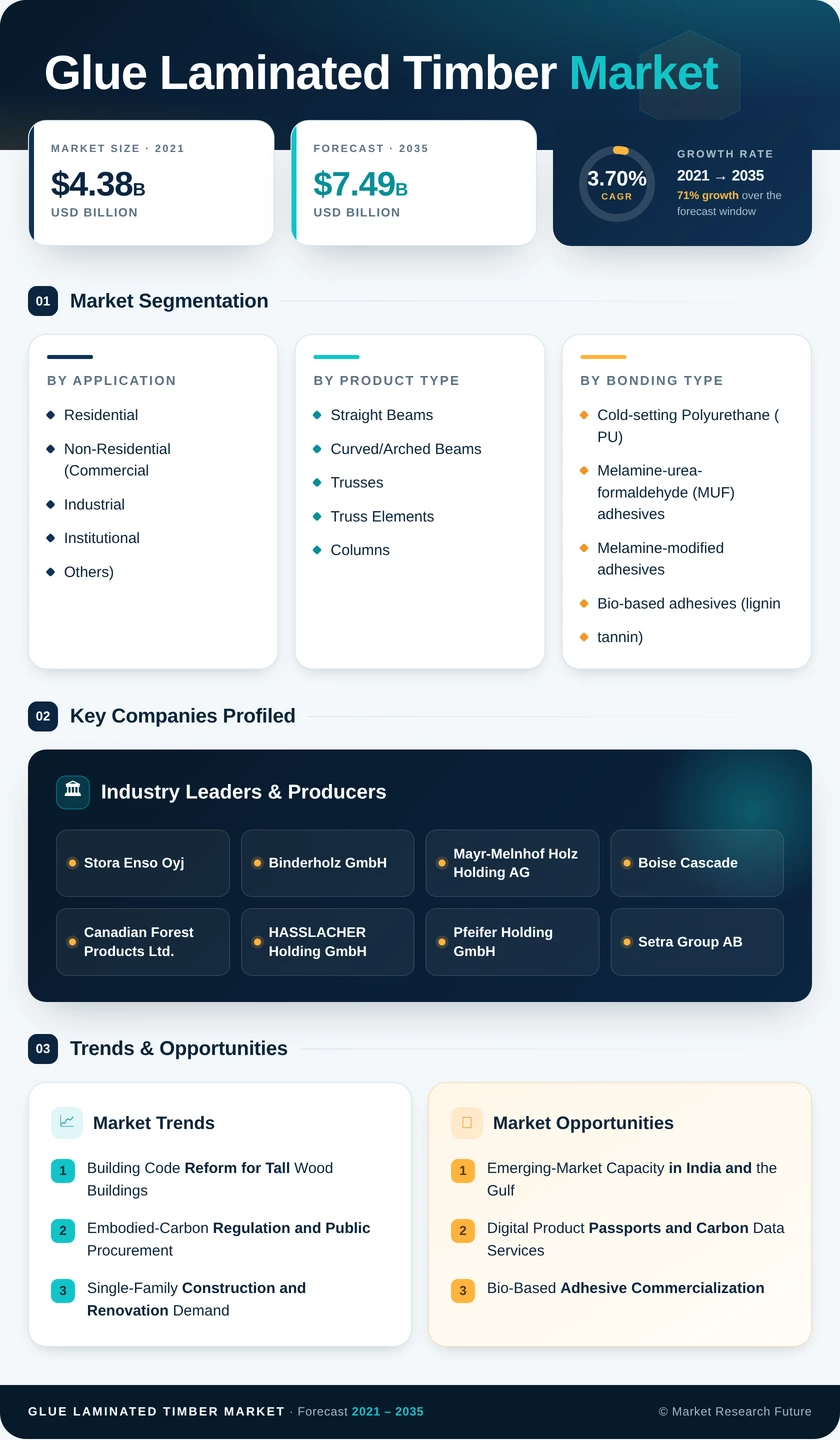
Glue Laminated Timber Market (2026 - 2035)

ID: MRFR/PCM/5758-HCR 111 Pages Chitranshi Jaiswal Last Updated: October 27, 2026
Glue Laminated Timber Market Research Report Information By Application (Residential, Non-Residential (Commercial, Industrial and Institutional, and Others)), By Product Type (Straight Beams, Curved/Arched Beams, Trusses and Truss Elements, and Columns and Posts), By Bonding Type (Cold-Setting Polyurethane (PU) and Melamine-Urea-Formaldehyde (MUF) Adhesives, Melamine-Modified Adhesives, and Bio-Based Adhesives (Lignin, Tannin)), And By Region (North America, Europe, Asia-Pacific, and Rest of the World) – Market Forecast Till 2035.
Glue Laminated Timber Market
Market Size
Forecast Period2026-2035
CAGR (2026-2035)3.70%
2025 Market SizeUSD 5.22 Billion
2035 Market SizeUSD 7.49 Billion
Key Players
Stora Enso Oyj
Binderholz GmbH
Mayr-Melnhof Holz Holding AG
Boise Cascade
Canadian Forest Products Ltd.
HASSLACHER Holding GmbH
Opportunities
  • Emerging-Market Capacity in India and the Gulf
  • Digital Product Passports and Carbon Data Services
  • Bio-Based Adhesive Commercialization
  1. 1 Market Summary | |
  2. 2 Key Report Takeaways | |
    1. 2.1 By Application | |
    2. 2.2 By Product Type | |
    3. 2.3 By Bonding Type | |
    4. 2.4 By Region | |
  3. 3 Market Size and Forecast (2021–2035) | |
  4. 4 Driver Impact Analysis | |
    1. 4.1 Building Code Reform for Tall Wood Buildings | |
    2. 4.2 Embodied-Carbon Regulation and Public Procurement | |
    3. 4.3 Single-Family Construction and Renovation Demand | |
    4. 4.4 Public Wood-Use Policy in Asia-Pacific | |
    5. 4.5 Automated Fabrication and BIM Integration | |
    6. 4.6 Green Finance and Taxonomy-Aligned Lending | |
  5. 5 Restraints Impact Analysis | |
    1. 5.1 Softwood Lumber Price Volatility | |
    2. 5.2 Fire-Safety Perception and Insurance Costs | |
    3. 5.3 Softwood Trade Duties | |
    4. 5.4 Formaldehyde Limits and Adhesive Certification Lag | |
    5. 5.5 Spruce Supply Disruption from Forest Damage | |
  6. 6 Opportunities | |
    1. 6.1 Emerging-Market Capacity in India and the Gulf | |
    2. 6.2 Digital Product Passports and Carbon Data Services | |
    3. 6.3 Bio-Based Adhesive Commercialization | |
    4. 6.4 Hybrid Timber-Concrete Mid-Rise Systems | |
    5. 6.5 Bridges and Light Infrastructure | |
  7. 7 Regional Market Share and Country-Level Analysis | |
    1. 7.1 Asia-Pacific | | |
      1. 7.1.1 China | | |
      2. 7.1.2 India | | |
      3. 7.1.3 Japan | | |
      4. 7.1.4 South Korea | | |
      5. 7.1.5 Rest of Asia-Pacific | |
    2. 7.2 North America | | |
      1. 7.2.1 United States | | |
      2. 7.2.2 Canada | | |
      3. 7.2.3 Mexico | |
    3. 7.3 Europe | | |
      1. 7.3.1 Germany | | |
      2. 7.3.2 United Kingdom | | |
      3. 7.3.3 France | | |
      4. 7.3.4 Italy | | |
      5. 7.3.5 Rest of Europe | |
    4. 7.4 South America | | |
      1. 7.4.1 Brazil | | |
      2. 7.4.2 Argentina | | |
      3. 7.4.3 Rest of South America | |
    5. 7.5 Middle East and Africa | | |
      1. 7.5.1 Saudi Arabia | | |
      2. 7.5.2 South Africa | | |
      3. 7.5.3 Rest of Middle East and Africa | |
  8. 8 Future Outlook (2026–2035) | |
    1. 8.1 Digital Fabrication and Robotic Production | |
    2. 8.2 Whole-Life Carbon Accounting | |
    3. 8.3 Urban Densification and Mid-Rise Demand | |
    4. 8.4 Forest Supply Resilience and Circularity | |
  9. 9 Segmentation Analysis | |
    1. 9.1 By Application | | |
      1. 9.1.1 Residential | | |
      2. 9.1.2 Non-Residential | | | |
        1. 9.1.2.1 Commercial | | | |
        2. 9.1.2.2 Industrial and Institutional | | | |
        3. 9.1.2.3 Others | |
    2. 9.2 By Product Type | | |
      1. 9.2.1 Straight Beams | | |
      2. 9.2.2 Curved/Arched Beams | | |
      3. 9.2.3 Trusses and Truss Elements | | |
      4. 9.2.4 Columns and Posts | |
    3. 9.3 By Bonding Type | | |
      1. 9.3.1 Cold-setting Polyurethane ( PU) and Melamine-urea-formaldehyde (MUF) adhesives | | |
      2. 9.3.2 Melamine-modified adhesives | | |
      3. 9.3.3 Bio-based adhesives (lignin, tannin) | |
  10. 10 Competitive Landscape | |
    1. 10.1 Market Concentration Analysis | |
    2. 10.2 Competitive Benchmarking Matrix | |
  11. 11 Recent News and Developments | |
  12. 12 Report Scope and Methodology | |
  13. 13 Detailed Sources and Citations | |
  14. 14 Frequently Asked Questions (FAQs) | | LIST OF TABLES | |
  15. TABLE 1 Global Market Size and Forecast, by Revenue (USD Billion), 2021–2035 | |
  16. TABLE 2 Driver Impact Analysis | |
  17. TABLE 3 Restraints Impact Analysis | |
  18. TABLE 4 Market Size, by Region, 2025 | |
  19. TABLE 5 Asia-Pacific Market, by Country, 2025 | |
  20. TABLE 6 North America Market, by Country, 2025 | |
  21. TABLE 7 Europe Market, by Country, 2025 | |
  22. TABLE 8 South America Market, by Country, 2025 | |
  23. TABLE 9 Middle East and Africa Market, by Country, 2025 | |
  24. TABLE 10 Market, by Application, 2025 | |
  25. TABLE 11 Market, by Product Type, 2025 | |
  26. TABLE 12 Market, by Bonding Type, 2025 | |
  27. TABLE 13 Competitive Benchmarking Matrix | |
  28. TABLE 14 Report Scope and Methodology | |
  29. TABLE 15 Detailed Sources and Citations | | LIST OF FIGURES | |
  30. FIGURE 1 Market Dynamics Overview (Drivers, Restraints, Opportunities) | |
  31. FIGURE 2 Value Chain Analysis | |
  32. FIGURE 3 Porter's Five Forces Analysis | |
  33. FIGURE 4 Market Size Trend, 2021–2035 (USD Billion) | |
  34. FIGURE 5 Market Share, by Application, 2025 | |
  35. FIGURE 6 Market Share, by Product Type, 2025 | |
  36. FIGURE 7 Market Share, by Bonding Type, 2025 | |
  37. FIGURE 8 Market Share, by Region, 2025 | |
  38. FIGURE 9 Country-Level Share Comparison, 2025 | |
  39. FIGURE 10 Competitive Landscape, Revenue Share Ranges of Key Players

Segmentation Quick Reference

DimensionSub-SegmentsDominant SegmentFastest Growing Segment
By ApplicationResidential; Non-Residential (Commercial, Industrial and Institutional, Others)Residential (62.9% share)Commercial (4.1% CAGR)
By Product TypeStraight Beams; Curved/Arched Beams; Trusses and Truss Elements; Columns and PostsStraight Beams (48.6% share)Curved/Arched Beams (4.6% CAGR)
By Bonding TypeCold-setting Polyurethane ( PU) and Melamine-urea-formaldehyde (MUF) adhesives; Melamine-modified adhesives; Bio-based adhesives (lignin, tannin)Cold-setting Polyurethane ( PU) and Melamine-urea-formaldehyde (MUF) adhesives (58.6% share)Bio-based adhesives (lignin, tannin) (5.3% CAGR)
By RegionAsia-Pacific; North America; Europe; South America; Middle East and AfricaAsia-Pacific (38.4% share)Asia-Pacific (38.4% share)

Market Segmentation Overview

By Application

Sub-SegmentKey Trend
ResidentialExposed ridge beams, headers and vaulted ceilings in single-family homes and remodels
Non-ResidentialCommercial offices, Industrial and Institutional buildings, and Others adopting glulam frames under new codes

Residential leads with a 62.9% share because single-family builders and remodelers buy standard glulam headers and ridge beams through distribution with short lead times. Non-Residential is where growth concentrates, and Commercial is its fastest-moving sub-segment at a 4.1% CAGR as tall-wood code provisions open mid-rise offices to glulam frames. Industrial and Institutional buyers follow, using long spans to cut foundation loads in warehouses and to signal sustainability in university buildings.

By Product Type

Sub-SegmentKey Trend
Straight BeamsHigh-volume standard sections with simple connections
Curved/Arched BeamsCNC bending and RF curing reduce premiums on complex geometries
Trusses and Truss ElementsLong-span roofs for halls and warehouses
Columns and PostsHeavier vertical members for multistory grids

Straight Beams dominate at 48.6% share because builders favor predictable pricing and standard detailing. Curved/Arched Beams grow fastest at a 4.6% CAGR, as automated bending and radio-frequency curing bring complex shapes close to straight-member throughput. Columns and Posts gain relevance as taller buildings require heavier vertical sections, while Trusses and Truss Elements remain tied to long-span roof work.

By Bonding Type

Sub-SegmentKey Trend
Cold-setting Polyurethane ( PU) and Melamine-urea-formaldehyde (MUF) adhesivesIncumbent chemistry with broad code listings
Melamine-modified adhesivesLower-emission blends fitting existing press cycles
Bio-based adhesives (lignin, tannin)Low-carbon formulations gaining certification

Cold-setting Polyurethane ( PU) and Melamine-urea-formaldehyde (MUF) adhesives lead with 58.6% share because their certification records satisfy structural engineers and insurers. Bio-based adhesives (lignin, tannin) are the fastest-growing chemistry at a 5.3% CAGR, propelled by carbon-scored tenders and new high-bio-content formulations. Melamine-modified adhesives serve as a transition option, helping producers meet the EU formaldehyde limit without replacing press equipment.


Download PDF ×

We do not share your information with anyone. However, we may send you emails based on your report interest from time to time. You may contact us at any time to opt-out.