×
Hero Background
English
Chinese
French
Japanese
Korean
German
Spanish

Geofoam Market Trends

ID: MRFR/CnM/9270-HCR
100 Pages
Priya Nagrale
October 2025

Geofoam Market Research Report Information By Type (Expanded Polystrene, Extruded Polystyrene) By End Use (Road & Reilways, Building & Construction, Others) Regional (North America, Europe, Asia-Pacific, Latin America, and the Middle East and Africa) Forecast till 2035

Share:
Download PDF ×

We do not share your information with anyone. However, we may send you emails based on your report interest from time to time. You may contact us at any time to opt-out.

Geofoam Market Infographic
Purchase Options

Market Trends

Key Emerging Trends in the Geofoam Market

The pace of change within the Geofoam has been so rapid reflecting increasing demand for lightweight versatile construction materials in recent years. It is widely used in various civil engineering applications due to its unique properties (Geofoam). One notable trend involves more infrastructure projects adopting Geofoam because it reduces overall project costs along with decreasing construction time constraints (Zhang et al., 2012). As a light material it offers an alternative fill solution to traditional options providing excellent load bearing capability with minimum settlement problems.

In addition, sustainability has become a major concern for the construction industry resulting in eco-friendly orientation of the Geofoam market. In terms of being recyclable, geo-foams meet the global push on sustainability making them attractive for adoption by environment friendly projects. This trend is supported further by stricter regulations and standards that encourage increased use of green buildings; thus increasing demand for geo- foams as a sustainable choice in building works.

Another striking issue relates to expanding application areas for geo-foams within transport infrastructure development. It serves as an ideal material for road and bridge construction due to its high compressive strength and light weight properties. Geo-foam has become widely used in highway embankments and bridge abutments as it reduces soil settlement while providing stable support. Furthermore, the globally increasing enhancement of transportation networks is making a demand for innovative and efficient building materials (Wu et al., 2015).

At the same time, researches aimed at improving the characteristics of Geofoam are being conducted intensively to expand its range of application. Manufacturers are investing in technological advancements that will help improve thermal insulation properties of Geofoams so as to allow their use in geotechnical and environmental engineering applications. This continuous innovation is expected to create new opportunities for geo-foams such as retaining walls, slope stabilization, landfill closures etc.

Players in this industry are looking at strategic alliances and partnerships as an alternative means of strengthening market presence and broadening products coverage. The aim of these collaborations is to enhance synergies with different types of construction with engaging Geofoam in diverse projects (Rashid & Hinze, 2009). Additionally, there has been an influx of new entrants into this market thereby leading to increased competition that spurs further innovations in both Geofoams products’ development process including their functionality.


Author
Priya Nagrale
Senior Research Analyst

With an experience of over five years in market research industry (Chemicals & Materials domain), I gather and analyze market data from diverse sources to produce results, which are then presented back to a client. Also, provide recommendations based on the findings. As a Senior Research Analyst, I perform quality checks (QC) for market estimations, QC for reports, and handle queries and work extensively on client customizations. Also, handle the responsibilities of client proposals, report planning, report finalization, and execution

Leave a Comment

FAQs

What growth rate global geofoam market would register in the future?

The global geofoam market would register a growth of 6.3%.

Which industry will play a crucial role in taking the geofoam market ahead?

The infreastructure development will play a prominent role in taking the market forward.

What is the key driving restraining factor for the global geofoam market?

Fluctuations in raw material prices could hamper the market growth.

Which region would enjoy the upper hand in the geofoam market?

The Asia-Pacific geofoam market would enjoy the upper hand in the geofoam market

Market Summary

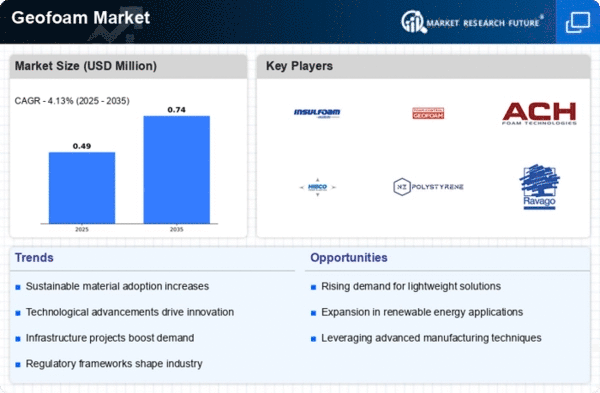
As per MRFR analysis, the Geofoam Market Size was estimated at 0.473 USD Million in 2024. The Geofoam industry is projected to grow from 0.493 in 2025 to 0.739 by 2035, exhibiting a compound annual growth rate (CAGR) of 4.13 during the forecast period 2025 - 2035.

Key Market Trends & Highlights

The Geofoam Market is experiencing a dynamic shift driven by sustainability and technological advancements.

  • North America remains the largest market for geofoam, driven by robust infrastructure projects and construction activities.
  • Asia-Pacific is emerging as the fastest-growing region, fueled by rapid urbanization and population growth.
  • The construction segment dominates the market, while the insulation segment is witnessing the fastest growth due to increasing energy efficiency demands.
  • Key market drivers include infrastructure development and rising construction costs, which are propelling the adoption of geofoam solutions.

Market Size & Forecast

2024 Market Size 0.473 (USD Million)
2035 Market Size 0.739 (USD Million)
CAGR (2025 - 2035) 4.13%
Largest Regional Market Share in 2024 North America

Major Players

<p>Insulfoam (US), Geofoam Solutions (US), Ach Foam Technologies (US), Expanded Polystyrene (EPS) (US), Polystyrene Products (US), Ravago (BE), BASF (DE), Dow Chemical (US), SABIC (SA)</p>

Market Trends

The Geofoam Market is currently experiencing a notable transformation, driven by increasing demand for lightweight and sustainable construction materials. This shift is largely influenced by the growing emphasis on environmental sustainability and the need for efficient building solutions. Geofoam, known for its excellent insulation properties and ease of handling, is becoming a preferred choice in various applications, including road construction, building foundations, and landscaping. As urbanization continues to rise, the market appears poised for further expansion, with stakeholders exploring innovative uses and applications of geofoam products. Moreover, advancements in manufacturing technologies are likely to enhance the quality and performance of geofoam materials. This evolution may lead to the development of specialized products tailored to meet specific industry requirements. The increasing focus on infrastructure development, particularly in emerging economies, suggests a robust future for the Geofoam Market. As construction practices evolve, the integration of geofoam into various projects could become more prevalent, potentially reshaping the landscape of modern construction practices.

Sustainability Focus

The Geofoam Market is witnessing a growing emphasis on sustainable practices. As environmental concerns gain traction, the demand for eco-friendly materials is rising. Geofoam, being lightweight and recyclable, aligns well with these sustainability goals, making it an attractive option for construction projects.

Technological Advancements

Innovations in manufacturing processes are enhancing the performance characteristics of geofoam products. These advancements may lead to improved durability and insulation properties, thereby expanding the range of applications in which geofoam can be effectively utilized.

Urbanization Trends

Rapid urbanization is driving the need for efficient construction solutions. The Geofoam Market is likely to benefit from this trend, as geofoam offers lightweight and versatile options for various infrastructure projects, including roads and buildings.

Geofoam Market Market Drivers

Market Growth Projections

The Global Geofoam Market Industry is projected to experience substantial growth in the coming years. With a market value expected to reach 1569.0 USD Million by 2035, the industry is poised for a promising trajectory. The compound annual growth rate of 7.19% from 2025 to 2035 reflects the increasing adoption of geofoam in various applications, driven by factors such as infrastructure development and sustainability initiatives. This growth is indicative of the material's versatility and effectiveness in modern construction practices, suggesting a robust future for the geofoam market.

Rising Infrastructure Development

The Global Geofoam Market Industry is experiencing growth driven by increasing infrastructure development across various regions. Governments and private sectors are investing heavily in transportation, urban development, and public works projects. For instance, the construction of new highways, bridges, and rail systems requires lightweight materials like geofoam to reduce load on substructures. This trend is expected to contribute to the market's expansion, with projections indicating a market value of 730.9 USD Million in 2024. As urbanization accelerates, the demand for geofoam in these projects is likely to rise, further solidifying its role in modern construction.

Expansion of the Transportation Sector

The Global Geofoam Market Industry is significantly influenced by the expansion of the transportation sector. With increasing investments in roadways, railways, and airports, geofoam is becoming a preferred choice for various applications, including embankments and subgrade stabilization. The lightweight nature of geofoam allows for easier handling and installation, which is particularly advantageous in large-scale transportation projects. As governments prioritize infrastructure upgrades to support economic growth, the demand for geofoam is expected to rise. This trend aligns with the overall market growth, contributing to the anticipated market value of 730.9 USD Million in 2024.

Environmental Sustainability Initiatives

The Global Geofoam Market Industry is benefiting from a growing emphasis on environmental sustainability. Geofoam Market, being a lightweight and recyclable material, aligns with the increasing demand for eco-friendly construction solutions. Governments are implementing regulations that encourage the use of sustainable materials in construction, which could lead to a greater adoption of geofoam. The material's ability to reduce carbon footprints in projects is becoming a key selling point. As sustainability becomes a priority, the market is anticipated to see a compound annual growth rate of 7.19% from 2025 to 2035, reflecting the industry's shift towards greener practices.

Technological Advancements in Material Science

Innovations in material science are propelling the Global Geofoam Market Industry forward. Advances in manufacturing techniques and material properties are enhancing the performance of geofoam products. For example, improvements in density and compressive strength allow geofoam to be used in more demanding applications, such as seismic retrofitting and slope stabilization. These technological developments not only improve the material's functionality but also expand its applicability in various construction scenarios. As these innovations continue to emerge, the market is expected to reach a valuation of 1569.0 USD Million by 2035, indicating a robust growth trajectory.

Increased Demand for Lightweight Construction Materials

The Global Geofoam Market Industry is witnessing a surge in demand for lightweight construction materials. As construction projects become more complex, the need for materials that reduce overall weight while maintaining structural integrity is paramount. Geofoam Market serves this purpose effectively, offering a viable solution for reducing loads on foundations and minimizing excavation requirements. This trend is particularly evident in regions prone to seismic activity, where lightweight materials can mitigate risks. The growing preference for such materials is likely to drive the market's growth, as stakeholders seek to enhance safety and efficiency in construction.

Market Segment Insights

By Application: Construction (Largest) vs. Insulation (Fastest-Growing)

<p>In the Geofoam Market, the application segment is primarily dominated by construction activities, which hold the largest share due to the increasing demand for lightweight and effective materials in various construction projects. Other significant applications include transportation, landfill, and geotechnical uses that contribute to the overall landscape of the market. As the focus on sustainable practices heightens, insulation has emerged as the fastest-growing application segment in the Geofoam Market. This change is driven by the need for energy-efficient building materials in residential and commercial properties, leading to increased adoption of geofoam-based insulation solutions that promise better thermal performance and reduced environmental impact.</p>

<p>Construction (Dominant) vs. Insulation (Emerging)</p>

<p>The construction application of geofoam is characterized by its extensive use in infrastructure projects such as roads, bridges, and buildings. Geofoam’s lightweight nature facilitates the reduction of foundation loads while offering superior moisture resistance and thermal insulation properties. This ensures that construction processes are more efficient and cost-effective. In contrast, the insulation segment is emerging rapidly as builders and architects prioritize energy efficiency. The growing trend of green building certifications drives the demand for geofoam materials as effective insulating solutions, appealing to a broad range of consumers looking to reduce energy costs and environmental footprints.</p>

By End Use: Residential (Largest) vs. Infrastructure (Fastest-Growing)

<p>In the Geofoam Market, the distribution of market share among the end-use segments significantly influences growth dynamics. The residential segment commands the largest share, owing to its extensive application in home construction, landscaping, and insulation solutions. This segment benefits from increasing residential construction activities and substantial investments in home developments, making it a crucial player in driving market demand. On the other hand, the infrastructure segment is emerging as the fastest-growing segment. The surge in infrastructural projects, particularly in developing regions, contributes to this growth. Factors such as government initiatives, urbanization, and an increased focus on sustainable construction methods further elevate infrastructure as a key area of growth within the Geofoam Market.</p>

<p>Residential (Dominant) vs. Environmental (Emerging)</p>

<p>The residential segment holds a dominant position in the Geofoam Market, primarily due to its versatile applications ranging from insulation to lightweight fill in construction projects. This segment is marked by a robust consumer demand for energy-efficient building solutions, which enhances its market presence. Conversely, the environmental segment is categorized as emerging due to its growing acceptance and application in environmental remediation and sustainable projects. As concerns about ecological impact rise, geofoam's lightweight and recyclable properties find increasing applicability in initiatives like land reclamation, erosion control, and waste management. Consequently, while residential remains predominant, environmental applications are steadily gaining traction as sustainability becomes a priority in construction and engineering.</p>

By Material Type: Expanded Polystyrene (Largest) vs. Extruded Polystyrene (Fastest-Growing)

<p>In the Geofoam Market, Expanded Polystyrene (EPS) holds the largest share, acclaimed for its lightweight and durable properties, making it a preferred choice in various applications, from construction to landscaping. Following closely, Extruded Polystyrene (XPS) is gaining momentum due to its excellent thermal insulation and moisture-resistant characteristics, catering to industries where temperature control is crucial. Growth trends within the 'Material Type' segment indicate a notable shift toward sustainability, with Polyurethane and Polyethylene also gaining traction due to their eco-friendly attributes. The increasing demand for lightweight yet strong materials in civil engineering and infrastructure projects propels the growth of EPS and XPS, while rising construction activities are projected to drive the adoption of these material types further.</p>

<p>Expanded Polystyrene (Dominant) vs. Extruded Polystyrene (Emerging)</p>

<p>Expanded Polystyrene (EPS) serves as the dominant material in the Geofoam Market, renowned for its cost-effectiveness and versatile applications. EPS is lightweight, making it indispensable for various uses, including void fill and site stabilization in construction projects. In contrast, Extruded Polystyrene (XPS) is emerging rapidly as a robust alternative, particularly in applications requiring superior insulation and moisture resistance. XPS is recognized for its closed-cell structure, which enhances its durability against adverse weather conditions. The market positioning of both materials reflects an increasing trend towards innovative construction solutions where efficiency and performance are paramount.</p>

Get more detailed insights about Geofoam Market Research Report—Global Forecast till 2035

Regional Insights

North America : Market Leader in Geofoam

North America is poised to maintain its leadership in the geofoam market, holding a significant market share of 25% as of 2024. The region's growth is driven by increasing demand in construction and infrastructure projects, alongside stringent regulations promoting sustainable building materials. The adoption of geofoam in various applications, including lightweight fill and insulation, is further supported by government initiatives aimed at enhancing energy efficiency. The United States stands out as the primary market, with key players such as Insulfoam, Geofoam Solutions, and Ach Foam Technologies leading the charge. The competitive landscape is characterized by innovation and strategic partnerships among these companies, which are focused on expanding their product offerings and enhancing performance. The presence of established firms like BASF and Dow Chemical also contributes to a robust market environment, ensuring continued growth and development.

Europe : Emerging Market with Potential

Europe is witnessing a growing interest in the geofoam market, with a market share of 15% as of 2024. The region's growth is fueled by increasing investments in infrastructure and a shift towards sustainable construction practices. Regulatory frameworks across various European countries are encouraging the use of eco-friendly materials, which is expected to drive demand for geofoam products in the coming years. Leading countries in this region include Germany, France, and the UK, where companies like BASF and Ravago are making significant strides. The competitive landscape is evolving, with a focus on innovation and sustainability. The presence of established players, along with emerging startups, is fostering a dynamic market environment that is likely to attract further investment and development in geofoam applications.

Asia-Pacific : Emerging Powerhouse in Geofoam

The Asia-Pacific region is gradually emerging in the geofoam market, holding a market share of 7% as of 2024. The growth is primarily driven by rapid urbanization and increasing infrastructure development in countries like China and India. Government initiatives aimed at enhancing construction standards and promoting lightweight materials are acting as catalysts for the adoption of geofoam in various applications. China and India are the leading countries in this region, with a growing number of local manufacturers entering the market. The competitive landscape is becoming more diverse, with both established players and new entrants vying for market share. Companies are focusing on product innovation and cost-effective solutions to meet the rising demand for geofoam in construction and civil engineering projects.

Middle East and Africa : Resource-Rich Frontier

The Middle East and Africa region is in the nascent stages of developing its geofoam market, currently holding a market share of just 1% as of 2024. The growth potential is significant, driven by increasing investments in infrastructure and urban development projects. Governments in the region are beginning to recognize the benefits of lightweight materials, which is expected to spur demand for geofoam in construction applications. Countries like Saudi Arabia and South Africa are leading the way in adopting geofoam solutions, with a focus on enhancing building efficiency and sustainability. The competitive landscape is still developing, with a few key players beginning to establish their presence. As awareness of geofoam's advantages grows, the market is likely to see increased activity and investment in the coming years.

Key Players and Competitive Insights

The Geofoam Market is currently characterized by a competitive landscape that is both dynamic and multifaceted, driven by increasing demand for lightweight, sustainable construction materials. Key players are actively engaging in strategies that emphasize innovation, regional expansion, and partnerships to enhance their market positioning. Companies such as Insulfoam (US) and BASF (DE) are at the forefront, leveraging their technological capabilities to develop advanced geofoam solutions that cater to diverse applications, from infrastructure to landscaping. This collective focus on innovation and sustainability is reshaping the competitive environment, fostering a climate where differentiation is increasingly based on product performance and environmental impact rather than solely on cost.

In terms of business tactics, companies are localizing manufacturing to reduce lead times and optimize supply chains, which is particularly crucial in a market that is moderately fragmented. The competitive structure allows for both established players and new entrants to coexist, although the influence of major companies like Dow Chemical (US) and SABIC (SA) is substantial. These firms are not only enhancing their production capabilities but are also investing in digital transformation initiatives to streamline operations and improve customer engagement.

In November 2025, Insulfoam (US) announced the opening of a new manufacturing facility in Texas, aimed at increasing production capacity to meet the growing demand for geofoam products in the southern U.S. This strategic move is significant as it positions Insulfoam closer to key markets, thereby reducing transportation costs and enhancing service delivery. The facility is expected to utilize advanced manufacturing technologies, which may further bolster the company's competitive edge in terms of product quality and sustainability.

In October 2025, BASF (DE) launched a new line of bio-based geofoam products, reflecting a commitment to sustainability and innovation. This initiative is particularly noteworthy as it aligns with global trends towards eco-friendly construction materials. By diversifying its product offerings, BASF not only addresses the increasing consumer demand for sustainable solutions but also strengthens its market position against competitors who may not yet have adopted such environmentally conscious practices.

In September 2025, Dow Chemical (US) entered into a strategic partnership with a leading construction firm to develop customized geofoam solutions for large-scale infrastructure projects. This collaboration is indicative of a broader trend where companies are seeking to leverage partnerships to enhance their product offerings and market reach. Such alliances are likely to facilitate knowledge sharing and innovation, ultimately benefiting both parties and the industry as a whole.

As of December 2025, the Geofoam Market is witnessing trends that emphasize digitalization, sustainability, and the integration of advanced technologies such as AI. Strategic alliances are increasingly shaping the competitive landscape, allowing companies to pool resources and expertise. The shift from price-based competition to a focus on innovation, technology, and supply chain reliability is becoming more pronounced. Moving forward, companies that can effectively differentiate themselves through these avenues are likely to thrive in an evolving market.

Key Companies in the Geofoam Market market include

Industry Developments

Future Outlook

Geofoam Market Future Outlook

<p>The Geofoam Market is projected to grow at a 4.13% CAGR from 2024 to 2035, driven by infrastructure development, environmental sustainability, and innovative applications.</p>

New opportunities lie in:

  • <p>Expansion into renewable energy projects utilizing geofoam for insulation.</p>
  • <p>Development of lightweight geofoam solutions for transportation infrastructure.</p>
  • <p>Partnerships with construction firms for integrated geofoam solutions in urban development.</p>

<p>By 2035, the Geofoam Market is expected to achieve robust growth, reflecting its strategic importance in various industries.</p>

Market Segmentation

Geofoam Market End Use Outlook

  • Residential
  • Commercial
  • Industrial
  • Infrastructure
  • Environmental

Geofoam Market Application Outlook

  • Construction
  • Transportation
  • Landfill
  • Geotechnical
  • Insulation

Geofoam Market Material Type Outlook

  • Expanded Polystyrene
  • Extruded Polystyrene
  • Polyurethane
  • Polyethylene
  • Cementitious

Report Scope

MARKET SIZE 20240.473(USD Million)
MARKET SIZE 20250.493(USD Million)
MARKET SIZE 20350.739(USD Million)
COMPOUND ANNUAL GROWTH RATE (CAGR)4.13% (2024 - 2035)
REPORT COVERAGERevenue Forecast, Competitive Landscape, Growth Factors, and Trends
BASE YEAR2024
Market Forecast Period2025 - 2035
Historical Data2019 - 2024
Market Forecast UnitsUSD Million
Key Companies ProfiledInsulfoam (US), Geofoam Solutions (US), Ach Foam Technologies (US), Expanded Polystyrene (EPS) (US), Polystyrene Products (US), Ravago (BE), BASF (DE), Dow Chemical (US), SABIC (SA)
Segments CoveredApplication, End Use, Material Type
Key Market OpportunitiesGrowing demand for lightweight construction materials in infrastructure projects enhances opportunities in the Geofoam Market.
Key Market DynamicsRising demand for lightweight construction materials drives innovation and competition in the Geofoam market.
Countries CoveredNorth America, Europe, APAC, South America, MEA

FAQs

What growth rate global geofoam market would register in the future?

The global geofoam market would register a growth of 6.3%.

Which industry will play a crucial role in taking the geofoam market ahead?

The infreastructure development will play a prominent role in taking the market forward.

What is the key driving restraining factor for the global geofoam market?

Fluctuations in raw material prices could hamper the market growth.

Which region would enjoy the upper hand in the geofoam market?

The Asia-Pacific geofoam market would enjoy the upper hand in the geofoam market

  1. EXECUTIVE SUMMARY
    1. Market Attractiveness Analysis
      1. Global Geofoam Market, by Type
      2. Global Geofoam Market, by End Use
      3. Global Geofoam Market, by Region
  2. MARKET INTRODUCTION
    1. Definition
    2. Scope of the Study
    3. Market Structure
  3. RESEARCH METHODOLOGY
    1. Research Process
    2. Primary Research
    3. Secondary Research
    4. Market Size Estimation
    5. Forecast Model
    6. List of Assumptions & Assumptions
  4. MARKET DYNAMICS
    1. Introduction
    2. Drivers
    3. Restraints
    4. Opportunities
    5. Challenges
    6. Trends
  5. MARKET FACTOR ANALYSIS
    1. Supply Chain Analysis
      1. Raw Material Suppliers
      2. Geofoam Manufacturers
      3. Distribution & Sales Channel
      4. End Users
    2. Porter’s Five Forces Model
      1. Bargaining Power of Suppliers
      2. Bargaining Power of Buyers
      3. Threat of New Entrants
      4. Threat of Substitutes
      5. Intensity of Rivalry
    3. Pricing Analysis (USD/Tons), by Region
    4. Impact of COVID-19 on the Global Geofoam Market
  6. GLOBAL GEOFOAM MARKET, BY TYPE (KILO TONS) (USD MILLION)
    1. Introduction
    2. Expanded Polystyrene
      1. Market Estimates & Forecast, by Region/Country, 2019–2028
    3. Extruded Polystyrene
      1. Market Estimates & Forecast, by Region/Country, 2019–2028
  7. GLOBAL GEOFOAM MARKET, BY END USE (KILO TONS) (USD MILLION)
    1. Introduction
    2. Road & Railways
      1. Market Estimates & Forecast, by Region/Country, 2019–2028
    3. Building & Construction
      1. Market Estimates & Forecast, by Region/Country, 2019–2028
    4. Others
      1. Market Estimates & Forecast, by Region/Country, 2019–2028
  8. GLOBAL GEOFOAM MARKET, BY REGION (KILO TONS) (USD MILLION)
    1. Overview
    2. North America
      1. US
      2. Canada
    3. Europe
      1. Germany
      2. UK
      3. France
      4. Russia
      5. Spain
      6. Italy
      7. Rest of Europe
    4. Asia-Pacific
      1. China
      2. Japan
      3. India
      4. South Korea
      5. Rest of Asia-Pacific
    5. Latin America
      1. Brazil
      2. Mexico
      3. Argentina
      4. Rest of Latin America
    6. Middle East & Africa
      1. Turkey
      2. GCC Countries
      3. South Africa
      4. Rest of the Middle East & Africa
  9. COMPETITIVE LANDSCAPE
    1. Market Introduction
    2. Recent Developments
      1. Mergers/Acquisitions, Expansion, Investment, Partnership, Collaboration, Product Launch
    3. Global Market Strategy Analysis
    4. Competitive Benchmarking
  10. COMPANY PROFILES
    1. Carlisle
      1. Company Overview
      2. Financial Overview
      3. Products Offered
      4. Key Developments
      5. SWOT Analysis
      6. Key Strategies
    2. Amvic Building Systems
      1. Company Overview
      2. Financial Overview
      3. Products Offered
      4. Key Developments
      5. SWOT Analysis
      6. Key Strategies
    3. Atlas Roofing Corporation
      1. Company Overview
      2. Financial Overview
      3. Products Offered
      4. Key Developments
      5. SWOT Analysis
      6. Key Strategies
    4. Insulation Company of America
      1. Company Overview
      2. Financial Overview
      3. Products Offered
      4. Key Developments
      5. SWOT Analysis
      6. Key Strategies
    5. Foam Products Corporation
      1. Company Overview
      2. Financial Overview
      3. Products Offered
      4. Key Developments
      5. SWOT Analysis
      6. Key Strategies
    6. Jablite
      1. Company Overview
      2. Financial Overview
      3. Products Offered
      4. Key Developments
      5. SWOT Analysis
      6. Key Strategies
    7. ThermaFoam, LLC
      1. Company Overview
      2. Financial Overview
      3. Products Offered
      4. Key Developments
      5. SWOT Analysis
      6. Key Strategies
    8. Expol
      1. Company Overview
      2. Financial Overview
      3. Products Offered
      4. Key Developments
      5. SWOT Analysis
      6. Key Strategies
    9. Pacific Allied Products, Ltd.
      1. Company Overview
      2. Financial Overview
      3. Products Offered
      4. Key Developments
      5. SWOT Analysis
      6. Key Strategies
    10. Airfoam
      1. Company Overview
      2. Financial Overview
      3. Products Offered
      4. Key Developments
      5. SWOT Analysis
      6. Key Strategies
    11. Harbor Foam
      1. Company Overview
      2. Financial Overview
      3. Products Offered
      4. Key Developments
      5. SWOT Analysis
      6. Key Strategies
    12. Groupe Legerlite Inc.
      1. Company Overview
      2. Financial Overview
      3. Products Offered
      4. Key Developments
      5. SWOT Analysis
      6. Key Strategies
    13. Drew Foam
      1. Company Overview
      2. Financial Overview
      3. Products Offered
      4. Key Developments
      5. SWOT Analysis
      6. Key Strategies
    14. Plasti-Fab Ltd.
      1. Company Overview
      2. Financial Overview
      3. Products Offered
      4. Key Developments
      5. SWOT Analysis
      6. Key Strategies
    15. Benchmark Foam Inc.
      1. Company Overview
      2. Financial Overview
      3. Products Offered
      4. Key Developments
      5. SWOT Analysis
      6. Key Strategies
    16. Mega Packaging Corporation
      1. Company Overview
      2. Financial Overview
      3. Products Offered
      4. Key Developments
      5. SWOT Analysis
      6. Key Strategies
    17. StarRFoam
      1. Company Overview
      2. Financial Overview
      3. Products Offered
      4. Key Developments
      5. SWOT Analysis
      6. Key Strategies
    18. Beaver Plastics Ltd.
      1. Company Overview
      2. Financial Overview
      3. Products Offered
      4. Key Developments
      5. SWOT Analysis
      6. Key Strategies
    19. Poly Molding LLC
      1. Company Overview
      2. Financial Overview
      3. Products Offered
      4. Key Developments
      5. SWOT Analysis
      6. Key Strategies
    20. Beaver Plastics Ltd.
      1. Company Overview
      2. Financial Overview
      3. Products Offered
      4. Key Developments
      5. SWOT Analysis
      6. Key Strategies
    21. Universal Foam Products
      1. Company Overview
      2. Financial Overview
      3. Products Offered
      4. Key Developments
      5. SWOT Analysis
      6. Key Strategies
    22. Polyfoam XPS
      1. Company Overview
      2. Financial Overview
      3. Products Offered
      4. Key Developments
      5. SWOT Analysis
      6. Key Strategies
    23. Galaxy Polystyrene LLC
      1. Company Overview
      2. Financial Overview
      3. Products Offered
      4. Key Developments
      5. SWOT Analysis
      6. Key Strategies
    24. Styro Insulations Mat. Ind. LCC.
      1. Company Overview
      2. Financial Overview
      3. Products Offered
      4. Key Developments
      5. SWOT Analysis
      6. Key Strategies
    25. Technopol SA
      1. Company Overview
      2. Financial Overview
      3. Products Offered
      4. Key Developments
      5. SWOT Analysis
      6. Key Strategies
  11. APPENDIX
  12. Discussion Blueprint

Geofoam Market Segmentation

Market Segmentation Overview

  • Detailed segmentation data will be available in the full report
  • Comprehensive analysis by multiple parameters
  • Regional and country-level breakdowns
  • Market size forecasts by segment
Infographic

Free Sample Request

Kindly complete the form below to receive a free sample of this Report

Get Free Sample

Customer Strories

Compare Licence

×
Features License Type
Single User Multiuser License Enterprise User
Price $4,950 $5,950 $7,250
Maximum User Access Limit 1 User Upto 10 Users Unrestricted Access Throughout the Organization
Free Customization
Direct Access to Analyst
Deliverable Format
Platform Access
Discount on Next Purchase 10% 15% 15%
Printable Versions