Request Free Sample ×

Kindly complete the form below to receive a free sample of this Report

* Please use a valid business email

Leading companies partner with us for data-driven Insights

clients tt-cursor
Hero Background
English
Chinese
French
Japanese
Korean
German
Spanish

Generic Pharmaceuticals Market Size

ID: MRFR/Pharma/10830-HCR
158 Pages
Vikita Thakur
April 2026

Generic Pharmaceuticals Market Research Report By Drug Type (Small Molecule Drugs, Biologics, Biosimilars), By Formulation Type (Tablets, Injectables, Topicals, Capsules, Solutions), By Therapeutic Area (Cardiovascular Diseases, Diabetes, Cancer, CNS Disorders, Infectious Diseases), By Distribution Channel (Retail Pharmacy, Hospital Pharmacy, Online Pharmacy, Wholesalers) andBy Regional (North America, Europe, South America, Asia Pacific, Middle East and Africa) - Growth & Industry Forecast 2025 To 2035

Share:
Download PDF ×

We do not share your information with anyone. However, we may send you emails based on your report interest from time to time. You may contact us at any time to opt-out.

Generic Pharmaceuticals Market Infographic
Purchase Options

Generic Pharmaceuticals Size

Generic Pharmaceuticals Market Growth Projections and Opportunities

The Generic pharmaceuticals Market size worth USD 766.5 Billion at 8.8% CAGR over the forecast period 2023-2032. The Generic Pharmaceuticals Market is characterized by a multitude of factors that collectively influence its growth and dynamics. One of the underlying factors is patients' expectations of quality medicines as well as financial availability. With international healthcare costs growing, generic products are a more cost-effective alternative to branded similar products. This is why both the healthcare provider and the consumer go for generic products. That to the fact that generics have substantial economic benefit is especially true in areas where health and the affordability issues become the most important challenges to overcome.

Period of drying up of branded drugs patents is considered as the main factor that influence the growth of generic pharmaceuticals. Upon the expiration of the patents, they provide an opportunity for the generics producers to make and market drugs with similar composition and effects with the originals. The expiry of this patent, frequently called the "patent cliff," causes more lots of competition and therefore more drugs produced by generic manufacturers thus a range of drugs becomes cheaper medicaments for consumers.

As global diligence of the chronic disorder increases, wide use of common medications in the process of managing chronic illness also becomes a challenge. With the steady rising rate of incidence for chronic diseases including cardiovascular disease, diabetes, and respiratory ailments, there is also a subsequent increase in demand for cheap medicines. Generic counterparts of medicines, which are utilized frequently in case of chronic diseases, allow patients to obtain accessible treatment while maintaining superior adherence and good health conditions within the society.

As for the market factors, they have the healthcare systems and payers' preferences as a part of their agenda. With the growing demand for healthcare worldwide, public, and private healthcare systems are increasingly favoring the use of off-patent drugs, which has the net effect of reducing costs and achieving cost-effectiveness. The provision of generic drugs for the formularies and single prescription plans results in healthcare specialists prescribing and dispensing generic equivalents, which, in turn, lead to market growth.

To this, addition a growing popularity of the term “generic biosimilars” shows itself as one of the key determinant of generic market. To this end, besides the advanced biologics, newer biosimilars, to replace older biologics, are frequently approved. Brand-name biologics are generally the most expensive types of medicines, and so, their biosimilars are increasingly being adopted and utilized as substitutes. This is because generics are cheaper, and so, they benefit the development of the entire generic pharmaceutical market.
Generic Pharmaceuticals Market Size Graph
Author
Author Profile
Vikita Thakur
Senior Research Analyst

She holds an experience of about 5+ years in market research and business consulting projects for sectors such as life sciences, medical devices, and healthcare IT. She possesses a robust background in data analysis, market estimation, competitive intelligence, pipeline analysis market trend identification, and consumer behavior insights. Her expertise lies in technical Sales support, client interaction and project management, designing and implementing market research studies, conducting competitive analysis, and synthesizing complex data into actionable recommendations that drive business growth.

Leave a Comment

FAQs

What is the current valuation of the Generic Pharmaceuticals Market?

<p>The overall market valuation was 437.9 USD Billion in 2024.</p>

What is the projected market size for the Generic Pharmaceuticals Market by 2035?

<p>The projected valuation for the Generic Pharmaceuticals Market is 1005.74 USD Billion by 2035.</p>

What is the expected CAGR for the Generic Pharmaceuticals Market during the forecast period 2025 - 2035?

<p>The expected CAGR for the Generic Pharmaceuticals Market during the forecast period 2025 - 2035 is 7.85%.</p>

Which therapeutic area is expected to have the highest market valuation in the Generic Pharmaceuticals Market?

<p>Pain Management is projected to reach a market valuation of 315.74 USD Billion by 2035.</p>

How do retail pharmacies contribute to the Generic Pharmaceuticals Market?

<p>Retail Pharmacies contributed a market valuation of 150.0 USD Billion in 2024, with expectations to grow significantly.</p>

What are the key players in the Generic Pharmaceuticals Market?

<p>Key players include Teva Pharmaceutical Industries Ltd, Sandoz International GmbH, and Mylan N.V., among others.</p>

What is the market valuation for oncology drugs in the Generic Pharmaceuticals Market?

<p>Oncology drugs are projected to reach a market valuation of 200.0 USD Billion by 2035.</p>

How does the market for injectables compare to other formulation types in the Generic Pharmaceuticals Market?

<p>Injectables had a market valuation of 80.0 USD Billion in 2024, with growth potential in the coming years.</p>

What is the expected market size for online pharmacies in the Generic Pharmaceuticals Market?

<p>Online Pharmacies are projected to grow from a valuation of 50.0 USD Billion in 2024 to 150.0 USD Billion by 2035.</p>

Which company is likely to lead in the Generic Pharmaceuticals Market?

<p>Teva Pharmaceutical Industries Ltd appears to be a leading player in the Generic Pharmaceuticals Market.</p>

Market Summary

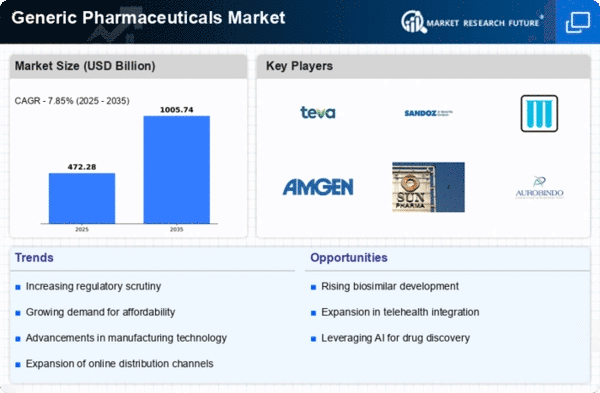
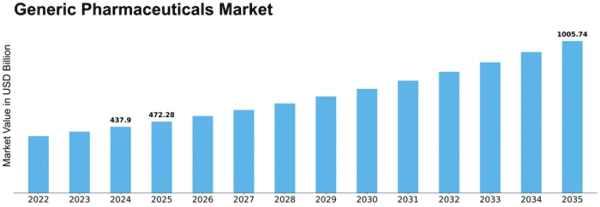
As per MRFR analysis, the Generic Pharmaceuticals Market Size was estimated at 437.9 USD Billion in 2024. The Generic Pharmaceuticals industry is projected to grow from 472.28 USD Billion in 2025 to 1005.74 USD Billion by 2035, exhibiting a compound annual growth rate (CAGR) of 7.85% during the forecast period 2025 - 2035.

Key Market Trends & Highlights

The Generic Pharmaceuticals Market is experiencing robust growth driven by increasing demand for affordable medications and technological advancements.

  • The market is witnessing a rising demand for affordable medications, particularly in North America, which remains the largest market.
  • Regulatory changes are enhancing market access, especially in the Asia-Pacific region, which is recognized as the fastest-growing area.
  • Technological innovations in drug development are propelling growth in the oncology segment, which is currently the largest in the market.
  • Key drivers such as increasing healthcare expenditure and the aging population are significantly influencing the expansion of the generic pharmaceuticals market.

Market Size & Forecast

2024 Market Size 437.9 (USD Billion)
2035 Market Size 1005.74 (USD Billion)
CAGR (2025 - 2035) 7.85%
Largest Regional Market Share in 2024 North America

Major Players

Teva Pharmaceutical Industries (IL), Sandoz (CH), Mylan (US), Amgen (US), Sun Pharmaceutical Industries (IN), Aurobindo Pharma (IN), Cipla (IN), Lupin (IN), Dr. Reddy's Laboratories (IN), Hikma Pharmaceuticals (GB)

Market Trends

The Generic Pharmaceuticals Market is currently experiencing a dynamic evolution, driven by various factors that shape its landscape. The increasing demand for cost-effective medication options is a primary catalyst, as healthcare systems worldwide seek to reduce expenditures while maintaining quality care. Additionally, the rise in chronic diseases necessitates a broader range of therapeutic alternatives, further propelling the growth of generic drugs. Regulatory frameworks are also adapting, with many countries streamlining approval processes to facilitate quicker market entry for generics, thereby enhancing competition and accessibility. Moreover, technological advancements in drug formulation and manufacturing processes are likely to play a pivotal role in the market's future. Innovations in biotechnology and digital health are expected to create new opportunities for generic pharmaceuticals, allowing for more efficient production and distribution. As the market continues to expand, stakeholders must remain vigilant to emerging trends and shifts in consumer preferences, which may influence the overall trajectory of the Generic Pharmaceuticals Market. The interplay of these factors suggests a robust and evolving environment for generic medications, with potential for sustained growth in the coming years.

Rising Demand for Affordable Medications

The quest for affordable healthcare solutions is intensifying, leading to a surge in the demand for generic medications. Patients and healthcare providers alike are increasingly recognizing the value of generics as a means to reduce costs without compromising on quality. This trend is likely to continue as more individuals seek budget-friendly options for their prescriptions.

Regulatory Changes Enhancing Market Access

Regulatory bodies are progressively implementing reforms aimed at expediting the approval process for generic drugs. These changes are designed to foster competition and improve patient access to essential medications. As a result, the Generic Pharmaceuticals Market is expected to benefit from a more streamlined pathway for new products, potentially increasing the variety available to consumers.

Technological Innovations in Drug Development

Advancements in technology are transforming the landscape of drug development within the Generic Pharmaceuticals Market. Innovations such as artificial intelligence and advanced manufacturing techniques are enhancing the efficiency and effectiveness of producing generics. This evolution may lead to improved product quality and reduced time-to-market, positioning generics favorably in the healthcare sector.

Generic Pharmaceuticals Market Market Drivers

Market Growth Projections

The Global Generic Pharmaceuticals Market Industry is poised for substantial growth, with projections indicating a market size of 389.5 USD Billion in 2024 and an anticipated increase to 600 USD Billion by 2035. This growth trajectory suggests a robust demand for generic medications, driven by factors such as rising healthcare costs, patent expirations, and increased healthcare expenditure. The projected CAGR of 4.01% from 2025 to 2035 further underscores the potential for expansion within the industry. As the market evolves, it is likely to witness increased competition and innovation, ultimately benefiting consumers and healthcare systems worldwide.

Increasing Healthcare Expenditure

Growing healthcare expenditure globally is a pivotal factor influencing the Global Generic Pharmaceuticals Market Industry. As nations invest more in healthcare infrastructure and services, there is a corresponding rise in the consumption of pharmaceuticals, including generics. This trend is particularly pronounced in emerging markets, where governments are prioritizing healthcare access for their populations. The increase in healthcare budgets is likely to facilitate the adoption of generic medications, as they provide a cost-effective solution to rising healthcare costs. The projected CAGR of 4.01% from 2025 to 2035 indicates a sustained growth trajectory for the Global Generic Pharmaceuticals Market Industry, driven by increased healthcare spending.

Patent Expirations of Major Drugs

The expiration of patents for several blockbuster drugs plays a crucial role in driving the Global Generic Pharmaceuticals Market Industry. As patents expire, generic manufacturers can produce equivalent medications at lower prices, thereby increasing market competition. This phenomenon has been observed with numerous high-revenue drugs, leading to substantial cost savings for healthcare systems. For instance, the loss of exclusivity for drugs such as Lipitor and Plavix has allowed generics to capture significant market share. The anticipated growth trajectory, with the market expected to reach 600 USD Billion by 2035, underscores the impact of patent expirations on the Global Generic Pharmaceuticals Market Industry.

Regulatory Support for Generic Drugs

Regulatory frameworks that support the approval and marketing of generic drugs significantly bolster the Global Generic Pharmaceuticals Market Industry. Governments and regulatory bodies are increasingly recognizing the importance of generics in promoting competition and reducing healthcare costs. Initiatives aimed at streamlining the approval process for generics, such as the FDA's Generic Drug User Fee Amendments, have facilitated faster market entry for these products. This regulatory support not only enhances the availability of generics but also encourages innovation within the industry. As a result, the Global Generic Pharmaceuticals Market Industry is likely to benefit from a more favorable regulatory environment, contributing to its overall growth.

Rising Demand for Cost-Effective Medications

The Global Generic Pharmaceuticals Market Industry experiences a notable increase in demand for cost-effective medications. As healthcare costs continue to rise, patients and healthcare providers are increasingly turning to generic drugs as a more affordable alternative to branded medications. This trend is particularly evident in developing regions, where access to healthcare is often limited by financial constraints. The market is projected to reach 389.5 USD Billion in 2024, reflecting a growing acceptance of generics among consumers and healthcare systems alike. The shift towards generics is likely to contribute significantly to the overall growth of the Global Generic Pharmaceuticals Market Industry.

Technological Advancements in Drug Manufacturing

Technological advancements in drug manufacturing are transforming the Global Generic Pharmaceuticals Market Industry. Innovations in production processes, such as continuous manufacturing and advanced quality control techniques, are enhancing the efficiency and quality of generic drug production. These advancements enable manufacturers to reduce costs and improve product consistency, thereby increasing competitiveness in the market. Furthermore, the integration of digital technologies in supply chain management is streamlining operations and reducing lead times. As the industry adapts to these technological changes, it is poised for growth, with the market projected to reach 600 USD Billion by 2035, reflecting the positive impact of these advancements.

Market Segment Insights

By Application: Cardiovascular (Largest) vs. Oncology (Fastest-Growing)

<p>In the Generic Pharmaceuticals Market, the Application segment is pivotal, with Cardiovascular medications holding the largest share. This segment's dominance is attributed to the increasing prevalence of cardiovascular diseases and the consistent demand for cost-effective treatment options. Other notable segments include Central Nervous System and Infectious Diseases, which contribute significantly to the market as well, but do not match the share of Cardiovascular. As healthcare systems tackle chronic diseases, the market sees steady growth in accessible generic options that cater to these high-demand therapeutic areas. The fastest-growing segment, Oncology, is experiencing a surge due to the rising incidence of cancer globally. This growth is fueled by advancements in biopharmaceuticals and an expanding pipeline of <a href="https://www.marketresearchfuture.com/reports/generic-oncology-drug-market-29578" target="_blank" title="generic oncology drug">generic oncology drugs</a>. Factors such as an aging population and increased awareness of cancer screenings are driving the demand for generic alternatives. Additionally, legislative efforts to enhance access to affordable medications are further propelling growth in this segment, making Oncology a critical area to watch in the coming years.</p>

<p>Cardiovascular: Dominant vs. Oncology: Emerging</p>

<p>The Cardiovascular segment in the Generic Pharmaceuticals Market remains dominant due to its extensive range of available generics, addressing numerous heart-related conditions efficiently. This segment benefits from a well-established infrastructure supporting the production and distribution of these drugs. On the other hand, the Oncology segment is emerging rapidly, driven by the increasing need for affordable cancer treatments. Generic oncology drugs are gaining traction, supported by advancements in <a href="https://www.marketresearchfuture.com/reports/drug-development-market-66529" target="_blank" title="drug development">drug development</a> and regulatory approvals. The market for generic oncology products is evolving quickly, presenting opportunities for manufacturers to enter a previously high-cost treatment area. As both segments evolve, they highlight the demand for effective, accessible healthcare solutions, with Cardiovascular maintaining a steadfast position while Oncology experiences significant growth.</p>

By Formulation Type: Tablets (Largest) vs. Injectables (Fastest-Growing)

In the Generic Pharmaceuticals Market, formulation types play a critical role in determining accessibility and usability of medications. Tablets dominate the market share due to their convenience, ease of administration, and cost-effectiveness. Following tablets, capsules and injectables hold significant portions of the market, catering to different patient needs and preferences. Topicals and powders, while smaller segments, serve specific therapeutic areas and have their devoted consumer bases. Emerging trends show injectables as the fastest-growing formulation type, driven by the increasing demand for biologics and targeted therapies. Innovations in delivery systems, patient adherence, and the rise of complex generics are propelling injectables. There is also a growing focus on patient-centric solutions, leading to a surge in demand for long-acting injectables and those with novel mechanisms of action that address previously unmet needs.

Tablets (Dominant) vs. Powders (Emerging)

Tablets are the dominant formulation in the Generic Pharmaceuticals Market, known for their stability, long shelf-life, and user convenience. Their widespread acceptance among patients and healthcare providers reinforces their position as the most preferred medication type. In comparison, powders represent an emerging segment that offers flexibility in dosing and administration, particularly in pediatric and geriatric care. Powders can be tailored to individual patient needs, making them particularly appealing for compounding pharmacies and personalized medicine approaches. While tablets cater to the mass market, powders are gaining traction due to advancements in formulation technology and growing interest in customized therapy options, thereby carving a niche in the competitive pharmaceutical landscape.

By Distribution Channel: Retail Pharmacies (Largest) vs. Online Pharmacies (Fastest-Growing)

In the Generic Pharmaceuticals Market, distribution through Retail Pharmacies holds the largest share, providing consumers easy access to a wide range of generic medications. This segment benefits from established infrastructures and customer trust, enabling it to dominate the market landscape. Conversely, Online Pharmacies are quickly gaining traction, reflecting the growing consumer preference for convenience and home delivery options, thus expanding their market presence significantly.

Retail Pharmacies (Dominant) vs. Online Pharmacies (Emerging)

Retail Pharmacies serve as the cornerstone of the Generic Pharmaceuticals Market, offering a vast selection of medications and being the primary point of purchase for consumers. Their established networks foster trust and reliability among consumers. On the other hand, Online Pharmacies are emerging as a strong contender, appealing to tech-savvy consumers who prioritize convenience and often seek competitive pricing. As digital health expands, Online Pharmacies will likely continue to thrive, adapting to market demands through enhanced logistics and user-friendly platforms.

By Therapeutic Area: Diabetes (Largest) vs. Pain Management (Fastest-Growing)

<p>In the Generic Pharmaceuticals Market, the therapeutic area of Diabetes leads with a significant market share, reflecting the growing prevalence of this condition globally. This segment's substantial representation is attributed to the increasing number of diabetes cases, fueled by lifestyle changes and an aging population. Contrastingly, Pain Management is rapidly gaining traction as a vital area, showcasing a robust growth trajectory among consumers requiring effective pain relief options, opening new avenues for generic drug manufacturers.</p>

<p>Diabetes: Dominant vs. Pain Management: Emerging</p>

<p>The Diabetes therapeutic area stands as the dominant segment in the Generic Pharmaceuticals Market, characterized by a well-established product range that includes various insulin formulations and oral hypoglycemics. This segment benefits from a vast customer base and constant demand due to the chronic nature of the disease. On the other hand, Pain Management is emerging as a fast-growing segment, driven by increasing awareness of pain as a critical health issue and the shift towards non-opioid therapies. This area presents lucrative opportunities for generic companies as they expand their portfolios to include alternatives that address a wide range of pain-related conditions.</p>

By End User: Hospitals (Largest) vs. Homecare (Fastest-Growing)

In the Generic Pharmaceuticals Market, the distribution of market share among various end users reveals a substantial dominance of hospitals, which capture the largest portion of the market. Hospitals benefit from a large patient base and the continuous need for affordable medications, especially for chronic diseases. This segment is followed by pharmacies and clinics, which also play significant roles in delivering generic drugs but to a lesser extent. Homecare and research institutions make up the smaller segments, yet they contribute positively through specialized services and research-oriented drug development.

Hospitals (Dominant) vs. Homecare (Emerging)

The hospitals segment stands as the dominant force in the Generic Pharmaceuticals Market due to their critical role in treatment and patient management. Hospitals typically have advanced facilities and a vast array of medical resources, making them key consumers of generic medications. On the other hand, the homecare segment is emerging robustly, driven by an increasing preference for at-home treatments and an aging population that requires ongoing medication management outside traditional settings. This shift towards homecare not only reduces hospital readmission rates but also reflects a broader trend towards personalized care, making it an increasingly important segment in the pharmaceutical landscape.

Get more detailed insights about Generic Pharmaceuticals Market Research Report — Global Forecast till 2035

Regional Insights

North America : Market Leader in Generics

North America continues to lead The Generic Pharmaceuticals, holding a significant share of 220.0 million in 2024. The region's growth is driven by increasing healthcare costs, a rising aging population, and favorable regulatory frameworks that encourage generic drug approvals. The demand for affordable medications is further fueled by initiatives aimed at reducing healthcare expenditures, making generics a preferred choice among consumers and healthcare providers alike. The competitive landscape in North America is characterized by the presence of major players such as Teva Pharmaceutical Industries, Mylan, and Amgen. These companies are leveraging advanced technologies and strategic partnerships to enhance their product offerings. The U.S. market, in particular, is witnessing a surge in generic drug approvals, supported by the FDA's commitment to expedite the review process, ensuring a steady supply of affordable medications to the market.

Europe : Growing Market with Regulations

Europe's generic pharmaceuticals market is projected to reach 130.0 million by 2025, driven by increasing healthcare demands and stringent regulations that promote the use of generics. The European Medicines Agency (EMA) plays a crucial role in ensuring the safety and efficacy of generic drugs, which enhances consumer confidence. Additionally, initiatives to reduce healthcare costs across member states are propelling the demand for generics, making them a vital component of national healthcare strategies. Leading countries in this region include Germany, France, and the UK, where the competitive landscape is dominated by companies like Sandoz and Hikma Pharmaceuticals. These firms are focusing on innovation and expanding their portfolios to meet diverse healthcare needs. The presence of a robust regulatory framework and a growing acceptance of generics among healthcare professionals further solidifies Europe's position in the global market.

Asia-Pacific : Emerging Market Potential

The Asia-Pacific region is witnessing rapid growth in the generic pharmaceuticals market, projected to reach 70.0 million by 2025. This growth is driven by increasing healthcare access, rising disposable incomes, and a growing awareness of the benefits of generic medications. Governments in countries like India and China are implementing policies to promote the use of generics, which is expected to further boost market demand. The region's diverse population and varying healthcare needs present significant opportunities for generic drug manufacturers. India stands out as a key player in the Asia-Pacific market, with companies like Sun Pharmaceutical Industries and Cipla leading the charge. The competitive landscape is characterized by a mix of local and international players, all vying for market share. The region's focus on expanding healthcare infrastructure and improving access to affordable medications is likely to drive further growth in the generic pharmaceuticals sector.

Middle East and Africa : Untapped Market Opportunities

The Middle East and Africa (MEA) region, with a market size of 17.9 million, presents untapped opportunities in the generic pharmaceuticals sector. The growth is primarily driven by increasing healthcare investments and a rising demand for affordable medications. Governments are focusing on enhancing healthcare access and affordability, which is crucial for the adoption of generic drugs. Additionally, the region's young population is contributing to the rising demand for healthcare services, further propelling the generics market. Countries like South Africa and the UAE are leading the way in adopting generic medications, with local manufacturers and international players expanding their presence. The competitive landscape is evolving, with companies like Aurobindo Pharma and Lupin making significant inroads. The region's regulatory bodies are also working towards creating a conducive environment for generic drug approvals, which is essential for market growth.

Key Players and Competitive Insights

The Generic Pharmaceuticals Market is characterized by a dynamic competitive landscape, driven by factors such as increasing healthcare costs, a growing aging population, and the rising prevalence of chronic diseases. Major players in this market, including Teva Pharmaceutical Industries (IL), Sandoz (CH), and Mylan (US), are strategically positioned to leverage their extensive portfolios and global reach. Teva, for instance, focuses on innovation and expanding its biosimilars segment, while Sandoz emphasizes its commitment to high-quality generics and biosimilars, aiming to enhance patient access to affordable medications. Mylan, on the other hand, has been actively pursuing strategic partnerships to bolster its product offerings and market presence, thereby shaping a competitive environment that is increasingly collaborative yet fiercely competitive.Key business tactics employed by these companies include localizing manufacturing and optimizing supply chains to enhance efficiency and reduce costs. The market structure appears moderately fragmented, with a mix of large multinational corporations and smaller players. This fragmentation allows for a diverse range of products and services, although the collective influence of key players like Teva and Sandoz tends to dominate market dynamics.

In November Teva Pharmaceutical Industries (IL) announced a strategic partnership with a leading biotechnology firm to co-develop a new biosimilar product. This collaboration is expected to enhance Teva's capabilities in the biosimilars market, potentially increasing its market share and reinforcing its position as a leader in the generic pharmaceuticals sector. The strategic importance of this partnership lies in its potential to accelerate product development timelines and improve access to affordable treatments for patients.

In October Sandoz (CH) launched a new digital platform aimed at streamlining the supply chain for its generic products. This initiative is designed to enhance transparency and efficiency, allowing healthcare providers to better manage inventory and reduce costs. The strategic significance of this move reflects Sandoz's commitment to digital transformation, which is increasingly vital in maintaining competitiveness in the evolving pharmaceutical landscape.

In September Mylan (US) expanded its manufacturing capabilities by investing in a new facility in India, aimed at increasing production capacity for its generic medications. This investment underscores Mylan's focus on supply chain reliability and its intent to meet the growing global demand for generics. The strategic importance of this expansion is multifaceted, as it not only enhances Mylan's production capabilities but also positions the company to respond more effectively to market fluctuations.

As of December current competitive trends in the Generic Pharmaceuticals Market are increasingly defined by digitalization, sustainability, and the integration of artificial intelligence (AI) into operations. Strategic alliances are shaping the landscape, enabling companies to pool resources and expertise to drive innovation. The shift from price-based competition to a focus on technological advancement and supply chain reliability is evident, suggesting that future competitive differentiation will hinge on the ability to innovate and adapt to changing market demands.

Key Companies in the Generic Pharmaceuticals Market include

Industry Developments

In recent months, the Global Generic Pharmaceuticals Market has seen significant developments, including growth in market capitalization among key players. For instance, in September 2023, Sun Pharmaceutical Industries reported strong earnings, reflecting the upward trend in demand for generics following the expiration of patents on various blockbuster drugs. In July 2023, Cipla announced a strategic partnership with a biotechnology firm to enhance its Research and Development capabilities, aiming to expand its generics portfolio. Additionally, in August 2023, Dr. Reddy's Laboratories successfully launched a high-value generic that is expected to capture a substantial market share within the oncology sector. 

Notably, Stada Arzneimittel's acquisition of a small yet innovative biotech firm in October 2023 further enhances its position in the generic drug space. The growing prevalence of chronic diseases globally and the increasing emphasis on cost-effective therapies are driving the demand for generics, resulting in a robust growth trajectory. Moreover, the market is being positively impacted by regulatory support aimed at expediting the approval of generic drugs, which contributes to enhanced accessibility of essential medications worldwide. Overall, these dynamics indicate a vibrant and evolving landscape for the Global Generic Pharmaceuticals Market.

Future Outlook

Generic Pharmaceuticals Market Future Outlook

The Generic Pharmaceuticals Market is projected to grow at a 7.85% CAGR from 2025 to 2035, driven by increasing healthcare costs, patent expirations, and rising demand for affordable medications.

New opportunities lie in:

  • Expansion into emerging markets with tailored generic products.
  • Investment in digital health technologies for streamlined distribution.
  • Partnerships with healthcare providers for integrated care solutions.

By 2035, the market is expected to solidify its position as a key player in global healthcare.

Market Segmentation

Generic Pharmaceuticals Market End User Outlook

  • Hospitals
  • Clinics
  • Homecare
  • Pharmacies
  • Research Institutions

Generic Pharmaceuticals Market Application Outlook

  • Cardiovascular
  • Central Nervous System
  • Infectious Diseases
  • Oncology
  • Diabetes

Generic Pharmaceuticals Market Formulation Type Outlook

  • Tablets
  • Capsules
  • Injectables
  • Topicals
  • Powders

Generic Pharmaceuticals Market Therapeutic Class Outlook

  • Antibiotics
  • Analgesics
  • Antidepressants
  • Antihypertensives
  • Antidiabetics

Generic Pharmaceuticals Market Distribution Channel Outlook

  • Retail Pharmacies
  • Hospital Pharmacies
  • Online Pharmacies
  • Wholesale Distributors
  • Direct Sales

Report Scope

MARKET SIZE 2024 437.9(USD Billion)
MARKET SIZE 2025 472.28(USD Billion)
MARKET SIZE 2035 1005.74(USD Billion)
COMPOUND ANNUAL GROWTH RATE (CAGR) 7.85% (2025 - 2035)
REPORT COVERAGE Revenue Forecast, Competitive Landscape, Growth Factors, and Trends
BASE YEAR 2024
Market Forecast Period 2025 - 2035
Historical Data 2019 - 2024
Market Forecast Units USD Billion
Key Companies Profiled Teva Pharmaceutical Industries (IL), Sandoz (CH), Mylan (US), Amgen (US), Sun Pharmaceutical Industries (IN), Aurobindo Pharma (IN), Cipla (IN), Lupin (IN), Dr. Reddy's Laboratories (IN), Hikma Pharmaceuticals (GB)
Segments Covered Application, Formulation Type, Distribution Channel, Therapeutic Class, End User
Key Market Opportunities Expansion of telehealth services enhances access to Generic Pharmaceuticals Market.
Key Market Dynamics Intensifying competition and regulatory scrutiny drive innovation and cost-efficiency in the Generic Pharmaceuticals Market.
Countries Covered North America, Europe, APAC, South America, MEA

FAQs

What is the current valuation of the Generic Pharmaceuticals Market?

<p>The overall market valuation was 437.9 USD Billion in 2024.</p>

What is the projected market size for the Generic Pharmaceuticals Market by 2035?

<p>The projected valuation for the Generic Pharmaceuticals Market is 1005.74 USD Billion by 2035.</p>

What is the expected CAGR for the Generic Pharmaceuticals Market during the forecast period 2025 - 2035?

<p>The expected CAGR for the Generic Pharmaceuticals Market during the forecast period 2025 - 2035 is 7.85%.</p>

Which therapeutic area is expected to have the highest market valuation in the Generic Pharmaceuticals Market?

<p>Pain Management is projected to reach a market valuation of 315.74 USD Billion by 2035.</p>

How do retail pharmacies contribute to the Generic Pharmaceuticals Market?

<p>Retail Pharmacies contributed a market valuation of 150.0 USD Billion in 2024, with expectations to grow significantly.</p>

What are the key players in the Generic Pharmaceuticals Market?

<p>Key players include Teva Pharmaceutical Industries Ltd, Sandoz International GmbH, and Mylan N.V., among others.</p>

What is the market valuation for oncology drugs in the Generic Pharmaceuticals Market?

<p>Oncology drugs are projected to reach a market valuation of 200.0 USD Billion by 2035.</p>

How does the market for injectables compare to other formulation types in the Generic Pharmaceuticals Market?

<p>Injectables had a market valuation of 80.0 USD Billion in 2024, with growth potential in the coming years.</p>

What is the expected market size for online pharmacies in the Generic Pharmaceuticals Market?

<p>Online Pharmacies are projected to grow from a valuation of 50.0 USD Billion in 2024 to 150.0 USD Billion by 2035.</p>

Which company is likely to lead in the Generic Pharmaceuticals Market?

<p>Teva Pharmaceutical Industries Ltd appears to be a leading player in the Generic Pharmaceuticals Market.</p>

  1. SECTION I: EXECUTIVE SUMMARY AND KEY HIGHLIGHTS
    1. | 1.1 EXECUTIVE SUMMARY
    2. | | 1.1.1 Market Overview
    3. | | 1.1.2 Key Findings
    4. | | 1.1.3 Market Segmentation
    5. | | 1.1.4 Competitive Landscape
    6. | | 1.1.5 Challenges and Opportunities
    7. | | 1.1.6 Future Outlook
  2. SECTION II: SCOPING, METHODOLOGY AND MARKET STRUCTURE
    1. | 2.1 MARKET INTRODUCTION
    2. | | 2.1.1 Definition
    3. | | 2.1.2 Scope of the study
    4. | | | 2.1.2.1 Research Objective
    5. | | | 2.1.2.2 Assumption
    6. | | | 2.1.2.3 Limitations
    7. | 2.2 RESEARCH METHODOLOGY
    8. | | 2.2.1 Overview
    9. | | 2.2.2 Data Mining
    10. | | 2.2.3 Secondary Research
    11. | | 2.2.4 Primary Research
    12. | | | 2.2.4.1 Primary Interviews and Information Gathering Process
    13. | | | 2.2.4.2 Breakdown of Primary Respondents
    14. | | 2.2.5 Forecasting Model
    15. | | 2.2.6 Market Size Estimation
    16. | | | 2.2.6.1 Bottom-Up Approach
    17. | | | 2.2.6.2 Top-Down Approach
    18. | | 2.2.7 Data Triangulation
    19. | | 2.2.8 Validation
  3. SECTION III: QUALITATIVE ANALYSIS
    1. | 3.1 MARKET DYNAMICS
    2. | | 3.1.1 Overview
    3. | | 3.1.2 Drivers
    4. | | 3.1.3 Restraints
    5. | | 3.1.4 Opportunities
    6. | 3.2 MARKET FACTOR ANALYSIS
    7. | | 3.2.1 Value chain Analysis
    8. | | 3.2.2 Porter's Five Forces Analysis
    9. | | | 3.2.2.1 Bargaining Power of Suppliers
    10. | | | 3.2.2.2 Bargaining Power of Buyers
    11. | | | 3.2.2.3 Threat of New Entrants
    12. | | | 3.2.2.4 Threat of Substitutes
    13. | | | 3.2.2.5 Intensity of Rivalry
    14. | | 3.2.3 COVID-19 Impact Analysis
    15. | | | 3.2.3.1 Market Impact Analysis
    16. | | | 3.2.3.2 Regional Impact
    17. | | | 3.2.3.3 Opportunity and Threat Analysis
  4. SECTION IV: QUANTITATIVE ANALYSIS
    1. | 4.1 Healthcare, BY Application (USD Billion)
    2. | | 4.1.1 Cardiovascular
    3. | | 4.1.2 Central Nervous System
    4. | | 4.1.3 Infectious Diseases
    5. | | 4.1.4 Oncology
    6. | | 4.1.5 Respiratory
    7. | 4.2 Healthcare, BY Formulation Type (USD Billion)
    8. | | 4.2.1 Tablets
    9. | | 4.2.2 Capsules
    10. | | 4.2.3 Injectables
    11. | | 4.2.4 Topicals
    12. | | 4.2.5 Powders
    13. | 4.3 Healthcare, BY Distribution Channel (USD Billion)
    14. | | 4.3.1 Retail Pharmacies
    15. | | 4.3.2 Hospital Pharmacies
    16. | | 4.3.3 Online Pharmacies
    17. | | 4.3.4 Wholesale Distributors
    18. | | 4.3.5 Direct Sales
    19. | 4.4 Healthcare, BY Therapeutic Area (USD Billion)
    20. | | 4.4.1 Diabetes
    21. | | 4.4.2 Hypertension
    22. | | 4.4.3 Asthma
    23. | | 4.4.4 Cholesterol Management
    24. | | 4.4.5 Pain Management
    25. | 4.5 Healthcare, BY Region (USD Billion)
    26. | | 4.5.1 North America
    27. | | | 4.5.1.1 US
    28. | | | 4.5.1.2 Canada
    29. | | 4.5.2 Europe
    30. | | | 4.5.2.1 Germany
    31. | | | 4.5.2.2 UK
    32. | | | 4.5.2.3 France
    33. | | | 4.5.2.4 Russia
    34. | | | 4.5.2.5 Italy
    35. | | | 4.5.2.6 Spain
    36. | | | 4.5.2.7 Rest of Europe
    37. | | 4.5.3 APAC
    38. | | | 4.5.3.1 China
    39. | | | 4.5.3.2 India
    40. | | | 4.5.3.3 Japan
    41. | | | 4.5.3.4 South Korea
    42. | | | 4.5.3.5 Malaysia
    43. | | | 4.5.3.6 Thailand
    44. | | | 4.5.3.7 Indonesia
    45. | | | 4.5.3.8 Rest of APAC
    46. | | 4.5.4 South America
    47. | | | 4.5.4.1 Brazil
    48. | | | 4.5.4.2 Mexico
    49. | | | 4.5.4.3 Argentina
    50. | | | 4.5.4.4 Rest of South America
    51. | | 4.5.5 MEA
    52. | | | 4.5.5.1 GCC Countries
    53. | | | 4.5.5.2 South Africa
    54. | | | 4.5.5.3 Rest of MEA
  5. SECTION V: COMPETITIVE ANALYSIS
    1. | 5.1 Competitive Landscape
    2. | | 5.1.1 Overview
    3. | | 5.1.2 Competitive Analysis
    4. | | 5.1.3 Market share Analysis
    5. | | 5.1.4 Major Growth Strategy in the Healthcare
    6. | | 5.1.5 Competitive Benchmarking
    7. | | 5.1.6 Leading Players in Terms of Number of Developments in the Healthcare
    8. | | 5.1.7 Key developments and growth strategies
    9. | | | 5.1.7.1 New Product Launch/Service Deployment
    10. | | | 5.1.7.2 Merger & Acquisitions
    11. | | | 5.1.7.3 Joint Ventures
    12. | | 5.1.8 Major Players Financial Matrix
    13. | | | 5.1.8.1 Sales and Operating Income
    14. | | | 5.1.8.2 Major Players R&D Expenditure. 2023
    15. | 5.2 Company Profiles
    16. | | 5.2.1 Teva Pharmaceutical Industries Ltd (IL)
    17. | | | 5.2.1.1 Financial Overview
    18. | | | 5.2.1.2 Products Offered
    19. | | | 5.2.1.3 Key Developments
    20. | | | 5.2.1.4 SWOT Analysis
    21. | | | 5.2.1.5 Key Strategies
    22. | | 5.2.2 Sandoz International GmbH (AT)
    23. | | | 5.2.2.1 Financial Overview
    24. | | | 5.2.2.2 Products Offered
    25. | | | 5.2.2.3 Key Developments
    26. | | | 5.2.2.4 SWOT Analysis
    27. | | | 5.2.2.5 Key Strategies
    28. | | 5.2.3 Mylan N.V. (US)
    29. | | | 5.2.3.1 Financial Overview
    30. | | | 5.2.3.2 Products Offered
    31. | | | 5.2.3.3 Key Developments
    32. | | | 5.2.3.4 SWOT Analysis
    33. | | | 5.2.3.5 Key Strategies
    34. | | 5.2.4 Amgen Inc (US)
    35. | | | 5.2.4.1 Financial Overview
    36. | | | 5.2.4.2 Products Offered
    37. | | | 5.2.4.3 Key Developments
    38. | | | 5.2.4.4 SWOT Analysis
    39. | | | 5.2.4.5 Key Strategies
    40. | | 5.2.5 Sun Pharmaceutical Industries Ltd (IN)
    41. | | | 5.2.5.1 Financial Overview
    42. | | | 5.2.5.2 Products Offered
    43. | | | 5.2.5.3 Key Developments
    44. | | | 5.2.5.4 SWOT Analysis
    45. | | | 5.2.5.5 Key Strategies
    46. | | 5.2.6 Aurobindo Pharma Ltd (IN)
    47. | | | 5.2.6.1 Financial Overview
    48. | | | 5.2.6.2 Products Offered
    49. | | | 5.2.6.3 Key Developments
    50. | | | 5.2.6.4 SWOT Analysis
    51. | | | 5.2.6.5 Key Strategies
    52. | | 5.2.7 Cipla Ltd (IN)
    53. | | | 5.2.7.1 Financial Overview
    54. | | | 5.2.7.2 Products Offered
    55. | | | 5.2.7.3 Key Developments
    56. | | | 5.2.7.4 SWOT Analysis
    57. | | | 5.2.7.5 Key Strategies
    58. | | 5.2.8 Lupin Limited (IN)
    59. | | | 5.2.8.1 Financial Overview
    60. | | | 5.2.8.2 Products Offered
    61. | | | 5.2.8.3 Key Developments
    62. | | | 5.2.8.4 SWOT Analysis
    63. | | | 5.2.8.5 Key Strategies
    64. | | 5.2.9 Hikma Pharmaceuticals PLC (GB)
    65. | | | 5.2.9.1 Financial Overview
    66. | | | 5.2.9.2 Products Offered
    67. | | | 5.2.9.3 Key Developments
    68. | | | 5.2.9.4 SWOT Analysis
    69. | | | 5.2.9.5 Key Strategies
    70. | | 5.2.10 Dr. Reddy's Laboratories Ltd (IN)
    71. | | | 5.2.10.1 Financial Overview
    72. | | | 5.2.10.2 Products Offered
    73. | | | 5.2.10.3 Key Developments
    74. | | | 5.2.10.4 SWOT Analysis
    75. | | | 5.2.10.5 Key Strategies
    76. | 5.3 Appendix
    77. | | 5.3.1 References
    78. | | 5.3.2 Related Reports
  6. LIST OF FIGURES
    1. | 6.1 MARKET SYNOPSIS
    2. | 6.2 NORTH AMERICA MARKET ANALYSIS
    3. | 6.3 US MARKET ANALYSIS BY APPLICATION
    4. | 6.4 US MARKET ANALYSIS BY FORMULATION TYPE
    5. | 6.5 US MARKET ANALYSIS BY DISTRIBUTION CHANNEL
    6. | 6.6 US MARKET ANALYSIS BY THERAPEUTIC AREA
    7. | 6.7 CANADA MARKET ANALYSIS BY APPLICATION
    8. | 6.8 CANADA MARKET ANALYSIS BY FORMULATION TYPE
    9. | 6.9 CANADA MARKET ANALYSIS BY DISTRIBUTION CHANNEL
    10. | 6.10 CANADA MARKET ANALYSIS BY THERAPEUTIC AREA
    11. | 6.11 EUROPE MARKET ANALYSIS
    12. | 6.12 GERMANY MARKET ANALYSIS BY APPLICATION
    13. | 6.13 GERMANY MARKET ANALYSIS BY FORMULATION TYPE
    14. | 6.14 GERMANY MARKET ANALYSIS BY DISTRIBUTION CHANNEL
    15. | 6.15 GERMANY MARKET ANALYSIS BY THERAPEUTIC AREA
    16. | 6.16 UK MARKET ANALYSIS BY APPLICATION
    17. | 6.17 UK MARKET ANALYSIS BY FORMULATION TYPE
    18. | 6.18 UK MARKET ANALYSIS BY DISTRIBUTION CHANNEL
    19. | 6.19 UK MARKET ANALYSIS BY THERAPEUTIC AREA
    20. | 6.20 FRANCE MARKET ANALYSIS BY APPLICATION
    21. | 6.21 FRANCE MARKET ANALYSIS BY FORMULATION TYPE
    22. | 6.22 FRANCE MARKET ANALYSIS BY DISTRIBUTION CHANNEL
    23. | 6.23 FRANCE MARKET ANALYSIS BY THERAPEUTIC AREA
    24. | 6.24 RUSSIA MARKET ANALYSIS BY APPLICATION
    25. | 6.25 RUSSIA MARKET ANALYSIS BY FORMULATION TYPE
    26. | 6.26 RUSSIA MARKET ANALYSIS BY DISTRIBUTION CHANNEL
    27. | 6.27 RUSSIA MARKET ANALYSIS BY THERAPEUTIC AREA
    28. | 6.28 ITALY MARKET ANALYSIS BY APPLICATION
    29. | 6.29 ITALY MARKET ANALYSIS BY FORMULATION TYPE
    30. | 6.30 ITALY MARKET ANALYSIS BY DISTRIBUTION CHANNEL
    31. | 6.31 ITALY MARKET ANALYSIS BY THERAPEUTIC AREA
    32. | 6.32 SPAIN MARKET ANALYSIS BY APPLICATION
    33. | 6.33 SPAIN MARKET ANALYSIS BY FORMULATION TYPE
    34. | 6.34 SPAIN MARKET ANALYSIS BY DISTRIBUTION CHANNEL
    35. | 6.35 SPAIN MARKET ANALYSIS BY THERAPEUTIC AREA
    36. | 6.36 REST OF EUROPE MARKET ANALYSIS BY APPLICATION
    37. | 6.37 REST OF EUROPE MARKET ANALYSIS BY FORMULATION TYPE
    38. | 6.38 REST OF EUROPE MARKET ANALYSIS BY DISTRIBUTION CHANNEL
    39. | 6.39 REST OF EUROPE MARKET ANALYSIS BY THERAPEUTIC AREA
    40. | 6.40 APAC MARKET ANALYSIS
    41. | 6.41 CHINA MARKET ANALYSIS BY APPLICATION
    42. | 6.42 CHINA MARKET ANALYSIS BY FORMULATION TYPE
    43. | 6.43 CHINA MARKET ANALYSIS BY DISTRIBUTION CHANNEL
    44. | 6.44 CHINA MARKET ANALYSIS BY THERAPEUTIC AREA
    45. | 6.45 INDIA MARKET ANALYSIS BY APPLICATION
    46. | 6.46 INDIA MARKET ANALYSIS BY FORMULATION TYPE
    47. | 6.47 INDIA MARKET ANALYSIS BY DISTRIBUTION CHANNEL
    48. | 6.48 INDIA MARKET ANALYSIS BY THERAPEUTIC AREA
    49. | 6.49 JAPAN MARKET ANALYSIS BY APPLICATION
    50. | 6.50 JAPAN MARKET ANALYSIS BY FORMULATION TYPE
    51. | 6.51 JAPAN MARKET ANALYSIS BY DISTRIBUTION CHANNEL
    52. | 6.52 JAPAN MARKET ANALYSIS BY THERAPEUTIC AREA
    53. | 6.53 SOUTH KOREA MARKET ANALYSIS BY APPLICATION
    54. | 6.54 SOUTH KOREA MARKET ANALYSIS BY FORMULATION TYPE
    55. | 6.55 SOUTH KOREA MARKET ANALYSIS BY DISTRIBUTION CHANNEL
    56. | 6.56 SOUTH KOREA MARKET ANALYSIS BY THERAPEUTIC AREA
    57. | 6.57 MALAYSIA MARKET ANALYSIS BY APPLICATION
    58. | 6.58 MALAYSIA MARKET ANALYSIS BY FORMULATION TYPE
    59. | 6.59 MALAYSIA MARKET ANALYSIS BY DISTRIBUTION CHANNEL
    60. | 6.60 MALAYSIA MARKET ANALYSIS BY THERAPEUTIC AREA
    61. | 6.61 THAILAND MARKET ANALYSIS BY APPLICATION
    62. | 6.62 THAILAND MARKET ANALYSIS BY FORMULATION TYPE
    63. | 6.63 THAILAND MARKET ANALYSIS BY DISTRIBUTION CHANNEL
    64. | 6.64 THAILAND MARKET ANALYSIS BY THERAPEUTIC AREA
    65. | 6.65 INDONESIA MARKET ANALYSIS BY APPLICATION
    66. | 6.66 INDONESIA MARKET ANALYSIS BY FORMULATION TYPE
    67. | 6.67 INDONESIA MARKET ANALYSIS BY DISTRIBUTION CHANNEL
    68. | 6.68 INDONESIA MARKET ANALYSIS BY THERAPEUTIC AREA
    69. | 6.69 REST OF APAC MARKET ANALYSIS BY APPLICATION
    70. | 6.70 REST OF APAC MARKET ANALYSIS BY FORMULATION TYPE
    71. | 6.71 REST OF APAC MARKET ANALYSIS BY DISTRIBUTION CHANNEL
    72. | 6.72 REST OF APAC MARKET ANALYSIS BY THERAPEUTIC AREA
    73. | 6.73 SOUTH AMERICA MARKET ANALYSIS
    74. | 6.74 BRAZIL MARKET ANALYSIS BY APPLICATION
    75. | 6.75 BRAZIL MARKET ANALYSIS BY FORMULATION TYPE
    76. | 6.76 BRAZIL MARKET ANALYSIS BY DISTRIBUTION CHANNEL
    77. | 6.77 BRAZIL MARKET ANALYSIS BY THERAPEUTIC AREA
    78. | 6.78 MEXICO MARKET ANALYSIS BY APPLICATION
    79. | 6.79 MEXICO MARKET ANALYSIS BY FORMULATION TYPE
    80. | 6.80 MEXICO MARKET ANALYSIS BY DISTRIBUTION CHANNEL
    81. | 6.81 MEXICO MARKET ANALYSIS BY THERAPEUTIC AREA
    82. | 6.82 ARGENTINA MARKET ANALYSIS BY APPLICATION
    83. | 6.83 ARGENTINA MARKET ANALYSIS BY FORMULATION TYPE
    84. | 6.84 ARGENTINA MARKET ANALYSIS BY DISTRIBUTION CHANNEL
    85. | 6.85 ARGENTINA MARKET ANALYSIS BY THERAPEUTIC AREA
    86. | 6.86 REST OF SOUTH AMERICA MARKET ANALYSIS BY APPLICATION
    87. | 6.87 REST OF SOUTH AMERICA MARKET ANALYSIS BY FORMULATION TYPE
    88. | 6.88 REST OF SOUTH AMERICA MARKET ANALYSIS BY DISTRIBUTION CHANNEL
    89. | 6.89 REST OF SOUTH AMERICA MARKET ANALYSIS BY THERAPEUTIC AREA
    90. | 6.90 MEA MARKET ANALYSIS
    91. | 6.91 GCC COUNTRIES MARKET ANALYSIS BY APPLICATION
    92. | 6.92 GCC COUNTRIES MARKET ANALYSIS BY FORMULATION TYPE
    93. | 6.93 GCC COUNTRIES MARKET ANALYSIS BY DISTRIBUTION CHANNEL
    94. | 6.94 GCC COUNTRIES MARKET ANALYSIS BY THERAPEUTIC AREA
    95. | 6.95 SOUTH AFRICA MARKET ANALYSIS BY APPLICATION
    96. | 6.96 SOUTH AFRICA MARKET ANALYSIS BY FORMULATION TYPE
    97. | 6.97 SOUTH AFRICA MARKET ANALYSIS BY DISTRIBUTION CHANNEL
    98. | 6.98 SOUTH AFRICA MARKET ANALYSIS BY THERAPEUTIC AREA
    99. | 6.99 REST OF MEA MARKET ANALYSIS BY APPLICATION
    100. | 6.100 REST OF MEA MARKET ANALYSIS BY FORMULATION TYPE
    101. | 6.101 REST OF MEA MARKET ANALYSIS BY DISTRIBUTION CHANNEL
    102. | 6.102 REST OF MEA MARKET ANALYSIS BY THERAPEUTIC AREA
    103. | 6.103 KEY BUYING CRITERIA OF HEALTHCARE
    104. | 6.104 RESEARCH PROCESS OF MRFR
    105. | 6.105 DRO ANALYSIS OF HEALTHCARE
    106. | 6.106 DRIVERS IMPACT ANALYSIS: HEALTHCARE
    107. | 6.107 RESTRAINTS IMPACT ANALYSIS: HEALTHCARE
    108. | 6.108 SUPPLY / VALUE CHAIN: HEALTHCARE
    109. | 6.109 HEALTHCARE, BY APPLICATION, 2024 (% SHARE)
    110. | 6.110 HEALTHCARE, BY APPLICATION, 2024 TO 2035 (USD Billion)
    111. | 6.111 HEALTHCARE, BY FORMULATION TYPE, 2024 (% SHARE)
    112. | 6.112 HEALTHCARE, BY FORMULATION TYPE, 2024 TO 2035 (USD Billion)
    113. | 6.113 HEALTHCARE, BY DISTRIBUTION CHANNEL, 2024 (% SHARE)
    114. | 6.114 HEALTHCARE, BY DISTRIBUTION CHANNEL, 2024 TO 2035 (USD Billion)
    115. | 6.115 HEALTHCARE, BY THERAPEUTIC AREA, 2024 (% SHARE)
    116. | 6.116 HEALTHCARE, BY THERAPEUTIC AREA, 2024 TO 2035 (USD Billion)
    117. | 6.117 BENCHMARKING OF MAJOR COMPETITORS
  7. LIST OF TABLES
    1. | 7.1 LIST OF ASSUMPTIONS
    2. | | 7.1.1
    3. | 7.2 North America MARKET SIZE ESTIMATES; FORECAST
    4. | | 7.2.1 BY APPLICATION, 2025-2035 (USD Billion)
    5. | | 7.2.2 BY FORMULATION TYPE, 2025-2035 (USD Billion)
    6. | | 7.2.3 BY DISTRIBUTION CHANNEL, 2025-2035 (USD Billion)
    7. | | 7.2.4 BY THERAPEUTIC AREA, 2025-2035 (USD Billion)
    8. | 7.3 US MARKET SIZE ESTIMATES; FORECAST
    9. | | 7.3.1 BY APPLICATION, 2025-2035 (USD Billion)
    10. | | 7.3.2 BY FORMULATION TYPE, 2025-2035 (USD Billion)
    11. | | 7.3.3 BY DISTRIBUTION CHANNEL, 2025-2035 (USD Billion)
    12. | | 7.3.4 BY THERAPEUTIC AREA, 2025-2035 (USD Billion)
    13. | 7.4 Canada MARKET SIZE ESTIMATES; FORECAST
    14. | | 7.4.1 BY APPLICATION, 2025-2035 (USD Billion)
    15. | | 7.4.2 BY FORMULATION TYPE, 2025-2035 (USD Billion)
    16. | | 7.4.3 BY DISTRIBUTION CHANNEL, 2025-2035 (USD Billion)
    17. | | 7.4.4 BY THERAPEUTIC AREA, 2025-2035 (USD Billion)
    18. | 7.5 Europe MARKET SIZE ESTIMATES; FORECAST
    19. | | 7.5.1 BY APPLICATION, 2025-2035 (USD Billion)
    20. | | 7.5.2 BY FORMULATION TYPE, 2025-2035 (USD Billion)
    21. | | 7.5.3 BY DISTRIBUTION CHANNEL, 2025-2035 (USD Billion)
    22. | | 7.5.4 BY THERAPEUTIC AREA, 2025-2035 (USD Billion)
    23. | 7.6 Germany MARKET SIZE ESTIMATES; FORECAST
    24. | | 7.6.1 BY APPLICATION, 2025-2035 (USD Billion)
    25. | | 7.6.2 BY FORMULATION TYPE, 2025-2035 (USD Billion)
    26. | | 7.6.3 BY DISTRIBUTION CHANNEL, 2025-2035 (USD Billion)
    27. | | 7.6.4 BY THERAPEUTIC AREA, 2025-2035 (USD Billion)
    28. | 7.7 UK MARKET SIZE ESTIMATES; FORECAST
    29. | | 7.7.1 BY APPLICATION, 2025-2035 (USD Billion)
    30. | | 7.7.2 BY FORMULATION TYPE, 2025-2035 (USD Billion)
    31. | | 7.7.3 BY DISTRIBUTION CHANNEL, 2025-2035 (USD Billion)
    32. | | 7.7.4 BY THERAPEUTIC AREA, 2025-2035 (USD Billion)
    33. | 7.8 France MARKET SIZE ESTIMATES; FORECAST
    34. | | 7.8.1 BY APPLICATION, 2025-2035 (USD Billion)
    35. | | 7.8.2 BY FORMULATION TYPE, 2025-2035 (USD Billion)
    36. | | 7.8.3 BY DISTRIBUTION CHANNEL, 2025-2035 (USD Billion)
    37. | | 7.8.4 BY THERAPEUTIC AREA, 2025-2035 (USD Billion)
    38. | 7.9 Russia MARKET SIZE ESTIMATES; FORECAST
    39. | | 7.9.1 BY APPLICATION, 2025-2035 (USD Billion)
    40. | | 7.9.2 BY FORMULATION TYPE, 2025-2035 (USD Billion)
    41. | | 7.9.3 BY DISTRIBUTION CHANNEL, 2025-2035 (USD Billion)
    42. | | 7.9.4 BY THERAPEUTIC AREA, 2025-2035 (USD Billion)
    43. | 7.10 Italy MARKET SIZE ESTIMATES; FORECAST
    44. | | 7.10.1 BY APPLICATION, 2025-2035 (USD Billion)
    45. | | 7.10.2 BY FORMULATION TYPE, 2025-2035 (USD Billion)
    46. | | 7.10.3 BY DISTRIBUTION CHANNEL, 2025-2035 (USD Billion)
    47. | | 7.10.4 BY THERAPEUTIC AREA, 2025-2035 (USD Billion)
    48. | 7.11 Spain MARKET SIZE ESTIMATES; FORECAST
    49. | | 7.11.1 BY APPLICATION, 2025-2035 (USD Billion)
    50. | | 7.11.2 BY FORMULATION TYPE, 2025-2035 (USD Billion)
    51. | | 7.11.3 BY DISTRIBUTION CHANNEL, 2025-2035 (USD Billion)
    52. | | 7.11.4 BY THERAPEUTIC AREA, 2025-2035 (USD Billion)
    53. | 7.12 Rest of Europe MARKET SIZE ESTIMATES; FORECAST
    54. | | 7.12.1 BY APPLICATION, 2025-2035 (USD Billion)
    55. | | 7.12.2 BY FORMULATION TYPE, 2025-2035 (USD Billion)
    56. | | 7.12.3 BY DISTRIBUTION CHANNEL, 2025-2035 (USD Billion)
    57. | | 7.12.4 BY THERAPEUTIC AREA, 2025-2035 (USD Billion)
    58. | 7.13 APAC MARKET SIZE ESTIMATES; FORECAST
    59. | | 7.13.1 BY APPLICATION, 2025-2035 (USD Billion)
    60. | | 7.13.2 BY FORMULATION TYPE, 2025-2035 (USD Billion)
    61. | | 7.13.3 BY DISTRIBUTION CHANNEL, 2025-2035 (USD Billion)
    62. | | 7.13.4 BY THERAPEUTIC AREA, 2025-2035 (USD Billion)
    63. | 7.14 China MARKET SIZE ESTIMATES; FORECAST
    64. | | 7.14.1 BY APPLICATION, 2025-2035 (USD Billion)
    65. | | 7.14.2 BY FORMULATION TYPE, 2025-2035 (USD Billion)
    66. | | 7.14.3 BY DISTRIBUTION CHANNEL, 2025-2035 (USD Billion)
    67. | | 7.14.4 BY THERAPEUTIC AREA, 2025-2035 (USD Billion)
    68. | 7.15 India MARKET SIZE ESTIMATES; FORECAST
    69. | | 7.15.1 BY APPLICATION, 2025-2035 (USD Billion)
    70. | | 7.15.2 BY FORMULATION TYPE, 2025-2035 (USD Billion)
    71. | | 7.15.3 BY DISTRIBUTION CHANNEL, 2025-2035 (USD Billion)
    72. | | 7.15.4 BY THERAPEUTIC AREA, 2025-2035 (USD Billion)
    73. | 7.16 Japan MARKET SIZE ESTIMATES; FORECAST
    74. | | 7.16.1 BY APPLICATION, 2025-2035 (USD Billion)
    75. | | 7.16.2 BY FORMULATION TYPE, 2025-2035 (USD Billion)
    76. | | 7.16.3 BY DISTRIBUTION CHANNEL, 2025-2035 (USD Billion)
    77. | | 7.16.4 BY THERAPEUTIC AREA, 2025-2035 (USD Billion)
    78. | 7.17 South Korea MARKET SIZE ESTIMATES; FORECAST
    79. | | 7.17.1 BY APPLICATION, 2025-2035 (USD Billion)
    80. | | 7.17.2 BY FORMULATION TYPE, 2025-2035 (USD Billion)
    81. | | 7.17.3 BY DISTRIBUTION CHANNEL, 2025-2035 (USD Billion)
    82. | | 7.17.4 BY THERAPEUTIC AREA, 2025-2035 (USD Billion)
    83. | 7.18 Malaysia MARKET SIZE ESTIMATES; FORECAST
    84. | | 7.18.1 BY APPLICATION, 2025-2035 (USD Billion)
    85. | | 7.18.2 BY FORMULATION TYPE, 2025-2035 (USD Billion)
    86. | | 7.18.3 BY DISTRIBUTION CHANNEL, 2025-2035 (USD Billion)
    87. | | 7.18.4 BY THERAPEUTIC AREA, 2025-2035 (USD Billion)
    88. | 7.19 Thailand MARKET SIZE ESTIMATES; FORECAST
    89. | | 7.19.1 BY APPLICATION, 2025-2035 (USD Billion)
    90. | | 7.19.2 BY FORMULATION TYPE, 2025-2035 (USD Billion)
    91. | | 7.19.3 BY DISTRIBUTION CHANNEL, 2025-2035 (USD Billion)
    92. | | 7.19.4 BY THERAPEUTIC AREA, 2025-2035 (USD Billion)
    93. | 7.20 Indonesia MARKET SIZE ESTIMATES; FORECAST
    94. | | 7.20.1 BY APPLICATION, 2025-2035 (USD Billion)
    95. | | 7.20.2 BY FORMULATION TYPE, 2025-2035 (USD Billion)
    96. | | 7.20.3 BY DISTRIBUTION CHANNEL, 2025-2035 (USD Billion)
    97. | | 7.20.4 BY THERAPEUTIC AREA, 2025-2035 (USD Billion)
    98. | 7.21 Rest of APAC MARKET SIZE ESTIMATES; FORECAST
    99. | | 7.21.1 BY APPLICATION, 2025-2035 (USD Billion)
    100. | | 7.21.2 BY FORMULATION TYPE, 2025-2035 (USD Billion)
    101. | | 7.21.3 BY DISTRIBUTION CHANNEL, 2025-2035 (USD Billion)
    102. | | 7.21.4 BY THERAPEUTIC AREA, 2025-2035 (USD Billion)
    103. | 7.22 South America MARKET SIZE ESTIMATES; FORECAST
    104. | | 7.22.1 BY APPLICATION, 2025-2035 (USD Billion)
    105. | | 7.22.2 BY FORMULATION TYPE, 2025-2035 (USD Billion)
    106. | | 7.22.3 BY DISTRIBUTION CHANNEL, 2025-2035 (USD Billion)
    107. | | 7.22.4 BY THERAPEUTIC AREA, 2025-2035 (USD Billion)
    108. | 7.23 Brazil MARKET SIZE ESTIMATES; FORECAST
    109. | | 7.23.1 BY APPLICATION, 2025-2035 (USD Billion)
    110. | | 7.23.2 BY FORMULATION TYPE, 2025-2035 (USD Billion)
    111. | | 7.23.3 BY DISTRIBUTION CHANNEL, 2025-2035 (USD Billion)
    112. | | 7.23.4 BY THERAPEUTIC AREA, 2025-2035 (USD Billion)
    113. | 7.24 Mexico MARKET SIZE ESTIMATES; FORECAST
    114. | | 7.24.1 BY APPLICATION, 2025-2035 (USD Billion)
    115. | | 7.24.2 BY FORMULATION TYPE, 2025-2035 (USD Billion)
    116. | | 7.24.3 BY DISTRIBUTION CHANNEL, 2025-2035 (USD Billion)
    117. | | 7.24.4 BY THERAPEUTIC AREA, 2025-2035 (USD Billion)
    118. | 7.25 Argentina MARKET SIZE ESTIMATES; FORECAST
    119. | | 7.25.1 BY APPLICATION, 2025-2035 (USD Billion)
    120. | | 7.25.2 BY FORMULATION TYPE, 2025-2035 (USD Billion)
    121. | | 7.25.3 BY DISTRIBUTION CHANNEL, 2025-2035 (USD Billion)
    122. | | 7.25.4 BY THERAPEUTIC AREA, 2025-2035 (USD Billion)
    123. | 7.26 Rest of South America MARKET SIZE ESTIMATES; FORECAST
    124. | | 7.26.1 BY APPLICATION, 2025-2035 (USD Billion)
    125. | | 7.26.2 BY FORMULATION TYPE, 2025-2035 (USD Billion)
    126. | | 7.26.3 BY DISTRIBUTION CHANNEL, 2025-2035 (USD Billion)
    127. | | 7.26.4 BY THERAPEUTIC AREA, 2025-2035 (USD Billion)
    128. | 7.27 MEA MARKET SIZE ESTIMATES; FORECAST
    129. | | 7.27.1 BY APPLICATION, 2025-2035 (USD Billion)
    130. | | 7.27.2 BY FORMULATION TYPE, 2025-2035 (USD Billion)
    131. | | 7.27.3 BY DISTRIBUTION CHANNEL, 2025-2035 (USD Billion)
    132. | | 7.27.4 BY THERAPEUTIC AREA, 2025-2035 (USD Billion)
    133. | 7.28 GCC Countries MARKET SIZE ESTIMATES; FORECAST
    134. | | 7.28.1 BY APPLICATION, 2025-2035 (USD Billion)
    135. | | 7.28.2 BY FORMULATION TYPE, 2025-2035 (USD Billion)
    136. | | 7.28.3 BY DISTRIBUTION CHANNEL, 2025-2035 (USD Billion)
    137. | | 7.28.4 BY THERAPEUTIC AREA, 2025-2035 (USD Billion)
    138. | 7.29 South Africa MARKET SIZE ESTIMATES; FORECAST
    139. | | 7.29.1 BY APPLICATION, 2025-2035 (USD Billion)
    140. | | 7.29.2 BY FORMULATION TYPE, 2025-2035 (USD Billion)
    141. | | 7.29.3 BY DISTRIBUTION CHANNEL, 2025-2035 (USD Billion)
    142. | | 7.29.4 BY THERAPEUTIC AREA, 2025-2035 (USD Billion)
    143. | 7.30 Rest of MEA MARKET SIZE ESTIMATES; FORECAST
    144. | | 7.30.1 BY APPLICATION, 2025-2035 (USD Billion)
    145. | | 7.30.2 BY FORMULATION TYPE, 2025-2035 (USD Billion)
    146. | | 7.30.3 BY DISTRIBUTION CHANNEL, 2025-2035 (USD Billion)
    147. | | 7.30.4 BY THERAPEUTIC AREA, 2025-2035 (USD Billion)
    148. | 7.31 PRODUCT LAUNCH/PRODUCT DEVELOPMENT/APPROVAL
    149. | | 7.31.1
    150. | 7.32 ACQUISITION/PARTNERSHIP
    151. | | 7.32.1

Healthcare Market Segmentation

Healthcare By Application (USD Billion, 2025-2035)

  • Cardiovascular
  • Central Nervous System
  • Infectious Diseases
  • Oncology
  • Respiratory

Healthcare By Formulation Type (USD Billion, 2025-2035)

  • Tablets
  • Capsules
  • Injectables
  • Topicals
  • Powders

Healthcare By Distribution Channel (USD Billion, 2025-2035)

  • Retail Pharmacies
  • Hospital Pharmacies
  • Online Pharmacies
  • Wholesale Distributors
  • Direct Sales

Healthcare By Therapeutic Area (USD Billion, 2025-2035)

  • Diabetes
  • Hypertension
  • Asthma
  • Cholesterol Management
  • Pain Management
Infographic

Free Sample Request

Kindly complete the form below to receive a free sample of this Report

Get Free Sample

Customer Strories

Compare Licence

×
Features License Type
Single User Multiuser License Enterprise User
Price $4,950 $5,950 $7,250
Maximum User Access Limit 1 User Upto 10 Users Unrestricted Access Throughout the Organization
Free Customization
Direct Access to Analyst
Deliverable Format
Platform Access
Discount on Next Purchase 10% 15% 15%
Printable Versions
%>