Request Free Sample ×

Kindly complete the form below to receive a free sample of this Report

* Please use a valid business email

Leading companies partner with us for data-driven Insights

clients tt-cursor
Hero Background
English
Chinese
French
Japanese
Korean
German
Spanish

Gastric Bypass Market Analysis

ID: MRFR/MED/3878-HCR
105 Pages
Vikita Thakur
March 2026

Gastric Bypass Market Research Report Information By Type (Endoscopic Sleeve Gastroplasty, Intragastric Balloon), Indication (Gastroesophageal Reflux Disease, Heart Disease, Type 2 Diabetes), End User (Hospitals, Surgical Centers) - Forecast till 2035

Share:
Download PDF ×

We do not share your information with anyone. However, we may send you emails based on your report interest from time to time. You may contact us at any time to opt-out.

Gastric Bypass Market Infographic
Purchase Options

Market Analysis

In-depth Analysis of Gastric Bypass Market Industry Landscape

The gastric bypass market undergoes significant changes driven by increasing prevalence of obesity and related health problems globally. Gastric bypass surgery is one intervention that is currently important amidst societies grappling with the rising numbers of obese populations thus changing the entire healthcare industry. This dynamism is a result of several factors notably change in lifestyles, increased awareness on health risks and advances in medical technology.

One major factor driving the gastric bypass market is escalating global obesity epidemic. Obesity rates have skyrocketed due to sedentary living habits becoming prevalent and diets moving towards processed and calorie packed foods. This surge has, therefore, led to a demand for effective ways of losing weight with gastric bypass surgery emerging as an option for those battling severe obesity cases. It has also contributed to increased acceptance of surgical procedures such as gastric bypass with more patients seeking its help.

Additionally, owing to greater consciousness about health risk attached with obesity, it has become a fundamental part of dynamics that shape this type of treatment procedures. Conditions such as diabetes mellitus, cardiovascular diseases (CVDs) and hypertension are closely connected to obesity; hence individuals seek sustainable weight loss over the long term. Therefore, as awareness grows there comes simultaneous acceptance for surgical interventions like gastric bypass which increases overall number of these processes being performed around the world.

Furthermore, advancements in medical technology have significantly impacted on dynamics of gastric bypass market. The surgical techniques, equipment and post-operative care have improved leading to better patient outcomes and shorter recovery times. For instance laparoscopic gastric bypass surgery is a game changer in this market since it involves minimally invasive procedures .This technique offers advantages such as shorter stays at hospitals, decreased pain after surgery and faster recovery time making it more appealing for people who are looking forward towards taking up bariatric surgeries.

Furthermore, the competitive landscape within the gastric bypass market is characterized by partnerships between healthcare providers, medical device manufacturers and pharmaceutical companies. Multidisciplinary methods where specialists work together to offer holistic treatment solutions are becoming popular. This practice enhances not only patient care but also fosters innovation as well as steering overall growth of gastric bypass market."

Author
Author Profile
Vikita Thakur
Senior Research Analyst

She holds an experience of about 5+ years in market research and business consulting projects for sectors such as life sciences, medical devices, and healthcare IT. She possesses a robust background in data analysis, market estimation, competitive intelligence, pipeline analysis market trend identification, and consumer behavior insights. Her expertise lies in technical Sales support, client interaction and project management, designing and implementing market research studies, conducting competitive analysis, and synthesizing complex data into actionable recommendations that drive business growth.

Leave a Comment

FAQs

What is the current valuation of the Gastric Bypass Market as of 2024?

<p>The Gastric Bypass Market was valued at approximately 2665.61 USD Million in 2024.</p>

What is the projected market valuation for the Gastric Bypass Market in 2035?

<p>The market is projected to reach approximately 4957.04 USD Million by 2035.</p>

What is the expected CAGR for the Gastric Bypass Market during the forecast period 2025 - 2035?

<p>The expected CAGR for the Gastric Bypass Market during the forecast period 2025 - 2035 is 5.76%.</p>

Which surgical procedure type holds the highest market value in the Gastric Bypass Market?

<p>The Roux-en-Y Gastric Bypass procedure held the highest market value at approximately 1980.0 USD Million.</p>

How does the market value for Obesity Class III patients compare to other obesity classes?

<p>The market value for Obesity Class III patients is projected to be around 2500.0 USD Million, indicating a substantial share.</p>

What are the projected market values for different surgical techniques in the Gastric Bypass Market?

Laparoscopic Surgery is projected to dominate with values reaching up to 2980.0 USD Million.

Which healthcare setting is expected to have the highest market valuation in the Gastric Bypass Market?

Hospitals are expected to have the highest market valuation, projected at around 2200.0 USD Million.

What are the anticipated postoperative complications and their market values?

Nutritional Deficiencies are projected to have a market value of approximately 1000.0 USD Million.

Who are the key players in the Gastric Bypass Market?

Key players include Johnson &amp; Johnson, Medtronic, and Boston Scientific, among others.

What is the market value range for Sleeve Gastrectomy procedures?

The market value for Sleeve Gastrectomy procedures is projected to range from 800.0 to 1500.0 USD Million.

Market Summary

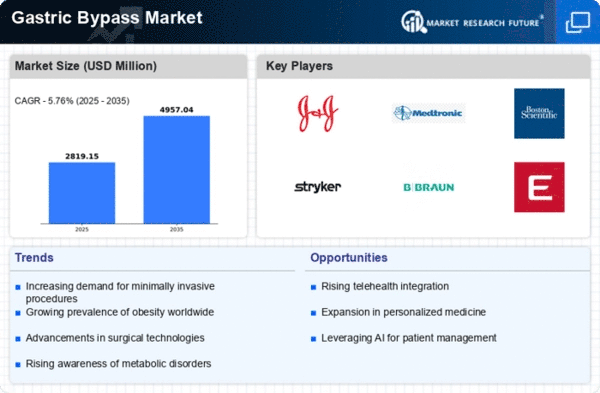
As per MRFR analysis, the Gastric Bypass Market Size was estimated at 2665.61 USD Million in 2024. The Gastric Bypass industry is projected to grow from 2849.69 in 2025 to 4957.04 by 2035, exhibiting a compound annual growth rate (CAGR) of 5.76% during the forecast period 2025 - 2035.

Key Market Trends & Highlights

The Gastric Bypass Market is experiencing robust growth driven by rising obesity rates and technological advancements.

  • North America remains the largest market for gastric bypass procedures, reflecting a high prevalence of obesity.
  • The Asia-Pacific region is emerging as the fastest-growing market, driven by increasing healthcare access and awareness.
  • Roux-en-Y gastric bypass continues to dominate the market, while sleeve gastrectomy is witnessing rapid growth among patients.
  • Key market drivers include increasing awareness of obesity-related health risks and advancements in surgical techniques.

Market Size & Forecast

2024 Market Size 2665.61 (USD Million)
2035 Market Size 4957.04 (USD Million)
CAGR (2025 - 2035) 5.76%
Largest Regional Market Share in 2024 North America

Major Players

Johnson & Johnson (US), Medtronic (US), Boston Scientific (US), Stryker (US), B. Braun Melsungen AG (DE), Ethicon (US), Intuitive Surgical (US), Conmed Corporation (US), Hologic (US)

Market Trends

The Gastric Bypass Market is currently experiencing a notable transformation, driven by a combination of increasing obesity rates and a growing awareness of the health risks associated with excess weight. As more individuals seek effective solutions for weight management, the demand for surgical interventions, particularly gastric bypass procedures, appears to be on the rise. This trend is further supported by advancements in surgical techniques and technologies, which enhance the safety and efficacy of these operations. Additionally, the rising prevalence of comorbidities linked to obesity, such as diabetes and cardiovascular diseases, underscores the necessity for effective weight-loss strategies, thereby propelling the market forward. Moreover, the Gastric Bypass Market is likely to benefit from an expanding demographic of patients, including younger individuals who are increasingly opting for surgical options as a long-term solution to obesity. The integration of telemedicine and digital health platforms into pre- and post-operative care may also play a crucial role in improving patient outcomes and satisfaction. As healthcare systems adapt to these changes, the Gastric Bypass Market is poised for continued growth, reflecting a broader shift towards proactive health management and surgical interventions as viable solutions for obesity-related challenges.

Rising Obesity Rates

The increasing prevalence of obesity worldwide is a primary driver of the Gastric Bypass Market. As more individuals struggle with weight management, the demand for surgical options is likely to grow, highlighting the need for effective interventions.

Technological Advancements

Innovations in surgical techniques and equipment are enhancing the safety and effectiveness of gastric bypass procedures. These advancements may lead to improved patient outcomes and a higher acceptance rate among potential candidates.

Demographic Shifts

An emerging trend involves younger populations seeking surgical solutions for obesity. This shift could reshape the Gastric Bypass Market, as younger patients may have different expectations and recovery needs compared to older demographics.

Gastric Bypass Market Market Drivers

Rising Obesity Rates

The increasing prevalence of obesity worldwide serves as a primary driver for the Global Gastric Bypass Market Industry. According to recent data, obesity rates have surged, with over 650 million adults classified as obese globally. This alarming trend necessitates effective weight loss solutions, such as gastric bypass surgery, which is recognized for its efficacy in achieving significant weight loss and improving obesity-related comorbidities. As a result, the market is projected to grow from 0.55 USD Billion in 2024 to 1.86 USD Billion by 2035, reflecting a compound annual growth rate of 11.8% from 2025 to 2035.

Market Growth Projections

The Global Gastric Bypass Market Industry is projected to experience substantial growth over the next decade. The market is expected to expand from 0.55 USD Billion in 2024 to an estimated 1.86 USD Billion by 2035. This growth trajectory indicates a compound annual growth rate of 11.8% from 2025 to 2035. Such projections highlight the increasing demand for gastric bypass surgeries as a solution for obesity management, driven by various factors including rising obesity rates, advancements in surgical techniques, and supportive healthcare policies.

Supportive Healthcare Policies

Supportive healthcare policies and insurance coverage for bariatric surgeries are fostering growth in the Global Gastric Bypass Market Industry. Many countries are recognizing the long-term health benefits and cost savings associated with treating obesity through surgical interventions. As a result, an increasing number of insurance providers are offering coverage for gastric bypass procedures, making them more accessible to patients. This trend is expected to drive market growth, as financial barriers diminish and more individuals pursue surgical options for weight management.

Increased Awareness and Acceptance

The growing awareness and acceptance of gastric bypass surgery as a viable weight loss option contribute to the expansion of the Global Gastric Bypass Market Industry. Public health campaigns and educational initiatives have successfully informed individuals about the benefits and risks associated with the procedure. This increased awareness has led to a greater willingness among patients to consider surgical options for obesity management. Consequently, the market is likely to experience substantial growth as more individuals seek out gastric bypass as a solution to their weight-related health issues.

Rising Prevalence of Comorbidities

The rising prevalence of obesity-related comorbidities, such as type 2 diabetes, hypertension, and sleep apnea, is a significant driver of the Global Gastric Bypass Market Industry. These conditions are often exacerbated by obesity, leading to a higher demand for effective treatment options. Gastric bypass surgery not only aids in weight loss but also has been shown to improve or resolve many of these comorbidities. As healthcare providers increasingly recognize the importance of addressing these interconnected health issues, the market for gastric bypass procedures is anticipated to grow.

Advancements in Surgical Techniques

Innovations in surgical techniques and technologies are propelling the Global Gastric Bypass Market Industry forward. Minimally invasive procedures, such as laparoscopic gastric bypass, have gained popularity due to their reduced recovery times and lower complication rates. These advancements not only enhance patient outcomes but also increase the number of eligible candidates for surgery. As healthcare providers adopt these modern techniques, the market is expected to expand significantly, catering to a growing demand for safer and more effective weight loss surgeries.

Market Segment Insights

By Surgical Procedure Type: Roux-en-Y Gastric Bypass (Largest) vs. Sleeve Gastrectomy (Fastest-Growing)

In the Gastric Bypass Market, the distribution of market share among surgical procedure types reveals that Roux-en-Y Gastric Bypass holds a significant position as the largest segment. It appeals to many patients due to its established effectiveness and favorable outcomes over the years. In contrast, Sleeve Gastrectomy has rapidly gained traction, becoming the fastest-growing segment, driven by its minimally invasive nature and enhanced recovery times, attracting both patients and healthcare providers alike.

Roux-en-Y Gastric Bypass (Dominant) vs. Sleeve Gastrectomy (Emerging)

Roux-en-Y Gastric Bypass is characterized by its long-standing history of use, providing a balanced approach to weight loss by altering both the stomach and small intestine. This procedure offers notable weight loss outcomes, sustaining its dominance in the market despite the rise of newer techniques. Sleeve Gastrectomy, on the other hand, is an emerging surgical option that involves removing a portion of the stomach to limit food intake. Its rise is attributed to lower risks and shorter hospital stays, making it an increasingly popular choice among patients seeking effective weight loss solutions.

By Patient Demographics: Obesity Class III (Largest) vs. Age Group 36-50 (Fastest-Growing)

<p>The Gastric Bypass Market's patient demographics reveal that Obesity Class III patients constitute a significant portion of the market, primarily driven by the increasing prevalence of severe obesity in various regions. This class accounts for the majority of bariatric surgeries, as patients often meet the criteria for surgical intervention. In contrast, the Age Group 36-50 is emerging rapidly, reflecting a growing awareness and acceptance of surgical options among middle-aged individuals, who are increasingly facing obesity-related health challenges.</p>

<p>Obesity Class III (Dominant) vs. Age Group 36-50 (Emerging)</p>

<p>Obesity Class III includes individuals with a body mass index (BMI) of 40 or more, categorizing them as severely obese. This demographic is often prioritized for gastric bypass surgeries due to their higher risk of comorbidities such as heart disease, diabetes, and hypertension. These patients typically seek surgical intervention as a critical step towards substantial weight loss and improved health outcomes. Meanwhile, the Age Group 36-50 is considered an emerging segment, as this age bracket is increasingly exposed to lifestyle-related health risks. The growing acceptance of gastric bypass as a safe and effective solution among these individuals, coupled with a proactive approach to health management, is propelling this demographic's participation in the market.</p>

By Postoperative Complications: Nutritional Deficiencies (Largest) vs. Dumping Syndrome (Fastest-Growing)

<p>Within the gastric bypass market, postoperative complications are critical factors impacting patient outcomes and management strategies. Nutritional deficiencies represent the largest segment, arising from the malabsorption effects post-surgery. Following this, dumping syndrome has emerged as the fastest-growing concern, with an increasing number of patients reporting symptoms that complicate their recovery process. In contrast, gastroesophageal reflux disease (GERD) and surgical site infections are also prevalent but do not exhibit the same rapid growth trends as nutritional deficiencies and dumping syndrome. The market shows a distinct pattern where the complexity of post-bypass care increases the importance of addressing these complications, thus driving growth in related therapeutic and nutritional solutions.</p>

<p>Nutritional Deficiencies (Dominant) vs. Dumping Syndrome (Emerging)</p>

<p>Nutritional deficiencies after gastric bypass surgery remain a dominant concern, primarily characterized by conditions such as vitamin B12 deficiency, anemia, and protein malnutrition. These deficiencies necessitate ongoing dietary management and supplementation, significantly impacting patient quality of life. As practitioners become more aware of these complications, they increasingly recommend proactive nutritional assessments and interventions. Conversely, dumping syndrome has surfaced as an emerging challenge characterized by symptoms like nausea, diarrhea, and abdominal pain following meals. This condition reflects the changes in gastric capacity and motility after surgery, making education on dietary habits crucial. The growing patient population and their experiences with these complications are prompting advancements in treatment options and dietary guidelines.</p>

By Surgical Techniques: Laparoscopic Surgery (Largest) vs. Robotic Surgery (Fastest-Growing)

<p>In the Gastric Bypass Market, surgical techniques are pivotal in determining treatment outcomes and patient satisfaction. Laparoscopic Surgery currently leads the market as the most prevalent technique, favored for its minimally invasive approach which results in shorter recovery times and lower complication rates. Open Surgery, while still in practice, has seen a decline in favorability due to its invasive nature. In contrast, Robotic Surgery, characterized by its precision and enhanced visualization, is gaining traction and is expected to grow rapidly in the coming years.</p>

<p>Surgical Technique: Laparoscopic Surgery (Dominant) vs. Robotic Surgery (Emerging)</p>

<p>Laparoscopic Surgery is the dominant technique in the Gastric Bypass Market, attributed to its reduced surgical trauma and expedited recovery for patients. This technique traditionally utilizes several small incisions and is known to offer various advantages such as less postoperative pain and shorter hospitalization. On the other hand, Robotic Surgery, although newer and currently an emerging choice, is rapidly becoming favorable due to its technological advancements that allow for increased dexterity and accuracy. Its adoption is primarily driven by surgeon preference for enhanced surgical outcomes and patient desirability for innovative treatment options.</p>

By Healthcare Setting: Hospital (Largest) vs. Ambulatory Surgical Center (Fastest-Growing)

<p>In the Gastric Bypass Market, the distribution among healthcare settings reveals that hospitals lead as the largest segment, accommodating the majority of procedures. Ambulatory surgical centers follow, benefiting from a growing number of patients opting for outpatient care. Specialty clinics, while significant, cater to a smaller clientele focused on personalized care, which limits their market share compared to the more established settings. Growth trends indicate a robust expansion within ambulatory surgical centers, driven by advancements in minimally invasive techniques and the increasing preference for outpatient services among patients. The rising awareness of obesity and its associated health risks has resulted in a growing demand for gastric bypass procedures, stimulating interest and investment in these facilities. As healthcare systems evolve, a trend towards offering more services in outpatient settings is expected to accelerate further growth in this segment.</p>

<p>Hospital (Dominant) vs. Specialty Clinic (Emerging)</p>

<p>Hospitals represent the dominant force in the Gastric Bypass Market, offering comprehensive surgical care, advanced technology, and a multidisciplinary approach to obesity treatment. These institutions provide extensive resources, including preoperative evaluations and postoperative care, which contribute to their prominence in the market. On the other hand, specialty clinics are emerging as vital players, catering to patients seeking tailored weight loss programs and personalized attention. While these clinics may have fewer resources, their focused approach and strong patient relationships enable them to carve out a niche. The patient-centered care offered by specialty clinics appeals to individuals looking for a customized experience in their weight-loss journey, thus driving their growth in a competitive landscape.</p>

Get more detailed insights about Gastric Bypass Market Research Report - Forecast till 2035

Regional Insights

North America : Market Leader in Innovation

North America continues to lead the gastric bypass market, holding a significant share of 1339.0M in 2024. The region's growth is driven by increasing obesity rates, rising healthcare expenditure, and advancements in surgical techniques. Regulatory support from agencies like the FDA has also catalyzed market expansion, ensuring safety and efficacy in procedures. The demand for minimally invasive surgeries is on the rise, further propelling market growth. The competitive landscape in North America is robust, featuring key players such as Johnson & Johnson, Medtronic, and Boston Scientific. These companies are at the forefront of innovation, developing advanced surgical tools and techniques. The U.S. remains the largest market, with a strong focus on research and development. The presence of established healthcare infrastructure and a growing awareness of obesity-related health issues contribute to the region's dominance in the gastric bypass market.

Europe : Emerging Market with Potential

Europe's gastric bypass market is valued at 800.0M, driven by increasing obesity rates and a growing emphasis on surgical weight loss solutions. Regulatory bodies are actively promoting guidelines to ensure patient safety and improve surgical outcomes. The European market is witnessing a shift towards innovative surgical techniques, including robotic-assisted surgeries, which are gaining traction among healthcare providers. The demand for effective weight management solutions is expected to fuel market growth in the coming years. Leading countries in Europe include Germany, France, and the UK, where healthcare systems are increasingly adopting advanced surgical methods. Key players like B. Braun Melsungen AG and Ethicon are investing in research and development to enhance their product offerings. The competitive landscape is characterized by a mix of established companies and emerging startups, all striving to capture market share in this evolving sector.

Asia-Pacific : Rapidly Growing Market

The Asia-Pacific gastric bypass market, valued at 400.0M, is experiencing rapid growth due to rising obesity rates and increasing healthcare access. Countries like China and India are witnessing a surge in demand for bariatric surgeries, driven by lifestyle changes and urbanization. Regulatory frameworks are evolving to support the adoption of advanced surgical techniques, which is expected to further boost market growth. The region's focus on improving healthcare infrastructure is also a significant driver. In the competitive landscape, key players such as Intuitive Surgical and Conmed Corporation are expanding their presence in the Asia-Pacific region. The market is characterized by a mix of local and international companies, all vying for a share of the growing demand for gastric bypass procedures. As awareness of obesity-related health issues increases, the market is poised for significant expansion in the coming years.

Middle East and Africa : Emerging Market Opportunities

The Middle East and Africa gastric bypass market is valued at 126.61M, with significant growth potential driven by rising obesity rates and increasing healthcare investments. Countries like the UAE and South Africa are focusing on enhancing their healthcare systems, which is expected to facilitate the adoption of advanced surgical techniques. Regulatory bodies are beginning to establish guidelines to ensure the safety and efficacy of bariatric surgeries, which will further support market growth. The competitive landscape in this region is evolving, with key players like Hologic and Stryker making inroads into the market. The presence of both local and international companies is fostering innovation and improving access to gastric bypass procedures. As awareness of obesity-related health issues grows, the demand for effective surgical solutions is expected to rise, creating opportunities for market expansion.

Key Players and Competitive Insights

The Gastric Bypass Market is characterized by a dynamic competitive landscape, driven by increasing obesity rates and a growing demand for effective weight-loss solutions. Key players such as Johnson & Johnson (US), Medtronic (US), and Ethicon (US) are strategically positioned to leverage innovation and technological advancements. Johnson & Johnson (US) focuses on enhancing surgical outcomes through the development of minimally invasive techniques, while Medtronic (US) emphasizes the integration of digital health solutions to improve patient monitoring and post-operative care. Ethicon (US), a subsidiary of Johnson & Johnson, is also investing in advanced surgical instruments that facilitate precision in gastric bypass procedures. Collectively, these strategies contribute to a competitive environment that prioritizes patient outcomes and operational efficiency.In terms of business tactics, companies are increasingly localizing manufacturing to reduce costs and enhance supply chain resilience. The market appears moderately fragmented, with several players vying for market share. However, the collective influence of major companies like Boston Scientific (US) and Stryker (US) is notable, as they engage in strategic partnerships and collaborations to expand their product offerings and geographical reach. This collaborative approach not only strengthens their market position but also fosters innovation through shared expertise.

In November Boston Scientific (US) announced the launch of a new line of advanced endoscopic tools designed specifically for bariatric surgery. This strategic move is significant as it aligns with the growing trend towards less invasive surgical options, potentially enhancing patient recovery times and overall satisfaction. By introducing these innovative tools, Boston Scientific (US) aims to capture a larger share of the gastric bypass market, responding to the increasing demand for effective and efficient surgical solutions.

In October Stryker (US) expanded its product portfolio by acquiring a leading manufacturer of surgical robotics. This acquisition is likely to bolster Stryker's capabilities in the gastric bypass segment, as robotic-assisted surgeries are gaining traction due to their precision and reduced recovery times. The integration of advanced robotics into their offerings may position Stryker (US) as a frontrunner in the market, appealing to both surgeons and patients seeking cutting-edge surgical options.

In September Medtronic (US) launched a comprehensive digital health platform aimed at enhancing patient engagement and post-operative care for gastric bypass patients. This initiative underscores the growing importance of digitalization in healthcare, as it allows for real-time monitoring and personalized care plans. By investing in digital health solutions, Medtronic (US) not only improves patient outcomes but also strengthens its competitive edge in a market increasingly focused on technology-driven solutions.

As of December the Gastric Bypass Market is witnessing trends that emphasize digitalization, sustainability, and the integration of artificial intelligence (AI) in surgical procedures. Strategic alliances among key players are shaping the competitive landscape, fostering innovation and enhancing operational efficiencies. The shift from price-based competition to a focus on technological advancements and supply chain reliability is evident. Moving forward, competitive differentiation will likely hinge on the ability to innovate and adapt to evolving patient needs, with a strong emphasis on improving surgical outcomes and patient experiences.

Key Companies in the Gastric Bypass Market include

Industry Developments

The Incisionless Operating PlatformTM from USGI Medical, which includes the g-CathTM EZ Delivery Catheter with Snowshoe® suture anchors, g-Prox® EZ, g-LixTM, and Transport®, reduces the need for external abdominal incisions by giving doctors the tools they need to perform minimally invasive procedures through a patient's mouth or other natural orifices. Notably, USGI Medical has established the capacity to fixate and plicate stomach tissue consistently and durably without the use of an incision.

According to Emergent Research's latest estimate, the worldwide bariatric surgery market is predicted to reach USD 4.81 billion by 2028, with a stable CAGR of 9.0 percent. Worldwide obesity concerns are driving the global bariatric surgery market's revenue growth to a large extent. Obesity is a serious public health issue that has fueled the demand for gastric bypass surgery in nations all over the world. Concerns about infection after surgery are a major factor causing some people to be hesitant to undergo procedures, which is limiting the market growth.

Intended Audience

  • Medical Devices Companies
  • Research and Development (R&D) Companies
  • Government Research Institute
  • Academic Institutes and Universities

Future Outlook

Gastric Bypass Market Future Outlook

The Gastric Bypass Market is projected to grow at a 5.76% CAGR from 2025 to 2035, driven by increasing obesity rates, technological advancements, and rising healthcare expenditure.

New opportunities lie in:

  • Expansion of telehealth services for pre- and post-operative care
  • Development of minimally invasive surgical techniques
  • Partnerships with insurance providers for better coverage options

By 2035, the Gastric Bypass Market is expected to be robust, reflecting sustained growth and innovation.

Market Segmentation

Gastric Bypass Market Postoperative Care Outlook

  • Nutritional Counseling
  • Psychological Support
  • Physical Therapy

Gastric Bypass Market Surgical Technique Outlook

  • Open Surgery
  • Laparoscopic Surgery
  • Robotic Surgery

Gastric Bypass Market Patient Demographics Outlook

  • Age Group
  • Gender
  • Body Mass Index
  • Comorbid Conditions

Gastric Bypass Market Surgical Procedure Type Outlook

  • Roux-en-Y Gastric Bypass
  • Sleeve Gastrectomy
  • Biliopancreatic Diversion
  • Duodenal Switch

Report Scope

MARKET SIZE 2024 2665.61(USD Million)
MARKET SIZE 2025 2849.69(USD Million)
MARKET SIZE 2035 4957.04(USD Million)
COMPOUND ANNUAL GROWTH RATE (CAGR) 5.76% (2025 - 2035)
REPORT COVERAGE Revenue Forecast, Competitive Landscape, Growth Factors, and Trends
BASE YEAR 2024
Market Forecast Period 2025 - 2035
Historical Data 2019 - 2024
Market Forecast Units USD Million
Key Companies Profiled Johnson & Johnson (US), Medtronic (US), Boston Scientific (US), Stryker (US), B. Braun Melsungen AG (DE), Ethicon (US), Intuitive Surgical (US), Conmed Corporation (US), Hologic (US)
Segments Covered Surgical Procedure Type, Patient Demographics, Surgical Technique, Postoperative Care
Key Market Opportunities Integration of advanced minimally invasive techniques enhances patient outcomes in the Gastric Bypass Market.
Key Market Dynamics Rising consumer awareness and technological advancements drive growth in the gastric bypass market, influencing competitive dynamics.
Countries Covered North America, Europe, APAC, South America, MEA

FAQs

What is the current valuation of the Gastric Bypass Market as of 2024?

<p>The Gastric Bypass Market was valued at approximately 2665.61 USD Million in 2024.</p>

What is the projected market valuation for the Gastric Bypass Market in 2035?

<p>The market is projected to reach approximately 4957.04 USD Million by 2035.</p>

What is the expected CAGR for the Gastric Bypass Market during the forecast period 2025 - 2035?

<p>The expected CAGR for the Gastric Bypass Market during the forecast period 2025 - 2035 is 5.76%.</p>

Which surgical procedure type holds the highest market value in the Gastric Bypass Market?

<p>The Roux-en-Y Gastric Bypass procedure held the highest market value at approximately 1980.0 USD Million.</p>

How does the market value for Obesity Class III patients compare to other obesity classes?

<p>The market value for Obesity Class III patients is projected to be around 2500.0 USD Million, indicating a substantial share.</p>

What are the projected market values for different surgical techniques in the Gastric Bypass Market?

Laparoscopic Surgery is projected to dominate with values reaching up to 2980.0 USD Million.

Which healthcare setting is expected to have the highest market valuation in the Gastric Bypass Market?

Hospitals are expected to have the highest market valuation, projected at around 2200.0 USD Million.

What are the anticipated postoperative complications and their market values?

Nutritional Deficiencies are projected to have a market value of approximately 1000.0 USD Million.

Who are the key players in the Gastric Bypass Market?

Key players include Johnson &amp; Johnson, Medtronic, and Boston Scientific, among others.

What is the market value range for Sleeve Gastrectomy procedures?

The market value for Sleeve Gastrectomy procedures is projected to range from 800.0 to 1500.0 USD Million.

  1. SECTION I: EXECUTIVE SUMMARY AND KEY HIGHLIGHTS
    1. | 1.1 EXECUTIVE SUMMARY
    2. | | 1.1.1 Market Overview
    3. | | 1.1.2 Key Findings
    4. | | 1.1.3 Market Segmentation
    5. | | 1.1.4 Competitive Landscape
    6. | | 1.1.5 Challenges and Opportunities
    7. | | 1.1.6 Future Outlook
  2. SECTION II: SCOPING, METHODOLOGY AND MARKET STRUCTURE
    1. | 2.1 MARKET INTRODUCTION
    2. | | 2.1.1 Definition
    3. | | 2.1.2 Scope of the study
    4. | | | 2.1.2.1 Research Objective
    5. | | | 2.1.2.2 Assumption
    6. | | | 2.1.2.3 Limitations
    7. | 2.2 RESEARCH METHODOLOGY
    8. | | 2.2.1 Overview
    9. | | 2.2.2 Data Mining
    10. | | 2.2.3 Secondary Research
    11. | | 2.2.4 Primary Research
    12. | | | 2.2.4.1 Primary Interviews and Information Gathering Process
    13. | | | 2.2.4.2 Breakdown of Primary Respondents
    14. | | 2.2.5 Forecasting Model
    15. | | 2.2.6 Market Size Estimation
    16. | | | 2.2.6.1 Bottom-Up Approach
    17. | | | 2.2.6.2 Top-Down Approach
    18. | | 2.2.7 Data Triangulation
    19. | | 2.2.8 Validation
  3. SECTION III: QUALITATIVE ANALYSIS
    1. | 3.1 MARKET DYNAMICS
    2. | | 3.1.1 Overview
    3. | | 3.1.2 Drivers
    4. | | 3.1.3 Restraints
    5. | | 3.1.4 Opportunities
    6. | 3.2 MARKET FACTOR ANALYSIS
    7. | | 3.2.1 Value chain Analysis
    8. | | 3.2.2 Porter's Five Forces Analysis
    9. | | | 3.2.2.1 Bargaining Power of Suppliers
    10. | | | 3.2.2.2 Bargaining Power of Buyers
    11. | | | 3.2.2.3 Threat of New Entrants
    12. | | | 3.2.2.4 Threat of Substitutes
    13. | | | 3.2.2.5 Intensity of Rivalry
    14. | | 3.2.3 COVID-19 Impact Analysis
    15. | | | 3.2.3.1 Market Impact Analysis
    16. | | | 3.2.3.2 Regional Impact
    17. | | | 3.2.3.3 Opportunity and Threat Analysis
  4. SECTION IV: QUANTITATIVE ANALYSIS
    1. | 4.1 Healthcare, BY Surgical Procedure Type (USD Million)
    2. | | 4.1.1 Roux-en-Y Gastric Bypass
    3. | | 4.1.2 Sleeve Gastrectomy
    4. | | 4.1.3 Biliopancreatic Diversion
    5. | | 4.1.4 Adjustable Gastric Banding
    6. | 4.2 Healthcare, BY Patient Demographics (USD Million)
    7. | | 4.2.1 Obesity Class I
    8. | | 4.2.2 Obesity Class II
    9. | | 4.2.3 Obesity Class III
    10. | | 4.2.4 Age Group 18-35
    11. | | 4.2.5 Age Group 36-50
    12. | 4.3 Healthcare, BY Postoperative Complications (USD Million)
    13. | | 4.3.1 Nutritional Deficiencies
    14. | | 4.3.2 Dumping Syndrome
    15. | | 4.3.3 Gastroesophageal Reflux Disease
    16. | | 4.3.4 Surgical Site Infections
    17. | 4.4 Healthcare, BY Surgical Techniques (USD Million)
    18. | | 4.4.1 Laparoscopic Surgery
    19. | | 4.4.2 Open Surgery
    20. | | 4.4.3 Robotic Surgery
    21. | 4.5 Healthcare, BY Healthcare Setting (USD Million)
    22. | | 4.5.1 Hospital
    23. | | 4.5.2 Ambulatory Surgical Center
    24. | | 4.5.3 Specialty Clinic
    25. | 4.6 Healthcare, BY Region (USD Million)
    26. | | 4.6.1 North America
    27. | | | 4.6.1.1 US
    28. | | | 4.6.1.2 Canada
    29. | | 4.6.2 Europe
    30. | | | 4.6.2.1 Germany
    31. | | | 4.6.2.2 UK
    32. | | | 4.6.2.3 France
    33. | | | 4.6.2.4 Russia
    34. | | | 4.6.2.5 Italy
    35. | | | 4.6.2.6 Spain
    36. | | | 4.6.2.7 Rest of Europe
    37. | | 4.6.3 APAC
    38. | | | 4.6.3.1 China
    39. | | | 4.6.3.2 India
    40. | | | 4.6.3.3 Japan
    41. | | | 4.6.3.4 South Korea
    42. | | | 4.6.3.5 Malaysia
    43. | | | 4.6.3.6 Thailand
    44. | | | 4.6.3.7 Indonesia
    45. | | | 4.6.3.8 Rest of APAC
    46. | | 4.6.4 South America
    47. | | | 4.6.4.1 Brazil
    48. | | | 4.6.4.2 Mexico
    49. | | | 4.6.4.3 Argentina
    50. | | | 4.6.4.4 Rest of South America
    51. | | 4.6.5 MEA
    52. | | | 4.6.5.1 GCC Countries
    53. | | | 4.6.5.2 South Africa
    54. | | | 4.6.5.3 Rest of MEA
  5. SECTION V: COMPETITIVE ANALYSIS
    1. | 5.1 Competitive Landscape
    2. | | 5.1.1 Overview
    3. | | 5.1.2 Competitive Analysis
    4. | | 5.1.3 Market share Analysis
    5. | | 5.1.4 Major Growth Strategy in the Healthcare
    6. | | 5.1.5 Competitive Benchmarking
    7. | | 5.1.6 Leading Players in Terms of Number of Developments in the Healthcare
    8. | | 5.1.7 Key developments and growth strategies
    9. | | | 5.1.7.1 New Product Launch/Service Deployment
    10. | | | 5.1.7.2 Merger & Acquisitions
    11. | | | 5.1.7.3 Joint Ventures
    12. | | 5.1.8 Major Players Financial Matrix
    13. | | | 5.1.8.1 Sales and Operating Income
    14. | | | 5.1.8.2 Major Players R&D Expenditure. 2023
    15. | 5.2 Company Profiles
    16. | | 5.2.1 Johnson & Johnson (US)
    17. | | | 5.2.1.1 Financial Overview
    18. | | | 5.2.1.2 Products Offered
    19. | | | 5.2.1.3 Key Developments
    20. | | | 5.2.1.4 SWOT Analysis
    21. | | | 5.2.1.5 Key Strategies
    22. | | 5.2.2 Medtronic (US)
    23. | | | 5.2.2.1 Financial Overview
    24. | | | 5.2.2.2 Products Offered
    25. | | | 5.2.2.3 Key Developments
    26. | | | 5.2.2.4 SWOT Analysis
    27. | | | 5.2.2.5 Key Strategies
    28. | | 5.2.3 Boston Scientific (US)
    29. | | | 5.2.3.1 Financial Overview
    30. | | | 5.2.3.2 Products Offered
    31. | | | 5.2.3.3 Key Developments
    32. | | | 5.2.3.4 SWOT Analysis
    33. | | | 5.2.3.5 Key Strategies
    34. | | 5.2.4 Stryker (US)
    35. | | | 5.2.4.1 Financial Overview
    36. | | | 5.2.4.2 Products Offered
    37. | | | 5.2.4.3 Key Developments
    38. | | | 5.2.4.4 SWOT Analysis
    39. | | | 5.2.4.5 Key Strategies
    40. | | 5.2.5 B. Braun Melsungen AG (DE)
    41. | | | 5.2.5.1 Financial Overview
    42. | | | 5.2.5.2 Products Offered
    43. | | | 5.2.5.3 Key Developments
    44. | | | 5.2.5.4 SWOT Analysis
    45. | | | 5.2.5.5 Key Strategies
    46. | | 5.2.6 Ethicon (US)
    47. | | | 5.2.6.1 Financial Overview
    48. | | | 5.2.6.2 Products Offered
    49. | | | 5.2.6.3 Key Developments
    50. | | | 5.2.6.4 SWOT Analysis
    51. | | | 5.2.6.5 Key Strategies
    52. | | 5.2.7 Intuitive Surgical (US)
    53. | | | 5.2.7.1 Financial Overview
    54. | | | 5.2.7.2 Products Offered
    55. | | | 5.2.7.3 Key Developments
    56. | | | 5.2.7.4 SWOT Analysis
    57. | | | 5.2.7.5 Key Strategies
    58. | | 5.2.8 Conmed Corporation (US)
    59. | | | 5.2.8.1 Financial Overview
    60. | | | 5.2.8.2 Products Offered
    61. | | | 5.2.8.3 Key Developments
    62. | | | 5.2.8.4 SWOT Analysis
    63. | | | 5.2.8.5 Key Strategies
    64. | | 5.2.9 Hologic (US)
    65. | | | 5.2.9.1 Financial Overview
    66. | | | 5.2.9.2 Products Offered
    67. | | | 5.2.9.3 Key Developments
    68. | | | 5.2.9.4 SWOT Analysis
    69. | | | 5.2.9.5 Key Strategies
    70. | 5.3 Appendix
    71. | | 5.3.1 References
    72. | | 5.3.2 Related Reports
  6. LIST OF FIGURES
    1. | 6.1 MARKET SYNOPSIS
    2. | 6.2 NORTH AMERICA MARKET ANALYSIS
    3. | 6.3 US MARKET ANALYSIS BY SURGICAL PROCEDURE TYPE
    4. | 6.4 US MARKET ANALYSIS BY PATIENT DEMOGRAPHICS
    5. | 6.5 US MARKET ANALYSIS BY POSTOPERATIVE COMPLICATIONS
    6. | 6.6 US MARKET ANALYSIS BY SURGICAL TECHNIQUES
    7. | 6.7 US MARKET ANALYSIS BY HEALTHCARE SETTING
    8. | 6.8 CANADA MARKET ANALYSIS BY SURGICAL PROCEDURE TYPE
    9. | 6.9 CANADA MARKET ANALYSIS BY PATIENT DEMOGRAPHICS
    10. | 6.10 CANADA MARKET ANALYSIS BY POSTOPERATIVE COMPLICATIONS
    11. | 6.11 CANADA MARKET ANALYSIS BY SURGICAL TECHNIQUES
    12. | 6.12 CANADA MARKET ANALYSIS BY HEALTHCARE SETTING
    13. | 6.13 EUROPE MARKET ANALYSIS
    14. | 6.14 GERMANY MARKET ANALYSIS BY SURGICAL PROCEDURE TYPE
    15. | 6.15 GERMANY MARKET ANALYSIS BY PATIENT DEMOGRAPHICS
    16. | 6.16 GERMANY MARKET ANALYSIS BY POSTOPERATIVE COMPLICATIONS
    17. | 6.17 GERMANY MARKET ANALYSIS BY SURGICAL TECHNIQUES
    18. | 6.18 GERMANY MARKET ANALYSIS BY HEALTHCARE SETTING
    19. | 6.19 UK MARKET ANALYSIS BY SURGICAL PROCEDURE TYPE
    20. | 6.20 UK MARKET ANALYSIS BY PATIENT DEMOGRAPHICS
    21. | 6.21 UK MARKET ANALYSIS BY POSTOPERATIVE COMPLICATIONS
    22. | 6.22 UK MARKET ANALYSIS BY SURGICAL TECHNIQUES
    23. | 6.23 UK MARKET ANALYSIS BY HEALTHCARE SETTING
    24. | 6.24 FRANCE MARKET ANALYSIS BY SURGICAL PROCEDURE TYPE
    25. | 6.25 FRANCE MARKET ANALYSIS BY PATIENT DEMOGRAPHICS
    26. | 6.26 FRANCE MARKET ANALYSIS BY POSTOPERATIVE COMPLICATIONS
    27. | 6.27 FRANCE MARKET ANALYSIS BY SURGICAL TECHNIQUES
    28. | 6.28 FRANCE MARKET ANALYSIS BY HEALTHCARE SETTING
    29. | 6.29 RUSSIA MARKET ANALYSIS BY SURGICAL PROCEDURE TYPE
    30. | 6.30 RUSSIA MARKET ANALYSIS BY PATIENT DEMOGRAPHICS
    31. | 6.31 RUSSIA MARKET ANALYSIS BY POSTOPERATIVE COMPLICATIONS
    32. | 6.32 RUSSIA MARKET ANALYSIS BY SURGICAL TECHNIQUES
    33. | 6.33 RUSSIA MARKET ANALYSIS BY HEALTHCARE SETTING
    34. | 6.34 ITALY MARKET ANALYSIS BY SURGICAL PROCEDURE TYPE
    35. | 6.35 ITALY MARKET ANALYSIS BY PATIENT DEMOGRAPHICS
    36. | 6.36 ITALY MARKET ANALYSIS BY POSTOPERATIVE COMPLICATIONS
    37. | 6.37 ITALY MARKET ANALYSIS BY SURGICAL TECHNIQUES
    38. | 6.38 ITALY MARKET ANALYSIS BY HEALTHCARE SETTING
    39. | 6.39 SPAIN MARKET ANALYSIS BY SURGICAL PROCEDURE TYPE
    40. | 6.40 SPAIN MARKET ANALYSIS BY PATIENT DEMOGRAPHICS
    41. | 6.41 SPAIN MARKET ANALYSIS BY POSTOPERATIVE COMPLICATIONS
    42. | 6.42 SPAIN MARKET ANALYSIS BY SURGICAL TECHNIQUES
    43. | 6.43 SPAIN MARKET ANALYSIS BY HEALTHCARE SETTING
    44. | 6.44 REST OF EUROPE MARKET ANALYSIS BY SURGICAL PROCEDURE TYPE
    45. | 6.45 REST OF EUROPE MARKET ANALYSIS BY PATIENT DEMOGRAPHICS
    46. | 6.46 REST OF EUROPE MARKET ANALYSIS BY POSTOPERATIVE COMPLICATIONS
    47. | 6.47 REST OF EUROPE MARKET ANALYSIS BY SURGICAL TECHNIQUES
    48. | 6.48 REST OF EUROPE MARKET ANALYSIS BY HEALTHCARE SETTING
    49. | 6.49 APAC MARKET ANALYSIS
    50. | 6.50 CHINA MARKET ANALYSIS BY SURGICAL PROCEDURE TYPE
    51. | 6.51 CHINA MARKET ANALYSIS BY PATIENT DEMOGRAPHICS
    52. | 6.52 CHINA MARKET ANALYSIS BY POSTOPERATIVE COMPLICATIONS
    53. | 6.53 CHINA MARKET ANALYSIS BY SURGICAL TECHNIQUES
    54. | 6.54 CHINA MARKET ANALYSIS BY HEALTHCARE SETTING
    55. | 6.55 INDIA MARKET ANALYSIS BY SURGICAL PROCEDURE TYPE
    56. | 6.56 INDIA MARKET ANALYSIS BY PATIENT DEMOGRAPHICS
    57. | 6.57 INDIA MARKET ANALYSIS BY POSTOPERATIVE COMPLICATIONS
    58. | 6.58 INDIA MARKET ANALYSIS BY SURGICAL TECHNIQUES
    59. | 6.59 INDIA MARKET ANALYSIS BY HEALTHCARE SETTING
    60. | 6.60 JAPAN MARKET ANALYSIS BY SURGICAL PROCEDURE TYPE
    61. | 6.61 JAPAN MARKET ANALYSIS BY PATIENT DEMOGRAPHICS
    62. | 6.62 JAPAN MARKET ANALYSIS BY POSTOPERATIVE COMPLICATIONS
    63. | 6.63 JAPAN MARKET ANALYSIS BY SURGICAL TECHNIQUES
    64. | 6.64 JAPAN MARKET ANALYSIS BY HEALTHCARE SETTING
    65. | 6.65 SOUTH KOREA MARKET ANALYSIS BY SURGICAL PROCEDURE TYPE
    66. | 6.66 SOUTH KOREA MARKET ANALYSIS BY PATIENT DEMOGRAPHICS
    67. | 6.67 SOUTH KOREA MARKET ANALYSIS BY POSTOPERATIVE COMPLICATIONS
    68. | 6.68 SOUTH KOREA MARKET ANALYSIS BY SURGICAL TECHNIQUES
    69. | 6.69 SOUTH KOREA MARKET ANALYSIS BY HEALTHCARE SETTING
    70. | 6.70 MALAYSIA MARKET ANALYSIS BY SURGICAL PROCEDURE TYPE
    71. | 6.71 MALAYSIA MARKET ANALYSIS BY PATIENT DEMOGRAPHICS
    72. | 6.72 MALAYSIA MARKET ANALYSIS BY POSTOPERATIVE COMPLICATIONS
    73. | 6.73 MALAYSIA MARKET ANALYSIS BY SURGICAL TECHNIQUES
    74. | 6.74 MALAYSIA MARKET ANALYSIS BY HEALTHCARE SETTING
    75. | 6.75 THAILAND MARKET ANALYSIS BY SURGICAL PROCEDURE TYPE
    76. | 6.76 THAILAND MARKET ANALYSIS BY PATIENT DEMOGRAPHICS
    77. | 6.77 THAILAND MARKET ANALYSIS BY POSTOPERATIVE COMPLICATIONS
    78. | 6.78 THAILAND MARKET ANALYSIS BY SURGICAL TECHNIQUES
    79. | 6.79 THAILAND MARKET ANALYSIS BY HEALTHCARE SETTING
    80. | 6.80 INDONESIA MARKET ANALYSIS BY SURGICAL PROCEDURE TYPE
    81. | 6.81 INDONESIA MARKET ANALYSIS BY PATIENT DEMOGRAPHICS
    82. | 6.82 INDONESIA MARKET ANALYSIS BY POSTOPERATIVE COMPLICATIONS
    83. | 6.83 INDONESIA MARKET ANALYSIS BY SURGICAL TECHNIQUES
    84. | 6.84 INDONESIA MARKET ANALYSIS BY HEALTHCARE SETTING
    85. | 6.85 REST OF APAC MARKET ANALYSIS BY SURGICAL PROCEDURE TYPE
    86. | 6.86 REST OF APAC MARKET ANALYSIS BY PATIENT DEMOGRAPHICS
    87. | 6.87 REST OF APAC MARKET ANALYSIS BY POSTOPERATIVE COMPLICATIONS
    88. | 6.88 REST OF APAC MARKET ANALYSIS BY SURGICAL TECHNIQUES
    89. | 6.89 REST OF APAC MARKET ANALYSIS BY HEALTHCARE SETTING
    90. | 6.90 SOUTH AMERICA MARKET ANALYSIS
    91. | 6.91 BRAZIL MARKET ANALYSIS BY SURGICAL PROCEDURE TYPE
    92. | 6.92 BRAZIL MARKET ANALYSIS BY PATIENT DEMOGRAPHICS
    93. | 6.93 BRAZIL MARKET ANALYSIS BY POSTOPERATIVE COMPLICATIONS
    94. | 6.94 BRAZIL MARKET ANALYSIS BY SURGICAL TECHNIQUES
    95. | 6.95 BRAZIL MARKET ANALYSIS BY HEALTHCARE SETTING
    96. | 6.96 MEXICO MARKET ANALYSIS BY SURGICAL PROCEDURE TYPE
    97. | 6.97 MEXICO MARKET ANALYSIS BY PATIENT DEMOGRAPHICS
    98. | 6.98 MEXICO MARKET ANALYSIS BY POSTOPERATIVE COMPLICATIONS
    99. | 6.99 MEXICO MARKET ANALYSIS BY SURGICAL TECHNIQUES
    100. | 6.100 MEXICO MARKET ANALYSIS BY HEALTHCARE SETTING
    101. | 6.101 ARGENTINA MARKET ANALYSIS BY SURGICAL PROCEDURE TYPE
    102. | 6.102 ARGENTINA MARKET ANALYSIS BY PATIENT DEMOGRAPHICS
    103. | 6.103 ARGENTINA MARKET ANALYSIS BY POSTOPERATIVE COMPLICATIONS
    104. | 6.104 ARGENTINA MARKET ANALYSIS BY SURGICAL TECHNIQUES
    105. | 6.105 ARGENTINA MARKET ANALYSIS BY HEALTHCARE SETTING
    106. | 6.106 REST OF SOUTH AMERICA MARKET ANALYSIS BY SURGICAL PROCEDURE TYPE
    107. | 6.107 REST OF SOUTH AMERICA MARKET ANALYSIS BY PATIENT DEMOGRAPHICS
    108. | 6.108 REST OF SOUTH AMERICA MARKET ANALYSIS BY POSTOPERATIVE COMPLICATIONS
    109. | 6.109 REST OF SOUTH AMERICA MARKET ANALYSIS BY SURGICAL TECHNIQUES
    110. | 6.110 REST OF SOUTH AMERICA MARKET ANALYSIS BY HEALTHCARE SETTING
    111. | 6.111 MEA MARKET ANALYSIS
    112. | 6.112 GCC COUNTRIES MARKET ANALYSIS BY SURGICAL PROCEDURE TYPE
    113. | 6.113 GCC COUNTRIES MARKET ANALYSIS BY PATIENT DEMOGRAPHICS
    114. | 6.114 GCC COUNTRIES MARKET ANALYSIS BY POSTOPERATIVE COMPLICATIONS
    115. | 6.115 GCC COUNTRIES MARKET ANALYSIS BY SURGICAL TECHNIQUES
    116. | 6.116 GCC COUNTRIES MARKET ANALYSIS BY HEALTHCARE SETTING
    117. | 6.117 SOUTH AFRICA MARKET ANALYSIS BY SURGICAL PROCEDURE TYPE
    118. | 6.118 SOUTH AFRICA MARKET ANALYSIS BY PATIENT DEMOGRAPHICS
    119. | 6.119 SOUTH AFRICA MARKET ANALYSIS BY POSTOPERATIVE COMPLICATIONS
    120. | 6.120 SOUTH AFRICA MARKET ANALYSIS BY SURGICAL TECHNIQUES
    121. | 6.121 SOUTH AFRICA MARKET ANALYSIS BY HEALTHCARE SETTING
    122. | 6.122 REST OF MEA MARKET ANALYSIS BY SURGICAL PROCEDURE TYPE
    123. | 6.123 REST OF MEA MARKET ANALYSIS BY PATIENT DEMOGRAPHICS
    124. | 6.124 REST OF MEA MARKET ANALYSIS BY POSTOPERATIVE COMPLICATIONS
    125. | 6.125 REST OF MEA MARKET ANALYSIS BY SURGICAL TECHNIQUES
    126. | 6.126 REST OF MEA MARKET ANALYSIS BY HEALTHCARE SETTING
    127. | 6.127 KEY BUYING CRITERIA OF HEALTHCARE
    128. | 6.128 RESEARCH PROCESS OF MRFR
    129. | 6.129 DRO ANALYSIS OF HEALTHCARE
    130. | 6.130 DRIVERS IMPACT ANALYSIS: HEALTHCARE
    131. | 6.131 RESTRAINTS IMPACT ANALYSIS: HEALTHCARE
    132. | 6.132 SUPPLY / VALUE CHAIN: HEALTHCARE
    133. | 6.133 HEALTHCARE, BY SURGICAL PROCEDURE TYPE, 2024 (% SHARE)
    134. | 6.134 HEALTHCARE, BY SURGICAL PROCEDURE TYPE, 2024 TO 2035 (USD Million)
    135. | 6.135 HEALTHCARE, BY PATIENT DEMOGRAPHICS, 2024 (% SHARE)
    136. | 6.136 HEALTHCARE, BY PATIENT DEMOGRAPHICS, 2024 TO 2035 (USD Million)
    137. | 6.137 HEALTHCARE, BY POSTOPERATIVE COMPLICATIONS, 2024 (% SHARE)
    138. | 6.138 HEALTHCARE, BY POSTOPERATIVE COMPLICATIONS, 2024 TO 2035 (USD Million)
    139. | 6.139 HEALTHCARE, BY SURGICAL TECHNIQUES, 2024 (% SHARE)
    140. | 6.140 HEALTHCARE, BY SURGICAL TECHNIQUES, 2024 TO 2035 (USD Million)
    141. | 6.141 HEALTHCARE, BY HEALTHCARE SETTING, 2024 (% SHARE)
    142. | 6.142 HEALTHCARE, BY HEALTHCARE SETTING, 2024 TO 2035 (USD Million)
    143. | 6.143 BENCHMARKING OF MAJOR COMPETITORS
  7. LIST OF TABLES
    1. | 7.1 LIST OF ASSUMPTIONS
    2. | | 7.1.1
    3. | 7.2 North America MARKET SIZE ESTIMATES; FORECAST
    4. | | 7.2.1 BY SURGICAL PROCEDURE TYPE, 2025-2035 (USD Million)
    5. | | 7.2.2 BY PATIENT DEMOGRAPHICS, 2025-2035 (USD Million)
    6. | | 7.2.3 BY POSTOPERATIVE COMPLICATIONS, 2025-2035 (USD Million)
    7. | | 7.2.4 BY SURGICAL TECHNIQUES, 2025-2035 (USD Million)
    8. | | 7.2.5 BY HEALTHCARE SETTING, 2025-2035 (USD Million)
    9. | 7.3 US MARKET SIZE ESTIMATES; FORECAST
    10. | | 7.3.1 BY SURGICAL PROCEDURE TYPE, 2025-2035 (USD Million)
    11. | | 7.3.2 BY PATIENT DEMOGRAPHICS, 2025-2035 (USD Million)
    12. | | 7.3.3 BY POSTOPERATIVE COMPLICATIONS, 2025-2035 (USD Million)
    13. | | 7.3.4 BY SURGICAL TECHNIQUES, 2025-2035 (USD Million)
    14. | | 7.3.5 BY HEALTHCARE SETTING, 2025-2035 (USD Million)
    15. | 7.4 Canada MARKET SIZE ESTIMATES; FORECAST
    16. | | 7.4.1 BY SURGICAL PROCEDURE TYPE, 2025-2035 (USD Million)
    17. | | 7.4.2 BY PATIENT DEMOGRAPHICS, 2025-2035 (USD Million)
    18. | | 7.4.3 BY POSTOPERATIVE COMPLICATIONS, 2025-2035 (USD Million)
    19. | | 7.4.4 BY SURGICAL TECHNIQUES, 2025-2035 (USD Million)
    20. | | 7.4.5 BY HEALTHCARE SETTING, 2025-2035 (USD Million)
    21. | 7.5 Europe MARKET SIZE ESTIMATES; FORECAST
    22. | | 7.5.1 BY SURGICAL PROCEDURE TYPE, 2025-2035 (USD Million)
    23. | | 7.5.2 BY PATIENT DEMOGRAPHICS, 2025-2035 (USD Million)
    24. | | 7.5.3 BY POSTOPERATIVE COMPLICATIONS, 2025-2035 (USD Million)
    25. | | 7.5.4 BY SURGICAL TECHNIQUES, 2025-2035 (USD Million)
    26. | | 7.5.5 BY HEALTHCARE SETTING, 2025-2035 (USD Million)
    27. | 7.6 Germany MARKET SIZE ESTIMATES; FORECAST
    28. | | 7.6.1 BY SURGICAL PROCEDURE TYPE, 2025-2035 (USD Million)
    29. | | 7.6.2 BY PATIENT DEMOGRAPHICS, 2025-2035 (USD Million)
    30. | | 7.6.3 BY POSTOPERATIVE COMPLICATIONS, 2025-2035 (USD Million)
    31. | | 7.6.4 BY SURGICAL TECHNIQUES, 2025-2035 (USD Million)
    32. | | 7.6.5 BY HEALTHCARE SETTING, 2025-2035 (USD Million)
    33. | 7.7 UK MARKET SIZE ESTIMATES; FORECAST
    34. | | 7.7.1 BY SURGICAL PROCEDURE TYPE, 2025-2035 (USD Million)
    35. | | 7.7.2 BY PATIENT DEMOGRAPHICS, 2025-2035 (USD Million)
    36. | | 7.7.3 BY POSTOPERATIVE COMPLICATIONS, 2025-2035 (USD Million)
    37. | | 7.7.4 BY SURGICAL TECHNIQUES, 2025-2035 (USD Million)
    38. | | 7.7.5 BY HEALTHCARE SETTING, 2025-2035 (USD Million)
    39. | 7.8 France MARKET SIZE ESTIMATES; FORECAST
    40. | | 7.8.1 BY SURGICAL PROCEDURE TYPE, 2025-2035 (USD Million)
    41. | | 7.8.2 BY PATIENT DEMOGRAPHICS, 2025-2035 (USD Million)
    42. | | 7.8.3 BY POSTOPERATIVE COMPLICATIONS, 2025-2035 (USD Million)
    43. | | 7.8.4 BY SURGICAL TECHNIQUES, 2025-2035 (USD Million)
    44. | | 7.8.5 BY HEALTHCARE SETTING, 2025-2035 (USD Million)
    45. | 7.9 Russia MARKET SIZE ESTIMATES; FORECAST
    46. | | 7.9.1 BY SURGICAL PROCEDURE TYPE, 2025-2035 (USD Million)
    47. | | 7.9.2 BY PATIENT DEMOGRAPHICS, 2025-2035 (USD Million)
    48. | | 7.9.3 BY POSTOPERATIVE COMPLICATIONS, 2025-2035 (USD Million)
    49. | | 7.9.4 BY SURGICAL TECHNIQUES, 2025-2035 (USD Million)
    50. | | 7.9.5 BY HEALTHCARE SETTING, 2025-2035 (USD Million)
    51. | 7.10 Italy MARKET SIZE ESTIMATES; FORECAST
    52. | | 7.10.1 BY SURGICAL PROCEDURE TYPE, 2025-2035 (USD Million)
    53. | | 7.10.2 BY PATIENT DEMOGRAPHICS, 2025-2035 (USD Million)
    54. | | 7.10.3 BY POSTOPERATIVE COMPLICATIONS, 2025-2035 (USD Million)
    55. | | 7.10.4 BY SURGICAL TECHNIQUES, 2025-2035 (USD Million)
    56. | | 7.10.5 BY HEALTHCARE SETTING, 2025-2035 (USD Million)
    57. | 7.11 Spain MARKET SIZE ESTIMATES; FORECAST
    58. | | 7.11.1 BY SURGICAL PROCEDURE TYPE, 2025-2035 (USD Million)
    59. | | 7.11.2 BY PATIENT DEMOGRAPHICS, 2025-2035 (USD Million)
    60. | | 7.11.3 BY POSTOPERATIVE COMPLICATIONS, 2025-2035 (USD Million)
    61. | | 7.11.4 BY SURGICAL TECHNIQUES, 2025-2035 (USD Million)
    62. | | 7.11.5 BY HEALTHCARE SETTING, 2025-2035 (USD Million)
    63. | 7.12 Rest of Europe MARKET SIZE ESTIMATES; FORECAST
    64. | | 7.12.1 BY SURGICAL PROCEDURE TYPE, 2025-2035 (USD Million)
    65. | | 7.12.2 BY PATIENT DEMOGRAPHICS, 2025-2035 (USD Million)
    66. | | 7.12.3 BY POSTOPERATIVE COMPLICATIONS, 2025-2035 (USD Million)
    67. | | 7.12.4 BY SURGICAL TECHNIQUES, 2025-2035 (USD Million)
    68. | | 7.12.5 BY HEALTHCARE SETTING, 2025-2035 (USD Million)
    69. | 7.13 APAC MARKET SIZE ESTIMATES; FORECAST
    70. | | 7.13.1 BY SURGICAL PROCEDURE TYPE, 2025-2035 (USD Million)
    71. | | 7.13.2 BY PATIENT DEMOGRAPHICS, 2025-2035 (USD Million)
    72. | | 7.13.3 BY POSTOPERATIVE COMPLICATIONS, 2025-2035 (USD Million)
    73. | | 7.13.4 BY SURGICAL TECHNIQUES, 2025-2035 (USD Million)
    74. | | 7.13.5 BY HEALTHCARE SETTING, 2025-2035 (USD Million)
    75. | 7.14 China MARKET SIZE ESTIMATES; FORECAST
    76. | | 7.14.1 BY SURGICAL PROCEDURE TYPE, 2025-2035 (USD Million)
    77. | | 7.14.2 BY PATIENT DEMOGRAPHICS, 2025-2035 (USD Million)
    78. | | 7.14.3 BY POSTOPERATIVE COMPLICATIONS, 2025-2035 (USD Million)
    79. | | 7.14.4 BY SURGICAL TECHNIQUES, 2025-2035 (USD Million)
    80. | | 7.14.5 BY HEALTHCARE SETTING, 2025-2035 (USD Million)
    81. | 7.15 India MARKET SIZE ESTIMATES; FORECAST
    82. | | 7.15.1 BY SURGICAL PROCEDURE TYPE, 2025-2035 (USD Million)
    83. | | 7.15.2 BY PATIENT DEMOGRAPHICS, 2025-2035 (USD Million)
    84. | | 7.15.3 BY POSTOPERATIVE COMPLICATIONS, 2025-2035 (USD Million)
    85. | | 7.15.4 BY SURGICAL TECHNIQUES, 2025-2035 (USD Million)
    86. | | 7.15.5 BY HEALTHCARE SETTING, 2025-2035 (USD Million)
    87. | 7.16 Japan MARKET SIZE ESTIMATES; FORECAST
    88. | | 7.16.1 BY SURGICAL PROCEDURE TYPE, 2025-2035 (USD Million)
    89. | | 7.16.2 BY PATIENT DEMOGRAPHICS, 2025-2035 (USD Million)
    90. | | 7.16.3 BY POSTOPERATIVE COMPLICATIONS, 2025-2035 (USD Million)
    91. | | 7.16.4 BY SURGICAL TECHNIQUES, 2025-2035 (USD Million)
    92. | | 7.16.5 BY HEALTHCARE SETTING, 2025-2035 (USD Million)
    93. | 7.17 South Korea MARKET SIZE ESTIMATES; FORECAST
    94. | | 7.17.1 BY SURGICAL PROCEDURE TYPE, 2025-2035 (USD Million)
    95. | | 7.17.2 BY PATIENT DEMOGRAPHICS, 2025-2035 (USD Million)
    96. | | 7.17.3 BY POSTOPERATIVE COMPLICATIONS, 2025-2035 (USD Million)
    97. | | 7.17.4 BY SURGICAL TECHNIQUES, 2025-2035 (USD Million)
    98. | | 7.17.5 BY HEALTHCARE SETTING, 2025-2035 (USD Million)
    99. | 7.18 Malaysia MARKET SIZE ESTIMATES; FORECAST
    100. | | 7.18.1 BY SURGICAL PROCEDURE TYPE, 2025-2035 (USD Million)
    101. | | 7.18.2 BY PATIENT DEMOGRAPHICS, 2025-2035 (USD Million)
    102. | | 7.18.3 BY POSTOPERATIVE COMPLICATIONS, 2025-2035 (USD Million)
    103. | | 7.18.4 BY SURGICAL TECHNIQUES, 2025-2035 (USD Million)
    104. | | 7.18.5 BY HEALTHCARE SETTING, 2025-2035 (USD Million)
    105. | 7.19 Thailand MARKET SIZE ESTIMATES; FORECAST
    106. | | 7.19.1 BY SURGICAL PROCEDURE TYPE, 2025-2035 (USD Million)
    107. | | 7.19.2 BY PATIENT DEMOGRAPHICS, 2025-2035 (USD Million)
    108. | | 7.19.3 BY POSTOPERATIVE COMPLICATIONS, 2025-2035 (USD Million)
    109. | | 7.19.4 BY SURGICAL TECHNIQUES, 2025-2035 (USD Million)
    110. | | 7.19.5 BY HEALTHCARE SETTING, 2025-2035 (USD Million)
    111. | 7.20 Indonesia MARKET SIZE ESTIMATES; FORECAST
    112. | | 7.20.1 BY SURGICAL PROCEDURE TYPE, 2025-2035 (USD Million)
    113. | | 7.20.2 BY PATIENT DEMOGRAPHICS, 2025-2035 (USD Million)
    114. | | 7.20.3 BY POSTOPERATIVE COMPLICATIONS, 2025-2035 (USD Million)
    115. | | 7.20.4 BY SURGICAL TECHNIQUES, 2025-2035 (USD Million)
    116. | | 7.20.5 BY HEALTHCARE SETTING, 2025-2035 (USD Million)
    117. | 7.21 Rest of APAC MARKET SIZE ESTIMATES; FORECAST
    118. | | 7.21.1 BY SURGICAL PROCEDURE TYPE, 2025-2035 (USD Million)
    119. | | 7.21.2 BY PATIENT DEMOGRAPHICS, 2025-2035 (USD Million)
    120. | | 7.21.3 BY POSTOPERATIVE COMPLICATIONS, 2025-2035 (USD Million)
    121. | | 7.21.4 BY SURGICAL TECHNIQUES, 2025-2035 (USD Million)
    122. | | 7.21.5 BY HEALTHCARE SETTING, 2025-2035 (USD Million)
    123. | 7.22 South America MARKET SIZE ESTIMATES; FORECAST
    124. | | 7.22.1 BY SURGICAL PROCEDURE TYPE, 2025-2035 (USD Million)
    125. | | 7.22.2 BY PATIENT DEMOGRAPHICS, 2025-2035 (USD Million)
    126. | | 7.22.3 BY POSTOPERATIVE COMPLICATIONS, 2025-2035 (USD Million)
    127. | | 7.22.4 BY SURGICAL TECHNIQUES, 2025-2035 (USD Million)
    128. | | 7.22.5 BY HEALTHCARE SETTING, 2025-2035 (USD Million)
    129. | 7.23 Brazil MARKET SIZE ESTIMATES; FORECAST
    130. | | 7.23.1 BY SURGICAL PROCEDURE TYPE, 2025-2035 (USD Million)
    131. | | 7.23.2 BY PATIENT DEMOGRAPHICS, 2025-2035 (USD Million)
    132. | | 7.23.3 BY POSTOPERATIVE COMPLICATIONS, 2025-2035 (USD Million)
    133. | | 7.23.4 BY SURGICAL TECHNIQUES, 2025-2035 (USD Million)
    134. | | 7.23.5 BY HEALTHCARE SETTING, 2025-2035 (USD Million)
    135. | 7.24 Mexico MARKET SIZE ESTIMATES; FORECAST
    136. | | 7.24.1 BY SURGICAL PROCEDURE TYPE, 2025-2035 (USD Million)
    137. | | 7.24.2 BY PATIENT DEMOGRAPHICS, 2025-2035 (USD Million)
    138. | | 7.24.3 BY POSTOPERATIVE COMPLICATIONS, 2025-2035 (USD Million)
    139. | | 7.24.4 BY SURGICAL TECHNIQUES, 2025-2035 (USD Million)
    140. | | 7.24.5 BY HEALTHCARE SETTING, 2025-2035 (USD Million)
    141. | 7.25 Argentina MARKET SIZE ESTIMATES; FORECAST
    142. | | 7.25.1 BY SURGICAL PROCEDURE TYPE, 2025-2035 (USD Million)
    143. | | 7.25.2 BY PATIENT DEMOGRAPHICS, 2025-2035 (USD Million)
    144. | | 7.25.3 BY POSTOPERATIVE COMPLICATIONS, 2025-2035 (USD Million)
    145. | | 7.25.4 BY SURGICAL TECHNIQUES, 2025-2035 (USD Million)
    146. | | 7.25.5 BY HEALTHCARE SETTING, 2025-2035 (USD Million)
    147. | 7.26 Rest of South America MARKET SIZE ESTIMATES; FORECAST
    148. | | 7.26.1 BY SURGICAL PROCEDURE TYPE, 2025-2035 (USD Million)
    149. | | 7.26.2 BY PATIENT DEMOGRAPHICS, 2025-2035 (USD Million)
    150. | | 7.26.3 BY POSTOPERATIVE COMPLICATIONS, 2025-2035 (USD Million)
    151. | | 7.26.4 BY SURGICAL TECHNIQUES, 2025-2035 (USD Million)
    152. | | 7.26.5 BY HEALTHCARE SETTING, 2025-2035 (USD Million)
    153. | 7.27 MEA MARKET SIZE ESTIMATES; FORECAST
    154. | | 7.27.1 BY SURGICAL PROCEDURE TYPE, 2025-2035 (USD Million)
    155. | | 7.27.2 BY PATIENT DEMOGRAPHICS, 2025-2035 (USD Million)
    156. | | 7.27.3 BY POSTOPERATIVE COMPLICATIONS, 2025-2035 (USD Million)
    157. | | 7.27.4 BY SURGICAL TECHNIQUES, 2025-2035 (USD Million)
    158. | | 7.27.5 BY HEALTHCARE SETTING, 2025-2035 (USD Million)
    159. | 7.28 GCC Countries MARKET SIZE ESTIMATES; FORECAST
    160. | | 7.28.1 BY SURGICAL PROCEDURE TYPE, 2025-2035 (USD Million)
    161. | | 7.28.2 BY PATIENT DEMOGRAPHICS, 2025-2035 (USD Million)
    162. | | 7.28.3 BY POSTOPERATIVE COMPLICATIONS, 2025-2035 (USD Million)
    163. | | 7.28.4 BY SURGICAL TECHNIQUES, 2025-2035 (USD Million)
    164. | | 7.28.5 BY HEALTHCARE SETTING, 2025-2035 (USD Million)
    165. | 7.29 South Africa MARKET SIZE ESTIMATES; FORECAST
    166. | | 7.29.1 BY SURGICAL PROCEDURE TYPE, 2025-2035 (USD Million)
    167. | | 7.29.2 BY PATIENT DEMOGRAPHICS, 2025-2035 (USD Million)
    168. | | 7.29.3 BY POSTOPERATIVE COMPLICATIONS, 2025-2035 (USD Million)
    169. | | 7.29.4 BY SURGICAL TECHNIQUES, 2025-2035 (USD Million)
    170. | | 7.29.5 BY HEALTHCARE SETTING, 2025-2035 (USD Million)
    171. | 7.30 Rest of MEA MARKET SIZE ESTIMATES; FORECAST
    172. | | 7.30.1 BY SURGICAL PROCEDURE TYPE, 2025-2035 (USD Million)
    173. | | 7.30.2 BY PATIENT DEMOGRAPHICS, 2025-2035 (USD Million)
    174. | | 7.30.3 BY POSTOPERATIVE COMPLICATIONS, 2025-2035 (USD Million)
    175. | | 7.30.4 BY SURGICAL TECHNIQUES, 2025-2035 (USD Million)
    176. | | 7.30.5 BY HEALTHCARE SETTING, 2025-2035 (USD Million)
    177. | 7.31 PRODUCT LAUNCH/PRODUCT DEVELOPMENT/APPROVAL
    178. | | 7.31.1
    179. | 7.32 ACQUISITION/PARTNERSHIP
    180. | | 7.32.1

Healthcare Market Segmentation

Healthcare By Surgical Procedure Type (USD Million, 2025-2035)

  • Roux-en-Y Gastric Bypass
  • Sleeve Gastrectomy
  • Biliopancreatic Diversion
  • Adjustable Gastric Banding

Healthcare By Patient Demographics (USD Million, 2025-2035)

  • Obesity Class I
  • Obesity Class II
  • Obesity Class III
  • Age Group 18-35
  • Age Group 36-50

Healthcare By Postoperative Complications (USD Million, 2025-2035)

  • Nutritional Deficiencies
  • Dumping Syndrome
  • Gastroesophageal Reflux Disease
  • Surgical Site Infections

Healthcare By Surgical Techniques (USD Million, 2025-2035)

  • Laparoscopic Surgery
  • Open Surgery
  • Robotic Surgery

Healthcare By Healthcare Setting (USD Million, 2025-2035)

  • Hospital
  • Ambulatory Surgical Center
  • Specialty Clinic
Infographic

Free Sample Request

Kindly complete the form below to receive a free sample of this Report

Get Free Sample

Customer Strories

Compare Licence

×
Features License Type
Single User Multiuser License Enterprise User
Price $4,950 $5,950 $7,250
Maximum User Access Limit 1 User Upto 10 Users Unrestricted Access Throughout the Organization
Free Customization
Direct Access to Analyst
Deliverable Format
Platform Access
Discount on Next Purchase 10% 15% 15%
Printable Versions