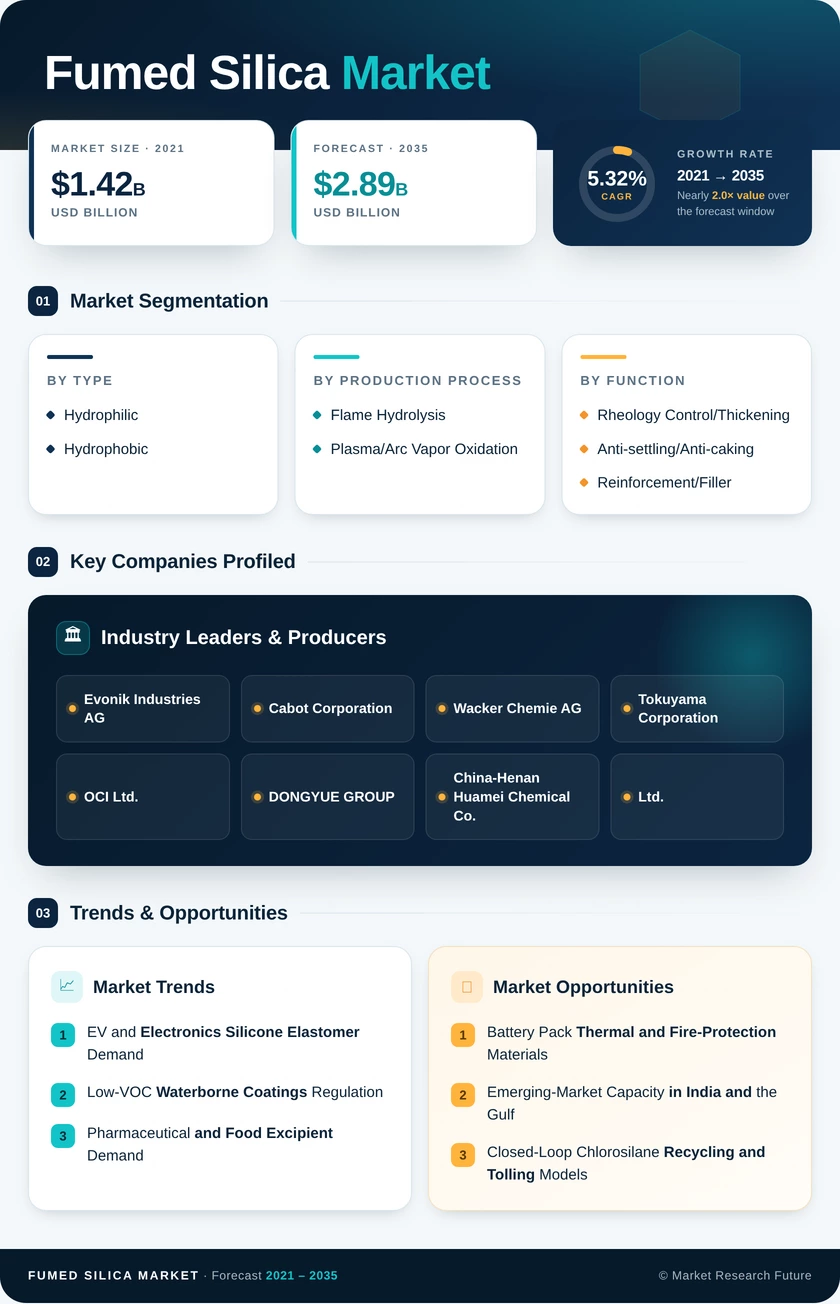
Fumed Silica Market (2026 - 2035)

ID: MRFR/CnM/3124-CR 200 Pages Chitranshi Jaiswal Last Updated: November 17, 2026
Fumed Silica Market Research Report Information By Type (Hydrophilic and Hydrophobic), By Production Process (Flame Hydrolysis and Plasma/Arc Vapor Oxidation), By Function (Rheology Control/Thickening, Anti-settling/Anti-caking, and Reinforcement/Filler), By Application (Silicone Rubber, Adhesives and Sealants, Paints, Coatings and Inks, Plastics and Composites, Food and Beverages, and Other Applications), And By Region (North America, Europe, Asia-Pacific, and Rest of the World) – Market Forecast Till 2035.
Fumed Silica Market
Market Size
Forecast Period2026-2035
CAGR (2026-2035)5.32%
2025 Market SizeUSD 1.72 Billion
2035 Market SizeUSD 2.89 Billion
Key Players
Evonik Industries AG
Cabot Corporation
Wacker Chemie AG
Tokuyama Corporation
OCI Ltd.
DONGYUE GROUP
Opportunities
  • Battery Pack Thermal and Fire-Protection Materials
  • Emerging-Market Capacity in India and the Gulf
  • Closed-Loop Chlorosilane Recycling and Tolling Models
  1. 1 Market Summary | |
  2. 2 Key Report Takeaways | |
    1. 2.1 By Type | |
    2. 2.2 By Production Process | |
    3. 2.3 By Function | |
    4. 2.4 By Application | |
    5. 2.5 By Region | |
  3. 3 Market Size and Forecast (2021–2035) | |
    1. 3.1 Historical Market Size (2021–2025) | |
    2. 3.2 Forecast Market Size (2026–2035) | |
    3. 3.3 Year-over-Year Growth Analysis | |
  4. 4 Driver Impact Analysis | |
    1. 4.1 EV and Electronics Silicone Elastomer Demand | |
    2. 4.2 Low-VOC Waterborne Coatings Regulation | |
    3. 4.3 Pharmaceutical and Food Excipient Demand | |
    4. 4.4 Semiconductor CMP Slurry Consumption | |
    5. 4.5 Construction Adhesives and Sealants in Asia | |
    6. 4.6 Wind Blades and Composite Reinforcement | |
  5. 5 Restraints Impact Analysis | |
    1. 5.1 SiCl₄ Feedstock Price Volatility | |
    2. 5.2 European Energy and Carbon Costs | |
    3. 5.3 Substitution by Precipitated Silica | |
    4. 5.4 Regulatory Scrutiny of Food-Grade Nanoparticles | |
    5. 5.5 High Capital Intensity of New Capacity | |
  6. 6 Opportunities | |
    1. 6.1 Battery Pack Thermal and Fire-Protection Materials | |
    2. 6.2 Emerging-Market Capacity in India and the Gulf | |
    3. 6.3 Closed-Loop Chlorosilane Recycling and Tolling Models | |
    4. 6.4 Digital Formulation Services and Data-Driven Grade Selection | |
    5. 6.5 Ultra-Pure Plasma-Route Grades | |
  7. 7 Regional Market Share and Country-Level Analysis | |
    1. 7.1 North America | | |
      1. 7.1.1 United States | | |
      2. 7.1.2 Canada | | |
      3. 7.1.3 Mexico | |
    2. 7.2 Europe | | |
      1. 7.2.1 Germany | | |
      2. 7.2.2 United Kingdom | | |
      3. 7.2.3 France | | |
      4. 7.2.4 Italy | | |
      5. 7.2.5 Rest of Europe | |
    3. 7.3 Asia-Pacific | | |
      1. 7.3.1 China | | |
      2. 7.3.2 India | | |
      3. 7.3.3 Japan | | |
      4. 7.3.4 South Korea | | |
      5. 7.3.5 Rest of Asia-Pacific | |
    4. 7.4 South America | | |
      1. 7.4.1 Brazil | | |
      2. 7.4.2 Argentina | | |
      3. 7.4.3 Rest of South America | |
    5. 7.5 Middle East and Africa | | |
      1. 7.5.1 Saudi Arabia | | |
      2. 7.5.2 South Africa | | |
      3. 7.5.3 Rest of Middle East and Africa | |
  8. 8 Future Outlook (2026–2035) | |
    1. 8.1 Electrification Supercycle | |
    2. 8.2 Semiconductor Capacity Build-Out | |
    3. 8.3 Decarbonized Production | |
    4. 8.4 AI-Assisted Process Control and Formulation | |
  9. 9 Segmentation Analysis | |
    1. 9.1 By Type | | |
      1. 9.1.1 Hydrophilic | | |
      2. 9.1.2 Hydrophobic | |
    2. 9.2 By Production Process | | |
      1. 9.2.1 Flame Hydrolysis | | |
      2. 9.2.2 Plasma/Arc Vapor Oxidation | |
    3. 9.3 By Function | | |
      1. 9.3.1 Rheology Control/Thickening | | |
      2. 9.3.2 Anti-settling/Anti-caking | | |
      3. 9.3.3 Reinforcement/Filler | |
    4. 9.4 By Application | | |
      1. 9.4.1 Silicone Rubber | | |
      2. 9.4.2 Adhesives and Sealants | | |
      3. 9.4.3 Paints, Coatings, and Inks | | |
      4. 9.4.4 Plastics and Composites (UPR) | | |
      5. 9.4.5 Food and Beverages | | |
      6. 9.4.6 Other Applications (Pharmaceuticals and Personal Care, etc.) | |
  10. 10 Competitive Landscape | |
    1. 10.1 Market Concentration Analysis | |
    2. 10.2 Competitive Benchmarking Matrix | |
    3. 10.3 Company Profiles | | |
      1. 10.3.1 Evonik Industries AG | | |
      2. 10.3.2 Cabot Corporation | | |
      3. 10.3.3 Wacker Chemie AG | | |
      4. 10.3.4 Tokuyama Corporation | | |
      5. 10.3.5 OCI Ltd. | | |
      6. 10.3.6 DONGYUE GROUP | | |
      7. 10.3.7 China-Henan Huamei Chemical Co., Ltd. | | |
      8. 10.3.8 Henan Xunyu Chemical Co., Ltd. | | |
      9. 10.3.9 Heraeus Group | | |
      10. 10.3.10 Gelest Inc. | | |
      11. 10.3.11 HPQ Silicon Inc. | | |
      12. 10.3.12 AMS Applied Material Solutions | | |
      13. 10.3.13 Ningbo Ruifeng Sealing Materials Co., Ltd. | | |
      14. 10.3.14 Kemipex | | |
      15. 10.3.15 Kemitura | |
  11. 11 Recent News & Developments | |
  12. 12 Report Scope and Methodology | |
  13. 13 Detailed Sources and Citations | |
  14. 14 Frequently Asked Questions (FAQs) | | LIST OF TABLES | |
  15. TABLE 1 Global Market Size & Forecast, by Value (USD Billion), 2021–2035 | |
  16. TABLE 2 Global Market – Year-over-Year Growth Analysis, 2021–2035 | |
  17. TABLE 3 Driver Impact Analysis on CAGR, 2026–2035 | |
  18. TABLE 4 Restraints Impact Analysis on CAGR, 2026–2035 | |
  19. TABLE 5 Global Market Share, by Region, 2025 | |
  20. TABLE 6 North America Market, by Country, 2025 | |
  21. TABLE 7 Europe Market, by Country, 2025 | |
  22. TABLE 8 Asia-Pacific Market, by Country, 2025 | |
  23. TABLE 9 South America Market, by Country, 2025 | |
  24. TABLE 10 Middle East and Africa Market, by Country, 2025 | |
  25. TABLE 11 Global Market, by Type, 2025 | |
  26. TABLE 12 Global Market, by Production Process, 2025 | |
  27. TABLE 13 Global Market, by Function, 2025 | |
  28. TABLE 14 Global Market, by Application, 2025 | |
  29. TABLE 15 Competitive Benchmarking Matrix, 2025 | |
  30. TABLE 16 Recent Developments & Strategic Announcements, 2023–2025 | |
  31. TABLE 17 Report Scope and Methodology | |
  32. TABLE 18 Detailed Sources and Citations | | LIST OF FIGURES | |
  33. FIGURE 1 Market Dynamics Overview – Drivers, Restraints and Opportunities | |
  34. FIGURE 2 Industry Value Chain Analysis – Feedstock to End Use | |
  35. FIGURE 3 Porter's Five Forces Analysis | |
  36. FIGURE 4 Global Market Size Trend, 2021–2035 (USD Billion) | |
  37. FIGURE 5 Market Share, by Type, 2025 | |
  38. FIGURE 6 Market Share, by Production Process, 2025 | |
  39. FIGURE 7 Market Share, by Function, 2025 | |
  40. FIGURE 8 Market Share, by Application, 2025 | |
  41. FIGURE 9 Regional Market Share, 2025 | |
  42. FIGURE 10 Asia-Pacific Market Share, by Country, 2025 | |
  43. FIGURE 11 Competitive Landscape – Estimated Revenue Share Ranges, 2025 | |
  44. FIGURE 12 Market Concentration Analysis

Segmentation Quick Reference

DimensionSub-SegmentsDominant SegmentFastest Growing Segment
By TypeHydrophilic; HydrophobicHydrophilic (80.6% share)Hydrophilic (80.6% share)
By Production ProcessFlame Hydrolysis; Plasma/Arc Vapor OxidationFlame Hydrolysis (77.6% share)Plasma/Arc Vapor Oxidation (6.35% CAGR)
By FunctionRheology Control/Thickening; Anti-settling/Anti-caking; Reinforcement/FillerRheology Control/Thickening (48.5% share)Rheology Control/Thickening (48.5% share)
By ApplicationSilicone Rubber; Adhesives and Sealants; Paints, Coatings, and Inks; Plastics and Composites (UPR); Food and Beverages; Other Applications (Pharmaceuticals and Personal Care, etc.)Adhesives and Sealants (31.4% share)Other Applications (Pharmaceuticals and Personal Care, etc.) (6.7% CAGR)
By RegionNorth America; Europe; Asia-Pacific; South America; Middle-East and AfricaAsia-Pacific (47.8%)Asia-Pacific (47.8%)

Market Segmentation Overview

By Type

Sub-SegmentKey Trend
HydrophilicEasy-dispersing grades for waterborne coatings and pharmaceutical glidants
HydrophobicSilane-treated grades for silicone rubber, wind-blade adhesives and 3D-printing resins

Hydrophilic grades lead and grow fastest because tablet makers and food processors need untreated surfaces that meet FDA and EFSA specifications. Hydrophobic grades grow more slowly due to higher cost per unit of reinforcement. They remain essential wherever silicone rubber must reach tensile targets that precipitated silica cannot meet.

By Production Process

Sub-SegmentKey Trend
Flame HydrolysisGreen-hydrogen burner trials to lower carbon intensity
Plasma/Arc Vapor OxidationChloride-free, ultra-pure output for CMP and aerogels

Flame Hydrolysis dominates thanks to established SiCl₄ integration and reactor scale that keep commodity grades cheap. Plasma/Arc Vapor Oxidation grows fastest because semiconductor fabs need sub-10 ppm metal content and buyers increasingly favor production powered by renewable electricity. Its lower throughput keeps it a high-value niche rather than a volume rival.

By Function

Sub-SegmentKey Trend
Rheology Control/ThickeningHigher loading in VOC-compliant waterborne coatings
Anti-settling/Anti-cakingPowder food and agrochemical demand in humid regions
Reinforcement/FillerPremium hydrophobic grades for EV silicone elastomers

Rheology Control/Thickening both leads and grows fastest, because each VOC-driven reformulation needs more sag control and shear-thinning behavior. Anti-settling/Anti-caking follows powder food and agrochemical volumes. Reinforcement/Filler grows more slowly but keeps premium pricing through silicone elastomer performance requirements.

By Application

Sub-SegmentKey Trend
Silicone RubberEV gaskets and medical tubing rated for 200 °C service
Adhesives and SealantsRobotic bead application in battery-electric vehicle assembly
Paints, Coatings, and InksWaterborne architectural reformulation in Europe
Plastics and Composites (UPR)Competition from hollow glass microspheres
Food and BeveragesInstant drink mixes across Southeast Asia
Other Applications (Pharmaceuticals and Personal Care, etc.)Generic tablet output and 3D-printing resins

Adhesives and Sealants hold the largest share, supported by Asian construction and the need to control bond-line thickness in EV assembly. Other Applications (Pharmaceuticals and Personal Care, etc.) grow fastest as generic drug makers and cosmetics producers specify fine hydrophilic grades. Silicone Rubber remains a steady, high-value outlet for reinforcing grades.


Download PDF ×

We do not share your information with anyone. However, we may send you emails based on your report interest from time to time. You may contact us at any time to opt-out.