
Request Free Sample ×

Kindly complete the form below to receive a free sample of this Report

* Please use a valid business email

Leading companies partner with us for data-driven Insights

clients tt-cursor
Hero Background
English
Chinese
French
Japanese
Korean
German
Spanish

Food Service Equipment Market Size

ID: MRFR/Equip/2503-HCR
100 Pages
Snehal Singh
March 2026

Food Service Equipment Market Size, Share & Growth Analysis Report By Product (Cooking Equipment, Storage & Handling Equipment, Ware Washing Equipment, Food Holding & Serving Equipment, and Others), By Application (Full-Service Restaurants, Quick Service Restaurants, Caterers, Hotels & Clubs, and Others), And By Region (North America, Europe, Asia-Pacific, And Rest Of The World) – Trends & Industry Forecast to 2035

Share:
Download PDF ×

We do not share your information with anyone. However, we may send you emails based on your report interest from time to time. You may contact us at any time to opt-out.

Food Service Equipment Market Infographic
Purchase Options

Food Service Equipment Size

Food Service Equipment Market Growth Projections and Opportunities

The Food Service Equipment Market is shaped by using various marketplace factors that influence its dynamics, growth, and traits. One critical component is the growing demand for food offerings throughout the globe. As the worldwide populace continues to develop, so does the need for green and advanced food service equipment in restaurants, motels, and different food establishments. This escalating demand is similarly fueled by the rising trend of eating out, reflecting changing client lifestyles and preferences. Moreover, technological improvements play a pivotal function in shaping the Food Service Equipment marketplace. Innovations in kitchen devices, which include smart appliances, automatic cooking structures, and electricity-green gadgets, are gaining prominence. The integration of generations no longer only enhances the performance of meal coaching but additionally aligns with the growing emphasis on sustainability within the industry. Manufacturers are continually investing in studies and improvements to introduce modern answers that cater to the evolving wishes of food service institutions. Another enormous market thing is the increasing recognition of food protection and hygiene. With the growing awareness among purchasers concerning the importance of secure and clean meal guidance, there may be a heightened demand for devices that meet stringent hygiene standards. This has brought about the development of advanced dishwashing machines, sanitization systems, and other tools designed to keep a hygienic meal carrier environment. Environmental concerns have also turned out to be a crucial element in the Food Service Equipment market. With an increasing emphasis on sustainability, there may be a growing demand for eco-friendly and power-efficient equipment. Manufacturers are responding to this fashion by way of developing products that limit power intake, lessen waste, and have a lower environmental impact. The adoption of inexperienced practices within the food provider enterprise is not best driven through regulatory requirements but also via the changing alternatives of environmentally conscious clients. In conclusion, the Food Service Equipment Market is inspired by an aggregate of things ranging from technological innovations and financial conditions to changing purchaser options and environmental concerns. The industry keeps conforming as it adapts to these marketplace forces, with producers and companies striving to live ahead by providing solutions that align with the dynamic landscape of the meals carrier quarter.

Food Service Equipment Market Size Graph
Author
Author Profile
Snehal Singh
Manager - Research

High acumen in analyzing complex macro & micro markets with more than 6 years of work experience in the field of market research. By implementing her analytical skills in forecasting and estimation into market research reports, she has expertise in Packaging, Construction, and Equipment domains. She handles a team size of 20-25 resources and ensures smooth running of the projects, associated marketing activities, and client servicing.

Leave a Comment

FAQs

What is the current valuation of the Food Service Equipment Market as of 2024?

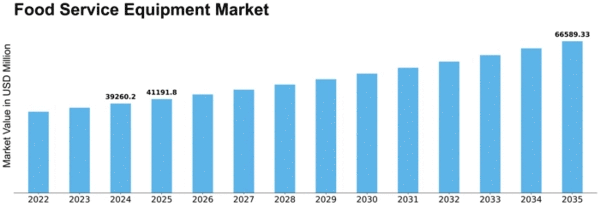
<p>The Food Service Equipment Market was valued at approximately 39,260.2 USD Million in 2024.</p>

What is the projected market valuation for the Food Service Equipment Market in 2035?

<p>The market is projected to reach approximately 66,589.33 USD Million by 2035.</p>

What is the expected CAGR for the Food Service Equipment Market during the forecast period 2025 - 2035?

<p>The expected CAGR for the Food Service Equipment Market during the forecast period 2025 - 2035 is 4.92%.</p>

Which segment had the highest valuation in the Food Service Equipment Market in 2024?

<p>In 2024, the Refrigeration Equipment segment had the highest valuation, estimated at around 9,000.0 to 15,000.0 USD Million.</p>

What are the key players in the Food Service Equipment Market?

<p>Key players in the Food Service Equipment Market include Ali Group, Middleby Corporation, and Welbilt Inc, among others.</p>

How does the valuation of Cooking Equipment compare to Dishwashing Equipment in 2024?

<p>In 2024, Cooking Equipment was valued between 8,000.0 and 14,000.0 USD Million, whereas Dishwashing Equipment was valued between 6,260.2 and 9,589.33 USD Million.</p>

What is the projected growth for the Restaurants segment by 2035?

The Restaurants segment is projected to grow from approximately 19,600.1 USD Million in 2024 to about 33,500.0 USD Million by 2035.

Which product type is expected to see significant growth in the Food Service Equipment Market?

Refrigerators, valued between 10,000.0 and 17,000.0 USD Million in 2024, are expected to see significant growth in the coming years.

What is the valuation range for Food Preparation Equipment in 2024?

Food Preparation Equipment was valued between 7,000.0 and 12,000.0 USD Million in 2024.

How does the Catering Services segment's valuation compare to that of Food Trucks in 2024?

In 2024, the Catering Services segment was valued between 6,000.0 and 10,000.0 USD Million, while Food Trucks were valued between 1,660.1 and 3,089.33 USD Million.

Market Summary

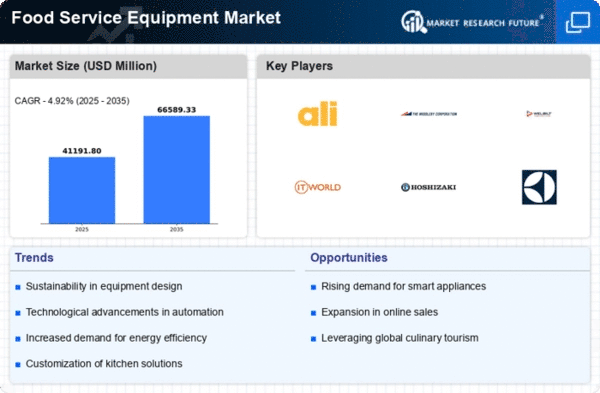
As per MRFR analysis, the Food Service Equipment Market was estimated at 39260.2 USD Million in 2024. The Food Service Equipment industry is projected to grow from 41191.9 USD Million in 2025 to 66589.33 USD Million by 2035, exhibiting a compound annual growth rate (CAGR) of 4.92% during the forecast period 2025 - 2035.

Key Market Trends & Highlights

The Food Service Equipment Market is experiencing a dynamic shift towards sustainability and technological integration.

  • The North American region remains the largest market for food service equipment, driven by a robust restaurant sector. In the Asia-Pacific region, the market is expanding rapidly, fueled by increasing urbanization and changing consumer preferences. Cooking equipment continues to dominate the market, while dishwashing equipment is emerging as the fastest-growing segment. Rising demand for convenience foods and the expansion of food delivery services are key drivers propelling market growth.

Market Size & Forecast

2024 Market Size 39260.2 (USD Million)
2035 Market Size 66589.33 (USD Million)
CAGR (2025 - 2035) 4.92%
Largest Regional Market Share in 2024 North America

Major Players

<a href="https://www.gofoodservice.com/brand/beverage-air?_gl=1*pf6wpb*_up*MQ..*_ga*MTE2ODEyODUzMC4xNzcxNTg1ODYw*_ga_4QHFNP2L33*czE3NzE1ODU4NjAkbzEkZzAkdDE3NzE1ODU4NjAkajYwJGwwJGg2MzEwNjExMTI.">Ali Group</a> (IT), Middleby Corporation (US), Welbilt Inc. (US), ITW (US), Hoshizaki Corporation (JP), Electrolux Professional (SE), <a href="https://www.cooksdirect.com/manufacturer-duke-manufacturing?srsltid=AfmBOopA32zOP6cM0J97CbH8Nl7tOplNnzJACjLazFGvycU8pxOy-Im5">Duke Manufacturing Co</a>. (US), Manitowoc Foodservice (US), Fagor Industrial (ES)

Market Trends

The Food Service Equipment Market is currently experiencing a dynamic evolution, driven by various factors that influence consumer preferences and operational efficiencies within the commercial foodservice market. As establishments increasingly prioritize sustainability, there is a noticeable shift towards energy-efficient food services equipmentequipment that minimize environmental impact. This trend aligns with a broader societal movement towards eco-consciousness, compelling manufacturers in the restaurant equipment industry to innovate and adapt their offerings. Additionally, the rise of technology integration within food service operations is reshaping the landscape, with smart equipment enhancing productivity and streamlining processes. The demand for automation and connectivity appears to be a key driver, as businesses seek to optimize their operations and improve customer experiences. 

Moreover, the Food Service Equipment Market is witnessing a diversification of product offerings, including specialized solutions such as buffet catering equipment, catering to a wide array of culinary styles and service formats. This diversification is indicative of changing consumer tastes and the growing popularity of global cuisines. As food service establishments strive to differentiate themselves, they are increasingly investing in specialized equipment that supports unique cooking methods and presentation styles. This trend not only enhances the dining experience but also reflects a broader cultural appreciation for culinary diversity. Overall, the Food Service Equipment Market is poised for continued growth, influenced by sustainability, technology, and evolving consumer preferences. across the commercial foodservice market and the wider restaurant equipment industry.

Sustainability Focus

The emphasis on sustainability is becoming increasingly pronounced within the Food Service Equipment Market. Operators are actively seeking equipment that minimizes environmental impact, such as energy-efficient appliances and materials that are recyclable or biodegradable. This trend reflects a broader societal shift towards eco-conscious practices, as consumers increasingly favor businesses that demonstrate a commitment to sustainability.

Technological Integration

The integration of advanced technology is transforming the Food Service Equipment Market. Smart appliances equipped with IoT capabilities are gaining popularity, allowing for enhanced monitoring and control of operations. This technological shift not only improves efficiency but also provides valuable data insights, enabling operators to make informed decisions and optimize their service delivery.

Versatile Equipment Solutions

There is a growing demand for versatile equipment solutions within the Food Service Equipment Market. Operators are looking for multifunctional appliances that can accommodate diverse menu items and adapt to changing consumer preferences. This trend suggests a potential move towards modular systems that offer flexibility and efficiency, allowing businesses to maximize their operational capabilities.

Food Service Equipment Market Market Drivers

Growth of the Hospitality Sector

The expansion of the hospitality sector significantly influences the Food Service Equipment Market. As tourism and travel continue to rebound, hotels, restaurants, and catering services are investing in modern equipment to meet the rising expectations of consumers. This growth is reflected in the projected market value of 66.5 USD Billion by 2035, indicating a robust demand for high-quality food service solutions. The hospitality industry's focus on enhancing guest experiences drives the need for innovative commercial kitchen equipment, cooking, and serving equipment. Consequently, food service operators are likely to prioritize investments in advanced technologies and commercial kitchen equipment to remain competitive and meet evolving consumer demands.

Rising Demand for Convenience Foods

The Food Service Equipment Market experiences a notable increase in demand for convenience foods, driven by changing consumer lifestyles and preferences. As more individuals seek quick meal solutions, food service establishments are adapting their offerings. This shift necessitates advanced equipment that can efficiently prepare and serve convenience foods. In 2024, the market is projected to reach 39.3 USD Billion, reflecting the growing need for innovative cooking and storage solutions. Additionally, the trend towards ready-to-eat meals is likely to propel the market further, as restaurants and catering services invest in equipment that enhances efficiency and food quality.

Technological Advancements in Equipment

Technological innovations play a pivotal role in shaping the Food Service Equipment Market. The integration of smart technologies, such as IoT-enabled appliances and energy-efficient systems, enhances operational efficiency and reduces energy consumption. For instance, smart ovens and refrigerators allow for remote monitoring and control, which can lead to significant cost savings. As the industry moves towards automation, the demand for advanced food service equipment is expected to rise. This trend aligns with the projected market growth, with estimates suggesting a CAGR of 4.9% from 2025 to 2035, indicating a robust future for technologically advanced food service solutions.

Focus on Sustainability and Energy Efficiency

Sustainability has emerged as a critical driver in the Food Service Equipment Industry. With increasing awareness of environmental issues, food service operators are prioritizing energy-efficient and eco-friendly equipment. This shift not only helps in reducing operational costs but also aligns with consumer preferences for sustainable practices. Equipment manufacturers are responding by developing products that minimize waste management and energy consumption. The market is likely to benefit from this trend, as establishments seek to comply with regulatory standards and enhance their brand image. As a result, the demand for sustainable food service equipment is expected to grow, contributing to the overall market expansion.

Increasing Health Consciousness Among Consumers

Health consciousness among consumers is reshaping the Food Service Equipment Industry. As individuals become more aware of nutrition and dietary preferences, food service establishments are adapting their menus to include healthier options. This trend necessitates the use of specialized equipment for preparing and serving nutritious meals. Operators are increasingly investing in equipment that supports healthy cooking methods, such as steamers and grills, to cater to this demand. The focus on health and wellness is likely to drive market growth, as establishments seek to attract health-conscious consumers and differentiate themselves in a competitive landscape.

Market Segment Insights

By Application: Cooking Equipment (Largest) vs. Refrigeration Equipment (Fastest-Growing)

<p>The Food Service Equipment Market showcases a diverse range of applications, with Cooking Equipment securing the largest market share. This category remains essential for food preparation and heating processes, catering to both commercial and residential sectors. Meanwhile, Refrigeration Equipment is emerging as the fastest-growing segment owing to the increasing demand for efficient food preservation methods, particularly in the face of rising health-conscious consumer trends. Growth trends in this market are driven by innovation and sustainability. The Cooking Equipment segment continues to evolve with the introduction of advanced technologies aimed at improving energy efficiency and functionality. In contrast, Refrigeration Equipment is experiencing rapid expansion due to the increasing need for proper storage facilities in restaurants and supermarkets, particularly as food safety regulations tighten and consumer preferences shift towards fresh foods.</p>

<p>Cooking Equipment (Dominant) vs. Dishwashing Equipment (Emerging)</p>

<p>Cooking Equipment plays a pivotal role in the Food Service Equipment Market, characterized by a broad array of products including ovens, fryers, and grills. This segment dominates due to its integral role in delivering high-quality food quickly in both commercial kitchens and restaurants. Innovations such as smart cooking technologies are enhancing efficiency, catering to a tech-savvy clientele. On the other hand, Dishwashing Equipment is categorized as an emerging segment, gaining traction as restaurants prioritize hygiene and efficiency in their operations. The shift towards automated dishwashing solutions highlights the growing need for speed and thorough cleanliness in food service environments, thereby increasing its market share. The distinctive features of both segments reflect their adaptability in answering operational demands in the food service industry.</p>

By End Use: Restaurants (Largest) vs. Food Trucks (Fastest-Growing)

<p>In the Food Service Equipment Market, the distribution of market share among end-use segments reveals interesting dynamics. Restaurants hold the largest share due to their high demand for a variety of equipment to cater to extensive menu options and customer volumes. Following closely are Cafes and Catering Services, which have carved out significant niches with specialized offerings, while Institutional Food Services and Food Trucks represent growing markets with unique operational needs.</p>

<p>Restaurants (Dominant) vs. Food Trucks (Emerging)</p>

<p>Restaurants remain the dominant segment in the Food Service Equipment Market due to their established infrastructure and diverse cuisine offerings that necessitate a wide range of equipment. They invest heavily in advanced technologies to enhance food preparation and service efficiency. In contrast, Food Trucks, classified as an emerging segment, are gaining popularity due to the increasing trend of mobile dining experiences. Their lower startup costs and adaptability to various locations appeal to a broad consumer base, leading to rapid growth in this sector. As more entrepreneurs enter the market, the demand for specific types of equipment tailored to a mobile service model continues to rise.</p>

By Product Type: Commercial Ovens (Largest) vs. Fryers (Fastest-Growing)

In the Food Service Equipment Market, Commercial Ovens are the largest segment, dominating the market share due to their essential role in a variety of culinary applications. These ovens are preferred for their versatility and efficiency, making them a staple in many commercial kitchens. On the other hand, Fryers, though smaller in market share compared to ovens, have been rapidly gaining traction and are recognized as the fastest-growing segment, reflecting a rising trend in fried food popularity and innovative cooking techniques.

Commercial Ovens (Dominant) vs. Fryers (Emerging)

Commercial Ovens represent the dominant force in the Food Service Equipment Market, offering a range of types including convection, combi, and deck ovens that cater to different cooking needs. Their versatility allows them to be utilized for baking, roasting, and more, suited for diverse cuisines. In contrast, Fryers, while emerging, have captured significant attention for their ability to produce high-quality, crispy foods quickly. As consumer preferences shift toward fried foods, manufacturers are focusing on innovation, introducing energy-efficient and easy-to-use fryer models that are becoming increasingly popular among restaurateurs. Thus, both segments are critical, with ovens established firmly in the market and fryers rapidly evolving to meet new trends.

Get more detailed insights about Food Service Equipment Market Research Report - Global Forecast till 2035

Regional Insights

North America : Market Leader in Food Service

North America continues to lead the Food Service Equipment Market, holding a significant share of 19600.0. The growth is driven by increasing consumer demand for dining experiences and the expansion of food service establishments. Regulatory support for food safety and energy efficiency standards further catalyzes market growth, encouraging innovation and investment in advanced equipment. The United States is the primary contributor, with major players like Middleby Corporation and Welbilt Inc. leading the competitive landscape. The presence of established brands and a robust distribution network enhances market penetration. Additionally, the trend towards automation and smart kitchen solutions is reshaping the industry, positioning North America as a hub for technological advancements in food service equipment.

Europe : Emerging Trends in Equipment

Europe's Food Service Equipment Market is valued at 10500.0, reflecting a steady growth trajectory. The region benefits from a diverse culinary landscape and increasing consumer preferences for quality dining experiences. Regulatory frameworks promoting sustainability and energy efficiency are pivotal in shaping market dynamics, driving demand for innovative and eco-friendly equipment. Leading countries like Germany, France, and the UK are at the forefront, with key players such as Electrolux Professional and Hoshizaki Corporation enhancing competition. The market is characterized by a mix of established brands and emerging startups, fostering innovation. As the food service sector evolves, the focus on health and safety regulations continues to influence equipment design and functionality.

Asia-Pacific : Rapid Growth and Innovation

The Asia-Pacific region, with a market size of 8000.0, is witnessing rapid growth in the Food Service Equipment Market. Factors such as urbanization, rising disposable incomes, and changing consumer lifestyles are driving demand for advanced food service solutions. Regulatory initiatives aimed at improving food safety standards are also contributing to market expansion, encouraging investment in modern equipment. Countries like China, Japan, and India are leading the charge, with a mix of local and international players competing for market share. Companies like Hoshizaki Corporation and Ali Group are well-positioned to capitalize on the growing demand. The competitive landscape is dynamic, with a focus on innovation and technology adoption, particularly in smart kitchen solutions and energy-efficient equipment.

Middle East and Africa : Emerging Market Potential

The Middle East and Africa (MEA) region, with a market size of 1160.2, presents emerging opportunities in the Food Service Equipment Market. The growth is fueled by increasing urbanization, a burgeoning hospitality sector, and a rising middle class seeking diverse dining options. Regulatory frameworks are gradually evolving to support food safety and quality standards, which is essential for market growth. Countries like the UAE and South Africa are leading the market, with a mix of local and international players enhancing competition. The presence of key players such as Fagor Industrial and Duke Manufacturing Co. is notable. As the region continues to develop, the focus on modernizing food service operations and enhancing customer experiences will drive demand for innovative equipment solutions.

Key Players and Competitive Insights

The Food Service Equipment Market is currently characterized by a dynamic competitive landscape, driven by innovation, sustainability, and technological advancements. Key players such as Ali Group (IT), Middleby Corporation (US), and Welbilt Inc. (US) are actively shaping the market through strategic initiatives. Ali Group (IT) focuses on expanding its product portfolio and enhancing operational efficiencies, while Middleby Corporation (US) emphasizes digital transformation and automation in its offerings. Welbilt Inc. (US) is also investing in sustainable practices, which appears to resonate well with current consumer preferences. Collectively, these strategies contribute to a competitive environment that is increasingly focused on meeting evolving customer demands and regulatory standards. In terms of business tactics, companies are localizing manufacturing to reduce lead times and optimize supply chains. The market structure is moderately fragmented, with several players vying for market share. This fragmentation allows for a diverse range of products and services, but it also intensifies competition among key players. The collective influence of these companies is significant, as they continuously adapt to market trends and consumer preferences, thereby shaping the overall competitive dynamics. In November 2025, Middleby Corporation (US) announced the launch of a new line of energy-efficient cooking equipment designed to reduce energy consumption by up to 30%. This strategic move not only aligns with the growing emphasis on sustainability but also positions Middleby as a leader in energy-efficient solutions within the Food Service Equipment Market. The introduction of such innovative products is likely to enhance their competitive edge and attract environmentally conscious customers. In October 2025, Welbilt Inc. (US) entered into a partnership with a leading technology firm to integrate AI-driven analytics into its kitchen equipment. This collaboration aims to optimize kitchen operations and improve food quality, which could significantly enhance customer satisfaction. By leveraging AI technology, Welbilt is poised to differentiate itself in a crowded market, potentially leading to increased market share and customer loyalty. In September 2025, Hoshizaki Corporation (JP) expanded its manufacturing capabilities in Southeast Asia, aiming to meet the rising demand for food service equipment in the region. This strategic expansion not only enhances Hoshizaki's production capacity but also allows for quicker response times to local market needs. Such regional investments are indicative of a broader trend where companies are seeking to localize operations to better serve their customers. As of December 2025, the Food Service Equipment Market is witnessing trends such as digitalization, sustainability, and AI integration, which are redefining competitive strategies. Strategic alliances are becoming increasingly prevalent, as companies recognize the value of collaboration in enhancing innovation and market reach. Looking ahead, competitive differentiation is likely to evolve from traditional price-based competition to a focus on innovation, technology, and supply chain reliability, reflecting the changing landscape of consumer expectations and regulatory requirements.

Key Companies in the Food Service Equipment Market include

Industry Developments

July 2020: Pump Solutions Group (Pump Solutions Group, acquired by Dover Corporation) launched two integrated rinse pumps, EvoWash and EvoRinse. The equipment is equipped with an optional powder or solid detergent dissolver, making it ideal for food service operations, both commercial and non-commercial.

Sysco, a global foodservice distributor, acquired Edward Don & Company, a leading foodservice equipment and supply supplier, in October 2024. Sysco's expansion beyond food and beverage distribution is noteworthy with this acquisition. Sysco hopes to strengthen its position as a foodservice industry one-stop shop by merging Edward Don's foodservice equipment and supply expertise.

This strategic initiative boosts Sysco's value proposition and shows its commitment to meeting changing customer expectations in a competitive market. Edward Don's decades of industry experience and solid customer base give Sysco additional expansion opportunities. By sharing resources and expertise, the companies may innovate and improve service and value for their global foodservice partners.

To expand its market position, Hoshizaki America announced a targeted sales team expansion in July 2023. To expand its refrigeration product support, the business created three new manufacturers' representative organizations. Hoshizaki is committed to providing high-quality refrigeration systems and excellent service and knowledge to customers in critical markets.

The Gabriel Group now represents Hoshizaki in the Midwest, offering clients in this crucial region localized insights and support. Preferred Source handles Northern Texas, while Elevate Foodservice Group handles the Northeast. This relationship with established and experienced representative groups helps Hoshizaki meet the unique needs of these varied countries, consolidating its commercial refrigeration sector leadership.

The Middleby Corporation acquired Marco Beverage Systems, a Dublin-based firm known for its creative and energy-efficient beverage dispensing solutions, in February 2023. This strategic decision supports Middleby's goal of broadening and improving its product line to satisfy beverage market demands. Marco's sustainable hot, cold, and sparkling water dispensers and cutting-edge cold brew coffee dispensing technology complement Middleby's offering, benefiting customers globally.

Middleby leverages on the expanding demand for premium, energy-efficient beverage systems, especially in sustainable and efficient markets, after the acquisition. Marco's beverage technology innovations boost Middleby's European market reach and global customer solutions. Middleby's commitment to innovation, sustainability, and cutting-edge beverage systems for different consumer preferences is shown by this relationship.

Future Outlook

Food Service Equipment Market Future Outlook

The Food Service Equipment Market is projected to grow at a 4.92% CAGR from 2025 to 2035, driven by technological advancements, increasing consumer demand, and sustainability initiatives.

New opportunities lie in:

  • <p>Integration of smart kitchen technologies for enhanced efficiency. Expansion of eco-friendly equipment lines to meet sustainability goals. Development of modular equipment solutions for flexible food service operations.</p>

By 2035, the market is expected to be robust, reflecting significant advancements and growth.

Market Segmentation

Food Service Equipment Market End Use Outlook

  • Restaurants
  • Cafes
  • Catering Services
  • Institutional Food Services
  • Food Trucks

Food Service Equipment Market Application Outlook

  • Cooking Equipment
  • Refrigeration Equipment
  • Food Preparation Equipment
  • Serving Equipment
  • Dishwashing Equipment

Food Service Equipment Market Product Type Outlook

  • Commercial Ovens
  • Fryers
  • Grills
  • Mixers
  • Food Processors

Report Scope

MARKET SIZE 2024 39260.2(USD Million)
MARKET SIZE 2025 41191.9(USD Million)
MARKET SIZE 2035 66589.33(USD Million)
COMPOUND ANNUAL GROWTH RATE (CAGR) 4.92% (2025 - 2035)
REPORT COVERAGE Revenue Forecast, Competitive Landscape, Growth Factors, and Trends
BASE YEAR 2024
Market Forecast Period 2025 - 2035
Historical Data 2019 - 2024
Market Forecast Units USD Million
Key Companies Profiled Ali Group (IT), Middleby Corporation (US), Welbilt Inc. (US), ITW (US), Hoshizaki Corporation (JP), Electrolux Professional (SE), Duke Manufacturing Co. (US), Manitowoc Foodservice (US), Fagor Industrial (ES)
Segments Covered Application, End Use, Product Type
Key Market Opportunities Integration of smart technology in Food Service Equipment enhances operational efficiency and customer experience.
Key Market Dynamics Technological advancements and sustainability trends drive innovation and competition in the Food Service Equipment Market.
Countries Covered North America, Europe, APAC, South America, MEA

FAQs

What is the current valuation of the Food Service Equipment Market as of 2024?

<p>The Food Service Equipment Market was valued at approximately 39,260.2 USD Million in 2024.</p>

What is the projected market valuation for the Food Service Equipment Market in 2035?

<p>The market is projected to reach approximately 66,589.33 USD Million by 2035.</p>

What is the expected CAGR for the Food Service Equipment Market during the forecast period 2025 - 2035?

<p>The expected CAGR for the Food Service Equipment Market during the forecast period 2025 - 2035 is 4.92%.</p>

Which segment had the highest valuation in the Food Service Equipment Market in 2024?

<p>In 2024, the Refrigeration Equipment segment had the highest valuation, estimated at around 9,000.0 to 15,000.0 USD Million.</p>

What are the key players in the Food Service Equipment Market?

<p>Key players in the Food Service Equipment Market include Ali Group, Middleby Corporation, and Welbilt Inc, among others.</p>

How does the valuation of Cooking Equipment compare to Dishwashing Equipment in 2024?

<p>In 2024, Cooking Equipment was valued between 8,000.0 and 14,000.0 USD Million, whereas Dishwashing Equipment was valued between 6,260.2 and 9,589.33 USD Million.</p>

What is the projected growth for the Restaurants segment by 2035?

The Restaurants segment is projected to grow from approximately 19,600.1 USD Million in 2024 to about 33,500.0 USD Million by 2035.

Which product type is expected to see significant growth in the Food Service Equipment Market?

Refrigerators, valued between 10,000.0 and 17,000.0 USD Million in 2024, are expected to see significant growth in the coming years.

What is the valuation range for Food Preparation Equipment in 2024?

Food Preparation Equipment was valued between 7,000.0 and 12,000.0 USD Million in 2024.

How does the Catering Services segment's valuation compare to that of Food Trucks in 2024?

In 2024, the Catering Services segment was valued between 6,000.0 and 10,000.0 USD Million, while Food Trucks were valued between 1,660.1 and 3,089.33 USD Million.

  1. SECTION I: EXECUTIVE SUMMARY AND KEY HIGHLIGHTS
    1. | 1.1 EXECUTIVE SUMMARY
    2. | | 1.1.1 Market Overview
    3. | | 1.1.2 Key Findings
    4. | | 1.1.3 Market Segmentation
    5. | | 1.1.4 Competitive Landscape
    6. | | 1.1.5 Challenges and Opportunities
    7. | | 1.1.6 Future Outlook
  2. SECTION II: SCOPING, METHODOLOGY AND MARKET STRUCTURE
    1. | 2.1 MARKET INTRODUCTION
    2. | | 2.1.1 Definition
    3. | | 2.1.2 Scope of the study
    4. | | | 2.1.2.1 Research Objective
    5. | | | 2.1.2.2 Assumption
    6. | | | 2.1.2.3 Limitations
    7. | 2.2 RESEARCH METHODOLOGY
    8. | | 2.2.1 Overview
    9. | | 2.2.2 Data Mining
    10. | | 2.2.3 Secondary Research
    11. | | 2.2.4 Primary Research
    12. | | | 2.2.4.1 Primary Interviews and Information Gathering Process
    13. | | | 2.2.4.2 Breakdown of Primary Respondents
    14. | | 2.2.5 Forecasting Model
    15. | | 2.2.6 Market Size Estimation
    16. | | | 2.2.6.1 Bottom-Up Approach
    17. | | | 2.2.6.2 Top-Down Approach
    18. | | 2.2.7 Data Triangulation
    19. | | 2.2.8 Validation
  3. SECTION III: QUALITATIVE ANALYSIS
    1. | 3.1 MARKET DYNAMICS
    2. | | 3.1.1 Overview
    3. | | 3.1.2 Drivers
    4. | | 3.1.3 Restraints
    5. | | 3.1.4 Opportunities
    6. | 3.2 MARKET FACTOR ANALYSIS
    7. | | 3.2.1 Value chain Analysis
    8. | | 3.2.2 Porter's Five Forces Analysis
    9. | | | 3.2.2.1 Bargaining Power of Suppliers
    10. | | | 3.2.2.2 Bargaining Power of Buyers
    11. | | | 3.2.2.3 Threat of New Entrants
    12. | | | 3.2.2.4 Threat of Substitutes
    13. | | | 3.2.2.5 Intensity of Rivalry
    14. | | 3.2.3 COVID-19 Impact Analysis
    15. | | | 3.2.3.1 Market Impact Analysis
    16. | | | 3.2.3.2 Regional Impact
    17. | | | 3.2.3.3 Opportunity and Threat Analysis
  4. SECTION IV: QUANTITATIVE ANALYSIS
    1. | 4.1 Construction, BY Application (USD Million)
    2. | | 4.1.1 Cooking Equipment
    3. | | 4.1.2 Refrigeration Equipment
    4. | | 4.1.3 Food Preparation Equipment
    5. | | 4.1.4 Serving Equipment
    6. | | 4.1.5 Dishwashing Equipment
    7. | 4.2 Construction, BY End Use (USD Million)
    8. | | 4.2.1 Restaurants
    9. | | 4.2.2 Cafes
    10. | | 4.2.3 Catering Services
    11. | | 4.2.4 Institutional Food Services
    12. | | 4.2.5 Food Trucks
    13. | 4.3 Construction, BY Product Type (USD Million)
    14. | | 4.3.1 Commercial Ovens
    15. | | 4.3.2 Refrigerators
    16. | | 4.3.3 Fryers
    17. | | 4.3.4 Grills
    18. | | 4.3.5 Food Processors
    19. | 4.4 Construction, BY Region (USD Million)
    20. | | 4.4.1 North America
    21. | | | 4.4.1.1 US
    22. | | | 4.4.1.2 Canada
    23. | | 4.4.2 Europe
    24. | | | 4.4.2.1 Germany
    25. | | | 4.4.2.2 UK
    26. | | | 4.4.2.3 France
    27. | | | 4.4.2.4 Russia
    28. | | | 4.4.2.5 Italy
    29. | | | 4.4.2.6 Spain
    30. | | | 4.4.2.7 Rest of Europe
    31. | | 4.4.3 APAC
    32. | | | 4.4.3.1 China
    33. | | | 4.4.3.2 India
    34. | | | 4.4.3.3 Japan
    35. | | | 4.4.3.4 South Korea
    36. | | | 4.4.3.5 Malaysia
    37. | | | 4.4.3.6 Thailand
    38. | | | 4.4.3.7 Indonesia
    39. | | | 4.4.3.8 Rest of APAC
    40. | | 4.4.4 South America
    41. | | | 4.4.4.1 Brazil
    42. | | | 4.4.4.2 Mexico
    43. | | | 4.4.4.3 Argentina
    44. | | | 4.4.4.4 Rest of South America
    45. | | 4.4.5 MEA
    46. | | | 4.4.5.1 GCC Countries
    47. | | | 4.4.5.2 South Africa
    48. | | | 4.4.5.3 Rest of MEA
  5. SECTION V: COMPETITIVE ANALYSIS
    1. | 5.1 Competitive Landscape
    2. | | 5.1.1 Overview
    3. | | 5.1.2 Competitive Analysis
    4. | | 5.1.3 Market share Analysis
    5. | | 5.1.4 Major Growth Strategy in the Construction
    6. | | 5.1.5 Competitive Benchmarking
    7. | | 5.1.6 Leading Players in Terms of Number of Developments in the Construction
    8. | | 5.1.7 Key developments and growth strategies
    9. | | | 5.1.7.1 New Product Launch/Service Deployment
    10. | | | 5.1.7.2 Merger & Acquisitions
    11. | | | 5.1.7.3 Joint Ventures
    12. | | 5.1.8 Major Players Financial Matrix
    13. | | | 5.1.8.1 Sales and Operating Income
    14. | | | 5.1.8.2 Major Players R&D Expenditure. 2023
    15. | 5.2 Company Profiles
    16. | | 5.2.1 Ali Group (IT)
    17. | | | 5.2.1.1 Financial Overview
    18. | | | 5.2.1.2 Products Offered
    19. | | | 5.2.1.3 Key Developments
    20. | | | 5.2.1.4 SWOT Analysis
    21. | | | 5.2.1.5 Key Strategies
    22. | | 5.2.2 Middleby Corporation (US)
    23. | | | 5.2.2.1 Financial Overview
    24. | | | 5.2.2.2 Products Offered
    25. | | | 5.2.2.3 Key Developments
    26. | | | 5.2.2.4 SWOT Analysis
    27. | | | 5.2.2.5 Key Strategies
    28. | | 5.2.3 Welbilt Inc (US)
    29. | | | 5.2.3.1 Financial Overview
    30. | | | 5.2.3.2 Products Offered
    31. | | | 5.2.3.3 Key Developments
    32. | | | 5.2.3.4 SWOT Analysis
    33. | | | 5.2.3.5 Key Strategies
    34. | | 5.2.4 Hoshizaki Corporation (JP)
    35. | | | 5.2.4.1 Financial Overview
    36. | | | 5.2.4.2 Products Offered
    37. | | | 5.2.4.3 Key Developments
    38. | | | 5.2.4.4 SWOT Analysis
    39. | | | 5.2.4.5 Key Strategies
    40. | | 5.2.5 Electrolux Professional (SE)
    41. | | | 5.2.5.1 Financial Overview
    42. | | | 5.2.5.2 Products Offered
    43. | | | 5.2.5.3 Key Developments
    44. | | | 5.2.5.4 SWOT Analysis
    45. | | | 5.2.5.5 Key Strategies
    46. | | 5.2.6 ITW Food Equipment Group (US)
    47. | | | 5.2.6.1 Financial Overview
    48. | | | 5.2.6.2 Products Offered
    49. | | | 5.2.6.3 Key Developments
    50. | | | 5.2.6.4 SWOT Analysis
    51. | | | 5.2.6.5 Key Strategies
    52. | | 5.2.7 Duke Manufacturing Co (US)
    53. | | | 5.2.7.1 Financial Overview
    54. | | | 5.2.7.2 Products Offered
    55. | | | 5.2.7.3 Key Developments
    56. | | | 5.2.7.4 SWOT Analysis
    57. | | | 5.2.7.5 Key Strategies
    58. | | 5.2.8 Fagor Industrial (ES)
    59. | | | 5.2.8.1 Financial Overview
    60. | | | 5.2.8.2 Products Offered
    61. | | | 5.2.8.3 Key Developments
    62. | | | 5.2.8.4 SWOT Analysis
    63. | | | 5.2.8.5 Key Strategies
    64. | | 5.2.9 Manitowoc Foodservice (US)
    65. | | | 5.2.9.1 Financial Overview
    66. | | | 5.2.9.2 Products Offered
    67. | | | 5.2.9.3 Key Developments
    68. | | | 5.2.9.4 SWOT Analysis
    69. | | | 5.2.9.5 Key Strategies
    70. | 5.3 Appendix
    71. | | 5.3.1 References
    72. | | 5.3.2 Related Reports
  6. LIST OF FIGURES
    1. | 6.1 MARKET SYNOPSIS
    2. | 6.2 NORTH AMERICA MARKET ANALYSIS
    3. | 6.3 US MARKET ANALYSIS BY APPLICATION
    4. | 6.4 US MARKET ANALYSIS BY END USE
    5. | 6.5 US MARKET ANALYSIS BY PRODUCT TYPE
    6. | 6.6 CANADA MARKET ANALYSIS BY APPLICATION
    7. | 6.7 CANADA MARKET ANALYSIS BY END USE
    8. | 6.8 CANADA MARKET ANALYSIS BY PRODUCT TYPE
    9. | 6.9 EUROPE MARKET ANALYSIS
    10. | 6.10 GERMANY MARKET ANALYSIS BY APPLICATION
    11. | 6.11 GERMANY MARKET ANALYSIS BY END USE
    12. | 6.12 GERMANY MARKET ANALYSIS BY PRODUCT TYPE
    13. | 6.13 UK MARKET ANALYSIS BY APPLICATION
    14. | 6.14 UK MARKET ANALYSIS BY END USE
    15. | 6.15 UK MARKET ANALYSIS BY PRODUCT TYPE
    16. | 6.16 FRANCE MARKET ANALYSIS BY APPLICATION
    17. | 6.17 FRANCE MARKET ANALYSIS BY END USE
    18. | 6.18 FRANCE MARKET ANALYSIS BY PRODUCT TYPE
    19. | 6.19 RUSSIA MARKET ANALYSIS BY APPLICATION
    20. | 6.20 RUSSIA MARKET ANALYSIS BY END USE
    21. | 6.21 RUSSIA MARKET ANALYSIS BY PRODUCT TYPE
    22. | 6.22 ITALY MARKET ANALYSIS BY APPLICATION
    23. | 6.23 ITALY MARKET ANALYSIS BY END USE
    24. | 6.24 ITALY MARKET ANALYSIS BY PRODUCT TYPE
    25. | 6.25 SPAIN MARKET ANALYSIS BY APPLICATION
    26. | 6.26 SPAIN MARKET ANALYSIS BY END USE
    27. | 6.27 SPAIN MARKET ANALYSIS BY PRODUCT TYPE
    28. | 6.28 REST OF EUROPE MARKET ANALYSIS BY APPLICATION
    29. | 6.29 REST OF EUROPE MARKET ANALYSIS BY END USE
    30. | 6.30 REST OF EUROPE MARKET ANALYSIS BY PRODUCT TYPE
    31. | 6.31 APAC MARKET ANALYSIS
    32. | 6.32 CHINA MARKET ANALYSIS BY APPLICATION
    33. | 6.33 CHINA MARKET ANALYSIS BY END USE
    34. | 6.34 CHINA MARKET ANALYSIS BY PRODUCT TYPE
    35. | 6.35 INDIA MARKET ANALYSIS BY APPLICATION
    36. | 6.36 INDIA MARKET ANALYSIS BY END USE
    37. | 6.37 INDIA MARKET ANALYSIS BY PRODUCT TYPE
    38. | 6.38 JAPAN MARKET ANALYSIS BY APPLICATION
    39. | 6.39 JAPAN MARKET ANALYSIS BY END USE
    40. | 6.40 JAPAN MARKET ANALYSIS BY PRODUCT TYPE
    41. | 6.41 SOUTH KOREA MARKET ANALYSIS BY APPLICATION
    42. | 6.42 SOUTH KOREA MARKET ANALYSIS BY END USE
    43. | 6.43 SOUTH KOREA MARKET ANALYSIS BY PRODUCT TYPE
    44. | 6.44 MALAYSIA MARKET ANALYSIS BY APPLICATION
    45. | 6.45 MALAYSIA MARKET ANALYSIS BY END USE
    46. | 6.46 MALAYSIA MARKET ANALYSIS BY PRODUCT TYPE
    47. | 6.47 THAILAND MARKET ANALYSIS BY APPLICATION
    48. | 6.48 THAILAND MARKET ANALYSIS BY END USE
    49. | 6.49 THAILAND MARKET ANALYSIS BY PRODUCT TYPE
    50. | 6.50 INDONESIA MARKET ANALYSIS BY APPLICATION
    51. | 6.51 INDONESIA MARKET ANALYSIS BY END USE
    52. | 6.52 INDONESIA MARKET ANALYSIS BY PRODUCT TYPE
    53. | 6.53 REST OF APAC MARKET ANALYSIS BY APPLICATION
    54. | 6.54 REST OF APAC MARKET ANALYSIS BY END USE
    55. | 6.55 REST OF APAC MARKET ANALYSIS BY PRODUCT TYPE
    56. | 6.56 SOUTH AMERICA MARKET ANALYSIS
    57. | 6.57 BRAZIL MARKET ANALYSIS BY APPLICATION
    58. | 6.58 BRAZIL MARKET ANALYSIS BY END USE
    59. | 6.59 BRAZIL MARKET ANALYSIS BY PRODUCT TYPE
    60. | 6.60 MEXICO MARKET ANALYSIS BY APPLICATION
    61. | 6.61 MEXICO MARKET ANALYSIS BY END USE
    62. | 6.62 MEXICO MARKET ANALYSIS BY PRODUCT TYPE
    63. | 6.63 ARGENTINA MARKET ANALYSIS BY APPLICATION
    64. | 6.64 ARGENTINA MARKET ANALYSIS BY END USE
    65. | 6.65 ARGENTINA MARKET ANALYSIS BY PRODUCT TYPE
    66. | 6.66 REST OF SOUTH AMERICA MARKET ANALYSIS BY APPLICATION
    67. | 6.67 REST OF SOUTH AMERICA MARKET ANALYSIS BY END USE
    68. | 6.68 REST OF SOUTH AMERICA MARKET ANALYSIS BY PRODUCT TYPE
    69. | 6.69 MEA MARKET ANALYSIS
    70. | 6.70 GCC COUNTRIES MARKET ANALYSIS BY APPLICATION
    71. | 6.71 GCC COUNTRIES MARKET ANALYSIS BY END USE
    72. | 6.72 GCC COUNTRIES MARKET ANALYSIS BY PRODUCT TYPE
    73. | 6.73 SOUTH AFRICA MARKET ANALYSIS BY APPLICATION
    74. | 6.74 SOUTH AFRICA MARKET ANALYSIS BY END USE
    75. | 6.75 SOUTH AFRICA MARKET ANALYSIS BY PRODUCT TYPE
    76. | 6.76 REST OF MEA MARKET ANALYSIS BY APPLICATION
    77. | 6.77 REST OF MEA MARKET ANALYSIS BY END USE
    78. | 6.78 REST OF MEA MARKET ANALYSIS BY PRODUCT TYPE
    79. | 6.79 KEY BUYING CRITERIA OF CONSTRUCTION
    80. | 6.80 RESEARCH PROCESS OF MRFR
    81. | 6.81 DRO ANALYSIS OF CONSTRUCTION
    82. | 6.82 DRIVERS IMPACT ANALYSIS: CONSTRUCTION
    83. | 6.83 RESTRAINTS IMPACT ANALYSIS: CONSTRUCTION
    84. | 6.84 SUPPLY / VALUE CHAIN: CONSTRUCTION
    85. | 6.85 CONSTRUCTION, BY APPLICATION, 2024 (% SHARE)
    86. | 6.86 CONSTRUCTION, BY APPLICATION, 2024 TO 2035 (USD Million)
    87. | 6.87 CONSTRUCTION, BY END USE, 2024 (% SHARE)
    88. | 6.88 CONSTRUCTION, BY END USE, 2024 TO 2035 (USD Million)
    89. | 6.89 CONSTRUCTION, BY PRODUCT TYPE, 2024 (% SHARE)
    90. | 6.90 CONSTRUCTION, BY PRODUCT TYPE, 2024 TO 2035 (USD Million)
    91. | 6.91 BENCHMARKING OF MAJOR COMPETITORS
  7. LIST OF TABLES
    1. | 7.1 LIST OF ASSUMPTIONS
    2. | | 7.1.1
    3. | 7.2 North America MARKET SIZE ESTIMATES; FORECAST
    4. | | 7.2.1 BY APPLICATION, 2025-2035 (USD Million)
    5. | | 7.2.2 BY END USE, 2025-2035 (USD Million)
    6. | | 7.2.3 BY PRODUCT TYPE, 2025-2035 (USD Million)
    7. | 7.3 US MARKET SIZE ESTIMATES; FORECAST
    8. | | 7.3.1 BY APPLICATION, 2025-2035 (USD Million)
    9. | | 7.3.2 BY END USE, 2025-2035 (USD Million)
    10. | | 7.3.3 BY PRODUCT TYPE, 2025-2035 (USD Million)
    11. | 7.4 Canada MARKET SIZE ESTIMATES; FORECAST
    12. | | 7.4.1 BY APPLICATION, 2025-2035 (USD Million)
    13. | | 7.4.2 BY END USE, 2025-2035 (USD Million)
    14. | | 7.4.3 BY PRODUCT TYPE, 2025-2035 (USD Million)
    15. | 7.5 Europe MARKET SIZE ESTIMATES; FORECAST
    16. | | 7.5.1 BY APPLICATION, 2025-2035 (USD Million)
    17. | | 7.5.2 BY END USE, 2025-2035 (USD Million)
    18. | | 7.5.3 BY PRODUCT TYPE, 2025-2035 (USD Million)
    19. | 7.6 Germany MARKET SIZE ESTIMATES; FORECAST
    20. | | 7.6.1 BY APPLICATION, 2025-2035 (USD Million)
    21. | | 7.6.2 BY END USE, 2025-2035 (USD Million)
    22. | | 7.6.3 BY PRODUCT TYPE, 2025-2035 (USD Million)
    23. | 7.7 UK MARKET SIZE ESTIMATES; FORECAST
    24. | | 7.7.1 BY APPLICATION, 2025-2035 (USD Million)
    25. | | 7.7.2 BY END USE, 2025-2035 (USD Million)
    26. | | 7.7.3 BY PRODUCT TYPE, 2025-2035 (USD Million)
    27. | 7.8 France MARKET SIZE ESTIMATES; FORECAST
    28. | | 7.8.1 BY APPLICATION, 2025-2035 (USD Million)
    29. | | 7.8.2 BY END USE, 2025-2035 (USD Million)
    30. | | 7.8.3 BY PRODUCT TYPE, 2025-2035 (USD Million)
    31. | 7.9 Russia MARKET SIZE ESTIMATES; FORECAST
    32. | | 7.9.1 BY APPLICATION, 2025-2035 (USD Million)
    33. | | 7.9.2 BY END USE, 2025-2035 (USD Million)
    34. | | 7.9.3 BY PRODUCT TYPE, 2025-2035 (USD Million)
    35. | 7.10 Italy MARKET SIZE ESTIMATES; FORECAST
    36. | | 7.10.1 BY APPLICATION, 2025-2035 (USD Million)
    37. | | 7.10.2 BY END USE, 2025-2035 (USD Million)
    38. | | 7.10.3 BY PRODUCT TYPE, 2025-2035 (USD Million)
    39. | 7.11 Spain MARKET SIZE ESTIMATES; FORECAST
    40. | | 7.11.1 BY APPLICATION, 2025-2035 (USD Million)
    41. | | 7.11.2 BY END USE, 2025-2035 (USD Million)
    42. | | 7.11.3 BY PRODUCT TYPE, 2025-2035 (USD Million)
    43. | 7.12 Rest of Europe MARKET SIZE ESTIMATES; FORECAST
    44. | | 7.12.1 BY APPLICATION, 2025-2035 (USD Million)
    45. | | 7.12.2 BY END USE, 2025-2035 (USD Million)
    46. | | 7.12.3 BY PRODUCT TYPE, 2025-2035 (USD Million)
    47. | 7.13 APAC MARKET SIZE ESTIMATES; FORECAST
    48. | | 7.13.1 BY APPLICATION, 2025-2035 (USD Million)
    49. | | 7.13.2 BY END USE, 2025-2035 (USD Million)
    50. | | 7.13.3 BY PRODUCT TYPE, 2025-2035 (USD Million)
    51. | 7.14 China MARKET SIZE ESTIMATES; FORECAST
    52. | | 7.14.1 BY APPLICATION, 2025-2035 (USD Million)
    53. | | 7.14.2 BY END USE, 2025-2035 (USD Million)
    54. | | 7.14.3 BY PRODUCT TYPE, 2025-2035 (USD Million)
    55. | 7.15 India MARKET SIZE ESTIMATES; FORECAST
    56. | | 7.15.1 BY APPLICATION, 2025-2035 (USD Million)
    57. | | 7.15.2 BY END USE, 2025-2035 (USD Million)
    58. | | 7.15.3 BY PRODUCT TYPE, 2025-2035 (USD Million)
    59. | 7.16 Japan MARKET SIZE ESTIMATES; FORECAST
    60. | | 7.16.1 BY APPLICATION, 2025-2035 (USD Million)
    61. | | 7.16.2 BY END USE, 2025-2035 (USD Million)
    62. | | 7.16.3 BY PRODUCT TYPE, 2025-2035 (USD Million)
    63. | 7.17 South Korea MARKET SIZE ESTIMATES; FORECAST
    64. | | 7.17.1 BY APPLICATION, 2025-2035 (USD Million)
    65. | | 7.17.2 BY END USE, 2025-2035 (USD Million)
    66. | | 7.17.3 BY PRODUCT TYPE, 2025-2035 (USD Million)
    67. | 7.18 Malaysia MARKET SIZE ESTIMATES; FORECAST
    68. | | 7.18.1 BY APPLICATION, 2025-2035 (USD Million)
    69. | | 7.18.2 BY END USE, 2025-2035 (USD Million)
    70. | | 7.18.3 BY PRODUCT TYPE, 2025-2035 (USD Million)
    71. | 7.19 Thailand MARKET SIZE ESTIMATES; FORECAST
    72. | | 7.19.1 BY APPLICATION, 2025-2035 (USD Million)
    73. | | 7.19.2 BY END USE, 2025-2035 (USD Million)
    74. | | 7.19.3 BY PRODUCT TYPE, 2025-2035 (USD Million)
    75. | 7.20 Indonesia MARKET SIZE ESTIMATES; FORECAST
    76. | | 7.20.1 BY APPLICATION, 2025-2035 (USD Million)
    77. | | 7.20.2 BY END USE, 2025-2035 (USD Million)
    78. | | 7.20.3 BY PRODUCT TYPE, 2025-2035 (USD Million)
    79. | 7.21 Rest of APAC MARKET SIZE ESTIMATES; FORECAST
    80. | | 7.21.1 BY APPLICATION, 2025-2035 (USD Million)
    81. | | 7.21.2 BY END USE, 2025-2035 (USD Million)
    82. | | 7.21.3 BY PRODUCT TYPE, 2025-2035 (USD Million)
    83. | 7.22 South America MARKET SIZE ESTIMATES; FORECAST
    84. | | 7.22.1 BY APPLICATION, 2025-2035 (USD Million)
    85. | | 7.22.2 BY END USE, 2025-2035 (USD Million)
    86. | | 7.22.3 BY PRODUCT TYPE, 2025-2035 (USD Million)
    87. | 7.23 Brazil MARKET SIZE ESTIMATES; FORECAST
    88. | | 7.23.1 BY APPLICATION, 2025-2035 (USD Million)
    89. | | 7.23.2 BY END USE, 2025-2035 (USD Million)
    90. | | 7.23.3 BY PRODUCT TYPE, 2025-2035 (USD Million)
    91. | 7.24 Mexico MARKET SIZE ESTIMATES; FORECAST
    92. | | 7.24.1 BY APPLICATION, 2025-2035 (USD Million)
    93. | | 7.24.2 BY END USE, 2025-2035 (USD Million)
    94. | | 7.24.3 BY PRODUCT TYPE, 2025-2035 (USD Million)
    95. | 7.25 Argentina MARKET SIZE ESTIMATES; FORECAST
    96. | | 7.25.1 BY APPLICATION, 2025-2035 (USD Million)
    97. | | 7.25.2 BY END USE, 2025-2035 (USD Million)
    98. | | 7.25.3 BY PRODUCT TYPE, 2025-2035 (USD Million)
    99. | 7.26 Rest of South America MARKET SIZE ESTIMATES; FORECAST
    100. | | 7.26.1 BY APPLICATION, 2025-2035 (USD Million)
    101. | | 7.26.2 BY END USE, 2025-2035 (USD Million)
    102. | | 7.26.3 BY PRODUCT TYPE, 2025-2035 (USD Million)
    103. | 7.27 MEA MARKET SIZE ESTIMATES; FORECAST
    104. | | 7.27.1 BY APPLICATION, 2025-2035 (USD Million)
    105. | | 7.27.2 BY END USE, 2025-2035 (USD Million)
    106. | | 7.27.3 BY PRODUCT TYPE, 2025-2035 (USD Million)
    107. | 7.28 GCC Countries MARKET SIZE ESTIMATES; FORECAST
    108. | | 7.28.1 BY APPLICATION, 2025-2035 (USD Million)
    109. | | 7.28.2 BY END USE, 2025-2035 (USD Million)
    110. | | 7.28.3 BY PRODUCT TYPE, 2025-2035 (USD Million)
    111. | 7.29 South Africa MARKET SIZE ESTIMATES; FORECAST
    112. | | 7.29.1 BY APPLICATION, 2025-2035 (USD Million)
    113. | | 7.29.2 BY END USE, 2025-2035 (USD Million)
    114. | | 7.29.3 BY PRODUCT TYPE, 2025-2035 (USD Million)
    115. | 7.30 Rest of MEA MARKET SIZE ESTIMATES; FORECAST
    116. | | 7.30.1 BY APPLICATION, 2025-2035 (USD Million)
    117. | | 7.30.2 BY END USE, 2025-2035 (USD Million)
    118. | | 7.30.3 BY PRODUCT TYPE, 2025-2035 (USD Million)
    119. | 7.31 PRODUCT LAUNCH/PRODUCT DEVELOPMENT/APPROVAL
    120. | | 7.31.1
    121. | 7.32 ACQUISITION/PARTNERSHIP
    122. | | 7.32.1

Construction Market Segmentation

Construction By Application (USD Million, 2025-2035)

  • Cooking Equipment
  • Refrigeration Equipment
  • Food Preparation Equipment
  • Serving Equipment
  • Dishwashing Equipment

Construction By End Use (USD Million, 2025-2035)

  • Restaurants
  • Cafes
  • Catering Services
  • Institutional Food Services
  • Food Trucks

Construction By Product Type (USD Million, 2025-2035)

  • Commercial Ovens
  • Refrigerators
  • Fryers
  • Grills
  • Food Processors
Infographic

Free Sample Request

Kindly complete the form below to receive a free sample of this Report

Get Free Sample

Customer Strories

Compare Licence

×
Features License Type
Single User Multiuser License Enterprise User
Price $4,950 $5,950 $7,250
Maximum User Access Limit 1 User Upto 10 Users Unrestricted Access Throughout the Organization
Free Customization
Direct Access to Analyst
Deliverable Format
Platform Access
Discount on Next Purchase 10% 15% 15%
Printable Versions