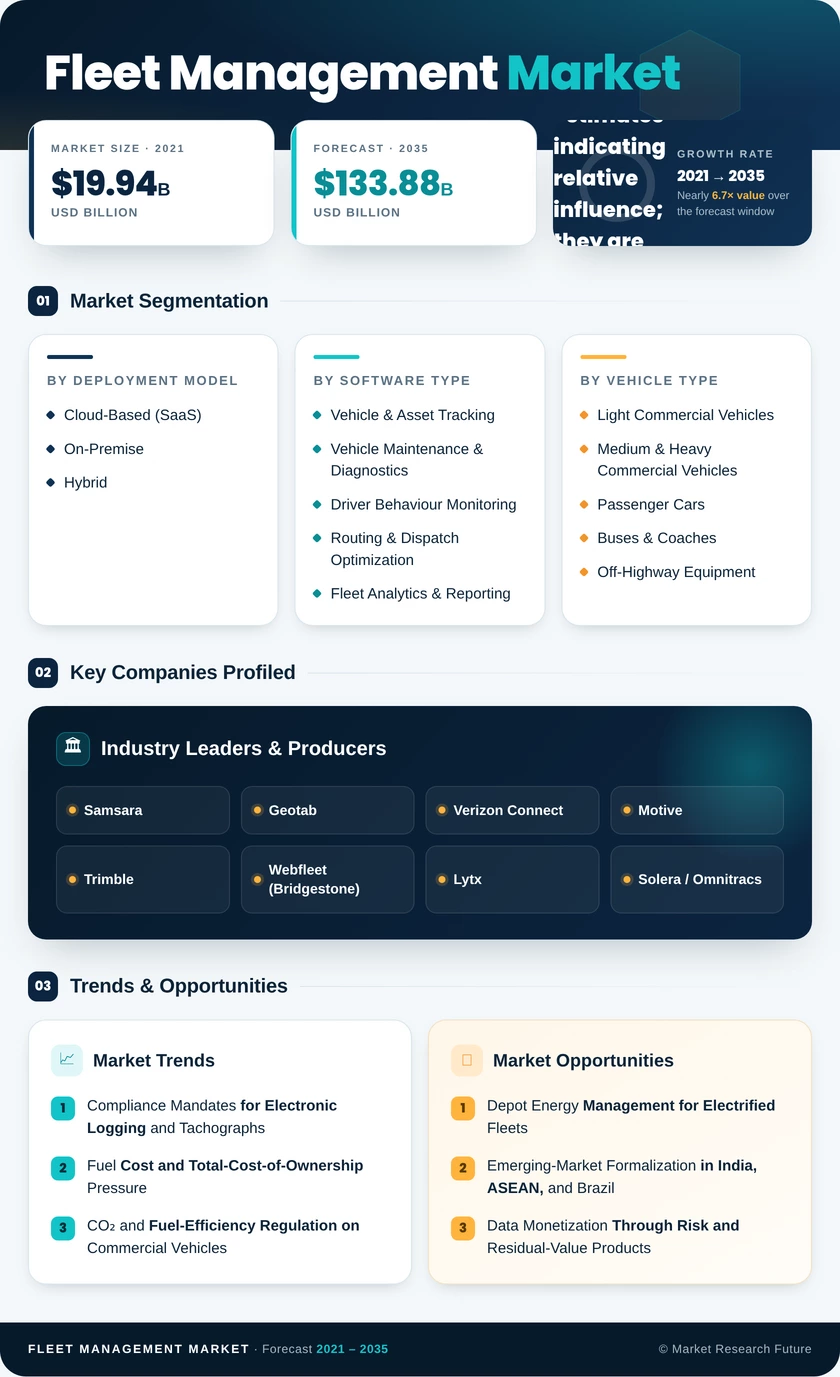
Segmentation Quick Reference
| Dimension | Sub-Segments | Dominant Segment | Fastest Growing Segment |
| By Deployment Model | Cloud-Based (SaaS), On-Premise, Hybrid | Cloud-Based (SaaS) | Hybrid |
| By Software Type | Vehicle & Asset Tracking, Vehicle Maintenance & Diagnostics, Driver Behaviour Monitoring, Routing & Dispatch Optimization, Fleet Analytics & Reporting, Fuel & Energy Management, Compliance & Safety Management | Vehicle & Asset Tracking | Fleet Analytics & Reporting |
| By Vehicle Type | Light Commercial Vehicles, Medium & Heavy Commercial Vehicles, Passenger Cars, Buses & Coaches, Off-Highway Equipment, Trailers & Containers | Light Commercial Vehicles | Off-Highway Equipment |
| By Fleet Size | Small (Under 50), Mid-Sized (50–199), Large (200–999), Enterprise (1,000+) | Mid-Sized (50–199) | Enterprise (1,000+) |
| By End-User Industry | Transportation & Logistics, Construction & Mining, Retail & Distribution, Utilities & Government, Oil & Gas, Manufacturing, Healthcare & Others | Transportation & Logistics | Construction & Mining |
| By Region | North America, Europe, Asia-Pacific, South America, Middle East & Africa | North America | Asia-Pacific |
Market Segmentation Overview
By Deployment Model
| Sub-Segment | Key Trend |
| Cloud-Based (SaaS) | Default procurement choice; continuous feature delivery without capital outlay |
| On-Premise | Persists in defense, transit authority, and critical infrastructure fleets with residency rules |
| Hybrid | Local video retention paired with cloud analytics resolves bandwidth and privacy tension |
Deployment preference is now settled at the architecture level and contested at the data-residency level. Buyers accept cloud delivery for analytics but increasingly demand local control over video and biometric records, which is why hybrid configurations grow faster than either pure model. Vendors are responding with edge appliances that pre-process footage on site and transmit only structured events upstream.
By Software Type
| Sub-Segment | Key Trend |
| Vehicle & Asset Tracking | Commoditizing into a baseline capability bundled with every tier |
| Vehicle Maintenance & Diagnostics | Predictive component alerts replacing calendar-based service intervals |
| Driver Behaviour Monitoring | Insurance linkage converting safety spend into measurable premium savings |
| Routing & Dispatch Optimization | Real-time re-sequencing as connectivity latency falls below ten milliseconds |
| Fleet Analytics & Reporting | Executive dashboards extending into audited emissions and cost-per-mile reporting |
| Fuel & Energy Management | Scope broadening from diesel control to charging session and tariff optimization |
| Compliance & Safety Management | Regulatory deadlines producing predictable, low-churn recurring revenue |
Software mix is migrating up the value stack. Tracking still carries the largest revenue block, but growth and margin now sit with analytics, prediction, and compliance automation. The practical consequence for buyers is that platform evaluation should weight data model quality and reporting defensibility far above map interface polish.
By Vehicle Type
| Sub-Segment | Key Trend |
| Light Commercial Vehicles | Parcel and field service expansion driving the largest connected unit volume |
| Medium & Heavy Commercial Vehicles | Highest revenue per vehicle from compliance and safety module attachment |
| Passenger Cars | Corporate policy enforcement and mobility service fleet monitoring |
| Buses & Coaches | Transit electrification requiring schedule adherence plus energy management |
| Off-Highway Equipment | Idle-hour visibility exposing previously unmeasured utilization waste |
| Trailers & Containers | Cold chain integrity and dwell-time reduction on unpowered assets |
Vehicle mix determines platform architecture requirements. Fleets combining road vehicles with yard equipment and unpowered trailers need three distinct connectivity approaches — cellular, satellite, and battery-powered sensor — under one interface. Providers that force separate portals for each asset class lose renewals to consolidators offering unified asset views.
By Fleet Size
| Sub-Segment | Key Trend |
| Small (Under 50 Vehicles) | Severe price competition; OEM connectivity lowering acquisition cost |
| Mid-Sized (50–199 Vehicles) | Largest installed share; strongest balance of complexity and budget |
| Large (200–999 Vehicles) | Multi-depot standardization and centralized reporting requirements |
| Enterprise (1,000+ Vehicles) | Consolidation of country-level vendors onto single global contracts |
Fleet size predicts buying behavior more reliably than industry vertical. Small operators buy on price and switch readily; mid-sized fleets buy on operational fit and stay for years; enterprises buy on integration capability, governance, and global support coverage. Sales strategies that ignore this segmentation typically misprice deals at both ends of the range.
By End-User Industry
| Sub-Segment | Key Trend |
| Transportation & Logistics | Shipper-mandated visibility making telematics a contractual precondition |
| Construction & Mining | Equipment utilization and fuel theft economics driving rapid adoption |
| Retail & Distribution | Delivery promise accuracy and route density optimization |
| Utilities & Government | Long contract terms with exceptional retention and slow procurement cycles |
| Oil & Gas | Remote-site connectivity and hazardous-zone driver safety requirements |
| Manufacturing | Inbound logistics synchronization with production scheduling |
| Healthcare & Others | Cold chain compliance and emergency response dispatch efficiency |
Vertical requirements diverge sharply once past basic tracking. Waste collection needs bin-lift sensor sequencing, public safety needs licence-plate recognition, and cold chain needs continuous temperature attestation. Domain depth, compliance templates, and local-language support now determine competitive outcomes more than core platform features, which explains why vertical specialists retain share against larger horizontal providers.


 Noah Malgeri
Co-Founder

 Peter Groot koerkamp
Account and Business Manager

 Younghwan Choi
Senior Retail Manager

 Mark Irwin
Management Consultant

 Akif Moroglu
Strategy & Business Development Director

 Guilherme Gomes Martins
Product Management Director

 Joseph Aguayo
Sales Operations & Pricing Manager

 La Terria Dodd
Program Support Specialist

 Rob Kooiker
Group Product Manager HVAC & Fire Protection GMA