Request Free Sample ×

Kindly complete the form below to receive a free sample of this Report

* Please use a valid business email

Leading companies partner with us for data-driven Insights

clients tt-cursor
Hero Background

China Coffee Machines Market

ID: MRFR/CG/45005-HCR
128 Pages
Pradeep Nandi
December 2024

China Coffee Machines Market Size, Share, Industry Trend & Analysis Research Report By Type (Filter Coffee Machines, Capsules Or Pod Coffee Machines, Traditional Espresso Machine, Bean-To-Cup Coffee Machines), By Technology (Manual, Semi-Automated, Fully Automated), By Distribution Channel (Specialty Stores, Hypermarkets Supermarkets, Online Stores, Others) and By End User (Residential, Commercial, Office, Hotels Restaurants) - Forecast to 2035

Share:
Download PDF ×

We do not share your information with anyone. However, we may send you emails based on your report interest from time to time. You may contact us at any time to opt-out.

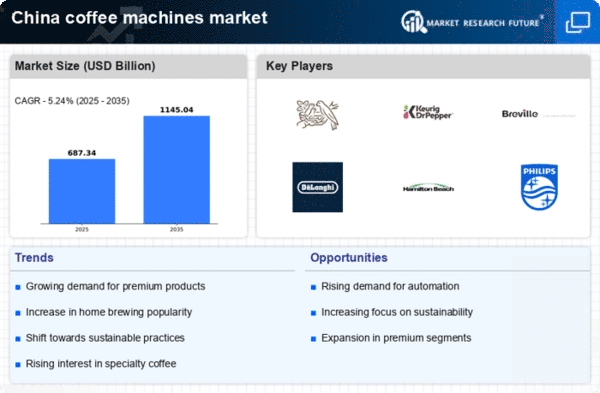
China Coffee Machines Market Infographic
Purchase Options

China Coffee Machines Market Summary

As per Market Research Future analysis, the China coffee machines market Size was estimated at 653.12 USD Billion in 2024. The China coffee machines market industry is projected to grow from 687.34 USD Billion in 2025 to 1145.04 USD Billion by 2035, exhibiting a compound annual growth rate (CAGR) of 5.24% during the forecast period 2025 - 2035

Key Market Trends & Highlights

The China coffee machines market is experiencing dynamic growth driven by evolving consumer preferences and technological advancements.

  • The rise of specialty coffee machines indicates a shift towards premium coffee experiences among consumers.
  • Sustainability initiatives are becoming increasingly important, reflecting a growing awareness of environmental issues.
  • Integration of smart technology in coffee machines is enhancing user convenience and engagement.
  • Growing urbanization and rising disposable income are key drivers fueling the demand for coffee machines in China.

Market Size & Forecast

2024 Market Size 653.12 (USD Billion)
2035 Market Size 1145.04 (USD Billion)
CAGR (2025 - 2035) 5.24%

Major Players

Nestle (CH), Keurig Dr Pepper (US), Breville (AU), De'Longhi (IT), Hamilton Beach (US), Philips (NL), Cuisinart (US), Bunn (US), Smeg (IT)

Our Impact
Enabled $4.3B Revenue Impact for Fortune 500 and Leading Multinationals
Partnering with 2000+ Global Organizations Each Year
30K+ Citations by Top-Tier Firms in the Industry

China Coffee Machines Market Trends

The coffee machines market is experiencing notable growth, driven by a rising consumer preference for coffee culture and convenience. As urbanization continues to expand, more individuals are seeking efficient and high-quality coffee solutions for their homes and workplaces. This trend is further supported by the increasing availability of diverse coffee machine types, catering to various tastes and preferences. Additionally, advancements in technology are enhancing the functionality of these machines, making them more user-friendly and appealing to a broader audience. Moreover, the coffee machines market is witnessing a shift towards sustainability, with manufacturers focusing on eco-friendly materials and energy-efficient designs. This aligns with the growing awareness of environmental issues among consumers, who are increasingly inclined to choose products that reflect their values. The integration of smart technology into coffee machines is also becoming prevalent, allowing users to customize their brewing experience through mobile applications. As these trends continue to evolve, the coffee machines market is poised for further expansion, reflecting changing consumer behaviors and preferences.

Rise of Specialty Coffee Machines

There is a growing interest in specialty coffee machines that offer unique brewing methods and customizable options. Consumers are increasingly seeking machines that allow them to replicate café-quality beverages at home, leading to a surge in demand for advanced brewing technologies.

Sustainability Initiatives

Manufacturers are increasingly adopting sustainable practices in the production of coffee machines. This includes using eco-friendly materials and energy-efficient technologies, which resonate with environmentally conscious consumers who prioritize sustainability in their purchasing decisions.

Integration of Smart Technology

The incorporation of smart technology into coffee machines is becoming more prevalent. Features such as app connectivity and programmable settings are appealing to tech-savvy consumers, allowing for a more personalized and convenient coffee-making experience.

China Coffee Machines Market Drivers

Rising Disposable Income

The increase in disposable income among the Chinese population is a pivotal driver for the coffee machines market. As consumers gain more financial freedom, they are more inclined to invest in premium coffee machines for home use. This trend is particularly evident in urban centers where the average disposable income has seen a rise of about 10% annually. The willingness to spend on high-quality coffee machines reflects a broader shift towards premiumization in consumer goods. Furthermore, the coffee machines market is likely to benefit from this trend as consumers seek to replicate café-quality beverages at home. The growing middle class in China is expected to further fuel this demand, making it a crucial factor for market expansion.

Growing Urbanization and Coffee Culture

The rapid urbanization in China is significantly influencing the coffee machines market. As more individuals migrate to urban areas, there is a noticeable shift in lifestyle preferences, with coffee consumption becoming a staple in daily routines. The increasing number of cafes and coffee shops in cities reflects this trend, leading to a heightened demand for coffee machines. In 2025, the coffee consumption in urban areas is projected to rise by approximately 15%, indicating a robust market potential. This urban coffee culture not only drives sales of traditional coffee machines but also encourages the adoption of advanced models that cater to the evolving tastes of consumers. Consequently, the coffee machines market is likely to experience substantial growth as urban dwellers seek convenient and high-quality coffee solutions.

Influence of Social Media and Marketing

The role of social media in shaping consumer behavior cannot be underestimated in the coffee machines market. Platforms like WeChat and Douyin are increasingly being utilized for marketing coffee products, creating a buzz around new machine launches and coffee trends. Influencers and coffee enthusiasts share their experiences, which significantly impacts purchasing decisions. In 2025, it is projected that social media marketing will drive approximately 20% of sales in the coffee machines market. This trend highlights the importance of digital presence and engagement in reaching potential customers. As brands leverage social media to connect with consumers, the coffee machines market is likely to witness a surge in demand driven by effective online marketing strategies.

Health Consciousness and Wellness Trends

An increasing awareness of health and wellness among Chinese consumers is shaping the coffee machines market. As individuals become more health-conscious, there is a growing preference for coffee products that offer health benefits, such as organic or specialty blends. This trend is likely to drive demand for coffee machines that can prepare healthier options, such as cold brew or espresso, which are perceived as more beneficial. In 2025, it is estimated that around 30% of coffee drinkers in China will prioritize health-oriented coffee products, thereby influencing their purchasing decisions regarding coffee machines. The coffee machines market must adapt to these evolving consumer preferences to remain competitive and relevant.

Technological Advancements in Coffee Machines

The coffee machines market is experiencing a wave of technological advancements that are reshaping consumer expectations. Innovations such as smart coffee machines, which can be controlled via mobile applications, are gaining traction among tech-savvy consumers. These machines offer features like customizable brewing settings and automated maintenance alerts, enhancing user experience. In 2025, it is anticipated that smart coffee machines will account for approximately 25% of total sales in the market. This shift towards technology-driven solutions indicates a growing demand for convenience and efficiency in coffee preparation. As manufacturers continue to integrate advanced technologies, the coffee machines market is likely to see increased competition and a broader range of product offerings.

Market Segment Insights

By Type: Filter Coffee Machines (Largest) vs. Bean-To-Cup Coffee Machines (Fastest-Growing)

In the China coffee machines market, Filter Coffee Machines command the largest market share, appealing to consumers seeking simplicity and cost-effectiveness in their coffee preparation. On the other hand, Bean-To-Cup Coffee Machines are gaining traction, particularly among younger, tech-savvy consumers who appreciate the convenience of freshly ground coffee at home. The growth trends highlight a clear consumer preference for both traditional and automated brewing methods, tailored to varying lifestyles and tastes. The market for coffee machines is rapidly evolving, driven by changing consumer preferences towards convenience and quality. Bean-To-Cup Coffee Machines have emerged as the fastest-growing segment due to their ability to provide barista-style coffee with minimal effort. Meanwhile, Filter Coffee Machines remain popular for their affordability and ease of use. Innovations in design and functionality are likely to influence these segments further, as brands adapt to consumer demands for both performance and aesthetics.

Filter Coffee Machines (Dominant) vs. Bean-To-Cup Coffee Machines (Emerging)

Filter Coffee Machines have established themselves as the dominant segment in the market, favored for their straightforward operation and affordability, making them a staple in many households. They typically offer a larger brewing capacity, which suits families and offices. In contrast, Bean-To-Cup Coffee Machines, while still emerging, are becoming increasingly popular due to their luxury appeal and ability to deliver fresh, ground coffee at the touch of a button. These machines cater to a niche market that values the quality and convenience of freshly brewed beverages, indicating a growing trend towards sophisticated, user-friendly appliances that enhance the coffee experience.

By Technology: Fully Automated (Largest) vs. Semi-Automated (Fastest-Growing)

In the China coffee machines market, the distribution among technology segments reveals that fully automated machines currently dominate with the largest market share, reflecting consumer preference for convenience and efficiency. Semi-automated machines, while having a smaller share, are increasingly gaining traction among consumers who seek a balance between control and automation in their coffee brewing experience. Growth trends indicate that the semi-automated segment is the fastest-growing category, driven by a rising interest in artisanal coffee preparation and a growing segment of younger consumers who value personalized coffee experiences. Innovations and improved features in both fully automated and semi-automated machines are helping to attract diverse consumer bases, further fueling market expansion.

Technology: Fully Automated (Dominant) vs. Semi-Automated (Emerging)

Fully automated coffee machines have established themselves as the dominant choice in the market due to their ease of use and ability to deliver consistent results with minimal effort from the user. These devices typically feature advanced technologies like touch screens and integrated grinding systems, appealing to consumers who prioritize convenience and speed. On the other hand, semi-automated machines are emerging as a popular choice for those who appreciate a hands-on approach to coffee making, allowing users to have more control over the brewing process. As interest in gourmet coffee rises, semi-automated machines are becoming increasingly favored by both coffee enthusiasts and casual drinkers, bolstering their position within the market.

By End-User: Residential (Largest) vs. Commercial (Fastest-Growing)

The end-user segment in the China coffee machines market exhibits a diverse landscape, with residential users holding the largest share. This segment has seen a surge in demand as consumers increasingly prioritize quality coffee at home, supported by the growing culture of home brewing. In contrast, the commercial segment is gaining momentum, driven by the expansion of coffee shops and cafes, which are becoming more prevalent in urban areas. Growth trends indicate a dynamic shift within the end-user segments, with the commercial sector emerging as the fastest-growing area. Factors contributing to this growth include rising consumer preferences for specialty coffee, increased foot traffic in urban centers, and innovations in machine technology. Additionally, offices, hotels, and restaurants are increasingly recognizing the value of high-quality coffee offerings to enhance customer experiences, further driving the demand in these segments.

Residential (Dominant) vs. Commercial (Emerging)

In the China coffee machines market, the residential segment stands out as the dominant force, characterized by a strong inclination towards convenience and quality. Consumers are investing in high-end coffee machines that cater to personal preferences, such as espresso and drip brewing. The rise of e-commerce platforms has also made these appliances more accessible than ever. On the other hand, the commercial segment is rapidly emerging, driven by the burgeoning coffee culture within urban landscapes. Cafes and restaurants are increasingly opting for sophisticated machines that offer consistency and quality, aiming to meet the evolving expectations of their clientele. This shift reflects a growing acknowledgment of coffee as not just a beverage but an integral part of the customer experience in commercial settings.

By Distribution Channel: Online Stores (Largest) vs. Specialty Stores (Fastest-Growing)

In the China coffee machines market, distribution channels play a crucial role in shaping consumer purchasing behavior. Online stores currently hold the largest share, capitalizing on the growing trend of e-commerce and convenience shopping. Specialty stores, while smaller in market share, are significantly growing as consumers seek curated selections and expert advice. Overall, hypermarkets and supermarkets also contribute meaningfully to the market, providing a wide variety of options. The growth trends in the segment indicate a shift towards online platforms, driven by increasing internet penetration and changing consumer habits favoring online shopping. Specialty stores have emerged as a fast-growing channel, reflecting a rising demand for premium, high-end coffee machines. This trend is fueled by the growing coffee culture in China and the increasing popularity of gourmet coffee experiences among consumers, leading to higher spending in specialty retail.

Online Stores (Dominant) vs. Specialty Stores (Emerging)

Online stores are currently the dominant distribution channel in the market, leveraging the convenience of digital shopping and increasing accessibility. With a vast selection and often competitive pricing, they attract a large consumer base seeking the best coffee machines without the need for in-person visits. On the other hand, specialty stores are emerging as a prominent channel, appealing to consumers looking for expertise and unique offerings. They provide an engaging shopping experience where knowledgeable staff can guide customers through their choices. This segment is increasingly featuring high-end coffee machines and accessories, attuned to the affluent segment of the population that is willing to invest in premium products. The growth of specialty stores reflects a shift in consumer preferences towards quality and experiences over mere price considerations.

Get more detailed insights about China Coffee Machines Market

Key Players and Competitive Insights

The coffee machines market in China is characterized by a dynamic competitive landscape, driven by evolving consumer preferences and technological advancements. Key players such as Nestle (CH), Keurig Dr Pepper (US), and De'Longhi (IT) are actively shaping the market through strategic initiatives. Nestle (CH) focuses on innovation and product diversification, particularly in the premium segment, while Keurig Dr Pepper (US) emphasizes its strong brand presence and extensive distribution network. De'Longhi (IT) is known for its commitment to quality and design, appealing to a more affluent consumer base. Collectively, these strategies contribute to a competitive environment that is increasingly focused on quality, convenience, and brand loyalty. In terms of business tactics, companies are localizing manufacturing to reduce costs and enhance supply chain efficiency. The market structure appears moderately fragmented, with several players vying for market share. This fragmentation allows for niche brands to thrive alongside established giants, creating a diverse array of options for consumers. The influence of key players is significant, as they set trends that smaller companies often follow, thereby shaping the overall market dynamics. In October 2025, Nestle (CH) announced a partnership with a local tech firm to integrate AI into its coffee machines, enhancing user experience through personalized brewing options. This move is strategically important as it aligns with the growing trend of digitalization in consumer appliances, potentially increasing customer engagement and satisfaction. By leveraging technology, Nestle (CH) aims to differentiate its products in a crowded market. In September 2025, De'Longhi (IT) launched a new line of eco-friendly coffee machines, utilizing sustainable materials and energy-efficient technologies. This initiative reflects a broader industry trend towards sustainability, appealing to environmentally conscious consumers. The strategic importance of this launch lies in its potential to capture a growing segment of the market that prioritizes eco-friendliness, thereby enhancing brand reputation and loyalty. In August 2025, Keurig Dr Pepper (US) expanded its distribution channels by partnering with major e-commerce platforms in China. This strategic move is likely to enhance accessibility and convenience for consumers, aligning with the increasing trend of online shopping. By broadening its reach, Keurig Dr Pepper (US) positions itself to capitalize on the growing demand for home brewing solutions. As of November 2025, current trends in the coffee machines market include a strong emphasis on digitalization, sustainability, and the integration of AI technologies. Strategic alliances are increasingly shaping the competitive landscape, allowing companies to pool resources and expertise. Looking ahead, competitive differentiation is expected to evolve, with a shift from price-based competition to a focus on innovation, technology, and supply chain reliability. This transition may redefine market dynamics, as companies that prioritize these aspects are likely to gain a competitive edge.

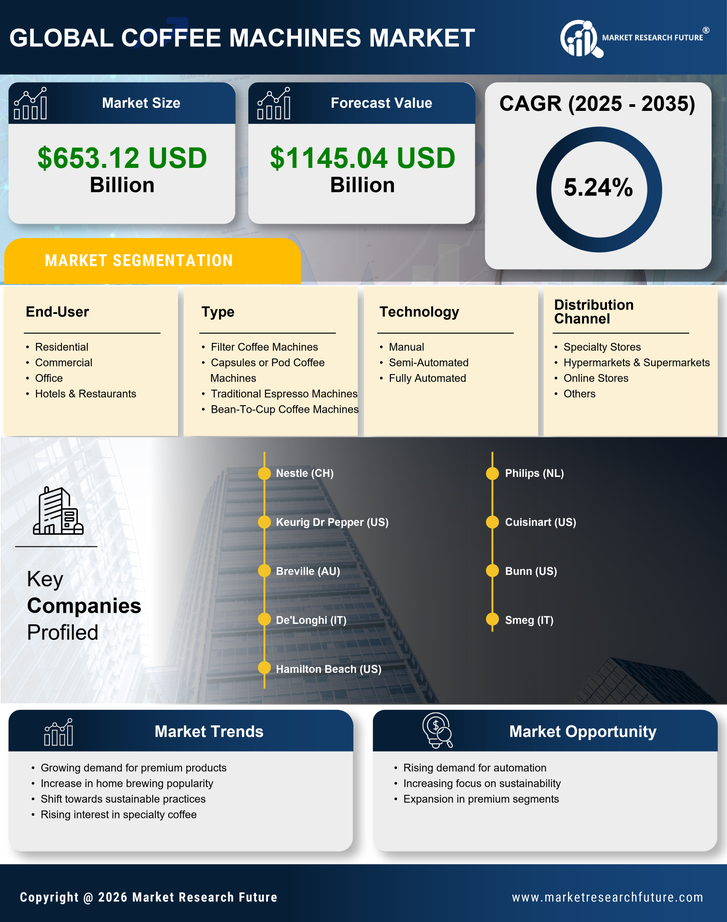
Key Companies in the China Coffee Machines Market include

Industry Developments

Recent developments in the China Coffee Machines Market have shown significant growth and expansion, particularly among major brands such as Delonghi, Gaggia, and Breville. The market is experiencing a surge in demand for home coffee machines, driven by increasing coffee consumption and a trend towards home brewing due to lifestyle changes. In October 2023, Nestle announced a strategic initiative to enhance their product line with innovative coffee solutions tailored for Chinese consumers. Additionally, the brand Hamilton Beach has been boosting its market presence through collaborations with local retailers to increase accessibility.

In terms of mergers and acquisitions, there have been reports of Siemens exploring partnerships with local coffee machine manufacturers to enhance its product offerings in China, aiming for a stronger foothold in this competitive market since August 2023. Over the past few years, market valuation has substantially increased, with an emphasis on sustainability and smart coffee machines spurring growth; companies like Melitta and JURA are investing in Research and Development to capitalize on this trend. Overall, the evolving landscape reflects consumers' preferences for convenience and quality in coffee preparation at home.

Future Outlook

China Coffee Machines Market Future Outlook

The Coffee Machines Market is projected to grow at a 5.24% CAGR from 2025 to 2035, driven by increasing consumer demand and technological advancements.

New opportunities lie in:

  • Expansion of smart coffee machine features for enhanced user experience.
  • Development of eco-friendly coffee machines using sustainable materials.
  • Introduction of subscription models for regular coffee supply and machine maintenance.

By 2035, the market is expected to achieve robust growth, reflecting evolving consumer preferences.

Market Segmentation

China Coffee Machines Market Type Outlook

  • Filter Coffee Machines
  • Capsules or Pod Coffee Machines
  • Traditional Espresso Machines
  • Bean-To-Cup Coffee Machines

China Coffee Machines Market End-User Outlook

  • Residential
  • Commercial
  • Office
  • Hotels & Restaurants

China Coffee Machines Market Technology Outlook

  • Manual
  • Semi-Automated
  • Fully Automated

China Coffee Machines Market Distribution Channel Outlook

  • Specialty Stores
  • Hypermarkets & Supermarkets
  • Online Stores
  • Others

Report Scope

MARKET SIZE 2024 653.12(USD Billion)
MARKET SIZE 2025 687.34(USD Billion)
MARKET SIZE 2035 1145.04(USD Billion)
COMPOUND ANNUAL GROWTH RATE (CAGR) 5.24% (2025 - 2035)
REPORT COVERAGE Revenue Forecast, Competitive Landscape, Growth Factors, and Trends
BASE YEAR 2024
Market Forecast Period 2025 - 2035
Historical Data 2019 - 2024
Market Forecast Units USD Billion
Key Companies Profiled Nestle (CH), Keurig Dr Pepper (US), Breville (AU), De'Longhi (IT), Hamilton Beach (US), Philips (NL), Cuisinart (US), Bunn (US), Smeg (IT)
Segments Covered Type, Technology, End-User, Distribution Channel
Key Market Opportunities Integration of smart technology in coffee machines enhances user experience and drives market growth.
Key Market Dynamics Rising consumer demand for smart coffee machines drives innovation and competition in the coffee machines market.
Countries Covered China
Author
Author Profile
Pradeep Nandi LinkedIn
Senior Research Analyst

I have a bachelor's degree in mechanical engineering and an MBA. I have more than two years of expertise in the retail, food, and beverage, chemical, and material industries, and hence have developed a sound cross-domain expertise. A firm believer in lifelong learning and sharing of knowledge. Having a proclivity for hatching ideas and trying to absorb as much information as possible in a short amount of time. Introducing corporates to the data and insight, which enables them to move from probability to possibility, has been my key areas of interest. 

Leave a Comment

FAQs

What is the current valuation of the coffee machines market in China as of 2024?

<p>The coffee machines market in China was valued at $653.12 Billion in 2024.</p>

What is the projected market valuation for coffee machines in China by 2035?

<p>The market is projected to reach $1,145.04 Billion by 2035.</p>

What is the expected CAGR for the coffee machines market in China during the forecast period 2025 - 2035?

<p>The expected CAGR for the coffee machines market in China during 2025 - 2035 is 5.24%.</p>

Which segment of coffee machines had the highest valuation in 2024?

<p>In 2024, Traditional Espresso Machines had the highest valuation at $200.0 Billion.</p>

What is the valuation range for Bean-To-Cup Coffee Machines in 2024?

<p>The valuation for Bean-To-Cup Coffee Machines ranged from $203.12 Billion to $365.04 Billion in 2024.</p>

How do the sales of Fully Automated coffee machines compare to Semi-Automated machines in 2024?

<p>In 2024, Fully Automated coffee machines were valued at $424.53 Billion, significantly higher than Semi-Automated machines at $163.28 Billion.</p>

What is the market valuation for the Commercial segment of coffee machines in 2024?

<p>The Commercial segment of coffee machines was valued between $200.0 Billion and $350.0 Billion in 2024.</p>

Which distribution channel generated the highest revenue for coffee machines in 2024?

<p>The Others distribution channel generated the highest revenue, with a valuation ranging from $359.19 Billion to $642.54 Billion in 2024.</p>

What are the key players in the coffee machines market in China?

<p>Key players in the market include Nestle (CH), Keurig Dr Pepper (US), Breville (AU), and De'Longhi (IT), among others.</p>

What is the projected growth trend for the coffee machines market in China?

<p>The coffee machines market in China is expected to experience robust growth, reaching $1,145.04 Billion by 2035.</p>

Download Free Sample

Kindly complete the form below to receive a free sample of this Report

Compare Licence

×
Features License Type
Single User Multiuser License Enterprise User
Price $4,950 $5,950 $7,250
Maximum User Access Limit 1 User Upto 10 Users Unrestricted Access Throughout the Organization
Free Customization
Direct Access to Analyst
Deliverable Format
Platform Access
Discount on Next Purchase 10% 15% 15%
Printable Versions