Request Free Sample ×

Kindly complete the form below to receive a free sample of this Report

* Please use a valid business email

Leading companies partner with us for data-driven Insights

clients tt-cursor
Hero Background

Japan 5G Fixed Wireless Access Market

ID: MRFR/SEM/55564-HCR
200 Pages
Aarti Dhapte
December 2024

Japan 5G Fixed Wireless Access Market Size, Share and Research Report By Offerings (Hardware, Services), By Application (Residential, Commercial, Industrial, Government) and By Territory (Urban, Semi-Urban, Rural)-Forecast to 2035

Share:
Download PDF ×

We do not share your information with anyone. However, we may send you emails based on your report interest from time to time. You may contact us at any time to opt-out.

Japan 5G Fixed Wireless Access Market Infographic
Purchase Options

Japan 5G Fixed Wireless Access Market Summary

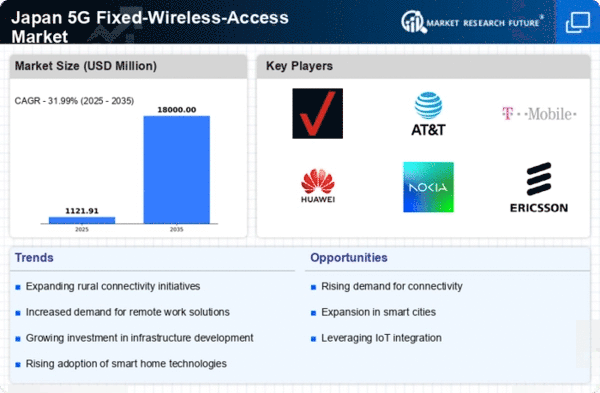
As per Market Research Future analysis, the Japan 5G Fixed Wireless Access Market size was estimated at 850.0 USD million. in 2024. The 5G Fixed-wireless-access market is projected to grow from 1121.91 USD Million in 2025 to 18000.0 USD Million by 2035, exhibiting a compound annual growth rate (CAGR) of 31.9% during the forecast period 2025 - 2035

Key Market Trends & Highlights

The Japan The market is poised for substantial growth driven by technological advancements. and increasing demand for connectivity.

  • The market is witnessing an increased demand for high-speed connectivity, particularly in urban areas.
  • Government initiatives and support are playing a crucial role in accelerating the deployment of 5G fixed-wireless-access solutions.
  • Sustainability and energy efficiency are becoming focal points for service providers in the competitive landscape.
  • Rising urbanization and the growing demand for remote work solutions are key drivers propelling market expansion.

Market Size & Forecast

2024 Market Size 850.0 (USD Million)
2035 Market Size 18000.0 (USD Million)
CAGR (2025 - 2035) 31.99%

Major Players

Verizon (US), AT&T (US), T-Mobile (US), Huawei (CN), Nokia (FI), Ericsson (SE), Samsung (KR), ZTE (CN), Comcast (US)

Our Impact
Enabled $4.3B Revenue Impact for Fortune 500 and Leading Multinationals
Partnering with 2000+ Global Organizations Each Year
30K+ Citations by Top-Tier Firms in the Industry

Japan 5G Fixed Wireless Access Market Trends

The Japan 5G Fixed Wireless Access Market is currently experiencing notable growth., driven by increasing demand for high-speed internet connectivity across various sectors. In Japan, the expansion of this market is influenced by the government's commitment to enhancing digital infrastructure and promoting advanced telecommunications technologies. As urban areas continue to evolve, the need for reliable and fast internet services becomes paramount. This trend is further supported by the rising adoption of smart devices and the Internet of Things (IoT), which require robust connectivity solutions. Additionally, the competitive landscape is characterized by several key players striving to innovate and offer superior services, thereby fostering a dynamic environment. Moreover, the regulatory framework in Japan appears to be conducive to the growth of the 5g fixed-wireless-access market. Initiatives aimed at reducing barriers to entry for new service providers may lead to increased competition, ultimately benefiting consumers through improved service offerings and pricing. The focus on sustainability and energy efficiency in telecommunications also suggests a shift towards greener technologies, which could play a crucial role in shaping the future of this market. As the landscape continues to evolve, stakeholders must remain vigilant to adapt to emerging trends and consumer preferences, ensuring that the market remains responsive to the needs of its users.

Increased Demand for High-Speed Connectivity

The demand for high-speed internet access is surging, particularly in urban regions. This trend is driven by the proliferation of smart devices and the growing reliance on digital services. As consumers seek faster and more reliable connections, service providers are compelled to enhance their offerings, leading to a more competitive market.

Government Initiatives and Support

The Japanese government is actively promoting the development of advanced telecommunications infrastructure. Policies aimed at fostering innovation and reducing regulatory hurdles are likely to encourage new entrants into the market. This support may enhance the overall service quality and accessibility for consumers.

Focus on Sustainability and Energy Efficiency

There is a noticeable shift towards sustainable practices within the telecommunications sector. Companies are increasingly prioritizing energy-efficient technologies and environmentally friendly solutions. This focus not only aligns with global sustainability goals but also appeals to environmentally conscious consumers.

Japan 5G Fixed Wireless Access Market Drivers

Growing Demand for Remote Work Solutions

The shift towards remote work in Japan is driving the demand for reliable internet solutions, thereby impacting the 5g fixed-wireless-access market. As more companies adopt flexible work arrangements, the need for high-speed internet access at home has become critical. Market data indicates that approximately 40% of the workforce in Japan is expected to work remotely by 2026, necessitating robust internet solutions. This trend suggests that the 5g fixed-wireless-access market will experience increased demand as individuals and businesses seek reliable connectivity to support remote work environments.

Rising Urbanization and Connectivity Needs

The rapid urbanization in Japan is driving the demand for enhanced connectivity solutions. As urban areas expand, the need for reliable and high-speed internet access becomes paramount. The 5g fixed-wireless-access market is positioned to address these connectivity challenges, particularly in densely populated regions. With an increasing number of smart devices and IoT applications, the market is expected to grow significantly. Reports indicate that urban areas in Japan are projected to see a 30% increase in demand for high-speed internet services by 2026. This trend suggests that the 5g fixed-wireless-access market will play a crucial role in meeting the connectivity needs of urban populations.

Increased Competition Among Service Providers

The competitive landscape among telecommunications service providers in Japan is intensifying, which is beneficial for the 5g fixed-wireless-access market. As companies strive to differentiate their offerings, there is a growing emphasis on providing high-speed internet solutions. This competition is likely to lead to innovative pricing strategies and service bundles, making 5g fixed-wireless-access more accessible to consumers. Market analysis suggests that the number of service providers offering fixed wireless solutions could increase by 25% over the next few years, further stimulating market growth and enhancing consumer choice.

Government Policies Promoting Digital Transformation

The Japanese government is actively promoting digital transformation initiatives, which significantly impact the 5g fixed-wireless-access market. Policies aimed at enhancing digital infrastructure and connectivity are likely to facilitate the adoption of fixed wireless solutions. The government has set ambitious targets to improve internet access in rural areas, with plans to invest over $5 billion in digital infrastructure by 2028. Such initiatives are expected to create a favorable environment for the 5g fixed-wireless-access market, encouraging investments and partnerships between public and private sectors to enhance connectivity.

Technological Advancements in Wireless Infrastructure

Technological innovations in wireless infrastructure are propelling the growth of the 5g fixed-wireless-access market. The introduction of advanced antenna technologies and network optimization techniques enhances the performance and reliability of fixed wireless solutions. In Japan, investments in next-generation wireless technologies are expected to reach approximately $10 billion by 2027. This influx of capital is likely to accelerate the deployment of 5g fixed-wireless-access solutions, enabling service providers to offer faster and more reliable internet services. As a result, the market is anticipated to expand, catering to both residential and commercial sectors.


Market Segment Insights

By Offerings: Hardware (Largest) vs. Services (Fastest-Growing)

In the Japan 5g fixed-wireless-access market, the offerings segment is characterized by a significant split between hardware and services. Hardware dominates the landscape, holding a substantial share as it encompasses critical components such as routers, antennas, and customer premises equipment essential for connectivity. In contrast, services emerge as a vital part of the ecosystem, facilitating user access and enhancing overall experience, albeit with a smaller share compared to hardware. The growth trajectory of this segment is being shaped by increasing demand for seamless connectivity and high-speed internet access. Hardware sales are driven by the need for robust infrastructure, while services are rapidly gaining traction due to the personalization and value-added features they offer to users. The evolving technological landscape, coupled with consumer expectations for quality and reliability, further propels the growth of services, making it a key area to watch in the coming years.

Hardware (Dominant) vs. Services (Emerging)

Hardware in the offerings segment of the Japan 5g fixed-wireless-access market is seen as the dominant force, providing essential equipment that supports high-speed internet access. Its robust performance is attributed to ongoing investments in infrastructure development and the adoption of advanced technologies. On the other hand, services represent an emerging category that is becoming increasingly relevant as users seek more integrated solutions. This segment includes installation, maintenance, and customer support services, which enhance user experience and satisfaction. As consumers become more tech-savvy, the demand for comprehensive service offerings will likely rise, requiring providers to innovate and expand their services to meet these changing needs.

By Territory: Urban (Largest) vs. Rural (Fastest-Growing)

In the Japan 5g fixed-wireless-access market, the territorial segment distribution showcases Urban areas as the largest contributor, accounting for a significant portion of market utilization due to their high density and demand for high-speed internet. Following Urban, Semi-Urban areas hold a steady position, serving as transitional zones that benefit from improving connectivity. Rural territories, while currently smaller in market size, show potential for growth as infrastructure investments increase. Growth trends indicate that Rural regions are becoming the fastest-growing segment, primarily driven by government initiatives and increased investment in telecommunications infrastructure. These developments aim to bridge the digital divide, enhancing connectivity in less populated areas. Moreover, advancements in technologies tailored for fixed-wireless access are enabling broader coverage and reliability, further accelerating uptake in Rural segments.

Urban (Dominant) vs. Rural (Emerging)

Urban areas dominate the Japan 5g fixed-wireless-access market due to their robust infrastructure and high demand for seamless connectivity. The concentration of businesses and tech hubs in Urban settings fuels this dominance, as they require reliable and fast internet for everyday operations. On the other hand, Rural areas are emerging due to recent enhancements in technology and significant governmental support aimed at improving access to high-speed internet. These areas are characterized by growing investments in telecommunications aimed at improving service delivery and customer satisfaction, positioning them as a vital segment for future growth in the 5g fixed-wireless-access market.

By Application: Residential (Largest) vs. Commercial (Fastest-Growing)

In the Japan 5g fixed-wireless-access market, the application segment is primarily dominated by the Residential sector, which holds the largest share due to the increasing demand for high-speed internet solutions in homes. The growth of smart home technologies and the surge in remote working trends have significantly contributed to the rising adoption of 5G services for residential use. Meanwhile, the Commercial segment is gaining traction, primarily driven by businesses seeking to enhance their operational efficiency and connectivity. This growing reliance on digital infrastructure in commercial settings supports a robust market presence, positioning it as the fastest-growing application area. The growth trends in the application segment depict a clear shift towards increased demand for high-capacity internet solutions across various sectors. The Residential sector remains the cornerstone, benefitting from a lifestyle increasingly leaning on digital connectivity, especially post-pandemic. Conversely, the Commercial application is experiencing rapid growth as businesses strive to innovate and optimize their operations through advanced technologies like IoT and AI, which are facilitated by 5G capabilities. The Government application is also expanding but at a slower pace, focusing on enhancing public services and administrative efficiency, while the Industrial sector adapts to integrate smart manufacturing processes.

Residential (Dominant) vs. Commercial (Emerging)

The Residential application in the Japan 5g fixed-wireless-access market is characterized by a high demand for reliable and fast internet services, prevalent among households transitioning to a more digital-centric lifestyle. Factors like the increased use of streaming services, online gaming, and remote work are fueling this demand. With the availability of 5G technology, residents are experiencing improved connectivity and higher data speeds, establishing this segment as the dominant player. On the other hand, the Commercial application represents an emerging segment that is rapidly adapting to 5G advancements. Businesses are recognizing the need for swift and reliable communication networks to support operations, and as such, are investing heavily in 5G infrastructure to enhance productivity and enable innovative technologies. This dual approach ensures that both segments are pivotal in shaping the future landscape of connectivity.

Get more detailed insights about Japan 5G Fixed Wireless Access Market

Key Players and Competitive Insights

The 5g fixed-wireless-access market in Japan is characterized by a dynamic competitive landscape, driven by rapid technological advancements and increasing demand for high-speed internet connectivity. Major players such as Verizon (US), AT&T (US), and Huawei (CN) are actively shaping the market through strategic initiatives focused on innovation and regional expansion. Verizon (US) has been particularly aggressive in enhancing its network capabilities, while AT&T (US) emphasizes partnerships to bolster its service offerings. Huawei (CN), on the other hand, is leveraging its technological expertise to penetrate the market, indicating a multifaceted competitive environment where each player seeks to carve out a distinct niche. Key business tactics employed by these companies include localizing manufacturing and optimizing supply chains to enhance operational efficiency. The market appears moderately fragmented, with several key players exerting influence over various segments. This fragmentation allows for a diverse range of offerings, catering to different consumer needs and preferences, while also fostering a competitive atmosphere that encourages innovation and service differentiation. In October 2025, Verizon (US) announced a strategic partnership with a leading Japanese telecommunications provider to enhance its 5g fixed-wireless-access services. This collaboration is expected to facilitate the deployment of advanced network infrastructure, thereby improving service reliability and customer experience. The strategic importance of this partnership lies in its potential to expand Verizon's footprint in Japan, allowing it to better compete against local players and enhance its market share. In September 2025, AT&T (US) launched a new initiative aimed at integrating AI technologies into its 5g fixed-wireless-access offerings. This move is designed to optimize network performance and enhance customer service through predictive analytics. The significance of this initiative is underscored by the growing importance of AI in telecommunications, suggesting that AT&T is positioning itself as a leader in technological innovation within the market. In August 2025, Huawei (CN) unveiled a new suite of 5g fixed-wireless-access solutions tailored for urban environments in Japan. This launch is indicative of Huawei's commitment to addressing the unique challenges posed by densely populated areas, thereby enhancing its competitive edge. The strategic importance of this development lies in its potential to attract urban consumers seeking reliable and high-speed internet access, further solidifying Huawei's presence in the market. As of November 2025, current trends in the competitive landscape include a pronounced focus on digitalization, sustainability, and the integration of AI technologies. Strategic alliances are increasingly shaping the market, as companies recognize the value of collaboration in enhancing service offerings and operational capabilities. Looking ahead, competitive differentiation is likely to evolve, with a shift from price-based competition to a greater emphasis on innovation, technological advancements, and supply chain reliability. This evolution suggests that companies will need to continuously adapt and innovate to maintain their competitive positions in the rapidly changing market.

Key Companies in the Japan 5G Fixed Wireless Access Market include

Industry Developments

The Japan 5G Fixed Wireless Access Market has recently seen significant developments, particularly with companies like SoftBank and Rakuten Mobile ramping up their infrastructure to enhance connectivity across urban and rural areas.

In September 2023, SoftBank announced a strategic partnership with Cisco Systems to optimize their 5G network infrastructure through advanced cybersecurity measures. Meanwhile, KDDI has been increasing investments to amplify its 5G capabilities, targeting a broader customer base by enhancing service offerings.

In terms of market growth, the valuation of companies in the 5G Fixed Wireless Access sector is expected to rise substantially, driven by heightened demand for high-speed internet services, particularly in remote locations. Moreover, notable mergers include Nokia and Fujitsu's recent collaboration in August 2023, aimed at expanding 5G rural coverage, thus increasing competition in the segment.

Overall, enterprises like Ericsson and Qualcomm are also refining their technologies to better serve the evolving landscape of telecommunications in Japan. The market has experienced a noticeable surge in innovation and investment over the past two years as stakeholders align their services with government initiatives encouraging digital transformation.

Future Outlook

Japan 5G Fixed Wireless Access Market Future Outlook

The 5G fixed-wireless-access market in Japan is poised for growth at 31.99% CAGR from 2025 to 2035, driven by increasing demand for high-speed connectivity and technological advancements.

New opportunities lie in:

  • Deployment of smart city infrastructure leveraging 5G connectivity.
  • Expansion of telehealth services utilizing remote monitoring technologies.
  • Development of enhanced mobile broadband solutions for rural areas.

By 2035, the market is expected to achieve substantial growth, driven by innovative applications and increased adoption.

Market Segmentation

Japan 5G Fixed Wireless Access Market Offerings Outlook

  • Hardware
  • Services

Japan 5G Fixed Wireless Access Market Territory Outlook

  • Urban
  • Semi-Urban
  • Rural

Japan 5G Fixed Wireless Access Market Application Outlook

  • Residential
  • Commercial
  • Industrial
  • Government

Report Scope

MARKET SIZE 2024 850.0(USD Million)
MARKET SIZE 2025 1121.91(USD Million)
MARKET SIZE 2035 18000.0(USD Million)
COMPOUND ANNUAL GROWTH RATE (CAGR) 31.99% (2025 - 2035)
REPORT COVERAGE Revenue Forecast, Competitive Landscape, Growth Factors, and Trends
BASE YEAR 2024
Market Forecast Period 2025 - 2035
Historical Data 2019 - 2024
Market Forecast Units USD Million
Key Companies Profiled Verizon (US), AT&T (US), T-Mobile (US), Huawei (CN), Nokia (FI), Ericsson (SE), Samsung (KR), ZTE (CN), Comcast (US)
Segments Covered Offerings, Territory, Application
Key Market Opportunities Expansion of rural connectivity solutions through enhanced 5g fixed-wireless-access market infrastructure.
Key Market Dynamics Intensifying competition and regulatory shifts drive innovation in the 5G fixed-wireless-access market.
Countries Covered Japan
Author
Author Profile
Aarti Dhapte LinkedIn
AVP - Research

A consulting professional focused on helping businesses navigate complex markets through structured research and strategic insights. I partner with clients to solve high-impact business problems across market entry strategy, competitive intelligence, and opportunity assessment. Over the course of my experience, I have led and contributed to 100+ market research and consulting engagements, delivering insights across multiple industries and geographies, and supporting strategic decisions linked to $500M+ market opportunities. My core expertise lies in building robust market sizing, forecasting, and commercial models (top-down and bottom-up), alongside deep-dive competitive and industry analysis. I have played a key role in shaping go-to-market strategies, investment cases, and growth roadmaps, enabling clients to make confident, data-backed decisions in dynamic markets.

Leave a Comment

FAQs

What was the market valuation of the Japan 5g fixed-wireless-access market in 2024?

<p>The market valuation was $850.0 Million in 2024.</p>

What is the projected market valuation for the Japan 5g fixed-wireless-access market by 2035?

<p>The projected market valuation for 2035 is $18,000.0 Million.</p>

What is the expected CAGR for the Japan 5g fixed-wireless-access market during the forecast period 2025 - 2035?

<p>The expected CAGR during the forecast period 2025 - 2035 is 31.99%.</p>

Which companies are considered key players in the Japan 5g fixed-wireless-access market?

<p>Key players include Verizon, AT&T, T-Mobile, Huawei, Nokia, Ericsson, Samsung, ZTE, and Comcast.</p>

What are the main segments of the Japan 5g fixed-wireless-access market?

<p>The main segments include Offerings, Territory, and Application.</p>

What was the valuation of hardware in the Offerings segment in 2024?

<p>The valuation of hardware in the Offerings segment was $300.0 Million in 2024.</p>

How much is the Services segment projected to be worth by 2035?

<p>The Services segment is projected to reach $12,000.0 Million by 2035.</p>

What is the valuation of the Rural territory segment in 2024?

<p>The Rural territory segment had a valuation of $300.0 Million in 2024.</p>

What is the projected valuation for the Commercial application segment by 2035?

<p>The projected valuation for the Commercial application segment by 2035 is $5,000.0 Million.</p>

How does the market size for Urban territory compare to Semi-Urban territory in 2024?

<p>In 2024, the Urban territory was valued at $300.0 Million, while the Semi-Urban territory was valued at $250.0 Million.</p>

Download Free Sample

Kindly complete the form below to receive a free sample of this Report

Compare Licence

×
Features License Type
Single User Multiuser License Enterprise User
Price $4,950 $5,950 $7,250
Maximum User Access Limit 1 User Upto 10 Users Unrestricted Access Throughout the Organization
Free Customization
Direct Access to Analyst
Deliverable Format
Platform Access
Discount on Next Purchase 10% 15% 15%
Printable Versions