
Request Free Sample ×

Kindly complete the form below to receive a free sample of this Report

* Please use a valid business email

Leading companies partner with us for data-driven Insights

clients tt-cursor
Hero Background
English
Chinese
French
Japanese
Korean
German
Spanish

Financial App Market Share

ID: MRFR/BS/4194-CR
100 Pages
Aarti Dhapte
Last Updated: April 06, 2026

Financial App Market Size, Share and Research Report By Software (Audit, Risk & Compliance, BI & Analytics Application, and Business Transaction Processing) And By Region (North America, Europe, Asia-Pacific, And Rest Of The World) –Industry Forecast Till 2035

Share:
Download PDF ×

We do not share your information with anyone. However, we may send you emails based on your report interest from time to time. You may contact us at any time to opt-out.

Financial App Market Infographic
Purchase Options

Market Share

Financial App Market Share Analysis

The Financial app Market is a dynamic and competitive panorama in which organizations employ various marketplace percentage positioning techniques to take advantage of an aggressive facet. One universal strategy is differentiation, in which businesses attempt to offer specific capabilities and offerings that set them aside from competitors. This can consist of revolutionary economic tools, customized user reports, or exclusive partnerships. By offering something one of a kind, the company's purpose is to draw and keep a devoted consumer base. Market segmentation is also a popular method in the Financial app Market. Companies discover precise goal demographics or personal desires and tailor their services for this reason. For instance, a few apps may additionally cater to tech-savvy millennials with functions like seamless virtual transactions and budgeting equipment. At the same time, others can also target older demographics with retirement planning and investment features. By know-how and addressing the particular wishes of different market segments, groups can establish a robust position within their chosen niches. Collaboration and partnerships are critical strategies hired via financial apps to decorate their marketplace percentage positioning. By forging alliances with other companies or integrating with 1/3-birthday celebration offerings, financial apps can amplify their capability and attain a broader audience. Collaborations with banks, fintech startups, or even non-economic entities can provide customers with a complete environment of services, making the app extra crucial to their economic lives. Customer-centric techniques play a pivotal function in market share positioning as well. Financial apps spend money on customer support, user interface improvements, and responsive remarks mechanisms to build a fantastic person reveal. The goal isn't always most effective to gather new users; however, additionally, to keep existing ones via extremely good service and continuous improvement based totally on personal comments. Innovation is a cornerstone of marketplace share positioning within the Financial app Market. Companies invest heavily in studies and development to live in advance of rising traits and technology. Lastly, strategic marketing and branding efforts are crucial for powerful market percentage positioning. Financial apps invest in creating a robust brand photograph that resonates with their audience. This involves no longer the simplest selling functions and blessings but also conveying a feeling of trust, reliability, and security. Effective advertising campaigns, social media presence, and public relations play critical roles in shaping public perception and influencing consumer preferences.


Author
Author Profile
Aarti Dhapte
AVP - Research

A consulting professional focused on helping businesses navigate complex markets through structured research and strategic insights. I partner with clients to solve high-impact business problems across market entry strategy, competitive intelligence, and opportunity assessment. Over the course of my experience, I have led and contributed to 100+ market research and consulting engagements, delivering insights across multiple industries and geographies, and supporting strategic decisions linked to $500M+ market opportunities. My core expertise lies in building robust market sizing, forecasting, and commercial models (top-down and bottom-up), alongside deep-dive competitive and industry analysis. I have played a key role in shaping go-to-market strategies, investment cases, and growth roadmaps, enabling clients to make confident, data-backed decisions in dynamic markets.

Leave a Comment

FAQs

What is the current valuation of the Financial App Market as of 2024?

<p>The Financial App Market was valued at 1.61 USD Billion in 2024.</p>

What is the projected market valuation for the Financial App Market in 2035?

<p>The market is projected to reach a valuation of 5.677 USD Billion by 2035.</p>

What is the expected CAGR for the Financial App Market during the forecast period 2025 - 2035?

<p>The expected CAGR for the Financial App Market during 2025 - 2035 is 12.14%.</p>

Who are the key players in the Financial App Market?

<p>Key players include PayPal, Square, Robinhood, Intuit, Revolut, Adyen, Sofi, Chime, and N26.</p>

What segments are included in the Financial App Market analysis?

<p>Segments include Audit, Risk & Compliance, BI & Analytics Application, and Business Transaction Processing.</p>

What was the valuation of the Risk & Compliance segment in 2024?

<p>The Risk & Compliance segment was valued at 0.3 USD Billion in 2024.</p>

What is the projected growth for the Business Transaction Processing segment by 2035?

<p>The Business Transaction Processing segment is expected to grow from 0.66 USD Billion in 2024 to a higher valuation by 2035.</p>

How does the Financial App Market's growth compare to other financial sectors?

<p>The Financial App Market's projected CAGR of 12.14% suggests robust growth compared to many traditional financial sectors.</p>

What role do companies like Robinhood and Chime play in the Financial App Market?

<p>Companies like Robinhood and Chime are pivotal in driving innovation and user engagement within the Financial App Market.</p>

What are the implications of the projected market growth for investors?

<p>The projected growth of the Financial App Market indicates potential investment opportunities, particularly in technology-driven financial solutions.</p>

Market Summary

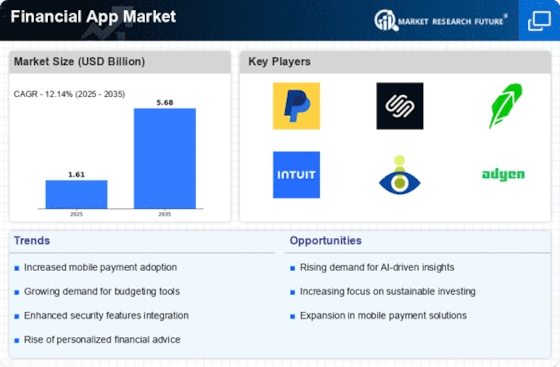
As per Market Research Future analysis, the Financial App Market Size was estimated at 1.61 USD Billion in 2024. The Financial App industry is projected to grow from USD 1.805 Billion in 2025 to USD 5.677 Billion by 2035, exhibiting a compound annual growth rate (CAGR) of 12.14% during the forecast period 2025 - 2035

Key Market Trends & Highlights

The Financial App Market is experiencing a transformative shift towards enhanced personalization and security features.

  • The market is witnessing increased personalization, allowing users to tailor their financial experiences to individual needs. A heightened focus on security is becoming paramount as users demand more robust protection for their financial data. The integration of AI and automation is reshaping user interactions, streamlining processes, and enhancing decision-making capabilities. The rise of mobile banking and growing demand for financial literacy are driving the market, particularly in North America and Asia-Pacific, with the audit segment leading and risk and compliance emerging as the fastest-growing area.

Market Size & Forecast

2024 Market Size 1.61 (USD Billion)
2035 Market Size 5.677 (USD Billion)
CAGR (2025 - 2035) 12.14%
Largest Regional Market Share in 2024 Asia Pacific

Major Players

PayPal (US), Square (US), Robinhood (US), Intuit (US), Revolut (GB), Adyen (NL), Sofi (US), Chime (US), N26 (DE)

Market Trends

The Financial App Market is currently experiencing a dynamic evolution, driven by technological advancements and changing consumer preferences. As individuals increasingly seek to manage their finances through digital platforms, the demand for innovative solutions continues to rise. This market encompasses a wide array of applications, including budgeting tools, investment platforms, and payment services, all designed to enhance user experience and financial literacy. The integration of artificial intelligence and machine learning into these applications appears to be a key factor in their growing popularity, as these technologies enable personalized financial advice and automated management features. Furthermore, the emphasis on security and data privacy is becoming paramount, as users become more aware of the risks associated with digital transactions. In addition to technological influences, the Financial App Market is also shaped by regulatory changes and economic conditions. As governments worldwide implement new financial regulations, app developers must adapt to ensure compliance while still providing user-friendly services. The rise of fintech companies has introduced a competitive landscape, prompting traditional financial institutions to innovate and collaborate with tech firms. This synergy may lead to the development of hybrid solutions that combine the reliability of established banks with the agility of startups. Overall, the Financial App Market is poised for continued growth, with evolving consumer expectations and technological advancements driving its trajectory.

Increased Personalization

The trend towards personalized financial services is gaining momentum, as users seek tailored solutions that cater to their unique financial situations. Applications are increasingly utilizing data analytics to offer customized recommendations, enhancing user engagement and satisfaction.

Focus on Security

As digital transactions proliferate, the emphasis on security measures within financial applications is intensifying. Developers are prioritizing robust encryption and authentication methods to protect user data, thereby fostering trust and confidence in digital financial management.

Integration of AI and Automation

The incorporation of artificial intelligence and automation into financial applications is transforming user experiences. These technologies facilitate smarter budgeting, investment strategies, and real-time financial insights, making it easier for users to achieve their financial goals.

Financial App Market Market Drivers

Rise of Mobile Banking

The Financial App Market is experiencing a notable rise in mobile banking adoption. As consumers increasingly prefer managing their finances through mobile devices, financial institutions are responding by enhancing their app offerings. According to recent data, mobile banking users have surged, with estimates indicating that over 70% of adults utilize mobile banking services. This trend is likely to continue, as convenience and accessibility become paramount for users. Financial apps that provide seamless banking experiences are poised to capture a larger market share. The integration of features such as instant fund transfers, bill payments, and account management within these apps is becoming standard. Consequently, the Financial App Market is evolving to meet the demands of a tech-savvy consumer base, which may drive further innovation and competition among app developers.

Increased Focus on User Experience

The Financial App Market is increasingly prioritizing user experience as a key driver of success. As competition intensifies, financial apps that offer intuitive interfaces and seamless navigation are more likely to attract and retain users. Recent data indicates that user satisfaction is closely linked to app design and functionality, with many users willing to switch to competitors for a better experience. This trend suggests that app developers must invest in user-centered design principles to enhance engagement. Features such as personalized dashboards, easy access to financial tools, and responsive customer support are becoming essential. Consequently, the Financial App Market is likely to see a shift towards prioritizing user experience, which may ultimately lead to increased customer loyalty and market growth.

Integration of Blockchain Technology

The Financial App Market is beginning to embrace blockchain technology, which offers potential benefits in terms of transparency and security. As cryptocurrencies gain popularity, financial apps that incorporate blockchain features are likely to attract a tech-savvy audience. Recent studies suggest that the use of blockchain can streamline transactions, reduce costs, and enhance security measures. This integration may also facilitate peer-to-peer transactions, allowing users to bypass traditional banking systems. As a result, financial apps that leverage blockchain technology could differentiate themselves in a competitive landscape. The Financial App Market appears to be on the cusp of a transformation, as more developers explore the possibilities of blockchain to enhance their offerings and meet the evolving needs of consumers.

Growing Demand for Financial Literacy

The Financial App Market is witnessing a growing demand for financial literacy tools. As individuals seek to improve their financial knowledge, apps that offer educational resources are gaining traction. Recent surveys indicate that a significant portion of users express interest in learning about budgeting, investing, and saving through interactive platforms. This trend suggests that financial apps that incorporate educational content may attract a broader audience. Furthermore, the rise of gamification in financial education is likely to enhance user engagement, making learning about finances more appealing. As a result, financial institutions and app developers are increasingly focusing on integrating educational features into their offerings. This shift not only benefits users but also positions the Financial App Market as a key player in promoting financial wellness and empowerment.

Regulatory Compliance and Security Enhancements

The Financial App Market is heavily influenced by regulatory compliance and the need for enhanced security measures. As data breaches and cyber threats become more prevalent, financial apps must adhere to stringent regulations to protect user information. Recent data indicates that compliance with regulations such as GDPR and PSD2 is becoming a critical factor for app developers. Users are increasingly concerned about the security of their financial data, prompting developers to implement advanced security features such as biometric authentication and encryption. This focus on security not only builds trust among users but also ensures that financial apps remain competitive in a crowded market. Consequently, the Financial App Market is likely to see a surge in investment towards security technologies, which may further drive innovation and user adoption.

Market Segment Insights

By Software: Audit (Largest) vs. Risk & Compliance (Fastest-Growing)

<p>The Software segment in the Financial App Market displays a diverse array of functionalities, with the Audit category holding the largest share. Its significance stems from the increasing regulatory requirements and the demand for transparent financial reporting. This segment effectively streamlines auditing processes, boosting efficiency and accuracy for financial institutions. In contrast, the Risk & Compliance segment is emerging as the fastest-growing sector, driven by a heightened focus on risk management strategies and global regulatory compliance frameworks. Financial firms increasingly seek solutions that can effectively mitigate risks associated with operational and market uncertainties, placing this segment in a prime position for rapid expansion.</p>

<p>Audit: Dominant vs. Risk & Compliance: Emerging</p>

<p>The Audit segment stands out as a dominant force in the Financial App Market, providing essential tools that enhance the accuracy and efficiency of financial reporting. It caters to the needs of financial institutions by automating auditing processes, thereby reducing human errors and increasing reliability. On the other hand, the Risk & Compliance segment, while still emerging, is quickly gaining traction as organizations recognize the importance of robust risk management systems. It offers solutions that help firms navigate complex regulatory landscapes and manage potential liabilities, making it an attractive investment for institutions aiming to safeguard their operations and build trust with stakeholders.</p>

Get more detailed insights about Financial App Market Research Report - Forecast to 2035

Regional Insights

North America : Financial Innovation Leader

North America is the largest market for financial apps, holding approximately 45% of the global share. The region's growth is driven by high smartphone penetration, increasing digital payment adoption, and a robust regulatory framework that encourages innovation. The U.S. leads this market, followed closely by Canada, which contributes around 15% to the overall market share. Regulatory support from agencies like the Consumer Financial Protection Bureau fosters a conducive environment for app development and user trust. The competitive landscape is dominated by key players such as PayPal, Square, and Robinhood, which have established strong brand recognition and user bases. The presence of innovative startups like Chime and Sofi further enhances the market dynamics. With a focus on user experience and security, these companies are continuously evolving their offerings to meet consumer demands, making North America a hotbed for financial app innovation.

Europe : Emerging Fintech Hub

Europe is witnessing significant growth in the financial app market, accounting for approximately 30% of the global share. The region benefits from a diverse consumer base and increasing demand for digital financial solutions. Countries like the UK and Germany are the largest markets, with the UK holding about 12% of the total market. Regulatory frameworks such as the EU's PSD2 directive are pivotal in promoting competition and innovation, allowing third-party providers to access bank data securely. Leading countries in this region include the UK, Germany, and France, with a competitive landscape featuring players like Revolut and N26. The presence of established banks venturing into fintech further intensifies competition. The European market is characterized by a strong emphasis on data protection and user privacy, which shapes the development of financial apps. This regulatory environment fosters consumer trust and encourages the adoption of digital financial services.

Asia-Pacific : Rapid Growth and Adoption

Asia-Pacific is rapidly emerging as a significant player in the financial app market, holding around 20% of the global share. The region's growth is propelled by increasing smartphone usage, a young population, and a shift towards cashless transactions. Countries like China and India are at the forefront, with China alone contributing approximately 10% to the global market. Government initiatives promoting digital finance and financial inclusion are crucial in driving this growth. The competitive landscape is diverse, with local players like Alipay and WeChat Pay dominating the Chinese market, while Indian startups like Paytm and PhonePe are gaining traction. The presence of global players is also notable, as they adapt their offerings to meet local needs. The region's unique blend of traditional banking and innovative fintech solutions creates a dynamic environment for financial app development, catering to a wide range of consumer preferences.

Middle East and Africa : Untapped Market Potential

The Middle East and Africa (MEA) region is an emerging market for financial apps, currently holding about 5% of the global share. The growth is driven by increasing smartphone penetration and a rising middle class seeking digital financial solutions. Countries like South Africa and Nigeria are leading this market, with Nigeria showing a remarkable increase in mobile banking adoption. Regulatory bodies are beginning to recognize the potential of fintech, creating frameworks to support innovation and consumer protection. The competitive landscape is characterized by a mix of local and international players. Companies like Paystack in Nigeria and YAP in the UAE are gaining popularity, while The Financial App Market. The region's unique challenges, such as varying regulatory environments and economic disparities, present both opportunities and hurdles for financial app developers. As the market matures, the demand for secure and user-friendly financial solutions is expected to grow significantly.

Key Players and Competitive Insights

The Financial App Market is currently characterized by a dynamic competitive landscape, driven by rapid technological advancements and evolving consumer preferences. Key players such as PayPal (US), Square (US), and Revolut (GB) are at the forefront, each adopting distinct strategies to enhance their market positioning. PayPal (US) continues to innovate its payment solutions, focusing on expanding its ecosystem through strategic partnerships and acquisitions. Square (US), on the other hand, emphasizes its commitment to small businesses, leveraging its point-of-sale systems and financial services to capture a larger share of the market. Meanwhile, Revolut (GB) is aggressively pursuing international expansion, aiming to penetrate new markets while enhancing its product offerings to attract a diverse customer base. Collectively, these strategies contribute to a competitive environment that is increasingly focused on innovation and customer-centric solutions.

The business tactics employed by these companies reflect a nuanced understanding of market demands. For instance, localizing services and optimizing supply chains are critical for enhancing customer experience and operational efficiency. The Financial App Market appears moderately fragmented, with a mix of established players and emerging startups. This fragmentation allows for a variety of service offerings, yet the influence of major players remains substantial, shaping market trends and consumer expectations.
In August 2025, PayPal (US) announced a strategic partnership with a leading cryptocurrency exchange, aiming to integrate cryptocurrency transactions into its platform. This move is significant as it positions PayPal (US) to capitalize on the growing interest in digital currencies, potentially attracting a new segment of tech-savvy consumers. The integration of cryptocurrency services could enhance user engagement and drive transaction volumes, thereby reinforcing PayPal's competitive edge in the financial app landscape.
In September 2025, Square (US) launched a new suite of financial management tools tailored for freelancers and gig economy workers. This initiative reflects Square's strategic focus on addressing the unique financial needs of this demographic, which has been increasingly underserved. By providing tailored solutions, Square (US) not only strengthens its market position but also fosters customer loyalty among a growing segment of the workforce.
In July 2025, Revolut (GB) expanded its services to include a new savings feature that offers competitive interest rates on deposits. This strategic enhancement is indicative of Revolut's commitment to providing comprehensive financial services, thereby attracting users who seek both transactional and savings capabilities within a single platform. Such innovations are likely to enhance user retention and attract new customers, further solidifying Revolut's position in the market.
As of October 2025, the Financial App Market is witnessing trends that emphasize digitalization, sustainability, and the integration of artificial intelligence. Strategic alliances among key players are increasingly shaping the competitive landscape, fostering innovation and enhancing service delivery. Looking ahead, it is anticipated that competitive differentiation will evolve, with a shift from traditional price-based competition to a focus on technological innovation, customer experience, and supply chain reliability. This evolution underscores the importance of adaptability and forward-thinking strategies in maintaining a competitive advantage in the rapidly changing financial app ecosystem.

Key Companies in the Financial App Market include

Industry Developments

September 2020: FreshBooks acquired Facturama. Facturama helps businesses with digital invoice management, reporting, and other services.

December 2021: Xero Limited acquired TaxCycle, a leading Canadian tax preparation software company for accountants and bookkeepers.

Future Outlook

Financial App Market Future Outlook

The Financial App Market is projected to grow at a 12.14% CAGR from 2025 to 2035, driven by technological advancements, increasing consumer demand, and regulatory changes.

New opportunities lie in:

  • Integration of AI-driven financial advisory services
  • Expansion of blockchain-based transaction solutions
  • Development of personalized budgeting tools for millennials

By 2035, the market is expected to be robust, characterized by innovation and diverse offerings.

Market Segmentation

Financial App Market Software Outlook

  • Audit
  • Risk & Compliance
  • BI & Analytics Application
  • Business Transaction Processing

Report Scope

MARKET SIZE 2024 1.61(USD Billion)
MARKET SIZE 2025 1.805(USD Billion)
MARKET SIZE 2035 5.677(USD Billion)
COMPOUND ANNUAL GROWTH RATE (CAGR) 12.14% (2025 - 2035)
REPORT COVERAGE Revenue Forecast, Competitive Landscape, Growth Factors, and Trends
BASE YEAR 2024
Market Forecast Period 2025 - 2035
Historical Data 2019 - 2024
Market Forecast Units USD Billion
Key Companies Profiled PayPal (US), Square (US), Robinhood (US), Intuit (US), Revolut (GB), Adyen (NL), Sofi (US), Chime (US), N26 (DE)
Segments Covered Software, Region
Key Market Opportunities Integration of artificial intelligence for personalized financial management in the Financial App Market.
Key Market Dynamics Rising consumer demand for personalized financial solutions drives innovation and competition in the Financial App Market.
Countries Covered North America, Europe, APAC, South America, MEA

FAQs

What is the current valuation of the Financial App Market as of 2024?

<p>The Financial App Market was valued at 1.61 USD Billion in 2024.</p>

What is the projected market valuation for the Financial App Market in 2035?

<p>The market is projected to reach a valuation of 5.677 USD Billion by 2035.</p>

What is the expected CAGR for the Financial App Market during the forecast period 2025 - 2035?

<p>The expected CAGR for the Financial App Market during 2025 - 2035 is 12.14%.</p>

Who are the key players in the Financial App Market?

<p>Key players include PayPal, Square, Robinhood, Intuit, Revolut, Adyen, Sofi, Chime, and N26.</p>

What segments are included in the Financial App Market analysis?

<p>Segments include Audit, Risk & Compliance, BI & Analytics Application, and Business Transaction Processing.</p>

What was the valuation of the Risk & Compliance segment in 2024?

<p>The Risk & Compliance segment was valued at 0.3 USD Billion in 2024.</p>

What is the projected growth for the Business Transaction Processing segment by 2035?

<p>The Business Transaction Processing segment is expected to grow from 0.66 USD Billion in 2024 to a higher valuation by 2035.</p>

How does the Financial App Market's growth compare to other financial sectors?

<p>The Financial App Market's projected CAGR of 12.14% suggests robust growth compared to many traditional financial sectors.</p>

What role do companies like Robinhood and Chime play in the Financial App Market?

<p>Companies like Robinhood and Chime are pivotal in driving innovation and user engagement within the Financial App Market.</p>

What are the implications of the projected market growth for investors?

<p>The projected growth of the Financial App Market indicates potential investment opportunities, particularly in technology-driven financial solutions.</p>

  1. SECTION I: EXECUTIVE SUMMARY AND KEY HIGHLIGHTS
    1. | 1.1 EXECUTIVE SUMMARY
    2. | | 1.1.1 Market Overview
    3. | | 1.1.2 Key Findings
    4. | | 1.1.3 Market Segmentation
    5. | | 1.1.4 Competitive Landscape
    6. | | 1.1.5 Challenges and Opportunities
    7. | | 1.1.6 Future Outlook
  2. SECTION II: SCOPING, METHODOLOGY AND MARKET STRUCTURE
    1. | 2.1 MARKET INTRODUCTION
    2. | | 2.1.1 Definition
    3. | | 2.1.2 Scope of the study
    4. | | | 2.1.2.1 Research Objective
    5. | | | 2.1.2.2 Assumption
    6. | | | 2.1.2.3 Limitations
    7. | 2.2 RESEARCH METHODOLOGY
    8. | | 2.2.1 Overview
    9. | | 2.2.2 Data Mining
    10. | | 2.2.3 Secondary Research
    11. | | 2.2.4 Primary Research
    12. | | | 2.2.4.1 Primary Interviews and Information Gathering Process
    13. | | | 2.2.4.2 Breakdown of Primary Respondents
    14. | | 2.2.5 Forecasting Model
    15. | | 2.2.6 Market Size Estimation
    16. | | | 2.2.6.1 Bottom-Up Approach
    17. | | | 2.2.6.2 Top-Down Approach
    18. | | 2.2.7 Data Triangulation
    19. | | 2.2.8 Validation
  3. SECTION III: QUALITATIVE ANALYSIS
    1. | 3.1 MARKET DYNAMICS
    2. | | 3.1.1 Overview
    3. | | 3.1.2 Drivers
    4. | | 3.1.3 Restraints
    5. | | 3.1.4 Opportunities
    6. | 3.2 MARKET FACTOR ANALYSIS
    7. | | 3.2.1 Value chain Analysis
    8. | | 3.2.2 Porter's Five Forces Analysis
    9. | | | 3.2.2.1 Bargaining Power of Suppliers
    10. | | | 3.2.2.2 Bargaining Power of Buyers
    11. | | | 3.2.2.3 Threat of New Entrants
    12. | | | 3.2.2.4 Threat of Substitutes
    13. | | | 3.2.2.5 Intensity of Rivalry
    14. | | 3.2.3 COVID-19 Impact Analysis
    15. | | | 3.2.3.1 Market Impact Analysis
    16. | | | 3.2.3.2 Regional Impact
    17. | | | 3.2.3.3 Opportunity and Threat Analysis
  4. SECTION IV: QUANTITATIVE ANALYSIS
    1. | 4.1 BFSI, BY Software (USD Billion)
    2. | | 4.1.1 Audit
    3. | | 4.1.2 Risk & Compliance
    4. | | 4.1.3 BI & Analytics Application
    5. | | 4.1.4 Business Transaction Processing
    6. | 4.2 BFSI, BY Region (USD Billion)
    7. | | 4.2.1 North America
    8. | | | 4.2.1.1 US
    9. | | | 4.2.1.2 Canada
    10. | | 4.2.2 Europe
    11. | | | 4.2.2.1 Germany
    12. | | | 4.2.2.2 UK
    13. | | | 4.2.2.3 France
    14. | | | 4.2.2.4 Russia
    15. | | | 4.2.2.5 Italy
    16. | | | 4.2.2.6 Spain
    17. | | | 4.2.2.7 Rest of Europe
    18. | | 4.2.3 APAC
    19. | | | 4.2.3.1 China
    20. | | | 4.2.3.2 India
    21. | | | 4.2.3.3 Japan
    22. | | | 4.2.3.4 South Korea
    23. | | | 4.2.3.5 Malaysia
    24. | | | 4.2.3.6 Thailand
    25. | | | 4.2.3.7 Indonesia
    26. | | | 4.2.3.8 Rest of APAC
    27. | | 4.2.4 South America
    28. | | | 4.2.4.1 Brazil
    29. | | | 4.2.4.2 Mexico
    30. | | | 4.2.4.3 Argentina
    31. | | | 4.2.4.4 Rest of South America
    32. | | 4.2.5 MEA
    33. | | | 4.2.5.1 GCC Countries
    34. | | | 4.2.5.2 South Africa
    35. | | | 4.2.5.3 Rest of MEA
  5. SECTION V: COMPETITIVE ANALYSIS
    1. | 5.1 Competitive Landscape
    2. | | 5.1.1 Overview
    3. | | 5.1.2 Competitive Analysis
    4. | | 5.1.3 Market share Analysis
    5. | | 5.1.4 Major Growth Strategy in the BFSI
    6. | | 5.1.5 Competitive Benchmarking
    7. | | 5.1.6 Leading Players in Terms of Number of Developments in the BFSI
    8. | | 5.1.7 Key developments and growth strategies
    9. | | | 5.1.7.1 New Product Launch/Service Deployment
    10. | | | 5.1.7.2 Merger & Acquisitions
    11. | | | 5.1.7.3 Joint Ventures
    12. | | 5.1.8 Major Players Financial Matrix
    13. | | | 5.1.8.1 Sales and Operating Income
    14. | | | 5.1.8.2 Major Players R&D Expenditure. 2023
    15. | 5.2 Company Profiles
    16. | | 5.2.1 PayPal (US)
    17. | | | 5.2.1.1 Financial Overview
    18. | | | 5.2.1.2 Products Offered
    19. | | | 5.2.1.3 Key Developments
    20. | | | 5.2.1.4 SWOT Analysis
    21. | | | 5.2.1.5 Key Strategies
    22. | | 5.2.2 Square (US)
    23. | | | 5.2.2.1 Financial Overview
    24. | | | 5.2.2.2 Products Offered
    25. | | | 5.2.2.3 Key Developments
    26. | | | 5.2.2.4 SWOT Analysis
    27. | | | 5.2.2.5 Key Strategies
    28. | | 5.2.3 Robinhood (US)
    29. | | | 5.2.3.1 Financial Overview
    30. | | | 5.2.3.2 Products Offered
    31. | | | 5.2.3.3 Key Developments
    32. | | | 5.2.3.4 SWOT Analysis
    33. | | | 5.2.3.5 Key Strategies
    34. | | 5.2.4 Intuit (US)
    35. | | | 5.2.4.1 Financial Overview
    36. | | | 5.2.4.2 Products Offered
    37. | | | 5.2.4.3 Key Developments
    38. | | | 5.2.4.4 SWOT Analysis
    39. | | | 5.2.4.5 Key Strategies
    40. | | 5.2.5 Revolut (GB)
    41. | | | 5.2.5.1 Financial Overview
    42. | | | 5.2.5.2 Products Offered
    43. | | | 5.2.5.3 Key Developments
    44. | | | 5.2.5.4 SWOT Analysis
    45. | | | 5.2.5.5 Key Strategies
    46. | | 5.2.6 Adyen (NL)
    47. | | | 5.2.6.1 Financial Overview
    48. | | | 5.2.6.2 Products Offered
    49. | | | 5.2.6.3 Key Developments
    50. | | | 5.2.6.4 SWOT Analysis
    51. | | | 5.2.6.5 Key Strategies
    52. | | 5.2.7 Sofi (US)
    53. | | | 5.2.7.1 Financial Overview
    54. | | | 5.2.7.2 Products Offered
    55. | | | 5.2.7.3 Key Developments
    56. | | | 5.2.7.4 SWOT Analysis
    57. | | | 5.2.7.5 Key Strategies
    58. | | 5.2.8 Chime (US)
    59. | | | 5.2.8.1 Financial Overview
    60. | | | 5.2.8.2 Products Offered
    61. | | | 5.2.8.3 Key Developments
    62. | | | 5.2.8.4 SWOT Analysis
    63. | | | 5.2.8.5 Key Strategies
    64. | | 5.2.9 N26 (DE)
    65. | | | 5.2.9.1 Financial Overview
    66. | | | 5.2.9.2 Products Offered
    67. | | | 5.2.9.3 Key Developments
    68. | | | 5.2.9.4 SWOT Analysis
    69. | | | 5.2.9.5 Key Strategies
    70. | 5.3 Appendix
    71. | | 5.3.1 References
    72. | | 5.3.2 Related Reports
  6. LIST OF FIGURES
    1. | 6.1 MARKET SYNOPSIS
    2. | 6.2 NORTH AMERICA MARKET ANALYSIS
    3. | 6.3 US MARKET ANALYSIS BY SOFTWARE
    4. | 6.4 CANADA MARKET ANALYSIS BY SOFTWARE
    5. | 6.5 EUROPE MARKET ANALYSIS
    6. | 6.6 GERMANY MARKET ANALYSIS BY SOFTWARE
    7. | 6.7 UK MARKET ANALYSIS BY SOFTWARE
    8. | 6.8 FRANCE MARKET ANALYSIS BY SOFTWARE
    9. | 6.9 RUSSIA MARKET ANALYSIS BY SOFTWARE
    10. | 6.10 ITALY MARKET ANALYSIS BY SOFTWARE
    11. | 6.11 SPAIN MARKET ANALYSIS BY SOFTWARE
    12. | 6.12 REST OF EUROPE MARKET ANALYSIS BY SOFTWARE
    13. | 6.13 APAC MARKET ANALYSIS
    14. | 6.14 CHINA MARKET ANALYSIS BY SOFTWARE
    15. | 6.15 INDIA MARKET ANALYSIS BY SOFTWARE
    16. | 6.16 JAPAN MARKET ANALYSIS BY SOFTWARE
    17. | 6.17 SOUTH KOREA MARKET ANALYSIS BY SOFTWARE
    18. | 6.18 MALAYSIA MARKET ANALYSIS BY SOFTWARE
    19. | 6.19 THAILAND MARKET ANALYSIS BY SOFTWARE
    20. | 6.20 INDONESIA MARKET ANALYSIS BY SOFTWARE
    21. | 6.21 REST OF APAC MARKET ANALYSIS BY SOFTWARE
    22. | 6.22 SOUTH AMERICA MARKET ANALYSIS
    23. | 6.23 BRAZIL MARKET ANALYSIS BY SOFTWARE
    24. | 6.24 MEXICO MARKET ANALYSIS BY SOFTWARE
    25. | 6.25 ARGENTINA MARKET ANALYSIS BY SOFTWARE
    26. | 6.26 REST OF SOUTH AMERICA MARKET ANALYSIS BY SOFTWARE
    27. | 6.27 MEA MARKET ANALYSIS
    28. | 6.28 GCC COUNTRIES MARKET ANALYSIS BY SOFTWARE
    29. | 6.29 SOUTH AFRICA MARKET ANALYSIS BY SOFTWARE
    30. | 6.30 REST OF MEA MARKET ANALYSIS BY SOFTWARE
    31. | 6.31 KEY BUYING CRITERIA OF BFSI
    32. | 6.32 RESEARCH PROCESS OF MRFR
    33. | 6.33 DRO ANALYSIS OF BFSI
    34. | 6.34 DRIVERS IMPACT ANALYSIS: BFSI
    35. | 6.35 RESTRAINTS IMPACT ANALYSIS: BFSI
    36. | 6.36 SUPPLY / VALUE CHAIN: BFSI
    37. | 6.37 BFSI, BY SOFTWARE, 2024 (% SHARE)
    38. | 6.38 BFSI, BY SOFTWARE, 2024 TO 2035 (USD Billion)
    39. | 6.39 BENCHMARKING OF MAJOR COMPETITORS
  7. LIST OF TABLES
    1. | 7.1 LIST OF ASSUMPTIONS
    2. | | 7.1.1
    3. | 7.2 North America MARKET SIZE ESTIMATES; FORECAST
    4. | | 7.2.1 BY SOFTWARE, 2025-2035 (USD Billion)
    5. | 7.3 US MARKET SIZE ESTIMATES; FORECAST
    6. | | 7.3.1 BY SOFTWARE, 2025-2035 (USD Billion)
    7. | 7.4 Canada MARKET SIZE ESTIMATES; FORECAST
    8. | | 7.4.1 BY SOFTWARE, 2025-2035 (USD Billion)
    9. | 7.5 Europe MARKET SIZE ESTIMATES; FORECAST
    10. | | 7.5.1 BY SOFTWARE, 2025-2035 (USD Billion)
    11. | 7.6 Germany MARKET SIZE ESTIMATES; FORECAST
    12. | | 7.6.1 BY SOFTWARE, 2025-2035 (USD Billion)
    13. | 7.7 UK MARKET SIZE ESTIMATES; FORECAST
    14. | | 7.7.1 BY SOFTWARE, 2025-2035 (USD Billion)
    15. | 7.8 France MARKET SIZE ESTIMATES; FORECAST
    16. | | 7.8.1 BY SOFTWARE, 2025-2035 (USD Billion)
    17. | 7.9 Russia MARKET SIZE ESTIMATES; FORECAST
    18. | | 7.9.1 BY SOFTWARE, 2025-2035 (USD Billion)
    19. | 7.10 Italy MARKET SIZE ESTIMATES; FORECAST
    20. | | 7.10.1 BY SOFTWARE, 2025-2035 (USD Billion)
    21. | 7.11 Spain MARKET SIZE ESTIMATES; FORECAST
    22. | | 7.11.1 BY SOFTWARE, 2025-2035 (USD Billion)
    23. | 7.12 Rest of Europe MARKET SIZE ESTIMATES; FORECAST
    24. | | 7.12.1 BY SOFTWARE, 2025-2035 (USD Billion)
    25. | 7.13 APAC MARKET SIZE ESTIMATES; FORECAST
    26. | | 7.13.1 BY SOFTWARE, 2025-2035 (USD Billion)
    27. | 7.14 China MARKET SIZE ESTIMATES; FORECAST
    28. | | 7.14.1 BY SOFTWARE, 2025-2035 (USD Billion)
    29. | 7.15 India MARKET SIZE ESTIMATES; FORECAST
    30. | | 7.15.1 BY SOFTWARE, 2025-2035 (USD Billion)
    31. | 7.16 Japan MARKET SIZE ESTIMATES; FORECAST
    32. | | 7.16.1 BY SOFTWARE, 2025-2035 (USD Billion)
    33. | 7.17 South Korea MARKET SIZE ESTIMATES; FORECAST
    34. | | 7.17.1 BY SOFTWARE, 2025-2035 (USD Billion)
    35. | 7.18 Malaysia MARKET SIZE ESTIMATES; FORECAST
    36. | | 7.18.1 BY SOFTWARE, 2025-2035 (USD Billion)
    37. | 7.19 Thailand MARKET SIZE ESTIMATES; FORECAST
    38. | | 7.19.1 BY SOFTWARE, 2025-2035 (USD Billion)
    39. | 7.20 Indonesia MARKET SIZE ESTIMATES; FORECAST
    40. | | 7.20.1 BY SOFTWARE, 2025-2035 (USD Billion)
    41. | 7.21 Rest of APAC MARKET SIZE ESTIMATES; FORECAST
    42. | | 7.21.1 BY SOFTWARE, 2025-2035 (USD Billion)
    43. | 7.22 South America MARKET SIZE ESTIMATES; FORECAST
    44. | | 7.22.1 BY SOFTWARE, 2025-2035 (USD Billion)
    45. | 7.23 Brazil MARKET SIZE ESTIMATES; FORECAST
    46. | | 7.23.1 BY SOFTWARE, 2025-2035 (USD Billion)
    47. | 7.24 Mexico MARKET SIZE ESTIMATES; FORECAST
    48. | | 7.24.1 BY SOFTWARE, 2025-2035 (USD Billion)
    49. | 7.25 Argentina MARKET SIZE ESTIMATES; FORECAST
    50. | | 7.25.1 BY SOFTWARE, 2025-2035 (USD Billion)
    51. | 7.26 Rest of South America MARKET SIZE ESTIMATES; FORECAST
    52. | | 7.26.1 BY SOFTWARE, 2025-2035 (USD Billion)
    53. | 7.27 MEA MARKET SIZE ESTIMATES; FORECAST
    54. | | 7.27.1 BY SOFTWARE, 2025-2035 (USD Billion)
    55. | 7.28 GCC Countries MARKET SIZE ESTIMATES; FORECAST
    56. | | 7.28.1 BY SOFTWARE, 2025-2035 (USD Billion)
    57. | 7.29 South Africa MARKET SIZE ESTIMATES; FORECAST
    58. | | 7.29.1 BY SOFTWARE, 2025-2035 (USD Billion)
    59. | 7.30 Rest of MEA MARKET SIZE ESTIMATES; FORECAST
    60. | | 7.30.1 BY SOFTWARE, 2025-2035 (USD Billion)
    61. | 7.31 PRODUCT LAUNCH/PRODUCT DEVELOPMENT/APPROVAL
    62. | | 7.31.1
    63. | 7.32 ACQUISITION/PARTNERSHIP
    64. | | 7.32.1

BFSI Market Segmentation

BFSI By Software (USD Billion, 2025-2035)

  • Audit
  • Risk & Compliance
  • BI & Analytics Application
  • Business Transaction Processing
Infographic

Free Sample Request

Kindly complete the form below to receive a free sample of this Report

Get Free Sample

Customer Strories

Compare Licence

×
Features License Type
Single User Multiuser License Enterprise User
Price $4,950 $5,950 $7,250
Maximum User Access Limit 1 User Upto 10 Users Unrestricted Access Throughout the Organization
Free Customization
Direct Access to Analyst
Deliverable Format
Platform Access
Discount on Next Purchase 10% 15% 15%
Printable Versions