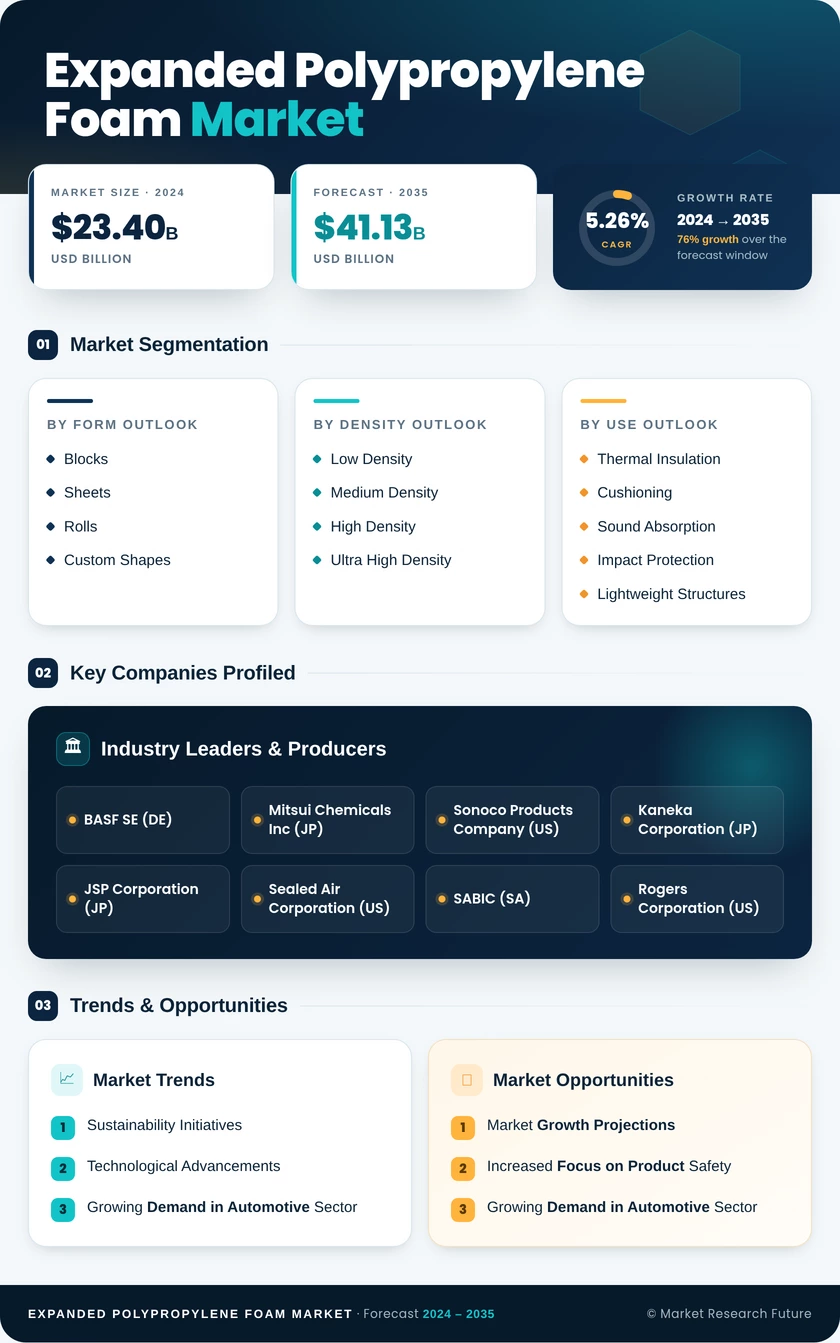
Segmentation Quick Reference
| Dimension | Sub-Segments | Dominant Segment | Fastest Growing Segment |
| By Raw Material | Synthetic Polypropylene; Bio-based & Recycled-Content Polypropylene | Synthetic Polypropylene | Bio-based & Recycled-Content Polypropylene |
| By Foam Type | Molded EPP; Extruded & Sheet EPP | Molded EPP | Molded EPP |
| By Application | Automotive; Dunnage & Industrial Packaging; Consumer Packaging; Sports & Leisure; HVAC & Building; Others | Automotive | Dunnage & Industrial Packaging |
| By End-User Industry | Automotive OEM & Tier-One; Logistics & E-Commerce; Consumer Electronics & Appliances; Healthcare & Life Sciences; Construction & HVAC | Automotive OEM & Tier-One | Logistics & E-Commerce |
| By Geography | North America; Europe; Asia-Pacific; South America; Middle East & Africa | Asia-Pacific | Asia-Pacific |
Market Segmentation Overview
By Raw Material
| Sub-Segment | Key Trend |
| Synthetic Polypropylene | Established pre-expansion characterisation keeps requalification costs high and incumbency strong. |
| Bio-based & Recycled-Content Polypropylene | Mass-balance certification unlocks Scope 3 claims without part-geometry requalification. |
Raw-material choice is currently a compliance decision rather than a performance one, since certified grades mold to the same parameters as conventional beads. Availability of certified feedstock, not converter capability, sets the ceiling on adoption through 2028.
By Foam Type
| Sub-Segment | Key Trend |
| Molded EPP | Three-dimensional steam-chest tooling consolidates multi-piece assemblies into single variable-density parts. |
| Extruded & Sheet EPP | Continuous-line economics retain advantage in laminated headliners, duct wrapping, and building underlays. |
Format selection follows geometry. Discrete three-dimensional parts route to molding, while flat and laminated applications stay on extrusion lines where throughput and yield are structurally better.
By Application
| Sub-Segment | Key Trend |
| Automotive | Battery enclosure and pack spacer content lifts per-vehicle mass above combustion baselines. |
| Dunnage & Industrial Packaging | Pooled crate systems shift buyers from purchase to per-rotation service contracts. |
| Consumer Packaging | Export appliance and electronics shippers displace expanded polystyrene on damage-rate evidence. |
| Sports & Leisure | Rotational-acceleration test protocols favour multi-density liners over single-use alternatives. |
| HVAC & Building | Duct consolidation removes assembly steps while improving thermal performance. |
| Others | Validated medical shippers and agricultural crates add small but high-margin volume. |
Automotive volume sets the industry's cost structure, but the fastest revenue growth sits in industrial transit systems where the commercial model is changing alongside the material. Converters serving both pools balance programme visibility against faster-turning contract work.
By End-User Industry
| Sub-Segment | Key Trend |
| Automotive OEM & Tier-One | Multi-year platform awards create revenue visibility but compress unit pricing. |
| Logistics & E-Commerce | Reverse-logistics density determines pool profitability and supplier selection. |
| Consumer Electronics & Appliances | Damage-rate reduction justifies premium over fibre-based transit protection. |
| Healthcare & Life Sciences | Validation cycles of 9–14 months produce durable supplier lock-in. |
| Construction & HVAC | Retrofit efficiency programmes drive specification in duct and underlay applications. |
End-user mix determines converter margin profile more than segment size does. Healthcare and pooled logistics customers pay for qualification and service depth, while automotive buyers pay for scale and process discipline.
By Region
| Sub-Segment | Key Trend |
| North America | Battery plant clusters pull conversion capacity within 400 km freight radii. |
| Europe | Binding reuse targets convert durable crate systems into a compliance requirement. |
| Asia-Pacific | Landed-cost advantage of 15–20% sustains export competitiveness alongside domestic demand. |
| South America | Agricultural export logistics anchor demand ahead of automotive volume |
| Middle East & Africa | Feedstock proximity remains underexploited pending downstream conversion investment. |
Geographic momentum is shifting at the margin without changing the ranking. New capacity in Ohio, Rayong, and Querétaro narrows the cost gap modestly, but Asia-Pacific retains leadership on both scale and growth rate through 2035.


 Noah Malgeri
Co-Founder

 Peter Groot koerkamp
Account and Business Manager

 Younghwan Choi
Senior Retail Manager

 Mark Irwin
Management Consultant

 Akif Moroglu
Strategy & Business Development Director

 Guilherme Gomes Martins
Product Management Director

 Joseph Aguayo
Sales Operations & Pricing Manager

 La Terria Dodd
Program Support Specialist

 Rob Kooiker
Group Product Manager HVAC & Fire Protection GMA