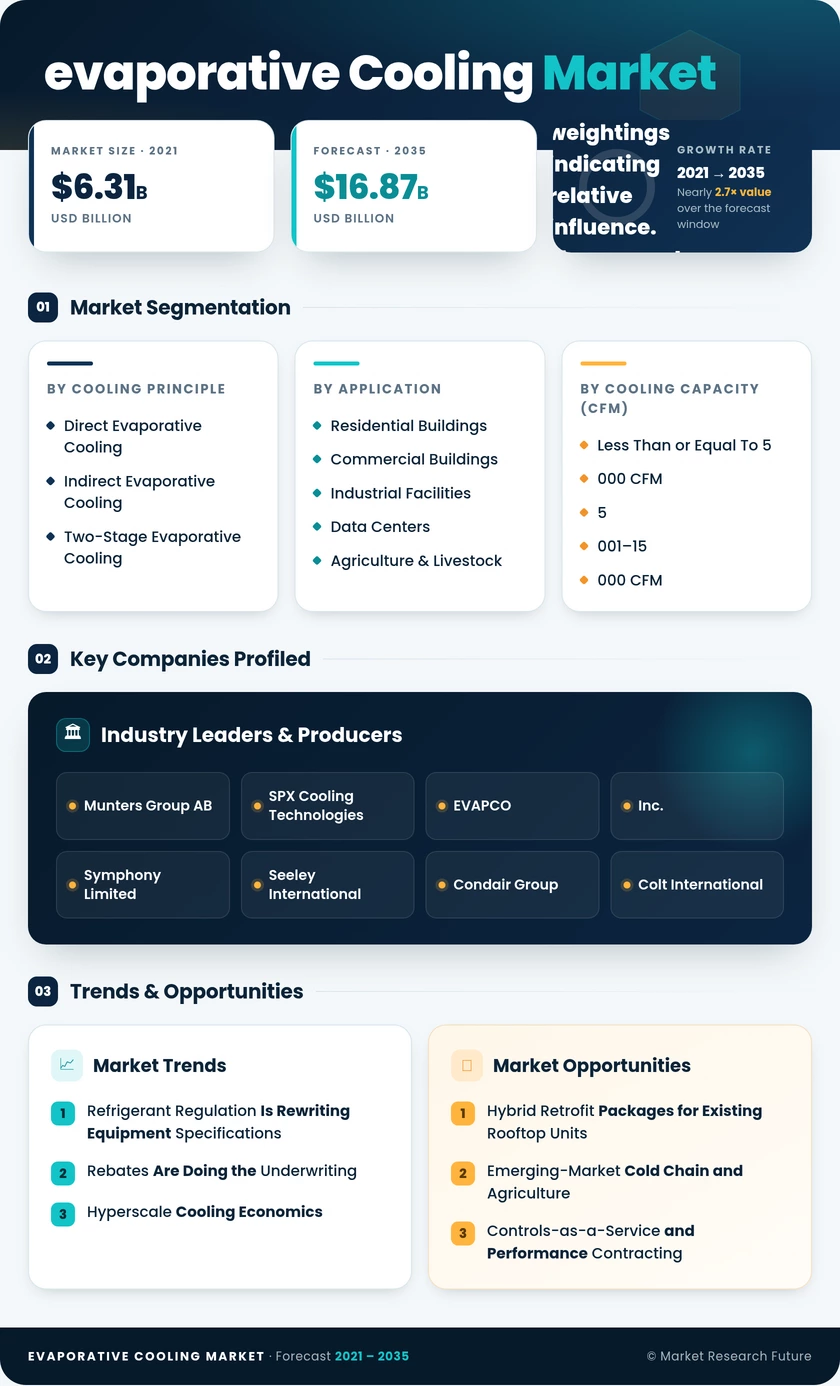
Segmentation Quick Reference
| Dimension | Sub-Segments | Dominant Segment | Fastest Growing Segment |
| By Cooling Principle | Direct Evaporative Cooling; Indirect Evaporative Cooling; Two-Stage Evaporative Cooling | Direct Evaporative Cooling | Two-Stage Evaporative Cooling |
| By Application | Residential Buildings; Commercial Buildings; Industrial Facilities; Data Centers; Agriculture & Livestock | Residential Buildings | Data Centers |
| By Cooling Capacity (CFM) | Less Than or Equal To 5,000 CFM; 5,001–15,000 CFM; Above 15,000 CFM | Less Than or Equal To 5,000 CFM | Above 15,000 CFM |
| By Component | Cooling Pads; Fans and Blowers; Water Distribution Systems; Control Systems; Others | Cooling Pads | Control Systems |
| By Geography | North America; Europe; Asia-Pacific; South America; Middle East & Africa | North America | Asia-Pacific |
Market Segmentation Overview
By Cooling Principle
| Sub-Segment | Key Trend |
| Direct Evaporative Cooling | Rigid cellulose and polymer media displacing aspen fiber; EC motor upgrades lifting efficiency |
| Indirect Evaporative Cooling | Adoption accelerating in data halls where process air must stay dry |
| Two-Stage Evaporative Cooling | Sensible pre-cooling extends viable operating envelope into moderately humid climates |
Cooling principle is the axis that determines addressable geography. Direct systems own the arid-climate volume business, while indirect and two-stage architectures are the mechanism by which the category expands its map. Vendors investing in heat-exchanger design are effectively buying access to territory that pure direct-evaporative players cannot reach.
By Application
| Sub-Segment | Key Trend |
| Residential Buildings | Rebate stacking and refrigerant substitution driving retrofit conversions |
| Commercial Buildings | Warehouse and big-box retail adopting large-capacity ducted systems |
| Industrial Facilities | Heat-stress regulation converting comfort spending into compliance spending |
| Data Centers | Adiabatic pre-cooling standard in new hyperscale and colocation designs |
| Agriculture & Livestock | Poultry and greenhouse operators quantifying yield gains from climate control |
Application mix determines margin structure. Residential delivers unit volume with commodity economics; data centers and industrial process cooling deliver engineered-project economics with longer sales cycles and materially higher contract values. Most vendors are attempting to move up this ladder simultaneously.
By Cooling Capacity (CFM)
| Sub-Segment | Key Trend |
| Less Than or Equal To 5,000 CFM | Portable and window-format units dominate replacement demand |
| 5,001–15,000 CFM | Ducted residential and light commercial ducted systems |
| Above 15,000 CFM | Large-format units scaling into data halls and distribution centers |
Capacity banding correlates tightly with channel structure. Smaller units move through retail and distributor networks with minimal engineering support; above 15,000 CFM, the sale becomes a consulting engagement involving mechanical engineers, commissioning agents, and often the utility.
By Component
| Sub-Segment | Key Trend |
| Cooling Pads | Extended-life polymer and ceramic media lengthening replacement intervals |
| Fans and Blowers | EC motor conversion cutting fan energy 25–40% versus PSC baselines |
| Water Distribution Systems | Conductivity-controlled bleed and recovery reducing consumption |
| Control Systems | Wet-bulb-aware logic, telemetry and grid-services participation |
| Others | Corrosion-resistant housings, filtration and structural assemblies |
Component economics are quietly shifting toward the control layer. Pads remain the aftermarket cash generator, but controls carry software-like margins and create the data asset that supports performance contracting, utility measurement and verification, and eventual demand-flexibility revenue.


 Noah Malgeri
Co-Founder

 Peter Groot koerkamp
Account and Business Manager

 Younghwan Choi
Senior Retail Manager

 Mark Irwin
Management Consultant

 Akif Moroglu
Strategy & Business Development Director

 Guilherme Gomes Martins
Product Management Director

 Joseph Aguayo
Sales Operations & Pricing Manager

 La Terria Dodd
Program Support Specialist

 Rob Kooiker
Group Product Manager HVAC & Fire Protection GMA