Request Free Sample ×

Kindly complete the form below to receive a free sample of this Report

* Please use a valid business email

Leading companies partner with us for data-driven Insights

clients tt-cursor
Hero Background
English
Chinese
French
Japanese
Korean
German
Spanish

Europe Medical Suction Device Market Size

ID: MRFR/MED/0152-HCR
100 Pages
Vikita Thakur
Last Updated: April 06, 2026

Europe, Middle East and Africa Medical Suction Device Market Research Report: Size, Share, Trend Analysis By Power Mode (Manually Operated Suction Devices, DC Powered Suction Devices, Battery Powered Suction Devices), Portability (Handheld Suction Devices, Wall-Mounted Suction Devices and Centralized Suction Devices), Application (Surgical Application, Airway cleaning, Research and diagnostics, and others), End User (Hospitals and Clinics, Homecare Settings, and others) and Region (Europe, the Middle East and Africa)) - Growth Outlook & Industry Forecast 2025 To 2035

Share:
Download PDF ×

We do not share your information with anyone. However, we may send you emails based on your report interest from time to time. You may contact us at any time to opt-out.

Europe Medical Suction Device Market Infographic
Purchase Options

Europe Medical Suction Device Size

Europe Medical Suction Device Market Growth Projections and Opportunities

Segment factors, including population size, age, and healthcare foundation, shape the medical suction device market. Maturing populations in Europe, for example, add to a more popularity for medical devices because of expanded healthcare needs. In Africa, population growth and further developing healthcare access add to a developing market for medical suction devices. The degree of healthcare consumption is a basic market factor. Governments and confidential healthcare suppliers distribute spending plans for medical hardware, including suction devices. Varieties in healthcare spending across nations in Europe and Africa influence the availability and consistency of medical suction devices, influencing market entrance and growth. The commonness of constant illnesses, like respiratory issues and cardiovascular circumstances, impacts the demand for medical suction devices. As these diseases become broader, healthcare offices require progressed suction devices for symptomatic and therapeutic purposes, driving market development. The proficiency of circulation channels is essential for market reach. Deep rooted circulation networks guarantee appropriate and boundless availability of medical suction devices. Factors, for example, such as coordinated operations, production network foundation, and administrative consistency in circulation add to market elements in the areas. Social and social variables assume a part in the reception of medical advances. Social perspectives towards healthcare and the degree of awareness about cutting edge medical devices impact the acknowledgment and use of suction devices. General health campaigns and instructive drives can affect market growth by cultivating awareness and understanding. Worldwide occasions, like pandemics, can significantly affect the medical suction device market. The Coronavirus pandemic, for instance, expanded the demand for respiratory care gear, including suction devices. Enthusiasm for such occasions and the capacity to adjust to changing healthcare needs are significant market factors.

Europe Medical Suction Device Market Size Graph
Author
Author Profile
Vikita Thakur
Senior Research Analyst

She holds an experience of about 5+ years in market research and business consulting projects for sectors such as life sciences, medical devices, and healthcare IT. She possesses a robust background in data analysis, market estimation, competitive intelligence, pipeline analysis market trend identification, and consumer behavior insights. Her expertise lies in technical Sales support, client interaction and project management, designing and implementing market research studies, conducting competitive analysis, and synthesizing complex data into actionable recommendations that drive business growth.

Leave a Comment

FAQs

What is the current valuation of the Europe medical suction device market?

<p>As of 2024, the Europe medical suction device market was valued at 276.4 USD Billion.</p>

What is the projected market size for the Europe medical suction device market by 2035?

<p>The market is expected to reach a valuation of 463.9 USD Billion by 2035.</p>

What is the expected CAGR for the Europe medical suction device market during the forecast period?

<p>The expected CAGR for the market from 2025 to 2035 is 4.82%.</p>

Which segments are included in the Europe medical suction device market?

<p>The market is segmented by application, end use, product type, technology, and patient type.</p>

What are the projected revenues for surgical suction devices by 2035?

<p>Surgical suction devices are projected to generate revenues between 90.0 and 90.0 USD Billion by 2035.</p>

How do portable suction devices perform in terms of market valuation?

<p>Portable suction devices are expected to achieve a market valuation ranging from 30.0 to 50.0 USD Billion by 2035.</p>

What is the market outlook for electric suction devices in 2035?

<p>Electric suction devices are anticipated to reach a market valuation between 70.0 and 120.0 USD Billion by 2035.</p>

Which companies are leading the Europe medical suction device market?

<p>Key players in the market include Medtronic, Boston Scientific, Smiths Medical, and B. Braun Melsungen AG.</p>

What is the expected revenue range for pediatric suction devices by 2035?

<p>Pediatric suction devices are projected to generate revenues between 53.9 and 53.9 USD Billion by 2035.</p>

How does the market for vacuum suction devices compare to other product types?

<p>Vacuum suction devices are expected to dominate with a valuation between 86.4 and 143.9 USD Billion by 2035.</p>

Market Summary

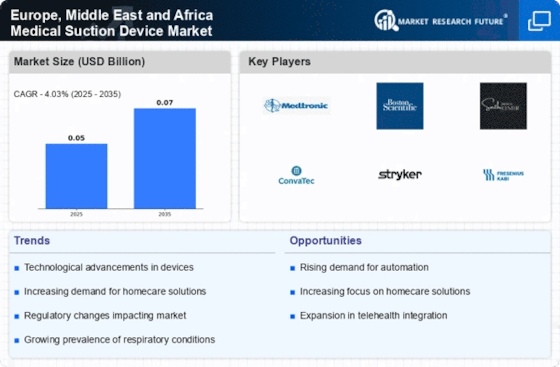
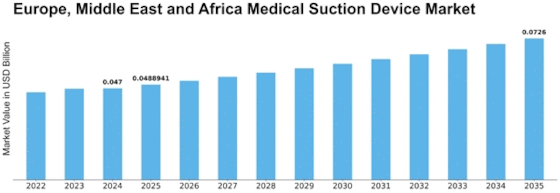
As per Market Research Future analysis, the Europe, Middle East and Africa Medical Suction Device Market Size was estimated at 0.047 USD Billion in 2024. The medical suction device industry is projected to grow from USD 0.0489 Billion in 2025 to USD 0.0726 Billion by 2035, exhibiting a compound annual growth rate (CAGR) of 4.03% during the forecast period 2025 - 2035

Key Market Trends & Highlights

The Europe, Middle East and Africa Medical Suction Device Market is poised for growth driven by technological advancements and increasing demand in emergency care settings.

  • Technological advancements are reshaping the medical suction device landscape, enhancing efficiency and usability.
  • The Europe region remains the largest market, while the Asia-Pacific region is recognized as the fastest-growing area for medical suction devices.
  • DC powered suction devices dominate the market, whereas battery powered suction devices are experiencing rapid growth.
  • Growing demand in emergency care settings and rising prevalence of chronic respiratory diseases are key drivers influencing market expansion.

Market Size & Forecast

2024 Market Size 0.047 (USD Billion)
2035 Market Size 0.0726 (USD Billion)
CAGR (2025 - 2035) 4.03%
Largest Regional Market Share in 2024 Europe

Major Players

Medtronic (IE), Boston Scientific (US), Smiths Medical (GB), ConvaTec (GB), Stryker (US), Fresenius Kabi (DE), Halyard Health (US), B. Braun Melsungen (DE), Olympus Corporation (JP)

Market Trends

The Europe, Middle East and Africa Medical Suction Device Market is currently experiencing a notable evolution, driven by advancements in technology and increasing healthcare demands. The market appears to be influenced by a growing emphasis on patient safety and the need for efficient medical procedures. As healthcare facilities strive to enhance their operational efficiency, the adoption of innovative suction devices is likely to rise. Furthermore, the regulatory landscape is evolving, with authorities focusing on ensuring the quality and safety of medical devices, which may further propel market growth. In addition, the rising prevalence of chronic diseases and the aging population in these regions seem to be contributing to the heightened demand for medical suction devices. Hospitals and clinics are increasingly recognizing the importance of reliable suction systems in various medical procedures, including surgeries and emergency care. This trend indicates a shift towards more sophisticated and user-friendly devices that can cater to diverse medical needs. Overall, the Europe, Middle East and Africa Medical Suction Device Market appears poised for continued growth, driven by technological advancements and changing healthcare dynamics.

Technological Advancements

The market is witnessing a surge in the development of advanced suction devices that incorporate innovative technologies. These devices are designed to enhance performance, improve patient outcomes, and streamline medical procedures. Features such as portability, ease of use, and integration with digital health systems are becoming increasingly prevalent.

Regulatory Changes

The regulatory environment surrounding medical devices is evolving, with authorities implementing stricter guidelines to ensure safety and efficacy. This trend may lead to increased compliance costs for manufacturers but could also enhance the overall quality of products available in the Europe, Middle East and Africa Medical Suction Device Market.

Growing Demand in Emergency Care

There is a noticeable increase in the demand for medical suction devices in emergency care settings. As healthcare providers prioritize rapid response and effective patient management, the need for reliable suction systems is becoming more critical. This trend suggests a shift towards equipping emergency departments with advanced suction technologies.

Europe Medical Suction Device Market Market Drivers

Regulatory Changes Impacting the Market

Regulatory changes are playing a crucial role in shaping the Europe, Middle East and Africa Medical Suction Device Market. Stricter regulations regarding device safety and efficacy are compelling manufacturers to enhance their product offerings. Compliance with these regulations not only ensures patient safety but also fosters innovation within the industry. For instance, the European Union's Medical Device Regulation (MDR) has introduced more rigorous assessment processes, which may lead to a reduction in the number of devices available in the market. However, this could also result in higher quality products that meet stringent safety standards. As manufacturers adapt to these regulatory frameworks, the market is expected to witness a shift towards more reliable and effective medical suction devices, potentially increasing market value in the long term.

Growing Demand in Emergency Care Settings

The demand for medical suction devices in emergency care settings is on the rise, significantly influencing the Europe, Middle East and Africa Medical Suction Device Market. Emergency departments require efficient suction devices to manage airway obstructions and other critical situations. The increasing incidence of respiratory diseases and trauma cases necessitates the availability of reliable suction equipment. According to recent data, emergency care accounts for a substantial portion of medical device usage, with suction devices being integral to patient management. This growing demand is expected to drive market growth, as healthcare facilities invest in advanced suction technologies to enhance patient care. The emphasis on rapid response and effective treatment in emergency situations is likely to further propel the market forward.

Rising Prevalence of Chronic Respiratory Diseases

The rising prevalence of chronic respiratory diseases is significantly impacting the Europe, Middle East and Africa Medical Suction Device Market. Conditions such as chronic obstructive pulmonary disease (COPD) and asthma require effective management strategies, including the use of suction devices for airway clearance. As the population ages and lifestyle factors contribute to respiratory issues, the demand for medical suction devices is expected to increase. Recent statistics indicate that respiratory diseases are among the leading causes of morbidity and mortality in the region, highlighting the urgent need for effective treatment options. Consequently, healthcare providers are likely to invest more in suction devices to improve patient outcomes, thereby driving market growth in the coming years.

Increasing Investment in Healthcare Infrastructure

Increasing investment in healthcare infrastructure across the Europe, Middle East and Africa region is poised to benefit the Medical Suction Device Market. Governments and private entities are allocating substantial resources to enhance healthcare facilities, which includes upgrading medical equipment. This trend is particularly evident in emerging markets where there is a push to improve healthcare access and quality. Enhanced infrastructure not only facilitates the adoption of advanced medical suction devices but also ensures that healthcare providers are equipped to deliver high-quality care. As investments continue to flow into healthcare systems, the demand for medical suction devices is likely to rise, contributing to the overall growth of the market.

Technological Advancements in Medical Suction Devices

The Europe, Middle East and Africa Medical Suction Device Market is experiencing a notable transformation due to rapid technological advancements. Innovations such as portable suction devices and automated systems are enhancing the efficiency and effectiveness of suction procedures. These advancements not only improve patient outcomes but also streamline operations in healthcare settings. The integration of smart technologies, including IoT connectivity, allows for real-time monitoring and data collection, which can lead to better clinical decisions. Furthermore, the market is projected to grow at a compound annual growth rate (CAGR) of approximately 6.5% over the next five years, driven by these technological improvements. As healthcare providers increasingly adopt these advanced devices, the overall landscape of the medical suction device market is likely to evolve significantly.


Market Segment Insights

By Application: Surgical (Largest) vs. Emergency (Fastest-Growing)

<p>In The Europe medical suction device market, the application segment is significantly divided into Surgical, Emergency, Home Care, Transport, and Pediatric categories. Among these, the Surgical application holds the largest market share, driven by the increasing number of surgical procedures and the technological advancements in suction devices designed for intraoperative use. The Emergency application follows closely, rapidly gaining traction due to the rising demand for quick-response medical equipment in emergency care settings, especially post-pandemic.</p>

<p>Surgical (Dominant) vs. Emergency (Emerging)</p>

<p>Surgical suction devices are well-established within the healthcare infrastructure, often characterized by their advanced features tailored for varied surgical settings. They dominate the market due to their critical role in ensuring patient safety and providing optimal visibility during procedures. In contrast, Emergency suction devices cater to a growing niche that requires portability and ease of use, facilitating rapid deployment in urgent care scenarios. The rising number of <a href="https://www.marketresearchfuture.com/reports/emergency-medical-services-market-8363" target="_blank" title="emergency medical services">emergency medical services</a> and the push for innovative solutions in acute care environments contribute to the emergence of this segment, making it a vital area for future growth.</p>

By End Use: Hospitals (Largest) vs. Home Healthcare (Fastest-Growing)

<p>In the European medical suction device market, Hospitals represent the largest end use segment, holding a significant share due to the high demand for surgical procedures and critical care. Ambulatory Surgical Centers and Long-term Care Facilities also play noteworthy roles, though they are smaller in comparison. Emergency Medical Services remain relevant, primarily driven by the need for immediate medical response and intervention. Home Healthcare, while currently less substantial than hospitals, is seeing increasing contributions due to evolving healthcare delivery methods that emphasize patient care at home. The growth trends in this segment are heavily influenced by demographic changes and technological advancements in medical suction devices. The aging population in Europe is leading to an increased prevalence of chronic diseases requiring regular suction management. Moreover, the expansion of home healthcare services is a direct response to the changing preferences of patients for receiving care at home, which in turn is propelling the development of innovative portable suction devices designed for home use. The demand in Emergency Medical Services is also rising, driven by the need for rapid medical interventions.</p>

<p>Healthcare Settings: Hospitals (Dominant) vs. Home Healthcare (Emerging)</p>

<p>The healthcare settings of Hospitals and Home Healthcare are critical players in the European medical suction device market. Hospitals are the dominant force, characterized by high volumes of procedures requiring sophisticated suction solutions to manage fluids during surgeries and other medical interventions. They benefit from established protocols and resources for deploying advanced suction devices. On the other hand, Home Healthcare is an emerging segment that is gaining traction, particularly as technology advances. Patients prefer receiving care at home, which encourages the development of user-friendly, portable suction devices. This segment is characterized by the need for devices that cater to both patient usability and caregiver training, which reflects a significant shift towards home-based care solutions.</p>

By Product Type: Wall-mounted Suction Devices (Largest) vs. Portable Suction Devices (Fastest-Growing)

<p>The Europe medical suction device market is characterized by a diverse range of products, with wall-mounted suction devices holding the largest share due to their widespread use in hospitals and healthcare facilities. These devices offer robust performance, reliability, and convenience, making them a preferred choice for many medical applications. In contrast, portable suction devices are quickly gaining traction, appealing to a growing segment of the market that values mobility, especially in emergency settings and home healthcare. Their ease of transport and usability in various environments is driving their increasing market share. Growth in the medical suction device segment is primarily driven by the increasing prevalence of respiratory conditions and surgical procedures that require suction devices. The convenience offered by portable devices is attracting interest from both medical professionals and patients. Additionally, technological advancements, such as improved battery life and enhanced functionality, are also making portable suction devices more popular. The overall trend indicates a shift towards more adaptable and user-friendly healthcare solutions that cater to diverse patient needs.</p>

<p>Wall-mounted Suction Devices (Dominant) vs. Portable Suction Devices (Emerging)</p>

<p>Wall-mounted suction devices are an established choice in the Europe medical suction device market, predominantly utilized in hospitals and surgical centers for their high efficiency and ability to provide continuous suction power. They are equipped with advanced filtration systems to enhance patient safety and minimize contamination risks, making them a reliable option in critical care environments. On the other hand, portable suction devices are emerging as a significant player, driven by the need for flexibility in various healthcare settings, including at-home care and emergency medical services. These devices utilize modern technology to offer user-friendly operation, compact design, and battery-powered options that enhance their appeal to healthcare providers looking for solutions that suit diverse medical scenarios.</p>

By Technology: Electromechanical (Largest) vs. Manual (Fastest-Growing)

<p>In the Europe medical suction device market, the technology segment is diverse, featuring electromechanical, manual, battery-operated, pneumatic, and vacuum types. Electromechanical devices hold the largest market share, owing to their reliability and efficiency in hospital settings. Manual devices, while having a smaller share, are gaining traction due to their ease of use and cost-effectiveness, making them popular in home care settings.</p>

<p>Technology: Electromechanical (Dominant) vs. Manual (Emerging)</p>

<p>Electromechanical suction devices are recognized as the dominant technology in the European medical suction device market, thanks to their precision and effectiveness in critical medical scenarios. These devices are often equipped with advanced features such as adjustable suction levels and automated controls, ensuring optimal performance. On the other hand, manual suction devices are becoming increasingly emerging solutions, particularly favored for their simplicity and portability. They are highly beneficial in resource-limited settings or for emergency use where immediate suction is necessary, showcasing how diverse user needs shape the evolving landscape of suction technology.</p>

By Patient Type: Adult (Largest) vs. Pediatric (Fastest-Growing)

<p>In the Europe medical suction device market, the patient type segment is primarily dominated by adults, who account for the largest share due to the increasing prevalence of chronic respiratory diseases. This group is followed by pediatric and neonatal categories, which also hold significant slices of the market share. Geriatric and obese patient categories, while smaller, are crucial as they represent a growing demographic requiring specialized suction devices for effective treatment.</p>

<p>Adult (Dominant) vs. Pediatric (Emerging)</p>

<p>The adult segment remains dominant in the Europe medical suction device market, driven by a high incidence of chronic conditions such as COPD and asthma. Adults often require robust suction solutions that cater to their specific health challenges, thus supporting comprehensive care in hospitals and outpatient settings. In contrast, the pediatric segment is emerging rapidly, fueled by increased awareness of children's respiratory issues and advancements in suction technologies tailored for younger patients. This segment is characterized by lightweight, portable devices designed to minimize discomfort in children while maximizing suction efficiency. The growing focus on pediatric healthcare is expected to further enhance the demand for innovative suction solutions tailored for this age group.</p>

Get more detailed insights about Europe, Middle East and Africa Medical Suction Device Market Research Report — Forecast till 2035

Regional Insights

North America : Healthcare Innovation Leader

The North American medical suction device market is driven by advanced healthcare infrastructure, increasing surgical procedures, and a growing elderly population. The U.S. holds the largest market share at approximately 70%, followed by Canada at around 15%. Regulatory support from agencies like the FDA further propels market growth, ensuring safety and efficacy in medical devices. Key players such as Medtronic, Boston Scientific, and Stryker dominate the landscape, leveraging innovative technologies to enhance patient outcomes. The competitive environment is characterized by strategic partnerships and mergers, aimed at expanding product portfolios and market reach. The presence of established healthcare systems in the U.S. and Canada fosters a conducive environment for market expansion.

Europe : Diverse Market Dynamics

The European medical suction device market is characterized by diverse healthcare systems and regulatory frameworks across countries. Germany and the UK are the largest markets, holding approximately 30% and 25% market shares, respectively. The increasing prevalence of chronic diseases and surgical interventions drives demand, supported by stringent regulations from the European Medicines Agency (EMA) that ensure product safety and efficacy. Leading countries like Germany, France, and the UK are home to key players such as Fresenius Kabi and B. Braun Melsungen. The competitive landscape is marked by innovation and collaboration among manufacturers, focusing on advanced suction technologies and user-friendly designs. The presence of robust healthcare infrastructure and funding further enhances market potential in this region.

Asia-Pacific : Emerging Market Potential

The Asia-Pacific medical suction device market is witnessing rapid growth, driven by increasing healthcare expenditure and rising awareness of advanced medical technologies. Countries like China and India are leading the market, with China holding approximately 40% of the share, followed by India at around 20%. The growing population and rising incidence of chronic diseases are significant demand drivers, alongside supportive government initiatives aimed at improving healthcare access. The competitive landscape features both global and local players, with companies like Olympus Corporation and Smiths Medical making significant inroads. The market is characterized by a focus on affordability and accessibility, with manufacturers adapting products to meet local needs. The region's dynamic healthcare environment presents numerous opportunities for growth and innovation.

Middle East and Africa : Untapped Market Opportunities

The Middle East and Africa medical suction device market is gradually expanding, driven by increasing healthcare investments and a rising prevalence of chronic diseases. The UAE and South Africa are the largest markets, accounting for approximately 30% and 25% of the market share, respectively. Government initiatives to enhance healthcare infrastructure and access are pivotal in driving market growth, alongside a growing awareness of advanced medical technologies. Key players in the region include Halyard Health and ConvaTec, focusing on innovative solutions tailored to local needs. The competitive landscape is evolving, with an increasing number of local manufacturers entering the market. The region's diverse healthcare challenges present unique opportunities for growth, particularly in rural and underserved areas.

Key Players and Competitive Insights

Major players in the medical suction device market are investing heavily in research and development to expand their product offerings, which is expected to further drive market growth. These companies are also implementing various strategic initiatives to expand their global presence, such as launching new products, forming contractual agreements, engaging in mergers and acquisitions, increasing investments, and collaborating with other organizations. Competitors in the industry must focus on offering cost-effective solutions to expand their market share and thrive in a competitive and growing market environment.In 2020, Airway Medical Ltd announced that they had been awarded funding from Innovate UK, an investment of up to USD 231.13 Mn (£191m) towards innovative portable and lightweight suction devices through the Sustainable Innovation Fund over the next two years.In addition to investing in research and development, major players in the medical suction device market are also focusing on innovation to stay ahead of the competition. They are continuously exploring new technologies and materials to improve the performance, efficiency, and safety of their products. Moreover, these companies are working to expand their products and are teaming up with healthcare providers to ensure their availability.

Key Companies in the Europe Medical Suction Device Market include

Industry Developments

2023: Airway Medical, alongside the University of Portsmouth and Versarien PLC, has successfully completed their project advancing the AMSU, an innovative airway suction device aimed at saving lives of patients with blocked airways and enhancing the well-being of those with chronic conditions.

2020: Airway Medical Ltd announced that they had been awarded funding from Innovate UK, an investment of up to USD 231.13 Mn (£191m) towards innovative portable and lightweight suction devices through the Sustainable Innovation Fund over the next two years.

Future Outlook

Europe Medical Suction Device Market Future Outlook

The Europe, Middle East and Africa Medical Suction Device Market is projected to grow at a 4.03% CAGR from 2025 to 2035, driven by technological advancements, increasing healthcare demands, and regulatory support.

New opportunities lie in:

  • Expansion of portable suction devices for home healthcare markets.
  • Development of integrated suction systems for surgical applications.
  • Investment in telehealth solutions incorporating suction device monitoring.

By 2035, the market is expected to exhibit robust growth, driven by innovation and evolving healthcare needs.

Market Segmentation

Europe Medical Suction Device Market End-Users Outlook

  • Hospitals and Clinics
  • Homecare Settings
  • Others

Europe Medical Suction Device Market Power Mode Outlook

  • Manually Operated Suction Devices
  • DC Powered Suction Devices
  • Battery Powered Suction Devices
  • Dual-Powered Suction Devices

Europe Medical Suction Device Market Application Outlook

  • Surgical Application
  • Airway Cleaning
  • Negative Pressure Wound Therapy (NPWT)
  • Research and Diagnostics
  • Others

Europe Medical Suction Device Market Portability Outlook

  • Handheld Suction Devices
  • Wall-Mounted Suction Devices
  • Centralized Suction Devices

Report Scope

MARKET SIZE 2024 0.047(USD Billion)
MARKET SIZE 2025 0.0489(USD Billion)
MARKET SIZE 2035 0.0726(USD Billion)
COMPOUND ANNUAL GROWTH RATE (CAGR) 4.03% (2025 - 2035)
REPORT COVERAGE Revenue Forecast, Competitive Landscape, Growth Factors, and Trends
BASE YEAR 2024
Market Forecast Period 2025 - 2035
Historical Data 2019 - 2024
Market Forecast Units USD Billion
Key Companies Profiled Medtronic (IE), Boston Scientific (US), Smiths Medical (GB), ConvaTec (GB), Stryker (US), Fresenius Kabi (DE), Halyard Health (US), B. Braun Melsungen (DE), Olympus Corporation (JP)
Segments Covered Power Mode
Key Market Opportunities Integration of advanced technologies enhances efficiency in the Europe, Middle East and Africa Medical Suction Device Market.
Key Market Dynamics Rising demand for advanced medical suction devices driven by regulatory changes and technological innovations in healthcare.
Countries Covered North America, Europe, APAC, South America, MEA

FAQs

What is the current valuation of the Europe medical suction device market?

<p>As of 2024, the Europe medical suction device market was valued at 276.4 USD Billion.</p>

What is the projected market size for the Europe medical suction device market by 2035?

<p>The market is expected to reach a valuation of 463.9 USD Billion by 2035.</p>

What is the expected CAGR for the Europe medical suction device market during the forecast period?

<p>The expected CAGR for the market from 2025 to 2035 is 4.82%.</p>

Which segments are included in the Europe medical suction device market?

<p>The market is segmented by application, end use, product type, technology, and patient type.</p>

What are the projected revenues for surgical suction devices by 2035?

<p>Surgical suction devices are projected to generate revenues between 90.0 and 90.0 USD Billion by 2035.</p>

How do portable suction devices perform in terms of market valuation?

<p>Portable suction devices are expected to achieve a market valuation ranging from 30.0 to 50.0 USD Billion by 2035.</p>

What is the market outlook for electric suction devices in 2035?

<p>Electric suction devices are anticipated to reach a market valuation between 70.0 and 120.0 USD Billion by 2035.</p>

Which companies are leading the Europe medical suction device market?

<p>Key players in the market include Medtronic, Boston Scientific, Smiths Medical, and B. Braun Melsungen AG.</p>

What is the expected revenue range for pediatric suction devices by 2035?

<p>Pediatric suction devices are projected to generate revenues between 53.9 and 53.9 USD Billion by 2035.</p>

How does the market for vacuum suction devices compare to other product types?

<p>Vacuum suction devices are expected to dominate with a valuation between 86.4 and 143.9 USD Billion by 2035.</p>

  1. SECTION I: EXECUTIVE SUMMARY AND KEY HIGHLIGHTS
    1. | 1.1 EXECUTIVE SUMMARY
    2. | | 1.1.1 Market Overview
    3. | | 1.1.2 Key Findings
    4. | | 1.1.3 Market Segmentation
    5. | | 1.1.4 Competitive Landscape
    6. | | 1.1.5 Challenges and Opportunities
    7. | | 1.1.6 Future Outlook
  2. SECTION II: SCOPING, METHODOLOGY AND MARKET STRUCTURE
    1. | 2.1 MARKET INTRODUCTION
    2. | | 2.1.1 Definition
    3. | | 2.1.2 Scope of the study
    4. | | | 2.1.2.1 Research Objective
    5. | | | 2.1.2.2 Assumption
    6. | | | 2.1.2.3 Limitations
    7. | 2.2 RESEARCH METHODOLOGY
    8. | | 2.2.1 Overview
    9. | | 2.2.2 Data Mining
    10. | | 2.2.3 Secondary Research
    11. | | 2.2.4 Primary Research
    12. | | | 2.2.4.1 Primary Interviews and Information Gathering Process
    13. | | | 2.2.4.2 Breakdown of Primary Respondents
    14. | | 2.2.5 Forecasting Model
    15. | | 2.2.6 Market Size Estimation
    16. | | | 2.2.6.1 Bottom-Up Approach
    17. | | | 2.2.6.2 Top-Down Approach
    18. | | 2.2.7 Data Triangulation
    19. | | 2.2.8 Validation
  3. SECTION III: QUALITATIVE ANALYSIS
    1. | 3.1 MARKET DYNAMICS
    2. | | 3.1.1 Overview
    3. | | 3.1.2 Drivers
    4. | | 3.1.3 Restraints
    5. | | 3.1.4 Opportunities
    6. | 3.2 MARKET FACTOR ANALYSIS
    7. | | 3.2.1 Value chain Analysis
    8. | | 3.2.2 Porter's Five Forces Analysis
    9. | | | 3.2.2.1 Bargaining Power of Suppliers
    10. | | | 3.2.2.2 Bargaining Power of Buyers
    11. | | | 3.2.2.3 Threat of New Entrants
    12. | | | 3.2.2.4 Threat of Substitutes
    13. | | | 3.2.2.5 Intensity of Rivalry
    14. | | 3.2.3 COVID-19 Impact Analysis
    15. | | | 3.2.3.1 Market Impact Analysis
    16. | | | 3.2.3.2 Regional Impact
    17. | | | 3.2.3.3 Opportunity and Threat Analysis
  4. SECTION IV: QUANTITATIVE ANALYSIS
    1. | 4.1 Healthcare, BY Application (USD Billion)
    2. | | 4.1.1 Surgical
    3. | | 4.1.2 Emergency
    4. | | 4.1.3 Home Care
    5. | | 4.1.4 Transport
    6. | | 4.1.5 Pediatric
    7. | 4.2 Healthcare, BY End Use (USD Billion)
    8. | | 4.2.1 Hospitals
    9. | | 4.2.2 Ambulatory Surgical Centers
    10. | | 4.2.3 Home Healthcare
    11. | | 4.2.4 Emergency Medical Services
    12. | | 4.2.5 Long-term Care Facilities
    13. | 4.3 Healthcare, BY Product Type (USD Billion)
    14. | | 4.3.1 Portable Suction Devices
    15. | | 4.3.2 Wall-mounted Suction Devices
    16. | | 4.3.3 Electric Suction Devices
    17. | | 4.3.4 Manual Suction Devices
    18. | | 4.3.5 Vacuum Suction Devices
    19. | 4.4 Healthcare, BY Technology (USD Billion)
    20. | | 4.4.1 Electromechanical
    21. | | 4.4.2 Manual
    22. | | 4.4.3 Battery-operated
    23. | | 4.4.4 Pneumatic
    24. | | 4.4.5 Vacuum
    25. | 4.5 Healthcare, BY Patient Type (USD Billion)
    26. | | 4.5.1 Adult
    27. | | 4.5.2 Pediatric
    28. | | 4.5.3 Neonatal
    29. | | 4.5.4 Geriatric
    30. | | 4.5.5 Obese
  5. SECTION V: COMPETITIVE ANALYSIS
    1. | 5.1 Competitive Landscape
    2. | | 5.1.1 Overview
    3. | | 5.1.2 Competitive Analysis
    4. | | 5.1.3 Market share Analysis
    5. | | 5.1.4 Major Growth Strategy in the Healthcare
    6. | | 5.1.5 Competitive Benchmarking
    7. | | 5.1.6 Leading Players in Terms of Number of Developments in the Healthcare
    8. | | 5.1.7 Key developments and growth strategies
    9. | | | 5.1.7.1 New Product Launch/Service Deployment
    10. | | | 5.1.7.2 Merger & Acquisitions
    11. | | | 5.1.7.3 Joint Ventures
    12. | | 5.1.8 Major Players Financial Matrix
    13. | | | 5.1.8.1 Sales and Operating Income
    14. | | | 5.1.8.2 Major Players R&D Expenditure. 2023
    15. | 5.2 Company Profiles
    16. | | 5.2.1 Medtronic (IE)
    17. | | | 5.2.1.1 Financial Overview
    18. | | | 5.2.1.2 Products Offered
    19. | | | 5.2.1.3 Key Developments
    20. | | | 5.2.1.4 SWOT Analysis
    21. | | | 5.2.1.5 Key Strategies
    22. | | 5.2.2 Boston Scientific (US)
    23. | | | 5.2.2.1 Financial Overview
    24. | | | 5.2.2.2 Products Offered
    25. | | | 5.2.2.3 Key Developments
    26. | | | 5.2.2.4 SWOT Analysis
    27. | | | 5.2.2.5 Key Strategies
    28. | | 5.2.3 Smiths Medical (GB)
    29. | | | 5.2.3.1 Financial Overview
    30. | | | 5.2.3.2 Products Offered
    31. | | | 5.2.3.3 Key Developments
    32. | | | 5.2.3.4 SWOT Analysis
    33. | | | 5.2.3.5 Key Strategies
    34. | | 5.2.4 Fisher & Paykel Healthcare (NZ)
    35. | | | 5.2.4.1 Financial Overview
    36. | | | 5.2.4.2 Products Offered
    37. | | | 5.2.4.3 Key Developments
    38. | | | 5.2.4.4 SWOT Analysis
    39. | | | 5.2.4.5 Key Strategies
    40. | | 5.2.5 ConvaTec (GB)
    41. | | | 5.2.5.1 Financial Overview
    42. | | | 5.2.5.2 Products Offered
    43. | | | 5.2.5.3 Key Developments
    44. | | | 5.2.5.4 SWOT Analysis
    45. | | | 5.2.5.5 Key Strategies
    46. | | 5.2.6 Stryker (US)
    47. | | | 5.2.6.1 Financial Overview
    48. | | | 5.2.6.2 Products Offered
    49. | | | 5.2.6.3 Key Developments
    50. | | | 5.2.6.4 SWOT Analysis
    51. | | | 5.2.6.5 Key Strategies
    52. | | 5.2.7 B. Braun Melsungen AG (DE)
    53. | | | 5.2.7.1 Financial Overview
    54. | | | 5.2.7.2 Products Offered
    55. | | | 5.2.7.3 Key Developments
    56. | | | 5.2.7.4 SWOT Analysis
    57. | | | 5.2.7.5 Key Strategies
    58. | | 5.2.8 Hollister Incorporated (US)
    59. | | | 5.2.8.1 Financial Overview
    60. | | | 5.2.8.2 Products Offered
    61. | | | 5.2.8.3 Key Developments
    62. | | | 5.2.8.4 SWOT Analysis
    63. | | | 5.2.8.5 Key Strategies
    64. | | 5.2.9 Teleflex (US)
    65. | | | 5.2.9.1 Financial Overview
    66. | | | 5.2.9.2 Products Offered
    67. | | | 5.2.9.3 Key Developments
    68. | | | 5.2.9.4 SWOT Analysis
    69. | | | 5.2.9.5 Key Strategies
    70. | | 5.2.10 Medi-Globe (DE)
    71. | | | 5.2.10.1 Financial Overview
    72. | | | 5.2.10.2 Products Offered
    73. | | | 5.2.10.3 Key Developments
    74. | | | 5.2.10.4 SWOT Analysis
    75. | | | 5.2.10.5 Key Strategies
    76. | 5.3 Appendix
    77. | | 5.3.1 References
    78. | | 5.3.2 Related Reports
  6. LIST OF FIGURES
    1. | 6.1 MARKET SYNOPSIS
    2. | 6.2 EUROPE MARKET ANALYSIS BY APPLICATION
    3. | 6.3 EUROPE MARKET ANALYSIS BY END USE
    4. | 6.4 EUROPE MARKET ANALYSIS BY PRODUCT TYPE
    5. | 6.5 EUROPE MARKET ANALYSIS BY TECHNOLOGY
    6. | 6.6 EUROPE MARKET ANALYSIS BY PATIENT TYPE
    7. | 6.7 KEY BUYING CRITERIA OF HEALTHCARE
    8. | 6.8 RESEARCH PROCESS OF MRFR
    9. | 6.9 DRO ANALYSIS OF HEALTHCARE
    10. | 6.10 DRIVERS IMPACT ANALYSIS: HEALTHCARE
    11. | 6.11 RESTRAINTS IMPACT ANALYSIS: HEALTHCARE
    12. | 6.12 SUPPLY / VALUE CHAIN: HEALTHCARE
    13. | 6.13 HEALTHCARE, BY APPLICATION, 2024 (% SHARE)
    14. | 6.14 HEALTHCARE, BY APPLICATION, 2024 TO 2035 (USD Billion)
    15. | 6.15 HEALTHCARE, BY END USE, 2024 (% SHARE)
    16. | 6.16 HEALTHCARE, BY END USE, 2024 TO 2035 (USD Billion)
    17. | 6.17 HEALTHCARE, BY PRODUCT TYPE, 2024 (% SHARE)
    18. | 6.18 HEALTHCARE, BY PRODUCT TYPE, 2024 TO 2035 (USD Billion)
    19. | 6.19 HEALTHCARE, BY TECHNOLOGY, 2024 (% SHARE)
    20. | 6.20 HEALTHCARE, BY TECHNOLOGY, 2024 TO 2035 (USD Billion)
    21. | 6.21 HEALTHCARE, BY PATIENT TYPE, 2024 (% SHARE)
    22. | 6.22 HEALTHCARE, BY PATIENT TYPE, 2024 TO 2035 (USD Billion)
    23. | 6.23 BENCHMARKING OF MAJOR COMPETITORS
  7. LIST OF TABLES
    1. | 7.1 LIST OF ASSUMPTIONS
    2. | | 7.1.1
    3. | 7.2 Europe MARKET SIZE ESTIMATES; FORECAST
    4. | | 7.2.1 BY APPLICATION, 2026-2035 (USD Billion)
    5. | | 7.2.2 BY END USE, 2026-2035 (USD Billion)
    6. | | 7.2.3 BY PRODUCT TYPE, 2026-2035 (USD Billion)
    7. | | 7.2.4 BY TECHNOLOGY, 2026-2035 (USD Billion)
    8. | | 7.2.5 BY PATIENT TYPE, 2026-2035 (USD Billion)
    9. | 7.3 PRODUCT LAUNCH/PRODUCT DEVELOPMENT/APPROVAL
    10. | | 7.3.1
    11. | 7.4 ACQUISITION/PARTNERSHIP
    12. | | 7.4.1

Europe Healthcare Market Segmentation

Healthcare By Application (USD Billion, 2022-2035)

  • Surgical
  • Emergency
  • Home Care
  • Transport
  • Pediatric

Healthcare By End Use (USD Billion, 2022-2035)

  • Hospitals
  • Ambulatory Surgical Centers
  • Home Healthcare
  • Emergency Medical Services
  • Long-term Care Facilities

Healthcare By Product Type (USD Billion, 2022-2035)

  • Portable Suction Devices
  • Wall-mounted Suction Devices
  • Electric Suction Devices
  • Manual Suction Devices
  • Vacuum Suction Devices

Healthcare By Technology (USD Billion, 2022-2035)

  • Electromechanical
  • Manual
  • Battery-operated
  • Pneumatic
  • Vacuum

Healthcare By Patient Type (USD Billion, 2022-2035)

  • Adult
  • Pediatric
  • Neonatal
  • Geriatric
  • Obese
Infographic

Free Sample Request

Kindly complete the form below to receive a free sample of this Report

Get Free Sample

Customer Strories

Compare Licence

×
Features License Type
Single User Multiuser License Enterprise User
Price $4,950 $5,950 $7,250
Maximum User Access Limit 1 User Upto 10 Users Unrestricted Access Throughout the Organization
Free Customization
Direct Access to Analyst
Deliverable Format
Platform Access
Discount on Next Purchase 10% 15% 15%
Printable Versions