Request Free Sample ×

Kindly complete the form below to receive a free sample of this Report

* Please use a valid business email

Leading companies partner with us for data-driven Insights

clients tt-cursor
Hero Background
English
Chinese
French
Japanese
Korean
German
Spanish

Europe Hospital Bed Market Analysis

ID: MRFR/MED/0170-HCR
50 Pages
Rahul Gotadki
April 2026

Europe, Middle East & Africa Hospital Bed Market by type (Standard bed, Manual bed, Hydraulic bed and Electric bed) by Application type (Medical/Surgical bed, Critical care bed, Maternity bed, Bariatric bed and others) and by End users (Hospitals & Clinics, Nursing homes and Maternity homes) - Growth & Industry Forecast 2025 To 2035

Share:
Download PDF ×

We do not share your information with anyone. However, we may send you emails based on your report interest from time to time. You may contact us at any time to opt-out.

Europe Hospital Bed Market Infographic
Purchase Options

Market Analysis

In-depth Analysis of Europe Hospital Bed Market Industry Landscape

The hospital bed market in Europe, the Middle East, and Africa (EMEA) is characterized by using dynamic factors encouraged by economic, demographic, and technological traits. Economic balance plays a pivotal position in shaping the EMEA hospital bed market. The demand for hospital beds is intricately tied to the overall monetary fitness of the vicinity. Economic fluctuations can impact healthcare budgets, sooner or later influencing the procurement and upgrading of hospital bed infrastructure. Demographic shifts, including a growing old populace and rising healthcare wishes, contribute substantially to market dynamics. With an increasing elderly populace in Europe and a developing demand for healthcare offerings in the Middle East and Africa, the need for hospital beds is expected to increase, using market increases. Rapid technological improvements have transformed hospital bed designs and functionalities. Smart beds, integrated with virtual features and affected person monitoring systems, are gaining a reputation inside the EMEA place. These improvements no longer only enhance patient care but also contribute to the market's dynamism. Intense competition among key players in the hospital bed market fosters innovation and drives product diversification. Market dynamics are trended through the continuous efforts of groups to stay ahead in terms of technology, quality, and price effectiveness. Ongoing investments in healthcare infrastructure across Europe, the Middle East, and Africa are pivotal in shaping market dynamics. The expansion of health center centers and the status quo of recent healthcare facilities contribute to extended demand for hospital beds. The COVID-19 pandemic has underscored the importance of hospital bed capacity. The surge in demand throughout the pandemic has led to a reevaluation of healthcare infrastructure, with nations inside the EMEA region focusing on bolstering their ability to handle fitness crises. The EMEA hospital bed market faces delivery chain demanding situations, which include uncooked fabric shortages and transportation disruptions. These demanding situations, exacerbated with the aid of global occasions, can affect market dynamics, influencing pricing and availability. Changing affected persons' possibilities for consolation and more suitable facilities contribute to the evolution of hospital bed designs. Adjustable capabilities, ergonomic designs, and patient-friendly technologies are becoming critical considerations for healthcare providers, shaping the market's direction. Increasing cognizance of environmental sustainability is influencing product development and procurement practices in the EMEA hospital bed market. Manufacturers are aligning with sustainable practices, addressing a developing subject among healthcare institutions. The integration of telemedicine in healthcare practices affects the demand for hospital beds.


Author
Author Profile
Rahul Gotadki
Research Manager

He holds an experience of about 9+ years in Market Research and Business Consulting, working under the spectrum of Life Sciences and Healthcare domains. Rahul conceptualizes and implements a scalable business strategy and provides strategic leadership to the clients. His expertise lies in market estimation, competitive intelligence, pipeline analysis, customer assessment, etc.

Leave a Comment

FAQs

What is the current valuation of the Europe hospital bed market?

<p>The Europe hospital bed market was valued at 1050.0 USD Million in 2024.</p>

What is the projected market size for the Europe hospital bed market by 2035?

<p>The market is projected to reach 1936.11 USD Million by 2035.</p>

What is the expected CAGR for the Europe hospital bed market during the forecast period?

<p>The expected CAGR for the Europe hospital bed market from 2025 to 2035 is 5.72%.</p>

Which segments are included in the Europe hospital bed market analysis?

<p>The market analysis includes segments such as Acute Care, Long-term Care, Home Care, Rehabilitation, and Palliative Care.</p>

What are the revenue ranges for the Acute Care segment in the Europe hospital bed market?

<p>The Acute Care segment generated revenues between 300.0 and 550.0 USD Million.</p>

How do electric beds compare to manual beds in terms of market valuation?

<p>Electric beds are valued between 400.0 and 800.0 USD Million, whereas manual beds range from 150.0 to 280.0 USD Million.</p>

What is the market valuation for hospital beds used in nursing homes?

<p>The market valuation for hospital beds in nursing homes is between 250.0 and 450.0 USD Million.</p>

Which companies are considered key players in the Europe hospital bed market?

<p>Key players include Fresenius SE, Getinge AB, Hill-Rom Holdings Inc, and Stryker Corporation.</p>

What is the revenue range for specialty beds in the Europe hospital bed market?

<p>Specialty beds are valued between 150.0 and 206.11 USD Million.</p>

What is the projected growth trend for the rehabilitation segment in the Europe hospital bed market?

<p>The rehabilitation segment is expected to grow, with a valuation range of 200.0 to 400.0 USD Million.</p>

Market Summary

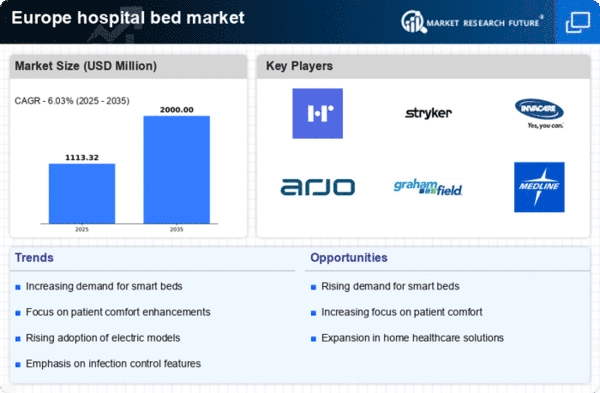
As per Market Research Future analysis, the Hospital Bed market Size was estimated at 1050.0 USD Million in 2024.   The Europe hospital bed market is projected to grow from 1113.32 USD Million in 2025 to 2000.0 USD Million by 2035, exhibiting a compound annual growth rate (CAGR) of 6.0% during the forecast period 2025 - 2035

Key Market Trends & Highlights

The Europe hospital bed market is experiencing a transformative shift towards advanced technology and patient-centered solutions.

  • Technological integration in hospital beds is enhancing patient care and operational efficiency across Europe. Customization and patient-centric design are becoming increasingly important in meeting diverse healthcare needs, particularly in Germany. The demand for home healthcare solutions is rising, reflecting a broader trend towards patient independence and comfort in the UK. Key market drivers include the aging population and increased healthcare demand, alongside technological advancements in bed design.

Market Size & Forecast

2024 Market Size 1050.0 (USD Million)
2035 Market Size 2000.0 (USD Million)
CAGR (2025 - 2035) 6.03%

Major Players

<p>Hill-Rom (US), Stryker (US), Invacare (US), Arjo (SE), Graham-Field (US), Medline Industries (US), Drive DeVilbiss Healthcare (GB), Linet (CZ), Karma Healthcare (IN)</p>

Market Trends

The hospital bed market is currently experiencing notable transformations driven by advancements in technology and evolving healthcare needs. Innovations such as smart beds, which integrate monitoring systems for patient health, are becoming increasingly prevalent.

These beds not only enhance patient comfort but also improve the efficiency of care delivery. Furthermore, the growing emphasis on patient-centered care is prompting healthcare facilities to invest in beds that offer customizable features, catering to individual patient requirements.

This shift reflects a broader trend towards enhancing the overall patient experience within healthcare settings. In addition, the rising demand for home healthcare solutions is influencing the hospital bed market.

As more patients prefer receiving care in the comfort of their homes, there is a corresponding increase in the need for portable and adjustable beds. This trend is likely to continue as healthcare systems adapt to changing patient preferences and the need for cost-effective solutions.

Overall, the hospital bed market appears poised for growth, driven by technological advancements and a shift towards more personalized care options.

Technological Integration

The integration of advanced technology into hospital beds is reshaping the market landscape. Features such as built-in monitoring systems and automated adjustments are enhancing patient care and safety. This trend indicates a move towards more intelligent healthcare solutions that prioritize both efficiency and comfort.

Customization and Patient-Centric Design

There is a growing focus on customization in the hospital bed market. Healthcare providers are increasingly seeking beds that can be tailored to meet the specific needs of patients. This trend reflects a broader commitment to patient-centric care, where individual preferences and comfort are paramount.

Home Healthcare Demand

The rising preference for home healthcare is significantly impacting the hospital bed market. As patients opt for care in their own homes, the demand for portable and adjustable beds is increasing. This trend suggests a shift in how healthcare is delivered, emphasizing convenience and comfort.

Europe Hospital Bed Market Market Drivers

Rising Healthcare Expenditure

Rising healthcare expenditure across European nations is a significant driver for the hospital bed market. Governments and private sectors are increasingly investing in healthcare infrastructure to meet the growing demand for medical services.


In 2025, healthcare spending in Europe is projected to reach approximately €2.5 trillion, reflecting a growth rate of about 4% annually. This increase in funding is likely to facilitate the procurement of advanced hospital beds, thereby enhancing patient care and comfort.

Additionally, as healthcare facilities expand and modernize, the need for high-quality hospital beds becomes more pronounced, further propelling the hospital bed market.

Expansion of Home Healthcare Services

The expansion of home healthcare services in Europe is emerging as a notable driver for the hospital bed market. As more patients prefer receiving care in the comfort of their homes, the demand for home hospital beds is increasing.


This trend is supported by advancements in telemedicine and remote monitoring technologies, which enable healthcare providers to deliver effective care outside traditional hospital settings.

The home healthcare market is expected to grow at a CAGR of around 10% over the next five years, indicating a robust demand for specialized beds that cater to home care needs.

Consequently, this shift is likely to influence the overall dynamics of the hospital bed market.

Technological Advancements in Bed Design

Technological advancements play a pivotal role in shaping the hospital bed market in Europe. Innovations such as smart beds equipped with sensors and monitoring systems enhance patient care and safety.


These beds can track vital signs, adjust positions automatically, and even alert healthcare providers in case of emergencies. The integration of such technologies is likely to improve patient outcomes and operational efficiency in hospitals.

According to recent estimates, the market for smart hospital beds is expected to grow at a CAGR of around 15% over the next five years.

This trend indicates a strong shift towards more advanced and efficient hospital bed solutions, which could significantly impact the hospital bed market.

Focus on Infection Control and Safety Standards

The heightened focus on infection control and safety standards in healthcare facilities is driving the hospital bed market in Europe. Hospitals are increasingly adopting stringent protocols to minimize the risk of hospital-acquired infections (HAIs).


This has led to a demand for hospital beds that are designed with materials and features that facilitate easy cleaning and disinfection. For instance, beds with antimicrobial surfaces and seamless designs are becoming more prevalent.

The European market is witnessing a shift towards beds that not only provide comfort but also adhere to the latest safety regulations. This trend is likely to influence purchasing decisions, thereby impacting the hospital bed market.

Aging Population and Increased Healthcare Demand

The aging population in Europe is a critical driver for the hospital bed market.


As the demographic shifts towards an older age group, the demand for healthcare services, including hospital beds, is expected to rise significantly. 

By 2030, it is projected that individuals aged 65 and older will account for approximately 20% of the total population in Europe. This demographic trend necessitates an increase in hospital infrastructure, including specialized beds that cater to the needs of elderly patients.

Furthermore, the European healthcare system is under pressure to provide adequate care, which may lead to increased investments in hospital facilities and equipment, thereby boosting the hospital bed market.

Market Segment Insights

By Application: Acute Care (Largest) vs. Home Care (Fastest-Growing)

<p>In the Europe hospital bed market, the application segment demonstrates a significant distribution of market share among various categories. Acute Care stands out as the largest segment, gaining substantial traction due to the increasing prevalence of acute medical conditions requiring immediate hospitalization. In contrast, Home Care is witnessing rapid growth as more patients prefer receiving treatment in home settings, driving demand for specialized home care beds.</p>

<p>Acute Care (Dominant) vs. Home Care (Emerging)</p>

<p>The Acute Care segment represents the most significant portion of the Europe hospital bed market, characterized by a wide array of advanced hospital beds designed for maximum patient care during critical conditions. This segment benefits from frequent innovations aimed at enhancing patient safety and comfort. On the other hand, the Home Care segment is emerging rapidly, fueled by technological advancements that facilitate patient monitoring and care at home. Beds in this category are often equipped with features catering specifically to elderly and chronically ill patients, ensuring comfort and ease of use for caregivers.</p>

By Type: Electric Bed (Largest) vs. Specialty Bed (Fastest-Growing)

<p>In the Europe hospital bed market, the segment distribution reveals a highly diverse landscape of bed types, each serving specific needs. Electric beds hold the largest share due to their advanced features, improving patient care and hospital efficiency. Following closely are semi-electric and manual beds, which cater to diverse hospital budgets and needs. In contrast, specialty beds are gaining traction, capturing the interest of healthcare providers looking for tailored solutions.</p>

<p>Electric Bed (Dominant) vs. Specialty Bed (Emerging)</p>

<p>Electric beds have dominated the Europe hospital bed market, attributed to their ease of use, patient comfort, and integration with modern medical technology. They facilitate quick adjustments and customization, making them a preferred choice for hospitals aiming to enhance patient care and operational efficiency. On the other hand, specialty beds, including those designed for specific patient needs such as pressure relief and bariatric support, are emerging strongly. These beds are attracting attention from hospitals catering to niche patient categories, driven by increasing awareness of patient-centered care and tailored solutions.</p>

By End Use: Hospitals (Largest) vs. Home Healthcare (Fastest-Growing)

<p>In the European hospital bed market, hospitals dominate as the largest end-use segment, accounting for a significant portion of the total market share, driven by the increasing demand for advanced healthcare services and infrastructure upgrades. Nursing homes and rehabilitation centers follow, playing crucial roles in patient care and recovery, while ambulatory surgical centers have been gaining traction as outpatient services expand, further diversifying the market landscape.</p>

<p>Hospital Beds: Hospitals (Dominant) vs. Home Healthcare (Emerging)</p>

<p>Hospitals represent the dominant segment in the European hospital bed market, characterized by the necessity for a wide variety of bedside equipment to enhance patient comfort and recovery. These institutions require high-quality, durable beds that accommodate diverse patient needs, reflecting advancements in medical technology and healthcare standards. On the other hand, home healthcare is emerging significantly as a key segment, fueled by the aging population and a shift towards at-home medical services. This segment demands specialized beds that provide enhanced comfort and functionality, catering to individual patient needs in a more personalized environment, thus reshaping the dynamics of home healthcare.</p>

Get more detailed insights about Europe, Middle East & Africa Hospital Bed Market Report- Forecast To 2035

Regional Insights

Germany : Strong Demand and Innovation Drive Growth

Germany holds a dominant position in the European hospital bed market, accounting for approximately 35% of the total market share with a value of $350.0 million. Key growth drivers include an aging population, increased healthcare spending, and advancements in medical technology.

Regulatory policies favoring healthcare infrastructure development and government initiatives to enhance hospital services further stimulate demand. The country’s robust industrial base supports the production and distribution of hospital beds, ensuring a steady supply to meet rising needs.

UK : Healthcare Reforms Boost Hospital Bed Demand

Key markets include London, Manchester, and Birmingham, where healthcare facilities are rapidly expanding.

The competitive landscape features major players like Drive DeVilbiss Healthcare and Invacare, which are well-established in the region. Local dynamics are influenced by NHS policies and funding, creating a favorable environment for innovation in hospital bed technology.

France : Government Support Fuels Market Expansion

Key markets include Paris, Lyon, and Marseille, where healthcare facilities are upgrading to meet modern standards.

The competitive landscape features players like Arjo and Linet, which are prominent in the region. Local market dynamics are shaped by public health policies and a strong emphasis on quality care, fostering a conducive environment for hospital bed manufacturers.

Russia : Growing Demand Amidst Healthcare Reforms

Key markets include Moscow and St. Petersburg, where healthcare facilities are undergoing significant upgrades. The competitive landscape is evolving, with both local and international players like Hill-Rom and Stryker establishing a presence.

Local dynamics are influenced by government initiatives aimed at improving healthcare access and quality, creating opportunities for hospital bed manufacturers.

Italy : Healthcare Investments Drive Market Demand

Key markets include Rome, Milan, and Naples, where healthcare facilities are expanding to meet patient needs. The competitive landscape features major players like Invacare and Arjo, which are well-positioned in the region.

Local market dynamics are shaped by regional healthcare policies and a strong emphasis on quality care, fostering a favorable environment for hospital bed manufacturers.

Spain : Healthcare Sector Modernization Accelerates Growth

Key markets include Madrid, Barcelona, and Valencia, where healthcare facilities are rapidly modernizing. The competitive landscape features players like Drive DeVilbiss Healthcare and Linet, which are significant in the region.

Local dynamics are influenced by government initiatives aimed at improving healthcare access and quality, creating a conducive environment for hospital bed manufacturers.

Rest of Europe : Diverse Opportunities Across Smaller Regions

Key markets include smaller countries like Belgium, Netherlands, and Switzerland, where healthcare facilities are adapting to local needs. The competitive landscape is diverse, with both local and international players competing for market share.

Local dynamics are shaped by unique healthcare challenges and opportunities, fostering a varied environment for hospital bed manufacturers.

Key Players and Competitive Insights

The hospital bed market in Europe is characterized by a competitive landscape that is increasingly shaped by innovation, strategic partnerships, and a focus on enhancing patient care. Key players such as Hill-Rom (US), Stryker (US), and Arjo (SE) are actively pursuing strategies that emphasize technological advancements and operational efficiencies.


Strategic Leadership and Innovation


Hill-Rom (US), for instance, has positioned itself as a leader in smart hospital solutions, integrating digital health technologies into its product offerings. This focus on innovation not only enhances patient outcomes but also strengthens its competitive edge in a market that is becoming more reliant on technology-driven solutions.


Business Tactics and Supply Chain Resilience


In terms of business tactics, companies are increasingly localizing manufacturing to reduce costs and improve supply chain resilience. The market appears moderately fragmented, with several players vying for market share, yet the influence of major companies remains substantial. Stryker (US), for example, has optimized its supply chain by investing in automation and advanced logistics, which allows for quicker response times and improved service delivery. This collective focus on operational efficiency and localized production is reshaping the competitive structure of the market.


Key Developments in 2025


Strategic Partnerships (October 2025)


In October 2025, Arjo (SE) announced a strategic partnership with a leading telehealth provider to enhance its product offerings with integrated remote monitoring capabilities. This move is significant as it aligns with the growing trend of telemedicine, allowing healthcare providers to monitor patients more effectively and improve care delivery. By integrating telehealth solutions, Arjo (SE) not only expands its product portfolio but also positions itself at the forefront of a rapidly evolving healthcare landscape.


Product Launches (September 2025)


In September 2025, Stryker (US) launched a new line of hospital beds equipped with advanced pressure management systems. This innovation is crucial as it addresses the increasing demand for patient safety and comfort, particularly in critical care settings. The introduction of these beds reflects Stryker's commitment to enhancing patient care through technology, thereby reinforcing its competitive position in the market.


Regional Expansion (August 2025)


In August 2025, Hill-Rom (US) expanded its operations in Eastern Europe by establishing a new manufacturing facility in Poland. This strategic move is likely to enhance its production capabilities and reduce lead times for European customers. By localizing its manufacturing, Hill-Rom (US) not only improves its supply chain efficiency but also demonstrates a commitment to meeting the specific needs of the European market.


Future Trends and Market Transformation


As of November 2025, the hospital bed market is witnessing trends that emphasize digitalization, sustainability, and the integration of artificial intelligence (AI) into healthcare solutions. Strategic alliances are becoming increasingly important, as companies recognize the value of collaboration in driving innovation.


The competitive differentiation is likely to evolve from traditional price-based competition to a focus on technological advancements, reliability in supply chains, and the ability to deliver superior patient outcomes. This shift indicates a transformative phase in the market, where companies that prioritize innovation and strategic partnerships will likely emerge as leaders.

Key Companies in the Europe Hospital Bed Market include

Industry Developments

Future Outlook

Europe Hospital Bed Market Future Outlook

<p>The <a href="https://www.marketresearchfuture.com/reports/hospital-bed-market-898">hospital bed market</a> is projected to grow at a 6.03% CAGR from 2025 to 2035, driven by technological advancements, increasing healthcare demands, and aging populations.</p>

New opportunities lie in:

  • <p>Development of smart hospital beds with integrated monitoring systems. Expansion of rental services for hospital beds in home care settings. Investment in eco-friendly materials for sustainable hospital bed production.</p>

<p>By 2035, the hospital bed market is expected to achieve substantial growth, reflecting evolving healthcare needs.</p>

Market Segmentation

Europe Hospital Bed Market Type Outlook

  • Acute Care
  • Long-Term Care
  • Psychiatric & Bariatric Care
  • Others

Europe Hospital Bed Market Power Outlook

  • Electric
  • Semi-Electric
  • Manual

Europe Hospital Bed Market End User Outlook

  • Hospitals
  • Clinics
  • Ambulatory

Report Scope

MARKET SIZE 2024 1050.0(USD Million)
MARKET SIZE 2025 1113.32(USD Million)
MARKET SIZE 2035 2000.0(USD Million)
COMPOUND ANNUAL GROWTH RATE (CAGR) 6.03% (2025 - 2035)
REPORT COVERAGE Revenue Forecast, Competitive Landscape, Growth Factors, and Trends
BASE YEAR 2024
Market Forecast Period 2025 - 2035
Historical Data 2019 - 2024
Market Forecast Units USD Million
Key Companies Profiled Hill-Rom (US), Stryker (US), Invacare (US), Arjo (SE), Graham-Field (US), Medline Industries (US), Drive DeVilbiss Healthcare (GB), Linet (CZ), Karma Healthcare (IN)
Segments Covered Type, Power, End User
Key Market Opportunities Integration of smart technology in hospital bed market enhances patient care and operational efficiency.
Key Market Dynamics Technological advancements and regulatory changes drive innovation and competition in the hospital bed market.
Countries Covered Germany, UK, France, Russia, Italy, Spain, Rest of Europe

FAQs

What is the current valuation of the Europe hospital bed market?

<p>The Europe hospital bed market was valued at 1050.0 USD Million in 2024.</p>

What is the projected market size for the Europe hospital bed market by 2035?

<p>The market is projected to reach 1936.11 USD Million by 2035.</p>

What is the expected CAGR for the Europe hospital bed market during the forecast period?

<p>The expected CAGR for the Europe hospital bed market from 2025 to 2035 is 5.72%.</p>

Which segments are included in the Europe hospital bed market analysis?

<p>The market analysis includes segments such as Acute Care, Long-term Care, Home Care, Rehabilitation, and Palliative Care.</p>

What are the revenue ranges for the Acute Care segment in the Europe hospital bed market?

<p>The Acute Care segment generated revenues between 300.0 and 550.0 USD Million.</p>

How do electric beds compare to manual beds in terms of market valuation?

<p>Electric beds are valued between 400.0 and 800.0 USD Million, whereas manual beds range from 150.0 to 280.0 USD Million.</p>

What is the market valuation for hospital beds used in nursing homes?

<p>The market valuation for hospital beds in nursing homes is between 250.0 and 450.0 USD Million.</p>

Which companies are considered key players in the Europe hospital bed market?

<p>Key players include Fresenius SE, Getinge AB, Hill-Rom Holdings Inc, and Stryker Corporation.</p>

What is the revenue range for specialty beds in the Europe hospital bed market?

<p>Specialty beds are valued between 150.0 and 206.11 USD Million.</p>

What is the projected growth trend for the rehabilitation segment in the Europe hospital bed market?

<p>The rehabilitation segment is expected to grow, with a valuation range of 200.0 to 400.0 USD Million.</p>

  1. SECTION I: EXECUTIVE SUMMARY AND KEY HIGHLIGHTS
    1. | 1.1 EXECUTIVE SUMMARY
    2. | | 1.1.1 Market Overview
    3. | | 1.1.2 Key Findings
    4. | | 1.1.3 Market Segmentation
    5. | | 1.1.4 Competitive Landscape
    6. | | 1.1.5 Challenges and Opportunities
    7. | | 1.1.6 Future Outlook
  2. SECTION II: SCOPING, METHODOLOGY AND MARKET STRUCTURE
    1. | 2.1 MARKET INTRODUCTION
    2. | | 2.1.1 Definition
    3. | | 2.1.2 Scope of the study
    4. | | | 2.1.2.1 Research Objective
    5. | | | 2.1.2.2 Assumption
    6. | | | 2.1.2.3 Limitations
    7. | 2.2 RESEARCH METHODOLOGY
    8. | | 2.2.1 Overview
    9. | | 2.2.2 Data Mining
    10. | | 2.2.3 Secondary Research
    11. | | 2.2.4 Primary Research
    12. | | | 2.2.4.1 Primary Interviews and Information Gathering Process
    13. | | | 2.2.4.2 Breakdown of Primary Respondents
    14. | | 2.2.5 Forecasting Model
    15. | | 2.2.6 Market Size Estimation
    16. | | | 2.2.6.1 Bottom-Up Approach
    17. | | | 2.2.6.2 Top-Down Approach
    18. | | 2.2.7 Data Triangulation
    19. | | 2.2.8 Validation
  3. SECTION III: QUALITATIVE ANALYSIS
    1. | 3.1 MARKET DYNAMICS
    2. | | 3.1.1 Overview
    3. | | 3.1.2 Drivers
    4. | | 3.1.3 Restraints
    5. | | 3.1.4 Opportunities
    6. | 3.2 MARKET FACTOR ANALYSIS
    7. | | 3.2.1 Value chain Analysis
    8. | | 3.2.2 Porter's Five Forces Analysis
    9. | | | 3.2.2.1 Bargaining Power of Suppliers
    10. | | | 3.2.2.2 Bargaining Power of Buyers
    11. | | | 3.2.2.3 Threat of New Entrants
    12. | | | 3.2.2.4 Threat of Substitutes
    13. | | | 3.2.2.5 Intensity of Rivalry
    14. | | 3.2.3 COVID-19 Impact Analysis
    15. | | | 3.2.3.1 Market Impact Analysis
    16. | | | 3.2.3.2 Regional Impact
    17. | | | 3.2.3.3 Opportunity and Threat Analysis
  4. SECTION IV: QUANTITATIVE ANALYSIS
    1. | 4.1 Healthcare, BY Application (USD Million)
    2. | | 4.1.1 Acute Care
    3. | | 4.1.2 Long-term Care
    4. | | 4.1.3 Home Care
    5. | | 4.1.4 Rehabilitation
    6. | | 4.1.5 Palliative Care
    7. | 4.2 Healthcare, BY Type (USD Million)
    8. | | 4.2.1 Manual Bed
    9. | | 4.2.2 Electric Bed
    10. | | 4.2.3 Semi-Electric Bed
    11. | | 4.2.4 Bariatric Bed
    12. | | 4.2.5 Specialty Bed
    13. | 4.3 Healthcare, BY End Use (USD Million)
    14. | | 4.3.1 Hospitals
    15. | | 4.3.2 Nursing Homes
    16. | | 4.3.3 Home Healthcare
    17. | | 4.3.4 Rehabilitation Centers
    18. | | 4.3.5 Ambulatory Surgical Centers
  5. SECTION V: COMPETITIVE ANALYSIS
    1. | 5.1 Competitive Landscape
    2. | | 5.1.1 Overview
    3. | | 5.1.2 Competitive Analysis
    4. | | 5.1.3 Market share Analysis
    5. | | 5.1.4 Major Growth Strategy in the Healthcare
    6. | | 5.1.5 Competitive Benchmarking
    7. | | 5.1.6 Leading Players in Terms of Number of Developments in the Healthcare
    8. | | 5.1.7 Key developments and growth strategies
    9. | | | 5.1.7.1 New Product Launch/Service Deployment
    10. | | | 5.1.7.2 Merger & Acquisitions
    11. | | | 5.1.7.3 Joint Ventures
    12. | | 5.1.8 Major Players Financial Matrix
    13. | | | 5.1.8.1 Sales and Operating Income
    14. | | | 5.1.8.2 Major Players R&D Expenditure. 2023
    15. | 5.2 Company Profiles
    16. | | 5.2.1 Fresenius SE (DE)
    17. | | | 5.2.1.1 Financial Overview
    18. | | | 5.2.1.2 Products Offered
    19. | | | 5.2.1.3 Key Developments
    20. | | | 5.2.1.4 SWOT Analysis
    21. | | | 5.2.1.5 Key Strategies
    22. | | 5.2.2 Getinge AB (SE)
    23. | | | 5.2.2.1 Financial Overview
    24. | | | 5.2.2.2 Products Offered
    25. | | | 5.2.2.3 Key Developments
    26. | | | 5.2.2.4 SWOT Analysis
    27. | | | 5.2.2.5 Key Strategies
    28. | | 5.2.3 Hill-Rom Holdings Inc (US)
    29. | | | 5.2.3.1 Financial Overview
    30. | | | 5.2.3.2 Products Offered
    31. | | | 5.2.3.3 Key Developments
    32. | | | 5.2.3.4 SWOT Analysis
    33. | | | 5.2.3.5 Key Strategies
    34. | | 5.2.4 Invacare Corporation (US)
    35. | | | 5.2.4.1 Financial Overview
    36. | | | 5.2.4.2 Products Offered
    37. | | | 5.2.4.3 Key Developments
    38. | | | 5.2.4.4 SWOT Analysis
    39. | | | 5.2.4.5 Key Strategies
    40. | | 5.2.5 Stryker Corporation (US)
    41. | | | 5.2.5.1 Financial Overview
    42. | | | 5.2.5.2 Products Offered
    43. | | | 5.2.5.3 Key Developments
    44. | | | 5.2.5.4 SWOT Analysis
    45. | | | 5.2.5.5 Key Strategies
    46. | | 5.2.6 Arjo AB (SE)
    47. | | | 5.2.6.1 Financial Overview
    48. | | | 5.2.6.2 Products Offered
    49. | | | 5.2.6.3 Key Developments
    50. | | | 5.2.6.4 SWOT Analysis
    51. | | | 5.2.6.5 Key Strategies
    52. | | 5.2.7 Linet spol. s r.o. (CZ)
    53. | | | 5.2.7.1 Financial Overview
    54. | | | 5.2.7.2 Products Offered
    55. | | | 5.2.7.3 Key Developments
    56. | | | 5.2.7.4 SWOT Analysis
    57. | | | 5.2.7.5 Key Strategies
    58. | | 5.2.8 Medline Industries Inc (US)
    59. | | | 5.2.8.1 Financial Overview
    60. | | | 5.2.8.2 Products Offered
    61. | | | 5.2.8.3 Key Developments
    62. | | | 5.2.8.4 SWOT Analysis
    63. | | | 5.2.8.5 Key Strategies
    64. | | 5.2.9 Graham-Field Health Products Inc (US)
    65. | | | 5.2.9.1 Financial Overview
    66. | | | 5.2.9.2 Products Offered
    67. | | | 5.2.9.3 Key Developments
    68. | | | 5.2.9.4 SWOT Analysis
    69. | | | 5.2.9.5 Key Strategies
    70. | 5.3 Appendix
    71. | | 5.3.1 References
    72. | | 5.3.2 Related Reports
  6. LIST OF FIGURES
    1. | 6.1 MARKET SYNOPSIS
    2. | 6.2 EUROPE MARKET ANALYSIS BY APPLICATION
    3. | 6.3 EUROPE MARKET ANALYSIS BY TYPE
    4. | 6.4 EUROPE MARKET ANALYSIS BY END USE
    5. | 6.5 KEY BUYING CRITERIA OF HEALTHCARE
    6. | 6.6 RESEARCH PROCESS OF MRFR
    7. | 6.7 DRO ANALYSIS OF HEALTHCARE
    8. | 6.8 DRIVERS IMPACT ANALYSIS: HEALTHCARE
    9. | 6.9 RESTRAINTS IMPACT ANALYSIS: HEALTHCARE
    10. | 6.10 SUPPLY / VALUE CHAIN: HEALTHCARE
    11. | 6.11 HEALTHCARE, BY APPLICATION, 2024 (% SHARE)
    12. | 6.12 HEALTHCARE, BY APPLICATION, 2024 TO 2035 (USD Million)
    13. | 6.13 HEALTHCARE, BY TYPE, 2024 (% SHARE)
    14. | 6.14 HEALTHCARE, BY TYPE, 2024 TO 2035 (USD Million)
    15. | 6.15 HEALTHCARE, BY END USE, 2024 (% SHARE)
    16. | 6.16 HEALTHCARE, BY END USE, 2024 TO 2035 (USD Million)
    17. | 6.17 BENCHMARKING OF MAJOR COMPETITORS
  7. LIST OF TABLES
    1. | 7.1 LIST OF ASSUMPTIONS
    2. | | 7.1.1
    3. | 7.2 Europe MARKET SIZE ESTIMATES; FORECAST
    4. | | 7.2.1 BY APPLICATION, 2026-2035 (USD Million)
    5. | | 7.2.2 BY TYPE, 2026-2035 (USD Million)
    6. | | 7.2.3 BY END USE, 2026-2035 (USD Million)
    7. | 7.3 PRODUCT LAUNCH/PRODUCT DEVELOPMENT/APPROVAL
    8. | | 7.3.1
    9. | 7.4 ACQUISITION/PARTNERSHIP
    10. | | 7.4.1

Europe Healthcare Market Segmentation

Healthcare By Application (USD Million, 2022-2035)

  • Acute Care
  • Long-term Care
  • Home Care
  • Rehabilitation
  • Palliative Care

Healthcare By Type (USD Million, 2022-2035)

  • Manual Bed
  • Electric Bed
  • Semi-Electric Bed
  • Bariatric Bed
  • Specialty Bed

Healthcare By End Use (USD Million, 2022-2035)

  • Hospitals
  • Nursing Homes
  • Home Healthcare
  • Rehabilitation Centers
  • Ambulatory Surgical Centers
Infographic

Free Sample Request

Kindly complete the form below to receive a free sample of this Report

Get Free Sample

Customer Strories

Compare Licence

×
Features License Type
Single User Multiuser License Enterprise User
Price $4,950 $5,950 $7,250
Maximum User Access Limit 1 User Upto 10 Users Unrestricted Access Throughout the Organization
Free Customization
Direct Access to Analyst
Deliverable Format
Platform Access
Discount on Next Purchase 10% 15% 15%
Printable Versions