Request Free Sample ×

Kindly complete the form below to receive a free sample of this Report

* Please use a valid business email

Leading companies partner with us for data-driven Insights

clients tt-cursor
Hero Background

Europe Decentralized Identity Market

ID: MRFR/ICT/58189-HCR
200 Pages
Aarti Dhapte
April 2026

Europe Decentralized Identity Market Size, Share and Research Report: By Technology (Blockchain, Self-Sovereign Identity, Public Key Infrastructure, Zero-Knowledge Proofs), By Application (Identity Verification, Access Control, Data Privacy Management, Credential Management), By End User (Government, Financial Services, Healthcare, Telecommunications, Education), By Deployment Model (Cloud-Based, On-Premises) and By Regional (Germany, UK, France, Russia, Italy, Spain, Rest of Europe)- Industry Forecast to 2035

Share:
Download PDF ×

We do not share your information with anyone. However, we may send you emails based on your report interest from time to time. You may contact us at any time to opt-out.

Europe Decentralized Identity Market Infographic
Purchase Options

Europe Decentralized Identity Market Summary

As per Market Research Future analysis, the Decentralized Identity market size was estimated at 252.02 USD Million in 2024. The decentralized identity market is projected to grow from 388.84 USD Million in 2025 to 29728.01 USD Million by 2035, exhibiting a compound annual growth rate (CAGR) of 54.2% during the forecast period 2025 - 2035

Key Market Trends & Highlights

The Europe decentralized identity market is experiencing robust growth driven by regulatory support and technological advancements.

  • Germany remains the largest market for decentralized identity solutions, reflecting a strong regulatory framework.
  • The UK is emerging as the fastest-growing region, showcasing a rapid adoption of innovative identity verification technologies.
  • There is a notable shift towards user-centric solutions, emphasizing the importance of individual control over personal data.
  • Key market drivers include rising demand for data privacy and increased focus on digital transformation initiatives.

Market Size & Forecast

2024 Market Size 252.02 (USD Million)
2035 Market Size 29728.01 (USD Million)
CAGR (2025 - 2035) 54.29%

Major Players

Microsoft (US), IBM (US), Accenture (IE), Sovrin Foundation (US), Civic Technologies (US), uPort (US), Evernym (US), Blockstack (US)

Our Impact
Enabled $4.3B Revenue Impact for Fortune 500 and Leading Multinationals
Partnering with 2000+ Global Organizations Each Year
30K+ Citations by Top-Tier Firms in the Industry

Europe Decentralized Identity Market Trends

The decentralized identity market is currently experiencing a notable evolution, driven by the increasing demand for secure and user-centric identity solutions. As individuals and organizations seek to regain control over personal data, the emphasis on privacy and security has intensified. This shift is reflected in the growing adoption of blockchain technology, which offers a decentralized framework for identity verification. Furthermore, regulatory frameworks across Europe are evolving to support these innovations, fostering an environment conducive to the development of decentralized identity solutions. The integration of these technologies into various sectors, including finance, healthcare, and public services, suggests a transformative potential that could redefine how identities are managed and verified. In addition, the rise of digital services and the need for seamless user experiences are propelling the decentralized identity market forward. Organizations are increasingly recognizing the importance of providing users with secure and efficient methods for identity management. This trend is likely to encourage collaboration among technology providers, governments, and industry stakeholders to create interoperable solutions that enhance user trust and streamline processes. As the landscape continues to evolve, the decentralized identity market appears poised for substantial growth, driven by technological advancements and a collective push towards more secure identity management practices.

Increased Regulatory Support

Regulatory bodies in Europe are actively developing frameworks that promote the use of decentralized identity solutions. This support is crucial for ensuring compliance with data protection laws, such as the General Data Protection Regulation (GDPR). As regulations evolve, they are likely to encourage organizations to adopt decentralized identity technologies, enhancing user privacy and data security.

Growing Adoption of Blockchain Technology

The decentralized identity market is witnessing a surge in the adoption of blockchain technology. This trend is driven by the technology's ability to provide secure, tamper-proof identity verification. Various sectors, including finance and healthcare, are exploring blockchain-based solutions to enhance trust and streamline identity management processes.

Focus on User-Centric Solutions

There is a noticeable shift towards user-centric identity solutions within the decentralized identity market. Organizations are prioritizing the development of systems that empower users to control their personal data. This focus on user autonomy is expected to drive innovation and improve the overall user experience in identity management.

Europe Decentralized Identity Market Drivers

Rising Demand for Data Privacy

The increasing awareness of data privacy issues among consumers in Europe is driving the decentralized identity market. As individuals become more concerned about how their personal information is used and shared, they are seeking solutions that provide greater control over their identities. This shift is reflected in a survey indicating that over 70% of Europeans prioritize data privacy when engaging with digital services. Consequently, businesses are compelled to adopt decentralized identity solutions to meet consumer expectations and comply with stringent regulations. The decentralized identity market is thus positioned to grow as organizations implement these technologies to enhance user trust and satisfaction.

Support from Government Initiatives

Government initiatives aimed at promoting digital identity solutions are playing a crucial role in shaping the decentralized identity market in Europe. Various European governments are investing in digital identity frameworks to enhance security and streamline public services. For example, the European Commission has proposed regulations to establish a European Digital Identity, which aims to facilitate secure online transactions. Such initiatives not only foster trust in digital services but also encourage the adoption of decentralized identity solutions among citizens and businesses. This supportive regulatory environment is likely to propel the growth of the decentralized identity market in the coming years.

Increased Focus on Digital Transformation

The ongoing digital transformation across various sectors in Europe is a key driver for the decentralized identity market. Organizations are increasingly adopting digital solutions to improve efficiency and customer engagement. This transformation necessitates secure and efficient identity management systems, leading to a surge in demand for decentralized identity solutions. According to recent estimates, the digital transformation market in Europe is expected to exceed €500 billion by 2025. As businesses seek to modernize their operations, the decentralized identity market is poised to benefit from this trend, providing innovative solutions that align with the evolving digital landscape.

Emergence of Decentralized Finance (DeFi) Solutions

The rise of decentralized finance (DeFi) solutions is influencing the decentralized identity market in Europe. As DeFi platforms gain traction, the need for secure and verifiable identities becomes paramount. Users require assurance that their identities are protected while engaging in financial transactions. The DeFi market in Europe is projected to grow significantly, with estimates suggesting it could reach €100 billion by 2025. This growth creates opportunities for decentralized identity solutions that can provide the necessary security and privacy for users. Consequently, the decentralized identity market is likely to expand as it aligns with the evolving needs of the DeFi ecosystem.

Technological Advancements in Identity Verification

Innovations in identity verification technologies are significantly impacting the decentralized identity market in Europe. The integration of biometrics, artificial intelligence, and machine learning into identity solutions enhances security and user experience. For instance, the market for biometric authentication is projected to reach €30 billion by 2026, indicating a robust demand for advanced verification methods. These technological advancements not only streamline the identity verification process but also reduce fraud, making decentralized identity solutions more appealing to businesses and consumers alike. As a result, the industry is likely to witness accelerated growth driven by these cutting-edge technologies.

Market Segment Insights

By Application: Identity Verification (Largest) vs. Credential Management (Fastest-Growing)

The application segment of the Europe decentralized identity market is characterized by distinct value distributions across its primary categories. Identity Verification holds the largest share within this segment, driven by an increasing demand for secure and efficient methods to validate user identities across various platforms. Access Management and Authentication closely follow, reflecting the crucial need for secure access in digital environments. Data Sharing is also significant, as organizations prioritize data protection alongside transparency in user consent and sharing processes.

Identity Verification: Dominant vs. Credential Management: Emerging

Identity Verification serves as the dominant application in the decentralized identity landscape, providing essential services across industries that require robust identity validation mechanisms. Its significance stems from the rising need for stringent security measures in an increasingly digital and collaborative ecosystem. In contrast, Credential Management is identified as an emerging trend in this market, focusing on the secure issuance, storage, and retrieval of digital credentials. With growing demand for user-friendly solutions that facilitate seamless access across multiple services, Credential Management is rapidly evolving, attracting significant interest and investment. Together, these applications shape the paradigm of secure identity management in Europe.

By End Use: Government (Largest) vs. Healthcare (Fastest-Growing)

In the Europe decentralized identity market, the Government sector is the largest end use, driven by the demand for secure identification services and digital identity verification for citizens. This segment accounts for a significant share due to ongoing digital transformation initiatives across government institutions aimed at enhancing efficiency and reducing fraud. Meanwhile, the Healthcare sector is rapidly growing, spurred by the need for secure patient data management and the adoption of telehealth services. Healthcare is increasingly prioritizing decentralized identity solutions to streamline patient interactions and improve data security, making it the fastest-growing segment.

Government (Dominant) vs. Healthcare (Emerging)

The Government segment in the Europe decentralized identity market is characterized by its focus on providing secure and efficient identity verification systems for citizens. This segment benefits from significant investments in digital infrastructure and regulatory support aimed at enhancing public service delivery. The need for transparency and accountability in governance fuels the demand for decentralized identity solutions, which help in minimizing identity fraud. Meanwhile, the Healthcare segment is emerging rapidly as health organizations adopt decentralized identity frameworks to improve patient identification processes. This sector is notable for its emphasis on safeguarding personal health information while enabling interoperability between various healthcare systems. As telehealth continues to grow, decentralized identity solutions are becoming critical for facilitating secure patient access to services.

By Technology: Blockchain (Largest) vs. Self-Sovereign Identity (Fastest-Growing)

In the Europe decentralized identity market, the technology segment showcases a diverse ecosystem with Blockchain leading the way as the largest segment. Blockchain technology is renowned for its robustness, security, and transparency, making it an ideal solution for decentralized identity systems. Meanwhile, Self-Sovereign Identity (SSI) is gaining rapid traction, reflecting the growing demand for user empowerment and control over personal data. Together, these technologies represent a significant shift in identity management across Europe. As businesses and governments increasingly recognize the importance of secure digital identities, growth in Blockchain is driven by its widespread adoption across various sectors. Self-Sovereign Identity, on the other hand, is emerging due to consumer preferences that emphasize privacy and autonomy. The trend reflects a broader movement towards decentralized solutions, urgent regulatory demands, and innovative applications that promise to reshape interactions in the digital realm.

Blockchain (Dominant) vs. Self-Sovereign Identity (Emerging)

Blockchain stands out as the dominant technology in the European decentralized identity market, characterized by its ability to provide secure, immutable records that enhance trust and accountability. Its established framework facilitates various applications across finance, healthcare, and public services, leading to its widespread adoption. Conversely, Self-Sovereign Identity is emerging as a vital component that empowers individuals to manage their digital identities autonomously and securely. This technology prioritizes user privacy, allowing for greater control over personal data sharing. While Blockchain is crucial for providing the infrastructure supporting decentralized identities, SSI addresses the growing demand for individual agency in identity management, signaling a promising shift towards user-centric models in the market.

By Deployment Model: Cloud-Based (Largest) vs. On-Premises (Fastest-Growing)

In the decentralized identity market, the 'Cloud-Based' deployment model currently holds the largest market share, driven by its scalability and ease of integration within existing IT infrastructures. Organizations are increasingly opting for cloud solutions due to lower costs and the ability to leverage advanced digital identity technologies without heavy upfront investments. On the other hand, the 'On-Premises' deployment model, which provides heightened control and customization options, is gaining traction as data privacy concerns rise, prompting businesses to reconsider their data management strategies. The growth trends for these segments indicate a bifurcation in deployment preferences among organizations. The cloud-based approach is expanding rapidly, favored by businesses seeking agility and operational efficiency, while the on-premises model is emerging as the preferred choice for industries with stringent regulatory requirements. This increase in demand for on-premises solutions reflects a broader market shift towards securing sensitive information locally, driven by evolving compliance mandates and data sovereignty issues.

Cloud-Based (Dominant) vs. On-Premises (Emerging)

The 'Cloud-Based' deployment model is characterized by its capacity for rapid deployment and updating of digital identity solutions, making it ideal for organizations looking to stay competitive in a fast-paced digital environment. This model is particularly attractive to small and medium-sized enterprises that may lack the resources to manage extensive IT infrastructure. Conversely, the 'On-Premises' deployment model offers organizations greater control over their data and security, which is crucial for industries such as finance and healthcare, where compliance and data protection are paramount. As businesses increasingly navigate complex regulatory landscapes, the on-premises solution is rapidly evolving to meet specific security needs while offering more customized frameworks, thus leading to its emergence in the market.

By User Type: Individuals (Largest) vs. Businesses (Fastest-Growing)

In the Europe decentralized identity market, the user type segment is diverse, comprising individuals, businesses, organizations, and government agencies. Among these, individuals hold the largest share, dominating the landscape due to the increasing emphasis on personal data control and privacy. Meanwhile, businesses are rapidly adopting decentralized identity solutions, making them the fastest-growing segment as they seek to enhance operational efficiency and secure customer data. This shift reflects broader trends toward digital transformation across industries. The growth trends within this segment are largely driven by technological advancements and changing consumer expectations. Individuals are increasingly aware of data ownership and privacy issues, propelling demand for decentralized identities that offer greater security. For businesses, the surge in cyber threats and regulatory pressures related to data protection are significant drivers. As organizations realize the potential benefits of decentralized identity systems, investment and interest in this sector continue to escalate, signaling a transformative shift in how identities are managed and utilized.

Individuals (Dominant) vs. Government Agencies (Emerging)

In the Europe decentralized identity market, individuals represent the dominant force, leveraging decentralized technologies to regain control over their personal information. This trend is fueled by a growing demand for privacy and self-sovereignty in a digital age. Conversely, government agencies are emerging as a pivotal segment, recognizing the potential of decentralized identity solutions in streamlining bureaucratic processes and enhancing security. They are exploring these technologies to improve citizen services and enable secure access to government resources. As governments strive to balance security with privacy rights, the integration of decentralized identity frameworks is expected to be a crucial element in shaping future policies and infrastructures.

Get more detailed insights about Europe Decentralized Identity Market

Regional Insights

Germany : Strong Growth and Innovation Hub

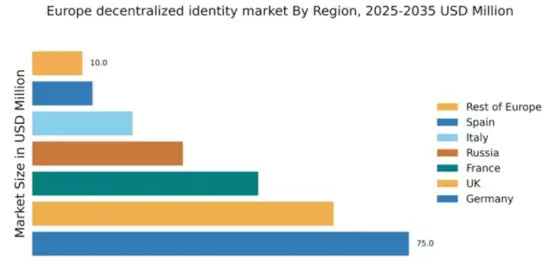
Germany holds a commanding 75.0% market share in the decentralized identity sector, valued at approximately €1.5 billion. Key growth drivers include robust government initiatives promoting digital identity solutions, alongside increasing demand for secure online transactions. The German government has implemented regulations that encourage innovation while ensuring user privacy. Infrastructure investments in digital technologies further bolster this market, making it a leader in Europe.

UK : Innovation and Regulation Drive Growth

The UK boasts a 60.0% market share in decentralized identity, translating to around €1.2 billion in value. The market is driven by a strong emphasis on privacy regulations and a growing demand for digital services. The UK government has introduced frameworks that support the adoption of decentralized identity technologies, enhancing consumer trust. The rise of fintech and e-commerce sectors also fuels demand for secure identity solutions.

France : Regulatory Support and Market Growth

France captures a 45.0% market share in the decentralized identity market, valued at approximately €900 million. Growth is propelled by government initiatives aimed at enhancing digital security and privacy. The French government has enacted laws that facilitate the use of decentralized identity solutions, aligning with EU regulations. Increased investment in tech startups focusing on identity solutions is also notable, reflecting a vibrant market landscape.

Russia : Market Potential and Regulatory Challenges

Russia holds a 30.0% market share in the decentralized identity sector, valued at about €600 million. The market is driven by increasing digitalization and a demand for secure identity verification methods. However, regulatory challenges persist, with the government exploring frameworks for decentralized identity. Major cities like Moscow and St. Petersburg are key markets, with local players beginning to emerge in this space.

Italy : Cultural Factors Influence Adoption

Italy's decentralized identity market accounts for 20.0% of the total, valued at approximately €400 million. Growth is influenced by cultural factors and a rising awareness of digital identity's importance. The Italian government is gradually implementing regulations to support digital identity initiatives, although adoption rates remain slower compared to other European nations. Key markets include Milan and Rome, where tech innovation is gaining traction.

Spain : Awareness and Infrastructure Development

Spain represents a 12.0% market share in the decentralized identity market, valued at around €240 million. The growth is driven by increasing awareness of digital identity solutions and government initiatives aimed at enhancing cybersecurity. Regulatory frameworks are being developed to support the adoption of decentralized technologies. Key cities like Madrid and Barcelona are emerging as focal points for innovation and investment in this sector.

Rest of Europe : Fragmented Landscape and Opportunities

The Rest of Europe accounts for a 10.02% market share in the decentralized identity sector, valued at approximately €200 million. This sub-region features a diverse landscape with varying growth rates influenced by local regulations and market maturity. Countries like the Netherlands and Sweden are leading in innovation, while others are still developing their frameworks. The presence of major players like IBM and Accenture is notable, driving sector-specific applications across industries.

Europe Decentralized Identity Market Regional Image

Key Players and Competitive Insights

The decentralized identity market is currently characterized by a dynamic competitive landscape, driven by the increasing demand for secure and user-centric identity solutions. Key players are actively engaging in strategic initiatives to enhance their market positioning. For instance, Microsoft (US) has been focusing on integrating decentralized identity solutions into its Azure platform, thereby leveraging its cloud infrastructure to offer robust identity management services. Similarly, IBM (US) is emphasizing partnerships with various governmental and private entities to promote its identity solutions, which are designed to enhance data privacy and security. These strategies collectively contribute to a competitive environment that is increasingly centered around innovation and user trust.In terms of business tactics, companies are adopting localized approaches to better cater to regional needs, which is particularly relevant in the context of Europe’s diverse regulatory landscape. The market structure appears moderately fragmented, with several players vying for dominance. However, the influence of major companies like Accenture (IE) and Sovrin Foundation (US) is notable, as they are shaping industry standards and practices through their extensive networks and collaborative efforts.

In October Accenture (IE) announced a strategic partnership with a leading European telecommunications provider to develop a decentralized identity framework aimed at enhancing customer privacy and security. This collaboration is significant as it not only expands Accenture's footprint in the European market but also aligns with the growing emphasis on privacy-centric solutions in identity management. The partnership is expected to facilitate the integration of decentralized identity solutions into existing telecommunications infrastructures, thereby streamlining user experiences.

In September Sovrin Foundation (US) launched a new initiative aimed at promoting the adoption of decentralized identity standards across Europe. This initiative is crucial as it seeks to establish a common framework that can be utilized by various stakeholders, including governments and enterprises. By fostering collaboration among different entities, Sovrin Foundation is positioning itself as a leader in the standardization of decentralized identity solutions, which could potentially accelerate market growth and adoption.

In August Civic Technologies (US) expanded its operations in Europe by introducing a new suite of identity verification tools tailored for the European market. This move is indicative of Civic's strategy to localize its offerings and address specific regulatory requirements, thereby enhancing its competitive edge. The introduction of these tools is likely to attract a broader customer base, particularly among businesses seeking compliant identity solutions.

As of November the competitive trends in the decentralized identity market are increasingly influenced by digitalization, sustainability, and the integration of AI technologies. Strategic alliances are becoming more prevalent, as companies recognize the need for collaborative approaches to address complex identity challenges. Looking ahead, it appears that competitive differentiation will evolve from traditional price-based strategies to a focus on innovation, technological advancements, and the reliability of supply chains. This shift underscores the importance of developing unique value propositions that resonate with the growing demand for secure and efficient identity solutions.

Key Companies in the Europe Decentralized Identity Market include

Industry Developments

The Europe Decentralized Identity Market has witnessed notable developments recently, with companies like Evernym, Consensys, and IBM actively shaping the landscape. In June 2023, Evernym announced a partnership with the Sovrin Foundation to enhance decentralized identity solutions, emphasizing secure and user-controlled digital identities. In August 2023, Consensys detailed its strategy to integrate decentralized identity systems across European fintech platforms, enhancing customer trust and data protection. 

The market has seen significant growth, with a valuation increase driven by heightened demand for privacy and cybersecurity measures. Additionally, in September 2022, IBM entered into an agreement with the ID2020 Alliance to promote blockchain-based identity solutions across Europe, reinforcing the continent's push toward digital transformation. 

Notably, September 2023 marked the collaboration of the European Union with Civic to test decentralized identity frameworks crucial for compliance with the upcoming eID regulation. In terms of mergers and acquisitions, there have been no major announcements involving the listed companies in the past six months. Overall, the European decentralized identity landscape is evolving rapidly, fostering innovative partnerships and driving a greater focus on secure, user-centric identity management solutions.

Future Outlook

Europe Decentralized Identity Market Future Outlook

The Decentralized Identity Market is projected to grow at a remarkable 54.29% CAGR from 2025 to 2035, driven by increasing demand for secure digital identities and regulatory support.

New opportunities lie in:

  • Development of interoperable identity solutions for cross-border transactions.
  • Integration of decentralized identity in IoT devices for enhanced security.
  • Creation of user-friendly mobile applications for identity management.

By 2035, the decentralized identity market is expected to be a cornerstone of digital security and privacy.

Market Segmentation

Europe Decentralized Identity Market End User Outlook

  • Government
  • Financial Services
  • Healthcare
  • Telecommunications
  • Education

Europe Decentralized Identity Market Technology Outlook

  • Blockchain
  • Self-Sovereign Identity
  • Public Key Infrastructure
  • Zero-Knowledge Proofs

Europe Decentralized Identity Market Application Outlook

  • Identity Verification
  • Access Control
  • Data Privacy Management
  • Credential Management

Europe Decentralized Identity Market Deployment Model Outlook

  • Cloud-Based
  • On-Premises

Report Scope

MARKET SIZE 2024 252.02(USD Million)
MARKET SIZE 2025 388.84(USD Million)
MARKET SIZE 2035 29728.01(USD Million)
COMPOUND ANNUAL GROWTH RATE (CAGR) 54.29% (2025 - 2035)
REPORT COVERAGE Revenue Forecast, Competitive Landscape, Growth Factors, and Trends
BASE YEAR 2024
Market Forecast Period 2025 - 2035
Historical Data 2019 - 2024
Market Forecast Units USD Million
Key Companies Profiled Microsoft (US), IBM (US), Accenture (IE), Sovrin Foundation (US), Civic Technologies (US), uPort (US), Evernym (US), Blockstack (US)
Segments Covered Technology, Application, End User, Deployment Model
Key Market Opportunities Growing demand for secure digital identities amid increasing privacy regulations and consumer awareness.
Key Market Dynamics Growing regulatory frameworks drive innovation and adoption in the decentralized identity market across Europe.
Countries Covered Germany, UK, France, Russia, Italy, Spain, Rest of Europe
Author
Author
Author Profile
Aarti Dhapte LinkedIn
AVP - Research
A consulting professional focused on helping businesses navigate complex markets through structured research and strategic insights. I partner with clients to solve high-impact business problems across market entry strategy, competitive intelligence, and opportunity assessment. Over the course of my experience, I have led and contributed to 100+ market research and consulting engagements, delivering insights across multiple industries and geographies, and supporting strategic decisions linked to $500M+ market opportunities. My core expertise lies in building robust market sizing, forecasting, and commercial models (top-down and bottom-up), alongside deep-dive competitive and industry analysis. I have played a key role in shaping go-to-market strategies, investment cases, and growth roadmaps, enabling clients to make confident, data-backed decisions in dynamic markets.
Leave a Comment

FAQs

What is the current valuation of the Europe decentralized identity market?

The market valuation was 252.02 USD Million in 2024.

What is the projected market size for the Europe decentralized identity market by 2035?

The projected valuation for 2035 is 297028.05 USD Million.

What is the expected CAGR for the Europe decentralized identity market during the forecast period?

The expected CAGR for the market from 2025 to 2035 is 90.2%.

Which application segments are leading in the Europe decentralized identity market?

The leading application segments include Authentication at 70000.0 USD Million and Credential Management at 80000.0 USD Million.

What are the primary end-use sectors for decentralized identity solutions in Europe?

Key end-use sectors include Financial Services at 70000.0 USD Million and Telecommunications at 80000.0 USD Million.

Which technologies are driving the Europe decentralized identity market?

The market is primarily driven by Self-Sovereign Identity technology, valued at 100028.05 USD Million.

What deployment models are prevalent in the Europe decentralized identity market?

Cloud-Based deployment is leading with a valuation of 150000.0 USD Million.

Who are the key players in the Europe decentralized identity market?

Key players include Sovrin Foundation, Evernym, and uPort, among others.

What user types are contributing to the growth of the Europe decentralized identity market?

Businesses are a major contributor, with a valuation of 120000.0 USD Million.

How does the market performance of decentralized identity solutions appear across different segments?

The market performance indicates strong growth across segments, particularly in Credential Management and Authentication.

Download Free Sample

Kindly complete the form below to receive a free sample of this Report

Compare Licence

×
Features License Type
Single User Multiuser License Enterprise User
Price $4,950 $5,950 $7,250
Maximum User Access Limit 1 User Upto 10 Users Unrestricted Access Throughout the Organization
Free Customization
Direct Access to Analyst
Deliverable Format
Platform Access
Discount on Next Purchase 10% 15% 15%
Printable Versions
%>