Request Free Sample ×

Kindly complete the form below to receive a free sample of this Report

* Please use a valid business email

Leading companies partner with us for data-driven Insights

clients tt-cursor
Hero Background
English
Chinese
French
Japanese
Korean
German
Spanish

Ethyleneamines Market Trends

ID: MRFR/CnM/5528-HCR
140 Pages
Priya Nagrale
March 2026

Ethyleneamines Market Research Report - by Type (Ethylenediamine), Manufacturing Process (Reaction Between Ethylene Dichloride and Ammonia), Application (Chelating Agent, Surfactants), End-use Industry (Automotive) and Region Forecast till 2035

Share:
Download PDF ×

We do not share your information with anyone. However, we may send you emails based on your report interest from time to time. You may contact us at any time to opt-out.

Ethyleneamines Market Infographic
Purchase Options

Market Trends

Key Emerging Trends in the Ethyleneamines Market

The market trends in the ethyleneamines industry are influenced by various factors such as demand from end-use industries, technological advancements, regulatory policies, and global economic conditions. Ethyleneamines are a versatile class of organic compounds used in a wide range of applications including adhesives, coatings, resins, textiles, pharmaceuticals, and personal care products. The market for ethyleneamines is driven by the growing demand for these chemicals in key end-use industries such as automotive, construction, and agriculture.

The Asia-Pacific market is expected to grow at the highest CAGR during the forecast period owing to the growing demand for the product in automotive and agriculture industry. China is the leading market in the region due to the growing consumption of the product in lube oil additives; agrochemicals; and paints and coating. Other regions contributing to the regional market growth are Japan, India, and Malaysia among others.

One of the significant market trends in the ethyleneamines industry is the increasing demand for ethyleneamines in the production of herbicides and pesticides. With the rising global population and the need to enhance agricultural productivity, there is a growing demand for agrochemicals to protect crops from pests and weeds. Ethyleneamines are used in the synthesis of several herbicides and pesticides due to their effectiveness in controlling unwanted vegetation and pests. As a result, the demand for ethyleneamines from the agriculture sector is expected to continue growing, driving market growth in the coming years.

Another key trend in the ethyleneamines market is the growing adoption of ethyleneamines in the production of epoxy resins. Epoxy resins are widely used in various applications such as coatings, adhesives, electrical laminates, and composites due to their excellent mechanical properties and chemical resistance. Ethyleneamines are essential curing agents for epoxy resins, enabling them to crosslink and form strong, durable bonds. With the increasing demand for epoxy resins in construction, automotive, and electronics industries, the demand for ethyleneamines as curing agents is also on the rise.

Moreover, the ethyleneamines market is witnessing significant growth due to the increasing demand for personal care and hygiene products. Ethyleneamines such as ethylenediamine and diethylenetriamine are used in the production of detergents, fabric softeners, and other household cleaning products due to their ability to remove stains and odors effectively. Additionally, ethyleneamines are used in the manufacture of personal care products such as shampoos, conditioners, and skincare formulations due to their mildness and ability to condition the skin and hair. With the growing awareness of personal hygiene and the increasing disposable income of consumers, the demand for ethyleneamines in the personal care industry is expected to witness steady growth.

Furthermore, technological advancements and innovations are driving market growth in the ethyleneamines industry. Manufacturers are focusing on developing novel production processes and improving the efficiency of existing manufacturing technologies to meet the growing demand for ethyleneamines and gain a competitive edge in the market. Additionally, research and development activities are underway to expand the application areas of ethyleneamines and develop new products with enhanced properties to cater to the evolving needs of end-users.

However, the ethyleneamines market is also facing challenges such as volatile raw material prices and stringent regulatory requirements. The prices of key raw materials used in the production of ethyleneamines, such as ethylene dichloride and ammonia, are subject to fluctuations due to factors such as supply-demand dynamics, geopolitical tensions, and environmental regulations. Moreover, regulatory authorities are imposing stricter regulations on the use of chemicals, including ethyleneamines, to ensure environmental and human health safety, which could impact market growth.


Author
Author Profile
Priya Nagrale
Senior Research Analyst

With an experience of over five years in market research industry (Chemicals & Materials domain), I gather and analyze market data from diverse sources to produce results, which are then presented back to a client. Also, provide recommendations based on the findings. As a Senior Research Analyst, I perform quality checks (QC) for market estimations, QC for reports, and handle queries and work extensively on client customizations. Also, handle the responsibilities of client proposals, report planning, report finalization, and execution

Leave a Comment

FAQs

What is the current valuation of the Ethyleneamines Market as of 2024?

<p>The Ethyleneamines Market was valued at 3154.1 USD Million in 2024.</p>

What is the projected market size for the Ethyleneamines Market in 2035?

<p>The market is projected to reach 11435.12 USD Million by 2035.</p>

What is the expected CAGR for the Ethyleneamines Market during the forecast period 2025 - 2035?

<p>The expected CAGR for the Ethyleneamines Market during 2025 - 2035 is 12.42%.</p>

Which companies are considered key players in the Ethyleneamines Market?

<p>Key players include Huntsman Corporation, BASF SE, Dow Inc., and AkzoNobel N.V.</p>

What are the primary applications of Ethyleneamines?

<p>Primary applications include Agriculture, Chemical Manufacturing, Pharmaceuticals, Personal Care, and Textiles.</p>

How does the Ethyleneamines Market perform in the Chemical Manufacturing segment?

The Chemical Manufacturing segment was valued at 789.24 USD Million in 2024 and is expected to grow significantly.

What is the market valuation for the Surfactants end-use segment?

The Surfactants end-use segment was valued at 1577.05 USD Million in 2024.

What types of Ethyleneamines are included in the market analysis?

Types include Ethylene Diamine, Diethylene Triamine, Triethylene Tetramine, Polyethylene Polyamines, and Aminoethylpiperazine.

What was the valuation of the Pharmaceuticals segment in 2024?

The Pharmaceuticals segment was valued at 631.68 USD Million in 2024.

What is the anticipated growth for the Textiles application segment by 2035?

The Textiles application segment is expected to see substantial growth, with a valuation of 3410.25 USD Million in 2035.

Market Summary

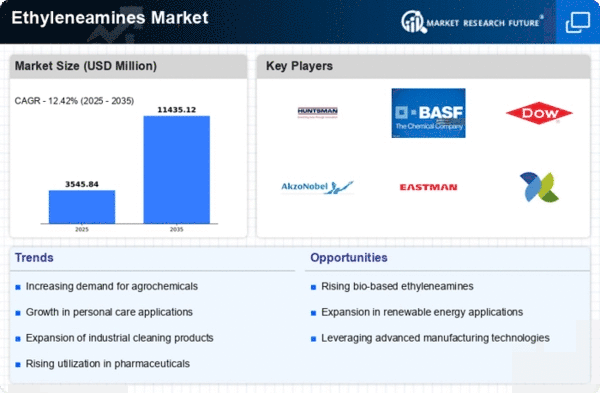
As per MRFR analysis, the Ethyleneamines Market Size was estimated at 3154.1 USD Million in 2024. The Ethyleneamines industry is projected to grow from 3545.9 in 2025 to 11435.12 by 2035, exhibiting a compound annual growth rate (CAGR) of 12.42% during the forecast period 2025 - 2035.

Key Market Trends & Highlights

The Ethyleneamines Market is poised for growth driven by sustainability and diverse applications.

  • Sustainable production practices are increasingly being adopted across the Ethyleneamines Market, particularly in North America. The diversification of applications in agriculture and pharmaceuticals is expanding the market's reach and potential. Technological advancements are facilitating innovations in production processes, enhancing efficiency and reducing costs. Rising demand in agriculture and regulatory support for sustainable solutions are key drivers propelling market growth.

Market Size & Forecast

2024 Market Size 3154.1 (USD Million)
2035 Market Size 11435.12 (USD Million)
CAGR (2025 - 2035) 12.42%
Largest Regional Market Share in 2024 North America

Major Players

Huntsman Corporation (US), BASF SE (DE), Dow Inc. (US), AkzoNobel N.V. (NL), Eastman Chemical Company (US), Hexion Inc. (US), Alkyl Amines Chemicals Limited (IN), Huntsman International LLC (US), Solvay S.A. (BE)

Market Trends

The Ethyleneamines Market is currently experiencing a dynamic phase characterized by evolving applications and increasing demand across various sectors. Ethyleneamines, which are primarily utilized in the production of agricultural chemicals, surfactants, and epoxy resins, are witnessing a surge in interest due to their versatile properties. This market appears to be driven by the growing need for sustainable and efficient chemical solutions, as industries seek to enhance product performance while minimizing environmental impact. Furthermore, the rise in research and development activities indicates a potential for innovative applications, which could further stimulate market growth.

In addition, the ethyleneamines market seems to be influenced by regulatory frameworks that promote the use of eco-friendly materials. As manufacturers adapt to these regulations, there is a noticeable shift towards bio-based ethyleneamines, which may offer a competitive edge within the global ethyleneamines market. The ongoing advancements in production technologies also suggest that the market could see improved efficiency and reduced costs, thereby attracting new entrants. Overall, the ethyleneamines market is poised for growth, with various factors contributing to its expansion and diversification in the coming years across the global ethyleneamines market landscape.

Sustainable Production Practices

The Ethyleneamines Market is witnessing a shift towards sustainable production methods. Manufacturers are increasingly adopting eco-friendly practices to align with global environmental standards. This trend indicates a growing awareness of the need for responsible sourcing and production, which may enhance the market's appeal to environmentally conscious consumers.

Diversification of Applications

There is a notable diversification in the applications of ethyleneamines across various industries. Beyond traditional uses, these compounds are finding roles in pharmaceuticals, personal care products, and advanced materials. This trend suggests that the market could expand its reach, tapping into new sectors and driving demand.

Technological Advancements

Technological innovations are playing a crucial role in shaping the Ethyleneamines Market. Enhanced production techniques and improved formulations are likely to lead to higher efficiency and performance of ethyleneamines. This trend may foster competitive advantages for manufacturers, enabling them to meet the evolving needs of end-users.

Ethyleneamines Market Market Drivers

Rising Demand in Agriculture

The Global Ethyleneamines Market Industry experiences a notable surge in demand from the agricultural sector, primarily due to the increasing need for effective crop protection chemicals and fertilizers. Ethyleneamines Market serve as essential intermediates in the production of various agrochemicals, which are crucial for enhancing agricultural productivity. As the global population continues to grow, the demand for food increases, thereby driving the need for innovative agricultural solutions. This trend is expected to contribute significantly to the market's growth, with projections indicating that the market could reach 3.15 USD Billion in 2024, reflecting the critical role of ethyleneamines in modern agriculture.

Expansion in End-Use Industries

The Global Ethyleneamines Market Industry is poised for growth due to its expanding applications across various end-use industries, including pharmaceuticals, personal care, and textiles. Ethyleneamines Market are utilized in the synthesis of numerous products, such as surfactants and emulsifiers, which are integral to these sectors. The increasing focus on product innovation and sustainability within these industries further propels the demand for ethyleneamines. As companies strive to enhance their product offerings, the market is likely to witness a robust growth trajectory, potentially reaching 12.5 USD Billion by 2035, driven by the diverse applications of ethyleneamines.

Market Trends and Growth Projections

The Global Ethyleneamines Market Industry is projected to experience substantial growth, with trends indicating a potential market size of 12.5 USD Billion by 2035. The anticipated compound annual growth rate of 13.36% from 2025 to 2035 reflects the increasing adoption of ethyleneamines across various sectors. Factors such as rising demand in agriculture, expansion in end-use industries, and technological advancements in production are driving this growth. The market's evolution is influenced by changing consumer preferences and regulatory frameworks, which are shaping the future landscape of ethyleneamines. This comprehensive analysis highlights the promising outlook for the industry.

Growing Demand for Eco-Friendly Products

The Global Ethyleneamines Market Industry is witnessing a shift towards eco-friendly products, driven by increasing consumer awareness and regulatory pressures regarding environmental sustainability. Ethyleneamines Market are being utilized in the formulation of biodegradable surfactants and other green chemicals, which are gaining traction in various applications. This trend is particularly evident in the personal care and cleaning products sectors, where consumers are increasingly opting for sustainable alternatives. As the demand for eco-friendly solutions continues to rise, the market for ethyleneamines is likely to expand, reflecting the industry's adaptability to changing consumer preferences and regulatory landscapes.

Technological Advancements in Production

Technological advancements in the production processes of ethyleneamines are significantly influencing the Global Ethyleneamines Market Industry. Innovations in manufacturing techniques, such as more efficient catalytic processes and greener production methods, are enhancing yield and reducing environmental impact. These advancements not only lower production costs but also align with the increasing regulatory emphasis on sustainability. As manufacturers adopt these technologies, they are likely to improve their competitive edge, thereby fostering market growth. The anticipated compound annual growth rate of 13.36% from 2025 to 2035 underscores the potential of these advancements in shaping the future of the industry.

Market Dynamics and Competitive Landscape

The Global Ethyleneamines Market Industry is characterized by dynamic market conditions and a competitive landscape that influences pricing, supply, and demand. Key players are continuously engaging in strategic partnerships, mergers, and acquisitions to enhance their market presence and expand their product portfolios. This competitive environment fosters innovation and drives the development of new applications for ethyleneamines. As companies strive to differentiate themselves, the market is expected to evolve, with emerging players potentially reshaping the industry dynamics. The interplay of these factors is likely to contribute to the overall growth trajectory of the market.

Market Segment Insights

By Application: Agriculture (Largest) vs. Pharmaceuticals (Fastest-Growing)

In the Ethyleneamines market, the application sectors exhibit varied distribution of market share. Agriculture stands out as the largest segment due to its extensive use of Ethyleneamines in fertilizers and crop protection agents. The Chemical Manufacturing sector also holds significant market presence, leveraging Ethyleneamines as key building blocks in the production of <a title="surfactants" href="https://www.marketresearchfuture.com/reports/surfactants-market-1422" target="_blank" rel="noopener">surfactants</a> and resins, followed closely by the Pharmaceuticals sector. Textiles and Personal Care represent smaller but important niches within the market. The growth trends in the Ethyleneamines market are primarily driven by increasing demand from end-use industries. The Agriculture segment is bolstered by the rising global food demand, prompting enhanced focus on crop yields. On the other hand, the Pharmaceuticals segment is experiencing rapid growth, fueled by advancements in drug formulations and a heightened focus on healthcare. Increasing environmental concerns are also promoting the development of sustainable chemical solutions across these applications.

Agriculture (Dominant) vs. Textiles (Emerging)

The Agriculture sector remains the dominant application in the Ethyleneamines market, primarily due to its critical role in agrochemical formulations that enhance crop protection and nutrition. Ethyleneamines are utilized in various products such as herbicides, fungicides, and fertilizers, making them essential for maximizing agricultural output. In contrast, the Textiles sector is emerging as a new application area, with the increasing use of Ethyleneamines in textile treatments and finishes to impart desired properties. This segment is gaining traction as manufacturers pursue innovations for improving fabric performance. The comparative stability of the Agriculture sector offers a sturdy foundation, while the Textiles segment targets future growth opportunities driven by evolving consumer preferences and technological advancements.

By End Use: Adhesives (Largest) vs. Surfactants (Fastest-Growing)

<p>In the Ethyleneamines Market, the end-use segments demonstrate a diverse distribution of market share, with adhesives holding the largest share due to their extensive application in construction and automotive sectors. Coatings and detergents also contribute significantly, catering to various industrial and household needs, whereas fuel additives and surfactants represent a smaller yet vital proportion. This landscape highlights the importance of adhesives in driving the market forward, reflecting their integral role in multiple industries. The growth trends within this segment showcase surfactants as the fastest-growing category, driven by increasing demand in cosmetics, cleaning products, and agricultural applications. Innovations in formulations and technology are propelling surfactants' market adoption. In contrast, while adhesives remain dominant, their growth is steady, influenced by advancements in product formulations and a robust construction sector that continues to thrive.</p>

<p>Adhesives (Dominant) vs. Surfactants (Emerging)</p>

<p>Adhesives have established themselves as the dominant segment within the Ethyleneamines Market, characterized by their widespread usage in a variety of applications including construction, automotive, and consumer goods. Their versatility in bonding different materials makes them essential in manufacturing processes. Innovations in adhesive formulations, such as the development of environmentally friendly options and increased performance capabilities, further solidify their market position. In contrast, surfactants are emerging as a crucial segment, driven by their applications in cleaning agents, personal care products, and agrochemicals. Their ability to lower surface tension and enhance the effectiveness of formulations makes them increasingly favored in modern applications, supported by ongoing research and technological advancements that boost their efficiency and appeal.</p>

By Type: Ethylene Diamine (Largest) vs. Diethylene Triamine (Fastest-Growing)

In the Ethyleneamines Market, the distribution of market share among the various types reveals that Ethylene Diamine is the largest segment, holding a prominent position due to its versatile applications across multiple industries including agriculture, pharmaceuticals, and industrial cleaning. Meanwhile, Diethylene Triamine is rapidly gaining traction, showcasing significant growth due to increasing demand in end-use sectors such as agrochemicals and textiles. This shift suggests a dynamic landscape where traditional leaders must innovate to maintain their footing against emerging competitors. The growth trends in this segment are primarily driven by the escalating need for eco-friendly and efficient chemical solutions. The demand for Diethylene Triamine is particularly surging as manufacturers focus on sustainability and enhanced product performance. Additionally, the expansion of end-user industries, particularly in emerging markets, further fuels the growth of these ethyleneamines, highlighting a shift toward specialized formulations that cater to ever-evolving consumer preferences.

Ethylene Diamine (Dominant) vs. Tetraethylene Pentamine (Emerging)

Ethylene Diamine stands out as the dominant player in the Ethyleneamines Market due to its established applications and strong presence across various sectors. With its ability to function as a building block for numerous chemicals, it serves critical roles in adhesives, coatings, and agriculture. Conversely, Tetraethylene Pentamine is an emerging segment, characterized by its unique properties that enable it to offer advantages in specialized applications such as oil and gas exploration and high-performance adhesives. As industries strive for innovation, Tetraethylene Pentamine presents unique opportunities for growth, appealing to manufacturers looking for superior chemical properties and enhanced performance metrics. While Ethylene Diamine retains its leadership status, the evolving landscape provides Tetraethylene Pentamine the potential to carve out a significant niche as demand for advanced materials continues to rise.

By Form: Liquid (Largest) vs. Powder (Fastest-Growing)

In the Ethyleneamines Market, the form segment comprises liquid, solid, and powder variants. The liquid form dominates the market, accounting for the largest share due to its versatility and widespread usage in various applications, such as agrochemicals and pharmaceuticals. On the other hand, powder and solid forms also play significant roles, though they occupy comparatively smaller shares in the overall market distribution. Solid forms cater to specific applications where stability and ease of handling are crucial.

Liquid (Dominant) vs. Powder (Emerging)

The liquid form of ethyleneamines is the dominant choice for many industries due to its superior solubility, making it ideal for applications such as crop protection and chemical manufacturing. As industries continue to innovate, the powder form is emerging rapidly, driven by its increasing use in specialized applications such as adhesives and coatings. The powder variant offers benefits like improved storage stability and handling convenience, which are particularly appealing for companies focusing on efficiency and eco-friendly practices. As the demand for eco-conscious products rises, the powder segment is set to grow faster, evidencing its growing importance in the market.

By Functionality: Curing Agent (Largest) vs. Corrosion Inhibitor (Fastest-Growing)

The Ethyleneamines market is characterized by a diverse range of functionality segments, with Curing Agents capturing the largest market share. These agents play a pivotal role in the development of durable adhesive and coating formulations, thereby establishing a strong foothold in various end-use industries. Meanwhile, the Corrosion Inhibitor segment, although smaller, is witnessing significant growth due to the increasing demand for protective coatings in the automotive and construction sectors. As industries increasingly focus on sustainable practices, the demand for eco-friendly corrosion inhibitors is also on the rise. Furthermore, the Hardener and Intermediate segments present steady growth, driven by their applications in resins and chemically-intensive processes. Factors such as technological advancements and rising industrialization are propelling the market forward, positioning these functionalities favorably for future expansion.

Curing Agent (Dominant) vs. Intermediate (Emerging)

Curing Agents are a dominant force in the Ethyleneamines market, known for their essential role in enhancing the performance and durability of industrial adhesives and coatings. Their significant market presence is attributed to widespread applications across various industries, including automotive, construction, and electronics. In contrast, the Intermediate segment is emerging rapidly, powered by its versatility in chemical synthesis and production processes. This segment serves as a precursor for a wide array of chemical products, including surfactants and plastics. As regulatory pressures push for cleaner manufacturing processes, the Intermediate segment is gaining traction due to its ability to meet the needs of both traditional and green chemistry applications. The growth in these segments highlights the evolving landscape of the Ethyleneamines market.

Get more detailed insights about Ethyleneamines Market Research Report- Forecast till 2035

Regional Insights

North America : Market Leader in Ethyleneamines

North America is poised to maintain its leadership in the Ethyleneamines market, holding a significant share of 1575.0 million in 2024. The region's growth is driven by robust demand from end-user industries such as agriculture, pharmaceuticals, and personal care. Regulatory support for sustainable chemical production further enhances market prospects, with initiatives aimed at reducing environmental impact and promoting innovation. The United States stands as the primary contributor, with key players like Huntsman Corporation and Dow Inc. leading the charge. The competitive landscape is characterized by strategic partnerships and technological advancements, ensuring a steady supply of high-quality ethyleneamines. The presence of established manufacturers and a strong distribution network solidify North America's position as a manufacturing hub for these essential chemicals.

Europe : Emerging Market with Growth Potential

Europe's Ethyleneamines market, valued at 900.0 million, is witnessing a surge in demand driven by the increasing adoption of bio-based products and stringent environmental regulations. The region's commitment to sustainability and innovation is fostering growth, with regulatory frameworks encouraging the use of eco-friendly chemicals. This shift is expected to propel market expansion as industries adapt to new standards and consumer preferences. Germany and France are leading the charge in this market, with major players like BASF SE and AkzoNobel N.V. actively investing in R&D to enhance product offerings. The competitive landscape is marked by collaborations and mergers aimed at strengthening market presence. As Europe transitions towards greener solutions, the Ethyleneamines market is set to benefit significantly from these trends.

Asia-Pacific : Rapid Growth in Emerging Economies

The Asia-Pacific region, with a market size of 550.0 million, is experiencing rapid growth in the Ethyleneamines sector, driven by increasing industrialization and urbanization. Countries like China and India are witnessing a surge in demand for ethyleneamines across various applications, including agriculture and textiles. Government initiatives aimed at boosting manufacturing capabilities and reducing import dependencies are further propelling market growth. China is the dominant player in this region, with significant contributions from local manufacturers and multinational corporations. The competitive landscape is evolving, with companies like Alkyl Amines Chemicals Limited and Hexion Inc. expanding their operations to meet rising demand. As the region continues to develop, the Ethyleneamines market is expected to flourish, supported by favorable economic conditions and regulatory frameworks.

Middle East and Africa : Emerging Market with Untapped Potential

The Middle East and Africa region, valued at 129.1 million, presents significant growth opportunities in the Ethyleneamines market. The demand is primarily driven by the agricultural sector, where ethyleneamines are used as growth enhancers and fertilizers. Additionally, the region's increasing focus on industrial diversification and chemical manufacturing is expected to boost market growth in the coming years. Countries like South Africa and the UAE are emerging as key players in this market, with investments in chemical production facilities. The competitive landscape is characterized by a mix of local and international companies, including Solvay S.A. and other regional players. As the region continues to develop its industrial base, the Ethyleneamines market is likely to see substantial growth, supported by government initiatives and investment in infrastructure.

Key Players and Competitive Insights

The Ethyleneamines Market is characterized by a dynamic competitive landscape, driven by increasing demand across various end-use industries such as agriculture, pharmaceuticals, and personal care. Key players are actively engaging in strategic initiatives to enhance their market positioning. For instance, Huntsman Corporation (US) focuses on innovation and sustainability, aiming to develop eco-friendly products that align with global environmental standards. Similarly, BASF SE (DE) emphasizes digital transformation and operational efficiency, leveraging advanced technologies to optimize production processes. These strategies collectively contribute to a competitive environment that is increasingly shaped by sustainability and technological advancements.In terms of business tactics, companies are localizing manufacturing and optimizing supply chains to enhance responsiveness to market demands. The competitive structure of the Ethyleneamines Market appears moderately fragmented, with several key players exerting influence. This fragmentation allows for a diverse range of products and innovations, although it also intensifies competition among established and emerging players.
In November Dow Inc. (US) announced the expansion of its ethyleneamines production facility in Texas, a strategic move aimed at increasing capacity to meet rising global demand. This expansion is significant as it not only enhances Dow's production capabilities but also positions the company to better serve its customers in the rapidly growing agricultural sector, where ethyleneamines are increasingly utilized as crop protection agents.
In October AkzoNobel N.V. (NL) launched a new line of bio-based ethyleneamines, reflecting its commitment to sustainability and innovation. This product line is expected to cater to environmentally conscious consumers and industries, thereby enhancing AkzoNobel's competitive edge in a market that is progressively leaning towards sustainable solutions. The introduction of bio-based products may also set a precedent for other companies to follow suit, potentially reshaping product offerings across the industry.
In September Eastman Chemical Company (US) entered into a strategic partnership with a leading agricultural firm to develop specialized ethyleneamines for use in advanced crop protection solutions. This collaboration is indicative of a broader trend where companies are seeking partnerships to leverage complementary strengths, thereby enhancing their product portfolios and market reach. Such alliances are likely to become more prevalent as firms navigate the complexities of evolving consumer preferences and regulatory landscapes.
As of December the Ethyleneamines Market is witnessing trends that emphasize digitalization, sustainability, and the integration of AI technologies. Strategic alliances are increasingly shaping the competitive landscape, allowing companies to pool resources and expertise. The shift from price-based competition to a focus on innovation, technology, and supply chain reliability is becoming evident. Moving forward, competitive differentiation will likely hinge on the ability to innovate and adapt to changing market dynamics, with sustainability at the forefront of strategic initiatives.

Key Companies in the Ethyleneamines Market include

Industry Developments

  • Q2 2024: BASF inaugurates new ethyleneamines plant in Nanjing, China BASF announced the opening of a new world-scale ethyleneamines production facility in Nanjing, China, to meet growing demand in Asia for ethyleneamines used in water treatment, personal care, and crop protection applications.
  • Q1 2024: Dow appoints new Vice President for Amines and Chelates business Dow named Dr. Lisa Chen as Vice President of its Amines and Chelates business, which includes the company’s global ethyleneamines portfolio, aiming to drive innovation and growth in specialty chemicals.
  • Q3 2024: Huntsman signs long-term supply agreement for ethyleneamines with major European coatings manufacturer Huntsman Corporation entered into a multi-year supply contract to provide ethyleneamines to a leading European coatings producer, strengthening its position in the specialty chemicals market.
  • Q2 2024: INEOS completes acquisition of European ethyleneamines assets from Sasol INEOS finalized the purchase of Sasol’s ethyleneamines production assets in Europe, expanding its footprint in the specialty amines sector and enhancing supply capabilities for industrial customers.
  • Q4 2024: Aditya Birla Chemicals announces expansion of ethyleneamines capacity in India Aditya Birla Chemicals revealed plans to expand its ethyleneamines manufacturing capacity at its Gujarat facility, targeting increased demand from the agrochemicals and pharmaceuticals sectors.
  • Q1 2025: BASF and Mitsui Chemicals form joint venture for sustainable ethyleneamines production BASF and Mitsui Chemicals announced a joint venture to develop and commercialize bio-based ethyleneamines, aiming to reduce carbon footprint and address sustainability goals in the chemical industry.
  • Q2 2025: Huntsman launches new high-purity ethyleneamines product line for electronics industry Huntsman introduced a new range of high-purity ethyleneamines designed for use in advanced electronics manufacturing, targeting the growing demand for specialty chemicals in semiconductor fabrication.
  • Q3 2024: Evonik opens R&D center for amines innovation in Germany Evonik Industries inaugurated a new research and development center focused on amines, including ethyleneamines, to accelerate product innovation and support custom solutions for industrial clients.
  • Q2 2024: INEOS signs supply agreement with major US agrochemical company for ethyleneamines INEOS secured a multi-year supply contract to provide ethyleneamines to a leading US agrochemical manufacturer, reinforcing its role as a key supplier to the agricultural sector.
  • Q1 2025: BASF receives regulatory approval for new ethyleneamines process technology in Europe BASF obtained regulatory clearance for its proprietary ethyleneamines production process, enabling more efficient and environmentally friendly manufacturing at its European facilities.
  • Q4 2024: Huntsman appoints new Chief Technology Officer to lead amines innovation Huntsman named Dr. Michael Bauer as Chief Technology Officer, tasking him with advancing the company’s amines and ethyleneamines technology platforms for new market applications.
  • Q2 2025: Dow announces $100 million investment in US ethyleneamines plant modernization Dow committed $100 million to upgrade its US ethyleneamines production facility, aiming to boost capacity, improve energy efficiency, and support growth in downstream specialty chemicals.

Target Audience

    • Traders and distributors of Ethyleneamines Market
    • Ethyleneamines Market manufacturers
    • Potential investors
    • Production process industries
    • Raw material suppliers
    • Nationalized laboratories
    • Government bodies

Future Outlook

Ethyleneamines Market Future Outlook

The Ethyleneamines Market is projected to grow at a 12.42% CAGR from 2025 to 2035, driven by increasing demand in agriculture, pharmaceuticals, and chemical manufacturing.

New opportunities lie in:

  • <p>Expansion into bio-based ethyleneamines production Development of customized formulations for niche applications Strategic partnerships with agricultural firms for product integration</p>

By 2035, the Ethyleneamines Market is expected to achieve robust growth and diversification.

Market Segmentation

Ethyleneamines Market Form Outlook

  • Liquid
  • Solid
  • Powder

Ethyleneamines Market Type Outlook

  • Ethylene Diamine
  • Diethylene Triamine
  • Triethylene Tetramine
  • Tetraethylene Pentamine

Ethyleneamines Market End Use Outlook

  • Adhesives
  • Coatings
  • Detergents
  • Fuel Additives
  • Surfactants

Ethyleneamines Market Application Outlook

  • Agriculture
  • Chemical Manufacturing
  • Pharmaceuticals
  • Personal Care
  • Textiles

Ethyleneamines Market Functionality Outlook

  • Curing Agent
  • Corrosion Inhibitor
  • Hardener
  • Intermediate

Report Scope

MARKET SIZE 2024 3154.1(USD Million)
MARKET SIZE 2025 3545.9(USD Million)
MARKET SIZE 2035 11435.12(USD Million)
COMPOUND ANNUAL GROWTH RATE (CAGR) 12.42% (2025 - 2035)
REPORT COVERAGE Revenue Forecast, Competitive Landscape, Growth Factors, and Trends
BASE YEAR 2024
Market Forecast Period 2025 - 2035
Historical Data 2019 - 2024
Market Forecast Units USD Million
Key Companies Profiled Huntsman Corporation (US), BASF SE (DE), Dow Inc. (US), AkzoNobel N.V. (NL), Eastman Chemical Company (US), Hexion Inc. (US), Alkyl Amines Chemicals Limited (IN), Huntsman International LLC (US), Solvay S.A. (BE)
Segments Covered Application, End Use, Type, Form, Functionality
Key Market Opportunities Growing demand for sustainable agricultural solutions drives innovation in the Ethyleneamines Market.
Key Market Dynamics Rising demand for sustainable agricultural practices drives growth in the Ethyleneamines Market, influencing production and innovation.
Countries Covered North America, Europe, APAC, South America, MEA

FAQs

What is the current valuation of the Ethyleneamines Market as of 2024?

<p>The Ethyleneamines Market was valued at 3154.1 USD Million in 2024.</p>

What is the projected market size for the Ethyleneamines Market in 2035?

<p>The market is projected to reach 11435.12 USD Million by 2035.</p>

What is the expected CAGR for the Ethyleneamines Market during the forecast period 2025 - 2035?

<p>The expected CAGR for the Ethyleneamines Market during 2025 - 2035 is 12.42%.</p>

Which companies are considered key players in the Ethyleneamines Market?

<p>Key players include Huntsman Corporation, BASF SE, Dow Inc., and AkzoNobel N.V.</p>

What are the primary applications of Ethyleneamines?

<p>Primary applications include Agriculture, Chemical Manufacturing, Pharmaceuticals, Personal Care, and Textiles.</p>

How does the Ethyleneamines Market perform in the Chemical Manufacturing segment?

The Chemical Manufacturing segment was valued at 789.24 USD Million in 2024 and is expected to grow significantly.

What is the market valuation for the Surfactants end-use segment?

The Surfactants end-use segment was valued at 1577.05 USD Million in 2024.

What types of Ethyleneamines are included in the market analysis?

Types include Ethylene Diamine, Diethylene Triamine, Triethylene Tetramine, Polyethylene Polyamines, and Aminoethylpiperazine.

What was the valuation of the Pharmaceuticals segment in 2024?

The Pharmaceuticals segment was valued at 631.68 USD Million in 2024.

What is the anticipated growth for the Textiles application segment by 2035?

The Textiles application segment is expected to see substantial growth, with a valuation of 3410.25 USD Million in 2035.

  1. SECTION I: EXECUTIVE SUMMARY AND KEY HIGHLIGHTS
    1. | 1.1 EXECUTIVE SUMMARY
    2. | | 1.1.1 Market Overview
    3. | | 1.1.2 Key Findings
    4. | | 1.1.3 Market Segmentation
    5. | | 1.1.4 Competitive Landscape
    6. | | 1.1.5 Challenges and Opportunities
    7. | | 1.1.6 Future Outlook
  2. SECTION II: SCOPING, METHODOLOGY AND MARKET STRUCTURE
    1. | 2.1 MARKET INTRODUCTION
    2. | | 2.1.1 Definition
    3. | | 2.1.2 Scope of the study
    4. | | | 2.1.2.1 Research Objective
    5. | | | 2.1.2.2 Assumption
    6. | | | 2.1.2.3 Limitations
    7. | 2.2 RESEARCH METHODOLOGY
    8. | | 2.2.1 Overview
    9. | | 2.2.2 Data Mining
    10. | | 2.2.3 Secondary Research
    11. | | 2.2.4 Primary Research
    12. | | | 2.2.4.1 Primary Interviews and Information Gathering Process
    13. | | | 2.2.4.2 Breakdown of Primary Respondents
    14. | | 2.2.5 Forecasting Model
    15. | | 2.2.6 Market Size Estimation
    16. | | | 2.2.6.1 Bottom-Up Approach
    17. | | | 2.2.6.2 Top-Down Approach
    18. | | 2.2.7 Data Triangulation
    19. | | 2.2.8 Validation
  3. SECTION III: QUALITATIVE ANALYSIS
    1. | 3.1 MARKET DYNAMICS
    2. | | 3.1.1 Overview
    3. | | 3.1.2 Drivers
    4. | | 3.1.3 Restraints
    5. | | 3.1.4 Opportunities
    6. | 3.2 MARKET FACTOR ANALYSIS
    7. | | 3.2.1 Value chain Analysis
    8. | | 3.2.2 Porter's Five Forces Analysis
    9. | | | 3.2.2.1 Bargaining Power of Suppliers
    10. | | | 3.2.2.2 Bargaining Power of Buyers
    11. | | | 3.2.2.3 Threat of New Entrants
    12. | | | 3.2.2.4 Threat of Substitutes
    13. | | | 3.2.2.5 Intensity of Rivalry
    14. | | 3.2.3 COVID-19 Impact Analysis
    15. | | | 3.2.3.1 Market Impact Analysis
    16. | | | 3.2.3.2 Regional Impact
    17. | | | 3.2.3.3 Opportunity and Threat Analysis
  4. SECTION IV: QUANTITATIVE ANALYSIS
    1. | 4.1 Chemicals and Materials, BY Application (USD Million)
    2. | | 4.1.1 Agriculture
    3. | | 4.1.2 Chemical Manufacturing
    4. | | 4.1.3 Pharmaceuticals
    5. | | 4.1.4 Personal Care
    6. | | 4.1.5 Textiles
    7. | 4.2 Chemicals and Materials, BY End Use (USD Million)
    8. | | 4.2.1 Adhesives
    9. | | 4.2.2 Coatings
    10. | | 4.2.3 Detergents
    11. | | 4.2.4 Fuel Additives
    12. | | 4.2.5 Surfactants
    13. | 4.3 Chemicals and Materials, BY Type (USD Million)
    14. | | 4.3.1 Ethylene Diamine
    15. | | 4.3.2 Diethylene Triamine
    16. | | 4.3.3 Triethylene Tetramine
    17. | | 4.3.4 Polyethylene Polyamines
    18. | | 4.3.5 Aminoethylpiperazine
    19. | 4.4 Chemicals and Materials, BY Region (USD Million)
    20. | | 4.4.1 North America
    21. | | | 4.4.1.1 US
    22. | | | 4.4.1.2 Canada
    23. | | 4.4.2 Europe
    24. | | | 4.4.2.1 Germany
    25. | | | 4.4.2.2 UK
    26. | | | 4.4.2.3 France
    27. | | | 4.4.2.4 Russia
    28. | | | 4.4.2.5 Italy
    29. | | | 4.4.2.6 Spain
    30. | | | 4.4.2.7 Rest of Europe
    31. | | 4.4.3 APAC
    32. | | | 4.4.3.1 China
    33. | | | 4.4.3.2 India
    34. | | | 4.4.3.3 Japan
    35. | | | 4.4.3.4 South Korea
    36. | | | 4.4.3.5 Malaysia
    37. | | | 4.4.3.6 Thailand
    38. | | | 4.4.3.7 Indonesia
    39. | | | 4.4.3.8 Rest of APAC
    40. | | 4.4.4 South America
    41. | | | 4.4.4.1 Brazil
    42. | | | 4.4.4.2 Mexico
    43. | | | 4.4.4.3 Argentina
    44. | | | 4.4.4.4 Rest of South America
    45. | | 4.4.5 MEA
    46. | | | 4.4.5.1 GCC Countries
    47. | | | 4.4.5.2 South Africa
    48. | | | 4.4.5.3 Rest of MEA
  5. SECTION V: COMPETITIVE ANALYSIS
    1. | 5.1 Competitive Landscape
    2. | | 5.1.1 Overview
    3. | | 5.1.2 Competitive Analysis
    4. | | 5.1.3 Market share Analysis
    5. | | 5.1.4 Major Growth Strategy in the Chemicals and Materials
    6. | | 5.1.5 Competitive Benchmarking
    7. | | 5.1.6 Leading Players in Terms of Number of Developments in the Chemicals and Materials
    8. | | 5.1.7 Key developments and growth strategies
    9. | | | 5.1.7.1 New Product Launch/Service Deployment
    10. | | | 5.1.7.2 Merger & Acquisitions
    11. | | | 5.1.7.3 Joint Ventures
    12. | | 5.1.8 Major Players Financial Matrix
    13. | | | 5.1.8.1 Sales and Operating Income
    14. | | | 5.1.8.2 Major Players R&D Expenditure. 2023
    15. | 5.2 Company Profiles
    16. | | 5.2.1 Huntsman Corporation (US)
    17. | | | 5.2.1.1 Financial Overview
    18. | | | 5.2.1.2 Products Offered
    19. | | | 5.2.1.3 Key Developments
    20. | | | 5.2.1.4 SWOT Analysis
    21. | | | 5.2.1.5 Key Strategies
    22. | | 5.2.2 BASF SE (DE)
    23. | | | 5.2.2.1 Financial Overview
    24. | | | 5.2.2.2 Products Offered
    25. | | | 5.2.2.3 Key Developments
    26. | | | 5.2.2.4 SWOT Analysis
    27. | | | 5.2.2.5 Key Strategies
    28. | | 5.2.3 Dow Inc. (US)
    29. | | | 5.2.3.1 Financial Overview
    30. | | | 5.2.3.2 Products Offered
    31. | | | 5.2.3.3 Key Developments
    32. | | | 5.2.3.4 SWOT Analysis
    33. | | | 5.2.3.5 Key Strategies
    34. | | 5.2.4 AkzoNobel N.V. (NL)
    35. | | | 5.2.4.1 Financial Overview
    36. | | | 5.2.4.2 Products Offered
    37. | | | 5.2.4.3 Key Developments
    38. | | | 5.2.4.4 SWOT Analysis
    39. | | | 5.2.4.5 Key Strategies
    40. | | 5.2.5 Eastman Chemical Company (US)
    41. | | | 5.2.5.1 Financial Overview
    42. | | | 5.2.5.2 Products Offered
    43. | | | 5.2.5.3 Key Developments
    44. | | | 5.2.5.4 SWOT Analysis
    45. | | | 5.2.5.5 Key Strategies
    46. | | 5.2.6 Hexion Inc. (US)
    47. | | | 5.2.6.1 Financial Overview
    48. | | | 5.2.6.2 Products Offered
    49. | | | 5.2.6.3 Key Developments
    50. | | | 5.2.6.4 SWOT Analysis
    51. | | | 5.2.6.5 Key Strategies
    52. | | 5.2.7 Solvay S.A. (BE)
    53. | | | 5.2.7.1 Financial Overview
    54. | | | 5.2.7.2 Products Offered
    55. | | | 5.2.7.3 Key Developments
    56. | | | 5.2.7.4 SWOT Analysis
    57. | | | 5.2.7.5 Key Strategies
    58. | | 5.2.8 Alkyl Amines Chemicals Limited (IN)
    59. | | | 5.2.8.1 Financial Overview
    60. | | | 5.2.8.2 Products Offered
    61. | | | 5.2.8.3 Key Developments
    62. | | | 5.2.8.4 SWOT Analysis
    63. | | | 5.2.8.5 Key Strategies
    64. | | 5.2.9 Huntsman International LLC (US)
    65. | | | 5.2.9.1 Financial Overview
    66. | | | 5.2.9.2 Products Offered
    67. | | | 5.2.9.3 Key Developments
    68. | | | 5.2.9.4 SWOT Analysis
    69. | | | 5.2.9.5 Key Strategies
    70. | 5.3 Appendix
    71. | | 5.3.1 References
    72. | | 5.3.2 Related Reports
  6. LIST OF FIGURES
    1. | 6.1 MARKET SYNOPSIS
    2. | 6.2 NORTH AMERICA MARKET ANALYSIS
    3. | 6.3 US MARKET ANALYSIS BY APPLICATION
    4. | 6.4 US MARKET ANALYSIS BY END USE
    5. | 6.5 US MARKET ANALYSIS BY TYPE
    6. | 6.6 CANADA MARKET ANALYSIS BY APPLICATION
    7. | 6.7 CANADA MARKET ANALYSIS BY END USE
    8. | 6.8 CANADA MARKET ANALYSIS BY TYPE
    9. | 6.9 EUROPE MARKET ANALYSIS
    10. | 6.10 GERMANY MARKET ANALYSIS BY APPLICATION
    11. | 6.11 GERMANY MARKET ANALYSIS BY END USE
    12. | 6.12 GERMANY MARKET ANALYSIS BY TYPE
    13. | 6.13 UK MARKET ANALYSIS BY APPLICATION
    14. | 6.14 UK MARKET ANALYSIS BY END USE
    15. | 6.15 UK MARKET ANALYSIS BY TYPE
    16. | 6.16 FRANCE MARKET ANALYSIS BY APPLICATION
    17. | 6.17 FRANCE MARKET ANALYSIS BY END USE
    18. | 6.18 FRANCE MARKET ANALYSIS BY TYPE
    19. | 6.19 RUSSIA MARKET ANALYSIS BY APPLICATION
    20. | 6.20 RUSSIA MARKET ANALYSIS BY END USE
    21. | 6.21 RUSSIA MARKET ANALYSIS BY TYPE
    22. | 6.22 ITALY MARKET ANALYSIS BY APPLICATION
    23. | 6.23 ITALY MARKET ANALYSIS BY END USE
    24. | 6.24 ITALY MARKET ANALYSIS BY TYPE
    25. | 6.25 SPAIN MARKET ANALYSIS BY APPLICATION
    26. | 6.26 SPAIN MARKET ANALYSIS BY END USE
    27. | 6.27 SPAIN MARKET ANALYSIS BY TYPE
    28. | 6.28 REST OF EUROPE MARKET ANALYSIS BY APPLICATION
    29. | 6.29 REST OF EUROPE MARKET ANALYSIS BY END USE
    30. | 6.30 REST OF EUROPE MARKET ANALYSIS BY TYPE
    31. | 6.31 APAC MARKET ANALYSIS
    32. | 6.32 CHINA MARKET ANALYSIS BY APPLICATION
    33. | 6.33 CHINA MARKET ANALYSIS BY END USE
    34. | 6.34 CHINA MARKET ANALYSIS BY TYPE
    35. | 6.35 INDIA MARKET ANALYSIS BY APPLICATION
    36. | 6.36 INDIA MARKET ANALYSIS BY END USE
    37. | 6.37 INDIA MARKET ANALYSIS BY TYPE
    38. | 6.38 JAPAN MARKET ANALYSIS BY APPLICATION
    39. | 6.39 JAPAN MARKET ANALYSIS BY END USE
    40. | 6.40 JAPAN MARKET ANALYSIS BY TYPE
    41. | 6.41 SOUTH KOREA MARKET ANALYSIS BY APPLICATION
    42. | 6.42 SOUTH KOREA MARKET ANALYSIS BY END USE
    43. | 6.43 SOUTH KOREA MARKET ANALYSIS BY TYPE
    44. | 6.44 MALAYSIA MARKET ANALYSIS BY APPLICATION
    45. | 6.45 MALAYSIA MARKET ANALYSIS BY END USE
    46. | 6.46 MALAYSIA MARKET ANALYSIS BY TYPE
    47. | 6.47 THAILAND MARKET ANALYSIS BY APPLICATION
    48. | 6.48 THAILAND MARKET ANALYSIS BY END USE
    49. | 6.49 THAILAND MARKET ANALYSIS BY TYPE
    50. | 6.50 INDONESIA MARKET ANALYSIS BY APPLICATION
    51. | 6.51 INDONESIA MARKET ANALYSIS BY END USE
    52. | 6.52 INDONESIA MARKET ANALYSIS BY TYPE
    53. | 6.53 REST OF APAC MARKET ANALYSIS BY APPLICATION
    54. | 6.54 REST OF APAC MARKET ANALYSIS BY END USE
    55. | 6.55 REST OF APAC MARKET ANALYSIS BY TYPE
    56. | 6.56 SOUTH AMERICA MARKET ANALYSIS
    57. | 6.57 BRAZIL MARKET ANALYSIS BY APPLICATION
    58. | 6.58 BRAZIL MARKET ANALYSIS BY END USE
    59. | 6.59 BRAZIL MARKET ANALYSIS BY TYPE
    60. | 6.60 MEXICO MARKET ANALYSIS BY APPLICATION
    61. | 6.61 MEXICO MARKET ANALYSIS BY END USE
    62. | 6.62 MEXICO MARKET ANALYSIS BY TYPE
    63. | 6.63 ARGENTINA MARKET ANALYSIS BY APPLICATION
    64. | 6.64 ARGENTINA MARKET ANALYSIS BY END USE
    65. | 6.65 ARGENTINA MARKET ANALYSIS BY TYPE
    66. | 6.66 REST OF SOUTH AMERICA MARKET ANALYSIS BY APPLICATION
    67. | 6.67 REST OF SOUTH AMERICA MARKET ANALYSIS BY END USE
    68. | 6.68 REST OF SOUTH AMERICA MARKET ANALYSIS BY TYPE
    69. | 6.69 MEA MARKET ANALYSIS
    70. | 6.70 GCC COUNTRIES MARKET ANALYSIS BY APPLICATION
    71. | 6.71 GCC COUNTRIES MARKET ANALYSIS BY END USE
    72. | 6.72 GCC COUNTRIES MARKET ANALYSIS BY TYPE
    73. | 6.73 SOUTH AFRICA MARKET ANALYSIS BY APPLICATION
    74. | 6.74 SOUTH AFRICA MARKET ANALYSIS BY END USE
    75. | 6.75 SOUTH AFRICA MARKET ANALYSIS BY TYPE
    76. | 6.76 REST OF MEA MARKET ANALYSIS BY APPLICATION
    77. | 6.77 REST OF MEA MARKET ANALYSIS BY END USE
    78. | 6.78 REST OF MEA MARKET ANALYSIS BY TYPE
    79. | 6.79 KEY BUYING CRITERIA OF CHEMICALS AND MATERIALS
    80. | 6.80 RESEARCH PROCESS OF MRFR
    81. | 6.81 DRO ANALYSIS OF CHEMICALS AND MATERIALS
    82. | 6.82 DRIVERS IMPACT ANALYSIS: CHEMICALS AND MATERIALS
    83. | 6.83 RESTRAINTS IMPACT ANALYSIS: CHEMICALS AND MATERIALS
    84. | 6.84 SUPPLY / VALUE CHAIN: CHEMICALS AND MATERIALS
    85. | 6.85 CHEMICALS AND MATERIALS, BY APPLICATION, 2024 (% SHARE)
    86. | 6.86 CHEMICALS AND MATERIALS, BY APPLICATION, 2024 TO 2035 (USD Million)
    87. | 6.87 CHEMICALS AND MATERIALS, BY END USE, 2024 (% SHARE)
    88. | 6.88 CHEMICALS AND MATERIALS, BY END USE, 2024 TO 2035 (USD Million)
    89. | 6.89 CHEMICALS AND MATERIALS, BY TYPE, 2024 (% SHARE)
    90. | 6.90 CHEMICALS AND MATERIALS, BY TYPE, 2024 TO 2035 (USD Million)
    91. | 6.91 BENCHMARKING OF MAJOR COMPETITORS
  7. LIST OF TABLES
    1. | 7.1 LIST OF ASSUMPTIONS
    2. | | 7.1.1
    3. | 7.2 North America MARKET SIZE ESTIMATES; FORECAST
    4. | | 7.2.1 BY APPLICATION, 2025-2035 (USD Million)
    5. | | 7.2.2 BY END USE, 2025-2035 (USD Million)
    6. | | 7.2.3 BY TYPE, 2025-2035 (USD Million)
    7. | 7.3 US MARKET SIZE ESTIMATES; FORECAST
    8. | | 7.3.1 BY APPLICATION, 2025-2035 (USD Million)
    9. | | 7.3.2 BY END USE, 2025-2035 (USD Million)
    10. | | 7.3.3 BY TYPE, 2025-2035 (USD Million)
    11. | 7.4 Canada MARKET SIZE ESTIMATES; FORECAST
    12. | | 7.4.1 BY APPLICATION, 2025-2035 (USD Million)
    13. | | 7.4.2 BY END USE, 2025-2035 (USD Million)
    14. | | 7.4.3 BY TYPE, 2025-2035 (USD Million)
    15. | 7.5 Europe MARKET SIZE ESTIMATES; FORECAST
    16. | | 7.5.1 BY APPLICATION, 2025-2035 (USD Million)
    17. | | 7.5.2 BY END USE, 2025-2035 (USD Million)
    18. | | 7.5.3 BY TYPE, 2025-2035 (USD Million)
    19. | 7.6 Germany MARKET SIZE ESTIMATES; FORECAST
    20. | | 7.6.1 BY APPLICATION, 2025-2035 (USD Million)
    21. | | 7.6.2 BY END USE, 2025-2035 (USD Million)
    22. | | 7.6.3 BY TYPE, 2025-2035 (USD Million)
    23. | 7.7 UK MARKET SIZE ESTIMATES; FORECAST
    24. | | 7.7.1 BY APPLICATION, 2025-2035 (USD Million)
    25. | | 7.7.2 BY END USE, 2025-2035 (USD Million)
    26. | | 7.7.3 BY TYPE, 2025-2035 (USD Million)
    27. | 7.8 France MARKET SIZE ESTIMATES; FORECAST
    28. | | 7.8.1 BY APPLICATION, 2025-2035 (USD Million)
    29. | | 7.8.2 BY END USE, 2025-2035 (USD Million)
    30. | | 7.8.3 BY TYPE, 2025-2035 (USD Million)
    31. | 7.9 Russia MARKET SIZE ESTIMATES; FORECAST
    32. | | 7.9.1 BY APPLICATION, 2025-2035 (USD Million)
    33. | | 7.9.2 BY END USE, 2025-2035 (USD Million)
    34. | | 7.9.3 BY TYPE, 2025-2035 (USD Million)
    35. | 7.10 Italy MARKET SIZE ESTIMATES; FORECAST
    36. | | 7.10.1 BY APPLICATION, 2025-2035 (USD Million)
    37. | | 7.10.2 BY END USE, 2025-2035 (USD Million)
    38. | | 7.10.3 BY TYPE, 2025-2035 (USD Million)
    39. | 7.11 Spain MARKET SIZE ESTIMATES; FORECAST
    40. | | 7.11.1 BY APPLICATION, 2025-2035 (USD Million)
    41. | | 7.11.2 BY END USE, 2025-2035 (USD Million)
    42. | | 7.11.3 BY TYPE, 2025-2035 (USD Million)
    43. | 7.12 Rest of Europe MARKET SIZE ESTIMATES; FORECAST
    44. | | 7.12.1 BY APPLICATION, 2025-2035 (USD Million)
    45. | | 7.12.2 BY END USE, 2025-2035 (USD Million)
    46. | | 7.12.3 BY TYPE, 2025-2035 (USD Million)
    47. | 7.13 APAC MARKET SIZE ESTIMATES; FORECAST
    48. | | 7.13.1 BY APPLICATION, 2025-2035 (USD Million)
    49. | | 7.13.2 BY END USE, 2025-2035 (USD Million)
    50. | | 7.13.3 BY TYPE, 2025-2035 (USD Million)
    51. | 7.14 China MARKET SIZE ESTIMATES; FORECAST
    52. | | 7.14.1 BY APPLICATION, 2025-2035 (USD Million)
    53. | | 7.14.2 BY END USE, 2025-2035 (USD Million)
    54. | | 7.14.3 BY TYPE, 2025-2035 (USD Million)
    55. | 7.15 India MARKET SIZE ESTIMATES; FORECAST
    56. | | 7.15.1 BY APPLICATION, 2025-2035 (USD Million)
    57. | | 7.15.2 BY END USE, 2025-2035 (USD Million)
    58. | | 7.15.3 BY TYPE, 2025-2035 (USD Million)
    59. | 7.16 Japan MARKET SIZE ESTIMATES; FORECAST
    60. | | 7.16.1 BY APPLICATION, 2025-2035 (USD Million)
    61. | | 7.16.2 BY END USE, 2025-2035 (USD Million)
    62. | | 7.16.3 BY TYPE, 2025-2035 (USD Million)
    63. | 7.17 South Korea MARKET SIZE ESTIMATES; FORECAST
    64. | | 7.17.1 BY APPLICATION, 2025-2035 (USD Million)
    65. | | 7.17.2 BY END USE, 2025-2035 (USD Million)
    66. | | 7.17.3 BY TYPE, 2025-2035 (USD Million)
    67. | 7.18 Malaysia MARKET SIZE ESTIMATES; FORECAST
    68. | | 7.18.1 BY APPLICATION, 2025-2035 (USD Million)
    69. | | 7.18.2 BY END USE, 2025-2035 (USD Million)
    70. | | 7.18.3 BY TYPE, 2025-2035 (USD Million)
    71. | 7.19 Thailand MARKET SIZE ESTIMATES; FORECAST
    72. | | 7.19.1 BY APPLICATION, 2025-2035 (USD Million)
    73. | | 7.19.2 BY END USE, 2025-2035 (USD Million)
    74. | | 7.19.3 BY TYPE, 2025-2035 (USD Million)
    75. | 7.20 Indonesia MARKET SIZE ESTIMATES; FORECAST
    76. | | 7.20.1 BY APPLICATION, 2025-2035 (USD Million)
    77. | | 7.20.2 BY END USE, 2025-2035 (USD Million)
    78. | | 7.20.3 BY TYPE, 2025-2035 (USD Million)
    79. | 7.21 Rest of APAC MARKET SIZE ESTIMATES; FORECAST
    80. | | 7.21.1 BY APPLICATION, 2025-2035 (USD Million)
    81. | | 7.21.2 BY END USE, 2025-2035 (USD Million)
    82. | | 7.21.3 BY TYPE, 2025-2035 (USD Million)
    83. | 7.22 South America MARKET SIZE ESTIMATES; FORECAST
    84. | | 7.22.1 BY APPLICATION, 2025-2035 (USD Million)
    85. | | 7.22.2 BY END USE, 2025-2035 (USD Million)
    86. | | 7.22.3 BY TYPE, 2025-2035 (USD Million)
    87. | 7.23 Brazil MARKET SIZE ESTIMATES; FORECAST
    88. | | 7.23.1 BY APPLICATION, 2025-2035 (USD Million)
    89. | | 7.23.2 BY END USE, 2025-2035 (USD Million)
    90. | | 7.23.3 BY TYPE, 2025-2035 (USD Million)
    91. | 7.24 Mexico MARKET SIZE ESTIMATES; FORECAST
    92. | | 7.24.1 BY APPLICATION, 2025-2035 (USD Million)
    93. | | 7.24.2 BY END USE, 2025-2035 (USD Million)
    94. | | 7.24.3 BY TYPE, 2025-2035 (USD Million)
    95. | 7.25 Argentina MARKET SIZE ESTIMATES; FORECAST
    96. | | 7.25.1 BY APPLICATION, 2025-2035 (USD Million)
    97. | | 7.25.2 BY END USE, 2025-2035 (USD Million)
    98. | | 7.25.3 BY TYPE, 2025-2035 (USD Million)
    99. | 7.26 Rest of South America MARKET SIZE ESTIMATES; FORECAST
    100. | | 7.26.1 BY APPLICATION, 2025-2035 (USD Million)
    101. | | 7.26.2 BY END USE, 2025-2035 (USD Million)
    102. | | 7.26.3 BY TYPE, 2025-2035 (USD Million)
    103. | 7.27 MEA MARKET SIZE ESTIMATES; FORECAST
    104. | | 7.27.1 BY APPLICATION, 2025-2035 (USD Million)
    105. | | 7.27.2 BY END USE, 2025-2035 (USD Million)
    106. | | 7.27.3 BY TYPE, 2025-2035 (USD Million)
    107. | 7.28 GCC Countries MARKET SIZE ESTIMATES; FORECAST
    108. | | 7.28.1 BY APPLICATION, 2025-2035 (USD Million)
    109. | | 7.28.2 BY END USE, 2025-2035 (USD Million)
    110. | | 7.28.3 BY TYPE, 2025-2035 (USD Million)
    111. | 7.29 South Africa MARKET SIZE ESTIMATES; FORECAST
    112. | | 7.29.1 BY APPLICATION, 2025-2035 (USD Million)
    113. | | 7.29.2 BY END USE, 2025-2035 (USD Million)
    114. | | 7.29.3 BY TYPE, 2025-2035 (USD Million)
    115. | 7.30 Rest of MEA MARKET SIZE ESTIMATES; FORECAST
    116. | | 7.30.1 BY APPLICATION, 2025-2035 (USD Million)
    117. | | 7.30.2 BY END USE, 2025-2035 (USD Million)
    118. | | 7.30.3 BY TYPE, 2025-2035 (USD Million)
    119. | 7.31 PRODUCT LAUNCH/PRODUCT DEVELOPMENT/APPROVAL
    120. | | 7.31.1
    121. | 7.32 ACQUISITION/PARTNERSHIP
    122. | | 7.32.1

Chemicals and Materials Market Segmentation

Chemicals and Materials By Application (USD Million, 2025-2035)

  • Agriculture
  • Chemical Manufacturing
  • Pharmaceuticals
  • Personal Care
  • Textiles

Chemicals and Materials By End Use (USD Million, 2025-2035)

  • Adhesives
  • Coatings
  • Detergents
  • Fuel Additives
  • Surfactants

Chemicals and Materials By Type (USD Million, 2025-2035)

  • Ethylene Diamine
  • Diethylene Triamine
  • Triethylene Tetramine
  • Polyethylene Polyamines
  • Aminoethylpiperazine
Infographic

Free Sample Request

Kindly complete the form below to receive a free sample of this Report

Get Free Sample

Customer Strories

Compare Licence

×
Features License Type
Single User Multiuser License Enterprise User
Price $4,950 $5,950 $7,250
Maximum User Access Limit 1 User Upto 10 Users Unrestricted Access Throughout the Organization
Free Customization
Direct Access to Analyst
Deliverable Format
Platform Access
Discount on Next Purchase 10% 15% 15%
Printable Versions