Request Free Sample ×

Kindly complete the form below to receive a free sample of this Report

* Please use a valid business email

Leading companies partner with us for data-driven Insights

clients tt-cursor
Hero Background
English
Chinese
French
Japanese
Korean
German
Spanish

Erectile Dysfunction Drugs Market Size

ID: MRFR/Pharma/0805-HCR
80 Pages
Rahul Gotadki
December 2024

Erectile Dysfunction Drugs Market Research Report: Size, Share, Trend Analysis By Drug Type (Phosphodiesterase Type 5 Inhibitors, Testosterone Replacement Therapy, Alprostadil, Penile Pumps), By Administration Route (Oral, Injectable, Intraurethral, Vacuum Erection Devices), By Patient Demographics (Men Above 40, Men Below 40, Diabetic Patients, Cardiovascular Patients), By Distribution Channel (Hospital Pharmacies, Retail Pharmacies, Online Pharmacies) and By Regional (North America, Europe, South America, Asia Pacific, Middle East and Africa) - Growth Outlook & Industry Forecast 2026 To 2035

Share:
Download PDF ×

We do not share your information with anyone. However, we may send you emails based on your report interest from time to time. You may contact us at any time to opt-out.

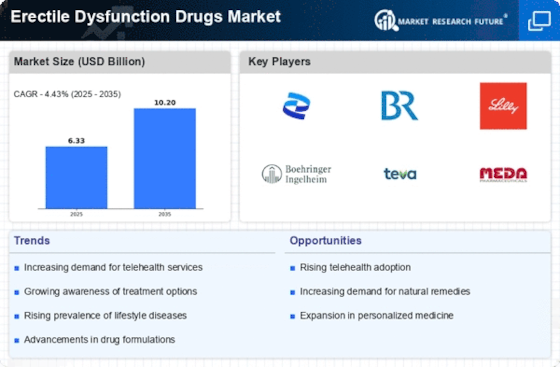
Erectile Dysfunction Drugs Market Infographic
Purchase Options

Erectile Dysfunction Drugs Size

Erectile Dysfunction Drugs Market Growth Projections and Opportunities

Erectile Dysfunction Drugs Market size is expected to reach USD 6.65 billion by 2030 at 6.8% CAGR during the forecast period. The market for erectile dysfunction (ED) drugs is influenced by a myriad of factors that collectively shape its dynamics. One of the primary drivers is the increasing prevalence of ED globally. Because of the mental and physically changing world, more people are stressed out or becoming sedentary, and the aging process begins. Sophisticated drug development and formulations that depends on advanced technology have taken the lead in the pharmaceutical market of today. The constant sustenance of the growth of the market could be attributed to the innovative delivery systems as well as the new and unique ways in which drugs can be harvested. Medical companies need to research heading towards treatment that is both good to be effective and use for patients to increase the market competitiveness, which can be achieved through more investments in research and development. the continuous trials of precise creation of formulations which ensure a shorter recovery time and whether they are less harmful while remaining effective is one of the reasons why their industries are significant players.

The availability of the health facility's accessibility and services of the ideal quality, on the other hand, significantly contribute to the market value of ED drugs. I can say from my first research that income level and access to healthcare are key economic factors which enable the spread of the economy. But, if we specifically consider the posed problem of administering ED drugs in the country of developing nations, then the answer will be somehow ambiguous. On the other hand the availability is very high in the industry (in developed markets) but the access (for medicine) might be equally scarce and limited in emerging markets. Well-being healthcare organizations may impede the access to medicine. At the same time, people also may have financial problems.

Psychological and emotional sides of the economics (of ED) is of great importance to both the market and the user either in the function of the economic elements or as client. Prejudice or inappropriate stigma towards those who are carrying sexual health problems tends to push them away and reluctant to seek a health care service. Campaigns and programs that focus on mental illness awareness and are aimed at reducing the impact of ED would create a successful market situation to allow the audience to discuss freely addressing the ED epidemic which will lead more people to seek healthcare services.

The aspect of ageing population trends round the world will bring in more of the elderly in the market hence 2030 the market will be more promising. As the number of elderly individuals increases, the prevalence of age-related ED also rises. This demographic shift creates a sustained demand for ED drugs, prompting pharmaceutical companies to develop targeted solutions for this specific population.
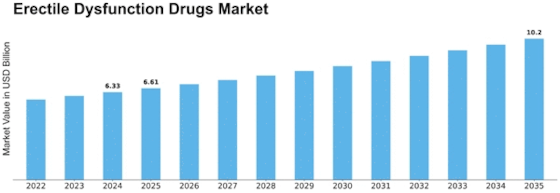

Erectile Dysfunction Drugs Market Size Graph
Author
Author Profile
Rahul Gotadki
Research Manager

He holds an experience of about 9+ years in Market Research and Business Consulting, working under the spectrum of Life Sciences and Healthcare domains. Rahul conceptualizes and implements a scalable business strategy and provides strategic leadership to the clients. His expertise lies in market estimation, competitive intelligence, pipeline analysis, customer assessment, etc.

Leave a Comment

FAQs

What is the current valuation of the Erectile Dysfunction Drugs Market as of 2024?

<p>The market valuation was 6.33 USD Billion in 2024.</p>

What is the projected market size for the Erectile Dysfunction Drugs Market in 2035?

<p>The projected valuation for 2035 is 10.2 USD Billion.</p>

What is the expected CAGR for the Erectile Dysfunction Drugs Market during the forecast period 2025 - 2035?

<p>The expected CAGR during this period is 4.43%.</p>

Which segment of Erectile Dysfunction Drugs is expected to have the highest valuation in 2035?

<p>Phosphodiesterase Type 5 Inhibitors is projected to reach 5.0 USD Billion by 2035.</p>

How do the sales of oral administration routes compare to injectable routes in 2035?

<p>Oral administration is expected to reach 4.5 USD Billion, while injectable routes may reach 2.5 USD Billion in 2035.</p>

What demographic is projected to contribute the most to the Erectile Dysfunction Drugs Market by 2035?

<p>Men above 40 are anticipated to contribute 4.05 USD Billion by 2035.</p>

What distribution channel is expected to see the highest growth in the Erectile Dysfunction Drugs Market?

<p>Retail pharmacies are projected to grow to 4.0 USD Billion by 2035.</p>

Which key players are leading the Erectile Dysfunction Drugs Market?

<p>Key players include Pfizer, Bayer, Eli Lilly, and others.</p>

What is the expected growth in the Alprostadil segment by 2035?

<p>The Alprostadil segment is projected to grow to 1.2 USD Billion by 2035.</p>

How does the market for diabetic patients compare to that of cardiovascular patients in 2035?

<p>Both segments are expected to reach similar valuations, with diabetic patients at 1.95 USD Billion and cardiovascular patients at 2.09 USD Billion.</p>

Market Summary

As per Market Research Future analysis, the Erectile Dysfunction Drugs Market Size was estimated at  3.1 USD Billion in 2025. The Erectile Dysfunction medications industry is projected to grow from  3.4 USD Billion in 2026 to 6.9 USD Billion by 2035, exhibiting a compound annual growth rate (CAGR) of 4.43% during the forecast period 2026 - 2035

Key Market Trends & Highlights

The Erectile Dysfunction Drugs Market is experiencing robust growth driven by increasing awareness and technological advancements.

  • North America remains the largest medications market for erectile dysfunction drugs, characterized by a high prevalence of related conditions. The Asia-Pacific region is emerging as the fastest-growing market, fueled by changing attitudes towards sexual health and wellness. Phosphodiesterase Type 5 inhibitors dominate the market, while testosterone replacement therapy is rapidly gaining traction as a preferred treatment option. Key market drivers include an aging population and advancements in drug development, which are significantly influencing ED pills market dynamics.

Market Size & Forecast

2025 Market Size 3.1 (USD Billion)
2035 Market Size 10.2 (USD Billion)
CAGR (2026 - 2035) 4.43%
Largest Regional Market Share in 2025 North America

Major Players

Top 10 ED medication companies are, Pfizer (US), Bayer (DE), Eli Lilly (US), Boehringer Ingelheim (DE), <a href="https://www.tevapharm.com/news-and-media/latest-news/teva-announces-exclusive-launch-of-generic-viagra-tablets-in-the-united-states/">Teva Pharmaceuticals</a> (IL), Meda Pharmaceuticals (SE), AstraZeneca (GB), GSK (GB), Hims (US)

Market Trends

The Erectile Dysfunction Drugs Market is currently experiencing a notable transformation, driven by a combination of evolving consumer preferences and advancements in pharmaceutical research. As awareness surrounding erectile dysfunction increases, more individuals are seeking effective treatments, which has led to a surge in demand for various therapeutic options.

The erectile dysfunction market is characterized by a diverse range of products, including both traditional medications and newer, innovative therapies that aim to address the underlying causes of erectile dysfunction. Furthermore, the growing acceptance of discussing sexual health issues is contributing to a more open dialogue, encouraging men to seek help and explore available solutions. In addition to changing societal attitudes, the Erectile Dysfunction Drugs Market is also influenced by technological advancements.

The rise of telemedicine and online pharmacies has made it easier for consumers to access medications discreetly and conveniently. This shift not only enhances patient privacy but also expands the reach of these products to a broader audience. As the Erectile Dysfunction Drugs Market continues to evolve, it appears poised for further growth, with ongoing research and development efforts likely to yield new treatment options that could reshape the landscape of erectile dysfunction management. Overall, the future of the Erectile Dysfunction Drugs Market seems promising, with a focus on improving patient outcomes and enhancing quality of life for those affected by this condition.

Increased Awareness and Acceptance

The growing awareness surrounding erectile dysfunction is fostering a more accepting environment for discussions about sexual health. This trend encourages individuals to seek treatment options, thereby expanding the Erectile Dysfunction Drugs Market for erectile dysfunction drugs.

Technological Integration in Healthcare

The integration of technology in healthcare, particularly through telemedicine, is transforming how patients access erectile dysfunction treatments. This shift allows for greater convenience and privacy, potentially increasing the number of individuals seeking help.

Emergence of Natural and Alternative Therapies

There is a rising interest in natural and alternative therapies for erectile dysfunction, as consumers seek holistic approaches to health. This trend may lead to the development of new products that cater to those preferring non-pharmaceutical options.

Erectile Dysfunction Drugs Market Market Drivers

Aging Population

The aging population is a critical driver of the Erectile Dysfunction Drugs Market. As individuals age, the prevalence of erectile dysfunction tends to increase, with studies indicating that approximately 50% of men aged 40 to 70 experience some degree of erectile dysfunction.
 
This demographic shift suggests a growing market for erectile dysfunction drugs, as older men are more likely to seek treatment. Furthermore, the increasing life expectancy in many regions contributes to a larger segment of the population that may require these medications.
The Erectile Dysfunction Drugs Market is thus poised to expand, driven by the need to address the sexual health concerns of an aging male population.

Advancements in Drug Development

Advancements in drug development and formulation are propelling the Erectile Dysfunction Drugs Market forward. The introduction of new medications with improved efficacy and fewer side effects enhances treatment options for patients.
 
For instance, the development of PDE5 inhibitors has revolutionized the management of erectile dysfunction, providing effective solutions for many men. Additionally, ongoing research into alternative therapies and combination treatments may further expand the market.
As pharmaceutical companies invest in innovative solutions, the Erectile Dysfunction Drugs Market is expected to experience growth driven by these advancements in drug development.

Increased Focus on Sexual Health

There is an increasing focus on sexual health and wellness, which serves as a vital driver for the Erectile Dysfunction Drugs Market.
 
As societal norms evolve, more men are becoming open to discussing sexual health issues, leading to greater awareness and acceptance of erectile dysfunction treatments.
This shift is reflected in the growing number of advertisements and educational campaigns aimed at destigmatizing erectile dysfunction.
Consequently, the Erectile Dysfunction Drugs Market is likely to benefit from heightened consumer interest and willingness to seek treatment, resulting in increased sales and market penetration for erectile dysfunction drugs.

Telemedicine and Online Pharmacies

The rise of telemedicine and online pharmacies is transforming the Erectile Dysfunction Drugs Market. With the increasing acceptance of remote healthcare services, patients can now consult healthcare professionals and obtain prescriptions for erectile dysfunction medications from the comfort of their homes.
 
This convenience is particularly appealing to men who may feel embarrassed about discussing their condition in person. The accessibility of online pharmacies also facilitates the purchase of these medications, potentially increasing market reach.
As telemedicine continues to gain traction, the Erectile Dysfunction Drugs Market is likely to see a surge in demand, driven by the ease of access to treatment options.

Rising Incidence of Chronic Diseases

The rising incidence of chronic diseases such as diabetes, hypertension, and cardiovascular conditions significantly impacts the Erectile Dysfunction Drugs Market.
 
These health issues are known to contribute to erectile dysfunction, with studies indicating that men with diabetes are three times more likely to experience erectile dysfunction than those without.
As the prevalence of these chronic conditions continues to rise, the demand for effective erectile dysfunction treatments is likely to increase.
This trend suggests that the Erectile Dysfunction Drugs Market will see sustained growth, as healthcare providers seek to address the sexual health needs of patients suffering from these chronic ailments.

Market Segment Insights

By Type: Phosphodiesterase Type 5 Inhibitors (Largest) vs. Testosterone Replacement Therapy (Fastest-Growing)

In the Erectile Dysfunction Drugs Market, Phosphodiesterase Type 5 Inhibitors (PDE5 inhibitors) dominate the segment with a significant market share due to their widespread acceptance and efficacy in treating erectile dysfunction. Popular products in this category include pharma Viagra, Cialis, and Levitra, which have been instrumental in defining the treatment landscape over the years. In contrast, Testosterone Replacement Therapy, an emerging player, is gaining traction among patients who are increasingly aware of low testosterone levels affecting their sexual health, thereby expanding its share in the Erectile Dysfunction Drugs Market.

<h4 style="margin-top: 25px; margin-bottom: 15px;">Phosphodiesterase Type 5 Inhibitors (Dominant) vs. Testosterone Replacement Therapy (Emerging)</h4>

Phosphodiesterase Type 5 Inhibitors have established themselves as the go-to treatment for erectile dysfunction, leveraging well-documented clinical efficacy and a broad marketing presence. These drugs work by enhancing blood flow to the penis, facilitating erection in response to sexual stimulation, which explains their dominance in the Erectile Dysfunction Drugs Market. On the other hand, Testosterone Replacement Therapy is rapidly emerging as an alternative for patients whose erectile dysfunction is linked to hormonal deficiencies. This therapy's growth is bolstered by the increasing recognition of the impact of testosterone levels on sexual health, making it appealing to a demographic that seeks comprehensive solutions for erectile dysfunction.

By Administration Route: Oral (Largest) vs. Injectable (Fastest-Growing)

The Erectile Dysfunction Drugs Market showcases a diverse array of administration routes, with oral medications holding the largest market share. This method, favored for its convenience and ease of use, remains the primary choice for many patients.<br> <br> <br>In contrast, injectable therapies, while currently smaller in market share, are rapidly gaining traction. The broader adoption of injectables is attributed to their effectiveness, especially in cases where oral medications may fall short, making them increasingly sought after.

<h4 style="margin-top: 25px; margin-bottom: 15px;">Oral (Dominant) vs. Injectable (Emerging)</h4>

Oral medications have established themselves as the dominant force in the Erectile Dysfunction Drugs Market, favored for their convenience, patient accessibility, and efficacy. Brands like Viagra and Cialis exemplify this category, often being the first line of treatment for ED.<br> <br> <br>On the other hand, injectable therapies, though considered emerging, are witnessing a surge in popularity due to their high success rates in managing more severe cases of erectile dysfunction. Innovations in formulation and delivery methods are expanding their appeal, positioning injectables as an attractive alternative for patients seeking immediate and reliable solutions.

By Patient Demographics: Men Above 40 (Largest) vs. Diabetic Patients (Fastest-Growing)

The Erectile Dysfunction Drugs Market shows a significant skew towards men above 40, who represent the largest demographic segment. This age group is most likely to experience erectile dysfunction due to natural physiological changes and associated health issues. They dominate market share, driven by increased awareness and willingness to seek treatment for sexual health concerns. In contrast, the diabetic patient demographic is the fastest-growing segment in the Erectile Dysfunction Drugs Market. This increase can be attributed to the rising prevalence of diabetes globally, which has a direct correlation with erectile dysfunction. As more men with diabetes recognize the link between their condition and sexual health, the demand for effective treatments is surging, leading to rapid growth within this group.

<h4 style="margin-top: 25px; margin-bottom: 15px;">Men Above 40 (Dominant) vs. Cardiovascular Patients (Emerging)</h4>

Men above 40 are considered the dominant demographic in the Erectile Dysfunction Drugs Market as they naturally experience higher incidences of erectile dysfunction. This group often has numerous treatment options available and is characterized by a greater likelihood of seeking medical advice and treatment. On the other hand, cardiovascular patients represent an emerging demographic in the erectile dysfunction market . As cardiovascular conditions can significantly affect erectile function, more awareness is being raised about the need for specialized treatments within this group. Moreover, as healthcare professionals emphasize the connections between cardiovascular health and erectile dysfunction, this segment could see substantial growth as patients seek targeted therapies tailored to their unique medical conditions.

By Distribution Channel: Retail Pharmacies (Largest) vs. Online Pharmacies (Fastest-Growing)

In the Erectile Dysfunction Drugs Market, <a href="https://www.marketresearchfuture.com/reports/retail-pharmacy-market-22432">retail pharmacies</a> hold a significant share, serving as the primary channel for consumers seeking treatment. These pharmacies benefit from physical accessibility and personal consultations, enhancing customer trust and satisfaction.<br> <br> <br>Meanwhile, hospital pharmacies represent a smaller fraction, specializing in prescriptions and offering tailored solutions for patients under medical care. Online pharmacies are gradually gaining traction, appealing to a tech-savvy demographic looking for convenience and discretion when purchasing medications.

<h4 style="margin-top: 25px; margin-bottom: 15px;">Retail Pharmacies (Dominant) vs. Online Pharmacies (Emerging)</h4>

Retail pharmacies continue to dominate the erectile dysfunction drugs distribution channel due to their established infrastructure and accessibility. They provide a personal touch with pharmacists available for consultations, which often reassures patients. The growth of online pharmacies marks a significant shift in consumer behavior, particularly among younger generations who prioritize convenience and privacy.<br> <br> <br>Online pharmacies typically offer competitive pricing and discreet shipping options, attracting a new customer base. However, <a href="https://www.marketresearchfuture.com/reports/epharmacy-market-6615">epharmacy pharmacies</a> still maintain loyalty among older demographics who may prefer face-to-face interactions when managing their health conditions.

Get more detailed insights about Erectile Dysfunction Drugs Market Research Report - Forecast till 2035

Regional Insights

North America : Market Leader in Innovation

North America is the largest market for erectile dysfunction drugs, holding approximately 45% of the global erectile dysfunction market share. The region's growth is driven by increasing awareness of erectile dysfunction, a growing aging population, and advancements in drug formulations. Regulatory support from agencies like the FDA has also catalyzed market expansion, allowing for quicker approvals of new treatments and erectile dysfunction generic medications. The United States is the primary contributor, with key players such as Pfizer and Eli Lilly, which focus on reducing cost of erectile dysfunction drugs, leading the Erectile Dysfunction Drugs Market. The Canadian ED drugs producers also support the growth of the region. The competitive landscape is characterized by a mix of established pharmaceutical giants and emerging companies. The presence of telehealth services, like Hims, is also reshaping how patients access these medications, further driving demand in the region.

Europe : Regulatory Framework Enhances Growth

Europe is the second-largest market for erectile dysfunction drugs, accounting for about 30% of the global share. The region benefits from a robust healthcare system and increasing acceptance of sexual health treatments. Regulatory bodies like the European Medicines Agency (EMA) have streamlined approval processes, encouraging innovation and market entry for new therapies, which is expected to boost growth in the coming years. Leading countries include Germany, the UK, and France, where awareness campaigns and healthcare initiatives are prevalent. Major players like Bayer and Boehringer Ingelheim, which emphasize on controlling ed drugs costs, are well-established, while new entrants are emerging, focusing on personalized medicine and telehealth solutions. The competitive landscape is dynamic, with a mix of traditional and digital health approaches gaining traction.

Asia-Pacific : Emerging Market with Potential

Asia-Pacific is an emerging powerhouse in the erectile dysfunction drugs market, holding around 20% of the global share. The region's growth is fueled by rising disposable incomes, increasing awareness of sexual health, and a growing elderly population. Countries like China and India are witnessing a surge in demand, supported by favorable regulatory environments that encourage the introduction of new therapies and erectile dysfunction generic medications. China and India are the leading markets, with a mix of local and international players vying for market share. Companies like Teva Pharmaceuticals and Meda Pharmaceuticals are expanding their presence. The competitive landscape is evolving, with a focus on affordability and accessibility, as well as the integration of digital health solutions to reach a broader audience.

Middle East and Africa : Untapped Market Opportunities

The Middle East and Africa represent a nascent market for OTC erectile dysfunction drugs, holding approximately 5% of the global share. The region's growth is driven by increasing healthcare investments, rising awareness of sexual health issues, and a gradual shift in cultural attitudes towards seeking treatment. Regulatory bodies are beginning to establish frameworks that support the introduction of new therapies, which is expected to enhance Erectile Dysfunction Drugs Market growth. Countries like South Africa and the UAE are leading the way, with a growing number of healthcare providers offering specialized services. The competitive landscape is still developing, with both local and international companies exploring opportunities. Key players are focusing on education and awareness campaigns to destigmatize erectile dysfunction and promote treatment options.

Key Players and Competitive Insights

The Erectile Dysfunction Drugs Market is characterized by a dynamic competitive landscape, driven by increasing awareness of sexual health and the growing prevalence of erectile dysfunction (ED) among men globally. Key players such as Pfizer (US), Eli Lilly (US), and Bayer (DE) are at the forefront, leveraging their extensive research capabilities and established brand recognition to maintain market leadership. These companies are focusing on innovation, with a particular emphasis on developing new formulations and delivery methods to enhance patient compliance and satisfaction. Additionally, strategic partnerships and collaborations are becoming increasingly common, as firms seek to expand their market reach and enhance their product offerings.
In terms of business tactics, companies are increasingly localizing manufacturing to reduce cost of ed drugs and improve supply chain efficiency. The Erectile Dysfunction Drugs Market structure appears moderately fragmented, with several players competing for market share. However, the influence of major companies remains substantial, as they set industry standards and drive technological advancements. This competitive environment encourages smaller firms to innovate and differentiate their products, thereby fostering a culture of continuous improvement within the sector.
In August 2025, Pfizer (US) announced the launch of a new digital health platform aimed at providing personalized treatment options for ED. This initiative is significant as it not only enhances patient engagement but also positions Pfizer as a leader in integrating technology with traditional pharmaceutical offerings. By utilizing data analytics and telehealth services, Pfizer aims to improve treatment adherence and outcomes, which could potentially reshape patient experiences in the Erectile Dysfunction Drugs Market.
Similarly, in July 2025, Eli Lilly (US) expanded its partnership with a leading telemedicine provider to offer remote consultations and prescriptions for its ED medications. This strategic move underscores the growing trend of digital health solutions in the pharmaceutical industry. By facilitating easier access to treatments, Eli Lilly is likely to capture a larger share of the Erectile Dysfunction Drugs Market, particularly among younger demographics who prefer online healthcare services.
In September 2025, Bayer (DE) launched a new campaign focused on raising awareness about the psychological aspects of ED, emphasizing the importance of mental health in sexual wellness. This initiative not only aligns with current trends in holistic health but also positions Bayer as a socially responsible player in the market. By addressing the emotional and psychological factors associated with ED, Bayer is likely to enhance its brand loyalty and customer trust, which are crucial in a market where stigma often hampers open discussions about sexual health.
As of October 2025, the competitive trends in the Erectile Dysfunction Drugs Market are increasingly defined by digitalization, sustainability, and the integration of artificial intelligence in product development and marketing strategies. Strategic alliances are shaping the landscape, allowing companies to pool resources and expertise to innovate more effectively. Looking ahead, it appears that competitive differentiation will evolve from traditional price-based competition, encouraging producers to increase affordability of drugs by controlling erectile dysfunction drug prices, to a focus on innovation, technology integration, and supply chain reliability, as companies strive to meet the changing needs of consumers in a rapidly evolving market.

Key Companies in the Erectile Dysfunction Drugs Market include

Industry Developments

Sildenafil Citrate and Erectile Dysfunction Drugs

Sildenafil Citrate is one of the most widely used active pharmaceutical ingredients for the treatment of erectile dysfunction (ED). It belongs to the class of phosphodiesterase type-5 (PDE5) inhibitors, which work by increasing blood flow to the penis during sexual stimulation. By blocking the PDE5 enzyme, Sildenafil helps relax smooth muscles in the blood vessels, enabling a stronger and more sustained erection.

OTC erectile dysfunction drugs, including Sildenafil, Tadalafil, and Vardenafil, have significantly transformed the management of generic ED drugs by offering safe, convenient, and effective treatment options. Sildenafil, in particular, is known for its rapid onset of action, usually within 30 to 60 minutes, and its effectiveness for up to four hours.

These medications are typically prescribed for men experiencing difficulty achieving or maintaining an erection due to aging, stress, chronic health conditions, or lifestyle factors. While ED drugs are generally well tolerated, they should be used under medical supervision, especially by individuals with cardiovascular conditions or those taking nitrate medications.

Furthermore, in August 2023, AbbVie and Bausch Health formed a partnership focusing on Research and Development of innovative solutions for erectile dysfunction, which is expected to boost their product offerings significantly. Current affairs indicate a growing market valuation driven by increased acknowledgment of erectile dysfunction as a prevalent health issue.

The Erectile Dysfunction Drugs Market was valued at approximately USD 4 billion in 2022, with projections indicating substantial growth due to rising awareness and the increasing acceptance of treatments. Noteworthy is the merger between Astellas Pharma and Bristol Myers Squibb in June 2022, aimed at consolidating their portfolios in urology, which will likely create synergies in product research. Elsewhere, Eli Lilly and Merck are focusing on expanding their clinical trials, further indicating a robust pipeline of potential new therapies in the Erectile Dysfunction Drugs Market.

Future Outlook

Erectile Dysfunction Drugs Market Future Outlook

The Erectile Dysfunction Drugs Market is projected to grow at a 4.43% CAGR from 2025 to 2035, driven by increasing awareness, aging populations, and advancements in drug formulations. Sildenafil Citrate

New opportunities lie in:

  • <p>Development of telehealth platforms for remote consultations and prescriptions. Expansion into emerging markets with tailored marketing strategies. Investment in R&amp;D for innovative drug delivery systems and formulations.</p>

By 2035, the Erectile Dysfunction Drugs Market is expected to solidify its growth trajectory, driven by innovation and strategic expansion.

Market Segmentation

Erectile Dysfunction Drugs Market Type Outlook

  • Phosphodiesterase Type 5 Inhibitors
  • Testosterone Replacement Therapy
  • Alprostadil
  • Penile Pumps

Erectile Dysfunction Drugs Market Administration Route Outlook

  • Oral
  • Injectable
  • Intraurethral
  • Vacuum Erection Devices

Erectile Dysfunction Drugs Market Distribution Channel Outlook

  • Hospital Pharmacies
  • Retail Pharmacies
  • Online Pharmacies

Erectile Dysfunction Drugs Market Patient Demographics Outlook

  • Men Above 40
  • Men Below 40
  • Diabetic Patients
  • Cardiovascular Patients

Report Scope

MARKET SIZE 2025  3.1 (USD Billion)
MARKET SIZE 2026  3.4 (USD Billion)
MARKET SIZE 2035  6.9 (USD Billion)
COMPOUND ANNUAL GROWTH RATE (CAGR) 4.43% (2026 - 2035)
REPORT COVERAGE Revenue Forecast, Competitive Landscape, Growth Factors, and Trends
BASE YEAR 2024
Market Forecast Period 2026 - 2035
Historical Data 2019 - 2024
Market Forecast Units USD Billion
Key Companies Profiled Top 10 ED medication companies are, Pfizer (US), Bayer (DE), Eli Lilly (US), Boehringer Ingelheim (DE), Teva Pharmaceuticals (IL), Meda Pharmaceuticals (SE), AstraZeneca (GB), GSK (GB), Hims (US)
Segments Covered Drug Type, Administration Route, Patient Demographics, Distribution Channel, Regional
Key Market Opportunities Emergence of novel therapies and digital health solutions in the Erectile Dysfunction Drugs Market.
Key Market Dynamics Rising consumer awareness and acceptance drive demand for innovative erectile dysfunction drug solutions amid evolving regulatory landscapes.
Countries Covered North America, Europe, APAC, South America, MEA

FAQs

What is the current valuation of the Erectile Dysfunction Drugs Market as of 2024?

<p>The market valuation was 6.33 USD Billion in 2024.</p>

What is the projected market size for the Erectile Dysfunction Drugs Market in 2035?

<p>The projected valuation for 2035 is 10.2 USD Billion.</p>

What is the expected CAGR for the Erectile Dysfunction Drugs Market during the forecast period 2025 - 2035?

<p>The expected CAGR during this period is 4.43%.</p>

Which segment of Erectile Dysfunction Drugs is expected to have the highest valuation in 2035?

<p>Phosphodiesterase Type 5 Inhibitors is projected to reach 5.0 USD Billion by 2035.</p>

How do the sales of oral administration routes compare to injectable routes in 2035?

<p>Oral administration is expected to reach 4.5 USD Billion, while injectable routes may reach 2.5 USD Billion in 2035.</p>

What demographic is projected to contribute the most to the Erectile Dysfunction Drugs Market by 2035?

<p>Men above 40 are anticipated to contribute 4.05 USD Billion by 2035.</p>

What distribution channel is expected to see the highest growth in the Erectile Dysfunction Drugs Market?

<p>Retail pharmacies are projected to grow to 4.0 USD Billion by 2035.</p>

Which key players are leading the Erectile Dysfunction Drugs Market?

<p>Key players include Pfizer, Bayer, Eli Lilly, and others.</p>

What is the expected growth in the Alprostadil segment by 2035?

<p>The Alprostadil segment is projected to grow to 1.2 USD Billion by 2035.</p>

How does the market for diabetic patients compare to that of cardiovascular patients in 2035?

<p>Both segments are expected to reach similar valuations, with diabetic patients at 1.95 USD Billion and cardiovascular patients at 2.09 USD Billion.</p>

  1. SECTION I: EXECUTIVE SUMMARY AND KEY HIGHLIGHTS
    1. | 1.1 EXECUTIVE SUMMARY
    2. | | 1.1.1 Market Overview
    3. | | 1.1.2 Key Findings
    4. | | 1.1.3 Market Segmentation
    5. | | 1.1.4 Competitive Landscape
    6. | | 1.1.5 Challenges and Opportunities
    7. | | 1.1.6 Future Outlook
  2. SECTION II: SCOPING, METHODOLOGY AND MARKET STRUCTURE
    1. | 2.1 MARKET INTRODUCTION
    2. | | 2.1.1 Definition
    3. | | 2.1.2 Scope of the study
    4. | | | 2.1.2.1 Research Objective
    5. | | | 2.1.2.2 Assumption
    6. | | | 2.1.2.3 Limitations
    7. | 2.2 RESEARCH METHODOLOGY
    8. | | 2.2.1 Overview
    9. | | 2.2.2 Data Mining
    10. | | 2.2.3 Secondary Research
    11. | | 2.2.4 Primary Research
    12. | | | 2.2.4.1 Primary Interviews and Information Gathering Process
    13. | | | 2.2.4.2 Breakdown of Primary Respondents
    14. | | 2.2.5 Forecasting Model
    15. | | 2.2.6 Market Size Estimation
    16. | | | 2.2.6.1 Bottom-Up Approach
    17. | | | 2.2.6.2 Top-Down Approach
    18. | | 2.2.7 Data Triangulation
    19. | | 2.2.8 Validation
  3. SECTION III: QUALITATIVE ANALYSIS
    1. | 3.1 MARKET DYNAMICS
    2. | | 3.1.1 Overview
    3. | | 3.1.2 Drivers
    4. | | 3.1.3 Restraints
    5. | | 3.1.4 Opportunities
    6. | 3.2 MARKET FACTOR ANALYSIS
    7. | | 3.2.1 Value chain Analysis
    8. | | 3.2.2 Porter's Five Forces Analysis
    9. | | | 3.2.2.1 Bargaining Power of Suppliers
    10. | | | 3.2.2.2 Bargaining Power of Buyers
    11. | | | 3.2.2.3 Threat of New Entrants
    12. | | | 3.2.2.4 Threat of Substitutes
    13. | | | 3.2.2.5 Intensity of Rivalry
    14. | | 3.2.3 COVID-19 Impact Analysis
    15. | | | 3.2.3.1 Market Impact Analysis
    16. | | | 3.2.3.2 Regional Impact
    17. | | | 3.2.3.3 Opportunity and Threat Analysis
  4. SECTION IV: QUANTITATIVE ANALYSIS
    1. | 4.1 Healthcare, BY Type (USD Billion)
    2. | | 4.1.1 Phosphodiesterase Type 5 Inhibitors
    3. | | 4.1.2 Testosterone Replacement Therapy
    4. | | 4.1.3 Alprostadil
    5. | | 4.1.4 Penile Pumps
    6. | 4.2 Healthcare, BY Administration Route (USD Billion)
    7. | | 4.2.1 Oral
    8. | | 4.2.2 Injectable
    9. | | 4.2.3 Intraurethral
    10. | | 4.2.4 Vacuum Erection Devices
    11. | 4.3 Healthcare, BY Patient Demographics (USD Billion)
    12. | | 4.3.1 Men Above 40
    13. | | 4.3.2 Men Below 40
    14. | | 4.3.3 Diabetic Patients
    15. | | 4.3.4 Cardiovascular Patients
    16. | 4.4 Healthcare, BY Distribution Channel (USD Billion)
    17. | | 4.4.1 Hospital Pharmacies
    18. | | 4.4.2 Retail Pharmacies
    19. | | 4.4.3 Online Pharmacies
    20. | 4.5 Healthcare, BY Region (USD Billion)
    21. | | 4.5.1 North America
    22. | | | 4.5.1.1 US
    23. | | | 4.5.1.2 Canada
    24. | | 4.5.2 Europe
    25. | | | 4.5.2.1 Germany
    26. | | | 4.5.2.2 UK
    27. | | | 4.5.2.3 France
    28. | | | 4.5.2.4 Russia
    29. | | | 4.5.2.5 Italy
    30. | | | 4.5.2.6 Spain
    31. | | | 4.5.2.7 Rest of Europe
    32. | | 4.5.3 APAC
    33. | | | 4.5.3.1 China
    34. | | | 4.5.3.2 India
    35. | | | 4.5.3.3 Japan
    36. | | | 4.5.3.4 South Korea
    37. | | | 4.5.3.5 Malaysia
    38. | | | 4.5.3.6 Thailand
    39. | | | 4.5.3.7 Indonesia
    40. | | | 4.5.3.8 Rest of APAC
    41. | | 4.5.4 South America
    42. | | | 4.5.4.1 Brazil
    43. | | | 4.5.4.2 Mexico
    44. | | | 4.5.4.3 Argentina
    45. | | | 4.5.4.4 Rest of South America
    46. | | 4.5.5 MEA
    47. | | | 4.5.5.1 GCC Countries
    48. | | | 4.5.5.2 South Africa
    49. | | | 4.5.5.3 Rest of MEA
  5. SECTION V: COMPETITIVE ANALYSIS
    1. | 5.1 Competitive Landscape
    2. | | 5.1.1 Overview
    3. | | 5.1.2 Competitive Analysis
    4. | | 5.1.3 Market share Analysis
    5. | | 5.1.4 Major Growth Strategy in the Healthcare
    6. | | 5.1.5 Competitive Benchmarking
    7. | | 5.1.6 Leading Players in Terms of Number of Developments in the Healthcare
    8. | | 5.1.7 Key developments and growth strategies
    9. | | | 5.1.7.1 New Product Launch/Service Deployment
    10. | | | 5.1.7.2 Merger & Acquisitions
    11. | | | 5.1.7.3 Joint Ventures
    12. | | 5.1.8 Major Players Financial Matrix
    13. | | | 5.1.8.1 Sales and Operating Income
    14. | | | 5.1.8.2 Major Players R&D Expenditure. 2023
    15. | 5.2 Company Profiles
    16. | | 5.2.1 Pfizer (US)
    17. | | | 5.2.1.1 Financial Overview
    18. | | | 5.2.1.2 Products Offered
    19. | | | 5.2.1.3 Key Developments
    20. | | | 5.2.1.4 SWOT Analysis
    21. | | | 5.2.1.5 Key Strategies
    22. | | 5.2.2 Bayer (DE)
    23. | | | 5.2.2.1 Financial Overview
    24. | | | 5.2.2.2 Products Offered
    25. | | | 5.2.2.3 Key Developments
    26. | | | 5.2.2.4 SWOT Analysis
    27. | | | 5.2.2.5 Key Strategies
    28. | | 5.2.3 Eli Lilly (US)
    29. | | | 5.2.3.1 Financial Overview
    30. | | | 5.2.3.2 Products Offered
    31. | | | 5.2.3.3 Key Developments
    32. | | | 5.2.3.4 SWOT Analysis
    33. | | | 5.2.3.5 Key Strategies
    34. | | 5.2.4 Boehringer Ingelheim (DE)
    35. | | | 5.2.4.1 Financial Overview
    36. | | | 5.2.4.2 Products Offered
    37. | | | 5.2.4.3 Key Developments
    38. | | | 5.2.4.4 SWOT Analysis
    39. | | | 5.2.4.5 Key Strategies
    40. | | 5.2.5 Teva Pharmaceuticals (IL)
    41. | | | 5.2.5.1 Financial Overview
    42. | | | 5.2.5.2 Products Offered
    43. | | | 5.2.5.3 Key Developments
    44. | | | 5.2.5.4 SWOT Analysis
    45. | | | 5.2.5.5 Key Strategies
    46. | | 5.2.6 Meda Pharmaceuticals (SE)
    47. | | | 5.2.6.1 Financial Overview
    48. | | | 5.2.6.2 Products Offered
    49. | | | 5.2.6.3 Key Developments
    50. | | | 5.2.6.4 SWOT Analysis
    51. | | | 5.2.6.5 Key Strategies
    52. | | 5.2.7 AstraZeneca (GB)
    53. | | | 5.2.7.1 Financial Overview
    54. | | | 5.2.7.2 Products Offered
    55. | | | 5.2.7.3 Key Developments
    56. | | | 5.2.7.4 SWOT Analysis
    57. | | | 5.2.7.5 Key Strategies
    58. | | 5.2.8 GSK (GB)
    59. | | | 5.2.8.1 Financial Overview
    60. | | | 5.2.8.2 Products Offered
    61. | | | 5.2.8.3 Key Developments
    62. | | | 5.2.8.4 SWOT Analysis
    63. | | | 5.2.8.5 Key Strategies
    64. | | 5.2.9 Hims (US)
    65. | | | 5.2.9.1 Financial Overview
    66. | | | 5.2.9.2 Products Offered
    67. | | | 5.2.9.3 Key Developments
    68. | | | 5.2.9.4 SWOT Analysis
    69. | | | 5.2.9.5 Key Strategies
    70. | 5.3 Appendix
    71. | | 5.3.1 References
    72. | | 5.3.2 Related Reports
  6. LIST OF FIGURES
    1. | 6.1 MARKET SYNOPSIS
    2. | 6.2 NORTH AMERICA MARKET ANALYSIS
    3. | 6.3 US MARKET ANALYSIS BY TYPE
    4. | 6.4 US MARKET ANALYSIS BY ADMINISTRATION ROUTE
    5. | 6.5 US MARKET ANALYSIS BY PATIENT DEMOGRAPHICS
    6. | 6.6 US MARKET ANALYSIS BY DISTRIBUTION CHANNEL
    7. | 6.7 CANADA MARKET ANALYSIS BY TYPE
    8. | 6.8 CANADA MARKET ANALYSIS BY ADMINISTRATION ROUTE
    9. | 6.9 CANADA MARKET ANALYSIS BY PATIENT DEMOGRAPHICS
    10. | 6.10 CANADA MARKET ANALYSIS BY DISTRIBUTION CHANNEL
    11. | 6.11 EUROPE MARKET ANALYSIS
    12. | 6.12 GERMANY MARKET ANALYSIS BY TYPE
    13. | 6.13 GERMANY MARKET ANALYSIS BY ADMINISTRATION ROUTE
    14. | 6.14 GERMANY MARKET ANALYSIS BY PATIENT DEMOGRAPHICS
    15. | 6.15 GERMANY MARKET ANALYSIS BY DISTRIBUTION CHANNEL
    16. | 6.16 UK MARKET ANALYSIS BY TYPE
    17. | 6.17 UK MARKET ANALYSIS BY ADMINISTRATION ROUTE
    18. | 6.18 UK MARKET ANALYSIS BY PATIENT DEMOGRAPHICS
    19. | 6.19 UK MARKET ANALYSIS BY DISTRIBUTION CHANNEL
    20. | 6.20 FRANCE MARKET ANALYSIS BY TYPE
    21. | 6.21 FRANCE MARKET ANALYSIS BY ADMINISTRATION ROUTE
    22. | 6.22 FRANCE MARKET ANALYSIS BY PATIENT DEMOGRAPHICS
    23. | 6.23 FRANCE MARKET ANALYSIS BY DISTRIBUTION CHANNEL
    24. | 6.24 RUSSIA MARKET ANALYSIS BY TYPE
    25. | 6.25 RUSSIA MARKET ANALYSIS BY ADMINISTRATION ROUTE
    26. | 6.26 RUSSIA MARKET ANALYSIS BY PATIENT DEMOGRAPHICS
    27. | 6.27 RUSSIA MARKET ANALYSIS BY DISTRIBUTION CHANNEL
    28. | 6.28 ITALY MARKET ANALYSIS BY TYPE
    29. | 6.29 ITALY MARKET ANALYSIS BY ADMINISTRATION ROUTE
    30. | 6.30 ITALY MARKET ANALYSIS BY PATIENT DEMOGRAPHICS
    31. | 6.31 ITALY MARKET ANALYSIS BY DISTRIBUTION CHANNEL
    32. | 6.32 SPAIN MARKET ANALYSIS BY TYPE
    33. | 6.33 SPAIN MARKET ANALYSIS BY ADMINISTRATION ROUTE
    34. | 6.34 SPAIN MARKET ANALYSIS BY PATIENT DEMOGRAPHICS
    35. | 6.35 SPAIN MARKET ANALYSIS BY DISTRIBUTION CHANNEL
    36. | 6.36 REST OF EUROPE MARKET ANALYSIS BY TYPE
    37. | 6.37 REST OF EUROPE MARKET ANALYSIS BY ADMINISTRATION ROUTE
    38. | 6.38 REST OF EUROPE MARKET ANALYSIS BY PATIENT DEMOGRAPHICS
    39. | 6.39 REST OF EUROPE MARKET ANALYSIS BY DISTRIBUTION CHANNEL
    40. | 6.40 APAC MARKET ANALYSIS
    41. | 6.41 CHINA MARKET ANALYSIS BY TYPE
    42. | 6.42 CHINA MARKET ANALYSIS BY ADMINISTRATION ROUTE
    43. | 6.43 CHINA MARKET ANALYSIS BY PATIENT DEMOGRAPHICS
    44. | 6.44 CHINA MARKET ANALYSIS BY DISTRIBUTION CHANNEL
    45. | 6.45 INDIA MARKET ANALYSIS BY TYPE
    46. | 6.46 INDIA MARKET ANALYSIS BY ADMINISTRATION ROUTE
    47. | 6.47 INDIA MARKET ANALYSIS BY PATIENT DEMOGRAPHICS
    48. | 6.48 INDIA MARKET ANALYSIS BY DISTRIBUTION CHANNEL
    49. | 6.49 JAPAN MARKET ANALYSIS BY TYPE
    50. | 6.50 JAPAN MARKET ANALYSIS BY ADMINISTRATION ROUTE
    51. | 6.51 JAPAN MARKET ANALYSIS BY PATIENT DEMOGRAPHICS
    52. | 6.52 JAPAN MARKET ANALYSIS BY DISTRIBUTION CHANNEL
    53. | 6.53 SOUTH KOREA MARKET ANALYSIS BY TYPE
    54. | 6.54 SOUTH KOREA MARKET ANALYSIS BY ADMINISTRATION ROUTE
    55. | 6.55 SOUTH KOREA MARKET ANALYSIS BY PATIENT DEMOGRAPHICS
    56. | 6.56 SOUTH KOREA MARKET ANALYSIS BY DISTRIBUTION CHANNEL
    57. | 6.57 MALAYSIA MARKET ANALYSIS BY TYPE
    58. | 6.58 MALAYSIA MARKET ANALYSIS BY ADMINISTRATION ROUTE
    59. | 6.59 MALAYSIA MARKET ANALYSIS BY PATIENT DEMOGRAPHICS
    60. | 6.60 MALAYSIA MARKET ANALYSIS BY DISTRIBUTION CHANNEL
    61. | 6.61 THAILAND MARKET ANALYSIS BY TYPE
    62. | 6.62 THAILAND MARKET ANALYSIS BY ADMINISTRATION ROUTE
    63. | 6.63 THAILAND MARKET ANALYSIS BY PATIENT DEMOGRAPHICS
    64. | 6.64 THAILAND MARKET ANALYSIS BY DISTRIBUTION CHANNEL
    65. | 6.65 INDONESIA MARKET ANALYSIS BY TYPE
    66. | 6.66 INDONESIA MARKET ANALYSIS BY ADMINISTRATION ROUTE
    67. | 6.67 INDONESIA MARKET ANALYSIS BY PATIENT DEMOGRAPHICS
    68. | 6.68 INDONESIA MARKET ANALYSIS BY DISTRIBUTION CHANNEL
    69. | 6.69 REST OF APAC MARKET ANALYSIS BY TYPE
    70. | 6.70 REST OF APAC MARKET ANALYSIS BY ADMINISTRATION ROUTE
    71. | 6.71 REST OF APAC MARKET ANALYSIS BY PATIENT DEMOGRAPHICS
    72. | 6.72 REST OF APAC MARKET ANALYSIS BY DISTRIBUTION CHANNEL
    73. | 6.73 SOUTH AMERICA MARKET ANALYSIS
    74. | 6.74 BRAZIL MARKET ANALYSIS BY TYPE
    75. | 6.75 BRAZIL MARKET ANALYSIS BY ADMINISTRATION ROUTE
    76. | 6.76 BRAZIL MARKET ANALYSIS BY PATIENT DEMOGRAPHICS
    77. | 6.77 BRAZIL MARKET ANALYSIS BY DISTRIBUTION CHANNEL
    78. | 6.78 MEXICO MARKET ANALYSIS BY TYPE
    79. | 6.79 MEXICO MARKET ANALYSIS BY ADMINISTRATION ROUTE
    80. | 6.80 MEXICO MARKET ANALYSIS BY PATIENT DEMOGRAPHICS
    81. | 6.81 MEXICO MARKET ANALYSIS BY DISTRIBUTION CHANNEL
    82. | 6.82 ARGENTINA MARKET ANALYSIS BY TYPE
    83. | 6.83 ARGENTINA MARKET ANALYSIS BY ADMINISTRATION ROUTE
    84. | 6.84 ARGENTINA MARKET ANALYSIS BY PATIENT DEMOGRAPHICS
    85. | 6.85 ARGENTINA MARKET ANALYSIS BY DISTRIBUTION CHANNEL
    86. | 6.86 REST OF SOUTH AMERICA MARKET ANALYSIS BY TYPE
    87. | 6.87 REST OF SOUTH AMERICA MARKET ANALYSIS BY ADMINISTRATION ROUTE
    88. | 6.88 REST OF SOUTH AMERICA MARKET ANALYSIS BY PATIENT DEMOGRAPHICS
    89. | 6.89 REST OF SOUTH AMERICA MARKET ANALYSIS BY DISTRIBUTION CHANNEL
    90. | 6.90 MEA MARKET ANALYSIS
    91. | 6.91 GCC COUNTRIES MARKET ANALYSIS BY TYPE
    92. | 6.92 GCC COUNTRIES MARKET ANALYSIS BY ADMINISTRATION ROUTE
    93. | 6.93 GCC COUNTRIES MARKET ANALYSIS BY PATIENT DEMOGRAPHICS
    94. | 6.94 GCC COUNTRIES MARKET ANALYSIS BY DISTRIBUTION CHANNEL
    95. | 6.95 SOUTH AFRICA MARKET ANALYSIS BY TYPE
    96. | 6.96 SOUTH AFRICA MARKET ANALYSIS BY ADMINISTRATION ROUTE
    97. | 6.97 SOUTH AFRICA MARKET ANALYSIS BY PATIENT DEMOGRAPHICS
    98. | 6.98 SOUTH AFRICA MARKET ANALYSIS BY DISTRIBUTION CHANNEL
    99. | 6.99 REST OF MEA MARKET ANALYSIS BY TYPE
    100. | 6.100 REST OF MEA MARKET ANALYSIS BY ADMINISTRATION ROUTE
    101. | 6.101 REST OF MEA MARKET ANALYSIS BY PATIENT DEMOGRAPHICS
    102. | 6.102 REST OF MEA MARKET ANALYSIS BY DISTRIBUTION CHANNEL
    103. | 6.103 KEY BUYING CRITERIA OF HEALTHCARE
    104. | 6.104 RESEARCH PROCESS OF MRFR
    105. | 6.105 DRO ANALYSIS OF HEALTHCARE
    106. | 6.106 DRIVERS IMPACT ANALYSIS: HEALTHCARE
    107. | 6.107 RESTRAINTS IMPACT ANALYSIS: HEALTHCARE
    108. | 6.108 SUPPLY / VALUE CHAIN: HEALTHCARE
    109. | 6.109 HEALTHCARE, BY TYPE, 2024 (% SHARE)
    110. | 6.110 HEALTHCARE, BY TYPE, 2024 TO 2035 (USD Billion)
    111. | 6.111 HEALTHCARE, BY ADMINISTRATION ROUTE, 2024 (% SHARE)
    112. | 6.112 HEALTHCARE, BY ADMINISTRATION ROUTE, 2024 TO 2035 (USD Billion)
    113. | 6.113 HEALTHCARE, BY PATIENT DEMOGRAPHICS, 2024 (% SHARE)
    114. | 6.114 HEALTHCARE, BY PATIENT DEMOGRAPHICS, 2024 TO 2035 (USD Billion)
    115. | 6.115 HEALTHCARE, BY DISTRIBUTION CHANNEL, 2024 (% SHARE)
    116. | 6.116 HEALTHCARE, BY DISTRIBUTION CHANNEL, 2024 TO 2035 (USD Billion)
    117. | 6.117 BENCHMARKING OF MAJOR COMPETITORS
  7. LIST OF TABLES
    1. | 7.1 LIST OF ASSUMPTIONS
    2. | | 7.1.1
    3. | 7.2 North America MARKET SIZE ESTIMATES; FORECAST
    4. | | 7.2.1 BY TYPE, 2025-2035 (USD Billion)
    5. | | 7.2.2 BY ADMINISTRATION ROUTE, 2025-2035 (USD Billion)
    6. | | 7.2.3 BY PATIENT DEMOGRAPHICS, 2025-2035 (USD Billion)
    7. | | 7.2.4 BY DISTRIBUTION CHANNEL, 2025-2035 (USD Billion)
    8. | 7.3 US MARKET SIZE ESTIMATES; FORECAST
    9. | | 7.3.1 BY TYPE, 2025-2035 (USD Billion)
    10. | | 7.3.2 BY ADMINISTRATION ROUTE, 2025-2035 (USD Billion)
    11. | | 7.3.3 BY PATIENT DEMOGRAPHICS, 2025-2035 (USD Billion)
    12. | | 7.3.4 BY DISTRIBUTION CHANNEL, 2025-2035 (USD Billion)
    13. | 7.4 Canada MARKET SIZE ESTIMATES; FORECAST
    14. | | 7.4.1 BY TYPE, 2025-2035 (USD Billion)
    15. | | 7.4.2 BY ADMINISTRATION ROUTE, 2025-2035 (USD Billion)
    16. | | 7.4.3 BY PATIENT DEMOGRAPHICS, 2025-2035 (USD Billion)
    17. | | 7.4.4 BY DISTRIBUTION CHANNEL, 2025-2035 (USD Billion)
    18. | 7.5 Europe MARKET SIZE ESTIMATES; FORECAST
    19. | | 7.5.1 BY TYPE, 2025-2035 (USD Billion)
    20. | | 7.5.2 BY ADMINISTRATION ROUTE, 2025-2035 (USD Billion)
    21. | | 7.5.3 BY PATIENT DEMOGRAPHICS, 2025-2035 (USD Billion)
    22. | | 7.5.4 BY DISTRIBUTION CHANNEL, 2025-2035 (USD Billion)
    23. | 7.6 Germany MARKET SIZE ESTIMATES; FORECAST
    24. | | 7.6.1 BY TYPE, 2025-2035 (USD Billion)
    25. | | 7.6.2 BY ADMINISTRATION ROUTE, 2025-2035 (USD Billion)
    26. | | 7.6.3 BY PATIENT DEMOGRAPHICS, 2025-2035 (USD Billion)
    27. | | 7.6.4 BY DISTRIBUTION CHANNEL, 2025-2035 (USD Billion)
    28. | 7.7 UK MARKET SIZE ESTIMATES; FORECAST
    29. | | 7.7.1 BY TYPE, 2025-2035 (USD Billion)
    30. | | 7.7.2 BY ADMINISTRATION ROUTE, 2025-2035 (USD Billion)
    31. | | 7.7.3 BY PATIENT DEMOGRAPHICS, 2025-2035 (USD Billion)
    32. | | 7.7.4 BY DISTRIBUTION CHANNEL, 2025-2035 (USD Billion)
    33. | 7.8 France MARKET SIZE ESTIMATES; FORECAST
    34. | | 7.8.1 BY TYPE, 2025-2035 (USD Billion)
    35. | | 7.8.2 BY ADMINISTRATION ROUTE, 2025-2035 (USD Billion)
    36. | | 7.8.3 BY PATIENT DEMOGRAPHICS, 2025-2035 (USD Billion)
    37. | | 7.8.4 BY DISTRIBUTION CHANNEL, 2025-2035 (USD Billion)
    38. | 7.9 Russia MARKET SIZE ESTIMATES; FORECAST
    39. | | 7.9.1 BY TYPE, 2025-2035 (USD Billion)
    40. | | 7.9.2 BY ADMINISTRATION ROUTE, 2025-2035 (USD Billion)
    41. | | 7.9.3 BY PATIENT DEMOGRAPHICS, 2025-2035 (USD Billion)
    42. | | 7.9.4 BY DISTRIBUTION CHANNEL, 2025-2035 (USD Billion)
    43. | 7.10 Italy MARKET SIZE ESTIMATES; FORECAST
    44. | | 7.10.1 BY TYPE, 2025-2035 (USD Billion)
    45. | | 7.10.2 BY ADMINISTRATION ROUTE, 2025-2035 (USD Billion)
    46. | | 7.10.3 BY PATIENT DEMOGRAPHICS, 2025-2035 (USD Billion)
    47. | | 7.10.4 BY DISTRIBUTION CHANNEL, 2025-2035 (USD Billion)
    48. | 7.11 Spain MARKET SIZE ESTIMATES; FORECAST
    49. | | 7.11.1 BY TYPE, 2025-2035 (USD Billion)
    50. | | 7.11.2 BY ADMINISTRATION ROUTE, 2025-2035 (USD Billion)
    51. | | 7.11.3 BY PATIENT DEMOGRAPHICS, 2025-2035 (USD Billion)
    52. | | 7.11.4 BY DISTRIBUTION CHANNEL, 2025-2035 (USD Billion)
    53. | 7.12 Rest of Europe MARKET SIZE ESTIMATES; FORECAST
    54. | | 7.12.1 BY TYPE, 2025-2035 (USD Billion)
    55. | | 7.12.2 BY ADMINISTRATION ROUTE, 2025-2035 (USD Billion)
    56. | | 7.12.3 BY PATIENT DEMOGRAPHICS, 2025-2035 (USD Billion)
    57. | | 7.12.4 BY DISTRIBUTION CHANNEL, 2025-2035 (USD Billion)
    58. | 7.13 APAC MARKET SIZE ESTIMATES; FORECAST
    59. | | 7.13.1 BY TYPE, 2025-2035 (USD Billion)
    60. | | 7.13.2 BY ADMINISTRATION ROUTE, 2025-2035 (USD Billion)
    61. | | 7.13.3 BY PATIENT DEMOGRAPHICS, 2025-2035 (USD Billion)
    62. | | 7.13.4 BY DISTRIBUTION CHANNEL, 2025-2035 (USD Billion)
    63. | 7.14 China MARKET SIZE ESTIMATES; FORECAST
    64. | | 7.14.1 BY TYPE, 2025-2035 (USD Billion)
    65. | | 7.14.2 BY ADMINISTRATION ROUTE, 2025-2035 (USD Billion)
    66. | | 7.14.3 BY PATIENT DEMOGRAPHICS, 2025-2035 (USD Billion)
    67. | | 7.14.4 BY DISTRIBUTION CHANNEL, 2025-2035 (USD Billion)
    68. | 7.15 India MARKET SIZE ESTIMATES; FORECAST
    69. | | 7.15.1 BY TYPE, 2025-2035 (USD Billion)
    70. | | 7.15.2 BY ADMINISTRATION ROUTE, 2025-2035 (USD Billion)
    71. | | 7.15.3 BY PATIENT DEMOGRAPHICS, 2025-2035 (USD Billion)
    72. | | 7.15.4 BY DISTRIBUTION CHANNEL, 2025-2035 (USD Billion)
    73. | 7.16 Japan MARKET SIZE ESTIMATES; FORECAST
    74. | | 7.16.1 BY TYPE, 2025-2035 (USD Billion)
    75. | | 7.16.2 BY ADMINISTRATION ROUTE, 2025-2035 (USD Billion)
    76. | | 7.16.3 BY PATIENT DEMOGRAPHICS, 2025-2035 (USD Billion)
    77. | | 7.16.4 BY DISTRIBUTION CHANNEL, 2025-2035 (USD Billion)
    78. | 7.17 South Korea MARKET SIZE ESTIMATES; FORECAST
    79. | | 7.17.1 BY TYPE, 2025-2035 (USD Billion)
    80. | | 7.17.2 BY ADMINISTRATION ROUTE, 2025-2035 (USD Billion)
    81. | | 7.17.3 BY PATIENT DEMOGRAPHICS, 2025-2035 (USD Billion)
    82. | | 7.17.4 BY DISTRIBUTION CHANNEL, 2025-2035 (USD Billion)
    83. | 7.18 Malaysia MARKET SIZE ESTIMATES; FORECAST
    84. | | 7.18.1 BY TYPE, 2025-2035 (USD Billion)
    85. | | 7.18.2 BY ADMINISTRATION ROUTE, 2025-2035 (USD Billion)
    86. | | 7.18.3 BY PATIENT DEMOGRAPHICS, 2025-2035 (USD Billion)
    87. | | 7.18.4 BY DISTRIBUTION CHANNEL, 2025-2035 (USD Billion)
    88. | 7.19 Thailand MARKET SIZE ESTIMATES; FORECAST
    89. | | 7.19.1 BY TYPE, 2025-2035 (USD Billion)
    90. | | 7.19.2 BY ADMINISTRATION ROUTE, 2025-2035 (USD Billion)
    91. | | 7.19.3 BY PATIENT DEMOGRAPHICS, 2025-2035 (USD Billion)
    92. | | 7.19.4 BY DISTRIBUTION CHANNEL, 2025-2035 (USD Billion)
    93. | 7.20 Indonesia MARKET SIZE ESTIMATES; FORECAST
    94. | | 7.20.1 BY TYPE, 2025-2035 (USD Billion)
    95. | | 7.20.2 BY ADMINISTRATION ROUTE, 2025-2035 (USD Billion)
    96. | | 7.20.3 BY PATIENT DEMOGRAPHICS, 2025-2035 (USD Billion)
    97. | | 7.20.4 BY DISTRIBUTION CHANNEL, 2025-2035 (USD Billion)
    98. | 7.21 Rest of APAC MARKET SIZE ESTIMATES; FORECAST
    99. | | 7.21.1 BY TYPE, 2025-2035 (USD Billion)
    100. | | 7.21.2 BY ADMINISTRATION ROUTE, 2025-2035 (USD Billion)
    101. | | 7.21.3 BY PATIENT DEMOGRAPHICS, 2025-2035 (USD Billion)
    102. | | 7.21.4 BY DISTRIBUTION CHANNEL, 2025-2035 (USD Billion)
    103. | 7.22 South America MARKET SIZE ESTIMATES; FORECAST
    104. | | 7.22.1 BY TYPE, 2025-2035 (USD Billion)
    105. | | 7.22.2 BY ADMINISTRATION ROUTE, 2025-2035 (USD Billion)
    106. | | 7.22.3 BY PATIENT DEMOGRAPHICS, 2025-2035 (USD Billion)
    107. | | 7.22.4 BY DISTRIBUTION CHANNEL, 2025-2035 (USD Billion)
    108. | 7.23 Brazil MARKET SIZE ESTIMATES; FORECAST
    109. | | 7.23.1 BY TYPE, 2025-2035 (USD Billion)
    110. | | 7.23.2 BY ADMINISTRATION ROUTE, 2025-2035 (USD Billion)
    111. | | 7.23.3 BY PATIENT DEMOGRAPHICS, 2025-2035 (USD Billion)
    112. | | 7.23.4 BY DISTRIBUTION CHANNEL, 2025-2035 (USD Billion)
    113. | 7.24 Mexico MARKET SIZE ESTIMATES; FORECAST
    114. | | 7.24.1 BY TYPE, 2025-2035 (USD Billion)
    115. | | 7.24.2 BY ADMINISTRATION ROUTE, 2025-2035 (USD Billion)
    116. | | 7.24.3 BY PATIENT DEMOGRAPHICS, 2025-2035 (USD Billion)
    117. | | 7.24.4 BY DISTRIBUTION CHANNEL, 2025-2035 (USD Billion)
    118. | 7.25 Argentina MARKET SIZE ESTIMATES; FORECAST
    119. | | 7.25.1 BY TYPE, 2025-2035 (USD Billion)
    120. | | 7.25.2 BY ADMINISTRATION ROUTE, 2025-2035 (USD Billion)
    121. | | 7.25.3 BY PATIENT DEMOGRAPHICS, 2025-2035 (USD Billion)
    122. | | 7.25.4 BY DISTRIBUTION CHANNEL, 2025-2035 (USD Billion)
    123. | 7.26 Rest of South America MARKET SIZE ESTIMATES; FORECAST
    124. | | 7.26.1 BY TYPE, 2025-2035 (USD Billion)
    125. | | 7.26.2 BY ADMINISTRATION ROUTE, 2025-2035 (USD Billion)
    126. | | 7.26.3 BY PATIENT DEMOGRAPHICS, 2025-2035 (USD Billion)
    127. | | 7.26.4 BY DISTRIBUTION CHANNEL, 2025-2035 (USD Billion)
    128. | 7.27 MEA MARKET SIZE ESTIMATES; FORECAST
    129. | | 7.27.1 BY TYPE, 2025-2035 (USD Billion)
    130. | | 7.27.2 BY ADMINISTRATION ROUTE, 2025-2035 (USD Billion)
    131. | | 7.27.3 BY PATIENT DEMOGRAPHICS, 2025-2035 (USD Billion)
    132. | | 7.27.4 BY DISTRIBUTION CHANNEL, 2025-2035 (USD Billion)
    133. | 7.28 GCC Countries MARKET SIZE ESTIMATES; FORECAST
    134. | | 7.28.1 BY TYPE, 2025-2035 (USD Billion)
    135. | | 7.28.2 BY ADMINISTRATION ROUTE, 2025-2035 (USD Billion)
    136. | | 7.28.3 BY PATIENT DEMOGRAPHICS, 2025-2035 (USD Billion)
    137. | | 7.28.4 BY DISTRIBUTION CHANNEL, 2025-2035 (USD Billion)
    138. | 7.29 South Africa MARKET SIZE ESTIMATES; FORECAST
    139. | | 7.29.1 BY TYPE, 2025-2035 (USD Billion)
    140. | | 7.29.2 BY ADMINISTRATION ROUTE, 2025-2035 (USD Billion)
    141. | | 7.29.3 BY PATIENT DEMOGRAPHICS, 2025-2035 (USD Billion)
    142. | | 7.29.4 BY DISTRIBUTION CHANNEL, 2025-2035 (USD Billion)
    143. | 7.30 Rest of MEA MARKET SIZE ESTIMATES; FORECAST
    144. | | 7.30.1 BY TYPE, 2025-2035 (USD Billion)
    145. | | 7.30.2 BY ADMINISTRATION ROUTE, 2025-2035 (USD Billion)
    146. | | 7.30.3 BY PATIENT DEMOGRAPHICS, 2025-2035 (USD Billion)
    147. | | 7.30.4 BY DISTRIBUTION CHANNEL, 2025-2035 (USD Billion)
    148. | 7.31 PRODUCT LAUNCH/PRODUCT DEVELOPMENT/APPROVAL
    149. | | 7.31.1
    150. | 7.32 ACQUISITION/PARTNERSHIP
    151. | | 7.32.1

Healthcare Market Segmentation

Healthcare By Type (USD Billion, 2025-2035)

  • Phosphodiesterase Type 5 Inhibitors
  • Testosterone Replacement Therapy
  • Alprostadil
  • Penile Pumps

Healthcare By Administration Route (USD Billion, 2025-2035)

  • Oral
  • Injectable
  • Intraurethral
  • Vacuum Erection Devices

Healthcare By Patient Demographics (USD Billion, 2025-2035)

  • Men Above 40
  • Men Below 40
  • Diabetic Patients
  • Cardiovascular Patients

Healthcare By Distribution Channel (USD Billion, 2025-2035)

  • Hospital Pharmacies
  • Retail Pharmacies
  • Online Pharmacies
Infographic

Free Sample Request

Kindly complete the form below to receive a free sample of this Report

Get Free Sample

Customer Strories

Compare Licence

×
Features License Type
Single User Multiuser License Enterprise User
Price $4,950 $5,950 $7,250
Maximum User Access Limit 1 User Upto 10 Users Unrestricted Access Throughout the Organization
Free Customization
Direct Access to Analyst
Deliverable Format
Platform Access
Discount on Next Purchase 10% 15% 15%
Printable Versions