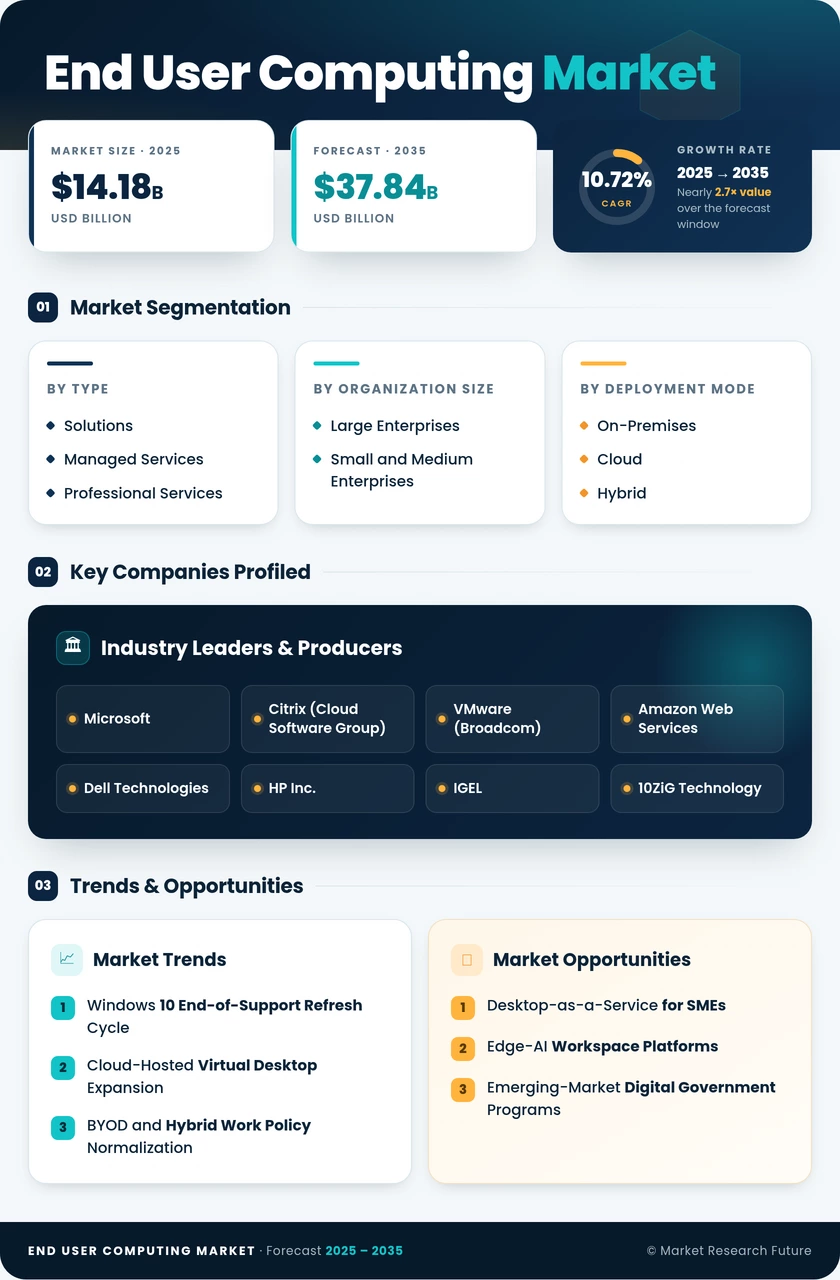
End-user Computing Market

ID: MRFR/ICT/24919-HCR
100 Pages
Ankit Gupta
Last Updated: June 24, 2026
End-User Computing Market Size, Share and Research Report By Product Type (Solutions, Managed Services, Professional Services), By Organization Size (Large Enterprises, Small and Medium Enterprises), By Deployment Mode (On-Premises, Cloud, Hybrid), By End-User Industry (IT and Telecom, Banking, Financial Services, and Insurance (BFSI), Healthcare, Government, Manufacturing, Others), By Delivery Model (Virtual Desktop Infrastructure, Desktop-as-a-Service, Remote Browser Isolation, Application Virtualization) and By Regional (North America, Europe, South America, Asia Pacific, Middle East and Africa) - Industry Forecast to 2035
Download PDF ×

We do not share your information with anyone. However, we may send you emails based on your report interest from time to time. You may contact us at any time to opt-out.

  1. 1 Market Overview |
    1. 1.1 Study Assumptions & Market Definition |
    2. 1.2 Scope of the Study |
    3. 1.3 Research Methodology
  2. 2 Market Summary & Key Takeaways
  3. 3 Market Dynamics |
    1. 3.1 Market Drivers Analysis | |
      1. 3.1.1 Windows 10 End-of-Support Hardware Refresh Cycle | |
      2. 3.1.2 Cloud-Hosted Virtual Desktop Expansion | |
      3. 3.1.3 BYOD and Hybrid Work Policy Normalization | |
      4. 3.1.4 AI-Capable Endpoint Proliferation | |
      5. 3.1.5 Unified Endpoint Management Investment | |
      6. 3.1.6 Edge-Computing & 5G-VDI Convergence | |
      7. 3.1.7 Regulatory Compliance & Zero-Trust Mandates |
    2. 3.2 Market Restraints Analysis | |
      1. 3.2.1 Data Sovereignty & Regulatory Fragmentation | |
      2. 3.2.2 Legacy Application Compatibility Barriers | |
      3. 3.2.3 Endpoint Security Fatigue & Alert Overload | |
      4. 3.2.4 High Initial Cost of Zero-Client Migration | |
      5. 3.2.5 Bandwidth Limitations in Rural and Emerging Regions |
    3. 3.3 Market Opportunity Analysis | |
      1. 3.3.1 Desktop-as-a-Service for SMEs | |
      2. 3.3.2 Edge-AI Workspace Platforms | |
      3. 3.3.3 Emerging-Market Digital Government Programs | |
      4. 3.3.4 Workspace-as-a-Platform Data Monetization | |
      5. 3.3.5 Zero-Trust Architecture Integration |
    4. 3.4 Industry Value Chain Analysis |
    5. 3.5 Porter's Five Forces Analysis
  4. 4 Global End User Computing Market Size & Forecast (2021–2035) |
    1. 4.1 Historical Market Size (2021–2025) |
    2. 4.2 Current & Forecast Market Size (2026–2035) |
    3. 4.3 Market Size by Revenue (USD Billion) |
    4. 4.4 Year-over-Year Growth Analysis
  5. 5 Segmentation Analysis |
    1. 5.1 By Product Type | |
      1. 5.1.1 Solutions | |
      2. 5.1.2 Managed Services | |
      3. 5.1.3 Professional Services |
    2. 5.2 By Organization Size | |
      1. 5.2.1 Large Enterprises | |
      2. 5.2.2 Small and Medium Enterprises |
    3. 5.3 By Deployment Mode | |
      1. 5.3.1 On-Premises | |
      2. 5.3.2 Cloud | |
      3. 5.3.3 Hybrid |
    4. 5.4 By End-User Industry | |
      1. 5.4.1 IT and Telecom | |
      2. 5.4.2 Banking, Financial Services, and Insurance (BFSI) | |
      3. 5.4.3 Healthcare | |
      4. 5.4.4 Government | |
      5. 5.4.5 Manufacturing | |
      6. 5.4.6 Others |
    5. 5.5 By Delivery Model | |
      1. 5.5.1 Virtual Desktop Infrastructure | |
      2. 5.5.2 Desktop-as-a-Service | |
      3. 5.5.3 Remote Browser Isolation | |
      4. 5.5.4 Application Virtualization
  6. 6 Regional Analysis |
    1. 6.1 North America | |
      1. 6.1.1 United States | |
      2. 6.1.2 Canada | |
      3. 6.1.3 Mexico |
    2. 6.2 Europe | |
      1. 6.2.1 Germany | |
      2. 6.2.2 United Kingdom | |
      3. 6.2.3 France | |
      4. 6.2.4 Italy | |
      5. 6.2.5 Spain | |
      6. 6.2.6 Nordic Countries | |
      7. 6.2.7 Russia | |
      8. 6.2.8 Rest of Europe |
    3. 6.3 Asia-Pacific | |
      1. 6.3.1 China | |
      2. 6.3.2 India | |
      3. 6.3.3 Japan | |
      4. 6.3.4 South Korea | |
      5. 6.3.5 ASEAN | |
      6. 6.3.6 Rest of Asia-Pacific |
    4. 6.4 South America | |
      1. 6.4.1 Brazil | |
      2. 6.4.2 Argentina | |
      3. 6.4.3 Rest of South America |
    5. 6.5 Middle East & Africa | |
      1. 6.5.1 Saudi Arabia | |
      2. 6.5.2 UAE | |
      3. 6.5.3 South Africa | |
      4. 6.5.4 Egypt | |
      5. 6.5.5 Rest of MEA
  7. 7 Competitive Landscape |
    1. 7.1 Market Share Analysis (2025) |
    2. 7.2 Competitive Benchmarking Matrix |
    3. 7.3 Company Profiles | |
      1. 7.3.1 Microsoft | |
      2. 7.3.2 Citrix (Cloud Software Group) | |
      3. 7.3.3 VMware (Broadcom) | |
      4. 7.3.4 Amazon Web Services | |
      5. 7.3.5 Dell Technologies | |
      6. 7.3.6 HP Inc. | |
      7. 7.3.7 IGEL | |
      8. 7.3.8 10ZiG Technology | |
      9. 7.3.9 Nutanix | |
      10. 7.3.10 Parallels (Alludo)
  8. 8 Future Outlook & Strategic Recommendations (2026–2035) |
    1. 8.1 AI-Native Workspace Architectures (2026–2028) |
    2. 8.2 Platform Consolidation and Vendor Lock-In Dynamics (2028–2031) |
    3. 8.3 Sustainability and Endpoint Lifecycle Management (2029–2032) |
    4. 8.4 Immersive Workspaces and Spatial Computing (2032–2035)
  9. 9 Recent Developments & News
  10. 10 Frequently Asked Questions (FAQs)
  11. 11 Report Scope & Methodology |
    1. 11.1 Study Period & Base Year |
    2. 11.2 Data Sources & Citations |
    3. 11.3 Abbreviations
  12. 12 LIST OF TABLES |
  13. TABLE 1 Global End User Computing Market Size & Forecast, by Revenue (USD Billion), 2021–2035 |
  14. TABLE 2 Global End User Computing Market — Year-over-Year Growth Analysis, 2021–2035 |
  15. TABLE 3 Market Driver Impact Analysis, 2026–2035 |
  16. TABLE 4 Market Restraint Impact Analysis, 2026–2035 |
  17. TABLE 5 Global End User Computing Market Size, by Product Type, 2021–2035 (USD Billion) |
  18. TABLE 6 Global End User Computing Market Size, by Organization Size, 2021–2035 (USD Billion) |
  19. TABLE 7 Global End User Computing Market Size, by Deployment Mode, 2021–2035 (USD Billion) |
  20. TABLE 8 Global End User Computing Market Size, by End-User Industry, 2021–2035 (USD Billion) |
  21. TABLE 9 Global End User Computing Market Size, by Delivery Model, 2021–2035 (USD Billion) |
  22. TABLE 10 Global End User Computing Market Size, by Region, 2021–2035 (USD Billion) |
  23. TABLE 11 Regional Summary — End User Computing Market Share, Value & CAGR, 2025 |
  24. TABLE 12 North America End User Computing Market Size, by Country, 2021–2035 (USD Billion) |
  25. TABLE 13 Europe End User Computing Market Size, by Country, 2021–2035 (USD Billion) |
  26. TABLE 14 Asia-Pacific End User Computing Market Size, by Country, 2021–2035 (USD Billion) |
  27. TABLE 15 South America End User Computing Market Size, by Country, 2021–2035 (USD Billion) |
  28. TABLE 16 Middle East & Africa End User Computing Market Size, by Country, 2021–2035 (USD Billion) |
  29. TABLE 17 Competitive Benchmarking Matrix — End User Computing Market, 2025 |
  30. TABLE 18 Company Profiles — Key Players, End User Computing Market |
  31. TABLE 19 Recent Developments & Strategic Announcements, 2023–2025 |
  32. TABLE 20 Report Scope & Methodology Summary |
  33. TABLE 21 Detailed Sources and Citations
  34. 13 LIST OF FIGURES |
  35. FIGURE 1 End User Computing Market Dynamics — Drivers, Restraints & Opportunities |
  36. FIGURE 2 Industry Value Chain Analysis — End User Computing Market |
  37. FIGURE 3 Porter's Five Forces Analysis — End User Computing Market |
  38. FIGURE 4 Global End User Computing Market Size Trend (USD Billion), 2021–2035 |
  39. FIGURE 5 End User Computing Market Share, by Product Type, 2025 (%) |
  40. FIGURE 6 End User Computing Market Share, by Organization Size, 2025 (%) |
  41. FIGURE 7 End User Computing Market Share, by Deployment Mode, 2025 (%) |
  42. FIGURE 8 End User Computing Market Share, by End-User Industry, 2025 (%) |
  43. FIGURE 9 End User Computing Market Share, by Delivery Model, 2025 (%) |
  44. FIGURE 10 End User Computing Market Share, by Region, 2025 (%) |
  45. FIGURE 11 North America End User Computing Market Size, by Country, 2025 (USD Billion) |
  46. FIGURE 12 Europe End User Computing Market Size, by Country, 2025 (USD Billion) |
  47. FIGURE 13 Asia-Pacific End User Computing Market Size, by Country, 2025 (USD Billion) |
  48. FIGURE 14 South America End User Computing Market Size, by Country, 2025 (USD Billion) |
  49. FIGURE 15 Middle East & Africa End User Computing Market Size, by Country, 2025 (USD Billion) |
  50. FIGURE 16 Competitive Landscape — Market Share of Top 10 Players, 2025 (%)

Segmentation Quick Reference

DimensionSub-SegmentsDominant SegmentFastest Growing Segment
Product TypeSolutions, Managed Services, Professional ServicesSolutionsManaged Services
Organization SizeLarge Enterprises, Small and Medium EnterprisesLarge EnterprisesSmall and Medium Enterprises
Deployment ModeOn-Premises, Cloud, HybridOn-PremisesCloud
End-User IndustryIT and Telecom, BFSI, Healthcare, Government, Manufacturing, OthersIT and TelecomHealthcare
Delivery ModelVirtual Desktop Infrastructure, Desktop-as-a-Service, Remote Browser Isolation, Application VirtualizationVirtual Desktop InfrastructureDesktop-as-a-Service


Market Segmentation Overview

By Product Type

Sub-SegmentKey Trend
SolutionsIntegrated suites combining VDI, security, and application delivery dominate enterprise procurement
Managed ServicesOutsourced Desktop-as-a-Service operations accelerating among SMEs seeking OpEx-model pricing
Professional ServicesMigration consulting demand peaking during the Windows 10 end-of-support transition cycle


Solutions remain the largest product type as enterprises consolidate virtual desktop infrastructure, endpoint security, and unified endpoint management for EUC into single-vendor platforms. Managed Services are growing fastest as providers absorb operational complexity for cost-sensitive buyers.

By Organization Size

Sub-SegmentKey Trend
Large EnterprisesMulti-site zero-trust endpoint deployments with hybrid VDI-DaaS architectures
Small and Medium EnterprisesConsumption-based DaaS subscriptions replacing traditional PC refresh cycles


Large enterprises drive the majority of absolute spending due to complex, globally distributed workforces. SMEs are the growth engine, attracted by Desktop-as-a-Service models that eliminate upfront infrastructure investment.

By Deployment Mode

Sub-SegmentKey Trend
On-PremisesStill preferred by regulated industries requiring full data sovereignty control
CloudFastest-growing mode driven by hyperscaler VDI/DaaS investment
HybridDominant transitional architecture for enterprises migrating from legacy on-premises setups


Cloud deployments are overtaking on-premises in growth terms as secure remote desktop for distributed teams becomes the default work architecture. Hybrid remains the pragmatic middle ground for organizations with multi-year migration plans.

By End-User Industry

Sub-SegmentKey Trend
IT and TelecomLargest vertical; massive VDI farms supporting remote developer and BPO workforces
BFSIRegulatory compliance driving secure desktop deployments for trading and contact centers
HealthcareFastest-growing; telehealth expansion and HIPAA-compliant zero-client thin client computing solutions
GovernmentZero-trust mandates accelerating endpoint modernization across federal and state agencies
ManufacturingConnected-worker programs deploying thin clients on factory floors


IT and Telecom anchors the end user computing market with the largest installed base of virtual desktops globally. Healthcare is emerging as the fastest-growing vertical as clinical endpoint security requirements intensify.

By Delivery Model

Sub-SegmentKey Trend
Virtual Desktop InfrastructureDominant model for full desktop experience with centralized IT control
Desktop-as-a-ServiceFastest-growing; cloud-native pay-per-user model favored by SMEs and hybrid workforces
Remote Browser IsolationGrowing niche for web-centric workloads requiring minimal attack surface
Application VirtualizationLegacy app delivery without full desktop overhead; steady adoption in regulated industries


Virtual desktop infrastructure remains the foundational delivery model, while Desktop-as-a-Service is rapidly closing the share gap as hyperscaler capacity expands and pricing becomes increasingly competitive.