Request Free Sample ×

Kindly complete the form below to receive a free sample of this Report

* Please use a valid business email

Leading companies partner with us for data-driven Insights

clients tt-cursor
Hero Background
English
Chinese
French
Japanese
Korean
German
Spanish

Emergency Ambulance Vehicle Market Analysis

ID: MRFR/AT/6665-CR
100 Pages
Shubham Munde
October 2022

Emergency Ambulance Vehicle Market Research Report Information By Vehicle Type (Vans, Cards, Motorcycles, Other), By Application (Hospitals, Emergency Centers, Others), And By Region (North America, Europe, Asia-Pacific, And Rest Of The World)-Market Forecast Till 2035

Share:
Download PDF ×

We do not share your information with anyone. However, we may send you emails based on your report interest from time to time. You may contact us at any time to opt-out.

Emergency Ambulance Vehicle Market Infographic
Purchase Options

Market Analysis

In-depth Analysis of Emergency Ambulance Vehicle Market Industry Landscape

The market dynamics of the emergency ambulance vehicle market are influenced by various factors that shape its growth, trends, and competition. One significant factor driving this market is the increasing demand for emergency medical services worldwide. As populations grow and age, the need for rapid and efficient medical response to emergencies becomes paramount. This demand is further fueled by urbanization, which leads to higher incidents of accidents and medical emergencies in densely populated areas. Additionally, advancements in healthcare infrastructure and the rising awareness about the importance of timely medical assistance contribute to the market's expansion.

Technological advancements play a crucial role in shaping the market dynamics of emergency ambulance vehicles. Manufacturers are constantly innovating to equip ambulances with state-of-the-art medical equipment and communication systems, enhancing their capabilities for delivering swift and effective care. Integration of GPS tracking, telemedicine services, and real-time data transmission capabilities are becoming standard features, enabling better coordination between emergency responders and healthcare facilities. Moreover, the development of electric and hybrid ambulance vehicles addresses concerns about environmental sustainability and operating costs, further driving market growth.

Government regulations and policies significantly impact the emergency ambulance vehicle market. Regulatory standards regarding vehicle safety, medical equipment, and emergency response protocols influence manufacturers' product development strategies. Compliance with these regulations is essential for gaining market access and maintaining the trust of healthcare providers and patients. Government initiatives aimed at improving emergency medical services, such as funding for ambulance fleets, training programs for emergency personnel, and incentives for adopting advanced technologies, also shape market dynamics by stimulating demand and fostering innovation.

Market competition among emergency ambulance vehicle manufacturers is intensifying as companies vie for market share and differentiation. Established players invest in research and development to enhance their product offerings and maintain a competitive edge. Meanwhile, new entrants and startups disrupt the market with innovative designs and business models, challenging traditional industry norms. Partnerships and collaborations between manufacturers, healthcare organizations, and technology firms are becoming common, driving market consolidation and fostering synergies to deliver comprehensive emergency medical solutions.

Consumer preferences and healthcare trends influence the market dynamics of emergency ambulance vehicles. Patients and healthcare providers increasingly prioritize comfort, safety, and accessibility when choosing ambulance services. This has led to the customization of ambulance interiors to accommodate various medical conditions and improve patient experience during transport. Furthermore, the growing emphasis on community-based healthcare and preventive medicine is reshaping the role of ambulances from mere transport vehicles to mobile healthcare units capable of delivering primary care and preventive services in underserved areas.

Global economic conditions and healthcare expenditure patterns also impact the emergency ambulance vehicle market. Economic downturns can constrain public spending on healthcare infrastructure and emergency services, affecting demand for ambulance vehicles. Conversely, economic growth and increased healthcare investments drive market expansion, especially in emerging markets where healthcare infrastructure is still developing. Moreover, healthcare reimbursement policies and insurance coverage influence purchasing decisions by healthcare providers and ambulance operators, shaping market demand and pricing strategies.

In conclusion, the market dynamics of the emergency ambulance vehicle market are driven by a combination of factors including demand for emergency medical services, technological advancements, government regulations, market competition, consumer preferences, and economic conditions. Understanding these dynamics is essential for stakeholders in the emergency medical services industry to navigate challenges, capitalize on opportunities, and contribute to improving emergency healthcare delivery worldwide.


Author
Author Profile
Shubham Munde
Team Lead - Research

Shubham brings over 7 years of expertise in Market Intelligence and Strategic Consulting, with a strong focus on the Automotive, Aerospace, and Defense sectors. Backed by a solid foundation in semiconductors, electronics, and software, he has successfully delivered high-impact syndicated and custom research on a global scale. His core strengths include market sizing, forecasting, competitive intelligence, consumer insights, and supply chain mapping. Widely recognized for developing scalable growth strategies, Shubham empowers clients to navigate complex markets and achieve a lasting competitive edge. Trusted by start-ups and Fortune 500 companies alike, he consistently converts challenges into strategic opportunities that drive sustainable growth.

Leave a Comment

FAQs

What is the current valuation of the Emergency Ambulance Vehicle Market?

<p>As of 2024, the Emergency Ambulance Vehicle Market was valued at 15.96 USD Billion.</p>

What is the projected market valuation for 2035?

<p>The market is projected to reach a valuation of 22.96 USD Billion by 2035.</p>

What is the expected CAGR for the Emergency Ambulance Vehicle Market from 2025 to 2035?

<p>The expected CAGR during the forecast period from 2025 to 2035 is 3.36%.</p>

Which segments are included in the Emergency Ambulance Vehicle Market?

<p>The market segments include Vans, Cards, Motorcycles, and Others.</p>

What were the valuations for the Vans segment in 2024?

<p>In 2024, the Vans segment was valued between 5.0 and 7.0 USD Billion.</p>

How does the Hospitals application segment perform in terms of valuation?

<p>The Hospitals application segment had a valuation ranging from 6.38 to 9.12 USD Billion in 2024.</p>

Who are the key players in the Emergency Ambulance Vehicle Market?

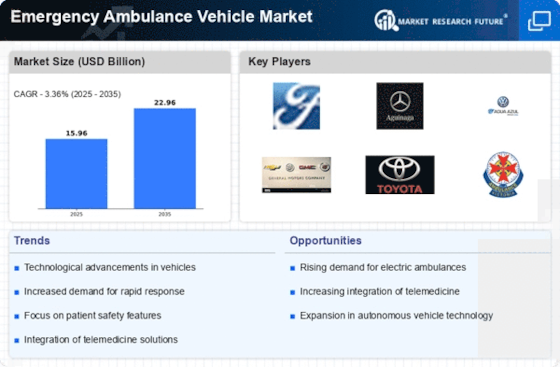
Key players include Ford Motor Company, Mercedes-Benz AG, Volkswagen AG, General Motors Company, and Toyota Motor Corporation.

What is the valuation range for the Others segment in the Type category?

The Others segment in the Type category was valued between 4.96 and 7.46 USD Billion in 2024.

What is the projected growth trend for Emergency centers application segment?

The Emergency centers application segment is projected to grow from 4.78 to 6.56 USD Billion by 2035.

How do the market dynamics appear for the Emergency Ambulance Vehicle Market?

The market dynamics suggest a steady growth trajectory, driven by increasing demand for emergency services and advancements in vehicle technology.

Market Summary

As per Market Research Future analysis, the Emergency Ambulance Vehicle Market Size was estimated at 15.96 USD Billion in 2024. The Emergency Ambulance Vehicle industry is projected to grow from USD 16.5 Billion in 2025 to USD 22.96 Billion by 2035, exhibiting a compound annual growth rate (CAGR) of 3.36% during the forecast period 2025 - 2035

Key Market Trends & Highlights

The Emergency Ambulance Vehicle Market is experiencing a dynamic shift towards technological integration and sustainability.

  • Technological integration is reshaping ambulance design, enhancing operational efficiency and patient care. Sustainability initiatives are gaining traction, with manufacturers focusing on eco-friendly materials and energy-efficient vehicles. Customization and specialization are becoming prevalent, particularly in the largest segment of vans catering to hospitals. The increasing demand for emergency services and rising awareness of health and safety are driving market growth, especially in the Asia-Pacific region.

Market Size & Forecast

2024 Market Size 15.96 (USD Billion)
2035 Market Size 22.96 (USD Billion)
CAGR (2025 - 2035) 3.36%
Largest Regional Market Share in 2024 North America

Major Players

Ford Motor Company (US), Mercedes-Benz AG (DE), Volkswagen AG (DE), General Motors Company (US), Toyota Motor Corporation (JP), <a href="https://www.ambulance.vic.gov.au/">Ambulance Victoria</a> (AU), Bristol Uniforms Limited (GB), Wheeled Coach Industries (US)

Market Trends

The Emergency Ambulance Vehicle Market is currently experiencing a transformative phase, driven by advancements in technology and an increasing emphasis on patient care. The integration of telemedicine and real-time data analytics into ambulance services appears to enhance the efficiency of emergency response systems. Furthermore, the growing awareness of the importance of rapid medical intervention suggests a rising demand for specialized vehicles equipped with advanced medical equipment. This trend is likely to influence manufacturers to innovate and adapt their offerings to meet the evolving needs of healthcare providers. In addition, the market seems to be shifting towards environmentally friendly solutions, with electric and hybrid ambulance vehicles gaining traction. This shift may be attributed to regulatory pressures and a societal push for sustainability. As urban areas expand and populations grow, the need for efficient and eco-conscious emergency services becomes increasingly apparent. Overall, the Emergency Ambulance Vehicle Market is poised for growth, with technological advancements and sustainability initiatives shaping its future landscape.

Technological Integration

The incorporation of advanced technologies into emergency ambulance vehicles is becoming more prevalent. Features such as telemedicine capabilities, GPS tracking, and real-time data sharing are enhancing the efficiency of emergency medical services. This trend indicates a shift towards more connected and responsive healthcare solutions.

Sustainability Initiatives

There is a noticeable movement towards environmentally sustainable ambulance solutions. The adoption of electric and hybrid vehicles is gaining momentum, driven by regulatory requirements and public demand for greener alternatives. This trend reflects a broader commitment to reducing the carbon footprint of emergency services.

Customization and Specialization

The Emergency Ambulance Vehicle Market is witnessing a trend towards customization to meet specific healthcare needs. Manufacturers are increasingly offering specialized vehicles tailored for various medical emergencies, which may improve patient outcomes and operational efficiency.

Emergency Ambulance Vehicle Market Market Drivers

Government Regulations and Funding

Government regulations and funding initiatives are crucial drivers of the Emergency Ambulance Vehicle Market. Many countries are implementing stringent regulations to ensure that emergency medical services meet specific standards of care and response times. This regulatory framework often leads to increased funding for ambulance services, enabling the acquisition of modern vehicles equipped with advanced medical technology. For example, recent policy changes in several regions have allocated substantial budgets for upgrading emergency fleets, which is expected to enhance service delivery. As a result, the Emergency Ambulance Vehicle Market is likely to experience growth as public and private sectors collaborate to meet these regulatory demands.

Rising Awareness of Health and Safety

The growing awareness of health and safety among the public is significantly influencing the Emergency Ambulance Vehicle Market. As communities become more informed about the importance of immediate medical assistance, there is an increasing expectation for accessible and efficient emergency services. Public campaigns and educational programs are fostering a culture of preparedness, which in turn drives demand for well-equipped ambulances. This heightened awareness is reflected in the increasing number of emergency service subscriptions and memberships, which are projected to rise by 20% in the coming years. Consequently, the Emergency Ambulance Vehicle Market is poised for expansion as service providers strive to meet the evolving expectations of the populace.

Increasing Demand for Emergency Services

The rising demand for emergency medical services is a primary driver of the Emergency Ambulance Vehicle Market. As urban populations expand and the prevalence of chronic diseases increases, the need for timely medical intervention becomes critical. According to recent statistics, emergency calls have surged by approximately 15% over the past few years, necessitating a corresponding increase in ambulance availability. This trend indicates a growing recognition of the importance of rapid response in saving lives, thereby propelling the market for emergency ambulances. Furthermore, government initiatives aimed at enhancing healthcare infrastructure are likely to bolster investments in emergency services, further stimulating the Emergency Ambulance Vehicle Market.

Technological Advancements in Ambulance Design

Technological advancements play a pivotal role in shaping the Emergency Ambulance Vehicle Market. Innovations such as telemedicine integration, advanced navigation systems, and real-time data transmission are enhancing the efficiency and effectiveness of emergency medical services. For instance, the incorporation of GPS technology allows for optimized routing, significantly reducing response times. Additionally, the development of electric and hybrid ambulances is gaining traction, aligning with sustainability goals while providing cost-effective solutions. The market is projected to witness a compound annual growth rate of around 8%, driven by these technological enhancements that improve patient care and operational efficiency in the Emergency Ambulance Vehicle Market.

Aging Population and Increased Healthcare Needs

The aging population is a significant demographic trend that is driving the Emergency Ambulance Vehicle Market. As the global population ages, the incidence of age-related health issues, such as cardiovascular diseases and mobility impairments, is on the rise. This demographic shift necessitates a robust emergency medical response system to address the unique healthcare needs of older adults. Projections indicate that by 2030, the number of individuals aged 65 and older will increase by 30%, further intensifying the demand for emergency services. Consequently, the Emergency Ambulance Vehicle Market is likely to expand as healthcare providers adapt to the increasing need for timely and effective emergency medical interventions.

Market Segment Insights

By Type: Vans (Largest) vs. Motorcycles (Fastest-Growing)

<p>In the Emergency Ambulance Vehicle Market, the type segment showcases a distinct distribution among various vehicle categories. Vans dominate the market due to their spacious interiors, allowing for the transport of larger medical equipment and personnel. Motorcycles, while smaller, are gaining traction for their agility and ability to navigate congested urban environments swiftly. The versatility of vans makes them the preferred choice among emergency services, ensuring they hold the largest market share in this segment.</p>

<p>Vans (Dominant) vs. Motorcycles (Emerging)</p>

<p>Vans remain the dominant segment within the Emergency Ambulance Vehicle Market due to their robust design and capacity to accommodate advanced medical equipment, making them indispensable for emergency medical services. Their ability to carry multiple patients and medical staff during emergencies positions them as the standard vehicle for most ambulance services. Conversely, motorcycles represent an emerging segment, particularly gaining attention for their rapid response capabilities in densely populated areas. Their nimble design allows for impressive maneuverability, making them ideal for first responders who require quick access to patients in critical situations. As urban environments become increasingly congested, motorcycles may play a vital role in enhancing emergency medical response times.</p>

By Application: Hospitals (Largest) vs. Emergency Centers (Fastest-Growing)

<p>In the Emergency Ambulance Vehicle Market, the application segment comprises Hospitals, Emergency Centers, and Others. Hospitals account for the largest market share due to their consistent demand for advanced emergency care vehicles equipped with modern medical technology. This robust infrastructure supports a higher volume of emergency calls, leading hospitals to invest significantly in ambulance services, ensuring quick and efficient patient transportation. On the other hand, Emergency Centers represent the fastest-growing segment. These facilities are increasingly experiencing a rise in patient traffic, driven by urbanization and a growing awareness of immediate healthcare services, making them essential in the emergency medical response ecosystem.</p>

<p>Hospitals (Dominant) vs. Emergency Centers (Emerging)</p>

<p>Hospitals have established themselves as the dominant force in the Emergency Ambulance Vehicle Market, primarily because of their extensive network and ability to provide comprehensive care. They require a fleet of ambulances that cater to various medical emergencies, ensuring patient safety and timely intervention. In contrast, Emergency Centers are emerging as a critical entity as they favor specialized resources and technology to handle acute medical situations effectively. Their growth is fueled by the increasing focus on outpatient care, enhancing accessibility to urgent medical assistance. Together, these segments play vital roles in the landscape of emergency medical services, adapting to the evolving healthcare demands and patient expectations.</p>

Get more detailed insights about Emergency Ambulance Vehicle Market Research Report—Global Forecast till 2035

Regional Insights

North America : Healthcare Innovation Leader

North America is the largest market for emergency ambulance vehicles, holding approximately 45% of the global market share. The region's growth is driven by increasing healthcare expenditures, advancements in emergency medical services, and stringent regulations mandating timely patient transport. The demand for advanced ambulance technologies, including telemedicine and real-time tracking, is also on the rise, further propelling market growth. The United States and Canada are the leading countries in this region, with the U.S. accounting for the majority of the market share. Key players such as Ford Motor Company, General Motors, and Mercedes-Benz AG dominate the competitive landscape, offering a range of specialized vehicles. The presence of established healthcare infrastructure and a focus on improving emergency response times contribute to the region's robust market dynamics.

Europe : Regulatory-Driven Market Growth

Europe is the second-largest market for emergency ambulance vehicles, accounting for approximately 30% of the global market share. The growth in this region is fueled by increasing investments in healthcare infrastructure, a rising aging population, and stringent EU regulations aimed at improving emergency medical services. Countries like Germany and the UK are leading the charge, with a focus on enhancing response times and vehicle capabilities. Germany, the UK, and France are the primary markets within Europe, showcasing a competitive landscape with key players such as Mercedes-Benz AG and Volkswagen AG. The region is witnessing a shift towards electric and hybrid ambulance vehicles, driven by sustainability initiatives. As regulations evolve, manufacturers are adapting to meet new standards, ensuring that the market remains dynamic and responsive to healthcare needs.

Asia-Pacific : Emerging Market Potential

Asia-Pacific is witnessing rapid growth in the emergency ambulance vehicle market, holding approximately 20% of the global market share. The region's expansion is driven by increasing urbanization, rising healthcare awareness, and government initiatives aimed at enhancing emergency response systems. Countries like China and India are at the forefront, with significant investments in healthcare infrastructure and emergency services. China and India are the leading markets in this region, characterized by a growing number of private ambulance services and public-private partnerships. The competitive landscape includes both local manufacturers and international players like Toyota. As the demand for advanced ambulance technologies rises, the market is expected to evolve, focusing on improved vehicle designs and enhanced medical equipment integration.

Middle East and Africa : Growing Healthcare Investments

The Middle East and Africa region is gradually emerging in the emergency ambulance vehicle market, holding about 5% of the global market share. The growth is primarily driven by increasing healthcare investments, rising population, and a growing emphasis on emergency medical services. Countries like the UAE and South Africa are leading the market, with government initiatives aimed at improving healthcare access and emergency response capabilities. In the UAE, significant investments in healthcare infrastructure are paving the way for advanced ambulance services. South Africa is also witnessing growth, with a focus on enhancing emergency response times. The competitive landscape includes both local and international players, with a growing interest in adopting advanced technologies to improve service delivery and patient care.

Key Players and Competitive Insights

The Emergency Ambulance Vehicle Market is currently characterized by a dynamic competitive landscape, driven by technological advancements, regulatory changes, and an increasing emphasis on patient care. Key players such as Ford Motor Company (US), Mercedes-Benz AG (DE), and General Motors Company (US) are strategically positioning themselves through innovation and partnerships. Ford Motor Company (US) has focused on enhancing its electric vehicle (EV) offerings, which aligns with the growing demand for sustainable solutions in emergency services. Meanwhile, Mercedes-Benz AG (DE) emphasizes luxury and advanced technology in its ambulance designs, catering to high-end markets. General Motors Company (US) is leveraging its extensive supply chain to optimize production efficiency, thereby enhancing its competitive edge in the market.The business tactics employed by these companies reflect a moderately fragmented market structure, where local manufacturing and supply chain optimization play crucial roles. Companies are increasingly localizing production to reduce costs and improve responsiveness to regional demands. This strategy not only enhances operational efficiency but also allows for better compliance with local regulations, which is vital in the emergency services sector. The collective influence of these key players shapes a competitive environment that is both challenging and ripe for innovation.
In August Ford Motor Company (US) announced a partnership with a leading telemedicine provider to integrate advanced communication technologies into its ambulance vehicles. This strategic move aims to enhance real-time patient monitoring and improve emergency response times, reflecting a broader trend towards digital transformation in healthcare. Such initiatives are likely to set new standards in the industry, emphasizing the importance of technology in emergency medical services.
In September Mercedes-Benz AG (DE) unveiled a new line of electric ambulances designed to reduce carbon emissions while maintaining high performance. This launch not only underscores the company's commitment to sustainability but also positions it as a leader in the transition towards greener emergency vehicles. The integration of electric powertrains in ambulances could potentially revolutionize the market, appealing to environmentally conscious consumers and municipalities.
In July General Motors Company (US) expanded its production capabilities by investing in a new facility dedicated to manufacturing specialized emergency vehicles. This investment is indicative of the company's long-term strategy to dominate the emergency vehicle segment by ensuring a steady supply of high-quality products. Such expansions are crucial in meeting the increasing demand for advanced ambulance solutions, particularly in urban areas where rapid response is essential.
As of October the Emergency Ambulance Vehicle Market is witnessing trends that emphasize digitalization, sustainability, and the integration of artificial intelligence. Strategic alliances among key players are becoming increasingly common, fostering innovation and enhancing service delivery. The competitive differentiation is likely to evolve from traditional price-based competition to a focus on technological advancements, reliability in supply chains, and the ability to meet regulatory standards. This shift suggests that companies that prioritize innovation and sustainability will be better positioned to thrive in the future.

Key Companies in the Emergency Ambulance Vehicle Market include

Industry Developments

May 2024 : Medical emergencies necessitate prompt attention and a prompt response as of May 2024. Moreover, ambulances perform their most critical function during such critical instances. The app of insurance startup ACKO now includes the capability to order an ambulance. By introducing this attribute, the organization is in line with its overarching goal of providing comprehensive protection solutions, which involves expanding its service offerings beyond insurance. The feature, which was introduced in collaboration with Red.Health, a prominent provider of emergency response services nationwide, will furnish vital aid to individuals in the event of medical emergencies.

The application will facilitate the retrieval of the closest ambulance from a comprehensive network of 3000 vehicles and will provide the driver's information in under three minutes. The application also features real-time monitoring, which gives users peace of mind. 

On August 18th, 2023, Zenzo, a healthcare provider, inaugurated its inaugural and distinctive 5G ambulance service in Mumbai. The ambulance serves patients via ultrafast 5G technology. Critical patients aboard the 5G ambulance service will receive treatment and diagnoses in a manner that is significantly altered. Equipped with state-of-the-art technology and sophisticated communication functionalities, Zenzo's advanced 5G ambulance promises to enhance the velocity and precision of emergency medical interventions. Consequently, this will result in improved patient outcomes and heightened efficiency in the provision of critical care services. It is a revolutionary development that utilizes state-of-the-art 5G-enabled devices.

It facilitates the collection and exchange of health data in real-time, enables sophisticated patient monitoring, and expedites treatment responses. It provides comprehensive, life-saving emergency care using significant life-saving equipment such as ventilators, defibrillators, multipara patient monitors, ECG machines, and syringe pumps.

Future Outlook

Emergency Ambulance Vehicle Market Future Outlook

The Emergency Ambulance Vehicle Market is projected to grow at a 3.36% CAGR from 2025 to 2035, driven by technological advancements, increasing healthcare demands, and urbanization.

New opportunities lie in:

  • <p>Integration of telemedicine capabilities in ambulances Development of electric and hybrid ambulance models Expansion of ambulance fleet management software solutions</p>

By 2035, the market is expected to be robust, reflecting advancements and increased demand.

Market Segmentation

Emergency Ambulance Vehicle Market Type Outlook

  • Vans
  • Cards
  • Motorcycles
  • Others

Emergency Ambulance Vehicle Market Application Outlook

  • Hospitals
  • Emergency centers
  • Others

Report Scope

MARKET SIZE 2024 15.96(USD Billion)
MARKET SIZE 2025 16.5(USD Billion)
MARKET SIZE 2035 22.96(USD Billion)
COMPOUND ANNUAL GROWTH RATE (CAGR) 3.36% (2025 - 2035)
REPORT COVERAGE Revenue Forecast, Competitive Landscape, Growth Factors, and Trends
BASE YEAR 2024
Market Forecast Period 2025 - 2035
Historical Data 2019 - 2024
Market Forecast Units USD Billion
Key Companies Profiled Ford Motor Company (US), Mercedes-Benz AG (DE), Volkswagen AG (DE), General Motors Company (US), Toyota Motor Corporation (JP), Ambulance Victoria (AU), Bristol Uniforms Limited (GB), Wheeled Coach Industries (US)
Segments Covered Vehicle Type, Application, Region
Key Market Opportunities Integration of advanced telemedicine technology in Emergency Ambulance Vehicles enhances patient care and operational efficiency.
Key Market Dynamics Technological advancements in emergency medical services drive demand for innovative ambulance vehicle designs and enhanced patient care.
Countries Covered North America, Europe, APAC, South America, MEA

FAQs

What is the current valuation of the Emergency Ambulance Vehicle Market?

<p>As of 2024, the Emergency Ambulance Vehicle Market was valued at 15.96 USD Billion.</p>

What is the projected market valuation for 2035?

<p>The market is projected to reach a valuation of 22.96 USD Billion by 2035.</p>

What is the expected CAGR for the Emergency Ambulance Vehicle Market from 2025 to 2035?

<p>The expected CAGR during the forecast period from 2025 to 2035 is 3.36%.</p>

Which segments are included in the Emergency Ambulance Vehicle Market?

<p>The market segments include Vans, Cards, Motorcycles, and Others.</p>

What were the valuations for the Vans segment in 2024?

<p>In 2024, the Vans segment was valued between 5.0 and 7.0 USD Billion.</p>

How does the Hospitals application segment perform in terms of valuation?

<p>The Hospitals application segment had a valuation ranging from 6.38 to 9.12 USD Billion in 2024.</p>

Who are the key players in the Emergency Ambulance Vehicle Market?

Key players include Ford Motor Company, Mercedes-Benz AG, Volkswagen AG, General Motors Company, and Toyota Motor Corporation.

What is the valuation range for the Others segment in the Type category?

The Others segment in the Type category was valued between 4.96 and 7.46 USD Billion in 2024.

What is the projected growth trend for Emergency centers application segment?

The Emergency centers application segment is projected to grow from 4.78 to 6.56 USD Billion by 2035.

How do the market dynamics appear for the Emergency Ambulance Vehicle Market?

The market dynamics suggest a steady growth trajectory, driven by increasing demand for emergency services and advancements in vehicle technology.

  1. SECTION I: EXECUTIVE SUMMARY AND KEY HIGHLIGHTS
    1. | 1.1 EXECUTIVE SUMMARY
    2. | | 1.1.1 Market Overview
    3. | | 1.1.2 Key Findings
    4. | | 1.1.3 Market Segmentation
    5. | | 1.1.4 Competitive Landscape
    6. | | 1.1.5 Challenges and Opportunities
    7. | | 1.1.6 Future Outlook
  2. SECTION II: SCOPING, METHODOLOGY AND MARKET STRUCTURE
    1. | 2.1 MARKET INTRODUCTION
    2. | | 2.1.1 Definition
    3. | | 2.1.2 Scope of the study
    4. | | | 2.1.2.1 Research Objective
    5. | | | 2.1.2.2 Assumption
    6. | | | 2.1.2.3 Limitations
    7. | 2.2 RESEARCH METHODOLOGY
    8. | | 2.2.1 Overview
    9. | | 2.2.2 Data Mining
    10. | | 2.2.3 Secondary Research
    11. | | 2.2.4 Primary Research
    12. | | | 2.2.4.1 Primary Interviews and Information Gathering Process
    13. | | | 2.2.4.2 Breakdown of Primary Respondents
    14. | | 2.2.5 Forecasting Model
    15. | | 2.2.6 Market Size Estimation
    16. | | | 2.2.6.1 Bottom-Up Approach
    17. | | | 2.2.6.2 Top-Down Approach
    18. | | 2.2.7 Data Triangulation
    19. | | 2.2.8 Validation
  3. SECTION III: QUALITATIVE ANALYSIS
    1. | 3.1 MARKET DYNAMICS
    2. | | 3.1.1 Overview
    3. | | 3.1.2 Drivers
    4. | | 3.1.3 Restraints
    5. | | 3.1.4 Opportunities
    6. | 3.2 MARKET FACTOR ANALYSIS
    7. | | 3.2.1 Value chain Analysis
    8. | | 3.2.2 Porter's Five Forces Analysis
    9. | | | 3.2.2.1 Bargaining Power of Suppliers
    10. | | | 3.2.2.2 Bargaining Power of Buyers
    11. | | | 3.2.2.3 Threat of New Entrants
    12. | | | 3.2.2.4 Threat of Substitutes
    13. | | | 3.2.2.5 Intensity of Rivalry
    14. | | 3.2.3 COVID-19 Impact Analysis
    15. | | | 3.2.3.1 Market Impact Analysis
    16. | | | 3.2.3.2 Regional Impact
    17. | | | 3.2.3.3 Opportunity and Threat Analysis
  4. SECTION IV: QUANTITATIVE ANALYSIS
    1. | 4.1 Automobile, BY Type (USD Billion)
    2. | | 4.1.1 Vans
    3. | | 4.1.2 Cards
    4. | | 4.1.3 Motorcycles
    5. | | 4.1.4 Others
    6. | 4.2 Automobile, BY Application (USD Billion)
    7. | | 4.2.1 Hospitals
    8. | | 4.2.2 Emergency centers
    9. | | 4.2.3 Others
    10. | 4.3 Automobile, BY Region (USD Billion)
    11. | | 4.3.1 North America
    12. | | | 4.3.1.1 US
    13. | | | 4.3.1.2 Canada
    14. | | 4.3.2 Europe
    15. | | | 4.3.2.1 Germany
    16. | | | 4.3.2.2 UK
    17. | | | 4.3.2.3 France
    18. | | | 4.3.2.4 Russia
    19. | | | 4.3.2.5 Italy
    20. | | | 4.3.2.6 Spain
    21. | | | 4.3.2.7 Rest of Europe
    22. | | 4.3.3 APAC
    23. | | | 4.3.3.1 China
    24. | | | 4.3.3.2 India
    25. | | | 4.3.3.3 Japan
    26. | | | 4.3.3.4 South Korea
    27. | | | 4.3.3.5 Malaysia
    28. | | | 4.3.3.6 Thailand
    29. | | | 4.3.3.7 Indonesia
    30. | | | 4.3.3.8 Rest of APAC
    31. | | 4.3.4 South America
    32. | | | 4.3.4.1 Brazil
    33. | | | 4.3.4.2 Mexico
    34. | | | 4.3.4.3 Argentina
    35. | | | 4.3.4.4 Rest of South America
    36. | | 4.3.5 MEA
    37. | | | 4.3.5.1 GCC Countries
    38. | | | 4.3.5.2 South Africa
    39. | | | 4.3.5.3 Rest of MEA
  5. SECTION V: COMPETITIVE ANALYSIS
    1. | 5.1 Competitive Landscape
    2. | | 5.1.1 Overview
    3. | | 5.1.2 Competitive Analysis
    4. | | 5.1.3 Market share Analysis
    5. | | 5.1.4 Major Growth Strategy in the Automobile
    6. | | 5.1.5 Competitive Benchmarking
    7. | | 5.1.6 Leading Players in Terms of Number of Developments in the Automobile
    8. | | 5.1.7 Key developments and growth strategies
    9. | | | 5.1.7.1 New Product Launch/Service Deployment
    10. | | | 5.1.7.2 Merger & Acquisitions
    11. | | | 5.1.7.3 Joint Ventures
    12. | | 5.1.8 Major Players Financial Matrix
    13. | | | 5.1.8.1 Sales and Operating Income
    14. | | | 5.1.8.2 Major Players R&D Expenditure. 2023
    15. | 5.2 Company Profiles
    16. | | 5.2.1 Ford Motor Company (US)
    17. | | | 5.2.1.1 Financial Overview
    18. | | | 5.2.1.2 Products Offered
    19. | | | 5.2.1.3 Key Developments
    20. | | | 5.2.1.4 SWOT Analysis
    21. | | | 5.2.1.5 Key Strategies
    22. | | 5.2.2 Mercedes-Benz AG (DE)
    23. | | | 5.2.2.1 Financial Overview
    24. | | | 5.2.2.2 Products Offered
    25. | | | 5.2.2.3 Key Developments
    26. | | | 5.2.2.4 SWOT Analysis
    27. | | | 5.2.2.5 Key Strategies
    28. | | 5.2.3 Volkswagen AG (DE)
    29. | | | 5.2.3.1 Financial Overview
    30. | | | 5.2.3.2 Products Offered
    31. | | | 5.2.3.3 Key Developments
    32. | | | 5.2.3.4 SWOT Analysis
    33. | | | 5.2.3.5 Key Strategies
    34. | | 5.2.4 General Motors Company (US)
    35. | | | 5.2.4.1 Financial Overview
    36. | | | 5.2.4.2 Products Offered
    37. | | | 5.2.4.3 Key Developments
    38. | | | 5.2.4.4 SWOT Analysis
    39. | | | 5.2.4.5 Key Strategies
    40. | | 5.2.5 Toyota Motor Corporation (JP)
    41. | | | 5.2.5.1 Financial Overview
    42. | | | 5.2.5.2 Products Offered
    43. | | | 5.2.5.3 Key Developments
    44. | | | 5.2.5.4 SWOT Analysis
    45. | | | 5.2.5.5 Key Strategies
    46. | | 5.2.6 Ambulance Victoria (AU)
    47. | | | 5.2.6.1 Financial Overview
    48. | | | 5.2.6.2 Products Offered
    49. | | | 5.2.6.3 Key Developments
    50. | | | 5.2.6.4 SWOT Analysis
    51. | | | 5.2.6.5 Key Strategies
    52. | | 5.2.7 Bristol Uniforms Limited (GB)
    53. | | | 5.2.7.1 Financial Overview
    54. | | | 5.2.7.2 Products Offered
    55. | | | 5.2.7.3 Key Developments
    56. | | | 5.2.7.4 SWOT Analysis
    57. | | | 5.2.7.5 Key Strategies
    58. | | 5.2.8 Wheeled Coach Industries (US)
    59. | | | 5.2.8.1 Financial Overview
    60. | | | 5.2.8.2 Products Offered
    61. | | | 5.2.8.3 Key Developments
    62. | | | 5.2.8.4 SWOT Analysis
    63. | | | 5.2.8.5 Key Strategies
    64. | 5.3 Appendix
    65. | | 5.3.1 References
    66. | | 5.3.2 Related Reports
  6. LIST OF FIGURES
    1. | 6.1 MARKET SYNOPSIS
    2. | 6.2 NORTH AMERICA MARKET ANALYSIS
    3. | 6.3 US MARKET ANALYSIS BY TYPE
    4. | 6.4 US MARKET ANALYSIS BY APPLICATION
    5. | 6.5 CANADA MARKET ANALYSIS BY TYPE
    6. | 6.6 CANADA MARKET ANALYSIS BY APPLICATION
    7. | 6.7 EUROPE MARKET ANALYSIS
    8. | 6.8 GERMANY MARKET ANALYSIS BY TYPE
    9. | 6.9 GERMANY MARKET ANALYSIS BY APPLICATION
    10. | 6.10 UK MARKET ANALYSIS BY TYPE
    11. | 6.11 UK MARKET ANALYSIS BY APPLICATION
    12. | 6.12 FRANCE MARKET ANALYSIS BY TYPE
    13. | 6.13 FRANCE MARKET ANALYSIS BY APPLICATION
    14. | 6.14 RUSSIA MARKET ANALYSIS BY TYPE
    15. | 6.15 RUSSIA MARKET ANALYSIS BY APPLICATION
    16. | 6.16 ITALY MARKET ANALYSIS BY TYPE
    17. | 6.17 ITALY MARKET ANALYSIS BY APPLICATION
    18. | 6.18 SPAIN MARKET ANALYSIS BY TYPE
    19. | 6.19 SPAIN MARKET ANALYSIS BY APPLICATION
    20. | 6.20 REST OF EUROPE MARKET ANALYSIS BY TYPE
    21. | 6.21 REST OF EUROPE MARKET ANALYSIS BY APPLICATION
    22. | 6.22 APAC MARKET ANALYSIS
    23. | 6.23 CHINA MARKET ANALYSIS BY TYPE
    24. | 6.24 CHINA MARKET ANALYSIS BY APPLICATION
    25. | 6.25 INDIA MARKET ANALYSIS BY TYPE
    26. | 6.26 INDIA MARKET ANALYSIS BY APPLICATION
    27. | 6.27 JAPAN MARKET ANALYSIS BY TYPE
    28. | 6.28 JAPAN MARKET ANALYSIS BY APPLICATION
    29. | 6.29 SOUTH KOREA MARKET ANALYSIS BY TYPE
    30. | 6.30 SOUTH KOREA MARKET ANALYSIS BY APPLICATION
    31. | 6.31 MALAYSIA MARKET ANALYSIS BY TYPE
    32. | 6.32 MALAYSIA MARKET ANALYSIS BY APPLICATION
    33. | 6.33 THAILAND MARKET ANALYSIS BY TYPE
    34. | 6.34 THAILAND MARKET ANALYSIS BY APPLICATION
    35. | 6.35 INDONESIA MARKET ANALYSIS BY TYPE
    36. | 6.36 INDONESIA MARKET ANALYSIS BY APPLICATION
    37. | 6.37 REST OF APAC MARKET ANALYSIS BY TYPE
    38. | 6.38 REST OF APAC MARKET ANALYSIS BY APPLICATION
    39. | 6.39 SOUTH AMERICA MARKET ANALYSIS
    40. | 6.40 BRAZIL MARKET ANALYSIS BY TYPE
    41. | 6.41 BRAZIL MARKET ANALYSIS BY APPLICATION
    42. | 6.42 MEXICO MARKET ANALYSIS BY TYPE
    43. | 6.43 MEXICO MARKET ANALYSIS BY APPLICATION
    44. | 6.44 ARGENTINA MARKET ANALYSIS BY TYPE
    45. | 6.45 ARGENTINA MARKET ANALYSIS BY APPLICATION
    46. | 6.46 REST OF SOUTH AMERICA MARKET ANALYSIS BY TYPE
    47. | 6.47 REST OF SOUTH AMERICA MARKET ANALYSIS BY APPLICATION
    48. | 6.48 MEA MARKET ANALYSIS
    49. | 6.49 GCC COUNTRIES MARKET ANALYSIS BY TYPE
    50. | 6.50 GCC COUNTRIES MARKET ANALYSIS BY APPLICATION
    51. | 6.51 SOUTH AFRICA MARKET ANALYSIS BY TYPE
    52. | 6.52 SOUTH AFRICA MARKET ANALYSIS BY APPLICATION
    53. | 6.53 REST OF MEA MARKET ANALYSIS BY TYPE
    54. | 6.54 REST OF MEA MARKET ANALYSIS BY APPLICATION
    55. | 6.55 KEY BUYING CRITERIA OF AUTOMOBILE
    56. | 6.56 RESEARCH PROCESS OF MRFR
    57. | 6.57 DRO ANALYSIS OF AUTOMOBILE
    58. | 6.58 DRIVERS IMPACT ANALYSIS: AUTOMOBILE
    59. | 6.59 RESTRAINTS IMPACT ANALYSIS: AUTOMOBILE
    60. | 6.60 SUPPLY / VALUE CHAIN: AUTOMOBILE
    61. | 6.61 AUTOMOBILE, BY TYPE, 2024 (% SHARE)
    62. | 6.62 AUTOMOBILE, BY TYPE, 2024 TO 2035 (USD Billion)
    63. | 6.63 AUTOMOBILE, BY APPLICATION, 2024 (% SHARE)
    64. | 6.64 AUTOMOBILE, BY APPLICATION, 2024 TO 2035 (USD Billion)
    65. | 6.65 BENCHMARKING OF MAJOR COMPETITORS
  7. LIST OF TABLES
    1. | 7.1 LIST OF ASSUMPTIONS
    2. | | 7.1.1
    3. | 7.2 North America MARKET SIZE ESTIMATES; FORECAST
    4. | | 7.2.1 BY TYPE, 2025-2035 (USD Billion)
    5. | | 7.2.2 BY APPLICATION, 2025-2035 (USD Billion)
    6. | 7.3 US MARKET SIZE ESTIMATES; FORECAST
    7. | | 7.3.1 BY TYPE, 2025-2035 (USD Billion)
    8. | | 7.3.2 BY APPLICATION, 2025-2035 (USD Billion)
    9. | 7.4 Canada MARKET SIZE ESTIMATES; FORECAST
    10. | | 7.4.1 BY TYPE, 2025-2035 (USD Billion)
    11. | | 7.4.2 BY APPLICATION, 2025-2035 (USD Billion)
    12. | 7.5 Europe MARKET SIZE ESTIMATES; FORECAST
    13. | | 7.5.1 BY TYPE, 2025-2035 (USD Billion)
    14. | | 7.5.2 BY APPLICATION, 2025-2035 (USD Billion)
    15. | 7.6 Germany MARKET SIZE ESTIMATES; FORECAST
    16. | | 7.6.1 BY TYPE, 2025-2035 (USD Billion)
    17. | | 7.6.2 BY APPLICATION, 2025-2035 (USD Billion)
    18. | 7.7 UK MARKET SIZE ESTIMATES; FORECAST
    19. | | 7.7.1 BY TYPE, 2025-2035 (USD Billion)
    20. | | 7.7.2 BY APPLICATION, 2025-2035 (USD Billion)
    21. | 7.8 France MARKET SIZE ESTIMATES; FORECAST
    22. | | 7.8.1 BY TYPE, 2025-2035 (USD Billion)
    23. | | 7.8.2 BY APPLICATION, 2025-2035 (USD Billion)
    24. | 7.9 Russia MARKET SIZE ESTIMATES; FORECAST
    25. | | 7.9.1 BY TYPE, 2025-2035 (USD Billion)
    26. | | 7.9.2 BY APPLICATION, 2025-2035 (USD Billion)
    27. | 7.10 Italy MARKET SIZE ESTIMATES; FORECAST
    28. | | 7.10.1 BY TYPE, 2025-2035 (USD Billion)
    29. | | 7.10.2 BY APPLICATION, 2025-2035 (USD Billion)
    30. | 7.11 Spain MARKET SIZE ESTIMATES; FORECAST
    31. | | 7.11.1 BY TYPE, 2025-2035 (USD Billion)
    32. | | 7.11.2 BY APPLICATION, 2025-2035 (USD Billion)
    33. | 7.12 Rest of Europe MARKET SIZE ESTIMATES; FORECAST
    34. | | 7.12.1 BY TYPE, 2025-2035 (USD Billion)
    35. | | 7.12.2 BY APPLICATION, 2025-2035 (USD Billion)
    36. | 7.13 APAC MARKET SIZE ESTIMATES; FORECAST
    37. | | 7.13.1 BY TYPE, 2025-2035 (USD Billion)
    38. | | 7.13.2 BY APPLICATION, 2025-2035 (USD Billion)
    39. | 7.14 China MARKET SIZE ESTIMATES; FORECAST
    40. | | 7.14.1 BY TYPE, 2025-2035 (USD Billion)
    41. | | 7.14.2 BY APPLICATION, 2025-2035 (USD Billion)
    42. | 7.15 India MARKET SIZE ESTIMATES; FORECAST
    43. | | 7.15.1 BY TYPE, 2025-2035 (USD Billion)
    44. | | 7.15.2 BY APPLICATION, 2025-2035 (USD Billion)
    45. | 7.16 Japan MARKET SIZE ESTIMATES; FORECAST
    46. | | 7.16.1 BY TYPE, 2025-2035 (USD Billion)
    47. | | 7.16.2 BY APPLICATION, 2025-2035 (USD Billion)
    48. | 7.17 South Korea MARKET SIZE ESTIMATES; FORECAST
    49. | | 7.17.1 BY TYPE, 2025-2035 (USD Billion)
    50. | | 7.17.2 BY APPLICATION, 2025-2035 (USD Billion)
    51. | 7.18 Malaysia MARKET SIZE ESTIMATES; FORECAST
    52. | | 7.18.1 BY TYPE, 2025-2035 (USD Billion)
    53. | | 7.18.2 BY APPLICATION, 2025-2035 (USD Billion)
    54. | 7.19 Thailand MARKET SIZE ESTIMATES; FORECAST
    55. | | 7.19.1 BY TYPE, 2025-2035 (USD Billion)
    56. | | 7.19.2 BY APPLICATION, 2025-2035 (USD Billion)
    57. | 7.20 Indonesia MARKET SIZE ESTIMATES; FORECAST
    58. | | 7.20.1 BY TYPE, 2025-2035 (USD Billion)
    59. | | 7.20.2 BY APPLICATION, 2025-2035 (USD Billion)
    60. | 7.21 Rest of APAC MARKET SIZE ESTIMATES; FORECAST
    61. | | 7.21.1 BY TYPE, 2025-2035 (USD Billion)
    62. | | 7.21.2 BY APPLICATION, 2025-2035 (USD Billion)
    63. | 7.22 South America MARKET SIZE ESTIMATES; FORECAST
    64. | | 7.22.1 BY TYPE, 2025-2035 (USD Billion)
    65. | | 7.22.2 BY APPLICATION, 2025-2035 (USD Billion)
    66. | 7.23 Brazil MARKET SIZE ESTIMATES; FORECAST
    67. | | 7.23.1 BY TYPE, 2025-2035 (USD Billion)
    68. | | 7.23.2 BY APPLICATION, 2025-2035 (USD Billion)
    69. | 7.24 Mexico MARKET SIZE ESTIMATES; FORECAST
    70. | | 7.24.1 BY TYPE, 2025-2035 (USD Billion)
    71. | | 7.24.2 BY APPLICATION, 2025-2035 (USD Billion)
    72. | 7.25 Argentina MARKET SIZE ESTIMATES; FORECAST
    73. | | 7.25.1 BY TYPE, 2025-2035 (USD Billion)
    74. | | 7.25.2 BY APPLICATION, 2025-2035 (USD Billion)
    75. | 7.26 Rest of South America MARKET SIZE ESTIMATES; FORECAST
    76. | | 7.26.1 BY TYPE, 2025-2035 (USD Billion)
    77. | | 7.26.2 BY APPLICATION, 2025-2035 (USD Billion)
    78. | 7.27 MEA MARKET SIZE ESTIMATES; FORECAST
    79. | | 7.27.1 BY TYPE, 2025-2035 (USD Billion)
    80. | | 7.27.2 BY APPLICATION, 2025-2035 (USD Billion)
    81. | 7.28 GCC Countries MARKET SIZE ESTIMATES; FORECAST
    82. | | 7.28.1 BY TYPE, 2025-2035 (USD Billion)
    83. | | 7.28.2 BY APPLICATION, 2025-2035 (USD Billion)
    84. | 7.29 South Africa MARKET SIZE ESTIMATES; FORECAST
    85. | | 7.29.1 BY TYPE, 2025-2035 (USD Billion)
    86. | | 7.29.2 BY APPLICATION, 2025-2035 (USD Billion)
    87. | 7.30 Rest of MEA MARKET SIZE ESTIMATES; FORECAST
    88. | | 7.30.1 BY TYPE, 2025-2035 (USD Billion)
    89. | | 7.30.2 BY APPLICATION, 2025-2035 (USD Billion)
    90. | 7.31 PRODUCT LAUNCH/PRODUCT DEVELOPMENT/APPROVAL
    91. | | 7.31.1
    92. | 7.32 ACQUISITION/PARTNERSHIP
    93. | | 7.32.1

Automobile Market Segmentation

Automobile By Type (USD Billion, 2025-2035)

  • Vans
  • Cards
  • Motorcycles
  • Others

Automobile By Application (USD Billion, 2025-2035)

  • Hospitals
  • Emergency centers
  • Others
Infographic

Free Sample Request

Kindly complete the form below to receive a free sample of this Report

Get Free Sample

Customer Strories

Compare Licence

×
Features License Type
Single User Multiuser License Enterprise User
Price $4,950 $5,950 $7,250
Maximum User Access Limit 1 User Upto 10 Users Unrestricted Access Throughout the Organization
Free Customization
Direct Access to Analyst
Deliverable Format
Platform Access
Discount on Next Purchase 10% 15% 15%
Printable Versions