Request Free Sample ×

Kindly complete the form below to receive a free sample of this Report

* Please use a valid business email

Leading companies partner with us for data-driven Insights

clients tt-cursor
Hero Background
English
Chinese
French
Japanese
Korean
German
Spanish

Electric Vehicle Capacitors Market Analysis

ID: MRFR/SEM/12365-HCR
128 Pages
Ankit Gupta
April 2026

Electric Vehicle Capacitors Market Size, Share and Research Report By Type (Aluminum Electrolytic Capacitors, Film Capacitor, and Others), By Application (Passenger Car and Commercial Vehicle), And By Region (North America, Europe, Asia-Pacific, And Rest Of The World) –Industry Forecast Till 2035

Share:
Download PDF ×

We do not share your information with anyone. However, we may send you emails based on your report interest from time to time. You may contact us at any time to opt-out.

Electric Vehicle Capacitors Market Infographic
Purchase Options

Market Analysis

In-depth Analysis of Electric Vehicle Capacitors Market Industry Landscape

The global electric vehicle capacitor market is set to reach US$ 3098.367 MN by 2032, at a 9.20% CAGR between years 2023-2032. Emerging Movements, such as automobile electric onset into a revolution through electrification shift is shaping the dynamics of EV capacitors market. As components that are invaluable to the electric vehicle, capacitors find themselves at a critical point as they influence both storage and distribution of energy affecting the efficiency and performance directly with respect to an EV. The significant factor driving this market is high growing of demand for sustainable transportation solutions that are being integrated around the globe and have made it compelling for the automakers to incorporate advanced capacitor technologies into their electric vehicle designs. Advanced technology is a market- affecting factor in the EV capacitors market. The development of electric vehicles brings a continuous development to keep improving the energy storage capabilities and look for raising more power density as well as to increase in overall system efficiency.

The evolution of the innovative technologies as lithium-ion capacitors and supercapacitors ensures that energy is stored in a short period of time and released almost instantly which increases accelerating, station swaying processes, or energy workouts with consequent improvement of overall power managing systems. It is not only the market of influences, but also the size of electric kind of motor car itself is growing. The stringent emission standards are being followed by the governments across the world, techniques that are provided to encourage people to adopt electric vehicles seems to be a highly conducive environment for EV capacitor market. As the market penetration by electric vehicles continues to rise, there is a commensurate increase in demand for capacitors because manufacturers have both the incentive and flexibility of improving integrated manufacturing with increased scale. Qualities, power plan Dynamics and advantages incorporating any semblance of key advertisers, arrangement efforts, problems areas and requirement are the fundamental segments in EV capacitor market showcase.

Frequently manufacturers enter relationships with suppliers in order to obtain sources of supply which will be both lasting and economical by ensuring they have the materials or components sufficient for use capacitors production capacity. Second, EV manufacturers’ partnerships with capacitor suppliers work to thrive in seamless integration of these components into electric vehicles. The strategic approach that is presented to activities supply chain ensures consistent production of high-quality capacitors for use in electric vehicles when the market is growing. The aspects of cost dynamics are seen to constitute a vital role in the formation of an appropriate trends market. As stated above, improving the performance of EV capacitors is achieved through the technological advancements as well as keeping in mind savings. A cost-cutting measure that is geared towards the reduction of pain point costs in EV capacitors includes economies of scale and continuing R&D research. This mitigation of costs is essential to the adoption of electric vehicles at large scale as they give them a more competitive edge in comparison with other automotive forms.


Author
Author Profile
Ankit Gupta
Team Lead - Research

Ankit Gupta is a seasoned market intelligence and strategic research professional with over six plus years of experience in the ICT and Semiconductor industries. With academic roots in Telecom, Marketing, and Electronics, he blends technical insight with business strategy. Ankit has led 200+ projects, including work for Fortune 500 clients like Microsoft and Rio Tinto, covering market sizing, tech forecasting, and go-to-market strategies. Known for bridging engineering and enterprise decision-making, his insights support growth, innovation, and investment planning across diverse technology markets.

Leave a Comment

FAQs

What is the current valuation of the Electric Vehicle Capacitors Market?

<p>As of 2024, the market valuation was 1673.4 USD Million.</p>

What is the projected market size for the Electric Vehicle Capacitors Market by 2035?

<p>The market is expected to reach a valuation of 4406.93 USD Million by 2035.</p>

What is the expected CAGR for the Electric Vehicle Capacitors Market during the forecast period?

<p>The market is anticipated to grow at a CAGR of 9.2% from 2025 to 2035.</p>

Which types of capacitors dominate the Electric Vehicle Capacitors Market?

<p>The market segments include Aluminum Electrolytic Capacitors, Film Capacitors, and Others, with Film Capacitors projected to grow from 600.0 to 1800.0 USD Million.</p>

What applications are driving the demand for Electric Vehicle Capacitors?

<p>Passenger Cars and Commercial Vehicles are key applications, with Passenger Cars expected to grow from 1000.0 to 2700.0 USD Million.</p>

Who are the leading players in the Electric Vehicle Capacitors Market?

<p>Key players include Tesla Inc, Panasonic Corporation, LG Chem Ltd, and Samsung SDI Co Ltd.</p>

What is the market performance of Aluminum Electrolytic Capacitors?

Aluminum Electrolytic Capacitors are projected to grow from 500.0 to 1300.0 USD Million.

How does the Electric Vehicle Capacitors Market compare between passenger and commercial vehicles?

In 2024, the market for Passenger Cars was valued at 1000.0 USD Million, while Commercial Vehicles were valued at 673.4 USD Million.

What trends are influencing the growth of the Electric Vehicle Capacitors Market?

The increasing demand for electric vehicles and advancements in capacitor technology are likely influencing market growth.

What is the significance of the Electric Vehicle Capacitors Market in the automotive industry?

The market plays a crucial role in enhancing the efficiency and performance of electric vehicles, contributing to overall automotive innovation.

Market Summary

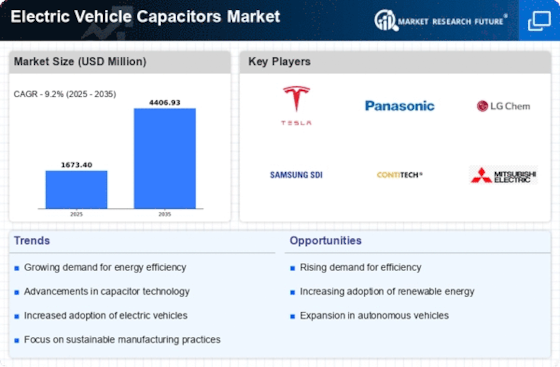
As per Market Research Future analysis, the Electric Vehicle Capacitors Market was estimated at 1673.4 USD Million in 2024. The Electric Vehicle Capacitors industry is projected to grow from 1827.38 USD Million in 2025 to 4406.93 USD Million by 2035, exhibiting a compound annual growth rate (CAGR) of 9.2% during the forecast period 2025 - 2035

Key Market Trends & Highlights

The Electric Vehicle Capacitors Market is poised for substantial growth driven by technological advancements and increasing demand for electric vehicles.

  • Technological advancements in capacitor design are enhancing performance and efficiency in electric vehicles. Sustainability and eco-friendly solutions are becoming pivotal in capacitor manufacturing, particularly in North America. Integration with advanced energy management systems is gaining traction, especially in the Asia-Pacific region. The rising demand for electric vehicles and government incentives are key drivers propelling market expansion.

Market Size & Forecast

2024 Market Size 1673.4 (USD Million)
2035 Market Size 4406.93 (USD Million)
CAGR (2025 - 2035) 9.2%
Largest Regional Market Share in 2024 North America

Major Players

Tesla Inc (US), Panasonic Corporation (JP), LG Chem Ltd (KR), Samsung SDI Co Ltd (KR), ContiTech AG (DE), Mitsubishi Electric Corporation (JP), Nippon Chemi-Con Corporation (JP), KEMET Corporation (US), AVX Corporation (US)

Market Trends

The Electric Vehicle Capacitors Market is currently experiencing a transformative phase, driven by the increasing demand for electric vehicles and the need for efficient energy storage solutions. As manufacturers strive to enhance vehicle performance and extend driving range, capacitors are becoming integral components in electric vehicle systems. These components are essential for managing power delivery, improving energy efficiency, and supporting regenerative braking systems. The market appears to be evolving rapidly, with innovations in capacitor technology, such as the development of supercapacitors and advanced materials, which may offer improved energy density and faster charging capabilities. Moreover, the growing emphasis on sustainability and environmental concerns is likely to propel the Electric Vehicle Capacitors Market further. As governments worldwide implement stricter regulations on emissions and promote the adoption of electric vehicles, the demand for high-performance capacitors is expected to rise. This trend suggests a shift towards more eco-friendly solutions, with manufacturers focusing on developing capacitors that not only meet performance standards but also align with sustainability goals. The interplay of technological advancements and regulatory frameworks indicates a dynamic landscape for the Electric Vehicle Capacitors Market, where innovation and environmental responsibility are paramount.

Technological Advancements in Capacitor Design

Recent innovations in capacitor technology are reshaping the Electric Vehicle Capacitors Market. Manufacturers are exploring new materials and designs that enhance energy density and efficiency. This trend indicates a potential for capacitors to play a more significant role in energy management systems within electric vehicles.

Sustainability and Eco-Friendly Solutions

The increasing focus on sustainability is influencing the Electric Vehicle Capacitors Market. As environmental regulations tighten, there is a growing demand for capacitors that not only perform well but also minimize ecological impact. This shift suggests that manufacturers are prioritizing eco-friendly materials and production processes.

Integration with Advanced Energy Management Systems

The integration of capacitors with sophisticated energy management systems is becoming more prevalent in the Electric Vehicle Capacitors Market. This trend highlights the importance of capacitors in optimizing energy flow and enhancing overall vehicle performance, indicating a move towards more intelligent electric vehicle designs.

Electric Vehicle Capacitors Market Market Drivers

Growing Focus on Energy Efficiency

The increasing emphasis on energy efficiency in the automotive sector is a significant driver for the Electric Vehicle Capacitors Market. As manufacturers strive to produce vehicles that consume less energy and have longer ranges, the role of capacitors becomes more pronounced. Capacitors are essential for energy management systems that optimize power usage and enhance vehicle performance. The push for energy-efficient solutions aligns with consumer expectations for sustainable transportation options. Consequently, this focus on energy efficiency is likely to propel the demand for advanced capacitor technologies, thereby fostering growth within the Electric Vehicle Capacitors Market.

Rising Demand for Electric Vehicles

The increasing consumer preference for electric vehicles (EVs) is a primary driver for the Electric Vehicle Capacitors Market. As more individuals and businesses transition to EVs, the demand for efficient energy storage solutions rises. Capacitors play a crucial role in enhancing the performance and longevity of electric vehicles by providing quick bursts of energy and stabilizing voltage levels. According to recent data, the EV market is projected to grow at a compound annual growth rate of over 20% in the coming years. This surge in demand for electric vehicles directly correlates with the need for advanced capacitor technologies, thereby propelling the Electric Vehicle Capacitors Market forward.

Expansion of Charging Infrastructure

The expansion of electric vehicle charging infrastructure is a crucial factor influencing the Electric Vehicle Capacitors Market. As more charging stations are established, the need for reliable and efficient energy storage solutions becomes increasingly important. Capacitors are integral to the operation of charging stations, as they help manage power fluctuations and ensure stable energy delivery. The growth of charging networks not only supports the adoption of electric vehicles but also creates a demand for advanced capacitor technologies that can enhance the efficiency of these systems. This trend suggests a promising outlook for the Electric Vehicle Capacitors Market as infrastructure development continues to accelerate.

Government Incentives and Regulations

Government policies and incentives aimed at promoting electric vehicle adoption significantly influence the Electric Vehicle Capacitors Market. Many countries have implemented stringent regulations to reduce carbon emissions, which encourages manufacturers and consumers to shift towards electric mobility. Financial incentives, such as tax credits and rebates for EV purchases, further stimulate market growth. For instance, in several regions, governments are investing in infrastructure to support electric vehicles, including charging stations that require efficient capacitor systems. This regulatory environment not only boosts the demand for electric vehicles but also enhances the need for high-performance capacitors, thereby driving the Electric Vehicle Capacitors Market.

Technological Innovations in Capacitor Technology

Technological advancements in capacitor design and materials are pivotal in shaping the Electric Vehicle Capacitors Market. Innovations such as the development of supercapacitors and hybrid capacitors are enhancing energy density and efficiency, making them more suitable for electric vehicles. These advancements allow for faster charging times and improved energy recovery systems, which are essential for the performance of electric vehicles. The market for advanced capacitor technologies is expected to expand as manufacturers seek to integrate these innovations into their EV designs. This trend indicates a robust growth trajectory for the Electric Vehicle Capacitors Market, as companies invest in research and development to meet evolving consumer demands.

Market Segment Insights

By Type: Aluminum Electrolytic Capacitors (Largest) vs. Film Capacitors (Fastest-Growing)

In the Electric Vehicle Capacitors Market, Aluminum Electrolytic Capacitors hold a significant share as the largest component, favored for their high capacitance and energy storage capabilities. Film Capacitors, while smaller in market share relative to aluminum electrolytics, are gaining traction due to their excellent performance at higher temperatures and frequencies, making them a critical choice for modern electric vehicles. In addition, the Others category includes various specialized capacitors that cater to niche applications, contributing to the overall diversity in capacitor technology for electric vehicles.

Capacitor Types: Aluminum Electrolytic (Dominant) vs. Film Capacitors (Emerging)

Aluminum Electrolytic Capacitors are recognized as the dominant technology in the Electric Vehicle Capacitors Market, prized for their ability to deliver high capacitance at low costs, making them ideal for energy storage in various electric vehicle systems. They are utilized extensively due to their robustness and adaptability. Film Capacitors, on the other hand, are emerging rapidly thanks to their superior electrical characteristics, such as low losses and high ripple current handling, which make them extraordinarily reliable for critical power applications in electric vehicles. Their compatibility with high voltage environments significantly boosts their adoption in newer electric vehicle designs.

By Application: Passenger Car (Largest) vs. Commercial Vehicle (Fastest-Growing)

In the Electric Vehicle Capacitors Market, the application segment is characterized by distinct values, predominantly dominated by the passenger car category. Passenger cars account for a significant market share, driven by their widespread adoption of electric vehicle technologies. Commercial vehicles, while currently a smaller segment, are rapidly increasing in importance as they embrace electrification trends. Hence, the market distribution displays a clear distinction wherein passenger cars lead the way, supported by factors like increasing urbanization and consumer preferences shifting towards electric mobility. Growth trends within this segment are primarily influenced by the rising demand for electric vehicles (EVs) across various geographies. The passenger car segment benefits from robust technological advancements and improved battery efficiency, ensuring widespread acceptance. In contrast, the commercial vehicle segment is emerging as the fastest-growing area, propelled by government regulations encouraging fleet electrification and the need for more sustainable logistics solutions. As both segments evolve, the synergy between regulatory frameworks and technological innovation will be crucial for driving their future growth.

Passenger Cars: Dominant vs. Commercial Vehicles: Emerging

Passenger cars represent the dominant force in the Electric Vehicle Capacitors Market, appealing to a broad spectrum of consumers thanks to their convenience, efficiency, and enhanced technology. This segment is characterized by high adoption rates, supported by leading manufacturers integrating advanced capacitors into their vehicles for improved energy efficiency and performance. On the other hand, commercial vehicles present an emerging opportunity; they are increasingly being designed with sophisticated capacitor systems that enable better energy management. The growth of <a href="https://www.marketresearchfuture.com/reports/e-commerce-payments-market-24750">e-commerce</a> and demand for greener logistics is catalyzing the adoption of electric commercial vehicles. As the industry progresses, the innovation occurring in both segments will likely lead to a more competitive landscape, benefiting from ongoing advancements in battery and capacitor technologies.

Get more detailed insights about Electric Vehicle Capacitors Market Research Report—Global Forecast till 2035

Regional Insights

North America : Leading Innovation and Adoption

North America is the largest market for electric vehicle capacitors, holding approximately 45% of the global market share. The region's growth is driven by increasing electric vehicle (EV) adoption, stringent emissions regulations, and significant investments in EV infrastructure. Government incentives and consumer demand for sustainable transportation are further propelling market expansion. The U.S. and Canada are the primary contributors to this growth, with a strong focus on innovation and technology advancements in the automotive sector. The competitive landscape in North America is robust, featuring key players such as Tesla Inc, KEMET Corporation, and AVX Corporation. These companies are at the forefront of developing advanced capacitor technologies that enhance vehicle performance and efficiency. The presence of established automotive manufacturers and a growing number of startups in the EV space are fostering a dynamic market environment, ensuring continuous innovation and competitive pricing.

Europe : Sustainable Mobility Initiatives

Europe is the second-largest market for electric vehicle capacitors, accounting for around 30% of the global market share. The region's growth is fueled by aggressive sustainability goals, government policies promoting electric mobility, and a strong automotive industry. The European Union's Green Deal and various national initiatives are driving investments in EV technology and infrastructure, creating a favorable environment for capacitor manufacturers. Countries like Germany and France are leading the charge in EV adoption and production. The competitive landscape in Europe is characterized by a mix of established automotive giants and innovative startups. Key players such as Panasonic Corporation and LG Chem Ltd are investing heavily in research and development to enhance capacitor performance. The presence of a well-developed supply chain and collaboration between automotive manufacturers and technology firms are further strengthening the market. As Europe aims for carbon neutrality, the demand for efficient electric vehicle capacitors is expected to rise significantly.

Asia-Pacific : Emerging Market Potential

Asia-Pacific is witnessing rapid growth in the electric vehicle capacitors market, holding approximately 20% of the global market share. The region's expansion is driven by increasing urbanization, rising disposable incomes, and government initiatives promoting electric vehicles. Countries like China and Japan are at the forefront, with significant investments in EV technology and infrastructure. The push for cleaner transportation solutions is further accelerating market growth, making Asia-Pacific a key player in the global landscape. The competitive environment in Asia-Pacific is vibrant, with major players such as Samsung SDI Co Ltd and Mitsubishi Electric Corporation leading the charge. The region is home to a plethora of manufacturers, ranging from established corporations to emerging startups, all vying for market share. The collaboration between automotive and technology sectors is fostering innovation, ensuring that Asia-Pacific remains a critical hub for electric vehicle capacitor development and production.

Middle East and Africa : Untapped Market Opportunities

The Middle East and Africa represent an emerging market for electric vehicle capacitors, currently holding about 5% of the global market share. The growth in this region is primarily driven by increasing government initiatives aimed at promoting electric mobility and reducing carbon emissions. Countries like South Africa and the UAE are beginning to invest in EV infrastructure, although the market is still in its nascent stages. The potential for growth is significant as awareness of electric vehicles increases among consumers and businesses alike. The competitive landscape in the Middle East and Africa is still developing, with a few key players beginning to establish a presence. Local manufacturers are exploring partnerships with international firms to enhance their technological capabilities. As the region's automotive market evolves, the demand for electric vehicle capacitors is expected to rise, driven by both governmental support and a growing consumer base interested in sustainable transportation solutions.

Key Players and Competitive Insights

Leading market players are investing heavily in new materials, advanced designs, and manufacturing processes. Innovations in capacitor technology, such as the development of high-energy-density materials and more efficient designs, can give companies a competitive edge. Market participants are also adopting a variety of strategic activities to expand their worldwide footprint, with important market developments including contractual agreements, new product launches, mergers and acquisitions, higher investments, and strategic partnerships with other market players. To expand and sustain in a more competitive and rising market climate, the Electric Vehicle Capacitors industry must offer to increase their production capacity.

Offering a range of capacitor products tailored to different applications and specifications is one of the key business tactics used by manufacturers in the global Electric Vehicle Capacitors industry to benefit clients and increase the market share. In recent years, the Electric Vehicle Capacitors industry has offered some of the most significant advantages to Consumers. Major players in the electric vehicle capacitors market, including Maxwell Technologies, Panasonic Corporation, Vishay Intertechnology, Inc., KEMET Corporation, and others, are attempting to increase market demand by investing in product development to increase their product line and cater to diverse consumer needs.

Maxwell Technologies is a leading player in the development and manufacturing of cutting-edge energy storage and power delivery solutions. Specializing in ultracapacitor products, the company excels in providing robust power solutions across a diverse range of applications. With a strategic focus on consumer and industrial electronics, renewable energy, automotive, transportation, and information technology sectors, Maxwell Technologies has established itself as a key contributor to multiple industries.

In October REC Group, a subsidiary of Reliance Industries and a leading PV module manufacturer, secured a supply agreement with Maxwell Technologies, a solar cell and module equipment maker.

Under this agreement, Maxwell Technologies will provide equipment to support REC Group's production of the REC Alpha Pure-R heterojunction (HJT) module.

Panasonic Industry Co., Ltd. is a dynamic player in the business landscape, specializing in the development, manufacturing, and sales of electrical components, electronic components, control devices, and electronic materials. Established on April 1, 2022, the company swiftly positioned itself as a key contributor to the industry. Distinguished by a commitment to addressing societal challenges, Panasonic Industry strategically focuses on sectors that demand continuous innovation. The company has successfully rolled out a comprehensive range of products, leveraging its unique materials and process technologies.

This approach has not only positioned Panasonic Industry as a leader in various markets but has also resulted in a substantial global market share.

In November Panasonic Industry Company announced the commercialization of the JX series of SP-Cap capacitors, acclaimed for their industry-leading reliability. Tailored for use in power circuits of advanced communication base stations like 5G and high-traffic servers, mass production is set to commence in December 2021.

Key Companies in the Electric Vehicle Capacitors Market include

Industry Developments

February 2022: Panasonic Corporation revealed that its Industry Company has successfully brought the KX series of SP-Cap conductive polymer aluminum electrolytic capacitors to the commercial market, boasting the industry's highest level of reliability, enduring up to 5,500 hours at 125°C. Tailored for power circuits in servers and communication base stations demanding capacitors with heightened durability for high-speed communications, this new capacitor series addresses critical needs in these applications.

October 2022: Skeleton Technologies, a global technology leader in fast charging solutions for transportation, grid, automotive, and industrial applications, has officially introduced its SuperBattery. In a significant development, the company has partnered with Shell and joined a consortium led by Shell to provide electrification solutions specifically tailored for mining sites.

Future Outlook

Electric Vehicle Capacitors Market Future Outlook

The Electric Vehicle Capacitors Market is projected to grow at a 9.2% CAGR from 2025 to 2035, driven by advancements in energy storage technologies and increasing EV adoption.

New opportunities lie in:

  • Development of high-capacity supercapacitors for rapid charging solutions.
  • Integration of capacitors in energy management systems for EVs.
  • Partnerships with automotive manufacturers for customized capacitor solutions.

By 2035, the market is expected to be robust, driven by innovation and strategic partnerships.

Market Segmentation

Electric Vehicle Capacitors Market Type Outlook

  • Aluminum Electrolytic Capacitors
  • Film Capacitor
  • Others

Electric Vehicle Capacitors Market Application Outlook

  • Passenger Car
  • Commercial Vehicle

Report Scope

MARKET SIZE 2024 1673.4(USD Million)
MARKET SIZE 2025 1827.38(USD Million)
MARKET SIZE 2035 4406.93(USD Million)
COMPOUND ANNUAL GROWTH RATE (CAGR) 9.2% (2025 - 2035)
REPORT COVERAGE Revenue Forecast, Competitive Landscape, Growth Factors, and Trends
BASE YEAR 2024
Market Forecast Period 2025 - 2035
Historical Data 2019 - 2024
Market Forecast Units USD Million
Key Companies Profiled Tesla Inc (US), Panasonic Corporation (JP), LG Chem Ltd (KR), Samsung SDI Co Ltd (KR), ContiTech AG (DE), Mitsubishi Electric Corporation (JP), Nippon Chemi-Con Corporation (JP), KEMET Corporation (US), AVX Corporation (US)
Segments Covered Type, Application, Region
Key Market Opportunities Advancements in energy density and efficiency drive growth in the Electric Vehicle Capacitors Market.
Key Market Dynamics Rising demand for high-performance capacitors driven by advancements in electric vehicle technology and energy efficiency standards.
Countries Covered North America, Europe, APAC, South America, MEA

FAQs

What is the current valuation of the Electric Vehicle Capacitors Market?

<p>As of 2024, the market valuation was 1673.4 USD Million.</p>

What is the projected market size for the Electric Vehicle Capacitors Market by 2035?

<p>The market is expected to reach a valuation of 4406.93 USD Million by 2035.</p>

What is the expected CAGR for the Electric Vehicle Capacitors Market during the forecast period?

<p>The market is anticipated to grow at a CAGR of 9.2% from 2025 to 2035.</p>

Which types of capacitors dominate the Electric Vehicle Capacitors Market?

<p>The market segments include Aluminum Electrolytic Capacitors, Film Capacitors, and Others, with Film Capacitors projected to grow from 600.0 to 1800.0 USD Million.</p>

What applications are driving the demand for Electric Vehicle Capacitors?

<p>Passenger Cars and Commercial Vehicles are key applications, with Passenger Cars expected to grow from 1000.0 to 2700.0 USD Million.</p>

Who are the leading players in the Electric Vehicle Capacitors Market?

<p>Key players include Tesla Inc, Panasonic Corporation, LG Chem Ltd, and Samsung SDI Co Ltd.</p>

What is the market performance of Aluminum Electrolytic Capacitors?

Aluminum Electrolytic Capacitors are projected to grow from 500.0 to 1300.0 USD Million.

How does the Electric Vehicle Capacitors Market compare between passenger and commercial vehicles?

In 2024, the market for Passenger Cars was valued at 1000.0 USD Million, while Commercial Vehicles were valued at 673.4 USD Million.

What trends are influencing the growth of the Electric Vehicle Capacitors Market?

The increasing demand for electric vehicles and advancements in capacitor technology are likely influencing market growth.

What is the significance of the Electric Vehicle Capacitors Market in the automotive industry?

The market plays a crucial role in enhancing the efficiency and performance of electric vehicles, contributing to overall automotive innovation.

  1. SECTION I: EXECUTIVE SUMMARY AND KEY HIGHLIGHTS
    1. | 1.1 EXECUTIVE SUMMARY
    2. | | 1.1.1 Market Overview
    3. | | 1.1.2 Key Findings
    4. | | 1.1.3 Market Segmentation
    5. | | 1.1.4 Competitive Landscape
    6. | | 1.1.5 Challenges and Opportunities
    7. | | 1.1.6 Future Outlook
  2. SECTION II: SCOPING, METHODOLOGY AND MARKET STRUCTURE
    1. | 2.1 MARKET INTRODUCTION
    2. | | 2.1.1 Definition
    3. | | 2.1.2 Scope of the study
    4. | | | 2.1.2.1 Research Objective
    5. | | | 2.1.2.2 Assumption
    6. | | | 2.1.2.3 Limitations
    7. | 2.2 RESEARCH METHODOLOGY
    8. | | 2.2.1 Overview
    9. | | 2.2.2 Data Mining
    10. | | 2.2.3 Secondary Research
    11. | | 2.2.4 Primary Research
    12. | | | 2.2.4.1 Primary Interviews and Information Gathering Process
    13. | | | 2.2.4.2 Breakdown of Primary Respondents
    14. | | 2.2.5 Forecasting Model
    15. | | 2.2.6 Market Size Estimation
    16. | | | 2.2.6.1 Bottom-Up Approach
    17. | | | 2.2.6.2 Top-Down Approach
    18. | | 2.2.7 Data Triangulation
    19. | | 2.2.8 Validation
  3. SECTION III: QUALITATIVE ANALYSIS
    1. | 3.1 MARKET DYNAMICS
    2. | | 3.1.1 Overview
    3. | | 3.1.2 Drivers
    4. | | 3.1.3 Restraints
    5. | | 3.1.4 Opportunities
    6. | 3.2 MARKET FACTOR ANALYSIS
    7. | | 3.2.1 Value chain Analysis
    8. | | 3.2.2 Porter's Five Forces Analysis
    9. | | | 3.2.2.1 Bargaining Power of Suppliers
    10. | | | 3.2.2.2 Bargaining Power of Buyers
    11. | | | 3.2.2.3 Threat of New Entrants
    12. | | | 3.2.2.4 Threat of Substitutes
    13. | | | 3.2.2.5 Intensity of Rivalry
    14. | | 3.2.3 COVID-19 Impact Analysis
    15. | | | 3.2.3.1 Market Impact Analysis
    16. | | | 3.2.3.2 Regional Impact
    17. | | | 3.2.3.3 Opportunity and Threat Analysis
  4. SECTION IV: QUANTITATIVE ANALYSIS
    1. | 4.1 Semiconductor & Electronics, BY Type (USD Million)
    2. | | 4.1.1 Aluminum Electrolytic Capacitors
    3. | | 4.1.2 Film Capacitor
    4. | | 4.1.3 Others
    5. | 4.2 Semiconductor & Electronics, BY Application (USD Million)
    6. | | 4.2.1 Passenger Car
    7. | | 4.2.2 Commercial Vehicle
    8. | 4.3 Semiconductor & Electronics, BY Region (USD Million)
    9. | | 4.3.1 North America
    10. | | | 4.3.1.1 US
    11. | | | 4.3.1.2 Canada
    12. | | 4.3.2 Europe
    13. | | | 4.3.2.1 Germany
    14. | | | 4.3.2.2 UK
    15. | | | 4.3.2.3 France
    16. | | | 4.3.2.4 Russia
    17. | | | 4.3.2.5 Italy
    18. | | | 4.3.2.6 Spain
    19. | | | 4.3.2.7 Rest of Europe
    20. | | 4.3.3 APAC
    21. | | | 4.3.3.1 China
    22. | | | 4.3.3.2 India
    23. | | | 4.3.3.3 Japan
    24. | | | 4.3.3.4 South Korea
    25. | | | 4.3.3.5 Malaysia
    26. | | | 4.3.3.6 Thailand
    27. | | | 4.3.3.7 Indonesia
    28. | | | 4.3.3.8 Rest of APAC
    29. | | 4.3.4 South America
    30. | | | 4.3.4.1 Brazil
    31. | | | 4.3.4.2 Mexico
    32. | | | 4.3.4.3 Argentina
    33. | | | 4.3.4.4 Rest of South America
    34. | | 4.3.5 MEA
    35. | | | 4.3.5.1 GCC Countries
    36. | | | 4.3.5.2 South Africa
    37. | | | 4.3.5.3 Rest of MEA
  5. SECTION V: COMPETITIVE ANALYSIS
    1. | 5.1 Competitive Landscape
    2. | | 5.1.1 Overview
    3. | | 5.1.2 Competitive Analysis
    4. | | 5.1.3 Market share Analysis
    5. | | 5.1.4 Major Growth Strategy in the Semiconductor & Electronics
    6. | | 5.1.5 Competitive Benchmarking
    7. | | 5.1.6 Leading Players in Terms of Number of Developments in the Semiconductor & Electronics
    8. | | 5.1.7 Key developments and growth strategies
    9. | | | 5.1.7.1 New Product Launch/Service Deployment
    10. | | | 5.1.7.2 Merger & Acquisitions
    11. | | | 5.1.7.3 Joint Ventures
    12. | | 5.1.8 Major Players Financial Matrix
    13. | | | 5.1.8.1 Sales and Operating Income
    14. | | | 5.1.8.2 Major Players R&D Expenditure. 2023
    15. | 5.2 Company Profiles
    16. | | 5.2.1 Tesla Inc (US)
    17. | | | 5.2.1.1 Financial Overview
    18. | | | 5.2.1.2 Products Offered
    19. | | | 5.2.1.3 Key Developments
    20. | | | 5.2.1.4 SWOT Analysis
    21. | | | 5.2.1.5 Key Strategies
    22. | | 5.2.2 Panasonic Corporation (JP)
    23. | | | 5.2.2.1 Financial Overview
    24. | | | 5.2.2.2 Products Offered
    25. | | | 5.2.2.3 Key Developments
    26. | | | 5.2.2.4 SWOT Analysis
    27. | | | 5.2.2.5 Key Strategies
    28. | | 5.2.3 LG Chem Ltd (KR)
    29. | | | 5.2.3.1 Financial Overview
    30. | | | 5.2.3.2 Products Offered
    31. | | | 5.2.3.3 Key Developments
    32. | | | 5.2.3.4 SWOT Analysis
    33. | | | 5.2.3.5 Key Strategies
    34. | | 5.2.4 Samsung SDI Co Ltd (KR)
    35. | | | 5.2.4.1 Financial Overview
    36. | | | 5.2.4.2 Products Offered
    37. | | | 5.2.4.3 Key Developments
    38. | | | 5.2.4.4 SWOT Analysis
    39. | | | 5.2.4.5 Key Strategies
    40. | | 5.2.5 ContiTech AG (DE)
    41. | | | 5.2.5.1 Financial Overview
    42. | | | 5.2.5.2 Products Offered
    43. | | | 5.2.5.3 Key Developments
    44. | | | 5.2.5.4 SWOT Analysis
    45. | | | 5.2.5.5 Key Strategies
    46. | | 5.2.6 Mitsubishi Electric Corporation (JP)
    47. | | | 5.2.6.1 Financial Overview
    48. | | | 5.2.6.2 Products Offered
    49. | | | 5.2.6.3 Key Developments
    50. | | | 5.2.6.4 SWOT Analysis
    51. | | | 5.2.6.5 Key Strategies
    52. | | 5.2.7 Nippon Chemi-Con Corporation (JP)
    53. | | | 5.2.7.1 Financial Overview
    54. | | | 5.2.7.2 Products Offered
    55. | | | 5.2.7.3 Key Developments
    56. | | | 5.2.7.4 SWOT Analysis
    57. | | | 5.2.7.5 Key Strategies
    58. | | 5.2.8 KEMET Corporation (US)
    59. | | | 5.2.8.1 Financial Overview
    60. | | | 5.2.8.2 Products Offered
    61. | | | 5.2.8.3 Key Developments
    62. | | | 5.2.8.4 SWOT Analysis
    63. | | | 5.2.8.5 Key Strategies
    64. | | 5.2.9 AVX Corporation (US)
    65. | | | 5.2.9.1 Financial Overview
    66. | | | 5.2.9.2 Products Offered
    67. | | | 5.2.9.3 Key Developments
    68. | | | 5.2.9.4 SWOT Analysis
    69. | | | 5.2.9.5 Key Strategies
    70. | 5.3 Appendix
    71. | | 5.3.1 References
    72. | | 5.3.2 Related Reports
  6. LIST OF FIGURES
    1. | 6.1 MARKET SYNOPSIS
    2. | 6.2 NORTH AMERICA MARKET ANALYSIS
    3. | 6.3 US MARKET ANALYSIS BY TYPE
    4. | 6.4 US MARKET ANALYSIS BY APPLICATION
    5. | 6.5 CANADA MARKET ANALYSIS BY TYPE
    6. | 6.6 CANADA MARKET ANALYSIS BY APPLICATION
    7. | 6.7 EUROPE MARKET ANALYSIS
    8. | 6.8 GERMANY MARKET ANALYSIS BY TYPE
    9. | 6.9 GERMANY MARKET ANALYSIS BY APPLICATION
    10. | 6.10 UK MARKET ANALYSIS BY TYPE
    11. | 6.11 UK MARKET ANALYSIS BY APPLICATION
    12. | 6.12 FRANCE MARKET ANALYSIS BY TYPE
    13. | 6.13 FRANCE MARKET ANALYSIS BY APPLICATION
    14. | 6.14 RUSSIA MARKET ANALYSIS BY TYPE
    15. | 6.15 RUSSIA MARKET ANALYSIS BY APPLICATION
    16. | 6.16 ITALY MARKET ANALYSIS BY TYPE
    17. | 6.17 ITALY MARKET ANALYSIS BY APPLICATION
    18. | 6.18 SPAIN MARKET ANALYSIS BY TYPE
    19. | 6.19 SPAIN MARKET ANALYSIS BY APPLICATION
    20. | 6.20 REST OF EUROPE MARKET ANALYSIS BY TYPE
    21. | 6.21 REST OF EUROPE MARKET ANALYSIS BY APPLICATION
    22. | 6.22 APAC MARKET ANALYSIS
    23. | 6.23 CHINA MARKET ANALYSIS BY TYPE
    24. | 6.24 CHINA MARKET ANALYSIS BY APPLICATION
    25. | 6.25 INDIA MARKET ANALYSIS BY TYPE
    26. | 6.26 INDIA MARKET ANALYSIS BY APPLICATION
    27. | 6.27 JAPAN MARKET ANALYSIS BY TYPE
    28. | 6.28 JAPAN MARKET ANALYSIS BY APPLICATION
    29. | 6.29 SOUTH KOREA MARKET ANALYSIS BY TYPE
    30. | 6.30 SOUTH KOREA MARKET ANALYSIS BY APPLICATION
    31. | 6.31 MALAYSIA MARKET ANALYSIS BY TYPE
    32. | 6.32 MALAYSIA MARKET ANALYSIS BY APPLICATION
    33. | 6.33 THAILAND MARKET ANALYSIS BY TYPE
    34. | 6.34 THAILAND MARKET ANALYSIS BY APPLICATION
    35. | 6.35 INDONESIA MARKET ANALYSIS BY TYPE
    36. | 6.36 INDONESIA MARKET ANALYSIS BY APPLICATION
    37. | 6.37 REST OF APAC MARKET ANALYSIS BY TYPE
    38. | 6.38 REST OF APAC MARKET ANALYSIS BY APPLICATION
    39. | 6.39 SOUTH AMERICA MARKET ANALYSIS
    40. | 6.40 BRAZIL MARKET ANALYSIS BY TYPE
    41. | 6.41 BRAZIL MARKET ANALYSIS BY APPLICATION
    42. | 6.42 MEXICO MARKET ANALYSIS BY TYPE
    43. | 6.43 MEXICO MARKET ANALYSIS BY APPLICATION
    44. | 6.44 ARGENTINA MARKET ANALYSIS BY TYPE
    45. | 6.45 ARGENTINA MARKET ANALYSIS BY APPLICATION
    46. | 6.46 REST OF SOUTH AMERICA MARKET ANALYSIS BY TYPE
    47. | 6.47 REST OF SOUTH AMERICA MARKET ANALYSIS BY APPLICATION
    48. | 6.48 MEA MARKET ANALYSIS
    49. | 6.49 GCC COUNTRIES MARKET ANALYSIS BY TYPE
    50. | 6.50 GCC COUNTRIES MARKET ANALYSIS BY APPLICATION
    51. | 6.51 SOUTH AFRICA MARKET ANALYSIS BY TYPE
    52. | 6.52 SOUTH AFRICA MARKET ANALYSIS BY APPLICATION
    53. | 6.53 REST OF MEA MARKET ANALYSIS BY TYPE
    54. | 6.54 REST OF MEA MARKET ANALYSIS BY APPLICATION
    55. | 6.55 KEY BUYING CRITERIA OF SEMICONDUCTOR & ELECTRONICS
    56. | 6.56 RESEARCH PROCESS OF MRFR
    57. | 6.57 DRO ANALYSIS OF SEMICONDUCTOR & ELECTRONICS
    58. | 6.58 DRIVERS IMPACT ANALYSIS: SEMICONDUCTOR & ELECTRONICS
    59. | 6.59 RESTRAINTS IMPACT ANALYSIS: SEMICONDUCTOR & ELECTRONICS
    60. | 6.60 SUPPLY / VALUE CHAIN: SEMICONDUCTOR & ELECTRONICS
    61. | 6.61 SEMICONDUCTOR & ELECTRONICS, BY TYPE, 2024 (% SHARE)
    62. | 6.62 SEMICONDUCTOR & ELECTRONICS, BY TYPE, 2024 TO 2035 (USD Million)
    63. | 6.63 SEMICONDUCTOR & ELECTRONICS, BY APPLICATION, 2024 (% SHARE)
    64. | 6.64 SEMICONDUCTOR & ELECTRONICS, BY APPLICATION, 2024 TO 2035 (USD Million)
    65. | 6.65 BENCHMARKING OF MAJOR COMPETITORS
  7. LIST OF TABLES
    1. | 7.1 LIST OF ASSUMPTIONS
    2. | | 7.1.1
    3. | 7.2 North America MARKET SIZE ESTIMATES; FORECAST
    4. | | 7.2.1 BY TYPE, 2025-2035 (USD Million)
    5. | | 7.2.2 BY APPLICATION, 2025-2035 (USD Million)
    6. | 7.3 US MARKET SIZE ESTIMATES; FORECAST
    7. | | 7.3.1 BY TYPE, 2025-2035 (USD Million)
    8. | | 7.3.2 BY APPLICATION, 2025-2035 (USD Million)
    9. | 7.4 Canada MARKET SIZE ESTIMATES; FORECAST
    10. | | 7.4.1 BY TYPE, 2025-2035 (USD Million)
    11. | | 7.4.2 BY APPLICATION, 2025-2035 (USD Million)
    12. | 7.5 Europe MARKET SIZE ESTIMATES; FORECAST
    13. | | 7.5.1 BY TYPE, 2025-2035 (USD Million)
    14. | | 7.5.2 BY APPLICATION, 2025-2035 (USD Million)
    15. | 7.6 Germany MARKET SIZE ESTIMATES; FORECAST
    16. | | 7.6.1 BY TYPE, 2025-2035 (USD Million)
    17. | | 7.6.2 BY APPLICATION, 2025-2035 (USD Million)
    18. | 7.7 UK MARKET SIZE ESTIMATES; FORECAST
    19. | | 7.7.1 BY TYPE, 2025-2035 (USD Million)
    20. | | 7.7.2 BY APPLICATION, 2025-2035 (USD Million)
    21. | 7.8 France MARKET SIZE ESTIMATES; FORECAST
    22. | | 7.8.1 BY TYPE, 2025-2035 (USD Million)
    23. | | 7.8.2 BY APPLICATION, 2025-2035 (USD Million)
    24. | 7.9 Russia MARKET SIZE ESTIMATES; FORECAST
    25. | | 7.9.1 BY TYPE, 2025-2035 (USD Million)
    26. | | 7.9.2 BY APPLICATION, 2025-2035 (USD Million)
    27. | 7.10 Italy MARKET SIZE ESTIMATES; FORECAST
    28. | | 7.10.1 BY TYPE, 2025-2035 (USD Million)
    29. | | 7.10.2 BY APPLICATION, 2025-2035 (USD Million)
    30. | 7.11 Spain MARKET SIZE ESTIMATES; FORECAST
    31. | | 7.11.1 BY TYPE, 2025-2035 (USD Million)
    32. | | 7.11.2 BY APPLICATION, 2025-2035 (USD Million)
    33. | 7.12 Rest of Europe MARKET SIZE ESTIMATES; FORECAST
    34. | | 7.12.1 BY TYPE, 2025-2035 (USD Million)
    35. | | 7.12.2 BY APPLICATION, 2025-2035 (USD Million)
    36. | 7.13 APAC MARKET SIZE ESTIMATES; FORECAST
    37. | | 7.13.1 BY TYPE, 2025-2035 (USD Million)
    38. | | 7.13.2 BY APPLICATION, 2025-2035 (USD Million)
    39. | 7.14 China MARKET SIZE ESTIMATES; FORECAST
    40. | | 7.14.1 BY TYPE, 2025-2035 (USD Million)
    41. | | 7.14.2 BY APPLICATION, 2025-2035 (USD Million)
    42. | 7.15 India MARKET SIZE ESTIMATES; FORECAST
    43. | | 7.15.1 BY TYPE, 2025-2035 (USD Million)
    44. | | 7.15.2 BY APPLICATION, 2025-2035 (USD Million)
    45. | 7.16 Japan MARKET SIZE ESTIMATES; FORECAST
    46. | | 7.16.1 BY TYPE, 2025-2035 (USD Million)
    47. | | 7.16.2 BY APPLICATION, 2025-2035 (USD Million)
    48. | 7.17 South Korea MARKET SIZE ESTIMATES; FORECAST
    49. | | 7.17.1 BY TYPE, 2025-2035 (USD Million)
    50. | | 7.17.2 BY APPLICATION, 2025-2035 (USD Million)
    51. | 7.18 Malaysia MARKET SIZE ESTIMATES; FORECAST
    52. | | 7.18.1 BY TYPE, 2025-2035 (USD Million)
    53. | | 7.18.2 BY APPLICATION, 2025-2035 (USD Million)
    54. | 7.19 Thailand MARKET SIZE ESTIMATES; FORECAST
    55. | | 7.19.1 BY TYPE, 2025-2035 (USD Million)
    56. | | 7.19.2 BY APPLICATION, 2025-2035 (USD Million)
    57. | 7.20 Indonesia MARKET SIZE ESTIMATES; FORECAST
    58. | | 7.20.1 BY TYPE, 2025-2035 (USD Million)
    59. | | 7.20.2 BY APPLICATION, 2025-2035 (USD Million)
    60. | 7.21 Rest of APAC MARKET SIZE ESTIMATES; FORECAST
    61. | | 7.21.1 BY TYPE, 2025-2035 (USD Million)
    62. | | 7.21.2 BY APPLICATION, 2025-2035 (USD Million)
    63. | 7.22 South America MARKET SIZE ESTIMATES; FORECAST
    64. | | 7.22.1 BY TYPE, 2025-2035 (USD Million)
    65. | | 7.22.2 BY APPLICATION, 2025-2035 (USD Million)
    66. | 7.23 Brazil MARKET SIZE ESTIMATES; FORECAST
    67. | | 7.23.1 BY TYPE, 2025-2035 (USD Million)
    68. | | 7.23.2 BY APPLICATION, 2025-2035 (USD Million)
    69. | 7.24 Mexico MARKET SIZE ESTIMATES; FORECAST
    70. | | 7.24.1 BY TYPE, 2025-2035 (USD Million)
    71. | | 7.24.2 BY APPLICATION, 2025-2035 (USD Million)
    72. | 7.25 Argentina MARKET SIZE ESTIMATES; FORECAST
    73. | | 7.25.1 BY TYPE, 2025-2035 (USD Million)
    74. | | 7.25.2 BY APPLICATION, 2025-2035 (USD Million)
    75. | 7.26 Rest of South America MARKET SIZE ESTIMATES; FORECAST
    76. | | 7.26.1 BY TYPE, 2025-2035 (USD Million)
    77. | | 7.26.2 BY APPLICATION, 2025-2035 (USD Million)
    78. | 7.27 MEA MARKET SIZE ESTIMATES; FORECAST
    79. | | 7.27.1 BY TYPE, 2025-2035 (USD Million)
    80. | | 7.27.2 BY APPLICATION, 2025-2035 (USD Million)
    81. | 7.28 GCC Countries MARKET SIZE ESTIMATES; FORECAST
    82. | | 7.28.1 BY TYPE, 2025-2035 (USD Million)
    83. | | 7.28.2 BY APPLICATION, 2025-2035 (USD Million)
    84. | 7.29 South Africa MARKET SIZE ESTIMATES; FORECAST
    85. | | 7.29.1 BY TYPE, 2025-2035 (USD Million)
    86. | | 7.29.2 BY APPLICATION, 2025-2035 (USD Million)
    87. | 7.30 Rest of MEA MARKET SIZE ESTIMATES; FORECAST
    88. | | 7.30.1 BY TYPE, 2025-2035 (USD Million)
    89. | | 7.30.2 BY APPLICATION, 2025-2035 (USD Million)
    90. | 7.31 PRODUCT LAUNCH/PRODUCT DEVELOPMENT/APPROVAL
    91. | | 7.31.1
    92. | 7.32 ACQUISITION/PARTNERSHIP
    93. | | 7.32.1

Semiconductor & Electronics Market Segmentation

Semiconductor & Electronics By Type (USD Million, 2025-2035)

  • Aluminum Electrolytic Capacitors
  • Film Capacitor
  • Others

Semiconductor & Electronics By Application (USD Million, 2025-2035)

  • Passenger Car
  • Commercial Vehicle
Infographic

Free Sample Request

Kindly complete the form below to receive a free sample of this Report

Get Free Sample

Customer Strories

Compare Licence

×
Features License Type
Single User Multiuser License Enterprise User
Price $4,950 $5,950 $7,250
Maximum User Access Limit 1 User Upto 10 Users Unrestricted Access Throughout the Organization
Free Customization
Direct Access to Analyst
Deliverable Format
Platform Access
Discount on Next Purchase 10% 15% 15%
Printable Versions
%>