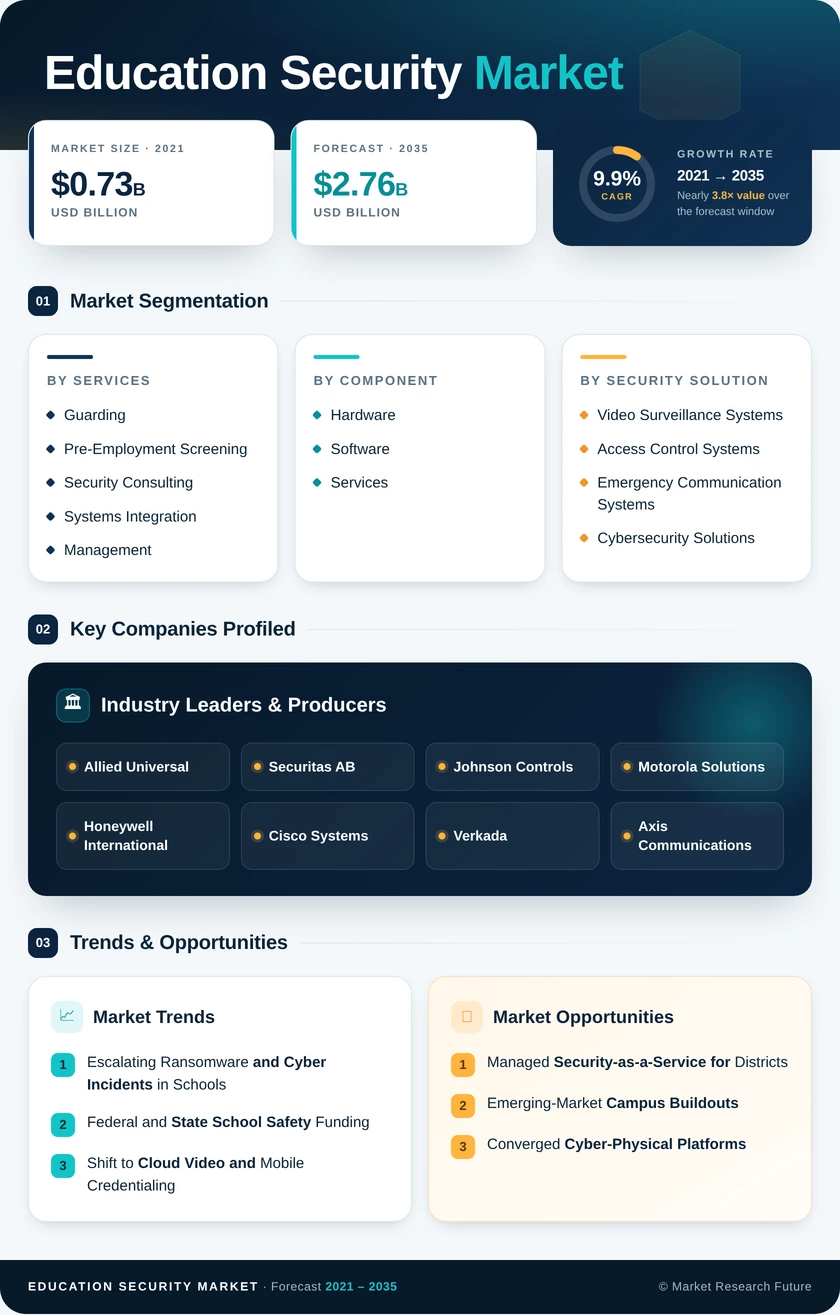
Education Security Market (2026 - 2035)

ID: MRFR/ICT/33837-HCR 100 Pages Aarti Dhapte Last Updated: November 13, 2026
Education Security Market Size, Share and Research Report By Services (Guarding, Pre-Employment Screening, Security Consulting, Systems Integration and Management, Alarm Monitoring Services, and Other Private Security Services), By Component (Hardware, Software, and Services), By Security Solution (Video Surveillance Systems, Access Control Systems, Emergency Communication Systems, and Cybersecurity Solutions), By Deployment Mode (On-Premise, Cloud, and Hybrid), By Facilities (Primary and Secondary Facilities, Higher Education Facilities, and Other Educational Facilities) And By Region (North America, Europe, Asia-Pacific, And Rest Of The World) –Industry Forecast Till 2035
Education Security Market
Market Size
Forecast Period2026-2035
CAGR (2026-2035)9.9%
2025 Market SizeUSD 1.07 Billion
2035 Market SizeUSD 2.76 Billion
Key Players
Allied Universal
Securitas AB
Johnson Controls
Motorola Solutions
Honeywell International
Cisco Systems
Opportunities
  • Managed Security-as-a-Service for Districts
  • Emerging-Market Campus Buildouts
  • Converged Cyber-Physical Platforms
  1. 1 Market Summary | |
  2. 2 Key Report Takeaways | |
    1. 2.1 By Services | |
    2. 2.2 By Component | |
    3. 2.3 By Security Solution | |
    4. 2.4 By Deployment Mode | |
    5. 2.5 By Facilities | |
    6. 2.6 By Region | |
  3. 3 Market Size and Forecast (2021–2035) | |
  4. 4 Driver Impact Analysis | |
    1. 4.1 Escalating Ransomware and Cyber Incidents in Schools | |
    2. 4.2 Federal and State School Safety Funding | |
    3. 4.3 Shift to Cloud Video and Mobile Credentialing | |
    4. 4.4 Panic-Alarm and Emergency Communication Mandates | |
    5. 4.5 Student Data Privacy Regulation | |
    6. 4.6 Smart-Campus Investment in Asia Pacific | |
  5. 5 Restraints Impact Analysis | |
    1. 5.1 Post-Relief Budget Contraction | |
    2. 5.2 Privacy Backlash Against Biometrics | |
    3. 5.3 Cybersecurity Skills Shortage | |
    4. 5.4 Legacy Infrastructure Integration Cost | |
    5. 5.5 Guard Labor Shortages and Wage Inflation | |
  6. 6 Opportunities | |
    1. 6.1 Managed Security-as-a-Service for Districts | |
    2. 6.2 Emerging-Market Campus Buildouts | |
    3. 6.3 Converged Cyber-Physical Platforms | |
    4. 6.4 Anonymized Safety Analytics and Risk Scoring | |
    5. 6.5 Hybrid Migration Services | |
  7. 7 Regional Market Share and Country-Level Analysis | |
    1. 7.1 North America | | |
      1. 7.1.1 United States | | |
      2. 7.1.2 Canada | | |
      3. 7.1.3 Mexico | |
    2. 7.2 South America | | |
      1. 7.2.1 Brazil | | |
      2. 7.2.2 Argentina | | |
      3. 7.2.3 Rest of South America | |
    3. 7.3 Europe | | |
      1. 7.3.1 Germany | | |
      2. 7.3.2 United Kingdom | | |
      3. 7.3.3 France | | |
      4. 7.3.4 Italy | | |
      5. 7.3.5 Spain | | |
      6. 7.3.6 Rest of Europe | |
    4. 7.4 APAC | | |
      1. 7.4.1 China | | |
      2. 7.4.2 Japan | | |
      3. 7.4.3 India | | |
      4. 7.4.4 South Korea | | |
      5. 7.4.5 South-East Asia | | |
      6. 7.4.6 Rest of APAC | |
    5. 7.5 Middle East | | |
      1. 7.5.1 Saudi Arabia | | |
      2. 7.5.2 United Arab Emirates | | |
      3. 7.5.3 Turkey | | |
      4. 7.5.4 Rest of Middle East | |
    6. 7.6 Africa | | |
      1. 7.6.1 South Africa | | |
      2. 7.6.2 Nigeria | | |
      3. 7.6.3 Rest of Africa | |
  8. 8 Future Outlook (2026–2035) | |
    1. 8.1 AI-Assisted Threat Detection Under Tighter Governance | |
    2. 8.2 Subscription Platform Economics | |
    3. 8.3 Zero Trust Cyber-Physical Convergence | |
    4. 8.4 Privacy, Accountability and Outcome Reporting | |
  9. 9 Segmentation Analysis | |
    1. 9.1 By Services | | |
      1. 9.1.1 Guarding | | |
      2. 9.1.2 Pre-Employment Screening | | |
      3. 9.1.3 Security Consulting | | |
      4. 9.1.4 Systems Integration and Management | | |
      5. 9.1.5 Alarm Monitoring Services | | |
      6. 9.1.6 Other Private Security Services | |
    2. 9.2 By Component | | |
      1. 9.2.1 Hardware | | |
      2. 9.2.2 Software | | |
      3. 9.2.3 Services | |
    3. 9.3 By Security Solution | | |
      1. 9.3.1 Video Surveillance Systems | | |
      2. 9.3.2 Access Control Systems | | |
      3. 9.3.3 Emergency Communication Systems | | |
      4. 9.3.4 Cybersecurity Solutions | |
    4. 9.4 By Deployment Mode | | |
      1. 9.4.1 On-Premise | | |
      2. 9.4.2 Cloud | | |
      3. 9.4.3 Hybrid | |
    5. 9.5 By Facilities | | |
      1. 9.5.1 Primary and Secondary Facilities | | |
      2. 9.5.2 Higher Education Facilities | | |
      3. 9.5.3 Other Educational Facilities | |
  10. 10 Competitive Landscape | |
    1. 10.1 Competitive Benchmarking Matrix | |
  11. 11 Recent News & Developments | |
  12. 12 Report Scope and Methodology | |
  13. 13 Detailed Sources and Citations | |
  14. 14 Frequently Asked Questions (FAQs) | | LIST OF TABLES | |
  15. TABLE 1 Global Market Snapshot, 2025–2035 | |
  16. TABLE 2 Global Market Size and Forecast, 2021–2035 (USD Billion) | |
  17. TABLE 3 Driver Impact Analysis, 2026–2035 | |
  18. TABLE 4 Restraints Impact Analysis, 2026–2035 | |
  19. TABLE 5 Regional Summary, 2025 | |
  20. TABLE 6 North America Market, by Country, 2025 | |
  21. TABLE 7 South America Market, by Country, 2025 | |
  22. TABLE 8 Europe Market, by Country, 2025 | |
  23. TABLE 9 APAC Market, by Country, 2025 | |
  24. TABLE 10 Middle East Market, by Country, 2025 | |
  25. TABLE 11 Africa Market, by Country, 2025 | |
  26. TABLE 12 Global Market, by Services, 2025 | |
  27. TABLE 13 Global Market, by Component, 2025 | |
  28. TABLE 14 Global Market, by Security Solution, 2025 | |
  29. TABLE 15 Global Market, by Deployment Mode, 2025 | |
  30. TABLE 16 Global Market, by Facilities, 2025 | |
  31. TABLE 17 Competitive Benchmarking Matrix, 2025 | |
  32. TABLE 18 Report Scope and Methodology | |
  33. TABLE 19 Detailed Sources and Citations | | LIST OF FIGURES | |
  34. FIGURE 1 Market Dynamics Overview (Drivers, Restraints, Opportunities) | |
  35. FIGURE 2 Industry Value Chain Analysis | |
  36. FIGURE 3 Porter's Five Forces Analysis | |
  37. FIGURE 4 Global Market Size Trend, 2021–2035 (USD Billion) | |
  38. FIGURE 5 Market Share, by Services, 2025 | |
  39. FIGURE 6 Market Share, by Component, 2025 | |
  40. FIGURE 7 Market Share, by Security Solution, 2025 | |
  41. FIGURE 8 Market Share, by Deployment Mode, 2025 | |
  42. FIGURE 9 Market Share, by Facilities, 2025 | |
  43. FIGURE 10 Regional Market Share, 2025 | |
  44. FIGURE 11 Regional Growth Comparison, 2026–2035 | |
  45. FIGURE 12 Competitive Landscape Positioning, 2025

Segmentation Quick Reference

DimensionSub-SegmentsDominant SegmentFastest Growing Segment
By ServicesGuarding; Pre-Employment Screening; Security Consulting; Systems Integration and Management; Alarm Monitoring Services; Other Private Security ServicesGuarding (40.5% share)Security Consulting (11.5% CAGR)
By ComponentHardware; Software; ServicesHardware (42.4% share)Software (11.7% CAGR)
By Security SolutionVideo Surveillance Systems; Access Control Systems; Emergency Communication Systems; Cybersecurity SolutionsVideo Surveillance Systems (43.5% share)Cybersecurity Solutions (11.8% CAGR)
By Deployment ModeOn-Premise; Cloud; HybridOn-Premise (44.3% share)Cloud (11.9% CAGR)
By FacilitiesPrimary and Secondary Facilities; Higher Education Facilities; Other Educational FacilitiesPrimary and Secondary Facilities (54.8% share)Higher Education Facilities (11.2% CAGR)
By RegionNorth America; South America; Europe; APAC; Middle East; AfricaNorth America (38.4% share)APAC (12.3% CAGR (2026–2035))

Market Segmentation Overview

By Services

Sub-SegmentKey Trend
GuardingOfficers equipped with mobile dashboards that receive AI alerts
Pre-Employment ScreeningExpanded background checks under child-safety laws
Security ConsultingDemand for risk audits, drills and compliance reviews
Systems Integration and ManagementMulti-vendor platforms managed under one contract.
Alarm Monitoring ServicesPanic-alarm mandates expanding remote monitoring
Other Private Security ServicesEvent and patrol coverage for large campuses

Guarding leads because large districts and universities still want visible officers on site, though rising wages are pushing buyers to pair fewer guards with technology. Security Consulting grows fastest as boards seek documented risk assessments for insurers and regulators. Alarm Monitoring Services and Systems Integration and Management benefit from that shift toward technology-supported staffing.

By Component

Sub-SegmentKey Trend
HardwareEdge AI cameras and smart door controllers
SoftwareCloud video management and mobile credentials
ServicesManaged monitoring and lifecycle maintenance

Hardware holds the largest share, supported by large camera and controller installations in APAC and Middle Eastern schools. Software grows fastest as mature markets move away from on-site recorders and plastic badges toward licensed platforms. Services expand alongside software because districts with small IT teams rely on integrators for setup and updates.

By Security Solution

Sub-SegmentKey Trend
Video Surveillance SystemsAnalytics upgrades on an existing installed base
Access Control SystemsVisitor management and controlled single-point entry
Emergency Communication SystemsPanic alarms linked to live video for responders.
Cybersecurity SolutionsNetwork segmentation and endpoint protection for districts

Video Surveillance Systems dominate because nearly every school already has cameras, so most spending now goes to upgrades rather than first purchases. Cybersecurity Solutions grow fastest as ransomware incidents and FCC pilot funds push districts toward segmentation and identity controls. Emergency Communication Systems gain steadily from Alyssa's Law-style mandates.

By Deployment Mode

Sub-SegmentKey Trend
On-PremiseLegacy recorders kept for local data control
CloudRemote, multi-campus management with automatic patching
HybridLocal footage storage with cloud-based management

On-Premise leads today because many older camera and access systems cannot connect to cloud platforms without replacement. Cloud grows fastest as administrators want automatic updates and a single view across multiple sites. Hybrid serves as the transition model, letting institutions keep sensitive footage on campus while moving management to the cloud.

By Facilities

Sub-SegmentKey Trend
Primary and Secondary FacilitiesGrant-funded hardening and panic-alarm compliance
Higher Education FacilitiesOpen-campus access control and research data defense
Other Educational FacilitiesAffordable cloud bundles for private academies

Primary and Secondary Facilities lead because child-safety laws and federal grants focus most heavily on younger students. Higher Education Facilities grow fastest as universities manage open grounds, residence halls, and valuable research data under large identity directories. Other Educational Facilities increasingly adopt low-cost cloud bundles that need little in-house expertise.


Download PDF ×

We do not share your information with anyone. However, we may send you emails based on your report interest from time to time. You may contact us at any time to opt-out.