Request Free Sample ×

Kindly complete the form below to receive a free sample of this Report

* Please use a valid business email

Leading companies partner with us for data-driven Insights

clients tt-cursor
Hero Background

E commerce Market

ID: MRFR/ICT/17317-HCR
200 Pages
Kiran Jinkalwad
Last Updated: May 29, 2026
E-Commerce Market Size, Share and Trends Analysis Report By Product Category (Electronics, Fashion, Home Goods, Groceries, Health and Beauty), By Business Model (B2C, B2B, C2C, C2B), By Payment Method (Credit Card, Digital Wallet, Bank Transfer, Cash on Delivery), By Customer Type (Individual Consumers, Small Businesses, Large Enterprises) and By Regional (North America, Europe, South America, Asia Pacific, Middle East and Africa) - Forecast to 2035
Download PDF ×

We do not share your information with anyone. However, we may send you emails based on your report interest from time to time. You may contact us at any time to opt-out.

  1. 1 Market Overview |
    1. 1.1 Study Assumptions & Market Definition |
    2. 1.2 Scope of the Study |
    3. 1.3 Research Methodology
  2. 2 Market Summary & Key Takeaways
  3. 3 Market Dynamics |
    1. 3.1 Market Drivers Analysis | |
      1. 3.1.1 Smartphone & Mobile Internet Penetration | |
      2. 3.1.2 AI-Powered Personalization and Recommendation Engines | |
      3. 3.1.3 D2C Direct-to-Consumer Platform Growth | |
      4. 3.1.4 Digital Payments and Fintech Infrastructure | |
      5. 3.1.5 Social and Live-Stream Commerce Acceleration | |
      6. 3.1.6 Headless Commerce & Composable Architecture Adoption | |
      7. 3.1.7 Cross-Border Trade Facilitation & Logistics Maturation |
    2. 3.2 Market Restraints Analysis | |
      1. 3.2.1 Data Privacy Regulation Complexity | |
      2. 3.2.2 Counterfeit Goods and Consumer Trust Deficits | |
      3. 3.2.3 Last-Mile Delivery Cost Inflation | |
      4. 3.2.4 Digital Tax and Tariff Fragmentation | |
      5. 3.2.5 Cybersecurity Threats and Fraud |
    3. 3.3 Market Opportunity Analysis | |
      1. 3.3.1 Social and Live-Stream Commerce Expansion | |
      2. 3.3.2 Composable and Headless Commerce Architecture | |
      3. 3.3.3 Emerging-Market Digital Leapfrogging | |
      4. 3.3.4 Data Monetization and Retail Media Networks | |
      5. 3.3.5 Cross-Border Trade Facilitation |
    4. 3.4 Industry Value Chain Analysis |
    5. 3.5 Porter's Five Forces Analysis
  4. 4 Global E Commerce Market Size & Forecast (2021–2035) |
    1. 4.1 Historical Market Size (2021–2025) |
    2. 4.2 Current & Forecast Market Size (2026–2035) |
    3. 4.3 Market Size by Revenue (USD Trillion) |
    4. 4.4 Year-over-Year Growth Analysis
  5. 5 Segmentation Analysis |
    1. 5.1 By Business Model | |
      1. 5.1.1 B2C Marketplace | |
      2. 5.1.2 D2C / Brand-Owned | |
      3. 5.1.3 B2B E-Commerce | |
      4. 5.1.4 Subscription Commerce | |
      5. 5.1.5 Social Commerce |
    2. 5.2 By Product Category | |
      1. 5.2.1 Electronics & Media | |
      2. 5.2.2 Fashion & Apparel | |
      3. 5.2.3 Grocery & Fresh Food | |
      4. 5.2.4 Health & Beauty | |
      5. 5.2.5 Furniture & Home | |
      6. 5.2.6 Other Product Categories |
    3. 5.3 By Platform Type | |
      1. 5.3.1 Web-Based Platforms | |
      2. 5.3.2 Mobile App Commerce | |
      3. 5.3.3 Social Platform Commerce | |
      4. 5.3.4 Voice & Conversational Commerce
  6. 6 Regional Analysis |
    1. 6.1 Asia-Pacific | |
      1. 6.1.1 China | |
      2. 6.1.2 India | |
      3. 6.1.3 Japan | |
      4. 6.1.4 South Korea | |
      5. 6.1.5 Southeast Asia (ASEAN-6) | |
      6. 6.1.6 Rest of Asia-Pacific |
    2. 6.2 North America | |
      1. 6.2.1 United States | |
      2. 6.2.2 Canada | |
      3. 6.2.3 Mexico |
    3. 6.3 Europe | |
      1. 6.3.1 United Kingdom | |
      2. 6.3.2 Germany | |
      3. 6.3.3 France | |
      4. 6.3.4 Nordics | |
      5. 6.3.5 Rest of Europe |
    4. 6.4 Latin America | |
      1. 6.4.1 Brazil | |
      2. 6.4.2 Mexico | |
      3. 6.4.3 Colombia | |
      4. 6.4.4 Argentina | |
      5. 6.4.5 Rest of Latin America |
    5. 6.5 Middle East & Africa | |
      1. 6.5.1 UAE | |
      2. 6.5.2 Saudi Arabia | |
      3. 6.5.3 South Africa | |
      4. 6.5.4 Nigeria | |
      5. 6.5.5 Rest of Middle East & Africa
  7. 7 Competitive Landscape |
    1. 7.1 Market Share Analysis (2025) |
    2. 7.2 Competitive Benchmarking Matrix |
    3. 7.3 Company Profiles | |
      1. 7.3.1 Amazon | |
      2. 7.3.2 Alibaba Group | |
      3. 7.3.3 JD.com | |
      4. 7.3.4 Shopify | |
      5. 7.3.5 Mercado Libre | |
      6. 7.3.6 Sea Limited (Shopee) | |
      7. 7.3.7 Walmart eCommerce | |
      8. 7.3.8 Pinduoduo (Temu) | |
      9. 7.3.9 eBay | |
      10. 7.3.10 Rakuten
  8. 8 Future Outlook & Strategic Recommendations (2026–2035) |
    1. 8.1 AI-Native Commerce and Autonomous Shopping |
    2. 8.2 Platform Economics and Marketplace Consolidation |
    3. 8.3 Sustainable and Circular Commerce |
    4. 8.4 Cross-Border Infrastructure and Regulatory Convergence
  9. 9 Recent Developments & News
  10. 10 Frequently Asked Questions (FAQs)
  11. 11 Report Scope & Methodology |
    1. 11.1 Study Period & Base Year |
    2. 11.2 Data Sources & Citations |
    3. 11.3 Abbreviations
  12. 12 LIST OF TABLES |
  13. TABLE 1 Global E Commerce Market Size & Forecast, by Revenue (USD Trillion), 2021–2035 |
  14. TABLE 2 Global E Commerce Market – Year-over-Year Growth Analysis, 2021–2035 |
  15. TABLE 3 Global E Commerce Market – Driver Impact Analysis |
  16. TABLE 4 Global E Commerce Market – Restraint Impact Analysis |
  17. TABLE 5 Global E Commerce Market Size, by Business Model, 2021–2035 (USD Trillion) |
  18. TABLE 6 Global E Commerce Market Size, by Product Category, 2021–2035 (USD Trillion) |
  19. TABLE 7 Global E Commerce Market Size, by Platform Type, 2021–2035 (USD Trillion) |
  20. TABLE 8 Global E Commerce Market Size, by Region, 2021–2035 (USD Trillion) |
  21. TABLE 9 Asia-Pacific E Commerce Market Size, by Country, 2021–2035 (USD Trillion) |
  22. TABLE 10 North America E Commerce Market Size, by Country, 2021–2035 (USD Trillion) |
  23. TABLE 11 Europe E Commerce Market Size, by Country, 2021–2035 (USD Trillion) |
  24. TABLE 12 Latin America E Commerce Market Size, by Country, 2021–2035 (USD Billion) |
  25. TABLE 13 Middle East & Africa E Commerce Market Size, by Country, 2021–2035 (USD Billion) |
  26. TABLE 14 Competitive Benchmarking Matrix – Global E Commerce Market, 2025 |
  27. TABLE 15 Company Profiles – Key Players, Global E Commerce Market |
  28. TABLE 16 Recent Developments & Strategic Announcements, 2023–2025 |
  29. TABLE 17 Report Scope & Methodology Summary |
  30. TABLE 18 Detailed Sources and Citations |
  31. TABLE 19 Asia-Pacific E Commerce Market Size, by Business Model, 2021–2035 (USD Trillion) |
  32. TABLE 20 Asia-Pacific E Commerce Market Size, by Product Category, 2021–2035 (USD Trillion) |
  33. TABLE 21 Asia-Pacific E Commerce Market Size, by Platform Type, 2021–2035 (USD Trillion) |
  34. TABLE 22 North America E Commerce Market Size, by Business Model, 2021–2035 (USD Trillion) |
  35. TABLE 23 North America E Commerce Market Size, by Product Category, 2021–2035 (USD Trillion) |
  36. TABLE 24 North America E Commerce Market Size, by Platform Type, 2021–2035 (USD Trillion) |
  37. TABLE 25 Europe E Commerce Market Size, by Business Model, 2021–2035 (USD Trillion) |
  38. TABLE 26 Europe E Commerce Market Size, by Product Category, 2021–2035 (USD Trillion) |
  39. TABLE 27 Europe E Commerce Market Size, by Platform Type, 2021–2035 (USD Trillion) |
  40. TABLE 28 Latin America E Commerce Market Size, by Business Model, 2021–2035 (USD Billion) |
  41. TABLE 29 Latin America E Commerce Market Size, by Product Category, 2021–2035 (USD Billion) |
  42. TABLE 30 Latin America E Commerce Market Size, by Platform Type, 2021–2035 (USD Billion) |
  43. TABLE 31 Middle East & Africa E Commerce Market Size, by Business Model, 2021–2035 (USD Billion) |
  44. TABLE 32 Middle East & Africa E Commerce Market Size, by Product Category, 2021–2035 (USD Billion) |
  45. TABLE 33 Middle East & Africa E Commerce Market Size, by Platform Type, 2021–2035 (USD Billion)
  46. 13 LIST OF FIGURES |
  47. FIGURE 1 Global E Commerce Market Dynamics Overview (Drivers, Restraints, Opportunities) |
  48. FIGURE 2 Industry Value Chain Analysis – Global E Commerce Market |
  49. FIGURE 3 Porter's Five Forces Analysis – Global E Commerce Market |
  50. FIGURE 4 Global E Commerce Market Size Trend (USD Trillion), 2021–2035 |
  51. FIGURE 5 Global E Commerce Market Share, by Business Model (%), 2025 |
  52. FIGURE 6 Global E Commerce Market Share, by Product Category (%), 2025 |
  53. FIGURE 7 Global E Commerce Market Share, by Platform Type (%), 2025 |
  54. FIGURE 8 Global E Commerce Market Share, by Region (%), 2025 |
  55. FIGURE 9 Asia-Pacific E Commerce Market Size Trend (USD Trillion), 2021–2035 |
  56. FIGURE 10 North America E Commerce Market Size Trend (USD Trillion), 2021–2035 |
  57. FIGURE 11 Europe E Commerce Market Size Trend (USD Trillion), 2021–2035 |
  58. FIGURE 12 Latin America E Commerce Market Size Trend (USD Billion), 2021–2035 |
  59. FIGURE 13 Middle East & Africa E Commerce Market Size Trend (USD Billion), 2021–2035 |
  60. FIGURE 14 Competitive Landscape Map – Global E Commerce Market, 2025

Segmentation Quick Reference

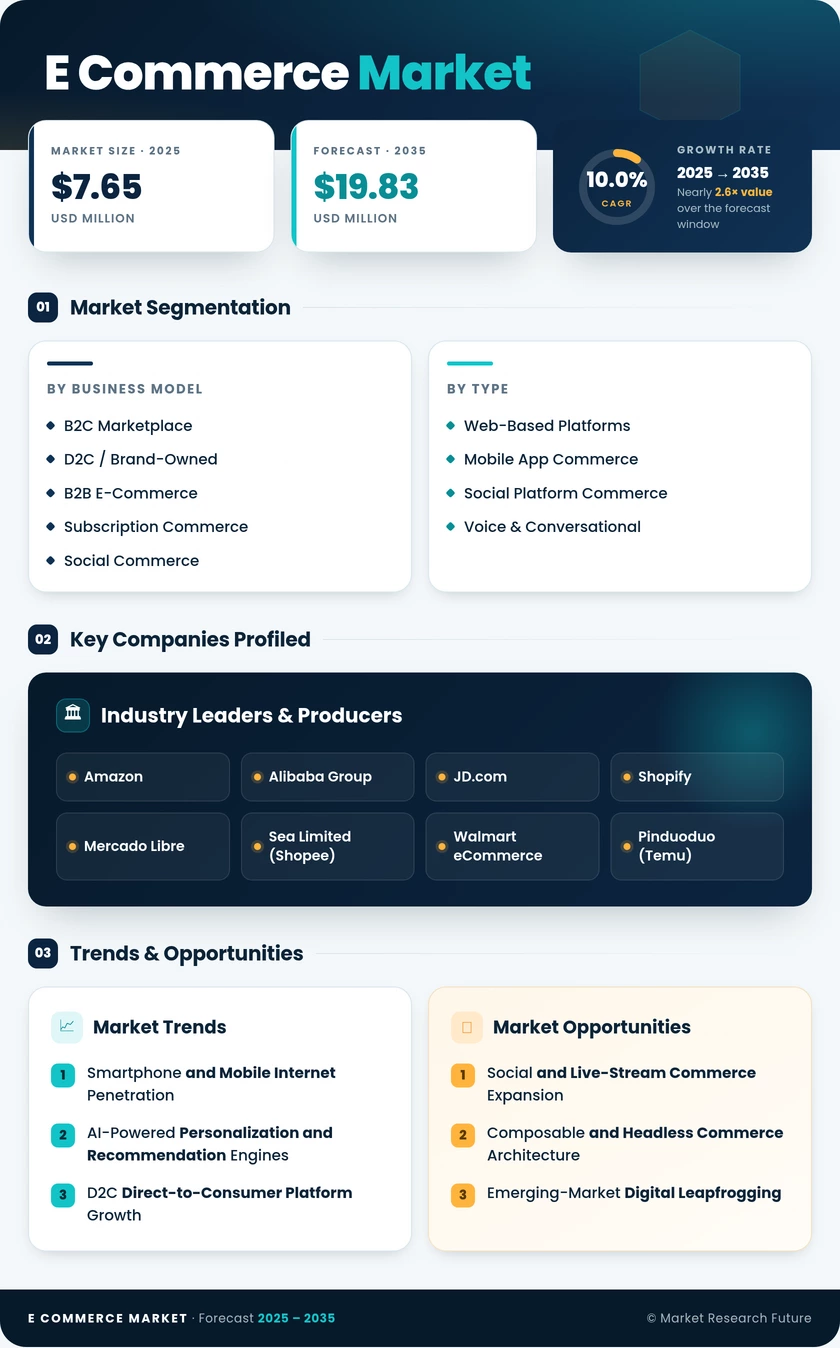
DimensionSub-SegmentsDominant SegmentFastest Growing Segment
By Business ModelB2C Marketplace, D2C / Brand-Owned, B2B E-Commerce, Subscription Commerce, Social CommerceB2C Marketplace (44.8% share)Social Commerce (14.7% CAGR)
By Product CategoryElectronics & Media, Fashion & Apparel, Grocery & Fresh Food, Health & Beauty, Furniture & HomeElectronics & Media (25.9% share)Grocery & Fresh Food (13.5% CAGR)
By Platform TypeWeb-Based Platforms, Mobile App Commerce, Social Platform Commerce, Voice & ConversationalWeb-Based Platforms (38.2% share)Voice & Conversational (18.4% CAGR)


Market Segmentation Overview

By Business Model

Sub-SegmentKey Trend
B2C MarketplaceNetwork effects deepening; retail media monetization growing 25% annually
D2C / Brand-OwnedBrands bypassing intermediaries; headless commerce enabling rapid channel expansion
B2B E-CommerceProcurement digitization is accelerating; Alibaba.com and Amazon Business are leading
Subscription CommerceRecurring revenue models expanding beyond media into grocery, fashion, and wellness
Social CommerceLive-stream and creator-driven purchasing are reshaping the discovery-to-checkout journey


The business model dimension reflects the structural evolution of the E Commerce Market from monolithic marketplace dependence toward a diversified ecosystem where D2C direct-to-consumer e-commerce platforms, social commerce, and subscription models coexist and compete for consumer attention and wallet share.

By Product Category

Sub-SegmentKey Trend
Electronics & MediaHigh average order values; strong comparison-shopping and review ecosystems
Fashion & ApparelVirtual try-on and AI sizing tools are reducing return rates by 20–30%
Grocery & Fresh FoodQuick commerce is compressing delivery windows to under 15 minutes in metros
Health & BeautyInfluencer-driven D2C brands are capturing market share from legacy CPG players
Furniture & HomeAR-powered product visualization driving online conversion in high-consideration categories


Product category segmentation highlights the breadth of the E Commerce Market across verticals with fundamentally different fulfillment, return, and personalization requirements — from low-margin, high-frequency grocery to high-margin, low-frequency furniture.

By Platform Type

Sub-SegmentKey Trend
Web-Based PlatformsDesktop-dominant for B2B; declining share in B2C consumer commerce
Mobile App CommerceMobile-first e-commerce checkout optimization is driving 2.5x higher conversion than mobile web
Social Platform CommerceIn-feed purchasing eliminates friction between content discovery and transaction
Voice & ConversationalAI-powered product recommendation engines are integrating into smart speakers and chat interfaces


Platform type segmentation captures the channel shift from desktop to mobile-native and AI-driven interfaces, underscoring why mobile-first e-commerce checkout optimization and AI-powered product recommendation engines are the two most critical technology investments for E Commerce Market participants through 2035.