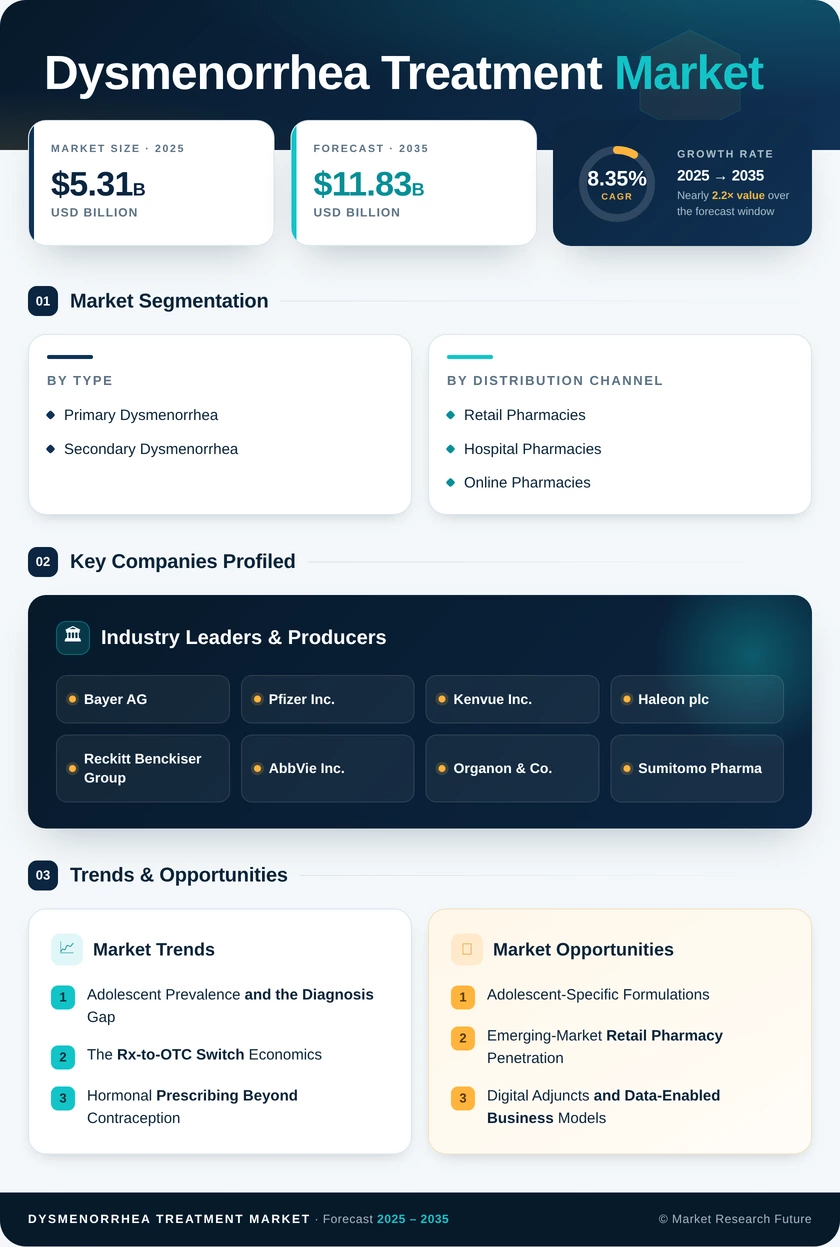
Segmentation Quick Reference
| Dimension | Sub-Segments | Dominant Segment | Fastest Growing Segment |
| By Treatment Type | Non-Steroidal Anti-Inflammatory Drugs (NSAIDs); Hormonal Therapy | Non-Steroidal Anti-Inflammatory Drugs (NSAIDs) | Hormonal Therapy |
| By Type | Primary Dysmenorrhea; Secondary Dysmenorrhea | Primary Dysmenorrhea | Secondary Dysmenorrhea |
| By Distribution Channel | Retail Pharmacies; Hospital Pharmacies; Online Pharmacies | Retail Pharmacies | Online Pharmacies |
| By Geography | North America; Europe; Asia-Pacific; South America; Middle East & Africa | North America | Asia-Pacific |
Market Segmentation Overview
By Treatment Type
| Sub-Segment | Key Trend |
| Non-Steroidal Anti-Inflammatory Drugs (NSAIDs) | Volume leadership sustained by OTC access, offset by tender-driven price erosion and duration-of-therapy caps. |
| Hormonal Therapy | Indication repositioning from contraception to pain, with GnRH antagonists anchoring the premium tier |
Treatment type is the axis where volume and value diverge most sharply. NSAIDs will still dispense the overwhelming majority of units in 2035, but hormonal regimens will have closed most of the revenue gap. Manufacturers holding assets on only one side of that divide face a structural disadvantage.
By Type
| Sub-Segment | Key Trend |
| Primary Dysmenorrhea | Demographic-driven, stable growth with high repeat purchase across a long patient lifespan |
| Secondary Dysmenorrhea | Diagnosis-driven expansion as endometriosis and fibroid identification accelerates. |
Type segmentation is effectively a diagnostic-capacity story. Every advance in imaging access or biomarker validation reclassifies patients from the primary bucket into the secondary one, lifting average revenue per patient without adding a single new consumer to the category.
By Distribution Channel
| Sub-Segment | Key Trend |
| Retail Pharmacies | Remains the default access point, benefiting from organised chain expansion in emerging economies |
| Hospital Pharmacies | Concentrates specialist-initiated hormonal and antagonist therapy with the highest per-script value. |
| Online Pharmacies | Fastest expansion, powered by telehealth prescribing and patient preference for discretion |
Channel dynamics reward discretion and convenience in roughly equal measure. Online growth outpaces every other sub-segment across all three dimensions, though regulatory tightening in Brazil and India has moved the model toward licensed domestic partnership rather than direct fulfilment.
By Region
| Sub-Segment | Key Trend |
| North America | Highest value density; specialty tier access and employer benefits design drive per-patient revenue |
| Europe | Strong diagnosis rates constrained by reference pricing and tender-based procurement. |
| Asia-Pacific | Steepest growth curve on retail pharmacy buildout and improving policy attention |
| South America | Moderate growth shaped by public formulary listings and e-pharmacy regulation |
| Middle East & Africa | Smallest base; clinic capacity is expanding faster than patient presentation |
Geographic weighting will shift meaningfully over the forecast window. North America retains leadership through 2035, but its share erodes by several points as Asia-Pacific converts pharmacy access into diagnosed, treated demand.


 Noah Malgeri
Co-Founder
Noah Malgeri
Co-Founder

 Peter Groot koerkamp
Account and Business Manager
Peter Groot koerkamp
Account and Business Manager

 Younghwan Choi
Senior Retail Manager
Younghwan Choi
Senior Retail Manager

 Mark Irwin
Management Consultant
Mark Irwin
Management Consultant

 Akif Moroglu
Strategy & Business Development Director
Akif Moroglu
Strategy & Business Development Director

 Guilherme Gomes Martins
Product Management Director
Guilherme Gomes Martins
Product Management Director

 Joseph Aguayo
Sales Operations & Pricing Manager
Joseph Aguayo
Sales Operations & Pricing Manager

 La Terria Dodd
Program Support Specialist
La Terria Dodd
Program Support Specialist

 Rob Kooiker
Group Product Manager HVAC & Fire Protection GMA
Rob Kooiker
Group Product Manager HVAC & Fire Protection GMA