
Request Free Sample ×

Kindly complete the form below to receive a free sample of this Report

* Please use a valid business email

Leading companies partner with us for data-driven Insights

clients tt-cursor
Hero Background
English
Chinese
French
Japanese
Korean
German
Spanish

Drone Inspection Monitoring Market Share

ID: MRFR/AD/12485-HCR
128 Pages
Abbas Raut
April 2026

Drone Inspection and Monitoring Market Size, Share, Industry Trend & Analysis Research Report Information By Type (Fixed-Wing, Multirotor, and Hybrid), By Solution (Platform, Software, Infrastructure, and Service) By Distribution Channel (Online and Offline) And By Region (North America, Europe, Asia-Pacific, And Rest Of The World) – Forecast Till 2035

Share:
Download PDF ×

We do not share your information with anyone. However, we may send you emails based on your report interest from time to time. You may contact us at any time to opt-out.

Drone Inspection Monitoring Market Infographic
Purchase Options

Market Share

Drone Inspection Monitoring Market Share Analysis

In the burgeoning field of Drone Inspection and Monitoring, companies are employing various strategies to establish and enhance their market share. These strategies are essential for navigating the competitive landscape of the drone industry, where technological innovation, regulatory compliance, and customer trust are paramount considerations.

Product differentiation stands as a key strategy in the Drone Inspection and Monitoring Market. Companies strive to differentiate their offerings by developing innovative drone solutions with unique features and capabilities tailored to inspection and monitoring tasks. This may involve integrating advanced sensors, cameras, and data analytics capabilities into their drones to enhance performance, accuracy, and efficiency. Additionally, companies focus on designing drones that are robust, reliable, and adaptable to various environmental conditions, including harsh weather and remote locations. By providing differentiated products that address the specific needs and challenges of inspection and monitoring applications, companies can gain a competitive advantage and capture market share in this rapidly evolving market.

Cost leadership is another critical strategy in the Drone Inspection and Monitoring Market, particularly as customers seek cost-effective solutions that offer value for money. Companies work to optimize production processes, source components efficiently, and leverage economies of scale to offer competitive pricing for their drone services. By providing cost-effective inspection and monitoring solutions without compromising on quality or reliability, companies can appeal to budget-conscious customers and gain market share, especially in price-sensitive segments of the market.

Segmentation plays a significant role in market share positioning in the Drone Inspection and Monitoring Market. Companies identify and target specific market segments based on factors such as industry vertical, application, geographical location, and customer requirements. For example, they may tailor their drone services to meet the unique needs of industries such as energy, infrastructure, agriculture, or environmental monitoring. By understanding the diverse requirements of different segments, companies can develop targeted marketing strategies and customized solutions that resonate with their target customers, thereby maximizing their market share within each segment.

Strategic partnerships and collaborations are essential for market share positioning in the Drone Inspection and Monitoring Market. Companies often form alliances with technology providers, regulatory bodies, industry associations, and end-users to leverage complementary expertise, resources, and distribution channels. These partnerships enable companies to expand their market reach, enhance their service offerings, and address emerging market opportunities more effectively. For example, collaborations with regulatory bodies may allow drone operators to gain access to airspace and secure permits, thereby facilitating the deployment of their services in regulated environments.

Brand reputation and trust are critical factors in the Drone Inspection and Monitoring Market, where reliability, safety, and data security are paramount considerations for customers. Companies invest in building strong brands that are synonymous with quality, integrity, and compliance with industry standards and regulations. By consistently delivering reliable and secure drone services that meet or exceed customer expectations, companies can earn the trust of customers and foster long-term relationships, thereby solidifying their market share and enhancing their competitive position.

Furthermore, companies in the Drone Inspection and Monitoring Market must remain agile and adaptable to changes in technology, regulations, and customer preferences. This requires ongoing research and development to innovate new drone technologies, improve data analytics capabilities, and address emerging market needs. By staying ahead of the curve and offering innovative solutions that meet the evolving demands of inspection and monitoring applications, companies can maintain their competitive position and seize new opportunities for growth in a dynamic and rapidly expanding market.


Author
Author Profile
Abbas Raut
Research Analyst

Abbas Raut is a Senior Research Analyst with 5+ years of experience delivering data-driven insights and strategic recommendations across the Automotive and Aerospace & Defense sectors. He specializes in emerging technologies, industry value chains, and global market dynamics shaping the future of mobility and defense. In automotive, Abbas has led studies on EVs, charging stations, BMS, superchargers, and more, guiding stakeholders through electrification and regulatory shifts. In Aerospace & Defense, he has analyzed markets for military electronics, drones, radars, and electronic warfare solutions, supporting procurement and investment strategies. With expertise in market sizing, forecasting, benchmarking, and technology adoption, Abbas is known for transforming complex datasets into actionable insights that drive strategy, innovation, and growth.

Leave a Comment

FAQs

What is the current valuation of the Drone Inspection and Monitoring Market?

<p>The market valuation was 15.76 USD Billion in 2024.</p>

What is the projected market size for the Drone Inspection and Monitoring Market by 2035?

<p>The market is expected to reach 74.03 USD Billion by 2035.</p>

What is the expected CAGR for the Drone Inspection and Monitoring Market during the forecast period?

<p>The expected CAGR for the market from 2025 to 2035 is 15.1%.</p>

Which companies are considered key players in the Drone Inspection and Monitoring Market?

<p>Key players include DJI, Parrot, senseFly, Skydio, Airobotics, Insitu, DroneDeploy, Kespry, and Airware.</p>

What are the main segments of the Drone Inspection and Monitoring Market?

<p>The main segments include Type, Solution, and Distribution Channel.</p>

How does the Fixed-Wing segment perform in terms of market valuation?

<p>The Fixed-Wing segment was valued at 2.37 USD Billion in 2024 and is projected to reach 10.0 USD Billion by 2035.</p>

What is the market valuation for the Multirotor segment?

The Multirotor segment was valued at 8.0 USD Billion in 2024 and is expected to grow to 40.0 USD Billion by 2035.

What is the projected growth for the Software solution in the Drone Inspection and Monitoring Market?

The Software solution segment was valued at 4.5 USD Billion in 2024 and is anticipated to reach 20.0 USD Billion by 2035.

What are the expected valuations for online and offline distribution channels?

The Online distribution channel was valued at 6.3 USD Billion in 2024, projected to grow to 30.0 USD Billion by 2035, while the Offline channel was valued at 9.46 USD Billion, expected to reach 44.03 USD Billion.

What is the anticipated growth for the Service solution segment?

The Service solution segment was valued at 5.11 USD Billion in 2024 and is projected to grow to 25.03 USD Billion by 2035.

Market Summary

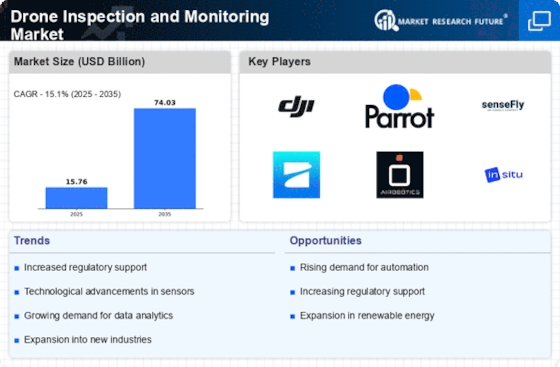
As per Market Research Future analysis, the Drone Inspection and Monitoring Market Size was estimated at 15.76 USD Billion in 2024. The Drone Inspection and Monitoring industry is projected to grow from 18.14 USD Billion in 2025 to 74.03 USD Billion by 2035, exhibiting a compound annual growth rate (CAGR) of 15.1% during the forecast period 2025 - 2035

Key Market Trends & Highlights

The Drone Inspection and Monitoring Market is poised for substantial growth driven by technological advancements and increasing demand across various sectors.

  • North America remains the largest market for drone inspection and monitoring, driven by robust infrastructure and regulatory support. The Asia-Pacific region is emerging as the fastest-growing market, fueled by rapid technological adoption and increasing investments in drone technology. Multirotor drones dominate the market due to their versatility, while fixed-wing drones are gaining traction as the fastest-growing segment for larger area coverage. Key market drivers include the increased demand for infrastructure inspection and enhanced data collection capabilities, which are shaping industry dynamics.

Market Size & Forecast

2024 Market Size 15.76 (USD Billion)
2035 Market Size 74.03 (USD Billion)
CAGR (2025 - 2035) 15.1%
Largest Regional Market Share in 2024 North America

Major Players

DJI (CN), Parrot (FR), senseFly (CH), Skydio (US), Airobotics (IL), Insitu (US), DroneDeploy (US), Kespry (US), Airware (US)

Market Trends

The Drone Inspection and Monitoring Market is currently experiencing a notable transformation, driven by advancements in technology and increasing demand for efficient inspection solutions across various industries. The integration of artificial intelligence and machine learning into drone systems enhances their capabilities, allowing for more precise data collection and analysis. This evolution appears to be fostering a shift towards automation, where traditional inspection methods are gradually being replaced by drone-based alternatives. As organizations seek to optimize operational efficiency and reduce costs, the adoption of drones for inspection purposes is likely to expand significantly. Moreover, regulatory frameworks are evolving to accommodate the growing use of drones in inspection and monitoring tasks. Governments are recognizing the potential benefits of drone technology, leading to the establishment of guidelines that facilitate safe and effective operations. This regulatory support may encourage more businesses to explore drone solutions, thereby broadening the market landscape. Additionally, the increasing focus on sustainability and environmental monitoring is propelling the demand for drone inspections in sectors such as agriculture and energy. Overall, the Drone Inspection and Monitoring Market seems poised for substantial growth as it adapts to emerging technologies and changing industry needs.

Technological Advancements

The Drone Inspection and Monitoring Market is witnessing rapid technological advancements, particularly in sensor technology and data analytics. Enhanced sensors enable drones to capture high-resolution images and gather critical data, which can be analyzed in real-time. This capability allows for more informed decision-making and timely interventions in various sectors.

Regulatory Developments

Regulatory frameworks are evolving to support the integration of drones into inspection and monitoring activities. Governments are establishing guidelines that promote safe operations while encouraging innovation. This regulatory environment is likely to facilitate broader adoption of drone technology across multiple industries.

Sustainability Focus

There is a growing emphasis on sustainability within the Drone Inspection and Monitoring Market. Organizations are increasingly utilizing drones for environmental monitoring and resource management. This trend reflects a broader commitment to sustainable practices, as drones offer efficient solutions for assessing environmental impacts.

Drone Inspection Monitoring Market Market Drivers

Enhanced Data Collection Capabilities

The Drone Inspection and Monitoring Market benefits from advanced data collection capabilities offered by modern drones. Equipped with high-resolution cameras and sensors, drones can capture detailed imagery and data that are crucial for analysis. This capability is particularly valuable in sectors such as agriculture and energy, where precise monitoring is essential. For instance, the agricultural sector is expected to utilize drone technology for crop health monitoring, potentially increasing yield by up to 20%. Such advancements in data collection not only improve operational efficiency but also enhance decision-making processes, thereby propelling market growth.

Cost Efficiency and Operational Savings

Cost efficiency remains a pivotal driver in the Drone Inspection and Monitoring Market. Traditional inspection methods often involve significant labor and equipment costs, whereas drones can perform similar tasks at a fraction of the expense. The operational savings realized through reduced manpower and faster inspection times are compelling for businesses across various sectors. For example, companies in the energy sector have reported savings of up to 30% by integrating drone inspections into their operations. This financial incentive is likely to encourage further investment in drone technology, fostering market expansion.

Integration with Artificial Intelligence

The integration of artificial intelligence (AI) into drone technology is a transformative driver for the Drone Inspection and Monitoring Market. AI enhances the analytical capabilities of drones, enabling them to process vast amounts of data and provide actionable insights. This integration is particularly beneficial in sectors such as construction and telecommunications, where real-time data analysis is crucial. The market for AI in drone applications is projected to expand significantly, with estimates suggesting a growth rate of over 25% in the coming years. This technological synergy not only improves operational efficiency but also positions drones as indispensable tools in various industries.

Growing Adoption in Environmental Monitoring

The Drone Inspection and Monitoring Market is witnessing a surge in adoption for environmental monitoring purposes. Drones are increasingly utilized to assess environmental conditions, track wildlife, and monitor natural resources. This trend aligns with the rising global emphasis on sustainability and conservation efforts. Regulatory bodies are also encouraging the use of drones for environmental assessments, which could lead to a more comprehensive understanding of ecological impacts. As organizations seek to comply with environmental regulations, the demand for drone-based monitoring solutions is expected to grow, thereby enhancing market prospects.

Increased Demand for Infrastructure Inspection

The Drone Inspection and Monitoring Market experiences heightened demand for infrastructure inspection services. As urbanization accelerates, the need for regular monitoring of bridges, roads, and buildings intensifies. Drones provide a cost-effective solution, enabling rapid assessments and reducing the risk associated with manual inspections. According to recent data, the infrastructure sector is projected to grow at a compound annual growth rate of 5.4%, further driving the adoption of drone technology. This trend suggests that stakeholders are increasingly recognizing the efficiency and safety benefits of drone inspections, which could lead to a substantial increase in market size.

Market Segment Insights

By Type: Multirotor (Largest) vs. Fixed-Wing (Fastest-Growing)

In the Drone Inspection and Monitoring Market, Multirotor drones hold the largest market share, favored for their maneuverability and ease of use in various inspection tasks. Fixed-Wing drones, while traditionally having a smaller share, are gaining traction due to their ability to cover vast areas efficiently, making them preferred for large-scale monitoring operations. Hybrid drones, combining features of both fixed-wing and multirotor designs, represent an emerging niche, contributing to innovation within the sector.

Drone Type: Multirotor (Dominant) vs. Fixed-Wing (Emerging)

Multirotor drones dominate the Drone Inspection and Monitoring Market due to their versatility and suitability for dynamic operational environments. They excel in delivering real-time data and access to challenging locales, making them ideal for inspections across a range of industries, including infrastructure and agriculture. In contrast, Fixed-Wing drones, recognized as an emerging technology, are increasingly adopted for their long-range capabilities and efficiency in covering expansive areas. This evolution in technology allows them to perform inspections that require extended flight durations, enhancing operational efficiencies on larger jobs. As industries seek more comprehensive monitoring solutions, the integration of these drone types is reshaping market dynamics.

By Solution: Software (Largest) vs. Service (Fastest-Growing)

In the Drone Inspection and Monitoring Market, the Software segment holds the largest market share, driven by the growing demand for advanced analytical tools and user-friendly interfaces. This segment facilitates real-time data processing and enhances the operational efficiency of drone operations. Meanwhile, the Service segment, encompassing inspection and monitoring services, is rapidly gaining traction, supported by increasing investments in drone technology and a shift towards subscription-based models that offer continuous support and expertise.

Software (Dominant) vs. Service (Emerging)

The Software segment is characterized by sophisticated applications that cater to various industries such as construction, agriculture, and infrastructure monitoring. These solutions are essential for processing high-resolution imagery and generating actionable insights. Conversely, the Service segment is emerging due to increased demand for customized inspection solutions, where service providers leverage drone technology to offer innovative monitoring solutions. This rising trend is a result of the growing recognition of the efficiencies that <a href="https://www.marketresearchfuture.com/reports/drone-services-market-9522" target="_blank">drone services</a> bring to traditional inspection methodologies, thereby promoting a shift towards more adaptable and real-time monitoring capabilities.

By Distribution Channel: Online (Largest) vs. Offline (Fastest-Growing)

The distribution channel for the Drone Inspection and Monitoring Market reveals that the online segment holds the largest share in the marketplace. With the increasing penetration of the internet and e-commerce platforms, consumers are gravitating towards online purchases for drone-related services and products. This trend is indicative of a larger shift in consumer behavior, where convenience and accessibility drive purchasing decisions, solidifying online distribution as a dominant force in the sector. On the other hand, the offline segment, although smaller in market share, is recognized as the fastest-growing segment. This growth can be attributed to the increasing number of deals with retailers and potential customers wanting to experience product demonstrations before purchase. Moreover, offline channels are leveraging partnerships with local businesses, which enhances trust and provides opportunities for customers to engage directly with products, thereby fostering growth in this area.

Online (Dominant) vs. Offline (Emerging)

In the Drone Inspection and Monitoring Market, the online distribution channel has emerged as a dominant force, characterized by its extensive reach and ability to provide customers with comprehensive information at their fingertips. With a high degree of availability and a variety of choices, customers can compare products easily, which enhances their buying experience. On the other hand, the offline segment is considered emerging as it adapts to changing customer preferences. Offline channels focus on personal engagement, offering hands-on experiences and direct interaction with knowledgeable staff. This strategy is particularly valuable in facilitating customer trust and loyalty, as consumers often prefer to see and test advanced tech such as drones before making significant purchasing decisions.

Get more detailed insights about Drone Inspection and Monitoring Market Research Report — Global Forecast till 2035

Regional Insights

By region, the study offers market insights of the North America, Europe, Asia-Pacific, and the Rest of the World. The North American Drone Inspection and Monitoring market area dominates this market due to a robust regulatory framework that facilitates the widespread adoption of drone technology. The region's advanced infrastructure, high-tech industries, and proactive regulatory environment contribute to a favorable ecosystem for the growth of the market.

Further, the main countries studied in the market report are The US, Canada, Germany, France, the UK, Italy, Spain, Japan, China, India, Australia, South Korea, and Brazil.

Figure 2: DRONE INSPECTION AND MONITORING MARKET SHARE BY REGION 2022 (USD Billion)

Europe's Drone Inspection and Monitoring market accounts for the second-largest market revenue share due to the increasing demand for cost-effective, efficient, and safer solutions across industries. Further, the German Drone Inspection and Monitoring market held the largest market revenue share, and the UK Drone Inspection and Monitoring market was the fastest-growing market in the European region.

The Asia-Pacific Drone Inspection and Monitoring Market is expected to rise at the fastest CAGR from the year 2023 to 2032. This is due to the region's surging emphasis on infrastructure development, increased awareness of the benefits of drone technology, and the demand for cost-effective and efficient solutions. Moreover,

Key Players and Competitive Insights

Leading market players are investing heavily in the research and development in order to expand their product lines, which will help the Drone Inspection and Monitoring market grow even more. Market participants are also undertaking a various strategic activities to spread their global footprint, with important market developments including mergers and acquisitions, contractual agreements, new product launches, higher investments, and collaboration with other organizations. To spread and survive in the  more competitive and rising market climate, the Drone Inspection and Monitoring industry must offer cost-effective items.Manufacturing locally to minimize the operational costs is one of the key business tactics used by the manufacturers in the global Drone Inspection and Monitoring industry to benefit the clients and increase the market sector. In recent years, the Drone Inspection and Monitoring industry has offered some of the most significant advantages to several industries.Major players in the Drone Inspection and the Monitoring market, including United Technologies Company, General Dynamics Corporation, Thales Group, Harris Corporation, Honeywell International Inc., Iridium Communications Inc., L3 Technologies Inc., Lockheed Martin Corporation, Northrop Grumman Systems Corporation, Raytheon Company, and others, are attempting to raise the market demand by investing in research and development operations.Autel Robotics is a Chinese drone manufacturer that has gained recognition for producing high-quality unmanned aerial vehicles (UAVs) for various applications. The company is known for its innovative approach to drone technology and offers a range of products catering to consumer, professional, and industrial needs. Autel Robotics has carved a niche in the market by providing feature-rich drones with advanced camera systems, reliable flight capabilities, and user-friendly interfaces. Their products often target enthusiasts, photographers, and professionals seeking reliable aerial platforms for photography, videography, mapping, and inspection purposes.

In September Autel Robotics announced a partnership with DroneDeploy, a leading cloud platform for drone operations. This partnership will integrate Autel's EVO II series drones with DroneDeploy's software, providing users with a seamless and efficient workflow for aerial data collection and analysis.

Key Companies in the Drone Inspection Monitoring Market include

Industry Developments

July 2023: Airbyte, a data integration platform, partnered with FlytBase, a drone autonomy platform. This partnership will facilitate the integration of drone data into various enterprise systems, enabling real-time insights and data-driven decision-making.

October 2023: Trimble, a leading provider of positioning and geospatial technology, acquired Geospatial Commissioning Services (GCS), a drone-based surveying and mapping company. This acquisition strengthens Trimble's position in the drone inspection and monitoring market and expands its service offerings.June 2023: Intel acquired Ascending Technologies, a leading provider of autonomous drones and software solutions. This acquisition gives Intel access to advanced drone technology and expertise, accelerating its development of autonomous drone solutions for various applications.

Future Outlook

Drone Inspection Monitoring Market Future Outlook

The Drone Inspection and Monitoring Market is projected to grow at a 15.1% CAGR from 2025 to 2035, driven by technological advancements, regulatory support, and increasing demand for efficiency.

New opportunities lie in:

  • Development of AI-driven analytics platforms for real-time data interpretation.</p><p>Expansion of <a href="https://www.marketresearchfuture.com/reports/drone-services-market-9522" target="_blank">drone services</a> in infrastructure maintenance and monitoring.</p><p>Integration of drone technology with IoT for enhanced operational efficiency.

By 2035, the market is expected to be robust, driven by innovation and diverse applications.

Market Segmentation

Drone Inspection Monitoring Market Type Outlook

  • Fixed-Wing
  • Multirotor
  • Hybrid

Drone Inspection Monitoring Market Solution Outlook

  • Platform
  • Software
  • Infrastructure
  • Service

Drone Inspection Monitoring Market Distribution Channel Outlook

  • Online
  • Offline

Report Scope

MARKET SIZE 2024 15.76(USD Billion)
MARKET SIZE 2025 18.14(USD Billion)
MARKET SIZE 2035 74.03(USD Billion)
COMPOUND ANNUAL GROWTH RATE (CAGR) 15.1% (2025 - 2035)
REPORT COVERAGE Revenue Forecast, Competitive Landscape, Growth Factors, and Trends
BASE YEAR 2024
Market Forecast Period 2025 - 2035
Historical Data 2019 - 2024
Market Forecast Units USD Billion
Key Companies Profiled DJI (CN), Parrot (FR), senseFly (CH), Skydio (US), Airobotics (IL), Insitu (US), DroneDeploy (US), Kespry (US), Airware (US)
Segments Covered Type, Solution, Distribution Channel, Region
Key Market Opportunities Integration of artificial intelligence enhances efficiency in the Drone Inspection and Monitoring Market.
Key Market Dynamics Technological advancements drive competitive forces, enhancing efficiency and safety in drone inspection and monitoring applications.
Countries Covered North America, Europe, APAC, South America, MEA

FAQs

What is the current valuation of the Drone Inspection and Monitoring Market?

<p>The market valuation was 15.76 USD Billion in 2024.</p>

What is the projected market size for the Drone Inspection and Monitoring Market by 2035?

<p>The market is expected to reach 74.03 USD Billion by 2035.</p>

What is the expected CAGR for the Drone Inspection and Monitoring Market during the forecast period?

<p>The expected CAGR for the market from 2025 to 2035 is 15.1%.</p>

Which companies are considered key players in the Drone Inspection and Monitoring Market?

<p>Key players include DJI, Parrot, senseFly, Skydio, Airobotics, Insitu, DroneDeploy, Kespry, and Airware.</p>

What are the main segments of the Drone Inspection and Monitoring Market?

<p>The main segments include Type, Solution, and Distribution Channel.</p>

How does the Fixed-Wing segment perform in terms of market valuation?

<p>The Fixed-Wing segment was valued at 2.37 USD Billion in 2024 and is projected to reach 10.0 USD Billion by 2035.</p>

What is the market valuation for the Multirotor segment?

The Multirotor segment was valued at 8.0 USD Billion in 2024 and is expected to grow to 40.0 USD Billion by 2035.

What is the projected growth for the Software solution in the Drone Inspection and Monitoring Market?

The Software solution segment was valued at 4.5 USD Billion in 2024 and is anticipated to reach 20.0 USD Billion by 2035.

What are the expected valuations for online and offline distribution channels?

The Online distribution channel was valued at 6.3 USD Billion in 2024, projected to grow to 30.0 USD Billion by 2035, while the Offline channel was valued at 9.46 USD Billion, expected to reach 44.03 USD Billion.

What is the anticipated growth for the Service solution segment?

The Service solution segment was valued at 5.11 USD Billion in 2024 and is projected to grow to 25.03 USD Billion by 2035.

  1. SECTION I: EXECUTIVE SUMMARY AND KEY HIGHLIGHTS
    1. | 1.1 EXECUTIVE SUMMARY
    2. | | 1.1.1 Market Overview
    3. | | 1.1.2 Key Findings
    4. | | 1.1.3 Market Segmentation
    5. | | 1.1.4 Competitive Landscape
    6. | | 1.1.5 Challenges and Opportunities
    7. | | 1.1.6 Future Outlook
  2. SECTION II: SCOPING, METHODOLOGY AND MARKET STRUCTURE
    1. | 2.1 MARKET INTRODUCTION
    2. | | 2.1.1 Definition
    3. | | 2.1.2 Scope of the study
    4. | | | 2.1.2.1 Research Objective
    5. | | | 2.1.2.2 Assumption
    6. | | | 2.1.2.3 Limitations
    7. | 2.2 RESEARCH METHODOLOGY
    8. | | 2.2.1 Overview
    9. | | 2.2.2 Data Mining
    10. | | 2.2.3 Secondary Research
    11. | | 2.2.4 Primary Research
    12. | | | 2.2.4.1 Primary Interviews and Information Gathering Process
    13. | | | 2.2.4.2 Breakdown of Primary Respondents
    14. | | 2.2.5 Forecasting Model
    15. | | 2.2.6 Market Size Estimation
    16. | | | 2.2.6.1 Bottom-Up Approach
    17. | | | 2.2.6.2 Top-Down Approach
    18. | | 2.2.7 Data Triangulation
    19. | | 2.2.8 Validation
  3. SECTION III: QUALITATIVE ANALYSIS
    1. | 3.1 MARKET DYNAMICS
    2. | | 3.1.1 Overview
    3. | | 3.1.2 Drivers
    4. | | 3.1.3 Restraints
    5. | | 3.1.4 Opportunities
    6. | 3.2 MARKET FACTOR ANALYSIS
    7. | | 3.2.1 Value chain Analysis
    8. | | 3.2.2 Porter's Five Forces Analysis
    9. | | | 3.2.2.1 Bargaining Power of Suppliers
    10. | | | 3.2.2.2 Bargaining Power of Buyers
    11. | | | 3.2.2.3 Threat of New Entrants
    12. | | | 3.2.2.4 Threat of Substitutes
    13. | | | 3.2.2.5 Intensity of Rivalry
    14. | | 3.2.3 COVID-19 Impact Analysis
    15. | | | 3.2.3.1 Market Impact Analysis
    16. | | | 3.2.3.2 Regional Impact
    17. | | | 3.2.3.3 Opportunity and Threat Analysis
  4. SECTION IV: QUANTITATIVE ANALYSIS
    1. | 4.1 Aerospace & Defense, BY Type (USD Billion)
    2. | | 4.1.1 Fixed-Wing
    3. | | 4.1.2 Multirotor
    4. | | 4.1.3 Hybrid
    5. | 4.2 Aerospace & Defense, BY Solution (USD Billion)
    6. | | 4.2.1 Platform
    7. | | 4.2.2 Software
    8. | | 4.2.3 Infrastructure
    9. | | 4.2.4 Service
    10. | 4.3 Aerospace & Defense, BY Distribution Channel (USD Billion)
    11. | | 4.3.1 Online
    12. | | 4.3.2 Offline
    13. | 4.4 Aerospace & Defense, BY Region (USD Billion)
    14. | | 4.4.1 North America
    15. | | | 4.4.1.1 US
    16. | | | 4.4.1.2 Canada
    17. | | 4.4.2 Europe
    18. | | | 4.4.2.1 Germany
    19. | | | 4.4.2.2 UK
    20. | | | 4.4.2.3 France
    21. | | | 4.4.2.4 Russia
    22. | | | 4.4.2.5 Italy
    23. | | | 4.4.2.6 Spain
    24. | | | 4.4.2.7 Rest of Europe
    25. | | 4.4.3 APAC
    26. | | | 4.4.3.1 China
    27. | | | 4.4.3.2 India
    28. | | | 4.4.3.3 Japan
    29. | | | 4.4.3.4 South Korea
    30. | | | 4.4.3.5 Malaysia
    31. | | | 4.4.3.6 Thailand
    32. | | | 4.4.3.7 Indonesia
    33. | | | 4.4.3.8 Rest of APAC
    34. | | 4.4.4 South America
    35. | | | 4.4.4.1 Brazil
    36. | | | 4.4.4.2 Mexico
    37. | | | 4.4.4.3 Argentina
    38. | | | 4.4.4.4 Rest of South America
    39. | | 4.4.5 MEA
    40. | | | 4.4.5.1 GCC Countries
    41. | | | 4.4.5.2 South Africa
    42. | | | 4.4.5.3 Rest of MEA
  5. SECTION V: COMPETITIVE ANALYSIS
    1. | 5.1 Competitive Landscape
    2. | | 5.1.1 Overview
    3. | | 5.1.2 Competitive Analysis
    4. | | 5.1.3 Market share Analysis
    5. | | 5.1.4 Major Growth Strategy in the Aerospace & Defense
    6. | | 5.1.5 Competitive Benchmarking
    7. | | 5.1.6 Leading Players in Terms of Number of Developments in the Aerospace & Defense
    8. | | 5.1.7 Key developments and growth strategies
    9. | | | 5.1.7.1 New Product Launch/Service Deployment
    10. | | | 5.1.7.2 Merger & Acquisitions
    11. | | | 5.1.7.3 Joint Ventures
    12. | | 5.1.8 Major Players Financial Matrix
    13. | | | 5.1.8.1 Sales and Operating Income
    14. | | | 5.1.8.2 Major Players R&D Expenditure. 2023
    15. | 5.2 Company Profiles
    16. | | 5.2.1 DJI (CN)
    17. | | | 5.2.1.1 Financial Overview
    18. | | | 5.2.1.2 Products Offered
    19. | | | 5.2.1.3 Key Developments
    20. | | | 5.2.1.4 SWOT Analysis
    21. | | | 5.2.1.5 Key Strategies
    22. | | 5.2.2 Parrot (FR)
    23. | | | 5.2.2.1 Financial Overview
    24. | | | 5.2.2.2 Products Offered
    25. | | | 5.2.2.3 Key Developments
    26. | | | 5.2.2.4 SWOT Analysis
    27. | | | 5.2.2.5 Key Strategies
    28. | | 5.2.3 senseFly (CH)
    29. | | | 5.2.3.1 Financial Overview
    30. | | | 5.2.3.2 Products Offered
    31. | | | 5.2.3.3 Key Developments
    32. | | | 5.2.3.4 SWOT Analysis
    33. | | | 5.2.3.5 Key Strategies
    34. | | 5.2.4 Skydio (US)
    35. | | | 5.2.4.1 Financial Overview
    36. | | | 5.2.4.2 Products Offered
    37. | | | 5.2.4.3 Key Developments
    38. | | | 5.2.4.4 SWOT Analysis
    39. | | | 5.2.4.5 Key Strategies
    40. | | 5.2.5 Airobotics (IL)
    41. | | | 5.2.5.1 Financial Overview
    42. | | | 5.2.5.2 Products Offered
    43. | | | 5.2.5.3 Key Developments
    44. | | | 5.2.5.4 SWOT Analysis
    45. | | | 5.2.5.5 Key Strategies
    46. | | 5.2.6 Insitu (US)
    47. | | | 5.2.6.1 Financial Overview
    48. | | | 5.2.6.2 Products Offered
    49. | | | 5.2.6.3 Key Developments
    50. | | | 5.2.6.4 SWOT Analysis
    51. | | | 5.2.6.5 Key Strategies
    52. | | 5.2.7 DroneDeploy (US)
    53. | | | 5.2.7.1 Financial Overview
    54. | | | 5.2.7.2 Products Offered
    55. | | | 5.2.7.3 Key Developments
    56. | | | 5.2.7.4 SWOT Analysis
    57. | | | 5.2.7.5 Key Strategies
    58. | | 5.2.8 Kespry (US)
    59. | | | 5.2.8.1 Financial Overview
    60. | | | 5.2.8.2 Products Offered
    61. | | | 5.2.8.3 Key Developments
    62. | | | 5.2.8.4 SWOT Analysis
    63. | | | 5.2.8.5 Key Strategies
    64. | | 5.2.9 Airware (US)
    65. | | | 5.2.9.1 Financial Overview
    66. | | | 5.2.9.2 Products Offered
    67. | | | 5.2.9.3 Key Developments
    68. | | | 5.2.9.4 SWOT Analysis
    69. | | | 5.2.9.5 Key Strategies
    70. | 5.3 Appendix
    71. | | 5.3.1 References
    72. | | 5.3.2 Related Reports
  6. LIST OF FIGURES
    1. | 6.1 MARKET SYNOPSIS
    2. | 6.2 NORTH AMERICA MARKET ANALYSIS
    3. | 6.3 US MARKET ANALYSIS BY TYPE
    4. | 6.4 US MARKET ANALYSIS BY SOLUTION
    5. | 6.5 US MARKET ANALYSIS BY DISTRIBUTION CHANNEL
    6. | 6.6 CANADA MARKET ANALYSIS BY TYPE
    7. | 6.7 CANADA MARKET ANALYSIS BY SOLUTION
    8. | 6.8 CANADA MARKET ANALYSIS BY DISTRIBUTION CHANNEL
    9. | 6.9 EUROPE MARKET ANALYSIS
    10. | 6.10 GERMANY MARKET ANALYSIS BY TYPE
    11. | 6.11 GERMANY MARKET ANALYSIS BY SOLUTION
    12. | 6.12 GERMANY MARKET ANALYSIS BY DISTRIBUTION CHANNEL
    13. | 6.13 UK MARKET ANALYSIS BY TYPE
    14. | 6.14 UK MARKET ANALYSIS BY SOLUTION
    15. | 6.15 UK MARKET ANALYSIS BY DISTRIBUTION CHANNEL
    16. | 6.16 FRANCE MARKET ANALYSIS BY TYPE
    17. | 6.17 FRANCE MARKET ANALYSIS BY SOLUTION
    18. | 6.18 FRANCE MARKET ANALYSIS BY DISTRIBUTION CHANNEL
    19. | 6.19 RUSSIA MARKET ANALYSIS BY TYPE
    20. | 6.20 RUSSIA MARKET ANALYSIS BY SOLUTION
    21. | 6.21 RUSSIA MARKET ANALYSIS BY DISTRIBUTION CHANNEL
    22. | 6.22 ITALY MARKET ANALYSIS BY TYPE
    23. | 6.23 ITALY MARKET ANALYSIS BY SOLUTION
    24. | 6.24 ITALY MARKET ANALYSIS BY DISTRIBUTION CHANNEL
    25. | 6.25 SPAIN MARKET ANALYSIS BY TYPE
    26. | 6.26 SPAIN MARKET ANALYSIS BY SOLUTION
    27. | 6.27 SPAIN MARKET ANALYSIS BY DISTRIBUTION CHANNEL
    28. | 6.28 REST OF EUROPE MARKET ANALYSIS BY TYPE
    29. | 6.29 REST OF EUROPE MARKET ANALYSIS BY SOLUTION
    30. | 6.30 REST OF EUROPE MARKET ANALYSIS BY DISTRIBUTION CHANNEL
    31. | 6.31 APAC MARKET ANALYSIS
    32. | 6.32 CHINA MARKET ANALYSIS BY TYPE
    33. | 6.33 CHINA MARKET ANALYSIS BY SOLUTION
    34. | 6.34 CHINA MARKET ANALYSIS BY DISTRIBUTION CHANNEL
    35. | 6.35 INDIA MARKET ANALYSIS BY TYPE
    36. | 6.36 INDIA MARKET ANALYSIS BY SOLUTION
    37. | 6.37 INDIA MARKET ANALYSIS BY DISTRIBUTION CHANNEL
    38. | 6.38 JAPAN MARKET ANALYSIS BY TYPE
    39. | 6.39 JAPAN MARKET ANALYSIS BY SOLUTION
    40. | 6.40 JAPAN MARKET ANALYSIS BY DISTRIBUTION CHANNEL
    41. | 6.41 SOUTH KOREA MARKET ANALYSIS BY TYPE
    42. | 6.42 SOUTH KOREA MARKET ANALYSIS BY SOLUTION
    43. | 6.43 SOUTH KOREA MARKET ANALYSIS BY DISTRIBUTION CHANNEL
    44. | 6.44 MALAYSIA MARKET ANALYSIS BY TYPE
    45. | 6.45 MALAYSIA MARKET ANALYSIS BY SOLUTION
    46. | 6.46 MALAYSIA MARKET ANALYSIS BY DISTRIBUTION CHANNEL
    47. | 6.47 THAILAND MARKET ANALYSIS BY TYPE
    48. | 6.48 THAILAND MARKET ANALYSIS BY SOLUTION
    49. | 6.49 THAILAND MARKET ANALYSIS BY DISTRIBUTION CHANNEL
    50. | 6.50 INDONESIA MARKET ANALYSIS BY TYPE
    51. | 6.51 INDONESIA MARKET ANALYSIS BY SOLUTION
    52. | 6.52 INDONESIA MARKET ANALYSIS BY DISTRIBUTION CHANNEL
    53. | 6.53 REST OF APAC MARKET ANALYSIS BY TYPE
    54. | 6.54 REST OF APAC MARKET ANALYSIS BY SOLUTION
    55. | 6.55 REST OF APAC MARKET ANALYSIS BY DISTRIBUTION CHANNEL
    56. | 6.56 SOUTH AMERICA MARKET ANALYSIS
    57. | 6.57 BRAZIL MARKET ANALYSIS BY TYPE
    58. | 6.58 BRAZIL MARKET ANALYSIS BY SOLUTION
    59. | 6.59 BRAZIL MARKET ANALYSIS BY DISTRIBUTION CHANNEL
    60. | 6.60 MEXICO MARKET ANALYSIS BY TYPE
    61. | 6.61 MEXICO MARKET ANALYSIS BY SOLUTION
    62. | 6.62 MEXICO MARKET ANALYSIS BY DISTRIBUTION CHANNEL
    63. | 6.63 ARGENTINA MARKET ANALYSIS BY TYPE
    64. | 6.64 ARGENTINA MARKET ANALYSIS BY SOLUTION
    65. | 6.65 ARGENTINA MARKET ANALYSIS BY DISTRIBUTION CHANNEL
    66. | 6.66 REST OF SOUTH AMERICA MARKET ANALYSIS BY TYPE
    67. | 6.67 REST OF SOUTH AMERICA MARKET ANALYSIS BY SOLUTION
    68. | 6.68 REST OF SOUTH AMERICA MARKET ANALYSIS BY DISTRIBUTION CHANNEL
    69. | 6.69 MEA MARKET ANALYSIS
    70. | 6.70 GCC COUNTRIES MARKET ANALYSIS BY TYPE
    71. | 6.71 GCC COUNTRIES MARKET ANALYSIS BY SOLUTION
    72. | 6.72 GCC COUNTRIES MARKET ANALYSIS BY DISTRIBUTION CHANNEL
    73. | 6.73 SOUTH AFRICA MARKET ANALYSIS BY TYPE
    74. | 6.74 SOUTH AFRICA MARKET ANALYSIS BY SOLUTION
    75. | 6.75 SOUTH AFRICA MARKET ANALYSIS BY DISTRIBUTION CHANNEL
    76. | 6.76 REST OF MEA MARKET ANALYSIS BY TYPE
    77. | 6.77 REST OF MEA MARKET ANALYSIS BY SOLUTION
    78. | 6.78 REST OF MEA MARKET ANALYSIS BY DISTRIBUTION CHANNEL
    79. | 6.79 KEY BUYING CRITERIA OF AEROSPACE & DEFENSE
    80. | 6.80 RESEARCH PROCESS OF MRFR
    81. | 6.81 DRO ANALYSIS OF AEROSPACE & DEFENSE
    82. | 6.82 DRIVERS IMPACT ANALYSIS: AEROSPACE & DEFENSE
    83. | 6.83 RESTRAINTS IMPACT ANALYSIS: AEROSPACE & DEFENSE
    84. | 6.84 SUPPLY / VALUE CHAIN: AEROSPACE & DEFENSE
    85. | 6.85 AEROSPACE & DEFENSE, BY TYPE, 2024 (% SHARE)
    86. | 6.86 AEROSPACE & DEFENSE, BY TYPE, 2024 TO 2035 (USD Billion)
    87. | 6.87 AEROSPACE & DEFENSE, BY SOLUTION, 2024 (% SHARE)
    88. | 6.88 AEROSPACE & DEFENSE, BY SOLUTION, 2024 TO 2035 (USD Billion)
    89. | 6.89 AEROSPACE & DEFENSE, BY DISTRIBUTION CHANNEL, 2024 (% SHARE)
    90. | 6.90 AEROSPACE & DEFENSE, BY DISTRIBUTION CHANNEL, 2024 TO 2035 (USD Billion)
    91. | 6.91 BENCHMARKING OF MAJOR COMPETITORS
  7. LIST OF TABLES
    1. | 7.1 LIST OF ASSUMPTIONS
    2. | | 7.1.1
    3. | 7.2 North America MARKET SIZE ESTIMATES; FORECAST
    4. | | 7.2.1 BY TYPE, 2025-2035 (USD Billion)
    5. | | 7.2.2 BY SOLUTION, 2025-2035 (USD Billion)
    6. | | 7.2.3 BY DISTRIBUTION CHANNEL, 2025-2035 (USD Billion)
    7. | 7.3 US MARKET SIZE ESTIMATES; FORECAST
    8. | | 7.3.1 BY TYPE, 2025-2035 (USD Billion)
    9. | | 7.3.2 BY SOLUTION, 2025-2035 (USD Billion)
    10. | | 7.3.3 BY DISTRIBUTION CHANNEL, 2025-2035 (USD Billion)
    11. | 7.4 Canada MARKET SIZE ESTIMATES; FORECAST
    12. | | 7.4.1 BY TYPE, 2025-2035 (USD Billion)
    13. | | 7.4.2 BY SOLUTION, 2025-2035 (USD Billion)
    14. | | 7.4.3 BY DISTRIBUTION CHANNEL, 2025-2035 (USD Billion)
    15. | 7.5 Europe MARKET SIZE ESTIMATES; FORECAST
    16. | | 7.5.1 BY TYPE, 2025-2035 (USD Billion)
    17. | | 7.5.2 BY SOLUTION, 2025-2035 (USD Billion)
    18. | | 7.5.3 BY DISTRIBUTION CHANNEL, 2025-2035 (USD Billion)
    19. | 7.6 Germany MARKET SIZE ESTIMATES; FORECAST
    20. | | 7.6.1 BY TYPE, 2025-2035 (USD Billion)
    21. | | 7.6.2 BY SOLUTION, 2025-2035 (USD Billion)
    22. | | 7.6.3 BY DISTRIBUTION CHANNEL, 2025-2035 (USD Billion)
    23. | 7.7 UK MARKET SIZE ESTIMATES; FORECAST
    24. | | 7.7.1 BY TYPE, 2025-2035 (USD Billion)
    25. | | 7.7.2 BY SOLUTION, 2025-2035 (USD Billion)
    26. | | 7.7.3 BY DISTRIBUTION CHANNEL, 2025-2035 (USD Billion)
    27. | 7.8 France MARKET SIZE ESTIMATES; FORECAST
    28. | | 7.8.1 BY TYPE, 2025-2035 (USD Billion)
    29. | | 7.8.2 BY SOLUTION, 2025-2035 (USD Billion)
    30. | | 7.8.3 BY DISTRIBUTION CHANNEL, 2025-2035 (USD Billion)
    31. | 7.9 Russia MARKET SIZE ESTIMATES; FORECAST
    32. | | 7.9.1 BY TYPE, 2025-2035 (USD Billion)
    33. | | 7.9.2 BY SOLUTION, 2025-2035 (USD Billion)
    34. | | 7.9.3 BY DISTRIBUTION CHANNEL, 2025-2035 (USD Billion)
    35. | 7.10 Italy MARKET SIZE ESTIMATES; FORECAST
    36. | | 7.10.1 BY TYPE, 2025-2035 (USD Billion)
    37. | | 7.10.2 BY SOLUTION, 2025-2035 (USD Billion)
    38. | | 7.10.3 BY DISTRIBUTION CHANNEL, 2025-2035 (USD Billion)
    39. | 7.11 Spain MARKET SIZE ESTIMATES; FORECAST
    40. | | 7.11.1 BY TYPE, 2025-2035 (USD Billion)
    41. | | 7.11.2 BY SOLUTION, 2025-2035 (USD Billion)
    42. | | 7.11.3 BY DISTRIBUTION CHANNEL, 2025-2035 (USD Billion)
    43. | 7.12 Rest of Europe MARKET SIZE ESTIMATES; FORECAST
    44. | | 7.12.1 BY TYPE, 2025-2035 (USD Billion)
    45. | | 7.12.2 BY SOLUTION, 2025-2035 (USD Billion)
    46. | | 7.12.3 BY DISTRIBUTION CHANNEL, 2025-2035 (USD Billion)
    47. | 7.13 APAC MARKET SIZE ESTIMATES; FORECAST
    48. | | 7.13.1 BY TYPE, 2025-2035 (USD Billion)
    49. | | 7.13.2 BY SOLUTION, 2025-2035 (USD Billion)
    50. | | 7.13.3 BY DISTRIBUTION CHANNEL, 2025-2035 (USD Billion)
    51. | 7.14 China MARKET SIZE ESTIMATES; FORECAST
    52. | | 7.14.1 BY TYPE, 2025-2035 (USD Billion)
    53. | | 7.14.2 BY SOLUTION, 2025-2035 (USD Billion)
    54. | | 7.14.3 BY DISTRIBUTION CHANNEL, 2025-2035 (USD Billion)
    55. | 7.15 India MARKET SIZE ESTIMATES; FORECAST
    56. | | 7.15.1 BY TYPE, 2025-2035 (USD Billion)
    57. | | 7.15.2 BY SOLUTION, 2025-2035 (USD Billion)
    58. | | 7.15.3 BY DISTRIBUTION CHANNEL, 2025-2035 (USD Billion)
    59. | 7.16 Japan MARKET SIZE ESTIMATES; FORECAST
    60. | | 7.16.1 BY TYPE, 2025-2035 (USD Billion)
    61. | | 7.16.2 BY SOLUTION, 2025-2035 (USD Billion)
    62. | | 7.16.3 BY DISTRIBUTION CHANNEL, 2025-2035 (USD Billion)
    63. | 7.17 South Korea MARKET SIZE ESTIMATES; FORECAST
    64. | | 7.17.1 BY TYPE, 2025-2035 (USD Billion)
    65. | | 7.17.2 BY SOLUTION, 2025-2035 (USD Billion)
    66. | | 7.17.3 BY DISTRIBUTION CHANNEL, 2025-2035 (USD Billion)
    67. | 7.18 Malaysia MARKET SIZE ESTIMATES; FORECAST
    68. | | 7.18.1 BY TYPE, 2025-2035 (USD Billion)
    69. | | 7.18.2 BY SOLUTION, 2025-2035 (USD Billion)
    70. | | 7.18.3 BY DISTRIBUTION CHANNEL, 2025-2035 (USD Billion)
    71. | 7.19 Thailand MARKET SIZE ESTIMATES; FORECAST
    72. | | 7.19.1 BY TYPE, 2025-2035 (USD Billion)
    73. | | 7.19.2 BY SOLUTION, 2025-2035 (USD Billion)
    74. | | 7.19.3 BY DISTRIBUTION CHANNEL, 2025-2035 (USD Billion)
    75. | 7.20 Indonesia MARKET SIZE ESTIMATES; FORECAST
    76. | | 7.20.1 BY TYPE, 2025-2035 (USD Billion)
    77. | | 7.20.2 BY SOLUTION, 2025-2035 (USD Billion)
    78. | | 7.20.3 BY DISTRIBUTION CHANNEL, 2025-2035 (USD Billion)
    79. | 7.21 Rest of APAC MARKET SIZE ESTIMATES; FORECAST
    80. | | 7.21.1 BY TYPE, 2025-2035 (USD Billion)
    81. | | 7.21.2 BY SOLUTION, 2025-2035 (USD Billion)
    82. | | 7.21.3 BY DISTRIBUTION CHANNEL, 2025-2035 (USD Billion)
    83. | 7.22 South America MARKET SIZE ESTIMATES; FORECAST
    84. | | 7.22.1 BY TYPE, 2025-2035 (USD Billion)
    85. | | 7.22.2 BY SOLUTION, 2025-2035 (USD Billion)
    86. | | 7.22.3 BY DISTRIBUTION CHANNEL, 2025-2035 (USD Billion)
    87. | 7.23 Brazil MARKET SIZE ESTIMATES; FORECAST
    88. | | 7.23.1 BY TYPE, 2025-2035 (USD Billion)
    89. | | 7.23.2 BY SOLUTION, 2025-2035 (USD Billion)
    90. | | 7.23.3 BY DISTRIBUTION CHANNEL, 2025-2035 (USD Billion)
    91. | 7.24 Mexico MARKET SIZE ESTIMATES; FORECAST
    92. | | 7.24.1 BY TYPE, 2025-2035 (USD Billion)
    93. | | 7.24.2 BY SOLUTION, 2025-2035 (USD Billion)
    94. | | 7.24.3 BY DISTRIBUTION CHANNEL, 2025-2035 (USD Billion)
    95. | 7.25 Argentina MARKET SIZE ESTIMATES; FORECAST
    96. | | 7.25.1 BY TYPE, 2025-2035 (USD Billion)
    97. | | 7.25.2 BY SOLUTION, 2025-2035 (USD Billion)
    98. | | 7.25.3 BY DISTRIBUTION CHANNEL, 2025-2035 (USD Billion)
    99. | 7.26 Rest of South America MARKET SIZE ESTIMATES; FORECAST
    100. | | 7.26.1 BY TYPE, 2025-2035 (USD Billion)
    101. | | 7.26.2 BY SOLUTION, 2025-2035 (USD Billion)
    102. | | 7.26.3 BY DISTRIBUTION CHANNEL, 2025-2035 (USD Billion)
    103. | 7.27 MEA MARKET SIZE ESTIMATES; FORECAST
    104. | | 7.27.1 BY TYPE, 2025-2035 (USD Billion)
    105. | | 7.27.2 BY SOLUTION, 2025-2035 (USD Billion)
    106. | | 7.27.3 BY DISTRIBUTION CHANNEL, 2025-2035 (USD Billion)
    107. | 7.28 GCC Countries MARKET SIZE ESTIMATES; FORECAST
    108. | | 7.28.1 BY TYPE, 2025-2035 (USD Billion)
    109. | | 7.28.2 BY SOLUTION, 2025-2035 (USD Billion)
    110. | | 7.28.3 BY DISTRIBUTION CHANNEL, 2025-2035 (USD Billion)
    111. | 7.29 South Africa MARKET SIZE ESTIMATES; FORECAST
    112. | | 7.29.1 BY TYPE, 2025-2035 (USD Billion)
    113. | | 7.29.2 BY SOLUTION, 2025-2035 (USD Billion)
    114. | | 7.29.3 BY DISTRIBUTION CHANNEL, 2025-2035 (USD Billion)
    115. | 7.30 Rest of MEA MARKET SIZE ESTIMATES; FORECAST
    116. | | 7.30.1 BY TYPE, 2025-2035 (USD Billion)
    117. | | 7.30.2 BY SOLUTION, 2025-2035 (USD Billion)
    118. | | 7.30.3 BY DISTRIBUTION CHANNEL, 2025-2035 (USD Billion)
    119. | 7.31 PRODUCT LAUNCH/PRODUCT DEVELOPMENT/APPROVAL
    120. | | 7.31.1
    121. | 7.32 ACQUISITION/PARTNERSHIP
    122. | | 7.32.1

Aerospace & Defense Market Segmentation

Aerospace & Defense By Type (USD Billion, 2025-2035)

  • Fixed-Wing
  • Multirotor
  • Hybrid

Aerospace & Defense By Solution (USD Billion, 2025-2035)

  • Platform
  • Software
  • Infrastructure
  • Service

Aerospace & Defense By Distribution Channel (USD Billion, 2025-2035)

  • Online
  • Offline
Infographic

Free Sample Request

Kindly complete the form below to receive a free sample of this Report

Get Free Sample

Customer Strories

Compare Licence

×
Features License Type
Single User Multiuser License Enterprise User
Price $4,950 $5,950 $7,250
Maximum User Access Limit 1 User Upto 10 Users Unrestricted Access Throughout the Organization
Free Customization
Direct Access to Analyst
Deliverable Format
Platform Access
Discount on Next Purchase 10% 15% 15%
Printable Versions
%>