Request Free Sample ×

Kindly complete the form below to receive a free sample of this Report

* Please use a valid business email

Leading companies partner with us for data-driven Insights

clients tt-cursor
Hero Background
English
Chinese
French
Japanese
Korean
German
Spanish

Doxorubicin Market Trends

ID: MRFR/MED/5907-HCR
85 Pages
Vikita Thakur
April 2026

Doxorubicin Market Research Report By Application (Breast Cancer, Lung Cancer, Leukemia, Ovarian Cancer), By Formulation (Injection, Lyophilized Powder, Tablet), By Distribution Channel (Hospital Pharmacy, Retail Pharmacy, Online Pharmacy), By End Use (Hospitals, Cancer Research Institutes, Homecare) and By Regional (North America, Europe, South America, Asia-Pacific, Middle East and Africa) - Growth & Industry Forecast 2025 To 2035

Share:
Download PDF ×

We do not share your information with anyone. However, we may send you emails based on your report interest from time to time. You may contact us at any time to opt-out.

Doxorubicin Market Infographic
Purchase Options

Market Trends

Key Emerging Trends in the Doxorubicin Market

The Doxorubicin market, a leading segment of the pharmaceutical industry, has seen important trends that shape its dynamics. Among the various cancers it has been used to treat include breast cancer, bladder cancer and leukemia. For instance, one notable trend in this market is the rising prevalence of cancer worldwide thus driving demand for anti-cancer drugs such as doxorubicin. This boom in sales can largely be attributed to decaying populations, changes in living standards and pollution factors among others which have made doxorubicin critical in contemporary oncology.

Nonetheless, research efforts towards reducing side effects and enhancing efficacy of Doxorubicin are shifting the drug markets. Drug delivery systems continue to show a greater emphasis on improved formulations and innovative technologies being undertaken by pharmaceutical companies as they aim to increase therapeutic impact of Doxorubicin while at the same time minimizing adverse effects. This has given rise for nanotechnology-based drug delivery systems that are gaining momentum since they have potential to boost targeted delivery of doxorubicin thereby diminishing its impact on normal tissues.

The Doxorubicin market also faces changing regulatory landscapes as well as pricing dynamics. The stringent regulatory frameworks being imposed globally by health authorities across countries have shaped production marketing and distribution strategies of doxorubicin products. Manufacturers are becoming more focused on compliance with quality standards such that drugs like these remain safe and effective (Margaret, 2015). At the same time there are debates going on about price controls for drugs such as doxirubicsn with proposals made to make them accessible even to poor people.

An emerging trend within the Doxorubucicn market involves collaborations and partnerships between industry players. Pharmaceutical firms are increasingly entering into strategic alliances through mergers & acquisitions aiming at building their product portfolios as well as extending their market presence. Such partnerships pool resources , expertise , skills , technology among other things thus quickening development and commercialization processes for Doxorubicin based therapies. This trend encourages both innovation and a variety of treatment options in the rapidly changing landscape of oncology.

Technological advancements, particularly in genomic research and personalized medicine, are redefining approaches to cancer treatment influencing the doxorubicin market. By basing the therapy on particular gene profiles thus providing each patient with individualized treatment, it implies that there is more targeted use of Doxorubicin thereby optimizing its therapeutic benefits while minimizing chances for adverse reactions (Margaret, 2015). This marks a major milestone in customization of cancer treatments and also highlights personalisation as a key part towards precision medicine in this industry.”


Author
Author Profile
Vikita Thakur
Senior Research Analyst

She holds an experience of about 5+ years in market research and business consulting projects for sectors such as life sciences, medical devices, and healthcare IT. She possesses a robust background in data analysis, market estimation, competitive intelligence, pipeline analysis market trend identification, and consumer behavior insights. Her expertise lies in technical Sales support, client interaction and project management, designing and implementing market research studies, conducting competitive analysis, and synthesizing complex data into actionable recommendations that drive business growth.

Leave a Comment

FAQs

What is the projected market valuation of Doxorubicin by 2035?

<p>The projected market valuation of Doxorubicin is expected to reach 4.024 USD Billion by 2035.</p>

What was the overall market valuation of Doxorubicin in 2024?

<p>The overall market valuation of Doxorubicin was 2.4 USD Billion in 2024.</p>

What is the expected CAGR for the Doxorubicin Market during the forecast period 2025 - 2035?

<p>The expected CAGR for the Doxorubicin Market during the forecast period 2025 - 2035 is 4.81%.</p>

Which application segment is projected to have the highest valuation in 2035?

<p>The Breast Cancer application segment is projected to reach 1.6 USD Billion by 2035.</p>

What are the key formulations of Doxorubicin and their projected valuations?

<p>The Injection formulation is expected to reach 1.6 USD Billion, while both Lyophilized Powder and Tablet formulations are projected to reach 1.2 USD Billion by 2035.</p>

Which distribution channel is anticipated to show significant growth by 2035?

<p>The Hospital Pharmacy distribution channel is anticipated to grow to 1.6 USD Billion by 2035.</p>

What end-use segment is expected to dominate the Doxorubicin Market by 2035?

<p>The Hospitals end-use segment is expected to dominate, reaching 1.6 USD Billion by 2035.</p>

Who are the key players in the Doxorubicin Market?

<p>Key players in the Doxorubicin Market include Teva Pharmaceuticals, Sandoz, Mylan, and Bristol-Myers Squibb.</p>

What is the projected valuation for the Leukemia application segment by 2035?

<p>The Leukemia application segment is projected to reach 0.8 USD Billion by 2035.</p>

How does the market for Online Pharmacy distribution compare to others by 2035?

<p>The Online Pharmacy distribution channel is projected to reach approximately 1.224 USD Billion by 2035, indicating notable growth.</p>

Market Summary

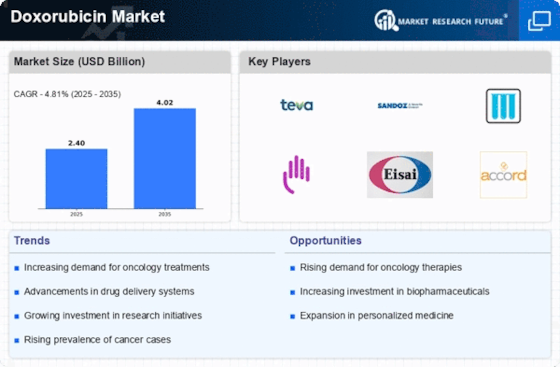
According to MRFR analysis, the Doxorubicin Market size was valued at USD 2.4 Billion in 2024. The market is projected to grow from USD 2.516 Billion in 2025 to USD 4.024 Billion by 2035, registering a CAGR of 4.81% during the forecast period 2025–2035. North America led the Doxorubicin Market with over 46% share, generating around USD 1.1 billion in revenue.
 
The Doxorubicin Market is growing steadily due to rising global cancer prevalence and increasing demand for effective chemotherapy treatments. Key trends include advancements in liposomal and targeted drug delivery systems, growing adoption of combination therapies, expansion of generic drug availability, and increasing investments in oncology research and personalized medicine approaches.
 
Global cancer incidence is rising significantly, increasing demand for chemotherapy drugs like doxorubicin used in breast cancer, leukemia, and other cancers. 

Key Market Trends & Highlights

The Doxorubicin Market is experiencing a dynamic evolution driven by innovative therapies and increasing cancer prevalence.

  • Advancements in drug formulations are enhancing the efficacy of Doxorubicin Market, particularly in North America, the largest market. There is a growing focus on combination therapies, which is becoming increasingly prevalent in the Asia-Pacific region, the fastest-growing market. The shift towards personalized medicine is influencing treatment protocols, especially in the breast cancer segment, which remains the largest. Rising incidence of cancer and increasing investment in cancer research are key drivers propelling market growth across various segments.

Market Size & Forecast

2024 Market Size 2.4 (USD Billion)
2035 Market Size 4.024 (USD Billion)
CAGR (2025 - 2035) 4.81%
Largest Regional Market Share in 2024 North America

Major Players

Companies such as Teva Pharmaceuticals (IL), Sandoz (DE), Mylan (US), Bristol-Myers Squibb (US), Eisai Co., Ltd. (JP), Accord Healthcare (GB), Fresenius Kabi (DE), Hikma Pharmaceuticals (GB), Sun Pharmaceutical Industries (IN) are some of the major participants in the global market.

Market Trends

The Doxorubicin Market is currently experiencing a dynamic phase characterized by evolving treatment protocols and increasing demand for effective cancer therapies, reinforcing positive doxorubicin market analysis outcomes. This chemotherapeutic agent, widely utilized in oncology, is gaining traction due to its efficacy against various malignancies.

The market landscape appears to be influenced by advancements in drug formulations and delivery mechanisms, particularly within the doxorubicin injection market and the expanding doxorubicin hydrochloride liposome injection market, which may enhance therapeutic outcomes and minimize adverse effects. Furthermore, the growing prevalence of cancer globally seems to be driving research and development efforts, potentially leading to innovative applications of Doxorubicin Market in combination therapies.

In addition, the regulatory environment surrounding Doxorubicin Market is evolving, with authorities emphasizing safety and efficacy in drug approval processes. This trend may encourage pharmaceutical companies to invest in clinical trials and explore novel formulations, particularly in the liposomal doxorubicin market and the expanding liposomal doxorubicin market size segment.

The Doxorubicin Market is also witnessing a shift towards personalized medicine, where treatment regimens are tailored to individual patient profiles. Such developments indicate a promising future for Doxorubicin Market, as it adapts to meet the changing needs of healthcare providers and patients alike while strengthening overall doxorubicin market growth prospects.

Advancements in Drug Formulations

Recent innovations in drug formulations are enhancing the therapeutic potential of Doxorubicin Market, especially within the liposomal doxorubicin market and doxorubicin hydrochloride liposome injection market segments. These advancements may lead to improved efficacy and reduced side effects, making treatments more tolerable for patients and positively impacting overall doxorubicin market share.

According to the World Health Organization, cancer remains a leading cause of mortality globally, accounting for nearly 10 million deaths annually, driving demand for safer and more effective chemotherapy formulations. 

Growing Focus on Combination Therapies

There is an increasing trend towards utilizing Doxorubicin Market in combination with other therapeutic agents. This approach could potentially enhance treatment outcomes and provide more comprehensive cancer care, contributing significantly to doxorubicin market trends globally.

The World Health Organization reports that cancer incidence is expected to rise to over 30 million new cases annually by 2040, encouraging the adoption of combination therapies to improve survival outcomes.

Shift Towards Personalized Medicine

The Doxorubicin Market is gradually moving towards personalized medicine, where therapies are tailored to individual patient characteristics. This trend may improve treatment effectiveness and patient satisfaction while reinforcing favorable doxorubicin market analysis insights.

Global Fund are also promoting data-driven healthcare systems, enabling more tailored treatment approaches and strengthening patient-centric care models globally.

Doxorubicin Market Market Drivers

Rising Incidence of Cancer

The increasing prevalence of cancer worldwide is a primary driver for the Doxorubicin Market. According to recent statistics, cancer cases are projected to rise significantly, with estimates suggesting that by 2040, the number of new cancer cases could reach 27.5 million annually. This alarming trend necessitates the development and availability of effective chemotherapeutic agents like Doxorubicin Market.
 
As healthcare systems strive to address this growing burden, the demand for Doxorubicin Market is likely to escalate, thereby propelling the market forward. Furthermore, the aging population, which is more susceptible to various forms of cancer, contributes to this upward trajectory. Consequently, the Doxorubicin Market is poised for substantial growth as it responds to the urgent need for effective cancer treatments.

Regulatory Approvals and Market Access

The Doxorubicin Market is also shaped by the regulatory landscape governing drug approvals. Recent trends indicate that regulatory agencies are streamlining the approval process for cancer therapies, including Doxorubicin Market formulations. This shift is particularly evident in the expedited review pathways established for breakthrough therapies.
 
As a result, new formulations of Doxorubicin Market are entering the market more rapidly, thereby increasing accessibility for patients. The approval of generic versions of Doxorubicin Market has further contributed to market expansion, making treatment more affordable. Consequently, the Doxorubicin Market is likely to benefit from these regulatory changes, which facilitate quicker access to essential cancer treatments.

Increasing Investment in Cancer Research

The Doxorubicin Market is significantly influenced by the rising investment in cancer research and development. Governments and private organizations are allocating substantial funds to explore new treatment modalities and improve existing therapies. In 2023, global spending on cancer research reached approximately 200 billion USD, with a notable portion directed towards enhancing the efficacy of established drugs like Doxorubicin Market.
 
This influx of capital not only supports clinical trials but also encourages collaborations between pharmaceutical companies and research institutions. As a result, the Doxorubicin Market is likely to experience growth driven by the continuous improvement of treatment protocols and the introduction of novel formulations that enhance patient outcomes.

Growing Awareness and Education on Cancer Treatment

The Doxorubicin Market is positively impacted by the increasing awareness and education surrounding cancer treatment options. Public health campaigns and educational initiatives are informing patients and healthcare providers about the benefits and risks associated with Doxorubicin Market. This heightened awareness is leading to more informed treatment decisions and a greater willingness to consider Doxorubicin Market as a viable option.
 
Additionally, patient advocacy groups are playing a crucial role in promoting access to effective cancer therapies. As awareness continues to grow, the demand for Doxorubicin Market is expected to rise, further driving the Doxorubicin Market. This trend underscores the importance of education in enhancing treatment uptake and improving patient outcomes.

Technological Advancements in Drug Delivery Systems

Innovations in drug delivery systems are transforming the Doxorubicin Market. Recent advancements, such as targeted delivery mechanisms and nanotechnology, enhance the efficacy and reduce the side effects of Doxorubicin Market. For instance, liposomal formulations of Doxorubicin Market have shown improved pharmacokinetics, leading to better therapeutic outcomes.
 
The market for liposomal Doxorubicin Market is expected to witness a compound annual growth rate (CAGR) of over 10% in the coming years. These technological improvements not only increase the effectiveness of Doxorubicin Market but also expand its application in various cancer types. As a result, the Doxorubicin Market is likely to benefit from these innovations, attracting investments and fostering further research and development.

Market Segment Insights

By Application: Breast Cancer (Largest) vs. Lung Cancer (Fastest-Growing)

The Doxorubicin Market is significantly driven by the application of the drug in treating breast cancer, which holds the largest market share and contributes substantially to overall doxorubicin market size. This segment's dominance is attributed to the high prevalence of breast cancer globally and the established efficacy of Doxorubicin Market in this indication. Following closely, the lung cancer segment has emerged as a major focus in recent years, reflecting an increasing recognition of the role of Doxorubicin Market in combination therapies for lung cancer patients, boosting its presence in the broader doxorubicin market.

Breast Cancer: Dominant vs. Leukemia: Emerging

Breast cancer remains the dominant segment in the market share, characterized by a robust clinical adoption and established treatment protocols that leverage the drug's effectiveness, thereby expanding doxorubicin market share. Conversely, the leukemia segment, while considered emerging, has been gaining traction due to novel combinations of Doxorubicin Market with targeted therapies, driven by the need for personalized treatment options and strengthening future doxorubicin market growth. Advances in treatment guidelines and a shift towards more nuanced approaches in leukemia therapy are contributing to its growth, making it a crucial area of investment for pharmaceutical companies.

By Formulation: Injection (Largest) vs. Lyophilized Powder (Fastest-Growing)

In the Doxorubicin Market, formulation segments play a crucial role in determining the therapeutic outcomes and patient compliance. The injection formulation currently holds the largest market share, favored for its rapid bioavailability and effective delivery of the drug. Conversely, the lyophilized powder segment is experiencing robust growth, capturing the interest of healthcare providers due to its stability and ease of storage, thereby appealing to a broader market base.

Formulation: Injection (Dominant) vs. Lyophilized Powder (Emerging)

The injection formulation of market share remains the dominant method due to its efficacy and rapid onset of action, making it the preferred choice for acute treatment scenarios. Healthcare professionals often rely on injections for their speed and reliability in delivering the necessary dosage directly into the bloodstream. Meanwhile, lyophilized powder is emerging as a strong contender, particularly in markets where stability and storage conditions are a concern. This formulation allows for longer shelf life and better handling logistics, thus driving its adoption in outpatient settings and expanding treatment options for oncologists.

By Distribution Channel: Hospital Pharmacy (Largest) vs. Online Pharmacy (Fastest-Growing)

In the Doxorubicin Market, the distribution among various channels reveals that Hospital Pharmacies hold the largest share. With their established presence and integral role in patient care, they significantly contribute to the overall sales. Conversely, Online Pharmacies are on an upward trajectory, capitalizing on the growing trend of e-commerce, providing convenient access to treatments and appealing to a tech-savvy demographic. This shift is leading to a rise in their market share as more patients prefer the flexibility of online purchasing. The growth trends in this segment highlight the evolving landscape of pharmaceutical distribution. Hospital Pharmacies are benefited by their trust and reliability, often being the primary source for patients in need of Doxorubicin Market. In contrast, Online Pharmacies are driven by factors such as increased internet penetration and changing consumer preferences towards home delivery and remote consultations, making them a fast-growing segment in the market. This transition is indicative of a broader trend towards digitalization in healthcare, which could transform the way patients obtain their medications.

Hospital Pharmacy (Dominant) vs. Online Pharmacy (Emerging)

Hospital Pharmacies are recognized as the dominant force in the market share, offering the advantage of on-site healthcare professionals who ensure proper medication administration and patient safety. Their long-established relationships with healthcare providers facilitate a steady demand for Doxorubicin Market, making them a crucial part of the distribution network. On the other hand, Online Pharmacies, characterized as an emerging segment, are rapidly gaining traction due to the increasing preference for digital health solutions. They provide patients with convenience and accessibility, featuring user-friendly platforms that streamline the purchasing process. This shift is reshaping traditional pharmacy dynamics, as online channels cater to patients seeking discreet and efficient options for accessing Doxorubicin Market.

By End-Use: Hospitals (Largest) vs. Cancer Research Institutes (Fastest-Growing)

In the Doxorubicin Market, the distribution of market share among end-use segments reveals that hospitals are the dominant players, utilizing Doxorubicin Market for a vast range of cancer treatments. They account for a significant portion of the market, primarily due to their capacity to administer chemotherapy to a large number of patients efficiently. Conversely, cancer research institutes, while currently holding a smaller share, are rapidly gaining momentum due to increased funding for cancer research and development initiatives.

Hospitals (Dominant) vs. Cancer Research Institutes (Emerging)

Hospitals play a central role in the market share, serving as primary providers of cancer treatment where Doxorubicin Market is used extensively. They possess the necessary infrastructure, medical expertise, and patient access that make them the leading end-user in this market. On the other hand, cancer research institutes serve as emerging players, focusing on innovative applications of Doxorubicin Market in clinical trials and cutting-edge research. Their contributions are becoming increasingly vital, as advancements in treatment protocols and personalized medicine are driving growth and interest, positioning them as a key component of the evolving landscape in cancer therapeutics.

Get more detailed insights about Doxorubicin Market Research Report – Global Forecast till 2035

Regional Insights

The Doxorubicin Market revenue is projected to experience steady growth, with regional segmentation revealing vital insights into market dynamics. In 2023, North America leads in the Doxorubicin Market, accounting for over 46% of the global revenue in 2024, reflecting its dominant position due to advanced healthcare infrastructure and high cancer treatment expenditures. Europe follows with a valuation of 0.61 USD Billion, showing strong demand for innovative oncology therapies.

The APAC region, worth 0.46 USD Billion in 2023, is gaining traction thanks to increasing healthcare investments and rising cancer prevalence.South America, valued at 0.18 USD Billion, indicates a growing awareness of oncology pharmaceuticals, albeit being the least dominant sector.

The Middle East and Africa (MEA) trails with a valuation of 0.12 USD Billion, facing challenges such as limited healthcare access and economic constraints. Overall, the Doxorubicin Market statistics reflect significant opportunities in North America and Europe, while APAC shows potential due to demographic shifts and improving healthcare facilities, with a forecast of an expanding market landscape across these diverse regions.

Source- Primary Research, Secondary Research, MRFR Database and Analyst Review

Key Players and Competitive Insights

The Doxorubicin Market is characterized by intense competition as it plays a pivotal role in the oncology sector, specifically in the treatment of various cancers. This market is driven by the increasing demand for effective chemotherapeutic agents and the ongoing advancements in drug formulations and delivery methods. The competitive landscape is largely influenced by the presence of numerous pharmaceutical companies engaged in research and development to create innovative products aimed at improving patient outcomes.
 
As companies strive to gain market share, strategic collaborations, mergers, and acquisitions are common, allowing players to leverage each other's strengths to enhance their product offerings.Additionally, the growing number of approvals for biosimilars and generics is reshaping the competitive dynamics, challenging well-established branded products and creating opportunities for new entrants.Bristol-Myers Squibb stands out in the Doxorubicin Market due to its extensive experience and strong reputation within the pharmaceutical industry.
 
The company has a robust research and development pipeline, focusing on innovative oncology therapies that effectively address various cancer types. Bristol-Myers Squibb has established a solid market presence, capitalizing on its brand recognition and loyal customer base. The company's commitment to scientific innovation allows it to maintain a competitive edge, with significant investments in clinical trials that enhance the efficacy and safety profile of its Doxorubicin Market products.Furthermore, an established distribution network aids in ensuring availability across various regions, increasing accessibility for healthcare providers and patients alike.
 
The emphasis on building strong relationships with healthcare professionals contributes to the company's consistent presence in oncology treatment discussions and guidelines.Dr. Reddy's Laboratories is another significant player in the Doxorubicin Market, leveraging its expertise in generics and biosimilars to expand its oncology portfolio. With a strong focus on affordability, Dr. Reddy offers high-quality Doxorubicin Market formulations that cater to a broad spectrum of patients, especially in emerging markets where cost-effectiveness is crucial.The company's commitment to rigorous quality control and compliance with international manufacturing standards fortifies its reputation.
 
Dr. Reddy's Laboratories utilizes a strategic approach to engage with healthcare professionals, thereby enhancing its visibility and credibility in the oncology space. Its ability to rapidly adapt to market needs and regulatory changes allows it to capitalize on opportunities, maintaining a solid foothold in the Doxorubicin Market sector while striving to contribute effectively to the global fight against cancer.

Key Companies in the Doxorubicin Market include

Industry Developments

Recent news developments in the Doxorubicin Market include significant collaborations and advancements in manufacturing processes among key players such as Bristol-Myers Squibb, Dr. Reddy's Laboratories, and Teva Pharmaceuticals. These companies are increasing production capacity in response to rising demand for Doxorubicin Market for cancer treatment, especially in emerging markets.

There has been a notable growth segment concentrated on generics from Accord Healthcare and Lupin Pharmaceuticals, further diversifying the market representation and affordability of Doxorubicin Market.In terms of mergers and acquisitions, companies such as Aurobindo Pharma and Sandoz are exploring strategic alliances to bolster their market presence and accelerate drug development within this therapeutic area.

Furthermore, Pfizer and Novartis are investing in innovative delivery methods, enhancing patient compliance and treatment efficacy, which has positively impacted their market valuations. Overall, the competitive landscape is seeing shifts influenced by robust research and strategic collaborations among these key players, effectively reshaping the dynamics within the Doxorubicin Market.

Future Outlook

Doxorubicin Market Future Outlook

The Doxorubicin Market is projected to reach USD 4.024 Billion by 2035, growing at a CAGR of 4.81%, driven by increasing cancer prevalence, advancements in drug formulations, and expanding healthcare access.

New opportunities lie in:

  • <p>Development of combination therapies to enhance efficacy and reduce side effects.</p>
  • <p> </p>
  • <p>Expansion into emerging markets with tailored pricing strategies.</p>
  • <p>Investment in digital health technologies for patient monitoring and adherence.</p>

By 2035, the Doxorubicin Market is expected to solidify its position as a key player in oncology therapeutics.

Market Segmentation

Doxorubicin Market End-Use Outlook

  • Hospitals
  • Cancer Research Institutes
  • Homecare

Doxorubicin Market Application Outlook

  • Breast Cancer
  • Lung Cancer
  • Leukemia
  • Ovarian Cancer

Doxorubicin Market Formulation Outlook

  • Injection
  • Lyophilized Powder
  • Tablet

Doxorubicin Market Distribution Channel Outlook

  • Hospital Pharmacy
  • Retail Pharmacy
  • Online Pharmacy

Report Scope

MARKET SIZE 2024 2.4(USD Billion)
MARKET SIZE 2025 2.516(USD Billion)
MARKET SIZE 2035 4.024(USD Billion)
COMPOUND ANNUAL GROWTH RATE (CAGR) 4.81% (2025 - 2035)
REPORT COVERAGE Revenue Forecast, Competitive Landscape, Growth Factors, and Trends
BASE YEAR 2024
Market Forecast Period 2025 - 2035
Historical Data 2019 - 2024
Market Forecast Units USD Billion
Key Companies Profiled Teva Pharmaceuticals (IL), Sandoz (DE), Mylan (US), Bristol-Myers Squibb (US), Eisai Co., Ltd. (JP), Accord Healthcare (GB), Fresenius Kabi (DE), Hikma Pharmaceuticals (GB), Sun Pharmaceutical Industries (IN)
Segments Covered Application, Formulation, Distribution Channel, End Use, Regional
Key Market Opportunities Emerging targeted therapies enhance Doxorubicin Market potential through improved efficacy and reduced side effects.
Key Market Dynamics Rising demand for Doxorubicin driven by advancements in cancer treatment and increasing patient populations.
Countries Covered North America, Europe, APAC, South America, MEA

FAQs

What is the projected market valuation of Doxorubicin by 2035?

<p>The projected market valuation of Doxorubicin is expected to reach 4.024 USD Billion by 2035.</p>

What was the overall market valuation of Doxorubicin in 2024?

<p>The overall market valuation of Doxorubicin was 2.4 USD Billion in 2024.</p>

What is the expected CAGR for the Doxorubicin Market during the forecast period 2025 - 2035?

<p>The expected CAGR for the Doxorubicin Market during the forecast period 2025 - 2035 is 4.81%.</p>

Which application segment is projected to have the highest valuation in 2035?

<p>The Breast Cancer application segment is projected to reach 1.6 USD Billion by 2035.</p>

What are the key formulations of Doxorubicin and their projected valuations?

<p>The Injection formulation is expected to reach 1.6 USD Billion, while both Lyophilized Powder and Tablet formulations are projected to reach 1.2 USD Billion by 2035.</p>

Which distribution channel is anticipated to show significant growth by 2035?

<p>The Hospital Pharmacy distribution channel is anticipated to grow to 1.6 USD Billion by 2035.</p>

What end-use segment is expected to dominate the Doxorubicin Market by 2035?

<p>The Hospitals end-use segment is expected to dominate, reaching 1.6 USD Billion by 2035.</p>

Who are the key players in the Doxorubicin Market?

<p>Key players in the Doxorubicin Market include Teva Pharmaceuticals, Sandoz, Mylan, and Bristol-Myers Squibb.</p>

What is the projected valuation for the Leukemia application segment by 2035?

<p>The Leukemia application segment is projected to reach 0.8 USD Billion by 2035.</p>

How does the market for Online Pharmacy distribution compare to others by 2035?

<p>The Online Pharmacy distribution channel is projected to reach approximately 1.224 USD Billion by 2035, indicating notable growth.</p>

  1. SECTION I: EXECUTIVE SUMMARY AND KEY HIGHLIGHTS |
    1. EXECUTIVE SUMMARY | |
      1. Market Overview | |
      2. Key Findings | |
      3. Market Segmentation | |
      4. Competitive Landscape | |
      5. Challenges and Opportunities | |
      6. Future Outlook 2
  2. SECTION II: SCOPING, METHODOLOGY AND MARKET STRUCTURE |
    1. MARKET INTRODUCTION | |
      1. Definition | |
      2. Scope of the study | | |
    2. RESEARCH METHODOLOGY | |
      1. Overview | |
      2. Data Mining | |
      3. Secondary Research | |
      4. Primary Research | | |
      5. Forecasting Model | |
      6. Market Size Estimation | | |
      7. Data Triangulation | |
      8. Validation 3
  3. SECTION III: QUALITATIVE ANALYSIS |
    1. MARKET DYNAMICS | |
      1. Overview | |
      2. Drivers | |
      3. Restraints | |
      4. Opportunities |
    2. MARKET FACTOR ANALYSIS | |
      1. Value chain Analysis | |
      2. Porter's Five Forces Analysis | | |
      3. COVID-19 Impact Analysis | | |
  4. SECTION IV: QUANTITATIVE ANALYSIS |
    1. Healthcare, BY Application (USD Billion) | |
      1. Breast Cancer | |
      2. Lung Cancer | |
      3. Leukemia | |
      4. Ovarian Cancer |
    2. Healthcare, BY Formulation (USD Billion) | |
      1. Injection | |
      2. Lyophilized Powder | |
      3. Tablet |
    3. Healthcare, BY Distribution Channel (USD Billion) | |
      1. Hospital Pharmacy | |
      2. Retail Pharmacy | |
      3. Online Pharmacy |
    4. Healthcare, BY End-Use (USD Billion) | |
      1. Hospitals | |
      2. Cancer Research Institutes | |
      3. Homecare |
    5. Healthcare, BY Region (USD Billion) | |
      1. North America | | |
      2. Europe | | |
      3. APAC | | |
      4. South America | | |
      5. MEA | | |
  5. SECTION V: COMPETITIVE ANALYSIS |
    1. Competitive Landscape | |
      1. Overview | |
      2. Competitive Analysis | |
      3. Market share Analysis | |
      4. Major Growth Strategy in the Healthcare | |
      5. Competitive Benchmarking | |
      6. Leading Players in Terms of Number of Developments in the Healthcare | |
      7. Key developments and growth strategies | | |
      8. Major Players Financial Matrix | | |
    2. Company Profiles | |
      1. Teva Pharmaceuticals (IL) | | |
      2. Sandoz (DE) | | |
      3. Mylan (US) | | |
      4. Bristol-Myers Squibb (US) | | |
      5. Eisai Co., Ltd. (JP) | | |
      6. Accord Healthcare (GB) | | |
      7. Fresenius Kabi (DE) | | |
      8. Hikma Pharmaceuticals (GB) | | |
      9. Sun Pharmaceutical Industries (IN) | | |
    3. Appendix | |
      1. References | |
      2. Related Reports 6 LIST OF FIGURES |
    4. MARKET SYNOPSIS |
    5. NORTH AMERICA MARKET ANALYSIS |
    6. US MARKET ANALYSIS BY APPLICATION |
    7. US MARKET ANALYSIS BY FORMULATION |
    8. US MARKET ANALYSIS BY DISTRIBUTION CHANNEL |
    9. US MARKET ANALYSIS BY END-USE |
    10. CANADA MARKET ANALYSIS BY APPLICATION |
    11. CANADA MARKET ANALYSIS BY FORMULATION |
    12. CANADA MARKET ANALYSIS BY DISTRIBUTION CHANNEL |
    13. CANADA MARKET ANALYSIS BY END-USE |
    14. EUROPE MARKET ANALYSIS |
    15. GERMANY MARKET ANALYSIS BY APPLICATION |
    16. GERMANY MARKET ANALYSIS BY FORMULATION |
    17. GERMANY MARKET ANALYSIS BY DISTRIBUTION CHANNEL |
    18. GERMANY MARKET ANALYSIS BY END-USE |
    19. UK MARKET ANALYSIS BY APPLICATION |
    20. UK MARKET ANALYSIS BY FORMULATION |
    21. UK MARKET ANALYSIS BY DISTRIBUTION CHANNEL |
    22. UK MARKET ANALYSIS BY END-USE |
    23. FRANCE MARKET ANALYSIS BY APPLICATION |
    24. FRANCE MARKET ANALYSIS BY FORMULATION |
    25. FRANCE MARKET ANALYSIS BY DISTRIBUTION CHANNEL |
    26. FRANCE MARKET ANALYSIS BY END-USE |
    27. RUSSIA MARKET ANALYSIS BY APPLICATION |
    28. RUSSIA MARKET ANALYSIS BY FORMULATION |
    29. RUSSIA MARKET ANALYSIS BY DISTRIBUTION CHANNEL |
    30. RUSSIA MARKET ANALYSIS BY END-USE |
    31. ITALY MARKET ANALYSIS BY APPLICATION |
    32. ITALY MARKET ANALYSIS BY FORMULATION |
    33. ITALY MARKET ANALYSIS BY DISTRIBUTION CHANNEL |
    34. ITALY MARKET ANALYSIS BY END-USE |
    35. SPAIN MARKET ANALYSIS BY APPLICATION |
    36. SPAIN MARKET ANALYSIS BY FORMULATION |
    37. SPAIN MARKET ANALYSIS BY DISTRIBUTION CHANNEL |
    38. SPAIN MARKET ANALYSIS BY END-USE |
    39. REST OF EUROPE MARKET ANALYSIS BY APPLICATION |
    40. REST OF EUROPE MARKET ANALYSIS BY FORMULATION |
    41. REST OF EUROPE MARKET ANALYSIS BY DISTRIBUTION CHANNEL |
    42. REST OF EUROPE MARKET ANALYSIS BY END-USE |
    43. APAC MARKET ANALYSIS |
    44. CHINA MARKET ANALYSIS BY APPLICATION |
    45. CHINA MARKET ANALYSIS BY FORMULATION |
    46. CHINA MARKET ANALYSIS BY DISTRIBUTION CHANNEL |
    47. CHINA MARKET ANALYSIS BY END-USE |
    48. INDIA MARKET ANALYSIS BY APPLICATION |
    49. INDIA MARKET ANALYSIS BY FORMULATION |
    50. INDIA MARKET ANALYSIS BY DISTRIBUTION CHANNEL |
    51. INDIA MARKET ANALYSIS BY END-USE |
    52. JAPAN MARKET ANALYSIS BY APPLICATION |
    53. JAPAN MARKET ANALYSIS BY FORMULATION |
    54. JAPAN MARKET ANALYSIS BY DISTRIBUTION CHANNEL |
    55. JAPAN MARKET ANALYSIS BY END-USE |
    56. SOUTH KOREA MARKET ANALYSIS BY APPLICATION |
    57. SOUTH KOREA MARKET ANALYSIS BY FORMULATION |
    58. SOUTH KOREA MARKET ANALYSIS BY DISTRIBUTION CHANNEL |
    59. SOUTH KOREA MARKET ANALYSIS BY END-USE |
    60. MALAYSIA MARKET ANALYSIS BY APPLICATION |
    61. MALAYSIA MARKET ANALYSIS BY FORMULATION |
    62. MALAYSIA MARKET ANALYSIS BY DISTRIBUTION CHANNEL |
    63. MALAYSIA MARKET ANALYSIS BY END-USE |
    64. THAILAND MARKET ANALYSIS BY APPLICATION |
    65. THAILAND MARKET ANALYSIS BY FORMULATION |
    66. THAILAND MARKET ANALYSIS BY DISTRIBUTION CHANNEL |
    67. THAILAND MARKET ANALYSIS BY END-USE |
    68. INDONESIA MARKET ANALYSIS BY APPLICATION |
    69. INDONESIA MARKET ANALYSIS BY FORMULATION |
    70. INDONESIA MARKET ANALYSIS BY DISTRIBUTION CHANNEL |
    71. INDONESIA MARKET ANALYSIS BY END-USE |
    72. REST OF APAC MARKET ANALYSIS BY APPLICATION |
    73. REST OF APAC MARKET ANALYSIS BY FORMULATION |
    74. REST OF APAC MARKET ANALYSIS BY DISTRIBUTION CHANNEL |
    75. REST OF APAC MARKET ANALYSIS BY END-USE |
    76. SOUTH AMERICA MARKET ANALYSIS |
    77. BRAZIL MARKET ANALYSIS BY APPLICATION |
    78. BRAZIL MARKET ANALYSIS BY FORMULATION |
    79. BRAZIL MARKET ANALYSIS BY DISTRIBUTION CHANNEL |
    80. BRAZIL MARKET ANALYSIS BY END-USE |
    81. MEXICO MARKET ANALYSIS BY APPLICATION |
    82. MEXICO MARKET ANALYSIS BY FORMULATION |
    83. MEXICO MARKET ANALYSIS BY DISTRIBUTION CHANNEL |
    84. MEXICO MARKET ANALYSIS BY END-USE |
    85. ARGENTINA MARKET ANALYSIS BY APPLICATION |
    86. ARGENTINA MARKET ANALYSIS BY FORMULATION |
    87. ARGENTINA MARKET ANALYSIS BY DISTRIBUTION CHANNEL |
    88. ARGENTINA MARKET ANALYSIS BY END-USE |
    89. REST OF SOUTH AMERICA MARKET ANALYSIS BY APPLICATION |
    90. REST OF SOUTH AMERICA MARKET ANALYSIS BY FORMULATION |
    91. REST OF SOUTH AMERICA MARKET ANALYSIS BY DISTRIBUTION CHANNEL |
    92. REST OF SOUTH AMERICA MARKET ANALYSIS BY END-USE |
    93. MEA MARKET ANALYSIS |
    94. GCC COUNTRIES MARKET ANALYSIS BY APPLICATION |
    95. GCC COUNTRIES MARKET ANALYSIS BY FORMULATION |
    96. GCC COUNTRIES MARKET ANALYSIS BY DISTRIBUTION CHANNEL |
    97. GCC COUNTRIES MARKET ANALYSIS BY END-USE |
    98. SOUTH AFRICA MARKET ANALYSIS BY APPLICATION |
    99. SOUTH AFRICA MARKET ANALYSIS BY FORMULATION |
    100. SOUTH AFRICA MARKET ANALYSIS BY DISTRIBUTION CHANNEL |
    101. SOUTH AFRICA MARKET ANALYSIS BY END-USE |
    102. REST OF MEA MARKET ANALYSIS BY APPLICATION |
    103. REST OF MEA MARKET ANALYSIS BY FORMULATION |
    104. REST OF MEA MARKET ANALYSIS BY DISTRIBUTION CHANNEL |
    105. REST OF MEA MARKET ANALYSIS BY END-USE |
    106. KEY BUYING CRITERIA OF HEALTHCARE |
    107. RESEARCH PROCESS OF MRFR |
    108. DRO ANALYSIS OF HEALTHCARE |
    109. DRIVERS IMPACT ANALYSIS: HEALTHCARE |
    110. RESTRAINTS IMPACT ANALYSIS: HEALTHCARE |
    111. SUPPLY / VALUE CHAIN: HEALTHCARE |
    112. HEALTHCARE, BY APPLICATION, 2024 (% SHARE) |
    113. HEALTHCARE, BY APPLICATION, 2024 TO 2035 (USD Billion) |
    114. HEALTHCARE, BY FORMULATION, 2024 (% SHARE) |
    115. HEALTHCARE, BY FORMULATION, 2024 TO 2035 (USD Billion) |
    116. HEALTHCARE, BY DISTRIBUTION CHANNEL, 2024 (% SHARE) |
    117. HEALTHCARE, BY DISTRIBUTION CHANNEL, 2024 TO 2035 (USD Billion) |
    118. HEALTHCARE, BY END-USE, 2024 (% SHARE) |
    119. HEALTHCARE, BY END-USE, 2024 TO 2035 (USD Billion) |
    120. BENCHMARKING OF MAJOR COMPETITORS 7 LIST OF TABLES |
    121. LIST OF ASSUMPTIONS | |
      1. |
    122. North America MARKET SIZE ESTIMATES; FORECAST | |
      1. BY APPLICATION, 2025-2035 (USD Billion) | |
      2. BY FORMULATION, 2025-2035 (USD Billion) | |
      3. BY DISTRIBUTION CHANNEL, 2025-2035 (USD Billion) | |
      4. BY END-USE, 2025-2035 (USD Billion) |
    123. US MARKET SIZE ESTIMATES; FORECAST | |
      1. BY APPLICATION, 2025-2035 (USD Billion) | |
      2. BY FORMULATION, 2025-2035 (USD Billion) | |
      3. BY DISTRIBUTION CHANNEL, 2025-2035 (USD Billion) | |
      4. BY END-USE, 2025-2035 (USD Billion) |
    124. Canada MARKET SIZE ESTIMATES; FORECAST | |
      1. BY APPLICATION, 2025-2035 (USD Billion) | |
      2. BY FORMULATION, 2025-2035 (USD Billion) | |
      3. BY DISTRIBUTION CHANNEL, 2025-2035 (USD Billion) | |
      4. BY END-USE, 2025-2035 (USD Billion) |
    125. Europe MARKET SIZE ESTIMATES; FORECAST | |
      1. BY APPLICATION, 2025-2035 (USD Billion) | |
      2. BY FORMULATION, 2025-2035 (USD Billion) | |
      3. BY DISTRIBUTION CHANNEL, 2025-2035 (USD Billion) | |
      4. BY END-USE, 2025-2035 (USD Billion) |
    126. Germany MARKET SIZE ESTIMATES; FORECAST | |
      1. BY APPLICATION, 2025-2035 (USD Billion) | |
      2. BY FORMULATION, 2025-2035 (USD Billion) | |
      3. BY DISTRIBUTION CHANNEL, 2025-2035 (USD Billion) | |
      4. BY END-USE, 2025-2035 (USD Billion) |
    127. UK MARKET SIZE ESTIMATES; FORECAST | |
      1. BY APPLICATION, 2025-2035 (USD Billion) | |
      2. BY FORMULATION, 2025-2035 (USD Billion) | |
      3. BY DISTRIBUTION CHANNEL, 2025-2035 (USD Billion) | |
      4. BY END-USE, 2025-2035 (USD Billion) |
    128. France MARKET SIZE ESTIMATES; FORECAST | |
      1. BY APPLICATION, 2025-2035 (USD Billion) | |
      2. BY FORMULATION, 2025-2035 (USD Billion) | |
      3. BY DISTRIBUTION CHANNEL, 2025-2035 (USD Billion) | |
      4. BY END-USE, 2025-2035 (USD Billion) |
    129. Russia MARKET SIZE ESTIMATES; FORECAST | |
      1. BY APPLICATION, 2025-2035 (USD Billion) | |
      2. BY FORMULATION, 2025-2035 (USD Billion) | |
      3. BY DISTRIBUTION CHANNEL, 2025-2035 (USD Billion) | |
      4. BY END-USE, 2025-2035 (USD Billion) |
    130. Italy MARKET SIZE ESTIMATES; FORECAST | |
      1. BY APPLICATION, 2025-2035 (USD Billion) | |
      2. BY FORMULATION, 2025-2035 (USD Billion) | |
      3. BY DISTRIBUTION CHANNEL, 2025-2035 (USD Billion) | |
      4. BY END-USE, 2025-2035 (USD Billion) |
    131. Spain MARKET SIZE ESTIMATES; FORECAST | |
      1. BY APPLICATION, 2025-2035 (USD Billion) | |
      2. BY FORMULATION, 2025-2035 (USD Billion) | |
      3. BY DISTRIBUTION CHANNEL, 2025-2035 (USD Billion) | |
      4. BY END-USE, 2025-2035 (USD Billion) |
    132. Rest of Europe MARKET SIZE ESTIMATES; FORECAST | |
      1. BY APPLICATION, 2025-2035 (USD Billion) | |
      2. BY FORMULATION, 2025-2035 (USD Billion) | |
      3. BY DISTRIBUTION CHANNEL, 2025-2035 (USD Billion) | |
      4. BY END-USE, 2025-2035 (USD Billion) |
    133. APAC MARKET SIZE ESTIMATES; FORECAST | |
      1. BY APPLICATION, 2025-2035 (USD Billion) | |
      2. BY FORMULATION, 2025-2035 (USD Billion) | |
      3. BY DISTRIBUTION CHANNEL, 2025-2035 (USD Billion) | |
      4. BY END-USE, 2025-2035 (USD Billion) |
    134. China MARKET SIZE ESTIMATES; FORECAST | |
      1. BY APPLICATION, 2025-2035 (USD Billion) | |
      2. BY FORMULATION, 2025-2035 (USD Billion) | |
      3. BY DISTRIBUTION CHANNEL, 2025-2035 (USD Billion) | |
      4. BY END-USE, 2025-2035 (USD Billion) |
    135. India MARKET SIZE ESTIMATES; FORECAST | |
      1. BY APPLICATION, 2025-2035 (USD Billion) | |
      2. BY FORMULATION, 2025-2035 (USD Billion) | |
      3. BY DISTRIBUTION CHANNEL, 2025-2035 (USD Billion) | |
      4. BY END-USE, 2025-2035 (USD Billion) |
    136. Japan MARKET SIZE ESTIMATES; FORECAST | |
      1. BY APPLICATION, 2025-2035 (USD Billion) | |
      2. BY FORMULATION, 2025-2035 (USD Billion) | |
      3. BY DISTRIBUTION CHANNEL, 2025-2035 (USD Billion) | |
      4. BY END-USE, 2025-2035 (USD Billion) |
    137. South Korea MARKET SIZE ESTIMATES; FORECAST | |
      1. BY APPLICATION, 2025-2035 (USD Billion) | |
      2. BY FORMULATION, 2025-2035 (USD Billion) | |
      3. BY DISTRIBUTION CHANNEL, 2025-2035 (USD Billion) | |
      4. BY END-USE, 2025-2035 (USD Billion) |
    138. Malaysia MARKET SIZE ESTIMATES; FORECAST | |
      1. BY APPLICATION, 2025-2035 (USD Billion) | |
      2. BY FORMULATION, 2025-2035 (USD Billion) | |
      3. BY DISTRIBUTION CHANNEL, 2025-2035 (USD Billion) | |
      4. BY END-USE, 2025-2035 (USD Billion) |
    139. Thailand MARKET SIZE ESTIMATES; FORECAST | |
      1. BY APPLICATION, 2025-2035 (USD Billion) | |
      2. BY FORMULATION, 2025-2035 (USD Billion) | |
      3. BY DISTRIBUTION CHANNEL, 2025-2035 (USD Billion) | |
      4. BY END-USE, 2025-2035 (USD Billion) |
    140. Indonesia MARKET SIZE ESTIMATES; FORECAST | |
      1. BY APPLICATION, 2025-2035 (USD Billion) | |
      2. BY FORMULATION, 2025-2035 (USD Billion) | |
      3. BY DISTRIBUTION CHANNEL, 2025-2035 (USD Billion) | |
      4. BY END-USE, 2025-2035 (USD Billion) |
    141. Rest of APAC MARKET SIZE ESTIMATES; FORECAST | |
      1. BY APPLICATION, 2025-2035 (USD Billion) | |
      2. BY FORMULATION, 2025-2035 (USD Billion) | |
      3. BY DISTRIBUTION CHANNEL, 2025-2035 (USD Billion) | |
      4. BY END-USE, 2025-2035 (USD Billion) |
    142. South America MARKET SIZE ESTIMATES; FORECAST | |
      1. BY APPLICATION, 2025-2035 (USD Billion) | |
      2. BY FORMULATION, 2025-2035 (USD Billion) | |
      3. BY DISTRIBUTION CHANNEL, 2025-2035 (USD Billion) | |
      4. BY END-USE, 2025-2035 (USD Billion) |
    143. Brazil MARKET SIZE ESTIMATES; FORECAST | |
      1. BY APPLICATION, 2025-2035 (USD Billion) | |
      2. BY FORMULATION, 2025-2035 (USD Billion) | |
      3. BY DISTRIBUTION CHANNEL, 2025-2035 (USD Billion) | |
      4. BY END-USE, 2025-2035 (USD Billion) |
    144. Mexico MARKET SIZE ESTIMATES; FORECAST | |
      1. BY APPLICATION, 2025-2035 (USD Billion) | |
      2. BY FORMULATION, 2025-2035 (USD Billion) | |
      3. BY DISTRIBUTION CHANNEL, 2025-2035 (USD Billion) | |
      4. BY END-USE, 2025-2035 (USD Billion) |
    145. Argentina MARKET SIZE ESTIMATES; FORECAST | |
      1. BY APPLICATION, 2025-2035 (USD Billion) | |
      2. BY FORMULATION, 2025-2035 (USD Billion) | |
      3. BY DISTRIBUTION CHANNEL, 2025-2035 (USD Billion) | |
      4. BY END-USE, 2025-2035 (USD Billion) |
    146. Rest of South America MARKET SIZE ESTIMATES; FORECAST | |
      1. BY APPLICATION, 2025-2035 (USD Billion) | |
      2. BY FORMULATION, 2025-2035 (USD Billion) | |
      3. BY DISTRIBUTION CHANNEL, 2025-2035 (USD Billion) | |
      4. BY END-USE, 2025-2035 (USD Billion) |
    147. MEA MARKET SIZE ESTIMATES; FORECAST | |
      1. BY APPLICATION, 2025-2035 (USD Billion) | |
      2. BY FORMULATION, 2025-2035 (USD Billion) | |
      3. BY DISTRIBUTION CHANNEL, 2025-2035 (USD Billion) | |
      4. BY END-USE, 2025-2035 (USD Billion) |
    148. GCC Countries MARKET SIZE ESTIMATES; FORECAST | |
      1. BY APPLICATION, 2025-2035 (USD Billion) | |
      2. BY FORMULATION, 2025-2035 (USD Billion) | |
      3. BY DISTRIBUTION CHANNEL, 2025-2035 (USD Billion) | |
      4. BY END-USE, 2025-2035 (USD Billion) |
    149. South Africa MARKET SIZE ESTIMATES; FORECAST | |
      1. BY APPLICATION, 2025-2035 (USD Billion) | |
      2. BY FORMULATION, 2025-2035 (USD Billion) | |
      3. BY DISTRIBUTION CHANNEL, 2025-2035 (USD Billion) | |
      4. BY END-USE, 2025-2035 (USD Billion) |
    150. Rest of MEA MARKET SIZE ESTIMATES; FORECAST | |
      1. BY APPLICATION, 2025-2035 (USD Billion) | |
      2. BY FORMULATION, 2025-2035 (USD Billion) | |
      3. BY DISTRIBUTION CHANNEL, 2025-2035 (USD Billion) | |
      4. BY END-USE, 2025-2035 (USD Billion) |
    151. PRODUCT LAUNCH/PRODUCT DEVELOPMENT/APPROVAL | |
      1. |
    152. ACQUISITION/PARTNERSHIP | |

Healthcare Market Segmentation

Healthcare By Application (USD Billion, 2025-2035)

  • Breast Cancer
  • Lung Cancer
  • Leukemia
  • Ovarian Cancer

Healthcare By Formulation (USD Billion, 2025-2035)

  • Injection
  • Lyophilized Powder
  • Tablet

Healthcare By Distribution Channel (USD Billion, 2025-2035)

  • Hospital Pharmacy
  • Retail Pharmacy
  • Online Pharmacy

Healthcare By End-Use (USD Billion, 2025-2035)

  • Hospitals
  • Cancer Research Institutes
  • Homecare
Infographic

Free Sample Request

Kindly complete the form below to receive a free sample of this Report

Get Free Sample

Customer Strories

Compare Licence

×
Features License Type
Single User Multiuser License Enterprise User
Price $4,950 $5,950 $7,250
Maximum User Access Limit 1 User Upto 10 Users Unrestricted Access Throughout the Organization
Free Customization
Direct Access to Analyst
Deliverable Format
Platform Access
Discount on Next Purchase 10% 15% 15%
Printable Versions
%>