Request Free Sample ×

Kindly complete the form below to receive a free sample of this Report

* Please use a valid business email

Leading companies partner with us for data-driven Insights

clients tt-cursor
Hero Background
English
Chinese
French
Japanese
Korean
German
Spanish

Doppler Ultrasound Market Trends

ID: MRFR/HC/6889-HCR
111 Pages
Nidhi Mandole
Last Updated: April 06, 2026

Doppler Ultrasound Market Research Report: Size, Share, Trend Analysis By Technology (Color Doppler Ultrasound, Power Doppler Ultrasound, Spectral Doppler Ultrasound, Continuous Wave Doppler Ultrasound), By Applications (Cardiology, Obstetrics and Gynecology, Vascular Imaging, Ophthalmology), By End Use (Hospitals, Diagnostic Imaging Centers, Ambulatory Surgical Centers, Research Institutions), By Product Type (Portable Doppler Ultrasound Devices, Standalone Doppler Ultrasound Systems, Wearable Doppler Ultrasound Devices) and By Regional (North America, Europe, South America, Asia-Pacific, Middle East and Africa) - Growth Outlook & Industry Forecast 2025 To 2035

Share:
Download PDF ×

We do not share your information with anyone. However, we may send you emails based on your report interest from time to time. You may contact us at any time to opt-out.

Doppler Ultrasound Market Infographic
Purchase Options

Market Trends

Key Emerging Trends in the Doppler Ultrasound Market

Doppler ultrasonography is developing rapidly due to medical imaging technology advances. Doppler ultrasonography checks blood flow and diagnoses abnormalities in numerous medical scenarios. Growing Doppler ultrasound instrument technology is a commercial trend. NEW features including color Doppler imaging, three-dimensional and four-dimensional imaging, and compact instruments increase diagnostic accuracy and patient outcomes. The increased number of cardiovascular disease patients is driving the doppler ultrasonography industry. Doppler ultrasonography helps physicians diagnose cardiac issues by showing blood flow in real time. This detects and treats cardiovascular issues early. Obstetrics and medicine employ Doppler ultrasonography to monitor mother and infant health. Due to increased attention, doppler ultrasonography technology is in great demand in mother-baby healthcare settings. As the population ages, we require diagnostic methods for age-related health issues. The company has grown as more elderly individuals have Doppler ultrasounds for circulation issues. Point-of-care ultrasonography is growing in healthcare. Small and easy to use, doppler ultrasonography equipment are ideal for point-of-care diagnostic and treatment choices. Doppler ultrasonography is growing increasingly popular in poorer nations strengthening their health care systems. These locations employ more doppler ultrasound technology since it's cheap and simple to procure. It helps them treat more patients. AI in Doppler ultrasound is clever for the future. AI technologies might simplify jobs, improve visual comprehension, and help physicians diagnose more accurately. This blend should also advance the industry. The major Doppler ultrasound firms are partnering and making savvy transactions to increase their product ranges and market dominance. Working with healthcare and research organizations helps you innovate and remain competitive in a changing sector. Quality control regulations impact the Doppler ultrasound market. Companies who invest in R&D to satisfy these requirements will have a competitive advantage and be able to guarantee product safety and success. Even in a robust market, doppler ultrasound reimbursement laws present complications. Compensation uncertainties may hinder market development, thus the firm must address them to continue growing.


Author
Author Profile
Nidhi Mandole
Senior Research Analyst

She is an extremely curious individual currently working in Healthcare and Medical Devices Domain. Nidhi is comfortably versed in data centric research backed by healthcare educational background. She leverages extensive data mining and analytics tools such as Primary and Secondary Research, Statistical Analysis, Machine Learning, Data Modelling. Her key role also involves Technical Sales Support, Client Interaction and Project management within the Healthcare team. Lastly, she showcases extensive affinity towards learning new skills and remain fascinated in implementing them.

Leave a Comment

FAQs

What is the current valuation of the Doppler Ultrasound Market as of 2024?

<p>The Doppler Ultrasound Market was valued at 3.503 USD Billion in 2024.</p>

What is the projected market size for the Doppler Ultrasound Market in 2035?

<p>The market is projected to reach 5.72 USD Billion by 2035.</p>

What is the expected CAGR for the Doppler Ultrasound Market during the forecast period 2025 - 2035?

<p>The expected CAGR for the Doppler Ultrasound Market during 2025 - 2035 is 4.56%.</p>

Which technology segment is anticipated to have the highest growth in the Doppler Ultrasound Market?

<p>The Color Doppler Ultrasound segment is expected to grow from 1.5 USD Billion in 2024 to 2.4 USD Billion by 2035.</p>

How does the Vascular Imaging application segment perform in the Doppler Ultrasound Market?

<p>The Vascular Imaging application segment was valued at 1.15 USD Billion in 2024 and is projected to reach 1.85 USD Billion by 2035.</p>

What are the key end-use segments in the Doppler Ultrasound Market?

<p>Key end-use segments include Hospitals, Diagnostic Imaging Centers, Ambulatory Surgical Centers, and Research Institutions.</p>

Which company is a leading player in the Doppler Ultrasound Market?

<p>GE Healthcare, Philips Healthcare, and Siemens Healthineers are among the leading players in the Doppler Ultrasound Market.</p>

What is the market size for Portable Doppler Ultrasound Devices in 2024?

<p>The Portable Doppler Ultrasound Devices segment was valued at 1.051 USD Billion in 2024.</p>

How does the Standalone Doppler Ultrasound Systems segment compare in size to other product types?

<p>The Standalone Doppler Ultrasound Systems segment was valued at 1.402 USD Billion in 2024, indicating substantial market presence.</p>

What is the growth outlook for the Obstetrics and Gynecology application segment?

<p>The Obstetrics and Gynecology application segment is projected to grow from 0.85 USD Billion in 2024 to 1.35 USD Billion by 2035.</p>

Market Summary

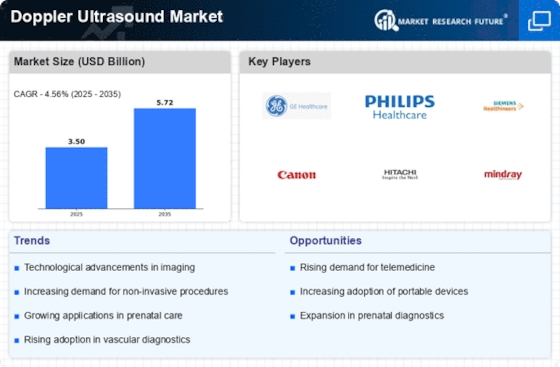
As per Market Research Future analysis, the Doppler Ultrasound Market Size was estimated at 3.503 USD Billion in 2024. The Doppler Ultrasound industry is projected to grow from 3.662 USD Billion in 2025 to 5.72 USD Billion by 2035, exhibiting a compound annual growth rate (CAGR) of 4.56% during the forecast period 2025 - 2035

Key Market Trends & Highlights

The Doppler Ultrasound Market is experiencing robust growth driven by technological advancements and increasing demand for non-invasive diagnostics.

  • North America remains the largest market for Doppler ultrasound, driven by advanced healthcare infrastructure and high adoption rates. The Asia-Pacific region is emerging as the fastest-growing market, fueled by increasing healthcare investments and rising awareness of diagnostic technologies. Color Doppler Ultrasound Market continues to dominate the market, while Power Doppler Ultrasound Market is witnessing rapid growth due to its enhanced imaging capabilities. Key market drivers include technological advancements in Doppler ultrasound and the rising prevalence of cardiovascular diseases, particularly among the aging population.

Market Size & Forecast

2024 Market Size 3.503 (USD Billion)
2035 Market Size 5.72 (USD Billion)
CAGR (2025 - 2035) 4.56%
Largest Regional Market Share in 2024 North America

Major Players

<a href="https://www.gehealthcare.in/products/ultrasound">GE Healthcare</a> (US), Philips Healthcare (NL), Siemens Healthineers (DE), Canon Medical Systems (JP), Hitachi Medical Systems (JP), Mindray (CN), Fujifilm (JP), Samsung Medison (KR), Esaote (IT)

Market Trends

The Doppler Ultrasound Market is currently experiencing a notable evolution, driven by advancements in technology and increasing demand for non-invasive diagnostic tools. The integration of artificial intelligence and machine learning into Doppler ultrasound systems appears to enhance image quality and diagnostic accuracy, thereby attracting healthcare providers seeking to improve patient outcomes. Furthermore, the growing prevalence of cardiovascular diseases and the rising geriatric population are likely to propel the adoption of Doppler ultrasound devices in clinical settings. As healthcare systems worldwide prioritize early detection and preventive care, the relevance of Doppler ultrasound technology continues to expand. In addition, the market seems to be influenced by the increasing focus on point-of-care testing, which allows for immediate results and faster clinical decision-making. This trend is particularly pertinent in emergency and critical care environments, where timely interventions can significantly impact patient survival rates. Moreover, the ongoing development of portable and handheld Doppler ultrasound devices indicates a shift towards more accessible and user-friendly solutions. As the Doppler Ultrasound Market evolves, stakeholders must remain attuned to these trends to capitalize on emerging opportunities and address the challenges posed by a dynamic healthcare landscape.

Technological Advancements

The integration of cutting-edge technologies, such as artificial intelligence and machine learning, is transforming the Doppler Ultrasound Market. These innovations enhance diagnostic capabilities, improve image clarity, and streamline workflow processes, making ultrasound systems more efficient and effective.

Rising Demand for Non-Invasive Diagnostics

There is an increasing preference for non-invasive diagnostic methods among healthcare providers and patients alike. This trend is likely to drive the adoption of Doppler ultrasound devices, as they offer safe and reliable alternatives for assessing various medical conditions without the need for invasive procedures.

Growth in Point-of-Care Testing

The shift towards point-of-care testing is gaining momentum within the Doppler Ultrasound Market. This approach allows for immediate diagnostic results, facilitating quicker clinical decisions, particularly in emergency and critical care settings, thereby enhancing patient management.

Doppler Ultrasound Market Market Drivers

Growth in Point-of-Care Testing

The expansion of point-of-care testing (POCT) is significantly influencing the Doppler Ultrasound Market. As healthcare systems strive for efficiency and rapid diagnosis, the demand for portable and user-friendly ultrasound devices is on the rise. Doppler ultrasound technology is increasingly being integrated into POCT settings, allowing for immediate assessment of patients in various environments, including emergency rooms and outpatient clinics. This trend is expected to drive market growth, with estimates suggesting a potential increase in market size by 5% annually over the next few years. The convenience and speed of point-of-care Doppler ultrasound systems are likely to enhance patient outcomes and streamline clinical workflows, making them an essential component of modern healthcare.

Rising Demand for Non-Invasive Diagnostics

The growing preference for non-invasive diagnostic methods is a key driver in the Doppler Ultrasound Market. Patients and healthcare providers alike are increasingly favoring procedures that minimize discomfort and risk. Doppler ultrasound, known for its non-invasive nature, allows for effective assessment of blood flow and vascular conditions without the need for surgical interventions. This trend is particularly evident in cardiology and obstetrics, where Doppler ultrasound is utilized for monitoring fetal health and cardiovascular conditions. The market is projected to witness a compound annual growth rate of around 7% as more healthcare facilities adopt Doppler ultrasound technology to meet the rising demand for safer diagnostic alternatives. This shift underscores the importance of non-invasive techniques in modern medical practice.

Increasing Prevalence of Cardiovascular Diseases

The rising incidence of cardiovascular diseases is a significant factor propelling the Doppler Ultrasound Market. As lifestyle-related health issues become more prevalent, the need for effective diagnostic tools to monitor and manage these conditions is paramount. Doppler ultrasound plays a crucial role in assessing blood flow and detecting abnormalities in cardiovascular function. With cardiovascular diseases being a leading cause of mortality worldwide, healthcare providers are increasingly relying on Doppler ultrasound for early detection and ongoing management. This trend is expected to contribute to a market growth rate of approximately 8% in the coming years, as more healthcare facilities invest in advanced Doppler ultrasound technologies to address the growing burden of cardiovascular health issues.

Technological Advancements in Doppler Ultrasound

The Doppler Ultrasound Market is experiencing a surge in technological advancements that enhance diagnostic capabilities. Innovations such as 3D and 4D imaging, along with portable ultrasound devices, are transforming the landscape of medical imaging. These advancements not only improve the accuracy of diagnoses but also facilitate real-time monitoring of patients. The integration of artificial intelligence in Doppler ultrasound systems is expected to streamline workflows and reduce the time required for image analysis. As a result, healthcare providers are increasingly adopting these advanced technologies, leading to a projected growth rate of approximately 6.5% in the Doppler Ultrasound Market over the next five years. This trend indicates a shift towards more sophisticated imaging solutions that cater to the evolving needs of healthcare professionals.

Aging Population and Increased Healthcare Expenditure

The aging population is a driving force behind the growth of the Doppler Ultrasound Market. As individuals age, the likelihood of developing various health conditions, including vascular and cardiac diseases, increases. This demographic shift is prompting healthcare systems to allocate more resources towards diagnostic imaging technologies, including Doppler ultrasound. Additionally, rising healthcare expenditure in many regions is facilitating the adoption of advanced medical technologies. It is estimated that the market could see a growth rate of around 6% annually as healthcare providers invest in Doppler ultrasound systems to cater to the needs of an aging population. This trend highlights the critical role of Doppler ultrasound in managing age-related health issues and improving patient care.

Market Segment Insights

By Technology: Color Doppler Ultrasound (Largest) vs. Power Doppler Ultrasound (Fastest-Growing)

In the Doppler Ultrasound , Color Doppler Ultrasound holds the largest market share due to its extensive application in cardiac and vascular imaging. It allows for the visualization of blood flow in color, making it a preferred choice among clinicians. Power Doppler Ultrasound , while currently smaller in market share, is gaining traction due to its ability to detect low-velocity blood flow, making it significant in various diagnostic applications.

Technology: Color Doppler Ultrasound (Dominant) vs. Power Doppler Ultrasound (Emerging)

Color Doppler Ultrasound is known for its capability to provide detailed imaging of blood flow and is widely utilized in cardiology and obstetrics. It stands as the dominant technology in the Doppler Ultrasound , highly favored for its accuracy and diagnostic capabilities. In contrast, Power Doppler Ultrasound is an emerging technology that enhances sensitivity to blood flow, particularly in small vessels, thus expanding its applicability in oncology and vascular studies. As healthcare professionals seek more precise and extensive diagnostic tools, Power Doppler is rapidly carving its niche in the market.

By Application: Cardiology (Largest) vs. Obstetrics and Gynecology (Fastest-Growing)

The Doppler Ultrasound Market showcases a diverse application segment, with Cardiology taking the lead as the largest contributor to market share. This prominence is attributed to the growing prevalence of cardiovascular diseases and the increasing adoption of Doppler ultrasound technologies in routine cardiac examinations. Meanwhile, Obstetrics and Gynecology is witnessing rapid growth, driven by heightened awareness of prenatal care and the rising adoption of non-invasive diagnostic methods in women's healthcare. As healthcare providers emphasize early detection and continuous monitoring, the demand for these applications rises. In recent years, the Doppler Ultrasound Market applications have been shaped by technological advancements and an increase in diagnostic imaging capabilities. Vascular Imaging continues to support the growing need for accurate blood flow assessment, while <a href="https://www.marketresearchfuture.com/reports/ophthalmology-device-market-43094">Ophthalmology</a> is increasingly recognized for its unique applications in eye diagnostics. Together, these trends indicate a dynamic and evolving market landscape where healthcare professionals are leveraging these technologies to enhance patient outcomes and streamline diagnostic processes.

Cardiology (Dominant) vs. Vascular Imaging (Emerging)

Cardiology remains dominant in the Doppler Ultrasound Market, reflecting its critical role in diagnosing and managing cardiovascular diseases. The integration of advanced Doppler techniques into routine cardiac assessments allows for enhanced visualization and better management of heart conditions. In contrast, Vascular Imaging is emerging as a significant player in the market, driven by increasing vascular disease prevalence and advancements in ultrasound technology. This segment is gaining traction due to its capability to provide detailed assessments of blood flow and vascular health, thereby supporting timely interventions. The growth potential of Vascular Imaging indicates a shift towards more comprehensive vascular care strategies in medical practice, underscoring the importance of Doppler ultrasound in diagnosing and monitoring complex vascular conditions.

By End-Use: Hospitals (Largest) vs. Diagnostic Imaging Centers (Fastest-Growing)

In the Doppler Ultrasound Market, hospitals represent a significant portion of the end-use distribution, showcasing a robust and steady demand for ultrasound technologies. This segment is primarily driven by the extensive healthcare infrastructure and the rising number of diagnostic procedures performed in these facilities. On the other hand, diagnostic imaging centers are witnessing rapid growth, reflecting an increasing focus on specialized diagnostic services, which cater to patients seeking non-invasive testing options. As awareness of ultrasound benefits rises, the focus on these centers continues to expand.

End-Use: Hospitals (Dominant) vs. Ambulatory Surgical Centers (Emerging)

Hospitals stand as the dominant end-user in the Doppler Ultrasound Market, benefiting from comprehensive patient care capabilities and advanced technological integrations. Their reliance on Doppler ultrasound for both emergency and routine diagnostics underscores its pivotal role in healthcare delivery. Conversely, ambulatory surgical centers are emerging rapidly, characterized by their ability to provide efficient, cost-effective care with a focus on outpatient procedures. This segment is growing due to the increasing shift toward outpatient services and the technological advancements that facilitate quick recovery times and enhanced patient experiences in such environments.

By Product Type: Portable Doppler Ultrasound Devices (Largest) vs. Standalone Doppler Ultrasound Systems (Fastest-Growing)

In the Doppler Ultrasound Market, the distribution of market share among the product types reveals that Portable Doppler Ultrasound Devices command a significant portion due to their adaptability and ease of use in various clinical settings. In contrast, Standalone Doppler Ultrasound Systems, although smaller in share, are rapidly gaining traction due to their enhanced capabilities and advanced imaging technologies. Wearable Doppler Ultrasound Devices are emerging but currently represent the smallest share of the market, appealing primarily to niche applications. Growth trends within the 'Product Type' segment indicate a clear preference for Portable Doppler Ultrasound Devices, driven by their convenience and portability in point-of-care settings. Standalone Systems are experiencing the fastest growth, propelled by advancements in technology and increased adoption in hospitals and diagnostic centers. Wearable devices, while not yet mainstream, are gaining interest for remote monitoring applications, suggesting a future upward trajectory as technology matures and market awareness increases.

Portable Doppler Ultrasound Devices (Dominant) vs. Wearable Doppler Ultrasound Devices (Emerging)

Portable Doppler Ultrasound Devices stand out as the dominant force in the market due to their versatility and user-friendly design, which cater to healthcare professionals in various environments, including outpatient settings and home healthcare. Their lightweight nature and battery-operated functionality enable easy transport and immediate use, making them a preferred choice for many practitioners. In contrast, Wearable Doppler Ultrasound Devices represent the emerging segment, focused on flexible and continuous monitoring of patients' vascular health. As technology advances, these wearables are expected to enhance patient engagement and provide more accessible healthcare solutions, but they face challenges in accuracy and acceptance in clinical settings.

Get more detailed insights about Doppler Ultrasound Market Research Report - Global Forecast till 2035

Regional Insights

The ecosystem is projected to reach a valuation of 3.35 USD Billion in 2023, with significant contributions from various regions. North America dominates the market, holding a majority share with a valuation of 1.4 USD Billion, and is expected to grow to 2.0 USD Billion by 2032, driven by advanced healthcare facilities and technological innovation. The US doppler ultrasound market leads North America. With the companies in the USA doppler market innovating rapidly, the landscape of doppler uses an upward trajectory path of its growth.

Europe follows closely, valued at 1.0 USD Billion in 2023 and increasing to 1.5 USD Billion, reflecting its robust healthcare infrastructure and preference for non-invasive diagnostic tools.The APAC region, valued at 0.75 USD Billion, is witnessing rapid growth due to rising healthcare expenditures and increasing awareness of Doppler ultrasound technology, aiming to reach 1.1 USD Billion by 2032. 

Meanwhile, South America and the MEA regions, valued at 0.2 USD Billion and 0.1 USD Billion, respectively, represent emerging markets with potential for growth driven by improving healthcare access and investment in medical technologies. Overall, the Doppler Ultrasound Market segmentation reflects varied growth dynamics, with North America and Europe holding significant portions of the market while APAC shows promising development potential.

Key Players and Competitive Insights

The competitive landscape of the Doppler Ultrasound Market is characterized by rapid advancements in technology and increasing applications of ultrasound imaging within the healthcare sector. As medical professionals seek more efficient and accurate diagnostic tools, the demand for Doppler ultrasound devices has surged. This market is not only driven by technological innovations but also by the growing awareness of non-invasive medical technologies. Companies in this sector are actively engaged in research and development initiatives to enhance imaging capabilities and expand their product offerings. The competition fosters a dynamic environment where emerging players are continuously attempting to carve out their niche alongside established industry leaders. Understanding the strengths, market share, and strategic initiatives of key participants becomes crucial in analyzing the overall competitiveness of this market.Sonomed Escalon stands out in the Doppler Ultrasound Market due to its concentrated focus on enhancing ultrasound imaging systems tailored for ophthalmology and other specialized sectors. The company boasts a robust portfolio of advanced products that integrate innovative technologies aimed at providing high-resolution imaging and superior clinical performance. Sonomed Escalon's strategic partnerships and collaborations have strengthened its market presence, enabling the development of cutting-edge solutions that meet the evolving demands of healthcare providers. The company invests significantly in research and development, which allows it to remain at the forefront of industry trends and maintain a competitive edge. Its commitment to customer satisfaction and the implementation of tailored service solutions further amplify its strengths in an increasingly competitive environment.Siemens Healthineers is another formidable player in the Doppler Ultrasound Market, well-regarded for its comprehensive range of diagnostic imaging solutions. The company's offerings are recognized for their quality, precision, and advanced technology, which is crucial in various clinical applications. Siemens Healthineers has invested heavily in artificial intelligence and machine learning to enhance the capabilities of its ultrasound systems, ensuring that healthcare professionals can make informed decisions based on precise imaging data. Its extensive global network allows Siemens Healthineers to maintain a strong market presence while providing comprehensive training and support to healthcare facilities. The company's focus on innovation, along with its commitment to enhancing patient outcomes, positions it as a leader in the ever-evolving Doppler ultrasound market.With an emphasis on developing highly effective and user-friendly devices, Siemens Healthineers continues to influence market trends and develop solutions that meet the needs of healthcare providers across the globe.

Key Companies in the Doppler Ultrasound Market include

Industry Developments

  • Q2 2024: GE HealthCare Launches Next-Generation LOGIQ Doppler Ultrasound Market System GE HealthCare announced the commercial launch of its new LOGIQ Doppler ultrasound system, featuring advanced AI-powered imaging and workflow enhancements, aimed at improving vascular and cardiac diagnostics.
  • Q2 2024: Siemens Healthineers Receives FDA Clearance for ACUSON Sequoia Doppler Ultrasound Market Enhancements Siemens Healthineers received FDA clearance for new Doppler imaging features on its ACUSON Sequoia platform, enabling improved blood flow visualization and diagnostic accuracy in vascular applications.
  • Q3 2024: Philips Partners with Mayo Clinic to Advance Doppler Ultrasound Market AI Integration Philips announced a strategic partnership with Mayo Clinic to co-develop AI algorithms for Doppler ultrasound systems, aiming to enhance real-time blood flow analysis and clinical decision support.
  • Q3 2024: Fujifilm Healthcare Opens New Ultrasound Manufacturing Facility in Texas Fujifilm Healthcare inaugurated a new manufacturing facility in Texas dedicated to the production of advanced Doppler ultrasound devices for the North American market.
  • Q4 2024: Butterfly Network Secures $50 Million Funding to Expand Portable Doppler Ultrasound Market Portfolio Butterfly Network raised $50 million in a new funding round to accelerate the development and commercialization of its portable Doppler ultrasound devices, targeting point-of-care and telemedicine applications.
  • Q4 2024: Canon Medical Systems Acquires Doppler Ultrasound Market Startup EchoWave Canon Medical Systems completed the acquisition of EchoWave, a startup specializing in AI-driven Doppler ultrasound technology, to strengthen its diagnostic imaging portfolio.
  • Q1 2025: Philips Launches Compact Doppler Ultrasound Market System for Emergency Medicine Philips introduced a new compact Doppler ultrasound system designed for rapid vascular assessment in emergency and critical care settings.
  • Q1 2025: Mindray Receives CE Mark for New Doppler Ultrasound Market Platform Mindray announced it has received CE Mark approval for its latest Doppler ultrasound platform, enabling expanded sales across the European Union.
  • Q2 2025: Samsung Medison Unveils Advanced Doppler Ultrasound Market System with AI-Powered Vascular Imaging Samsung Medison launched a new Doppler ultrasound system featuring AI-powered vascular imaging capabilities, aimed at improving diagnostic precision in cardiovascular care.
  • Q2 2025: Hitachi Healthcare Announces Partnership with Cleveland Clinic for Doppler Ultrasound Market Research Hitachi Healthcare entered into a research partnership with Cleveland Clinic to develop next-generation Doppler ultrasound technologies for early detection of vascular diseases.
  • Q3 2025: Siemens Healthineers Wins Major Hospital Contract for Doppler Ultrasound Market Systems in Germany Siemens Healthineers secured a multi-year contract to supply Doppler ultrasound systems to a leading hospital network in Germany, supporting nationwide vascular imaging initiatives.
  • Q3 2025: Philips Appoints New Head of Ultrasound Division to Drive Doppler Innovation Philips announced the appointment of a new executive to lead its global ultrasound division, with a focus on accelerating innovation in Doppler imaging technologies.

Future Outlook

Doppler Ultrasound Market Future Outlook

The Doppler Ultrasound Market is projected to grow at a 4.56% CAGR from 2025 to 2035, driven by technological advancements, increasing demand for non-invasive diagnostics, and expanding healthcare infrastructure.

New opportunities lie in:

  • <p>Development of portable Doppler ultrasound devices for remote diagnostics.</p>
  • <p> </p>
  • <p>Integration of AI algorithms for enhanced imaging and analysis.</p>
  • <p>Expansion into emerging markets with tailored product offerings.</p>

By 2035, the Doppler Ultrasound Market is expected to achieve robust growth and increased market penetration.

Market Segmentation

Doppler Ultrasound Market End-Use Outlook

  • Hospitals
  • Diagnostic Imaging Centers
  • Ambulatory Surgical Centers
  • Research Institutions

Doppler Ultrasound Market Technology Outlook

  • Color Doppler Ultrasound
  • Power Doppler Ultrasound
  • Spectral Doppler Ultrasound
  • Continuous Wave Doppler Ultrasound

Doppler Ultrasound Market Application Outlook

  • Cardiology
  • Obstetrics and Gynecology
  • Vascular Imaging
  • Ophthalmology

Doppler Ultrasound Market Product Type Outlook

  • Portable Doppler Ultrasound Devices
  • Standalone Doppler Ultrasound Systems
  • Wearable Doppler Ultrasound Devices

Report Scope

MARKET SIZE 2024 3.503(USD Billion)
MARKET SIZE 2025 3.662(USD Billion)
MARKET SIZE 2035 5.72(USD Billion)
COMPOUND ANNUAL GROWTH RATE (CAGR) 4.56% (2025 - 2035)
REPORT COVERAGE Revenue Forecast, Competitive Landscape, Growth Factors, and Trends
BASE YEAR 2024
Market Forecast Period 2025 - 2035
Historical Data 2019 - 2024
Market Forecast Units USD Billion
Key Companies Profiled GE Healthcare (US), Philips Healthcare (NL), Siemens Healthineers (DE), Canon Medical Systems (JP), Hitachi Medical Systems (JP), Mindray (CN), Fujifilm (JP), Samsung Medison (KR), Esaote (IT)
Segments Covered Technology, Applications, End Use, Product Type, Regional
Key Market Opportunities Integration of artificial intelligence in Doppler Ultrasound Market enhances diagnostic accuracy and operational efficiency.
Key Market Dynamics Technological advancements in Doppler ultrasound devices drive competitive dynamics and enhance diagnostic capabilities in healthcare.
Countries Covered North America, Europe, APAC, South America, MEA

FAQs

What is the current valuation of the Doppler Ultrasound Market as of 2024?

<p>The Doppler Ultrasound Market was valued at 3.503 USD Billion in 2024.</p>

What is the projected market size for the Doppler Ultrasound Market in 2035?

<p>The market is projected to reach 5.72 USD Billion by 2035.</p>

What is the expected CAGR for the Doppler Ultrasound Market during the forecast period 2025 - 2035?

<p>The expected CAGR for the Doppler Ultrasound Market during 2025 - 2035 is 4.56%.</p>

Which technology segment is anticipated to have the highest growth in the Doppler Ultrasound Market?

<p>The Color Doppler Ultrasound segment is expected to grow from 1.5 USD Billion in 2024 to 2.4 USD Billion by 2035.</p>

How does the Vascular Imaging application segment perform in the Doppler Ultrasound Market?

<p>The Vascular Imaging application segment was valued at 1.15 USD Billion in 2024 and is projected to reach 1.85 USD Billion by 2035.</p>

What are the key end-use segments in the Doppler Ultrasound Market?

<p>Key end-use segments include Hospitals, Diagnostic Imaging Centers, Ambulatory Surgical Centers, and Research Institutions.</p>

Which company is a leading player in the Doppler Ultrasound Market?

<p>GE Healthcare, Philips Healthcare, and Siemens Healthineers are among the leading players in the Doppler Ultrasound Market.</p>

What is the market size for Portable Doppler Ultrasound Devices in 2024?

<p>The Portable Doppler Ultrasound Devices segment was valued at 1.051 USD Billion in 2024.</p>

How does the Standalone Doppler Ultrasound Systems segment compare in size to other product types?

<p>The Standalone Doppler Ultrasound Systems segment was valued at 1.402 USD Billion in 2024, indicating substantial market presence.</p>

What is the growth outlook for the Obstetrics and Gynecology application segment?

<p>The Obstetrics and Gynecology application segment is projected to grow from 0.85 USD Billion in 2024 to 1.35 USD Billion by 2035.</p>

  1. SECTION I: EXECUTIVE SUMMARY AND KEY HIGHLIGHTS
    1. | 1.1 EXECUTIVE SUMMARY
    2. | | 1.1.1 Market Overview
    3. | | 1.1.2 Key Findings
    4. | | 1.1.3 Market Segmentation
    5. | | 1.1.4 Competitive Landscape
    6. | | 1.1.5 Challenges and Opportunities
    7. | | 1.1.6 Future Outlook
  2. SECTION II: SCOPING, METHODOLOGY AND MARKET STRUCTURE
    1. | 2.1 MARKET INTRODUCTION
    2. | | 2.1.1 Definition
    3. | | 2.1.2 Scope of the study
    4. | | | 2.1.2.1 Research Objective
    5. | | | 2.1.2.2 Assumption
    6. | | | 2.1.2.3 Limitations
    7. | 2.2 RESEARCH METHODOLOGY
    8. | | 2.2.1 Overview
    9. | | 2.2.2 Data Mining
    10. | | 2.2.3 Secondary Research
    11. | | 2.2.4 Primary Research
    12. | | | 2.2.4.1 Primary Interviews and Information Gathering Process
    13. | | | 2.2.4.2 Breakdown of Primary Respondents
    14. | | 2.2.5 Forecasting Model
    15. | | 2.2.6 Market Size Estimation
    16. | | | 2.2.6.1 Bottom-Up Approach
    17. | | | 2.2.6.2 Top-Down Approach
    18. | | 2.2.7 Data Triangulation
    19. | | 2.2.8 Validation
  3. SECTION III: QUALITATIVE ANALYSIS
    1. | 3.1 MARKET DYNAMICS
    2. | | 3.1.1 Overview
    3. | | 3.1.2 Drivers
    4. | | 3.1.3 Restraints
    5. | | 3.1.4 Opportunities
    6. | 3.2 MARKET FACTOR ANALYSIS
    7. | | 3.2.1 Value chain Analysis
    8. | | 3.2.2 Porter's Five Forces Analysis
    9. | | | 3.2.2.1 Bargaining Power of Suppliers
    10. | | | 3.2.2.2 Bargaining Power of Buyers
    11. | | | 3.2.2.3 Threat of New Entrants
    12. | | | 3.2.2.4 Threat of Substitutes
    13. | | | 3.2.2.5 Intensity of Rivalry
    14. | | 3.2.3 COVID-19 Impact Analysis
    15. | | | 3.2.3.1 Market Impact Analysis
    16. | | | 3.2.3.2 Regional Impact
    17. | | | 3.2.3.3 Opportunity and Threat Analysis
  4. SECTION IV: QUANTITATIVE ANALYSIS
    1. | 4.1 Healthcare, BY Technology (USD Billion)
    2. | | 4.1.1 Color Doppler Ultrasound
    3. | | 4.1.2 Power Doppler Ultrasound
    4. | | 4.1.3 Spectral Doppler Ultrasound
    5. | | 4.1.4 Continuous Wave Doppler Ultrasound
    6. | 4.2 Healthcare, BY Application (USD Billion)
    7. | | 4.2.1 Cardiology
    8. | | 4.2.2 Obstetrics and Gynecology
    9. | | 4.2.3 Vascular Imaging
    10. | | 4.2.4 Ophthalmology
    11. | 4.3 Healthcare, BY End-Use (USD Billion)
    12. | | 4.3.1 Hospitals
    13. | | 4.3.2 Diagnostic Imaging Centers
    14. | | 4.3.3 Ambulatory Surgical Centers
    15. | | 4.3.4 Research Institutions
    16. | 4.4 Healthcare, BY Product Type (USD Billion)
    17. | | 4.4.1 Portable Doppler Ultrasound Devices
    18. | | 4.4.2 Standalone Doppler Ultrasound Systems
    19. | | 4.4.3 Wearable Doppler Ultrasound Devices
    20. | 4.5 Healthcare, BY Region (USD Billion)
    21. | | 4.5.1 North America
    22. | | | 4.5.1.1 US
    23. | | | 4.5.1.2 Canada
    24. | | 4.5.2 Europe
    25. | | | 4.5.2.1 Germany
    26. | | | 4.5.2.2 UK
    27. | | | 4.5.2.3 France
    28. | | | 4.5.2.4 Russia
    29. | | | 4.5.2.5 Italy
    30. | | | 4.5.2.6 Spain
    31. | | | 4.5.2.7 Rest of Europe
    32. | | 4.5.3 APAC
    33. | | | 4.5.3.1 China
    34. | | | 4.5.3.2 India
    35. | | | 4.5.3.3 Japan
    36. | | | 4.5.3.4 South Korea
    37. | | | 4.5.3.5 Malaysia
    38. | | | 4.5.3.6 Thailand
    39. | | | 4.5.3.7 Indonesia
    40. | | | 4.5.3.8 Rest of APAC
    41. | | 4.5.4 South America
    42. | | | 4.5.4.1 Brazil
    43. | | | 4.5.4.2 Mexico
    44. | | | 4.5.4.3 Argentina
    45. | | | 4.5.4.4 Rest of South America
    46. | | 4.5.5 MEA
    47. | | | 4.5.5.1 GCC Countries
    48. | | | 4.5.5.2 South Africa
    49. | | | 4.5.5.3 Rest of MEA
  5. SECTION V: COMPETITIVE ANALYSIS
    1. | 5.1 Competitive Landscape
    2. | | 5.1.1 Overview
    3. | | 5.1.2 Competitive Analysis
    4. | | 5.1.3 Market share Analysis
    5. | | 5.1.4 Major Growth Strategy in the Healthcare
    6. | | 5.1.5 Competitive Benchmarking
    7. | | 5.1.6 Leading Players in Terms of Number of Developments in the Healthcare
    8. | | 5.1.7 Key developments and growth strategies
    9. | | | 5.1.7.1 New Product Launch/Service Deployment
    10. | | | 5.1.7.2 Merger & Acquisitions
    11. | | | 5.1.7.3 Joint Ventures
    12. | | 5.1.8 Major Players Financial Matrix
    13. | | | 5.1.8.1 Sales and Operating Income
    14. | | | 5.1.8.2 Major Players R&D Expenditure. 2023
    15. | 5.2 Company Profiles
    16. | | 5.2.1 GE Healthcare (US)
    17. | | | 5.2.1.1 Financial Overview
    18. | | | 5.2.1.2 Products Offered
    19. | | | 5.2.1.3 Key Developments
    20. | | | 5.2.1.4 SWOT Analysis
    21. | | | 5.2.1.5 Key Strategies
    22. | | 5.2.2 Philips Healthcare (NL)
    23. | | | 5.2.2.1 Financial Overview
    24. | | | 5.2.2.2 Products Offered
    25. | | | 5.2.2.3 Key Developments
    26. | | | 5.2.2.4 SWOT Analysis
    27. | | | 5.2.2.5 Key Strategies
    28. | | 5.2.3 Siemens Healthineers (DE)
    29. | | | 5.2.3.1 Financial Overview
    30. | | | 5.2.3.2 Products Offered
    31. | | | 5.2.3.3 Key Developments
    32. | | | 5.2.3.4 SWOT Analysis
    33. | | | 5.2.3.5 Key Strategies
    34. | | 5.2.4 Canon Medical Systems (JP)
    35. | | | 5.2.4.1 Financial Overview
    36. | | | 5.2.4.2 Products Offered
    37. | | | 5.2.4.3 Key Developments
    38. | | | 5.2.4.4 SWOT Analysis
    39. | | | 5.2.4.5 Key Strategies
    40. | | 5.2.5 Hitachi Medical Systems (JP)
    41. | | | 5.2.5.1 Financial Overview
    42. | | | 5.2.5.2 Products Offered
    43. | | | 5.2.5.3 Key Developments
    44. | | | 5.2.5.4 SWOT Analysis
    45. | | | 5.2.5.5 Key Strategies
    46. | | 5.2.6 Mindray (CN)
    47. | | | 5.2.6.1 Financial Overview
    48. | | | 5.2.6.2 Products Offered
    49. | | | 5.2.6.3 Key Developments
    50. | | | 5.2.6.4 SWOT Analysis
    51. | | | 5.2.6.5 Key Strategies
    52. | | 5.2.7 Fujifilm (JP)
    53. | | | 5.2.7.1 Financial Overview
    54. | | | 5.2.7.2 Products Offered
    55. | | | 5.2.7.3 Key Developments
    56. | | | 5.2.7.4 SWOT Analysis
    57. | | | 5.2.7.5 Key Strategies
    58. | | 5.2.8 Samsung Medison (KR)
    59. | | | 5.2.8.1 Financial Overview
    60. | | | 5.2.8.2 Products Offered
    61. | | | 5.2.8.3 Key Developments
    62. | | | 5.2.8.4 SWOT Analysis
    63. | | | 5.2.8.5 Key Strategies
    64. | | 5.2.9 Esaote (IT)
    65. | | | 5.2.9.1 Financial Overview
    66. | | | 5.2.9.2 Products Offered
    67. | | | 5.2.9.3 Key Developments
    68. | | | 5.2.9.4 SWOT Analysis
    69. | | | 5.2.9.5 Key Strategies
    70. | 5.3 Appendix
    71. | | 5.3.1 References
    72. | | 5.3.2 Related Reports
  6. LIST OF FIGURES
    1. | 6.1 MARKET SYNOPSIS
    2. | 6.2 NORTH AMERICA MARKET ANALYSIS
    3. | 6.3 US MARKET ANALYSIS BY TECHNOLOGY
    4. | 6.4 US MARKET ANALYSIS BY APPLICATION
    5. | 6.5 US MARKET ANALYSIS BY END-USE
    6. | 6.6 US MARKET ANALYSIS BY PRODUCT TYPE
    7. | 6.7 CANADA MARKET ANALYSIS BY TECHNOLOGY
    8. | 6.8 CANADA MARKET ANALYSIS BY APPLICATION
    9. | 6.9 CANADA MARKET ANALYSIS BY END-USE
    10. | 6.10 CANADA MARKET ANALYSIS BY PRODUCT TYPE
    11. | 6.11 EUROPE MARKET ANALYSIS
    12. | 6.12 GERMANY MARKET ANALYSIS BY TECHNOLOGY
    13. | 6.13 GERMANY MARKET ANALYSIS BY APPLICATION
    14. | 6.14 GERMANY MARKET ANALYSIS BY END-USE
    15. | 6.15 GERMANY MARKET ANALYSIS BY PRODUCT TYPE
    16. | 6.16 UK MARKET ANALYSIS BY TECHNOLOGY
    17. | 6.17 UK MARKET ANALYSIS BY APPLICATION
    18. | 6.18 UK MARKET ANALYSIS BY END-USE
    19. | 6.19 UK MARKET ANALYSIS BY PRODUCT TYPE
    20. | 6.20 FRANCE MARKET ANALYSIS BY TECHNOLOGY
    21. | 6.21 FRANCE MARKET ANALYSIS BY APPLICATION
    22. | 6.22 FRANCE MARKET ANALYSIS BY END-USE
    23. | 6.23 FRANCE MARKET ANALYSIS BY PRODUCT TYPE
    24. | 6.24 RUSSIA MARKET ANALYSIS BY TECHNOLOGY
    25. | 6.25 RUSSIA MARKET ANALYSIS BY APPLICATION
    26. | 6.26 RUSSIA MARKET ANALYSIS BY END-USE
    27. | 6.27 RUSSIA MARKET ANALYSIS BY PRODUCT TYPE
    28. | 6.28 ITALY MARKET ANALYSIS BY TECHNOLOGY
    29. | 6.29 ITALY MARKET ANALYSIS BY APPLICATION
    30. | 6.30 ITALY MARKET ANALYSIS BY END-USE
    31. | 6.31 ITALY MARKET ANALYSIS BY PRODUCT TYPE
    32. | 6.32 SPAIN MARKET ANALYSIS BY TECHNOLOGY
    33. | 6.33 SPAIN MARKET ANALYSIS BY APPLICATION
    34. | 6.34 SPAIN MARKET ANALYSIS BY END-USE
    35. | 6.35 SPAIN MARKET ANALYSIS BY PRODUCT TYPE
    36. | 6.36 REST OF EUROPE MARKET ANALYSIS BY TECHNOLOGY
    37. | 6.37 REST OF EUROPE MARKET ANALYSIS BY APPLICATION
    38. | 6.38 REST OF EUROPE MARKET ANALYSIS BY END-USE
    39. | 6.39 REST OF EUROPE MARKET ANALYSIS BY PRODUCT TYPE
    40. | 6.40 APAC MARKET ANALYSIS
    41. | 6.41 CHINA MARKET ANALYSIS BY TECHNOLOGY
    42. | 6.42 CHINA MARKET ANALYSIS BY APPLICATION
    43. | 6.43 CHINA MARKET ANALYSIS BY END-USE
    44. | 6.44 CHINA MARKET ANALYSIS BY PRODUCT TYPE
    45. | 6.45 INDIA MARKET ANALYSIS BY TECHNOLOGY
    46. | 6.46 INDIA MARKET ANALYSIS BY APPLICATION
    47. | 6.47 INDIA MARKET ANALYSIS BY END-USE
    48. | 6.48 INDIA MARKET ANALYSIS BY PRODUCT TYPE
    49. | 6.49 JAPAN MARKET ANALYSIS BY TECHNOLOGY
    50. | 6.50 JAPAN MARKET ANALYSIS BY APPLICATION
    51. | 6.51 JAPAN MARKET ANALYSIS BY END-USE
    52. | 6.52 JAPAN MARKET ANALYSIS BY PRODUCT TYPE
    53. | 6.53 SOUTH KOREA MARKET ANALYSIS BY TECHNOLOGY
    54. | 6.54 SOUTH KOREA MARKET ANALYSIS BY APPLICATION
    55. | 6.55 SOUTH KOREA MARKET ANALYSIS BY END-USE
    56. | 6.56 SOUTH KOREA MARKET ANALYSIS BY PRODUCT TYPE
    57. | 6.57 MALAYSIA MARKET ANALYSIS BY TECHNOLOGY
    58. | 6.58 MALAYSIA MARKET ANALYSIS BY APPLICATION
    59. | 6.59 MALAYSIA MARKET ANALYSIS BY END-USE
    60. | 6.60 MALAYSIA MARKET ANALYSIS BY PRODUCT TYPE
    61. | 6.61 THAILAND MARKET ANALYSIS BY TECHNOLOGY
    62. | 6.62 THAILAND MARKET ANALYSIS BY APPLICATION
    63. | 6.63 THAILAND MARKET ANALYSIS BY END-USE
    64. | 6.64 THAILAND MARKET ANALYSIS BY PRODUCT TYPE
    65. | 6.65 INDONESIA MARKET ANALYSIS BY TECHNOLOGY
    66. | 6.66 INDONESIA MARKET ANALYSIS BY APPLICATION
    67. | 6.67 INDONESIA MARKET ANALYSIS BY END-USE
    68. | 6.68 INDONESIA MARKET ANALYSIS BY PRODUCT TYPE
    69. | 6.69 REST OF APAC MARKET ANALYSIS BY TECHNOLOGY
    70. | 6.70 REST OF APAC MARKET ANALYSIS BY APPLICATION
    71. | 6.71 REST OF APAC MARKET ANALYSIS BY END-USE
    72. | 6.72 REST OF APAC MARKET ANALYSIS BY PRODUCT TYPE
    73. | 6.73 SOUTH AMERICA MARKET ANALYSIS
    74. | 6.74 BRAZIL MARKET ANALYSIS BY TECHNOLOGY
    75. | 6.75 BRAZIL MARKET ANALYSIS BY APPLICATION
    76. | 6.76 BRAZIL MARKET ANALYSIS BY END-USE
    77. | 6.77 BRAZIL MARKET ANALYSIS BY PRODUCT TYPE
    78. | 6.78 MEXICO MARKET ANALYSIS BY TECHNOLOGY
    79. | 6.79 MEXICO MARKET ANALYSIS BY APPLICATION
    80. | 6.80 MEXICO MARKET ANALYSIS BY END-USE
    81. | 6.81 MEXICO MARKET ANALYSIS BY PRODUCT TYPE
    82. | 6.82 ARGENTINA MARKET ANALYSIS BY TECHNOLOGY
    83. | 6.83 ARGENTINA MARKET ANALYSIS BY APPLICATION
    84. | 6.84 ARGENTINA MARKET ANALYSIS BY END-USE
    85. | 6.85 ARGENTINA MARKET ANALYSIS BY PRODUCT TYPE
    86. | 6.86 REST OF SOUTH AMERICA MARKET ANALYSIS BY TECHNOLOGY
    87. | 6.87 REST OF SOUTH AMERICA MARKET ANALYSIS BY APPLICATION
    88. | 6.88 REST OF SOUTH AMERICA MARKET ANALYSIS BY END-USE
    89. | 6.89 REST OF SOUTH AMERICA MARKET ANALYSIS BY PRODUCT TYPE
    90. | 6.90 MEA MARKET ANALYSIS
    91. | 6.91 GCC COUNTRIES MARKET ANALYSIS BY TECHNOLOGY
    92. | 6.92 GCC COUNTRIES MARKET ANALYSIS BY APPLICATION
    93. | 6.93 GCC COUNTRIES MARKET ANALYSIS BY END-USE
    94. | 6.94 GCC COUNTRIES MARKET ANALYSIS BY PRODUCT TYPE
    95. | 6.95 SOUTH AFRICA MARKET ANALYSIS BY TECHNOLOGY
    96. | 6.96 SOUTH AFRICA MARKET ANALYSIS BY APPLICATION
    97. | 6.97 SOUTH AFRICA MARKET ANALYSIS BY END-USE
    98. | 6.98 SOUTH AFRICA MARKET ANALYSIS BY PRODUCT TYPE
    99. | 6.99 REST OF MEA MARKET ANALYSIS BY TECHNOLOGY
    100. | 6.100 REST OF MEA MARKET ANALYSIS BY APPLICATION
    101. | 6.101 REST OF MEA MARKET ANALYSIS BY END-USE
    102. | 6.102 REST OF MEA MARKET ANALYSIS BY PRODUCT TYPE
    103. | 6.103 KEY BUYING CRITERIA OF HEALTHCARE
    104. | 6.104 RESEARCH PROCESS OF MRFR
    105. | 6.105 DRO ANALYSIS OF HEALTHCARE
    106. | 6.106 DRIVERS IMPACT ANALYSIS: HEALTHCARE
    107. | 6.107 RESTRAINTS IMPACT ANALYSIS: HEALTHCARE
    108. | 6.108 SUPPLY / VALUE CHAIN: HEALTHCARE
    109. | 6.109 HEALTHCARE, BY TECHNOLOGY, 2024 (% SHARE)
    110. | 6.110 HEALTHCARE, BY TECHNOLOGY, 2024 TO 2035 (USD Billion)
    111. | 6.111 HEALTHCARE, BY APPLICATION, 2024 (% SHARE)
    112. | 6.112 HEALTHCARE, BY APPLICATION, 2024 TO 2035 (USD Billion)
    113. | 6.113 HEALTHCARE, BY END-USE, 2024 (% SHARE)
    114. | 6.114 HEALTHCARE, BY END-USE, 2024 TO 2035 (USD Billion)
    115. | 6.115 HEALTHCARE, BY PRODUCT TYPE, 2024 (% SHARE)
    116. | 6.116 HEALTHCARE, BY PRODUCT TYPE, 2024 TO 2035 (USD Billion)
    117. | 6.117 BENCHMARKING OF MAJOR COMPETITORS
  7. LIST OF TABLES
    1. | 7.1 LIST OF ASSUMPTIONS
    2. | | 7.1.1
    3. | 7.2 North America MARKET SIZE ESTIMATES; FORECAST
    4. | | 7.2.1 BY TECHNOLOGY, 2025-2035 (USD Billion)
    5. | | 7.2.2 BY APPLICATION, 2025-2035 (USD Billion)
    6. | | 7.2.3 BY END-USE, 2025-2035 (USD Billion)
    7. | | 7.2.4 BY PRODUCT TYPE, 2025-2035 (USD Billion)
    8. | 7.3 US MARKET SIZE ESTIMATES; FORECAST
    9. | | 7.3.1 BY TECHNOLOGY, 2025-2035 (USD Billion)
    10. | | 7.3.2 BY APPLICATION, 2025-2035 (USD Billion)
    11. | | 7.3.3 BY END-USE, 2025-2035 (USD Billion)
    12. | | 7.3.4 BY PRODUCT TYPE, 2025-2035 (USD Billion)
    13. | 7.4 Canada MARKET SIZE ESTIMATES; FORECAST
    14. | | 7.4.1 BY TECHNOLOGY, 2025-2035 (USD Billion)
    15. | | 7.4.2 BY APPLICATION, 2025-2035 (USD Billion)
    16. | | 7.4.3 BY END-USE, 2025-2035 (USD Billion)
    17. | | 7.4.4 BY PRODUCT TYPE, 2025-2035 (USD Billion)
    18. | 7.5 Europe MARKET SIZE ESTIMATES; FORECAST
    19. | | 7.5.1 BY TECHNOLOGY, 2025-2035 (USD Billion)
    20. | | 7.5.2 BY APPLICATION, 2025-2035 (USD Billion)
    21. | | 7.5.3 BY END-USE, 2025-2035 (USD Billion)
    22. | | 7.5.4 BY PRODUCT TYPE, 2025-2035 (USD Billion)
    23. | 7.6 Germany MARKET SIZE ESTIMATES; FORECAST
    24. | | 7.6.1 BY TECHNOLOGY, 2025-2035 (USD Billion)
    25. | | 7.6.2 BY APPLICATION, 2025-2035 (USD Billion)
    26. | | 7.6.3 BY END-USE, 2025-2035 (USD Billion)
    27. | | 7.6.4 BY PRODUCT TYPE, 2025-2035 (USD Billion)
    28. | 7.7 UK MARKET SIZE ESTIMATES; FORECAST
    29. | | 7.7.1 BY TECHNOLOGY, 2025-2035 (USD Billion)
    30. | | 7.7.2 BY APPLICATION, 2025-2035 (USD Billion)
    31. | | 7.7.3 BY END-USE, 2025-2035 (USD Billion)
    32. | | 7.7.4 BY PRODUCT TYPE, 2025-2035 (USD Billion)
    33. | 7.8 France MARKET SIZE ESTIMATES; FORECAST
    34. | | 7.8.1 BY TECHNOLOGY, 2025-2035 (USD Billion)
    35. | | 7.8.2 BY APPLICATION, 2025-2035 (USD Billion)
    36. | | 7.8.3 BY END-USE, 2025-2035 (USD Billion)
    37. | | 7.8.4 BY PRODUCT TYPE, 2025-2035 (USD Billion)
    38. | 7.9 Russia MARKET SIZE ESTIMATES; FORECAST
    39. | | 7.9.1 BY TECHNOLOGY, 2025-2035 (USD Billion)
    40. | | 7.9.2 BY APPLICATION, 2025-2035 (USD Billion)
    41. | | 7.9.3 BY END-USE, 2025-2035 (USD Billion)
    42. | | 7.9.4 BY PRODUCT TYPE, 2025-2035 (USD Billion)
    43. | 7.10 Italy MARKET SIZE ESTIMATES; FORECAST
    44. | | 7.10.1 BY TECHNOLOGY, 2025-2035 (USD Billion)
    45. | | 7.10.2 BY APPLICATION, 2025-2035 (USD Billion)
    46. | | 7.10.3 BY END-USE, 2025-2035 (USD Billion)
    47. | | 7.10.4 BY PRODUCT TYPE, 2025-2035 (USD Billion)
    48. | 7.11 Spain MARKET SIZE ESTIMATES; FORECAST
    49. | | 7.11.1 BY TECHNOLOGY, 2025-2035 (USD Billion)
    50. | | 7.11.2 BY APPLICATION, 2025-2035 (USD Billion)
    51. | | 7.11.3 BY END-USE, 2025-2035 (USD Billion)
    52. | | 7.11.4 BY PRODUCT TYPE, 2025-2035 (USD Billion)
    53. | 7.12 Rest of Europe MARKET SIZE ESTIMATES; FORECAST
    54. | | 7.12.1 BY TECHNOLOGY, 2025-2035 (USD Billion)
    55. | | 7.12.2 BY APPLICATION, 2025-2035 (USD Billion)
    56. | | 7.12.3 BY END-USE, 2025-2035 (USD Billion)
    57. | | 7.12.4 BY PRODUCT TYPE, 2025-2035 (USD Billion)
    58. | 7.13 APAC MARKET SIZE ESTIMATES; FORECAST
    59. | | 7.13.1 BY TECHNOLOGY, 2025-2035 (USD Billion)
    60. | | 7.13.2 BY APPLICATION, 2025-2035 (USD Billion)
    61. | | 7.13.3 BY END-USE, 2025-2035 (USD Billion)
    62. | | 7.13.4 BY PRODUCT TYPE, 2025-2035 (USD Billion)
    63. | 7.14 China MARKET SIZE ESTIMATES; FORECAST
    64. | | 7.14.1 BY TECHNOLOGY, 2025-2035 (USD Billion)
    65. | | 7.14.2 BY APPLICATION, 2025-2035 (USD Billion)
    66. | | 7.14.3 BY END-USE, 2025-2035 (USD Billion)
    67. | | 7.14.4 BY PRODUCT TYPE, 2025-2035 (USD Billion)
    68. | 7.15 India MARKET SIZE ESTIMATES; FORECAST
    69. | | 7.15.1 BY TECHNOLOGY, 2025-2035 (USD Billion)
    70. | | 7.15.2 BY APPLICATION, 2025-2035 (USD Billion)
    71. | | 7.15.3 BY END-USE, 2025-2035 (USD Billion)
    72. | | 7.15.4 BY PRODUCT TYPE, 2025-2035 (USD Billion)
    73. | 7.16 Japan MARKET SIZE ESTIMATES; FORECAST
    74. | | 7.16.1 BY TECHNOLOGY, 2025-2035 (USD Billion)
    75. | | 7.16.2 BY APPLICATION, 2025-2035 (USD Billion)
    76. | | 7.16.3 BY END-USE, 2025-2035 (USD Billion)
    77. | | 7.16.4 BY PRODUCT TYPE, 2025-2035 (USD Billion)
    78. | 7.17 South Korea MARKET SIZE ESTIMATES; FORECAST
    79. | | 7.17.1 BY TECHNOLOGY, 2025-2035 (USD Billion)
    80. | | 7.17.2 BY APPLICATION, 2025-2035 (USD Billion)
    81. | | 7.17.3 BY END-USE, 2025-2035 (USD Billion)
    82. | | 7.17.4 BY PRODUCT TYPE, 2025-2035 (USD Billion)
    83. | 7.18 Malaysia MARKET SIZE ESTIMATES; FORECAST
    84. | | 7.18.1 BY TECHNOLOGY, 2025-2035 (USD Billion)
    85. | | 7.18.2 BY APPLICATION, 2025-2035 (USD Billion)
    86. | | 7.18.3 BY END-USE, 2025-2035 (USD Billion)
    87. | | 7.18.4 BY PRODUCT TYPE, 2025-2035 (USD Billion)
    88. | 7.19 Thailand MARKET SIZE ESTIMATES; FORECAST
    89. | | 7.19.1 BY TECHNOLOGY, 2025-2035 (USD Billion)
    90. | | 7.19.2 BY APPLICATION, 2025-2035 (USD Billion)
    91. | | 7.19.3 BY END-USE, 2025-2035 (USD Billion)
    92. | | 7.19.4 BY PRODUCT TYPE, 2025-2035 (USD Billion)
    93. | 7.20 Indonesia MARKET SIZE ESTIMATES; FORECAST
    94. | | 7.20.1 BY TECHNOLOGY, 2025-2035 (USD Billion)
    95. | | 7.20.2 BY APPLICATION, 2025-2035 (USD Billion)
    96. | | 7.20.3 BY END-USE, 2025-2035 (USD Billion)
    97. | | 7.20.4 BY PRODUCT TYPE, 2025-2035 (USD Billion)
    98. | 7.21 Rest of APAC MARKET SIZE ESTIMATES; FORECAST
    99. | | 7.21.1 BY TECHNOLOGY, 2025-2035 (USD Billion)
    100. | | 7.21.2 BY APPLICATION, 2025-2035 (USD Billion)
    101. | | 7.21.3 BY END-USE, 2025-2035 (USD Billion)
    102. | | 7.21.4 BY PRODUCT TYPE, 2025-2035 (USD Billion)
    103. | 7.22 South America MARKET SIZE ESTIMATES; FORECAST
    104. | | 7.22.1 BY TECHNOLOGY, 2025-2035 (USD Billion)
    105. | | 7.22.2 BY APPLICATION, 2025-2035 (USD Billion)
    106. | | 7.22.3 BY END-USE, 2025-2035 (USD Billion)
    107. | | 7.22.4 BY PRODUCT TYPE, 2025-2035 (USD Billion)
    108. | 7.23 Brazil MARKET SIZE ESTIMATES; FORECAST
    109. | | 7.23.1 BY TECHNOLOGY, 2025-2035 (USD Billion)
    110. | | 7.23.2 BY APPLICATION, 2025-2035 (USD Billion)
    111. | | 7.23.3 BY END-USE, 2025-2035 (USD Billion)
    112. | | 7.23.4 BY PRODUCT TYPE, 2025-2035 (USD Billion)
    113. | 7.24 Mexico MARKET SIZE ESTIMATES; FORECAST
    114. | | 7.24.1 BY TECHNOLOGY, 2025-2035 (USD Billion)
    115. | | 7.24.2 BY APPLICATION, 2025-2035 (USD Billion)
    116. | | 7.24.3 BY END-USE, 2025-2035 (USD Billion)
    117. | | 7.24.4 BY PRODUCT TYPE, 2025-2035 (USD Billion)
    118. | 7.25 Argentina MARKET SIZE ESTIMATES; FORECAST
    119. | | 7.25.1 BY TECHNOLOGY, 2025-2035 (USD Billion)
    120. | | 7.25.2 BY APPLICATION, 2025-2035 (USD Billion)
    121. | | 7.25.3 BY END-USE, 2025-2035 (USD Billion)
    122. | | 7.25.4 BY PRODUCT TYPE, 2025-2035 (USD Billion)
    123. | 7.26 Rest of South America MARKET SIZE ESTIMATES; FORECAST
    124. | | 7.26.1 BY TECHNOLOGY, 2025-2035 (USD Billion)
    125. | | 7.26.2 BY APPLICATION, 2025-2035 (USD Billion)
    126. | | 7.26.3 BY END-USE, 2025-2035 (USD Billion)
    127. | | 7.26.4 BY PRODUCT TYPE, 2025-2035 (USD Billion)
    128. | 7.27 MEA MARKET SIZE ESTIMATES; FORECAST
    129. | | 7.27.1 BY TECHNOLOGY, 2025-2035 (USD Billion)
    130. | | 7.27.2 BY APPLICATION, 2025-2035 (USD Billion)
    131. | | 7.27.3 BY END-USE, 2025-2035 (USD Billion)
    132. | | 7.27.4 BY PRODUCT TYPE, 2025-2035 (USD Billion)
    133. | 7.28 GCC Countries MARKET SIZE ESTIMATES; FORECAST
    134. | | 7.28.1 BY TECHNOLOGY, 2025-2035 (USD Billion)
    135. | | 7.28.2 BY APPLICATION, 2025-2035 (USD Billion)
    136. | | 7.28.3 BY END-USE, 2025-2035 (USD Billion)
    137. | | 7.28.4 BY PRODUCT TYPE, 2025-2035 (USD Billion)
    138. | 7.29 South Africa MARKET SIZE ESTIMATES; FORECAST
    139. | | 7.29.1 BY TECHNOLOGY, 2025-2035 (USD Billion)
    140. | | 7.29.2 BY APPLICATION, 2025-2035 (USD Billion)
    141. | | 7.29.3 BY END-USE, 2025-2035 (USD Billion)
    142. | | 7.29.4 BY PRODUCT TYPE, 2025-2035 (USD Billion)
    143. | 7.30 Rest of MEA MARKET SIZE ESTIMATES; FORECAST
    144. | | 7.30.1 BY TECHNOLOGY, 2025-2035 (USD Billion)
    145. | | 7.30.2 BY APPLICATION, 2025-2035 (USD Billion)
    146. | | 7.30.3 BY END-USE, 2025-2035 (USD Billion)
    147. | | 7.30.4 BY PRODUCT TYPE, 2025-2035 (USD Billion)
    148. | 7.31 PRODUCT LAUNCH/PRODUCT DEVELOPMENT/APPROVAL
    149. | | 7.31.1
    150. | 7.32 ACQUISITION/PARTNERSHIP
    151. | | 7.32.1

Healthcare Market Segmentation

Healthcare By Technology (USD Billion, 2025-2035)

  • Color Doppler Ultrasound
  • Power Doppler Ultrasound
  • Spectral Doppler Ultrasound
  • Continuous Wave Doppler Ultrasound

Healthcare By Application (USD Billion, 2025-2035)

  • Cardiology
  • Obstetrics and Gynecology
  • Vascular Imaging
  • Ophthalmology

Healthcare By End-Use (USD Billion, 2025-2035)

  • Hospitals
  • Diagnostic Imaging Centers
  • Ambulatory Surgical Centers
  • Research Institutions

Healthcare By Product Type (USD Billion, 2025-2035)

  • Portable Doppler Ultrasound Devices
  • Standalone Doppler Ultrasound Systems
  • Wearable Doppler Ultrasound Devices
Infographic

Free Sample Request

Kindly complete the form below to receive a free sample of this Report

Get Free Sample

Customer Strories

Compare Licence

×
Features License Type
Single User Multiuser License Enterprise User
Price $4,950 $5,950 $7,250
Maximum User Access Limit 1 User Upto 10 Users Unrestricted Access Throughout the Organization
Free Customization
Direct Access to Analyst
Deliverable Format
Platform Access
Discount on Next Purchase 10% 15% 15%
Printable Versions