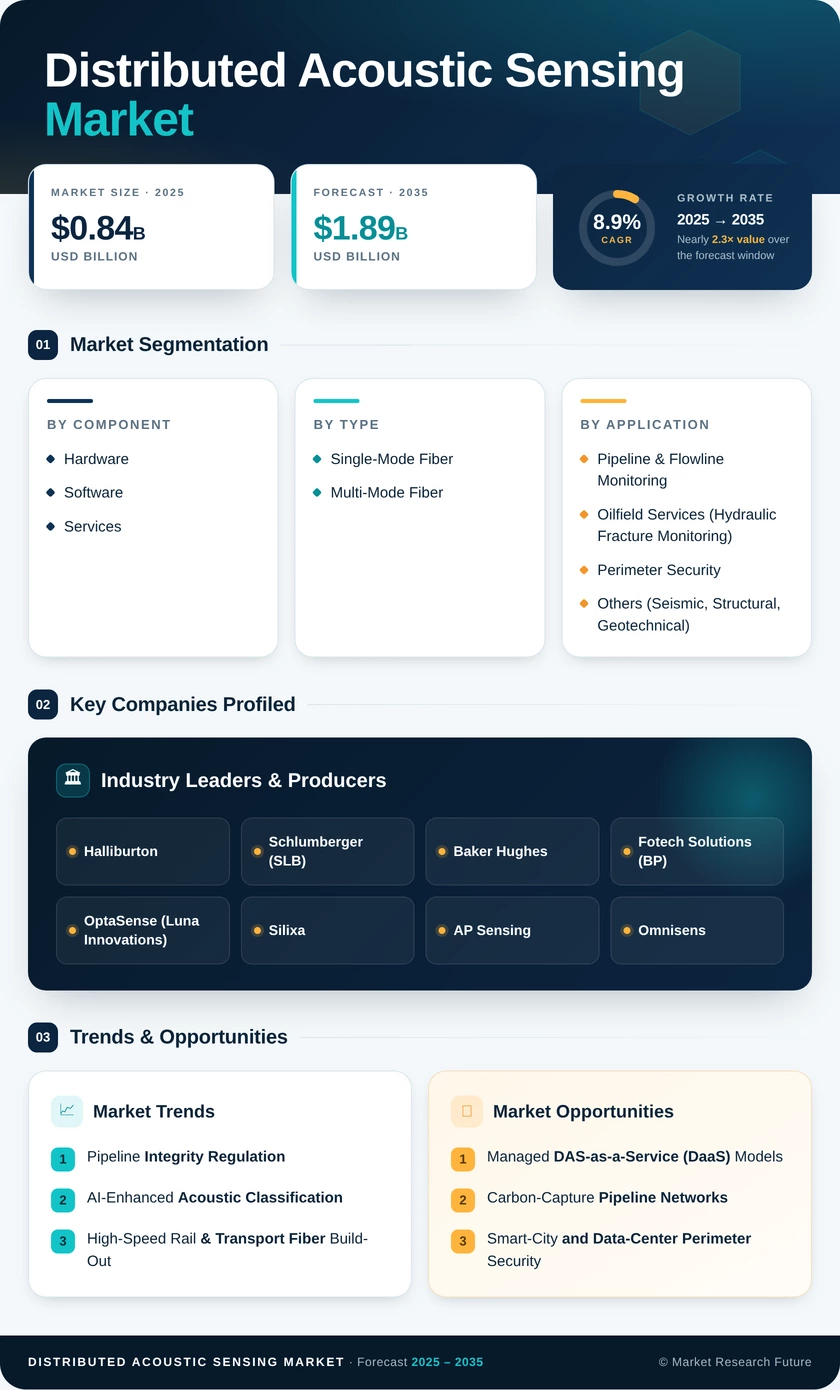
Distributed Acoustic Sensing Market

ID: MRFR/SEM/8211-HCR
200 Pages
Ankit Gupta
Last Updated: June 17, 2026
Distributed Acoustic Sensing Market Size, Share and Research Report By Component (Hardware, Software, Services), By Fiber Type (Single-Mode Fiber, Multi-Mode Fiber), By Application (Pipeline & Flowline Monitoring, Oilfield Services (Hydraulic Fracture Monitoring), Perimeter Security, Others (Seismic, Structural, Geotechnical)), By End-Use Industry (Oil & Gas, Transportation & Logistics, Utilities, Defense & Security, Others (Mining, Geoscience)) and By Regional (North America, Europe, South America, Asia Pacific, Middle East and Africa) - Industry Forecast to 2035.
Download PDF ×

We do not share your information with anyone. However, we may send you emails based on your report interest from time to time. You may contact us at any time to opt-out.

  1. 1 Market Overview |
    1. 1.1 Study Assumptions & Market Definition |
    2. 1.2 Scope of the Study |
    3. 1.3 Research Methodology
  2. 2 Market Summary & Key Takeaways
  3. 3 Market Dynamics |
    1. 3.1 Market Drivers Analysis | |
      1. 3.1.1 Pipeline Integrity Regulation Tightening | |
      2. 3.1.2 AI-Enhanced Acoustic Classification | |
      3. 3.1.3 High-Speed Rail & Transport Fiber Build-Out | |
      4. 3.1.4 Offshore Wind & Subsea Cable Monitoring | |
      5. 3.1.5 Utility Grid Modernization Programs | |
      6. 3.1.6 Perimeter and Border Security Mandates | |
      7. 3.1.7 Cost Reduction via Silicon-Photonic Interrogators |
    2. 3.2 Market Restraints Analysis | |
      1. 3.2.1 High Upfront Interrogator Costs | |
      2. 3.2.2 Fiber Attenuation Over Ultra-Long Distances | |
      3. 3.2.3 Shortage of Trained DAS Deployment Engineers | |
      4. 3.2.4 Data Volume and Edge-Processing Bottlenecks | |
      5. 3.2.5 Interoperability Gaps Across Vendor Platforms |
    3. 3.3 Market Opportunity Analysis | |
      1. 3.3.1 Managed DAS-as-a-Service (DaaS) Models | |
      2. 3.3.2 Carbon-Capture Pipeline Networks | |
      3. 3.3.3 Smart-City and Data-Center Perimeter Security | |
      4. 3.3.4 Emerging-Market Railway Modernization | |
      5. 3.3.5 Acoustic Data Monetization and Digital Twins |
    4. 3.4 Industry Value Chain Analysis |
    5. 3.5 Porter's Five Forces Analysis
  4. 4 Global Distributed Acoustic Sensing Market Size & Forecast (2021–2035) |
    1. 4.1 Historical Market Size (2021–2025) |
    2. 4.2 Current & Forecast Market Size (2026–2035) |
    3. 4.3 Market Size by Revenue (USD Billion) |
    4. 4.4 Year-over-Year Growth Analysis
  5. 5 Segmentation Analysis |
    1. 5.1 By Component | |
      1. 5.1.1 Hardware | |
      2. 5.1.2 Software | |
      3. 5.1.3 Services |
    2. 5.2 By Fiber Type | |
      1. 5.2.1 Single-Mode Fiber | |
      2. 5.2.2 Multi-Mode Fiber |
    3. 5.3 By Application | |
      1. 5.3.1 Pipeline & Flowline Monitoring | |
      2. 5.3.2 Oilfield Services (Hydraulic Fracture Monitoring) | |
      3. 5.3.3 Perimeter Security | |
      4. 5.3.4 Others (Seismic, Structural, Geotechnical) |
    4. 5.4 By End-Use Industry | |
      1. 5.4.1 Oil & Gas | |
      2. 5.4.2 Transportation & Logistics | |
      3. 5.4.3 Utilities | |
      4. 5.4.4 Defense & Security | |
      5. 5.4.5 Others (Mining, Geoscience)
  6. 6 Regional Analysis |
    1. 6.1 North America | |
      1. 6.1.1 United States | |
      2. 6.1.2 Canada | |
      3. 6.1.3 Mexico |
    2. 6.2 Europe | |
      1. 6.2.1 Germany | |
      2. 6.2.2 United Kingdom | |
      3. 6.2.3 France | |
      4. 6.2.4 Italy | |
      5. 6.2.5 Spain | |
      6. 6.2.6 Nordic Countries | |
      7. 6.2.7 Russia | |
      8. 6.2.8 Rest of Europe |
    3. 6.3 Asia-Pacific | |
      1. 6.3.1 China | |
      2. 6.3.2 India | |
      3. 6.3.3 Japan | |
      4. 6.3.4 South Korea | |
      5. 6.3.5 ASEAN | |
      6. 6.3.6 Rest of Asia-Pacific |
    4. 6.4 South America | |
      1. 6.4.1 Brazil | |
      2. 6.4.2 Argentina | |
      3. 6.4.3 Rest of South America |
    5. 6.5 Middle East & Africa | |
      1. 6.5.1 Saudi Arabia | |
      2. 6.5.2 UAE | |
      3. 6.5.3 South Africa | |
      4. 6.5.4 Egypt | |
      5. 6.5.5 Rest of MEA
  7. 7 Competitive Landscape |
    1. 7.1 Market Share Analysis (2025) |
    2. 7.2 Competitive Benchmarking Matrix |
    3. 7.3 Company Profiles | |
      1. 7.3.1 Halliburton | |
      2. 7.3.2 Schlumberger (SLB) | |
      3. 7.3.3 Baker Hughes | |
      4. 7.3.4 Fotech Solutions (BP) | |
      5. 7.3.5 OptaSense (Luna Innovations) | |
      6. 7.3.6 Silixa | |
      7. 7.3.7 AP Sensing | |
      8. 7.3.8 Omnisens | |
      9. 7.3.9 Hifi Engineering | |
      10. 7.3.10 Bandweaver
  8. 8 Future Outlook & Strategic Recommendations (2026–2035) |
    1. 8.1 AI-Driven Autonomous Monitoring |
    2. 8.2 Platform Economics and Data Integration |
    3. 8.3 Energy-Transition Infrastructure Monitoring |
    4. 8.4 ESG Reporting and Regulatory Convergence
  9. 9 Recent Developments & News
  10. 10 Frequently Asked Questions (FAQs)
  11. 11 Report Scope & Methodology |
    1. 11.1 Study Period & Base Year |
    2. 11.2 Data Sources & Citations |
    3. 11.3 Abbreviations
  12. 12 LIST OF TABLES |
  13. TABLE 1 Global Distributed Acoustic Sensing Market Size & Forecast, by Revenue (USD Billion), 2021–2035 |
  14. TABLE 2 Global Distributed Acoustic Sensing Market — Year-over-Year Growth Analysis, 2021–2035 |
  15. TABLE 3 Global Distributed Acoustic Sensing Market — Driver Impact Analysis, 2026–2035 |
  16. TABLE 4 Global Distributed Acoustic Sensing Market — Restraint Impact Analysis, 2026–2035 |
  17. TABLE 5 Global Distributed Acoustic Sensing Market Size, by Component, 2021–2035 (USD Billion) |
  18. TABLE 6 Global Distributed Acoustic Sensing Market Size, by Fiber Type, 2021–2035 (USD Billion) |
  19. TABLE 7 Global Distributed Acoustic Sensing Market Size, by Application, 2021–2035 (USD Billion) |
  20. TABLE 8 Global Distributed Acoustic Sensing Market Size, by End-Use Industry, 2021–2035 (USD Billion) |
  21. TABLE 9 Global Distributed Acoustic Sensing Market Size, by Region, 2021–2035 (USD Billion) |
  22. TABLE 10 North America Distributed Acoustic Sensing Market Size, by Country, 2021–2035 (USD Billion) |
  23. TABLE 11 Europe Distributed Acoustic Sensing Market Size, by Country, 2021–2035 (USD Billion) |
  24. TABLE 12 Asia-Pacific Distributed Acoustic Sensing Market Size, by Country, 2021–2035 (USD Billion) |
  25. TABLE 13 South America Distributed Acoustic Sensing Market Size, by Country, 2021–2035 (USD Billion) |
  26. TABLE 14 Middle East & Africa Distributed Acoustic Sensing Market Size, by Country, 2021–2035 (USD Billion) |
  27. TABLE 15 Competitive Benchmarking Matrix — Global Distributed Acoustic Sensing Market, 2025 |
  28. TABLE 16 Company Profiles — Key Players, Global Distributed Acoustic Sensing Market |
  29. TABLE 17 Recent Developments & Strategic Announcements, 2023–2025 |
  30. TABLE 18 Report Scope & Methodology Summary |
  31. TABLE 19 Detailed Sources and Citations
  32. 13 LIST OF FIGURES |
  33. FIGURE 1 Global Distributed Acoustic Sensing Market Dynamics — Drivers, Restraints & Opportunities |
  34. FIGURE 2 Industry Value Chain Analysis — Distributed Acoustic Sensing Market |
  35. FIGURE 3 Porter's Five Forces Analysis — Distributed Acoustic Sensing Market |
  36. FIGURE 4 Global Distributed Acoustic Sensing Market Size Trend (USD Billion), 2021–2035 |
  37. FIGURE 5 Global Distributed Acoustic Sensing Market Share, by Component (%), 2024 |
  38. FIGURE 6 Global Distributed Acoustic Sensing Market Share, by Fiber Type (%), 2024 |
  39. FIGURE 7 Global Distributed Acoustic Sensing Market Share, by Application (%), 2024 |
  40. FIGURE 8 Global Distributed Acoustic Sensing Market Share, by End-Use Industry (%), 2024 |
  41. FIGURE 9 Global Distributed Acoustic Sensing Market Share, by Region (%), 2024 |
  42. FIGURE 10 North America Distributed Acoustic Sensing Market Share, by Country (%), 2024 |
  43. FIGURE 11 Europe Distributed Acoustic Sensing Market Share, by Country (%), 2024 |
  44. FIGURE 12 Asia-Pacific Distributed Acoustic Sensing Market Share, by Country (%), 2024 |
  45. FIGURE 13 South America Distributed Acoustic Sensing Market Share, by Country (%), 2024 |
  46. FIGURE 14 Middle East & Africa Distributed Acoustic Sensing Market Share, by Country (%), 2024 |
  47. FIGURE 15 Competitive Landscape — Market Share of Top 10 Players (%), 2025

Segmentation Quick Reference

DimensionSub-SegmentsDominant SegmentFastest Growing Segment
ComponentHardware, Software, ServicesHardwareServices
Fiber TypeSingle-Mode Fiber, Multi-Mode FiberSingle-Mode FiberMulti-Mode Fiber
ApplicationPipeline & Flowline Monitoring, Oilfield Services (Hydraulic Fracture Monitoring), Perimeter Security, OthersPipeline & Flowline MonitoringPerimeter Security
End-Use IndustryOil & Gas, Transportation & Logistics, Utilities, Defense & Security, OthersOil & GasUtilities
GeographyNorth America, Europe, Asia-Pacific, South America, Middle East & AfricaNorth AmericaAsia-Pacific


Market Segmentation Overview

By Component

Sub-SegmentKey Trend
HardwareSilicon-photonic interrogators driving cost reduction and sub-meter spatial resolution
SoftwareAI-enhanced classification platforms enabling real-time event detection and digital-twin integration
ServicesManaged DAS-as-a-Service subscriptions replacing capex-heavy ownership models


Hardware captures the majority of distributed acoustic sensing market revenue as greenfield pipeline and rail projects require upfront interrogator and fiber procurement. Software and services are converging into bundled platform offerings.

By Fiber Type

Sub-SegmentKey Trend
Single-Mode FiberPreferred for long-haul deployments exceeding 10 km due to low attenuation characteristics
Multi-Mode FiberGrowing adoption in short-range perimeter security and campus-scale data-center applications


Single-mode fiber remains the industry standard for pipeline and rail corridor DAS deployments. Multi-mode fiber is carving out a niche in shorter-range security and industrial monitoring applications.

By Application

Sub-SegmentKey Trend
Pipeline & Flowline MonitoringRegulatory mandates (PHMSA, EU TEN-E) driving mandatory continuous monitoring adoption
Oilfield Services (Hydraulic Fracture Monitoring)Real-time frac diagnostics improving well-completion efficiency in unconventional basins
Perimeter SecurityBorder protection and critical-infrastructure intrusion detection accelerating demand
Others (Seismic, Structural, Geotechnical)Earthquake early-warning and tunnel-integrity monitoring expanding addressable use cases


Pipeline monitoring anchors the distributed acoustic sensing market's application landscape. Perimeter security is the fastest-growing application as governments and enterprises invest in physical-layer intrusion detection.

By End-Use Industry

Sub-SegmentKey Trend
Oil & GasUpstream frac monitoring and midstream pipeline integrity remain core demand drivers
Transportation & LogisticsHigh-speed rail and freight corridor fiber sensing deployments scaling rapidly in Asia-Pacific
UtilitiesPower-cable fault detection and smart-grid monitoring emerging as high-growth verticals
Defense & SecurityMilitary perimeter and border surveillance applications driving specialized DAS procurement
Others (Mining, Geoscience)Micro-seismicity and slope-stability monitoring in mining operations gaining traction


Oil and gas will continue to anchor the distributed acoustic sensing market through 2035, but utilities and transportation are converging as the second and third largest verticals as energy-transition and rail-modernization investments scale globally.