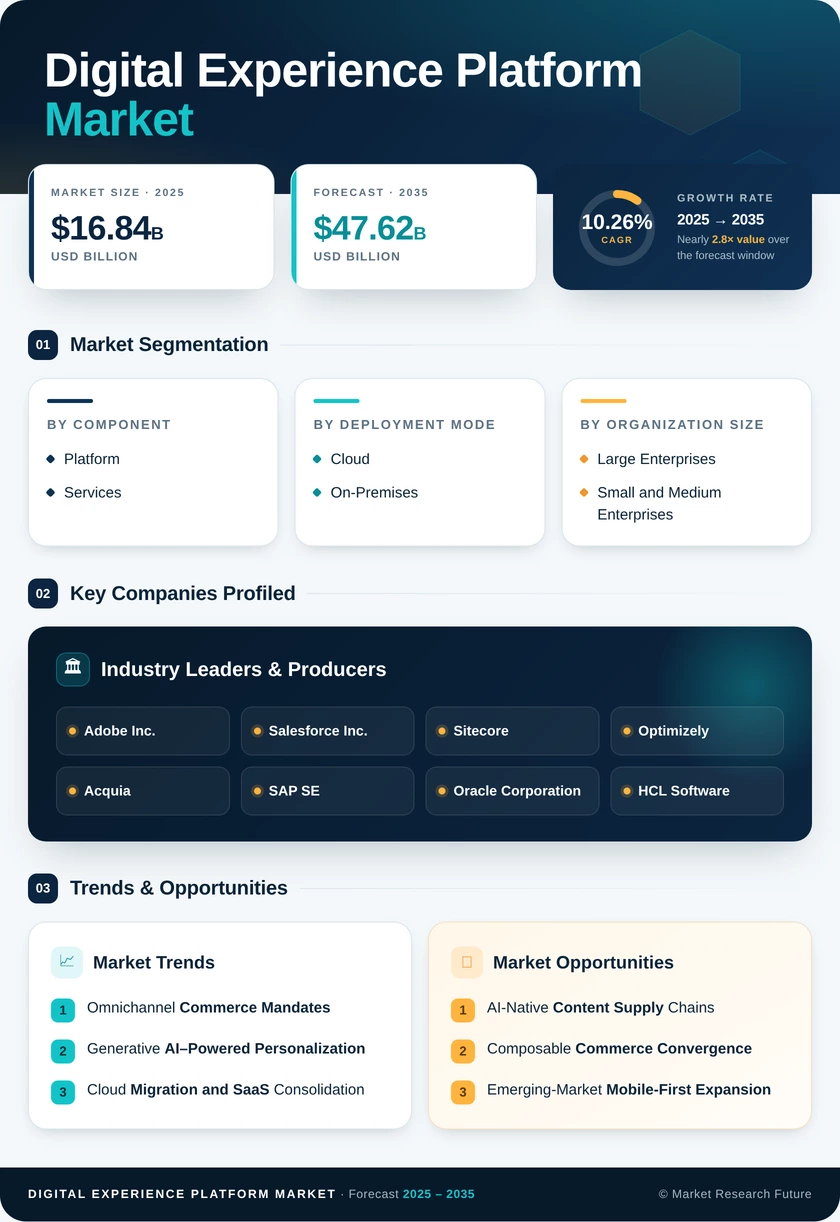
Digital Experience Platform Market

ID: MRFR/ICT/27095-HCR
100 Pages
Nirmit Biswas
Last Updated: June 24, 2026
Digital Experience Platform Market Size, Share and Research Report By Component (Platform, Services), By Deployment Mode (Cloud, On-Premises), By Organization Size (Large Enterprises, Small and Medium Enterprises), By End-User Industry (Retail and E-Commerce, IT and Telecom, BFSI, Healthcare, Manufacturing, Other End-User Industries) and By Regional (North America, Europe, South America, Asia Pacific, Middle East and Africa) - Industry Forecast to 2035
Download PDF ×

We do not share your information with anyone. However, we may send you emails based on your report interest from time to time. You may contact us at any time to opt-out.

Digital Experience Platform Market

Market Size

Forecast Period2026-2035
CAGR (2026-2035)10.26%
2025 Market SizeUSD 16.84 Billion
2035 Market SizeUSD 47.62 Billion

Key Players

Adobe Inc.
Salesforce Inc.
Sitecore
Optimizely
Acquia
SAP SE
Opportunities
  • AI-Native Content Supply Chains
  • Composable Commerce Convergence
  • Emerging-Market Mobile-First Expansion
  1. 1 Market Overview |
    1. 1.1 Study Assumptions & Market Definition |
    2. 1.2 Scope of the Study |
    3. 1.3 Research Methodology
  2. 2 Market Summary & Key Takeaways
  3. 3 Market Size & Forecast (2021–2035) |
    1. 3.1 Historical Market Size (2021–2025) |
    2. 3.2 Current & Forecast Market Size (2026–2035) |
    3. 3.3 Market Size by Revenue (USD Billion) |
    4. 3.4 Year-over-Year Growth Analysis
  4. 4 Market Dynamics |
    1. 4.1 Market Drivers Analysis | |
      1. 4.1.1 Omnichannel Commerce Mandates | |
      2. 4.1.2 Generative AI–Powered Personalization | |
      3. 4.1.3 Open-Banking & API-Economy Regulations | |
      4. 4.1.4 Cloud Migration & SaaS Consolidation | |
      5. 4.1.5 Customer Data Privacy Legislation | |
      6. 4.1.6 Mobile-First Emerging-Market Demand | |
      7. 4.1.7 Composable Architecture Standardization |
    2. 4.2 Market Restraints Analysis | |
      1. 4.2.1 Integration Complexity with Legacy Stacks | |
      2. 4.2.2 Data-Privacy Compliance Costs | |
      3. 4.2.3 Vendor Lock-In Concerns | |
      4. 4.2.4 Skill Shortages in Composable Architecture | |
      5. 4.2.5 Total Cost of Ownership Ambiguity |
    3. 4.3 Market Opportunity Analysis | |
      1. 4.3.1 AI-Native Content Supply Chains | |
      2. 4.3.2 Composable Commerce Convergence | |
      3. 4.3.3 Emerging-Market Mobile-First Expansion | |
      4. 4.3.4 Data Monetization Through Experience Analytics | |
      5. 4.3.5 Regulated-Industry Digital Front Doors |
    4. 4.4 Industry Value Chain Analysis |
    5. 4.5 Porter's Five Forces Analysis
  5. 5 Segmentation Analysis |
    1. 5.1 By Component | |
      1. 5.1.1 Platform | |
      2. 5.1.2 Services |
    2. 5.2 By Deployment Mode | |
      1. 5.2.1 Cloud | |
      2. 5.2.2 On-Premises |
    3. 5.3 By Organization Size | |
      1. 5.3.1 Large Enterprises | |
      2. 5.3.2 Small and Medium Enterprises |
    4. 5.4 By End-User Industry | |
      1. 5.4.1 Retail and E-Commerce | |
      2. 5.4.2 IT and Telecom | |
      3. 5.4.3 BFSI | |
      4. 5.4.4 Healthcare | |
      5. 5.4.5 Manufacturing | |
      6. 5.4.6 Other End-User Industries
  6. 6 Regional Analysis |
    1. 6.1 North America | |
      1. 6.1.1 United States | |
      2. 6.1.2 Canada | |
      3. 6.1.3 Mexico |
    2. 6.2 Europe | |
      1. 6.2.1 Germany | |
      2. 6.2.2 United Kingdom | |
      3. 6.2.3 France | |
      4. 6.2.4 Italy | |
      5. 6.2.5 Spain | |
      6. 6.2.6 Nordic Countries | |
      7. 6.2.7 Russia | |
      8. 6.2.8 Rest of Europe |
    3. 6.3 Asia-Pacific | |
      1. 6.3.1 China | |
      2. 6.3.2 India | |
      3. 6.3.3 Japan | |
      4. 6.3.4 South Korea | |
      5. 6.3.5 ASEAN | |
      6. 6.3.6 Rest of Asia-Pacific |
    4. 6.4 South America | |
      1. 6.4.1 Brazil | |
      2. 6.4.2 Argentina | |
      3. 6.4.3 Rest of South America |
    5. 6.5 Middle East & Africa | |
      1. 6.5.1 Saudi Arabia | |
      2. 6.5.2 UAE | |
      3. 6.5.3 South Africa | |
      4. 6.5.4 Egypt | |
      5. 6.5.5 Rest of MEA
  7. 7 Competitive Landscape |
    1. 7.1 Market Share Analysis (2025) |
    2. 7.2 Competitive Benchmarking Matrix |
    3. 7.3 Company Profiles | |
      1. 7.3.1 Adobe Inc. | |
      2. 7.3.2 Salesforce Inc. | |
      3. 7.3.3 Sitecore | |
      4. 7.3.4 Optimizely | |
      5. 7.3.5 Acquia | |
      6. 7.3.6 SAP SE | |
      7. 7.3.7 Oracle Corporation | |
      8. 7.3.8 HCL Software | |
      9. 7.3.9 Liferay Inc. | |
      10. 7.3.10 Bloomreach
  8. 8 Future Outlook & Strategic Recommendations (2026–2035) |
    1. 8.1 AI-Orchestrated Experience Engines |
    2. 8.2 Composable Platform Economics |
    3. 8.3 Privacy-First Personalization Supercycle |
    4. 8.4 Immersive and Spatial Experience Layer
  9. 9 Recent Developments & News
  10. 10 Frequently Asked Questions (FAQs)
  11. 11 Report Scope & Methodology |
    1. 11.1 Study Period & Base Year |
    2. 11.2 Data Sources & Citations |
    3. 11.3 Abbreviations
  12. 12 LIST OF TABLES
  13. 13 LIST OF FIGURES

Segmentation Quick Reference

DimensionSub-SegmentsDominant SegmentFastest Growing Segment
ComponentPlatform, ServicesPlatformServices
Deployment ModeCloud, On-PremisesCloudCloud
Organization SizeLarge Enterprises, Small and Medium EnterprisesLarge EnterprisesSmall and Medium Enterprises
End-User IndustryRetail and E-Commerce, IT and Telecom, BFSI, Healthcare, Manufacturing, Other End-User IndustriesRetail and E-CommerceBFSI
GeographyNorth America, Europe, Asia-Pacific, South America, Middle East & AfricaNorth AmericaAsia-Pacific


Market Segmentation Overview

By Component

Sub-SegmentKey Trend
PlatformConsolidation of content management, analytics, personalization, and commerce into unified cloud-native suites
ServicesGrowing demand for integration, managed operations, and strategic consulting as composable architectures increases implementation complexity.


Platform software remains the revenue backbone as vendors bundle headless CMS, analytics dashboards, and AI-powered personalization into single SKUs. Services are growing faster because composable DXP stacks require specialized systems-integration expertise that most enterprises lack in-house.

By Deployment Mode

Sub-SegmentKey Trend
CloudConsumption-based SaaS models with quarterly feature releases and elastic scaling
On-PremisesPersists in regulated industries (BFSI, government) where data-sovereignty rules restrict cloud adoption


Cloud deployment accelerates as hyperscalers offer DXP-optimized infrastructure tiers. On premises retain share in verticals where compliance mandates physical control over customer data.

By Organization Size

Sub-SegmentKey Trend
Large EnterprisesMulti-brand, multi-region orchestration with deep IT governance
Small and Medium EnterprisesVendor unbundling and modular pricing lower the adoption barrier


Large enterprises drive the majority of current spend, but SME growth outpaced them as vendors introduce starter tiers and pre-configured industry templates.

By End-User Industry

Sub-SegmentKey Trend
Retail and E-CommerceOmnichannel commerce convergence; composable storefronts
IT and TelecomSelf-service subscriber portals; churn-reduction personalization
BFSIOpen-banking API exposure; consumer-grade digital interfaces
HealthcarePatient portal modernization; HIPAA-compliant content delivery
ManufacturingDealer and distributor experience portals; product information management
Other End-User IndustriesGovernment, education, and media digital transformation initiatives


Retail leads to revenue share, while BFSI leads to growth rate. Healthcare and government represent underpenetrated verticals with high compliance-driven switching costs that favor specialized DXP vendors.