×
Request Free Sample ×

Kindly complete the form below to receive a free sample of this Report

* Please use a valid business email

Leading companies partner with us for data-driven Insights

clients tt-cursor
Hero Background
English
Chinese
French
Japanese
Korean
German
Spanish

Diesel Particulate Filter Market Size

ID: MRFR/AT/4813-HCR
100 Pages
Swapnil Palwe
February 2026

Diesel Particulate Filter Market Research Report Information By Vehicle Type (Passenger Vehicles, Light Commercial Vehicle (LCV), Heavy Commercial Vehicle (HCV), and Off-Highway Vehicle), By Product Type (Regenerating Type Filters, and Disposable Type Filters), By Material Type (Cordierite Wall Flow Filters, Silicon Carbide Wall Flow Filters, Ceramic Fiber Filters, and Other Substrates), By Sales Channel (Original Equipment Manufacturer (OEM), and Aftersales) And By Region –Market Forecast Till 2035

Share:
Download PDF ×

We do not share your information with anyone. However, we may send you emails based on your report interest from time to time. You may contact us at any time to opt-out.

Diesel Particulate Filter Market Infographic
Purchase Options

Diesel Particulate Filter Size

Diesel Particulate Filter Market Growth Projections and Opportunities

The Diesel Particulate Filter market has dynamic forces that shape its growth and evolution. Such stringent emission regulations have led to increased demand for effective emission control technologies such as DPFs. It is becoming crucial to maintain the global environment, hence the reason behind this phenomenon in this sector. Strict emission standards are being introduced by governments globally to control air pollution forcing auto makers to adopt cleaner technologies.

Diesel vehicles production and sales also shape the DPF market in a major way. In order to comply with emissions norms, manufacturers are compelled to integrate DPFs into their vehicles, as consumers continue to prefer diesel engines because of their fuel efficiency and torque benefits. With this rise in demand, there has been an increase in competition among DPF manufacturers while at the same time expanding the market size of these devices. To satisfy different vehicle categories and applications, companies invest heavily in research and development so as to enhance filter’s efficiency and durability.

The market dynamics are also influenced by technological advancements. Firms that operate under competitive environment stay ahead of others through continuous innovation in filter materials, design and manufacturing processes. The adaptability of industry players is reflected in how DPF technologies have evolved toward newer engine designs as well as varying vehicle applications over time. In addition, performance enhancement is achieved through integration of smart features like sensors and monitoring systems , which facilitate predictive maintenance on DPFs thus creating more markets.

The geographical distribution of the diesel particulate filter is another key factor influencing its dynamics.Fast adoption rate for these filters can be seen in regions characterized by strict emission norms like Europe or North America . However, emerging economies with a growing automotive sector, such as Asia-Pacific ,have started catching up due to increasing implementation of emission standards and growing environmental concerns . This variety makes it possible that diverse competition challenges will be encountered by businesses within a given market area.
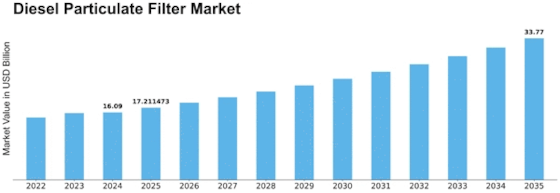

Diesel Particulate Filter Market Size Graph
Author
Swapnil Palwe
Team Lead - Research

With a technical background as Bachelor's in Mechanical Engineering, with MBA in Operations Management , Swapnil has 6+ years of experience in market research, consulting and analytics with the tasks of data mining, analysis, and project execution. He is the POC for our clients, for their consulting projects running under the Automotive/A&D domain. Swapnil has worked on major projects in verticals such as Aerospace & Defense, Automotive and many other domain projects. He has worked on projects for fortune 500 companies' syndicate and consulting projects along with several government projects.

Leave a Comment

FAQs

What is the projected market valuation of the Diesel Particulate Filter Market by 2035?

<p>The Diesel Particulate Filter Market is projected to reach a valuation of 33.77 USD Billion by 2035.</p>

What was the market valuation of the Diesel Particulate Filter Market in 2024?

<p>In 2024, the Diesel Particulate Filter Market was valued at 16.09 USD Billion.</p>

What is the expected CAGR for the Diesel Particulate Filter Market during the forecast period 2025 - 2035?

<p>The expected CAGR for the Diesel Particulate Filter Market during the forecast period 2025 - 2035 is 6.97%.</p>

Which vehicle type segment is projected to have the highest valuation by 2035?

<p>The Heavy Commercial Vehicles (HCV) segment is projected to reach a valuation of 12.0 USD Billion by 2035.</p>

What are the projected valuations for Regenerating Type Filters by 2035?

<p>Regenerating Type Filters are projected to reach a valuation of 20.0 USD Billion by 2035.</p>

Which material type is expected to have the highest market valuation by 2035?

Cordierite Wall Flow Filters are expected to reach a valuation of 13.45 USD Billion by 2035.

What is the projected market size for the Aftersales channel by 2035?

The Aftersales channel is projected to reach a market size of 16.89 USD Billion by 2035.

Who are the key players in the Diesel Particulate Filter Market?

Key players in the Diesel Particulate Filter Market include Bosch, Denso, Cummins, Faurecia, and Tenneco.

What is the projected valuation for Light Commercial Vehicles (LCV) by 2035?

The Light Commercial Vehicles (LCV) segment is projected to reach a valuation of 6.0 USD Billion by 2035.

What is the expected growth trend for Disposable Type Filters by 2035?

Disposable Type Filters are expected to grow to a valuation of 13.77 USD Billion by 2035.

Market Summary

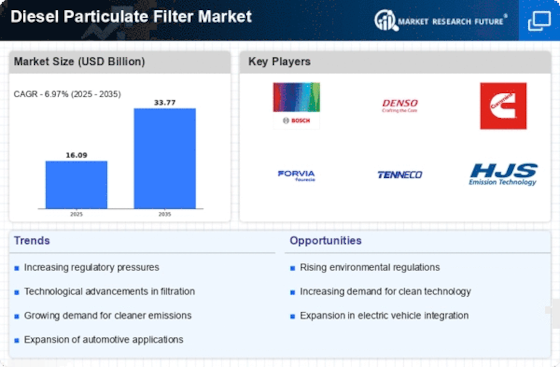
As per Market Research Future analysis, the Diesel Particulate Filter Market Size was estimated at 16.09 USD Billion in 2024. The Diesel Particulate Filter industry is projected to grow from 17.21 USD Billion in 2025 to 33.77 USD Billion by 2035, exhibiting a compound annual growth rate (CAGR) of 6.9% during the forecast period 2025 - 2035

Key Market Trends & Highlights

The Diesel Particulate Filter Market is experiencing robust growth driven by regulatory pressures and technological advancements.

  • North America remains the largest market for diesel particulate filters, driven by stringent emissions regulations. Asia-Pacific is identified as the fastest-growing region, reflecting increasing industrialization and vehicle production. Passenger vehicles dominate the market, while heavy commercial vehicles are emerging as the fastest-growing segment. Regulatory compliance pressure and environmental awareness are key drivers propelling market expansion.

Market Size & Forecast

2024 Market Size 16.09 (USD Billion)
2035 Market Size 33.77 (USD Billion)
CAGR (2025 - 2035) 6.97%
Largest Regional Market Share in 2024 Europe

Major Players

Bosch (DE), Denso (JP), Cummins (US), Faurecia (FR), Tenneco (US), HJS Emission Technology (DE), Eberspächer (DE), Mann+Hummel (DE), Schaeffler (DE)

Market Trends

The Diesel Particulate Filter Market is currently experiencing a notable transformation driven by increasing environmental regulations and a growing emphasis on reducing emissions from diesel engines. As governments worldwide implement stricter standards to combat air pollution, the demand for advanced filtration technologies is on the rise. This shift is prompting manufacturers to innovate and enhance their product offerings, focusing on efficiency and sustainability. Furthermore, the automotive sector is witnessing a gradual transition towards cleaner technologies, which may influence the market dynamics in the coming years. In addition to regulatory pressures, the Diesel Particulate Filter Market is also influenced by advancements in technology. The integration of smart sensors and monitoring systems into diesel particulate filters is becoming more prevalent, allowing for real-time performance tracking and maintenance alerts. This technological evolution not only improves the operational efficiency of diesel engines but also extends the lifespan of the filters themselves. As the market continues to evolve, stakeholders must remain vigilant to adapt to these changes and capitalize on emerging opportunities.

Regulatory Influence

The diesel particulate filter market is significantly shaped by stringent environmental regulations aimed at reducing harmful emissions. Governments are enforcing laws that require the installation of advanced filtration systems in diesel vehicles, thereby driving demand for innovative solutions.

Technological Advancements

Recent developments in technology are enhancing the performance and efficiency of diesel particulate filters. The incorporation of smart technologies, such as sensors and monitoring systems, is enabling better maintenance and operational efficiency, which could lead to longer filter lifespans.

Shift Towards Sustainability

There is a growing trend towards sustainability within the Diesel Particulate Filter Market. Manufacturers are increasingly focusing on eco-friendly materials and processes, reflecting a broader commitment to environmental stewardship and the reduction of the carbon footprint.

Diesel Particulate Filter Market Market Drivers

Environmental Awareness

Increasing environmental awareness among consumers and businesses is significantly impacting the Diesel Particulate Filter Market. As public concern regarding air quality and climate change grows, there is a heightened focus on reducing emissions from diesel engines. This shift in consumer behavior is prompting manufacturers to prioritize the development of cleaner technologies, including advanced diesel particulate filters. Market trends suggest that companies that invest in sustainable practices and products are likely to gain a competitive edge. Furthermore, this growing environmental consciousness is expected to drive policy changes that further support the adoption of diesel particulate filters, thereby enhancing market opportunities.

Technological Innovations

Technological advancements play a pivotal role in shaping the Diesel Particulate Filter Market. Innovations in filter materials and designs have led to the development of more efficient and durable filters. For example, the introduction of advanced catalytic converters and improved regeneration techniques has enhanced the performance of diesel particulate filters. Market data indicates that the adoption of these technologies is expected to increase, with a projected growth rate of approximately 5% annually over the next five years. This trend suggests that manufacturers are investing significantly in research and development to create filters that not only comply with regulations but also offer better performance and longevity, thus driving market growth.

Regulatory Compliance Pressure

The Diesel Particulate Filter Market is experiencing heightened pressure due to stringent regulatory frameworks aimed at reducing emissions from diesel engines. Governments across various regions have implemented laws that mandate the installation of diesel particulate filters in new vehicles. For instance, regulations such as Euro 6 in Europe and EPA standards in the United States have set strict limits on particulate matter emissions. This regulatory compliance not only drives the demand for diesel particulate filters but also encourages manufacturers to innovate and improve filter technologies. As a result, the market is likely to witness a surge in the adoption of advanced filtration systems that meet or exceed these regulatory requirements, thereby enhancing the overall market landscape.

Growing Demand for Diesel Vehicles

The Diesel Particulate Filter Market is also influenced by the growing demand for diesel vehicles, particularly in sectors such as transportation and construction. Diesel engines are favored for their fuel efficiency and torque, making them ideal for heavy-duty applications. As the demand for diesel vehicles rises, so does the need for effective emission control technologies, including diesel particulate filters. Market analysis shows that the sales of diesel vehicles are projected to increase by 3% annually, which directly correlates with the rising demand for diesel particulate filters. This trend indicates a robust market potential for manufacturers and suppliers in the diesel particulate filter sector.

Economic Growth in Emerging Markets

Economic growth in emerging markets is contributing to the expansion of the Diesel Particulate Filter Market. As these economies develop, there is an increasing demand for transportation and industrial vehicles, many of which utilize diesel engines. This growth is accompanied by a rising awareness of the need for emission control technologies, including diesel particulate filters. Market data indicates that regions such as Asia-Pacific and Latin America are witnessing a surge in vehicle sales, which is likely to drive the demand for diesel particulate filters. Consequently, manufacturers are focusing on these emerging markets to capitalize on the growth opportunities presented by the increasing adoption of diesel vehicles and the corresponding need for effective emission control solutions.

Market Segment Insights

By Vehicle Type: Passenger Vehicles (Largest) vs. Heavy Commercial Vehicles (Fastest-Growing)

<p>In the Diesel Particulate Filter Market, passenger vehicles represent the largest segment, capturing a significant share due to the high volume of vehicles and stringent emission regulations influencing production. On the other hand, heavy commercial vehicles are noted for their rapid growth, driven by increasing demand for transportation and logistics, especially in urban areas where fuel efficiency and emission control are becoming crucial requirements for compliance with environmental standards.</p>

<p>Passenger Vehicles (Dominant) vs. Off-Highway Vehicles (Emerging)</p>

<p>Passenger vehicles dominate the Diesel Particulate Filter Market, largely attributable to their prevalence in urban settings and the rigorous emissions norms established globally. These vehicles are equipped with advanced filtration systems to comply with governmental regulations, ensuring reduced particulate emissions. Conversely, off-highway vehicles are positioned as an emerging segment, driven by developments in agriculture, construction, and mining sectors, where robust diesel engines are prevalent. The evolving technologies in diesel particulate filtration for off-highway applications are paving the way for new market opportunities, as manufacturers seek to enhance operational efficiency while meeting sustainability goals.</p>

By Product Type: Regenerating Type Filters (Largest) vs. Disposable Type Filters (Fastest-Growing)

<p>In the Diesel Particulate Filter Market, the product types showcase a clear distribution. Regenerating Type Filters have gained the largest share, owing to their cost-effectiveness and longer operational life, making them a preferred choice amongst manufacturers. In contrast, Disposable Type Filters are rapidly gaining traction, driven by an increasing emphasis on maintenance-free solutions in various applications, appealing especially to those looking for convenience and efficiency. The growth trends in this segment are largely influenced by regulatory demands for emission reductions and advancements in filter technologies. Regenerating Type Filters are benefiting from investments aimed at enhancing their efficiency and longevity, while Disposable Type Filters are emerging as a solution that requires minimal upkeep. This dynamic reflects a shift in consumer preferences toward products that offer ease of use and sustainable performance, setting the stage for robust growth in the coming years.</p>

<p>Product Type: Regenerating Type Filters (Dominant) vs. Disposable Type Filters (Emerging)</p>

<p>Regenerating Type Filters stand out in the Diesel Particulate Filter Market as the dominant choice for various applications, mainly due to their capability to clean and reuse over extended periods, thus offering a more sustainable option. They are typically integrated into commercial and industrial vehicle systems where efficiency is paramount. On the other hand, Disposable Type Filters are quickly emerging, particularly in lighter-duty applications, where low maintenance and immediate replacement solutions are vital to users. This segment appeals to the market's growing trend towards simplified operations and rapid adoption, catering to customer segments looking for practical filter solutions without the need for extensive maintenance. Though currently smaller in market share, the trajectory of Disposable Type Filters indicates a significant shift in future demand.</p>

By Material Type: Cordierite Wall Flow Filters (Largest) vs. Silicon Carbide Wall Flow Filters (Fastest-Growing)

<p>The Diesel Particulate Filter Market showcases a diverse array of material types used in the manufacture of filters. Among these, Cordierite wall flow filters hold the largest share due to their excellent thermal stability and lower production costs, making them preferred in various diesel engine applications. Silicon carbide wall flow filters are gaining traction rapidly, positioned as the fastest-growing segment due to their superior performance in high-temperature environments and their effectiveness in reducing particulate matter emissions.</p>

<p>Material Type: Cordierite (Dominant) vs. Silicon Carbide (Emerging)</p>

<p>Cordierite wall flow filters dominate the Diesel Particulate Filter Market, widely regarded for their cost-effectiveness and thermal shock resistance. They are particularly favored in light-duty vehicles, providing reliable emission control while maintaining durability. On the other hand, silicon carbide wall flow filters are emerging as a competitive alternative, particularly in heavy-duty applications where high thermal endurance is required. These filters excel in their ability to trap a larger volume of soot and perform well in harsh operating conditions, driving their rapid adoption in various markets. As regulatory standards on emissions tighten, the preference for high-performance materials like silicon carbide is expected to increase, potentially altering market dynamics.</p>

By Sales Channel: OEM (Largest) vs. Aftersales (Fastest-Growing)

<p>In the Diesel Particulate Filter Market, the sales channel segmentation showcases a notable distribution with Original Equipment Manufacturers (OEM) taking the lead in market share. The OEM segment is often preferred by end-users due to the assurance of quality and compatibility with vehicles, which drives its popularity. In contrast, the Aftersales segment is gaining traction as vehicle owners look for cost-effective and alternative solutions to mitigate particulate emissions, propelling it as a significant player in the market.</p>

<p>Sales Channel: OEM (Dominant) vs. Aftersales (Emerging)</p>

<p>The Original Equipment Manufacturer (OEM) segment dominates the Diesel Particulate Filter Market due to its strong association with vehicle manufacturers and the assurance of high-quality products designed for specific engines. OEM products are preferred by consumers looking for reliability and compliance with emissions standards. On the other hand, the Aftersales segment is emerging rapidly as it caters to the growing demand for retrofitting and replacement filters in older vehicles. This segment targets cost-conscious consumers and independent workshops, thus expanding its reach in the market. The competition between OEM and Aftersales is intense, with innovation and service quality becoming key differentiators.</p>

Get more detailed insights about Diesel Particulate Filter Market Research Report – Forecast to 2035

Regional Insights

North America : Regulatory Compliance Leader

North America is the largest market for diesel particulate filters (DPFs), holding approximately 40% of the global market share. The region's growth is driven by stringent emissions regulations and a rising demand for cleaner diesel technologies. The U.S. Environmental Protection Agency (EPA) has implemented strict standards that compel manufacturers to adopt advanced filtration technologies, boosting market demand significantly. The competitive landscape in North America is characterized by the presence of major players such as Cummins and Bosch, which dominate the market with innovative solutions. The U.S. and Canada are the leading countries, with a strong focus on R&D to enhance filter efficiency and durability. The market is also witnessing collaborations between manufacturers and automotive companies to develop next-generation DPFs that meet evolving regulatory requirements.

Europe : Innovation and Sustainability Hub

Europe is the second-largest market for diesel particulate filters, accounting for approximately 30% of the global share. The region's growth is propelled by stringent EU regulations aimed at reducing vehicle emissions and promoting sustainable transport solutions. The European Commission's commitment to the Green Deal and the Euro 6 standards are key drivers, pushing manufacturers to innovate and enhance DPF technologies. Leading countries in Europe include Germany, France, and the UK, where major players like Faurecia and Mann+Hummel are actively engaged in developing advanced filtration systems. The competitive landscape is robust, with a focus on sustainability and compliance with environmental regulations. The presence of numerous automotive manufacturers in the region further stimulates demand for high-performance DPFs, ensuring a dynamic market environment.

Asia-Pacific : Emerging Market Potential

Asia-Pacific is witnessing rapid growth in the diesel particulate filter market, holding approximately 25% of the global share. The region's expansion is driven by increasing vehicle production, urbanization, and rising environmental concerns. Countries like China and India are implementing stricter emissions regulations, which are catalyzing the demand for advanced DPF technologies to meet compliance standards. China is the largest market in the region, with significant contributions from local manufacturers and international players like Denso. The competitive landscape is evolving, with a focus on cost-effective solutions and technological advancements. As the automotive industry in Asia-Pacific continues to grow, the demand for efficient and reliable DPFs is expected to rise, supported by government initiatives aimed at reducing air pollution and enhancing vehicle performance.

Middle East and Africa : Resource-Rich Market Dynamics

The Middle East and Africa region is gradually emerging in the diesel particulate filter market, holding about 5% of the global share. The growth is primarily driven by increasing awareness of environmental issues and the need for cleaner technologies in the automotive sector. Governments in countries like South Africa and the UAE are beginning to implement regulations aimed at reducing emissions, which is expected to boost the demand for DPFs in the coming years. South Africa is the leading market in this region, with a growing automotive industry that is increasingly adopting advanced emission control technologies. The competitive landscape is still developing, with opportunities for both local and international players to establish a foothold. As awareness of air quality issues rises, the demand for diesel particulate filters is anticipated to grow, supported by government initiatives and investments in cleaner technologies.

Key Players and Competitive Insights

Leading market players are investing heavily in research and development to expand their product lines, which will help the diesel particulate filter market grow even more. Market participants are also undertaking various strategic activities to expand their global footprint, with important market developments including new product launches, contractual agreements, mergers and acquisitions, higher investments, and collaboration with other organizations. To expand and survive in a more competitive and rising market climate, the diesel particulate filter industry must offer cost-effective items.
Manufacturing locally to minimize operational costs is one of the key business tactics manufacturers use in the Diesel Particulate Filter Market industry to benefit clients and increase the market sector. Major players in the Diesel Particulate Filter Market, including Johnson Matthey (UK), Marelli Holdings Co., Ltd. (Italy), BASF SE (Germany), SANGO Co., Ltd (Japan), and others, are trying to expand market demand by investing in research and development operations.
Automotive industry parts and components are offered by BorgWarner Inc. For internal combustion, hybrid, and electric vehicle products for light, medium, and heavy-duty vehicles as well as off-highway applications, it produces and distributes such technologies and solutions. Turbochargers, emission and thermal systems, gearbox parts and systems, timing devices and chains, torque transfer systems for all-wheel drive, rotating electrical devices and gearbox components and systems are all part of the company's product line.
 It sells goods to original equipment producers of light vehicles, such as passenger cars, sport utility vehicles, vans, light trucks, as well as other OEMs of commercial and off-highway vehicles.
In October BorgWarner announced the completion of its acquisition of Delphi Technologies. The merger expanded BorgWarner's capabilities in propulsion systems, including exhaust after-treatment technologies such as diesel particulate filters.
Johnson Matthey Plc is a specialty chemical and sustainable technologies provider. It offers catalysts and related technologies for pharmaceuticals, automotive, and chemical processing. It also launches the distribution, fabrication, marketing, refining and recycling of special metals and their products. It also designs and manufactures active pharmaceutical ingredients. The firm provides battery materials for automotive applications, battery systems for various applications, and fuel cell technologies. It serves environmental, automotive, chemical, medical, recycling, oil and gas and other industries.
In March Johnson Matthey launched the ActivDPFTM diesel particulate filter (DPF) system, an innovative system for stationary diesel engines.
The technology offers engineers and facility operators clean energy whenever needed with no requirement for the filter monitoring system.

Key Companies in the Diesel Particulate Filter Market include

Industry Developments

March 2024: Intangles Lab Pvt. Ltd., a company providing Digital Twin solutions has recently announced their Diesel Particulate Filter Market (DPF) solution.

The AI-enabled tool has been developed by the Technology & Innovation Group at Intangles and is expected to revolutionize the whole commercial vehicle sector, giving more advanced DPF regeneration quality insights. The statement also read that it would be able to reduce fuel consumption and enhance engine performance in addition to environmental sustainability.

Diesel engines are tackling the soot accumulation in DPFs as they face tighter emissions standards and growing environmental concern resulting in clogs which lower engine output and increase maintenance costs. Utilizing sophisticated AI algorithms, Intangles’ new DPF solution provides predictive alerts on the need for DPF regeneration—thus avoiding losses caused by exhaust back pressure.

This system integrates multiple parameters around diesel engine exhaust to achieve an accuracy of over 95% in classifying and assessing the quality of regeneration cycles, ensuring vehicles maintain optimum performance while satisfying stringent emission requirements.

Furthermore, this new feature advises on suitable modes of regeneration based on altered conditions regarding environment and vehicle-specific issues. By applying such recommendations, fleet operators can program parked regeneration ahead instead of having continued operation when there are unfavorable climatic situations like city traffic or cold weather where conventional methods of regenerations always fail according to I intangles media release about its innovative approach to predictive maintenance that helps fleet operators mitigate risks associated with DPF clogging related problems that may disrupt operations considerably.

The Indian market as well as North America have seen this DPF solution gaining significant traction due to its relevancy and usefulness within these areas. This suggests that Intangles’ DPF solution is quite versatile and universally applicable for different types of diesel-powered vehicles ranging from heavy commercial ones of 2,000-15,000 cc category up to passenger cars aimed at significantly improving their performance reliability.

March 2020: Vitesco Technologies secured a contract from a European vehicle manufacturer to supply innovative electric heating elements for diesel catalytic converters. This EMICAT brand e-catalyst technology will be deployed in two of the manufacturer's 48-volt hybrid van models. EMICAT e-catalyst developed by Vitesco Technologies ensures effective exhaust gas after treatment, even when the exhaust gas has a lower temperature.

June 2020: Clark has launched its C40-55SD and C60-80D900 series diesel forklifts with four to eight tons load capacities, equipped with a Kubota diesel engine of level 5. This diesel engine is equipped with a diesel particulate filter (DPF) and diesel oxidation catalytic converter and is now open.

Future Outlook

Diesel Particulate Filter Market Future Outlook

The Diesel Particulate Filter Market is projected to grow at a 6.97% CAGR from 2025 to 2035, driven by stringent emission regulations and technological advancements.

New opportunities lie in:

  • <p>Expansion into emerging markets with tailored DPF solutions. Development of advanced DPF monitoring systems for predictive maintenance. Partnerships with automotive manufacturers for integrated DPF technologies.</p>

By 2035, the market is expected to be robust, driven by innovation and regulatory compliance.

Market Segmentation

Diesel Particulate Filter Market Product Type Outlook

  • Regenerating Type Filters
  • Disposable Type Filters

Diesel Particulate Filter Market Vehicle Type Outlook

  • Passenger Vehicles
  • Light Commercial Vehicles (LCV)
  • Heavy Commercial Vehicles (HCV)
  • Off-Highway Vehicles

Diesel Particulate Filter Market Material Type Outlook

  • Cordierite Wall Flow Filters
  • Silicon Carbide Wall Flow Filters
  • Ceramic Fiber Filters
  • Other Substrates

Diesel Particulate Filter Market Sales Channel Outlook

  • Original Equipment Manufacturer (OEM)
  • Aftersales

Report Scope

MARKET SIZE 2024 16.09(USD Billion)
MARKET SIZE 2025 17.21(USD Billion)
MARKET SIZE 2035 33.77(USD Billion)
COMPOUND ANNUAL GROWTH RATE (CAGR) 6.97% (2025 - 2035)
REPORT COVERAGE Revenue Forecast, Competitive Landscape, Growth Factors, and Trends
BASE YEAR 2024
Market Forecast Period 2025 - 2035
Historical Data 2019 - 2024
Market Forecast Units USD Billion
Key Companies Profiled Bosch (DE), Denso (JP), Cummins (US), Faurecia (FR), Tenneco (US), HJS Emission Technology (DE), Eberspächer (DE), Mann+Hummel (DE), Schaeffler (DE)
Segments Covered Vehicle Type, Product Type, Material Type, Sales Channel, Region –Market Forecast Till 2035
Key Market Opportunities Increasing regulatory pressures drive demand for advanced Diesel Particulate Filter technologies in commercial vehicles.
Key Market Dynamics Rising regulatory pressures drive innovation in Diesel Particulate Filter technology and enhance market competitiveness.
Countries Covered North America, Europe, APAC, South America, MEA

FAQs

What is the projected market valuation of the Diesel Particulate Filter Market by 2035?

<p>The Diesel Particulate Filter Market is projected to reach a valuation of 33.77 USD Billion by 2035.</p>

What was the market valuation of the Diesel Particulate Filter Market in 2024?

<p>In 2024, the Diesel Particulate Filter Market was valued at 16.09 USD Billion.</p>

What is the expected CAGR for the Diesel Particulate Filter Market during the forecast period 2025 - 2035?

<p>The expected CAGR for the Diesel Particulate Filter Market during the forecast period 2025 - 2035 is 6.97%.</p>

Which vehicle type segment is projected to have the highest valuation by 2035?

<p>The Heavy Commercial Vehicles (HCV) segment is projected to reach a valuation of 12.0 USD Billion by 2035.</p>

What are the projected valuations for Regenerating Type Filters by 2035?

<p>Regenerating Type Filters are projected to reach a valuation of 20.0 USD Billion by 2035.</p>

Which material type is expected to have the highest market valuation by 2035?

Cordierite Wall Flow Filters are expected to reach a valuation of 13.45 USD Billion by 2035.

What is the projected market size for the Aftersales channel by 2035?

The Aftersales channel is projected to reach a market size of 16.89 USD Billion by 2035.

Who are the key players in the Diesel Particulate Filter Market?

Key players in the Diesel Particulate Filter Market include Bosch, Denso, Cummins, Faurecia, and Tenneco.

What is the projected valuation for Light Commercial Vehicles (LCV) by 2035?

The Light Commercial Vehicles (LCV) segment is projected to reach a valuation of 6.0 USD Billion by 2035.

What is the expected growth trend for Disposable Type Filters by 2035?

Disposable Type Filters are expected to grow to a valuation of 13.77 USD Billion by 2035.

  1. SECTION I: EXECUTIVE SUMMARY AND KEY HIGHLIGHTS
    1. | 1.1 EXECUTIVE SUMMARY
    2. | | 1.1.1 Market Overview
    3. | | 1.1.2 Key Findings
    4. | | 1.1.3 Market Segmentation
    5. | | 1.1.4 Competitive Landscape
    6. | | 1.1.5 Challenges and Opportunities
    7. | | 1.1.6 Future Outlook
  2. SECTION II: SCOPING, METHODOLOGY AND MARKET STRUCTURE
    1. | 2.1 MARKET INTRODUCTION
    2. | | 2.1.1 Definition
    3. | | 2.1.2 Scope of the study
    4. | | | 2.1.2.1 Research Objective
    5. | | | 2.1.2.2 Assumption
    6. | | | 2.1.2.3 Limitations
    7. | 2.2 RESEARCH METHODOLOGY
    8. | | 2.2.1 Overview
    9. | | 2.2.2 Data Mining
    10. | | 2.2.3 Secondary Research
    11. | | 2.2.4 Primary Research
    12. | | | 2.2.4.1 Primary Interviews and Information Gathering Process
    13. | | | 2.2.4.2 Breakdown of Primary Respondents
    14. | | 2.2.5 Forecasting Model
    15. | | 2.2.6 Market Size Estimation
    16. | | | 2.2.6.1 Bottom-Up Approach
    17. | | | 2.2.6.2 Top-Down Approach
    18. | | 2.2.7 Data Triangulation
    19. | | 2.2.8 Validation
  3. SECTION III: QUALITATIVE ANALYSIS
    1. | 3.1 MARKET DYNAMICS
    2. | | 3.1.1 Overview
    3. | | 3.1.2 Drivers
    4. | | 3.1.3 Restraints
    5. | | 3.1.4 Opportunities
    6. | 3.2 MARKET FACTOR ANALYSIS
    7. | | 3.2.1 Value chain Analysis
    8. | | 3.2.2 Porter's Five Forces Analysis
    9. | | | 3.2.2.1 Bargaining Power of Suppliers
    10. | | | 3.2.2.2 Bargaining Power of Buyers
    11. | | | 3.2.2.3 Threat of New Entrants
    12. | | | 3.2.2.4 Threat of Substitutes
    13. | | | 3.2.2.5 Intensity of Rivalry
    14. | | 3.2.3 COVID-19 Impact Analysis
    15. | | | 3.2.3.1 Market Impact Analysis
    16. | | | 3.2.3.2 Regional Impact
    17. | | | 3.2.3.3 Opportunity and Threat Analysis
  4. SECTION IV: QUANTITATIVE ANALYSIS
    1. | 4.1 Automobile, BY Vehicle Type (USD Billion)
    2. | | 4.1.1 Passenger Vehicles
    3. | | 4.1.2 Light Commercial Vehicles (LCV)
    4. | | 4.1.3 Heavy Commercial Vehicles (HCV)
    5. | | 4.1.4 Off-Highway Vehicles
    6. | 4.2 Automobile, BY Product Type (USD Billion)
    7. | | 4.2.1 Regenerating Type Filters
    8. | | 4.2.2 Disposable Type Filters
    9. | 4.3 Automobile, BY Material Type (USD Billion)
    10. | | 4.3.1 Cordierite Wall Flow Filters
    11. | | 4.3.2 Silicon Carbide Wall Flow Filters
    12. | | 4.3.3 Ceramic Fiber Filters
    13. | | 4.3.4 Other Substrates
    14. | 4.4 Automobile, BY Sales Channel (USD Billion)
    15. | | 4.4.1 Original Equipment Manufacturer (OEM)
    16. | | 4.4.2 Aftersales
    17. | 4.5 Automobile, BY Region (USD Billion)
    18. | | 4.5.1 North America
    19. | | | 4.5.1.1 US
    20. | | | 4.5.1.2 Canada
    21. | | 4.5.2 Europe
    22. | | | 4.5.2.1 Germany
    23. | | | 4.5.2.2 UK
    24. | | | 4.5.2.3 France
    25. | | | 4.5.2.4 Russia
    26. | | | 4.5.2.5 Italy
    27. | | | 4.5.2.6 Spain
    28. | | | 4.5.2.7 Rest of Europe
    29. | | 4.5.3 APAC
    30. | | | 4.5.3.1 China
    31. | | | 4.5.3.2 India
    32. | | | 4.5.3.3 Japan
    33. | | | 4.5.3.4 South Korea
    34. | | | 4.5.3.5 Malaysia
    35. | | | 4.5.3.6 Thailand
    36. | | | 4.5.3.7 Indonesia
    37. | | | 4.5.3.8 Rest of APAC
    38. | | 4.5.4 South America
    39. | | | 4.5.4.1 Brazil
    40. | | | 4.5.4.2 Mexico
    41. | | | 4.5.4.3 Argentina
    42. | | | 4.5.4.4 Rest of South America
    43. | | 4.5.5 MEA
    44. | | | 4.5.5.1 GCC Countries
    45. | | | 4.5.5.2 South Africa
    46. | | | 4.5.5.3 Rest of MEA
  5. SECTION V: COMPETITIVE ANALYSIS
    1. | 5.1 Competitive Landscape
    2. | | 5.1.1 Overview
    3. | | 5.1.2 Competitive Analysis
    4. | | 5.1.3 Market share Analysis
    5. | | 5.1.4 Major Growth Strategy in the Automobile
    6. | | 5.1.5 Competitive Benchmarking
    7. | | 5.1.6 Leading Players in Terms of Number of Developments in the Automobile
    8. | | 5.1.7 Key developments and growth strategies
    9. | | | 5.1.7.1 New Product Launch/Service Deployment
    10. | | | 5.1.7.2 Merger & Acquisitions
    11. | | | 5.1.7.3 Joint Ventures
    12. | | 5.1.8 Major Players Financial Matrix
    13. | | | 5.1.8.1 Sales and Operating Income
    14. | | | 5.1.8.2 Major Players R&D Expenditure. 2023
    15. | 5.2 Company Profiles
    16. | | 5.2.1 Bosch (DE)
    17. | | | 5.2.1.1 Financial Overview
    18. | | | 5.2.1.2 Products Offered
    19. | | | 5.2.1.3 Key Developments
    20. | | | 5.2.1.4 SWOT Analysis
    21. | | | 5.2.1.5 Key Strategies
    22. | | 5.2.2 Denso (JP)
    23. | | | 5.2.2.1 Financial Overview
    24. | | | 5.2.2.2 Products Offered
    25. | | | 5.2.2.3 Key Developments
    26. | | | 5.2.2.4 SWOT Analysis
    27. | | | 5.2.2.5 Key Strategies
    28. | | 5.2.3 Cummins (US)
    29. | | | 5.2.3.1 Financial Overview
    30. | | | 5.2.3.2 Products Offered
    31. | | | 5.2.3.3 Key Developments
    32. | | | 5.2.3.4 SWOT Analysis
    33. | | | 5.2.3.5 Key Strategies
    34. | | 5.2.4 Faurecia (FR)
    35. | | | 5.2.4.1 Financial Overview
    36. | | | 5.2.4.2 Products Offered
    37. | | | 5.2.4.3 Key Developments
    38. | | | 5.2.4.4 SWOT Analysis
    39. | | | 5.2.4.5 Key Strategies
    40. | | 5.2.5 Tenneco (US)
    41. | | | 5.2.5.1 Financial Overview
    42. | | | 5.2.5.2 Products Offered
    43. | | | 5.2.5.3 Key Developments
    44. | | | 5.2.5.4 SWOT Analysis
    45. | | | 5.2.5.5 Key Strategies
    46. | | 5.2.6 HJS Emission Technology (DE)
    47. | | | 5.2.6.1 Financial Overview
    48. | | | 5.2.6.2 Products Offered
    49. | | | 5.2.6.3 Key Developments
    50. | | | 5.2.6.4 SWOT Analysis
    51. | | | 5.2.6.5 Key Strategies
    52. | | 5.2.7 Eberspächer (DE)
    53. | | | 5.2.7.1 Financial Overview
    54. | | | 5.2.7.2 Products Offered
    55. | | | 5.2.7.3 Key Developments
    56. | | | 5.2.7.4 SWOT Analysis
    57. | | | 5.2.7.5 Key Strategies
    58. | | 5.2.8 Mann+Hummel (DE)
    59. | | | 5.2.8.1 Financial Overview
    60. | | | 5.2.8.2 Products Offered
    61. | | | 5.2.8.3 Key Developments
    62. | | | 5.2.8.4 SWOT Analysis
    63. | | | 5.2.8.5 Key Strategies
    64. | | 5.2.9 Schaeffler (DE)
    65. | | | 5.2.9.1 Financial Overview
    66. | | | 5.2.9.2 Products Offered
    67. | | | 5.2.9.3 Key Developments
    68. | | | 5.2.9.4 SWOT Analysis
    69. | | | 5.2.9.5 Key Strategies
    70. | 5.3 Appendix
    71. | | 5.3.1 References
    72. | | 5.3.2 Related Reports
  6. LIST OF FIGURES
    1. | 6.1 MARKET SYNOPSIS
    2. | 6.2 NORTH AMERICA MARKET ANALYSIS
    3. | 6.3 US MARKET ANALYSIS BY VEHICLE TYPE
    4. | 6.4 US MARKET ANALYSIS BY PRODUCT TYPE
    5. | 6.5 US MARKET ANALYSIS BY MATERIAL TYPE
    6. | 6.6 US MARKET ANALYSIS BY SALES CHANNEL
    7. | 6.7 CANADA MARKET ANALYSIS BY VEHICLE TYPE
    8. | 6.8 CANADA MARKET ANALYSIS BY PRODUCT TYPE
    9. | 6.9 CANADA MARKET ANALYSIS BY MATERIAL TYPE
    10. | 6.10 CANADA MARKET ANALYSIS BY SALES CHANNEL
    11. | 6.11 EUROPE MARKET ANALYSIS
    12. | 6.12 GERMANY MARKET ANALYSIS BY VEHICLE TYPE
    13. | 6.13 GERMANY MARKET ANALYSIS BY PRODUCT TYPE
    14. | 6.14 GERMANY MARKET ANALYSIS BY MATERIAL TYPE
    15. | 6.15 GERMANY MARKET ANALYSIS BY SALES CHANNEL
    16. | 6.16 UK MARKET ANALYSIS BY VEHICLE TYPE
    17. | 6.17 UK MARKET ANALYSIS BY PRODUCT TYPE
    18. | 6.18 UK MARKET ANALYSIS BY MATERIAL TYPE
    19. | 6.19 UK MARKET ANALYSIS BY SALES CHANNEL
    20. | 6.20 FRANCE MARKET ANALYSIS BY VEHICLE TYPE
    21. | 6.21 FRANCE MARKET ANALYSIS BY PRODUCT TYPE
    22. | 6.22 FRANCE MARKET ANALYSIS BY MATERIAL TYPE
    23. | 6.23 FRANCE MARKET ANALYSIS BY SALES CHANNEL
    24. | 6.24 RUSSIA MARKET ANALYSIS BY VEHICLE TYPE
    25. | 6.25 RUSSIA MARKET ANALYSIS BY PRODUCT TYPE
    26. | 6.26 RUSSIA MARKET ANALYSIS BY MATERIAL TYPE
    27. | 6.27 RUSSIA MARKET ANALYSIS BY SALES CHANNEL
    28. | 6.28 ITALY MARKET ANALYSIS BY VEHICLE TYPE
    29. | 6.29 ITALY MARKET ANALYSIS BY PRODUCT TYPE
    30. | 6.30 ITALY MARKET ANALYSIS BY MATERIAL TYPE
    31. | 6.31 ITALY MARKET ANALYSIS BY SALES CHANNEL
    32. | 6.32 SPAIN MARKET ANALYSIS BY VEHICLE TYPE
    33. | 6.33 SPAIN MARKET ANALYSIS BY PRODUCT TYPE
    34. | 6.34 SPAIN MARKET ANALYSIS BY MATERIAL TYPE
    35. | 6.35 SPAIN MARKET ANALYSIS BY SALES CHANNEL
    36. | 6.36 REST OF EUROPE MARKET ANALYSIS BY VEHICLE TYPE
    37. | 6.37 REST OF EUROPE MARKET ANALYSIS BY PRODUCT TYPE
    38. | 6.38 REST OF EUROPE MARKET ANALYSIS BY MATERIAL TYPE
    39. | 6.39 REST OF EUROPE MARKET ANALYSIS BY SALES CHANNEL
    40. | 6.40 APAC MARKET ANALYSIS
    41. | 6.41 CHINA MARKET ANALYSIS BY VEHICLE TYPE
    42. | 6.42 CHINA MARKET ANALYSIS BY PRODUCT TYPE
    43. | 6.43 CHINA MARKET ANALYSIS BY MATERIAL TYPE
    44. | 6.44 CHINA MARKET ANALYSIS BY SALES CHANNEL
    45. | 6.45 INDIA MARKET ANALYSIS BY VEHICLE TYPE
    46. | 6.46 INDIA MARKET ANALYSIS BY PRODUCT TYPE
    47. | 6.47 INDIA MARKET ANALYSIS BY MATERIAL TYPE
    48. | 6.48 INDIA MARKET ANALYSIS BY SALES CHANNEL
    49. | 6.49 JAPAN MARKET ANALYSIS BY VEHICLE TYPE
    50. | 6.50 JAPAN MARKET ANALYSIS BY PRODUCT TYPE
    51. | 6.51 JAPAN MARKET ANALYSIS BY MATERIAL TYPE
    52. | 6.52 JAPAN MARKET ANALYSIS BY SALES CHANNEL
    53. | 6.53 SOUTH KOREA MARKET ANALYSIS BY VEHICLE TYPE
    54. | 6.54 SOUTH KOREA MARKET ANALYSIS BY PRODUCT TYPE
    55. | 6.55 SOUTH KOREA MARKET ANALYSIS BY MATERIAL TYPE
    56. | 6.56 SOUTH KOREA MARKET ANALYSIS BY SALES CHANNEL
    57. | 6.57 MALAYSIA MARKET ANALYSIS BY VEHICLE TYPE
    58. | 6.58 MALAYSIA MARKET ANALYSIS BY PRODUCT TYPE
    59. | 6.59 MALAYSIA MARKET ANALYSIS BY MATERIAL TYPE
    60. | 6.60 MALAYSIA MARKET ANALYSIS BY SALES CHANNEL
    61. | 6.61 THAILAND MARKET ANALYSIS BY VEHICLE TYPE
    62. | 6.62 THAILAND MARKET ANALYSIS BY PRODUCT TYPE
    63. | 6.63 THAILAND MARKET ANALYSIS BY MATERIAL TYPE
    64. | 6.64 THAILAND MARKET ANALYSIS BY SALES CHANNEL
    65. | 6.65 INDONESIA MARKET ANALYSIS BY VEHICLE TYPE
    66. | 6.66 INDONESIA MARKET ANALYSIS BY PRODUCT TYPE
    67. | 6.67 INDONESIA MARKET ANALYSIS BY MATERIAL TYPE
    68. | 6.68 INDONESIA MARKET ANALYSIS BY SALES CHANNEL
    69. | 6.69 REST OF APAC MARKET ANALYSIS BY VEHICLE TYPE
    70. | 6.70 REST OF APAC MARKET ANALYSIS BY PRODUCT TYPE
    71. | 6.71 REST OF APAC MARKET ANALYSIS BY MATERIAL TYPE
    72. | 6.72 REST OF APAC MARKET ANALYSIS BY SALES CHANNEL
    73. | 6.73 SOUTH AMERICA MARKET ANALYSIS
    74. | 6.74 BRAZIL MARKET ANALYSIS BY VEHICLE TYPE
    75. | 6.75 BRAZIL MARKET ANALYSIS BY PRODUCT TYPE
    76. | 6.76 BRAZIL MARKET ANALYSIS BY MATERIAL TYPE
    77. | 6.77 BRAZIL MARKET ANALYSIS BY SALES CHANNEL
    78. | 6.78 MEXICO MARKET ANALYSIS BY VEHICLE TYPE
    79. | 6.79 MEXICO MARKET ANALYSIS BY PRODUCT TYPE
    80. | 6.80 MEXICO MARKET ANALYSIS BY MATERIAL TYPE
    81. | 6.81 MEXICO MARKET ANALYSIS BY SALES CHANNEL
    82. | 6.82 ARGENTINA MARKET ANALYSIS BY VEHICLE TYPE
    83. | 6.83 ARGENTINA MARKET ANALYSIS BY PRODUCT TYPE
    84. | 6.84 ARGENTINA MARKET ANALYSIS BY MATERIAL TYPE
    85. | 6.85 ARGENTINA MARKET ANALYSIS BY SALES CHANNEL
    86. | 6.86 REST OF SOUTH AMERICA MARKET ANALYSIS BY VEHICLE TYPE
    87. | 6.87 REST OF SOUTH AMERICA MARKET ANALYSIS BY PRODUCT TYPE
    88. | 6.88 REST OF SOUTH AMERICA MARKET ANALYSIS BY MATERIAL TYPE
    89. | 6.89 REST OF SOUTH AMERICA MARKET ANALYSIS BY SALES CHANNEL
    90. | 6.90 MEA MARKET ANALYSIS
    91. | 6.91 GCC COUNTRIES MARKET ANALYSIS BY VEHICLE TYPE
    92. | 6.92 GCC COUNTRIES MARKET ANALYSIS BY PRODUCT TYPE
    93. | 6.93 GCC COUNTRIES MARKET ANALYSIS BY MATERIAL TYPE
    94. | 6.94 GCC COUNTRIES MARKET ANALYSIS BY SALES CHANNEL
    95. | 6.95 SOUTH AFRICA MARKET ANALYSIS BY VEHICLE TYPE
    96. | 6.96 SOUTH AFRICA MARKET ANALYSIS BY PRODUCT TYPE
    97. | 6.97 SOUTH AFRICA MARKET ANALYSIS BY MATERIAL TYPE
    98. | 6.98 SOUTH AFRICA MARKET ANALYSIS BY SALES CHANNEL
    99. | 6.99 REST OF MEA MARKET ANALYSIS BY VEHICLE TYPE
    100. | 6.100 REST OF MEA MARKET ANALYSIS BY PRODUCT TYPE
    101. | 6.101 REST OF MEA MARKET ANALYSIS BY MATERIAL TYPE
    102. | 6.102 REST OF MEA MARKET ANALYSIS BY SALES CHANNEL
    103. | 6.103 KEY BUYING CRITERIA OF AUTOMOBILE
    104. | 6.104 RESEARCH PROCESS OF MRFR
    105. | 6.105 DRO ANALYSIS OF AUTOMOBILE
    106. | 6.106 DRIVERS IMPACT ANALYSIS: AUTOMOBILE
    107. | 6.107 RESTRAINTS IMPACT ANALYSIS: AUTOMOBILE
    108. | 6.108 SUPPLY / VALUE CHAIN: AUTOMOBILE
    109. | 6.109 AUTOMOBILE, BY VEHICLE TYPE, 2024 (% SHARE)
    110. | 6.110 AUTOMOBILE, BY VEHICLE TYPE, 2024 TO 2035 (USD Billion)
    111. | 6.111 AUTOMOBILE, BY PRODUCT TYPE, 2024 (% SHARE)
    112. | 6.112 AUTOMOBILE, BY PRODUCT TYPE, 2024 TO 2035 (USD Billion)
    113. | 6.113 AUTOMOBILE, BY MATERIAL TYPE, 2024 (% SHARE)
    114. | 6.114 AUTOMOBILE, BY MATERIAL TYPE, 2024 TO 2035 (USD Billion)
    115. | 6.115 AUTOMOBILE, BY SALES CHANNEL, 2024 (% SHARE)
    116. | 6.116 AUTOMOBILE, BY SALES CHANNEL, 2024 TO 2035 (USD Billion)
    117. | 6.117 BENCHMARKING OF MAJOR COMPETITORS
  7. LIST OF TABLES
    1. | 7.1 LIST OF ASSUMPTIONS
    2. | | 7.1.1
    3. | 7.2 North America MARKET SIZE ESTIMATES; FORECAST
    4. | | 7.2.1 BY VEHICLE TYPE, 2025-2035 (USD Billion)
    5. | | 7.2.2 BY PRODUCT TYPE, 2025-2035 (USD Billion)
    6. | | 7.2.3 BY MATERIAL TYPE, 2025-2035 (USD Billion)
    7. | | 7.2.4 BY SALES CHANNEL, 2025-2035 (USD Billion)
    8. | 7.3 US MARKET SIZE ESTIMATES; FORECAST
    9. | | 7.3.1 BY VEHICLE TYPE, 2025-2035 (USD Billion)
    10. | | 7.3.2 BY PRODUCT TYPE, 2025-2035 (USD Billion)
    11. | | 7.3.3 BY MATERIAL TYPE, 2025-2035 (USD Billion)
    12. | | 7.3.4 BY SALES CHANNEL, 2025-2035 (USD Billion)
    13. | 7.4 Canada MARKET SIZE ESTIMATES; FORECAST
    14. | | 7.4.1 BY VEHICLE TYPE, 2025-2035 (USD Billion)
    15. | | 7.4.2 BY PRODUCT TYPE, 2025-2035 (USD Billion)
    16. | | 7.4.3 BY MATERIAL TYPE, 2025-2035 (USD Billion)
    17. | | 7.4.4 BY SALES CHANNEL, 2025-2035 (USD Billion)
    18. | 7.5 Europe MARKET SIZE ESTIMATES; FORECAST
    19. | | 7.5.1 BY VEHICLE TYPE, 2025-2035 (USD Billion)
    20. | | 7.5.2 BY PRODUCT TYPE, 2025-2035 (USD Billion)
    21. | | 7.5.3 BY MATERIAL TYPE, 2025-2035 (USD Billion)
    22. | | 7.5.4 BY SALES CHANNEL, 2025-2035 (USD Billion)
    23. | 7.6 Germany MARKET SIZE ESTIMATES; FORECAST
    24. | | 7.6.1 BY VEHICLE TYPE, 2025-2035 (USD Billion)
    25. | | 7.6.2 BY PRODUCT TYPE, 2025-2035 (USD Billion)
    26. | | 7.6.3 BY MATERIAL TYPE, 2025-2035 (USD Billion)
    27. | | 7.6.4 BY SALES CHANNEL, 2025-2035 (USD Billion)
    28. | 7.7 UK MARKET SIZE ESTIMATES; FORECAST
    29. | | 7.7.1 BY VEHICLE TYPE, 2025-2035 (USD Billion)
    30. | | 7.7.2 BY PRODUCT TYPE, 2025-2035 (USD Billion)
    31. | | 7.7.3 BY MATERIAL TYPE, 2025-2035 (USD Billion)
    32. | | 7.7.4 BY SALES CHANNEL, 2025-2035 (USD Billion)
    33. | 7.8 France MARKET SIZE ESTIMATES; FORECAST
    34. | | 7.8.1 BY VEHICLE TYPE, 2025-2035 (USD Billion)
    35. | | 7.8.2 BY PRODUCT TYPE, 2025-2035 (USD Billion)
    36. | | 7.8.3 BY MATERIAL TYPE, 2025-2035 (USD Billion)
    37. | | 7.8.4 BY SALES CHANNEL, 2025-2035 (USD Billion)
    38. | 7.9 Russia MARKET SIZE ESTIMATES; FORECAST
    39. | | 7.9.1 BY VEHICLE TYPE, 2025-2035 (USD Billion)
    40. | | 7.9.2 BY PRODUCT TYPE, 2025-2035 (USD Billion)
    41. | | 7.9.3 BY MATERIAL TYPE, 2025-2035 (USD Billion)
    42. | | 7.9.4 BY SALES CHANNEL, 2025-2035 (USD Billion)
    43. | 7.10 Italy MARKET SIZE ESTIMATES; FORECAST
    44. | | 7.10.1 BY VEHICLE TYPE, 2025-2035 (USD Billion)
    45. | | 7.10.2 BY PRODUCT TYPE, 2025-2035 (USD Billion)
    46. | | 7.10.3 BY MATERIAL TYPE, 2025-2035 (USD Billion)
    47. | | 7.10.4 BY SALES CHANNEL, 2025-2035 (USD Billion)
    48. | 7.11 Spain MARKET SIZE ESTIMATES; FORECAST
    49. | | 7.11.1 BY VEHICLE TYPE, 2025-2035 (USD Billion)
    50. | | 7.11.2 BY PRODUCT TYPE, 2025-2035 (USD Billion)
    51. | | 7.11.3 BY MATERIAL TYPE, 2025-2035 (USD Billion)
    52. | | 7.11.4 BY SALES CHANNEL, 2025-2035 (USD Billion)
    53. | 7.12 Rest of Europe MARKET SIZE ESTIMATES; FORECAST
    54. | | 7.12.1 BY VEHICLE TYPE, 2025-2035 (USD Billion)
    55. | | 7.12.2 BY PRODUCT TYPE, 2025-2035 (USD Billion)
    56. | | 7.12.3 BY MATERIAL TYPE, 2025-2035 (USD Billion)
    57. | | 7.12.4 BY SALES CHANNEL, 2025-2035 (USD Billion)
    58. | 7.13 APAC MARKET SIZE ESTIMATES; FORECAST
    59. | | 7.13.1 BY VEHICLE TYPE, 2025-2035 (USD Billion)
    60. | | 7.13.2 BY PRODUCT TYPE, 2025-2035 (USD Billion)
    61. | | 7.13.3 BY MATERIAL TYPE, 2025-2035 (USD Billion)
    62. | | 7.13.4 BY SALES CHANNEL, 2025-2035 (USD Billion)
    63. | 7.14 China MARKET SIZE ESTIMATES; FORECAST
    64. | | 7.14.1 BY VEHICLE TYPE, 2025-2035 (USD Billion)
    65. | | 7.14.2 BY PRODUCT TYPE, 2025-2035 (USD Billion)
    66. | | 7.14.3 BY MATERIAL TYPE, 2025-2035 (USD Billion)
    67. | | 7.14.4 BY SALES CHANNEL, 2025-2035 (USD Billion)
    68. | 7.15 India MARKET SIZE ESTIMATES; FORECAST
    69. | | 7.15.1 BY VEHICLE TYPE, 2025-2035 (USD Billion)
    70. | | 7.15.2 BY PRODUCT TYPE, 2025-2035 (USD Billion)
    71. | | 7.15.3 BY MATERIAL TYPE, 2025-2035 (USD Billion)
    72. | | 7.15.4 BY SALES CHANNEL, 2025-2035 (USD Billion)
    73. | 7.16 Japan MARKET SIZE ESTIMATES; FORECAST
    74. | | 7.16.1 BY VEHICLE TYPE, 2025-2035 (USD Billion)
    75. | | 7.16.2 BY PRODUCT TYPE, 2025-2035 (USD Billion)
    76. | | 7.16.3 BY MATERIAL TYPE, 2025-2035 (USD Billion)
    77. | | 7.16.4 BY SALES CHANNEL, 2025-2035 (USD Billion)
    78. | 7.17 South Korea MARKET SIZE ESTIMATES; FORECAST
    79. | | 7.17.1 BY VEHICLE TYPE, 2025-2035 (USD Billion)
    80. | | 7.17.2 BY PRODUCT TYPE, 2025-2035 (USD Billion)
    81. | | 7.17.3 BY MATERIAL TYPE, 2025-2035 (USD Billion)
    82. | | 7.17.4 BY SALES CHANNEL, 2025-2035 (USD Billion)
    83. | 7.18 Malaysia MARKET SIZE ESTIMATES; FORECAST
    84. | | 7.18.1 BY VEHICLE TYPE, 2025-2035 (USD Billion)
    85. | | 7.18.2 BY PRODUCT TYPE, 2025-2035 (USD Billion)
    86. | | 7.18.3 BY MATERIAL TYPE, 2025-2035 (USD Billion)
    87. | | 7.18.4 BY SALES CHANNEL, 2025-2035 (USD Billion)
    88. | 7.19 Thailand MARKET SIZE ESTIMATES; FORECAST
    89. | | 7.19.1 BY VEHICLE TYPE, 2025-2035 (USD Billion)
    90. | | 7.19.2 BY PRODUCT TYPE, 2025-2035 (USD Billion)
    91. | | 7.19.3 BY MATERIAL TYPE, 2025-2035 (USD Billion)
    92. | | 7.19.4 BY SALES CHANNEL, 2025-2035 (USD Billion)
    93. | 7.20 Indonesia MARKET SIZE ESTIMATES; FORECAST
    94. | | 7.20.1 BY VEHICLE TYPE, 2025-2035 (USD Billion)
    95. | | 7.20.2 BY PRODUCT TYPE, 2025-2035 (USD Billion)
    96. | | 7.20.3 BY MATERIAL TYPE, 2025-2035 (USD Billion)
    97. | | 7.20.4 BY SALES CHANNEL, 2025-2035 (USD Billion)
    98. | 7.21 Rest of APAC MARKET SIZE ESTIMATES; FORECAST
    99. | | 7.21.1 BY VEHICLE TYPE, 2025-2035 (USD Billion)
    100. | | 7.21.2 BY PRODUCT TYPE, 2025-2035 (USD Billion)
    101. | | 7.21.3 BY MATERIAL TYPE, 2025-2035 (USD Billion)
    102. | | 7.21.4 BY SALES CHANNEL, 2025-2035 (USD Billion)
    103. | 7.22 South America MARKET SIZE ESTIMATES; FORECAST
    104. | | 7.22.1 BY VEHICLE TYPE, 2025-2035 (USD Billion)
    105. | | 7.22.2 BY PRODUCT TYPE, 2025-2035 (USD Billion)
    106. | | 7.22.3 BY MATERIAL TYPE, 2025-2035 (USD Billion)
    107. | | 7.22.4 BY SALES CHANNEL, 2025-2035 (USD Billion)
    108. | 7.23 Brazil MARKET SIZE ESTIMATES; FORECAST
    109. | | 7.23.1 BY VEHICLE TYPE, 2025-2035 (USD Billion)
    110. | | 7.23.2 BY PRODUCT TYPE, 2025-2035 (USD Billion)
    111. | | 7.23.3 BY MATERIAL TYPE, 2025-2035 (USD Billion)
    112. | | 7.23.4 BY SALES CHANNEL, 2025-2035 (USD Billion)
    113. | 7.24 Mexico MARKET SIZE ESTIMATES; FORECAST
    114. | | 7.24.1 BY VEHICLE TYPE, 2025-2035 (USD Billion)
    115. | | 7.24.2 BY PRODUCT TYPE, 2025-2035 (USD Billion)
    116. | | 7.24.3 BY MATERIAL TYPE, 2025-2035 (USD Billion)
    117. | | 7.24.4 BY SALES CHANNEL, 2025-2035 (USD Billion)
    118. | 7.25 Argentina MARKET SIZE ESTIMATES; FORECAST
    119. | | 7.25.1 BY VEHICLE TYPE, 2025-2035 (USD Billion)
    120. | | 7.25.2 BY PRODUCT TYPE, 2025-2035 (USD Billion)
    121. | | 7.25.3 BY MATERIAL TYPE, 2025-2035 (USD Billion)
    122. | | 7.25.4 BY SALES CHANNEL, 2025-2035 (USD Billion)
    123. | 7.26 Rest of South America MARKET SIZE ESTIMATES; FORECAST
    124. | | 7.26.1 BY VEHICLE TYPE, 2025-2035 (USD Billion)
    125. | | 7.26.2 BY PRODUCT TYPE, 2025-2035 (USD Billion)
    126. | | 7.26.3 BY MATERIAL TYPE, 2025-2035 (USD Billion)
    127. | | 7.26.4 BY SALES CHANNEL, 2025-2035 (USD Billion)
    128. | 7.27 MEA MARKET SIZE ESTIMATES; FORECAST
    129. | | 7.27.1 BY VEHICLE TYPE, 2025-2035 (USD Billion)
    130. | | 7.27.2 BY PRODUCT TYPE, 2025-2035 (USD Billion)
    131. | | 7.27.3 BY MATERIAL TYPE, 2025-2035 (USD Billion)
    132. | | 7.27.4 BY SALES CHANNEL, 2025-2035 (USD Billion)
    133. | 7.28 GCC Countries MARKET SIZE ESTIMATES; FORECAST
    134. | | 7.28.1 BY VEHICLE TYPE, 2025-2035 (USD Billion)
    135. | | 7.28.2 BY PRODUCT TYPE, 2025-2035 (USD Billion)
    136. | | 7.28.3 BY MATERIAL TYPE, 2025-2035 (USD Billion)
    137. | | 7.28.4 BY SALES CHANNEL, 2025-2035 (USD Billion)
    138. | 7.29 South Africa MARKET SIZE ESTIMATES; FORECAST
    139. | | 7.29.1 BY VEHICLE TYPE, 2025-2035 (USD Billion)
    140. | | 7.29.2 BY PRODUCT TYPE, 2025-2035 (USD Billion)
    141. | | 7.29.3 BY MATERIAL TYPE, 2025-2035 (USD Billion)
    142. | | 7.29.4 BY SALES CHANNEL, 2025-2035 (USD Billion)
    143. | 7.30 Rest of MEA MARKET SIZE ESTIMATES; FORECAST
    144. | | 7.30.1 BY VEHICLE TYPE, 2025-2035 (USD Billion)
    145. | | 7.30.2 BY PRODUCT TYPE, 2025-2035 (USD Billion)
    146. | | 7.30.3 BY MATERIAL TYPE, 2025-2035 (USD Billion)
    147. | | 7.30.4 BY SALES CHANNEL, 2025-2035 (USD Billion)
    148. | 7.31 PRODUCT LAUNCH/PRODUCT DEVELOPMENT/APPROVAL
    149. | | 7.31.1
    150. | 7.32 ACQUISITION/PARTNERSHIP
    151. | | 7.32.1

Automobile Market Segmentation

Automobile By Vehicle Type (USD Billion, 2025-2035)

  • Passenger Vehicles
  • Light Commercial Vehicles (LCV)
  • Heavy Commercial Vehicles (HCV)
  • Off-Highway Vehicles

Automobile By Product Type (USD Billion, 2025-2035)

  • Regenerating Type Filters
  • Disposable Type Filters

Automobile By Material Type (USD Billion, 2025-2035)

  • Cordierite Wall Flow Filters
  • Silicon Carbide Wall Flow Filters
  • Ceramic Fiber Filters
  • Other Substrates

Automobile By Sales Channel (USD Billion, 2025-2035)

  • Original Equipment Manufacturer (OEM)
  • Aftersales
Infographic

Free Sample Request

Kindly complete the form below to receive a free sample of this Report

Get Free Sample

Customer Strories

Compare Licence

×
Features License Type
Single User Multiuser License Enterprise User
Price $4,950 $5,950 $7,250
Maximum User Access Limit 1 User Upto 10 Users Unrestricted Access Throughout the Organization
Free Customization
Direct Access to Analyst
Deliverable Format
Platform Access
Discount on Next Purchase 10% 15% 15%
Printable Versions