Request Free Sample ×

Kindly complete the form below to receive a free sample of this Report

* Please use a valid business email

Leading companies partner with us for data-driven Insights

clients tt-cursor
Hero Background
English
Chinese
French
Japanese
Korean
German
Spanish

Dental Sleep Medicine Market Analysis

ID: MRFR/MED/2220-CR
83 Pages
Satyendra Maurya
Last Updated: April 15, 2026

Dental Sleep Medicine Market Research Report Information by treatment & diagnostics (positive airway pressure (pap) therapy, oral and nasal devices, airway systems, other devices, drugs, surgery, polysomnography and polygraphy, oximetry and actigraph), by end users - forecast till 2035

Share:
Download PDF ×

We do not share your information with anyone. However, we may send you emails based on your report interest from time to time. You may contact us at any time to opt-out.

Dental Sleep Medicine Market Infographic
Purchase Options

Market Analysis

In-depth Analysis of Dental Sleep Medicine Market Industry Landscape

Market analysis of the Dental Sleep Medicine (DSM) market involves a comprehensive examination of various factors that influence its dynamics, growth, and competitive landscape. One crucial aspect is the increasing prevalence of sleep-related disorders, particularly sleep apnea, driving the demand for effective solutions. The market analysis reveals a notable shift in treatment preferences, with a growing acceptance of oral appliances over traditional Continuous Positive Airway Pressure (CPAP) machines. The effectiveness and comfort of these custom-fitted devices contribute to their popularity among patients seeking alternative and patient-friendly options.

Technological advancements play a pivotal role in market analysis, showcasing a trend towards digitalization in DSM. The integration of advanced technologies such as 3D imaging and digital impressions has significantly improved diagnostics and treatment planning. This not only enhances the precision of oral appliance customization but also streamlines the overall patient experience. The market analysis indicates a positive correlation between technological innovation and the growth of DSM, as practitioners and patients alike benefit from more efficient and accessible solutions.

Collaborative care models emerge as a key factor in the market analysis of Dental Sleep Medicine. Dentists and sleep specialists working together create a synergistic approach to identifying, diagnosing, and treating sleep-related issues. This collaboration ensures a more holistic and coordinated patient care strategy, positively impacting the overall quality of care. Market analysis suggests that this trend fosters the integration of DSM services into the broader healthcare ecosystem, expanding the reach and impact of these specialized services.

Market segmentation is a crucial aspect of the analysis, recognizing that different regions may exhibit unique challenges and opportunities. Urban areas, with higher concentrations of healthcare facilities, tend to be more advanced in DSM adoption, while rural areas may face barriers such as limited access to specialized care. Market analysis assists in identifying these regional variations, allowing for targeted efforts to bridge gaps and improve accessibility to DSM services across diverse geographic landscapes.

The analysis of the aging population emerges as a demographic factor influencing the DSM market. As the population ages, there is a natural increase in the prevalence of sleep-related disorders. Market analysis highlights the importance of tailoring DSM approaches to address the specific needs and considerations of older adults. This demographic trend represents a substantial market for DSM services, emphasizing the necessity of adapting strategies to cater to the unique challenges associated with an aging population.

Competitive analysis within the Dental Sleep Medicine market reveals a diverse landscape of manufacturers and service providers offering a range of oral appliances and treatment options. Market analysis indicates that companies strive to differentiate themselves based on the effectiveness of their products, patient satisfaction, and the ability to adapt to evolving technological and healthcare trends. As the market becomes more competitive, innovation becomes a driving force, with companies continuously improving existing products and developing new solutions to capture and retain market share.


Author
Author Profile
Satyendra Maurya
Research Analyst

An accomplished research analyst with high proficiency in market forecasting, data visualization, competitive benchmarking, and others. He holds a pronounced track record in research and consulting projects for sectors such as life sciences, medical devices, and healthcare IT. His capabilities in qualitative and quantitative analysis have resulted in positive client outcomes. Working on niche market trends, opportunities, sales, and forecasted value is part of his skill set.

Leave a Comment

FAQs

What is the current valuation of the Dental Sleep Medicine Market?

<p>As of 2024, the Dental Sleep Medicine Market was valued at approximately 5.222 USD Billion.</p>

What is the projected market size for the Dental Sleep Medicine Market by 2035?

<p>The market is expected to reach a valuation of 10.52 USD Billion by 2035.</p>

What is the expected CAGR for the Dental Sleep Medicine Market during the forecast period 2025 - 2035?

<p>The anticipated CAGR for the Dental Sleep Medicine Market from 2025 to 2035 is 6.57%.</p>

Which companies are considered key players in the Dental Sleep Medicine Market?

<p>Key players in the market include ResMed, Philips, SomnoMed, Natus Medical, Zyppah, Oral Sleep Appliances, TAP, and Breathe Technologies.</p>

What are the primary treatment segments in the Dental Sleep Medicine Market?

<p>The main treatment segments include Positive Airway Pressure (PAP) Therapy, Oral and Nasal Devices, Airway Systems, Other Devices, Drugs, and Surgery.</p>

What was the market size for Positive Airway Pressure (PAP) Therapy in 2024?

In 2024, the market size for Positive Airway Pressure (PAP) Therapy was approximately 1.5 USD Billion.

How does the market for diagnostics in Dental Sleep Medicine break down?

The diagnostics segment includes Polysomnography and Polygraphy, Oximetry, and Actigraphy, with a total market size of 5.2 USD Billion in 2024.

What is the expected growth for the Oral and Nasal Devices segment by 2035?

The Oral and Nasal Devices segment is projected to grow from 1.2 USD Billion in 2024 to 2.4 USD Billion by 2035.

What are the end-user segments in the Dental Sleep Medicine Market?

End-user segments consist of Home, Sleep Laboratories, and Hospitals, with Hospitals showing a market size of 2.522 USD Billion in 2024.

What is the projected market size for the Home end-user segment by 2035?

The Home end-user segment is expected to grow from 1.5 USD Billion in 2024 to 3.0 USD Billion by 2035.

Market Summary

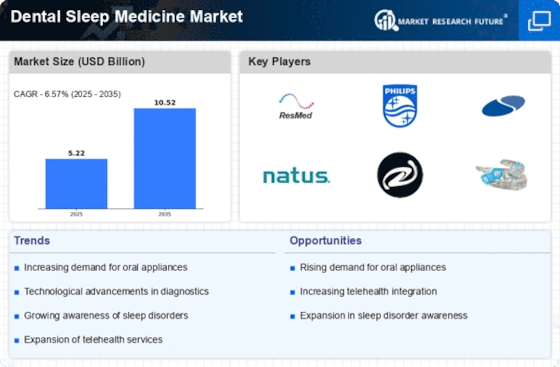
As per Market Research Future analysis, the Dental Sleep Medicine Market Size was estimated at 5.222 USD Billion in 2024. The Dental Sleep Medicine industry is projected to grow from 5.565 USD Billion in 2025 to 10.52 USD Billion by 2035, exhibiting a compound annual growth rate (CAGR) of 6.5% during the forecast period 2025 - 2035

Key Market Trends & Highlights

The Dental Sleep Medicine Market is experiencing robust growth driven by technological advancements and increasing awareness of sleep disorders.

  • Technological advancements in dental devices are enhancing treatment efficacy and patient compliance. The focus on preventive care is reshaping treatment paradigms in the Dental Sleep Medicine Market sector. North America remains the largest market, while the Asia-Pacific region is emerging as the fastest-growing area. Rising prevalence of sleep disorders and increased awareness are key drivers propelling market expansion.

Market Size & Forecast

2024 Market Size 5.222 (USD Billion)
2035 Market Size 10.52 (USD Billion)
CAGR (2025 - 2035) 6.57%
Largest Regional Market Share in 2024 North America

Major Players

ResMed (AU), Philips (NL), SomnoMed (AU), Natus Medical (US), Zyppah (US), Oral Sleep Appliances (US), TAP (US), Breathe Technologies (US)

Market Trends

The Dental Sleep Medicine Market is currently experiencing a notable evolution, driven by an increasing awareness of sleep disorders and their impact on overall health. As more individuals recognize the importance of quality sleep, there is a growing demand for effective treatment options. This market encompasses various therapeutic approaches, including oral appliances and continuous positive airway pressure (CPAP) devices, which are designed to alleviate conditions such as obstructive sleep apnea. Furthermore, advancements in technology are facilitating the development of innovative solutions, enhancing patient compliance and comfort. In addition to technological progress, the Dental Sleep Medicine Market is influenced by a shift towards preventive care. Healthcare providers are increasingly focusing on early diagnosis and intervention, which may lead to improved patient outcomes. This proactive approach is likely to foster collaboration between dental professionals and sleep specialists, creating a more integrated healthcare model. As the market continues to expand, it appears poised for further growth, driven by ongoing research and the rising prevalence of sleep-related disorders.

Technological Advancements

The Dental Sleep Medicine Market is witnessing a surge in technological innovations, particularly in the development of more comfortable and effective oral appliances. These advancements aim to enhance patient adherence to treatment protocols, thereby improving overall health outcomes.

Preventive Care Focus

There is a discernible trend towards preventive care within the Dental Sleep Medicine Market. Healthcare providers are increasingly prioritizing early detection and management of sleep disorders, which may lead to better patient outcomes and reduced healthcare costs.

Interdisciplinary Collaboration

The market is experiencing a growing trend of collaboration between dental professionals and sleep specialists. This interdisciplinary approach is likely to enhance the quality of care provided to patients, as it fosters a more comprehensive understanding of sleep-related issues.

Dental Sleep Medicine Market Market Drivers

Increased Awareness and Education

The growing awareness and education surrounding sleep health are pivotal in driving the Dental Sleep Medicine Market. Campaigns aimed at educating the public about the risks associated with untreated sleep disorders have gained momentum. Healthcare professionals are increasingly emphasizing the link between oral health and sleep quality, leading to a greater understanding of dental sleep medicine. This heightened awareness is likely to result in more patients seeking dental interventions for sleep apnea, thereby expanding the market. Additionally, educational initiatives targeting dental practitioners are fostering a more informed workforce capable of addressing sleep-related issues, further propelling the Dental Sleep Medicine Market.

Rising Prevalence of Sleep Disorders

The increasing prevalence of sleep disorders, particularly obstructive sleep apnea, is a primary driver of the Dental Sleep Medicine Market. Recent estimates suggest that approximately 22 million individuals suffer from sleep apnea in the United States alone. This growing patient population necessitates effective treatment options, thereby propelling demand for dental sleep medicine solutions. As awareness of sleep disorders rises, more patients seek diagnosis and treatment, leading to a surge in the market. The Dental Sleep Medicine Market is likely to expand as healthcare providers recognize the importance of integrating dental solutions into sleep disorder management, potentially improving patient outcomes and quality of life.

Technological Innovations in Dental Devices

Technological advancements in dental devices are significantly influencing the Dental Sleep Medicine Market. Innovations such as custom-fitted oral appliances and advanced diagnostic tools enhance the effectiveness of treatments for sleep apnea and other sleep-related disorders. The introduction of 3D printing technology allows for the rapid production of personalized dental devices, improving patient comfort and compliance. Furthermore, the integration of telemedicine in dental practices facilitates remote consultations and follow-ups, making it easier for patients to access care. As these technologies continue to evolve, they are expected to drive growth in the Dental Sleep Medicine Market, attracting both practitioners and patients seeking modern solutions.

Aging Population and Associated Health Issues

The aging population is a significant factor contributing to the growth of the Dental Sleep Medicine Market. As individuals age, the likelihood of developing sleep disorders increases, with studies indicating that sleep apnea prevalence is higher among older adults. This demographic shift is expected to lead to a greater demand for dental sleep medicine solutions tailored to the needs of older patients. Furthermore, the correlation between age-related health issues and sleep disorders underscores the necessity for comprehensive treatment approaches. Consequently, the Dental Sleep Medicine Market is poised for expansion as healthcare systems adapt to the needs of an aging population, integrating dental solutions into broader health management strategies.

Interdisciplinary Collaboration in Healthcare

Interdisciplinary collaboration among healthcare providers is emerging as a crucial driver of the Dental Sleep Medicine Market. The integration of dental professionals into sleep medicine teams fosters a holistic approach to patient care, enhancing treatment outcomes. Collaborative efforts between dentists, sleep specialists, and primary care physicians facilitate comprehensive management of sleep disorders, leading to improved patient satisfaction. This trend is likely to encourage more dental practitioners to engage in sleep medicine, thereby expanding the market. As healthcare systems increasingly recognize the value of interdisciplinary approaches, the Dental Sleep Medicine Market is expected to benefit from enhanced cooperation and shared expertise among various healthcare disciplines.

Market Segment Insights

By Treatment: Positive Airway Pressure (PAP) Therapy (Largest) vs. Oral and Nasal Devices (Fastest-Growing)

In the Dental Sleep Medicine Market, Positive Airway Pressure (PAP) Therapy stands out as the largest segment, accounting for a significant portion of total market share. This therapy has been widely accepted owing to its effectiveness in treating obstructive sleep apnea, leading to its dominating position among treatment options. Meanwhile, Oral and <a href="https://www.marketresearchfuture.com/reports/nasal-packing-device-market-34014">Nasal Devices </a>are emerging rapidly, capturing attention due to their non-invasive nature and ease of use, thus appealing to a growing customer base seeking alternatives to PAP therapy.

Positive Airway Pressure (PAP) Therapy (Dominant) vs. Oral and Nasal Devices (Emerging)

Positive Airway Pressure (PAP) Therapy remains a cornerstone in the Dental Sleep Medicine Market landscape, renowned for its efficacy and established clinical backing. This dominant treatment is favored by healthcare practitioners and patients alike, often recommended for severe cases of sleep apnea. In contrast, Oral and Nasal Devices have started gaining momentum, particularly among those seeking less intrusive options. They cater to a demographic that favors convenience without sacrificing treatment quality. Both segments present unique benefits, with PAP Therapy solidifying its place as the go-to choice, while Oral and Nasal Devices show promising growth potential, driven by innovation and user-centric designs.

By Diagnostics: Polysomnography (Largest) vs. Oximetry (Fastest-Growing)

Within the Dental Sleep Medicine Market, diagnostics play a crucial role, with <a href="https://www.marketresearchfuture.com/reports/polysomnography-devices-market-11741">Polysomnography </a>leading the segment by a significant margin. Polygraphy and Oximetry also contribute to market share, but Polysomnography remains the front-runner due to its comprehensive nature in diagnosing sleep disorders. The distribution of market share indicates a strong preference for Polysomnography, which clinicians consider the gold standard in sleep diagnostics. Looking at growth trends, Oximetry is emerging as the fastest-growing segment in Dental Sleep Medicine Market. This growth can be attributed to advancements in technology that allow for continuous monitoring of oxygen levels while sleeping, alongside the increasing prevalence of sleep apnea. Consumer awareness and the shift towards home-based diagnostic tools also play a vital role in driving this segment's growth.

Polysomnography (Dominant) vs. Actigraphy (Emerging)

Polysomnography is the dominant diagnostic approach in the Dental Sleep Medicine Market, primarily due to its ability to provide comprehensive data on sleep architecture and disorders. It involves multiple physiological measurements, including EEG, EOG, and EMG, making it indispensable for accurate diagnosis. Meanwhile, Actigraphy is an emerging tool gaining traction for its convenience and ability to monitor sleep patterns over extended periods. This non-invasive method offers a less intrusive alternative for patients, which is contributing to its increased adoption. As more healthcare providers recognize the benefits of both methods, they are often used in tandem to enhance diagnostic accuracy and patient outcomes.

By End-User: Home (Largest) vs. Sleep Laboratories (Fastest-Growing)

In the Dental Sleep Medicine Market, the end-user segment is primarily composed of three key areas: Home, Sleep Laboratories, and <a href="https://www.marketresearchfuture.com/reports/hospital-services-market-12357">Hospitals</a>. Among these, the home care segment holds the largest market share due to the increasing preference for convenient and comfortable sleep disorder management options. Home setups allow patients to utilize dental sleep devices in the comfort of their own space, significantly boosting their adoption rates. Conversely, sleep laboratories, which specialize in comprehensive diagnostic services, represent the fastest-growing segment as more patients seek professional assessments for their sleep disorders. The growth in the sleep laboratories sector is driven by rising awareness about sleep disorders and the importance of accurate diagnoses. As more patients become informed about the need for professional evaluations, sleep laboratories are swiftly enhancing their facilities and technologies to cater to this demand. Furthermore, collaborations between dental professionals and sleep specialists are fostering innovation and expanding treatment options in these settings. This dynamic is crucial in propelling the market forward, making sleep laboratories an attractive choice for patients.

Home (Dominant) vs. Sleep Laboratories (Emerging)

The Home segment is the dominant player in the Dental Sleep Medicine Market, capitalizing on advancements that make at-home care accessible, such as user-friendly dental appliances and telehealth consultations. This segment thrives on the appeal of convenience and the growing trend of self-management of health conditions, allowing patients to avoid clinical visits while effectively addressing their sleep issues. On the other hand, Sleep Laboratories are emerging as a critical player, driven by their ability to provide thorough sleep assessments and personalized treatment plans. These facilities often possess specialized equipment and trained staff, making them vital for accurate diagnostics and tailored therapies. As the recognition of sleep disorders grows, both segments are likely to expand, though their market strategies and patient interactions differ significantly.

Get more detailed insights about Dental Sleep Medicine Market Research Report – Forecast to 2035

Regional Insights

North America : Leading Market for Dental Solutions

North America is the largest market for Dental Sleep Medicine, accounting for approximately 45% of the global market share. The growth is driven by increasing awareness of sleep disorders, advancements in dental technology, and supportive healthcare policies. Regulatory catalysts, such as the American Academy of Sleep Medicine guidelines, further enhance market demand. The U.S. and Canada are the primary contributors, with the U.S. alone holding around 40% of the market share. The competitive landscape in North America is robust, featuring key players like ResMed, Philips, and Natus Medical. These companies are at the forefront of innovation, offering a range of oral appliances and CPAP devices. The presence of established healthcare infrastructure and a growing number of sleep clinics also contribute to the market's expansion. As awareness of sleep apnea increases, the demand for effective dental sleep solutions is expected to rise significantly.

Europe : Emerging Market with Growth Potential

Europe is witnessing significant growth in the Dental Sleep Medicine market, holding approximately 30% of the global share. The demand is fueled by rising incidences of sleep apnea and increasing healthcare expenditure. Regulatory frameworks, such as the European Sleep Research Society guidelines, are promoting the adoption of dental sleep appliances. Countries like Germany and the UK are leading the market, with Germany accounting for about 12% of the total market share. The competitive landscape in Europe is characterized by a mix of established players and emerging companies. Key players include Philips and SomnoMed, which are innovating to meet the growing demand for effective sleep solutions. The presence of a well-developed healthcare system and increasing awareness of sleep disorders are driving market growth. As more patients seek treatment, the market is expected to expand further, supported by favorable regulations and technological advancements.

Asia-Pacific : Rapidly Growing Market Segment

The Asia-Pacific region is rapidly emerging in the Dental Sleep Medicine market, currently holding about 20% of the global share. The growth is driven by increasing urbanization, rising disposable incomes, and a growing awareness of sleep disorders. Countries like China and Australia are leading this growth, with China expected to account for a significant portion of the market due to its large population and increasing healthcare investments. The competitive landscape in Asia-Pacific is evolving, with both local and international players entering the market. Companies like SomnoMed and Breathe Technologies are expanding their presence, offering innovative solutions tailored to regional needs. The increasing number of sleep clinics and healthcare facilities is also contributing to market growth. As awareness of dental sleep medicine continues to rise, the region is poised for substantial growth in the coming years.

Middle East and Africa : Untapped Market with Potential

The Middle East and Africa region is an untapped market for Dental Sleep Medicine, currently holding about 5% of the global share. The growth potential is significant, driven by increasing healthcare investments and a rising prevalence of sleep disorders. Countries like South Africa and the UAE are leading the way, with growing awareness and healthcare initiatives aimed at improving sleep health. Regulatory support is gradually increasing, which is expected to catalyze market growth in the coming years. The competitive landscape in this region is still developing, with a mix of local and international players. Companies are beginning to recognize the opportunities in dental sleep solutions, with a focus on education and awareness campaigns. As healthcare infrastructure improves and more patients seek treatment, the market is likely to expand. The potential for growth in this region is substantial, making it an attractive area for investment and innovation.

Key Players and Competitive Insights

The Dental Sleep Medicine Market is currently characterized by a dynamic competitive landscape, driven by increasing awareness of sleep disorders and the growing demand for effective treatment solutions. Key players such as ResMed (AU), Philips (NL), and SomnoMed (AU) are at the forefront, each adopting distinct strategies to enhance their market presence. ResMed (AU) focuses on innovation in digital health technologies, aiming to integrate telehealth solutions into their offerings. Philips (NL), on the other hand, emphasizes a comprehensive approach by expanding its product portfolio through strategic acquisitions and partnerships, thereby enhancing its capabilities in sleep apnea management. SomnoMed (AU) is concentrating on regional expansion, particularly in North America, to capitalize on the rising prevalence of obstructive sleep apnea (OSA). Collectively, these strategies contribute to a competitive environment that is increasingly centered around technological advancement and patient-centric solutions.
In terms of business tactics, companies are localizing manufacturing and optimizing supply chains to enhance efficiency and responsiveness to market demands. The competitive structure of the Dental Sleep Medicine Market appears moderately fragmented, with several players vying for market share. However, the influence of major companies is substantial, as they set industry standards and drive innovation, thereby shaping the overall market dynamics.
In August 2025, ResMed (AU) announced the launch of a new cloud-connected device designed to improve patient adherence to therapy. This strategic move underscores ResMed's commitment to leveraging technology to enhance patient outcomes and streamline the management of sleep disorders. By integrating cloud connectivity, the device allows for real-time monitoring and personalized treatment adjustments, which could significantly improve patient engagement and satisfaction.
In September 2025, Philips (NL) revealed its acquisition of a leading telehealth platform, aiming to bolster its digital health capabilities. This acquisition is strategically important as it positions Philips to offer a more integrated solution for sleep apnea management, combining traditional treatment methods with advanced telehealth services. Such a move not only enhances Philips' product offerings but also aligns with the growing trend of remote patient monitoring in healthcare.
In July 2025, SomnoMed (AU) expanded its distribution network in North America by partnering with several dental practices and sleep clinics. This strategic action is likely to enhance SomnoMed's market penetration and accessibility, allowing it to reach a broader patient base. By fostering relationships with healthcare providers, SomnoMed is positioning itself as a key player in the North American Dental Sleep Medicine Market, potentially increasing its competitive edge.
As of October 2025, the Dental Sleep Medicine Market is witnessing trends such as digitalization, sustainability, and the integration of artificial intelligence in treatment solutions. Strategic alliances among companies are increasingly shaping the competitive landscape, facilitating knowledge sharing and resource optimization. Looking ahead, it appears that competitive differentiation will evolve from traditional price-based competition to a focus on innovation, technological advancements, and supply chain reliability. Companies that can effectively leverage these trends are likely to secure a more prominent position in the market.

Key Companies in the Dental Sleep Medicine Market include

Industry Developments

2018, April- The American Academy of Dental Sleep Medicine Market, a leading national dentists' organization, has announced the AADSM Mastery Program, which will ensure that dentists have the necessary skills and training to provide patients with sleep-related breathing disorders such as snoring and obstructive sleep apnea (OSA) with proper oral appliance therapy (OAT).

Future Outlook

Dental Sleep Medicine Market Future Outlook

The Dental Sleep Medicine Market is projected to grow at a 6.57% CAGR from 2025 to 2035, driven by increasing awareness, technological advancements, and rising prevalence of sleep disorders.

New opportunities lie in:

  • <p>Development of telehealth platforms for remote consultations and follow-ups. Integration of AI-driven diagnostics in dental practices. Expansion of dental sleep medicine training programs for healthcare professionals.</p>

By 2035, the market is expected to be robust, reflecting substantial growth and innovation.

Market Segmentation

Dental Sleep Medicine Market End-User Outlook

  • Home
  • Sleep Laboratories
  • Hospitals

Dental Sleep Medicine Market Treatment Outlook

  • Positive Airway Pressure (PAP) Therapy
  • Oral and Nasal Devices
  • Airway Systems
  • Other Devices
  • Drugs
  • Surgery

Dental Sleep Medicine Market Diagnostics Outlook

  • Polysomnography and Polygraphy
  • Oximetry
  • Actigraphy

Report Scope

MARKET SIZE 2024 5.222(USD Billion)
MARKET SIZE 2025 5.565(USD Billion)
MARKET SIZE 2035 10.52(USD Billion)
COMPOUND ANNUAL GROWTH RATE (CAGR) 6.57% (2025 - 2035)
REPORT COVERAGE Revenue Forecast, Competitive Landscape, Growth Factors, and Trends
BASE YEAR 2024
Market Forecast Period 2025 - 2035
Historical Data 2019 - 2024
Market Forecast Units USD Billion
Key Companies Profiled ResMed (AU), Philips (NL), SomnoMed (AU), Natus Medical (US), Zyppah (US), Oral Sleep Appliances (US), TAP (US), Breathe Technologies (US)
Segments Covered treatment & diagnostics, end users - forecast till 2035
Key Market Opportunities Integration of telehealth solutions enhances access to Dental Sleep Medicine services and patient engagement.
Key Market Dynamics Rising demand for oral appliances drives innovation and competition in the Dental Sleep Medicine sector.
Countries Covered North America, Europe, APAC, South America, MEA

FAQs

What is the current valuation of the Dental Sleep Medicine Market?

<p>As of 2024, the Dental Sleep Medicine Market was valued at approximately 5.222 USD Billion.</p>

What is the projected market size for the Dental Sleep Medicine Market by 2035?

<p>The market is expected to reach a valuation of 10.52 USD Billion by 2035.</p>

What is the expected CAGR for the Dental Sleep Medicine Market during the forecast period 2025 - 2035?

<p>The anticipated CAGR for the Dental Sleep Medicine Market from 2025 to 2035 is 6.57%.</p>

Which companies are considered key players in the Dental Sleep Medicine Market?

<p>Key players in the market include ResMed, Philips, SomnoMed, Natus Medical, Zyppah, Oral Sleep Appliances, TAP, and Breathe Technologies.</p>

What are the primary treatment segments in the Dental Sleep Medicine Market?

<p>The main treatment segments include Positive Airway Pressure (PAP) Therapy, Oral and Nasal Devices, Airway Systems, Other Devices, Drugs, and Surgery.</p>

What was the market size for Positive Airway Pressure (PAP) Therapy in 2024?

In 2024, the market size for Positive Airway Pressure (PAP) Therapy was approximately 1.5 USD Billion.

How does the market for diagnostics in Dental Sleep Medicine break down?

The diagnostics segment includes Polysomnography and Polygraphy, Oximetry, and Actigraphy, with a total market size of 5.2 USD Billion in 2024.

What is the expected growth for the Oral and Nasal Devices segment by 2035?

The Oral and Nasal Devices segment is projected to grow from 1.2 USD Billion in 2024 to 2.4 USD Billion by 2035.

What are the end-user segments in the Dental Sleep Medicine Market?

End-user segments consist of Home, Sleep Laboratories, and Hospitals, with Hospitals showing a market size of 2.522 USD Billion in 2024.

What is the projected market size for the Home end-user segment by 2035?

The Home end-user segment is expected to grow from 1.5 USD Billion in 2024 to 3.0 USD Billion by 2035.

  1. SECTION I: EXECUTIVE SUMMARY AND KEY HIGHLIGHTS |
    1. EXECUTIVE SUMMARY | |
      1. Market Overview | |
      2. Key Findings | |
      3. Market Segmentation | |
      4. Competitive Landscape | |
      5. Challenges and Opportunities | |
      6. Future Outlook 2
  2. SECTION II: SCOPING, METHODOLOGY AND MARKET STRUCTURE |
    1. MARKET INTRODUCTION | |
      1. Definition | |
      2. Scope of the study | | |
    2. RESEARCH METHODOLOGY | |
      1. Overview | |
      2. Data Mining | |
      3. Secondary Research | |
      4. Primary Research | | |
      5. Forecasting Model | |
      6. Market Size Estimation | | |
      7. Data Triangulation | |
      8. Validation 3
  3. SECTION III: QUALITATIVE ANALYSIS |
    1. MARKET DYNAMICS | |
      1. Overview | |
      2. Drivers | |
      3. Restraints | |
      4. Opportunities |
    2. MARKET FACTOR ANALYSIS | |
      1. Value chain Analysis | |
      2. Porter's Five Forces Analysis | | |
      3. COVID-19 Impact Analysis | | |
  4. SECTION IV: QUANTITATIVE ANALYSIS |
    1. Healthcare, BY Treatment (USD Billion) | |
      1. Positive Airway Pressure (PAP) Therapy | |
      2. Oral and Nasal Devices | |
      3. Airway Systems | |
      4. Other Devices | |
      5. Drugs | |
      6. Surgery |
    2. Healthcare, BY Diagnostics (USD Billion) | |
      1. Polysomnography and Polygraphy | |
      2. Oximetry | |
      3. Actigraphy |
    3. Healthcare, BY End-User (USD Billion) | |
      1. Home | |
      2. Sleep Laboratories | |
      3. Hospitals |
    4. Healthcare, BY Region (USD Billion) | |
      1. North America | | |
      2. Europe | | |
      3. APAC | | |
      4. South America | | |
      5. MEA | | |
  5. SECTION V: COMPETITIVE ANALYSIS |
    1. Competitive Landscape | |
      1. Overview | |
      2. Competitive Analysis | |
      3. Market share Analysis | |
      4. Major Growth Strategy in the Healthcare | |
      5. Competitive Benchmarking | |
      6. Leading Players in Terms of Number of Developments in the Healthcare | |
      7. Key developments and growth strategies | | |
      8. Major Players Financial Matrix | | |
    2. Company Profiles | |
      1. ResMed (AU) | | |
      2. Philips (NL) | | |
      3. SomnoMed (AU) | | |
      4. Natus Medical (US) | | |
      5. Zyppah (US) | | |
      6. Oral Sleep Appliances (US) | | |
      7. TAP (US) | | |
      8. Breathe Technologies (US) | | |
    3. Appendix | |
      1. References | |
      2. Related Reports 6 LIST OF FIGURES |
    4. MARKET SYNOPSIS |
    5. NORTH AMERICA MARKET ANALYSIS |
    6. US MARKET ANALYSIS BY TREATMENT |
    7. US MARKET ANALYSIS BY DIAGNOSTICS |
    8. US MARKET ANALYSIS BY END-USER |
    9. CANADA MARKET ANALYSIS BY TREATMENT |
    10. CANADA MARKET ANALYSIS BY DIAGNOSTICS |
    11. CANADA MARKET ANALYSIS BY END-USER |
    12. EUROPE MARKET ANALYSIS |
    13. GERMANY MARKET ANALYSIS BY TREATMENT |
    14. GERMANY MARKET ANALYSIS BY DIAGNOSTICS |
    15. GERMANY MARKET ANALYSIS BY END-USER |
    16. UK MARKET ANALYSIS BY TREATMENT |
    17. UK MARKET ANALYSIS BY DIAGNOSTICS |
    18. UK MARKET ANALYSIS BY END-USER |
    19. FRANCE MARKET ANALYSIS BY TREATMENT |
    20. FRANCE MARKET ANALYSIS BY DIAGNOSTICS |
    21. FRANCE MARKET ANALYSIS BY END-USER |
    22. RUSSIA MARKET ANALYSIS BY TREATMENT |
    23. RUSSIA MARKET ANALYSIS BY DIAGNOSTICS |
    24. RUSSIA MARKET ANALYSIS BY END-USER |
    25. ITALY MARKET ANALYSIS BY TREATMENT |
    26. ITALY MARKET ANALYSIS BY DIAGNOSTICS |
    27. ITALY MARKET ANALYSIS BY END-USER |
    28. SPAIN MARKET ANALYSIS BY TREATMENT |
    29. SPAIN MARKET ANALYSIS BY DIAGNOSTICS |
    30. SPAIN MARKET ANALYSIS BY END-USER |
    31. REST OF EUROPE MARKET ANALYSIS BY TREATMENT |
    32. REST OF EUROPE MARKET ANALYSIS BY DIAGNOSTICS |
    33. REST OF EUROPE MARKET ANALYSIS BY END-USER |
    34. APAC MARKET ANALYSIS |
    35. CHINA MARKET ANALYSIS BY TREATMENT |
    36. CHINA MARKET ANALYSIS BY DIAGNOSTICS |
    37. CHINA MARKET ANALYSIS BY END-USER |
    38. INDIA MARKET ANALYSIS BY TREATMENT |
    39. INDIA MARKET ANALYSIS BY DIAGNOSTICS |
    40. INDIA MARKET ANALYSIS BY END-USER |
    41. JAPAN MARKET ANALYSIS BY TREATMENT |
    42. JAPAN MARKET ANALYSIS BY DIAGNOSTICS |
    43. JAPAN MARKET ANALYSIS BY END-USER |
    44. SOUTH KOREA MARKET ANALYSIS BY TREATMENT |
    45. SOUTH KOREA MARKET ANALYSIS BY DIAGNOSTICS |
    46. SOUTH KOREA MARKET ANALYSIS BY END-USER |
    47. MALAYSIA MARKET ANALYSIS BY TREATMENT |
    48. MALAYSIA MARKET ANALYSIS BY DIAGNOSTICS |
    49. MALAYSIA MARKET ANALYSIS BY END-USER |
    50. THAILAND MARKET ANALYSIS BY TREATMENT |
    51. THAILAND MARKET ANALYSIS BY DIAGNOSTICS |
    52. THAILAND MARKET ANALYSIS BY END-USER |
    53. INDONESIA MARKET ANALYSIS BY TREATMENT |
    54. INDONESIA MARKET ANALYSIS BY DIAGNOSTICS |
    55. INDONESIA MARKET ANALYSIS BY END-USER |
    56. REST OF APAC MARKET ANALYSIS BY TREATMENT |
    57. REST OF APAC MARKET ANALYSIS BY DIAGNOSTICS |
    58. REST OF APAC MARKET ANALYSIS BY END-USER |
    59. SOUTH AMERICA MARKET ANALYSIS |
    60. BRAZIL MARKET ANALYSIS BY TREATMENT |
    61. BRAZIL MARKET ANALYSIS BY DIAGNOSTICS |
    62. BRAZIL MARKET ANALYSIS BY END-USER |
    63. MEXICO MARKET ANALYSIS BY TREATMENT |
    64. MEXICO MARKET ANALYSIS BY DIAGNOSTICS |
    65. MEXICO MARKET ANALYSIS BY END-USER |
    66. ARGENTINA MARKET ANALYSIS BY TREATMENT |
    67. ARGENTINA MARKET ANALYSIS BY DIAGNOSTICS |
    68. ARGENTINA MARKET ANALYSIS BY END-USER |
    69. REST OF SOUTH AMERICA MARKET ANALYSIS BY TREATMENT |
    70. REST OF SOUTH AMERICA MARKET ANALYSIS BY DIAGNOSTICS |
    71. REST OF SOUTH AMERICA MARKET ANALYSIS BY END-USER |
    72. MEA MARKET ANALYSIS |
    73. GCC COUNTRIES MARKET ANALYSIS BY TREATMENT |
    74. GCC COUNTRIES MARKET ANALYSIS BY DIAGNOSTICS |
    75. GCC COUNTRIES MARKET ANALYSIS BY END-USER |
    76. SOUTH AFRICA MARKET ANALYSIS BY TREATMENT |
    77. SOUTH AFRICA MARKET ANALYSIS BY DIAGNOSTICS |
    78. SOUTH AFRICA MARKET ANALYSIS BY END-USER |
    79. REST OF MEA MARKET ANALYSIS BY TREATMENT |
    80. REST OF MEA MARKET ANALYSIS BY DIAGNOSTICS |
    81. REST OF MEA MARKET ANALYSIS BY END-USER |
    82. KEY BUYING CRITERIA OF HEALTHCARE |
    83. RESEARCH PROCESS OF MRFR |
    84. DRO ANALYSIS OF HEALTHCARE |
    85. DRIVERS IMPACT ANALYSIS: HEALTHCARE |
    86. RESTRAINTS IMPACT ANALYSIS: HEALTHCARE |
    87. SUPPLY / VALUE CHAIN: HEALTHCARE |
    88. HEALTHCARE, BY TREATMENT, 2024 (% SHARE) |
    89. HEALTHCARE, BY TREATMENT, 2024 TO 2035 (USD Billion) |
    90. HEALTHCARE, BY DIAGNOSTICS, 2024 (% SHARE) |
    91. HEALTHCARE, BY DIAGNOSTICS, 2024 TO 2035 (USD Billion) |
    92. HEALTHCARE, BY END-USER, 2024 (% SHARE) |
    93. HEALTHCARE, BY END-USER, 2024 TO 2035 (USD Billion) |
    94. BENCHMARKING OF MAJOR COMPETITORS 7 LIST OF TABLES |
    95. LIST OF ASSUMPTIONS | |
      1. |
    96. North America MARKET SIZE ESTIMATES; FORECAST | |
      1. BY TREATMENT, 2025-2035 (USD Billion) | |
      2. BY DIAGNOSTICS, 2025-2035 (USD Billion) | |
      3. BY END-USER, 2025-2035 (USD Billion) |
    97. US MARKET SIZE ESTIMATES; FORECAST | |
      1. BY TREATMENT, 2025-2035 (USD Billion) | |
      2. BY DIAGNOSTICS, 2025-2035 (USD Billion) | |
      3. BY END-USER, 2025-2035 (USD Billion) |
    98. Canada MARKET SIZE ESTIMATES; FORECAST | |
      1. BY TREATMENT, 2025-2035 (USD Billion) | |
      2. BY DIAGNOSTICS, 2025-2035 (USD Billion) | |
      3. BY END-USER, 2025-2035 (USD Billion) |
    99. Europe MARKET SIZE ESTIMATES; FORECAST | |
      1. BY TREATMENT, 2025-2035 (USD Billion) | |
      2. BY DIAGNOSTICS, 2025-2035 (USD Billion) | |
      3. BY END-USER, 2025-2035 (USD Billion) |
    100. Germany MARKET SIZE ESTIMATES; FORECAST | |
      1. BY TREATMENT, 2025-2035 (USD Billion) | |
      2. BY DIAGNOSTICS, 2025-2035 (USD Billion) | |
      3. BY END-USER, 2025-2035 (USD Billion) |
    101. UK MARKET SIZE ESTIMATES; FORECAST | |
      1. BY TREATMENT, 2025-2035 (USD Billion) | |
      2. BY DIAGNOSTICS, 2025-2035 (USD Billion) | |
      3. BY END-USER, 2025-2035 (USD Billion) |
    102. France MARKET SIZE ESTIMATES; FORECAST | |
      1. BY TREATMENT, 2025-2035 (USD Billion) | |
      2. BY DIAGNOSTICS, 2025-2035 (USD Billion) | |
      3. BY END-USER, 2025-2035 (USD Billion) |
    103. Russia MARKET SIZE ESTIMATES; FORECAST | |
      1. BY TREATMENT, 2025-2035 (USD Billion) | |
      2. BY DIAGNOSTICS, 2025-2035 (USD Billion) | |
      3. BY END-USER, 2025-2035 (USD Billion) |
    104. Italy MARKET SIZE ESTIMATES; FORECAST | |
      1. BY TREATMENT, 2025-2035 (USD Billion) | |
      2. BY DIAGNOSTICS, 2025-2035 (USD Billion) | |
      3. BY END-USER, 2025-2035 (USD Billion) |
    105. Spain MARKET SIZE ESTIMATES; FORECAST | |
      1. BY TREATMENT, 2025-2035 (USD Billion) | |
      2. BY DIAGNOSTICS, 2025-2035 (USD Billion) | |
      3. BY END-USER, 2025-2035 (USD Billion) |
    106. Rest of Europe MARKET SIZE ESTIMATES; FORECAST | |
      1. BY TREATMENT, 2025-2035 (USD Billion) | |
      2. BY DIAGNOSTICS, 2025-2035 (USD Billion) | |
      3. BY END-USER, 2025-2035 (USD Billion) |
    107. APAC MARKET SIZE ESTIMATES; FORECAST | |
      1. BY TREATMENT, 2025-2035 (USD Billion) | |
      2. BY DIAGNOSTICS, 2025-2035 (USD Billion) | |
      3. BY END-USER, 2025-2035 (USD Billion) |
    108. China MARKET SIZE ESTIMATES; FORECAST | |
      1. BY TREATMENT, 2025-2035 (USD Billion) | |
      2. BY DIAGNOSTICS, 2025-2035 (USD Billion) | |
      3. BY END-USER, 2025-2035 (USD Billion) |
    109. India MARKET SIZE ESTIMATES; FORECAST | |
      1. BY TREATMENT, 2025-2035 (USD Billion) | |
      2. BY DIAGNOSTICS, 2025-2035 (USD Billion) | |
      3. BY END-USER, 2025-2035 (USD Billion) |
    110. Japan MARKET SIZE ESTIMATES; FORECAST | |
      1. BY TREATMENT, 2025-2035 (USD Billion) | |
      2. BY DIAGNOSTICS, 2025-2035 (USD Billion) | |
      3. BY END-USER, 2025-2035 (USD Billion) |
    111. South Korea MARKET SIZE ESTIMATES; FORECAST | |
      1. BY TREATMENT, 2025-2035 (USD Billion) | |
      2. BY DIAGNOSTICS, 2025-2035 (USD Billion) | |
      3. BY END-USER, 2025-2035 (USD Billion) |
    112. Malaysia MARKET SIZE ESTIMATES; FORECAST | |
      1. BY TREATMENT, 2025-2035 (USD Billion) | |
      2. BY DIAGNOSTICS, 2025-2035 (USD Billion) | |
      3. BY END-USER, 2025-2035 (USD Billion) |
    113. Thailand MARKET SIZE ESTIMATES; FORECAST | |
      1. BY TREATMENT, 2025-2035 (USD Billion) | |
      2. BY DIAGNOSTICS, 2025-2035 (USD Billion) | |
      3. BY END-USER, 2025-2035 (USD Billion) |
    114. Indonesia MARKET SIZE ESTIMATES; FORECAST | |
      1. BY TREATMENT, 2025-2035 (USD Billion) | |
      2. BY DIAGNOSTICS, 2025-2035 (USD Billion) | |
      3. BY END-USER, 2025-2035 (USD Billion) |
    115. Rest of APAC MARKET SIZE ESTIMATES; FORECAST | |
      1. BY TREATMENT, 2025-2035 (USD Billion) | |
      2. BY DIAGNOSTICS, 2025-2035 (USD Billion) | |
      3. BY END-USER, 2025-2035 (USD Billion) |
    116. South America MARKET SIZE ESTIMATES; FORECAST | |
      1. BY TREATMENT, 2025-2035 (USD Billion) | |
      2. BY DIAGNOSTICS, 2025-2035 (USD Billion) | |
      3. BY END-USER, 2025-2035 (USD Billion) |
    117. Brazil MARKET SIZE ESTIMATES; FORECAST | |
      1. BY TREATMENT, 2025-2035 (USD Billion) | |
      2. BY DIAGNOSTICS, 2025-2035 (USD Billion) | |
      3. BY END-USER, 2025-2035 (USD Billion) |
    118. Mexico MARKET SIZE ESTIMATES; FORECAST | |
      1. BY TREATMENT, 2025-2035 (USD Billion) | |
      2. BY DIAGNOSTICS, 2025-2035 (USD Billion) | |
      3. BY END-USER, 2025-2035 (USD Billion) |
    119. Argentina MARKET SIZE ESTIMATES; FORECAST | |
      1. BY TREATMENT, 2025-2035 (USD Billion) | |
      2. BY DIAGNOSTICS, 2025-2035 (USD Billion) | |
      3. BY END-USER, 2025-2035 (USD Billion) |
    120. Rest of South America MARKET SIZE ESTIMATES; FORECAST | |
      1. BY TREATMENT, 2025-2035 (USD Billion) | |
      2. BY DIAGNOSTICS, 2025-2035 (USD Billion) | |
      3. BY END-USER, 2025-2035 (USD Billion) |
    121. MEA MARKET SIZE ESTIMATES; FORECAST | |
      1. BY TREATMENT, 2025-2035 (USD Billion) | |
      2. BY DIAGNOSTICS, 2025-2035 (USD Billion) | |
      3. BY END-USER, 2025-2035 (USD Billion) |
    122. GCC Countries MARKET SIZE ESTIMATES; FORECAST | |
      1. BY TREATMENT, 2025-2035 (USD Billion) | |
      2. BY DIAGNOSTICS, 2025-2035 (USD Billion) | |
      3. BY END-USER, 2025-2035 (USD Billion) |
    123. South Africa MARKET SIZE ESTIMATES; FORECAST | |
      1. BY TREATMENT, 2025-2035 (USD Billion) | |
      2. BY DIAGNOSTICS, 2025-2035 (USD Billion) | |
      3. BY END-USER, 2025-2035 (USD Billion) |
    124. Rest of MEA MARKET SIZE ESTIMATES; FORECAST | |
      1. BY TREATMENT, 2025-2035 (USD Billion) | |
      2. BY DIAGNOSTICS, 2025-2035 (USD Billion) | |
      3. BY END-USER, 2025-2035 (USD Billion) |
    125. PRODUCT LAUNCH/PRODUCT DEVELOPMENT/APPROVAL | |
      1. |
    126. ACQUISITION/PARTNERSHIP | |

Healthcare Market Segmentation

Healthcare By Treatment (USD Billion, 2025-2035)

  • Positive Airway Pressure (PAP) Therapy
  • Oral and Nasal Devices
  • Airway Systems
  • Other Devices
  • Drugs
  • Surgery

Healthcare By Diagnostics (USD Billion, 2025-2035)

  • Polysomnography and Polygraphy
  • Oximetry
  • Actigraphy

Healthcare By End-User (USD Billion, 2025-2035)

  • Home
  • Sleep Laboratories
  • Hospitals
Infographic

Free Sample Request

Kindly complete the form below to receive a free sample of this Report

Get Free Sample

Customer Strories

Compare Licence

×
Features License Type
Single User Multiuser License Enterprise User
Price $4,950 $5,950 $7,250
Maximum User Access Limit 1 User Upto 10 Users Unrestricted Access Throughout the Organization
Free Customization
Direct Access to Analyst
Deliverable Format
Platform Access
Discount on Next Purchase 10% 15% 15%
Printable Versions