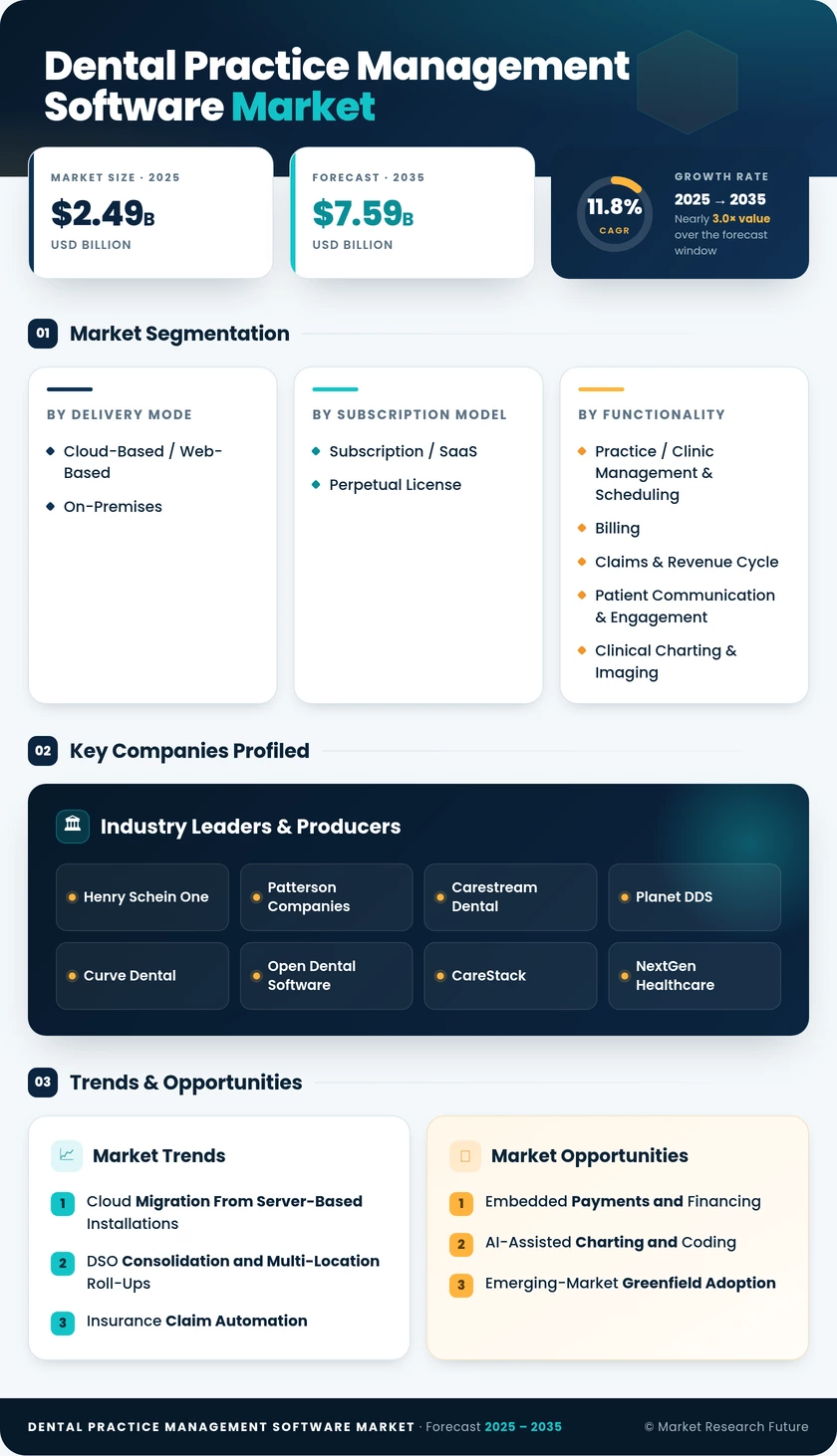
Segmentation Quick Reference
| Dimension | Sub-Segments | Dominant Segment | Fastest Growing Segment |
| By Delivery Mode | On-Premises; Cloud-Based / Web-Based | Cloud-Based / Web-Based | Cloud-Based / Web-Based |
| By Subscription Model | Perpetual License; Subscription / SaaS | Subscription / SaaS | Subscription / SaaS |
| By Functionality | Patient Communication & Engagement; Practice / Clinic Management & Scheduling; Billing, Claims & Revenue Cycle; Clinical Charting & Imaging; Analytics & Reporting | Practice / Clinic Management & Scheduling | Clinical Charting & Imaging |
| By Practice Size | Solo Practices (1–2 Ops); Small Group Practices (3–5 Ops); Mid-Size Group Practices (6–15 Ops); Large DSOs (16+ Ops) | Solo Practices (1–2 Ops) | Mid-Size Group Practices (6–15 Ops) |
| By End User | Dental Clinics; Hospitals; Dental Academic & Research Institutes; Others | Dental Clinics | Dental Academic & Research Institutes |
| By Geography | North America; Europe; Asia-Pacific; South America; Middle East & Africa | North America | Asia-Pacific |
Market Segmentation Overview
By Delivery Mode
| Sub-Segment | Key Trend |
| On-Premises | Contracting toward support-only revenue as hardware refresh cycles force decisions |
| Cloud-Based / Web-Based | Default choice for new installations and every multi-location deployment |
Deployment choice has stopped being a technical debate and become a risk decision. Ransomware exposure, remote access expectations, and multi-site reporting all point in the same direction, and vendors have redirected engineering investment accordingly.
By Subscription Model
| Sub-Segment | Key Trend |
| Perpetual License | Legacy base maintained through annual support contracts, rarely sold new |
| Subscription / SaaS | Bundles updates, hosting, and support; enables usage-based upsell |
Recurring revenue improves vendor valuation multiples and smooths practice cash flow simultaneously, which is why the conversion has proceeded faster than most incumbents forecast.
By Functionality
| Sub-Segment | Key Trend |
| Patient Communication & Engagement | Two-way messaging and automated recall are now table stakes |
| Practice / Clinic Management & Scheduling | Chair-utilisation optimisation remains the core value driver |
| Billing, Claims & Revenue Cycle | Real-time eligibility and automated attachments cut days-in-AR |
| Clinical Charting & Imaging | AI detection models embedding directly into charting flow |
| Analytics & Reporting | Multi-location benchmarking demanded by group operators |
Functional breadth increasingly decides competitive outcomes. Practices tired of stitching four vendors together are consolidating onto unified suites, even where individual modules score lower than best-of-breed alternatives.
By Practice Size
| Sub-Segment | Key Trend |
| Solo Practices (1–2 Ops) | Price-sensitive; drawn to simplified low-tier offerings |
| Small Group Practices (3–5 Ops) | Shared scheduling and provider coverage drive cloud adoption |
| Mid-Size Group Practices (6–15 Ops) | Standardising systems ahead of further acquisition |
| Large DSOs (16+ Ops) | Enterprise contracts with centralised analytics and procurement leverage |
Group formation reshapes the buyer profile. Purchasing authority is moving from the practising dentist to a regional operations director, which changes evaluation criteria toward reporting, control, and vendor stability.
By End User
| Sub-Segment | Key Trend |
| Dental Clinics | Core installed base; replacement-cycle driven |
| Hospitals | Oral surgery units integrating with enterprise clinical systems |
| Dental Academic & Research Institutes | Teaching-clinic digitisation supported by grant funding |
| Others | Mobile, military and community oral health programmes |
Institutional buyers move slowly but sign large, long contracts. Vendors with interoperability credentials and audit-ready architectures win these tenders, and the reference value carries into surrounding private-practice markets.


 Noah Malgeri
Co-Founder
Noah Malgeri
Co-Founder

 Peter Groot koerkamp
Account and Business Manager
Peter Groot koerkamp
Account and Business Manager

 Younghwan Choi
Senior Retail Manager
Younghwan Choi
Senior Retail Manager

 Mark Irwin
Management Consultant
Mark Irwin
Management Consultant

 Akif Moroglu
Strategy & Business Development Director
Akif Moroglu
Strategy & Business Development Director

 Guilherme Gomes Martins
Product Management Director
Guilherme Gomes Martins
Product Management Director

 Joseph Aguayo
Sales Operations & Pricing Manager
Joseph Aguayo
Sales Operations & Pricing Manager

 La Terria Dodd
Program Support Specialist
La Terria Dodd
Program Support Specialist

 Rob Kooiker
Group Product Manager HVAC & Fire Protection GMA
Rob Kooiker
Group Product Manager HVAC & Fire Protection GMA