
Request Free Sample ×

Kindly complete the form below to receive a free sample of this Report

* Please use a valid business email

Leading companies partner with us for data-driven Insights

clients tt-cursor
Hero Background
English
Chinese
French
Japanese
Korean
German
Spanish

Dairy Ingredients Market Share

ID: MRFR/FnB/1276-CR
200 Pages
Snehal Singh
July 2025

Dairy Ingredients Market Size, Share, Industry Trend & Analysis Research Report By Type (Milk Powder, Whey Protein, Cheese Powder, Casein, Cream), By Application (Food and Beverages, Nutritional Products, Confectionery, Bakery, Dairy Products), By Form (Liquid, Powder, Granular, Frozen), By End-use (Industrial, Retail, Food Service), and By Regional (North America, Europe, South America, Asia Pacific, Middle East and Africa) - Forecast to 2035

Share:
Download PDF ×

We do not share your information with anyone. However, we may send you emails based on your report interest from time to time. You may contact us at any time to opt-out.

Dairy Ingredients Market Infographic
Purchase Options

Market Share

Dairy Ingredients Market Share Analysis

Companies use numerous tactics to position themselves strategically and gain market share in the vast dairy ingredients industry. Companies use uniqueness by delivering distinct dairy ingredients to separate out from competitors. This might entail developing specialist components like lactose-free milk powders or organic dairy proteins for niche markets and people with unique dietary needs.

Pricing methods also affect dairy ingredients market share. Companies may undercut competitors by pricing their products competitively. Some organizations may market themselves as premium suppliers, supplying high-quality dairy components at a greater price to attract quality-conscious customers.

Brand positioning is another important dairy components market share strategy. Companies invest in strong, trusted brands that consumers like and associate with. Companies may stand out and gain client loyalty by providing high-quality dairy ingredients. Brands may also promote sustainability, ethical sourcing, and health advantages, improving a company's market position.

Distribution methods help dairy components reach customers and grow market share. Companies may strategically collaborate with distributors, retailers, or food makers to increase product availability. Companies may boost visibility and accessibility by acquiring favorable shelf placement and building effective distribution networks, making their dairy components easier to buy than competitors.

Targeted marketing and product development are major dairy ingredients market share positioning methods. Market research helps companies target certain customer categories or trends with their goods and marketing. Companies may manufacture dairy components with vitamins or probiotics for health-conscious customers or specific ingredients for newborn formula or sports nutrition.

Innovation is key for dairy ingredients firms seeking market share. Dairy ingredient manufacturers spend in R&D to fulfill market preferences. Innovation differentiates and keeps firms ahead of the competition by inventing new processing methods, tastes, textures, or nutritional profiles.

Partnerships can also help dairy components gain market share. To use their experience, resources, and client base, companies may develop strategic alliances with dairy farmers, food manufacturers, or research organizations. Together, organizations may establish synergies, develop new goods, and enter new markets, increasing their competitive position.

Finally, dairy ingredients firms must use excellent marketing and promotion to grow. Digital marketing, trade exhibitions, and industry journals help companies sell their products. Companies may increase market share by showcasing the unique qualities, advantages, and uses of their dairy components, influencing customer perceptions and preferences.

Author
Author Profile
Snehal Singh
Manager - Research

High acumen in analyzing complex macro & micro markets with more than 6 years of work experience in the field of market research. By implementing her analytical skills in forecasting and estimation into market research reports, she has expertise in Packaging, Construction, and Equipment domains. She handles a team size of 20-25 resources and ensures smooth running of the projects, associated marketing activities, and client servicing.

Leave a Comment

FAQs

What is the current valuation of the Dairy Ingredients Market in 2025?

<p>The Dairy Ingredients Market is valued at approximately 57.4 USD Billion in 2024, and it is expected to grow significantly in the coming years.</p>

What is the projected market size for the Dairy Ingredients Market by 2035?

<p>The market is projected to reach approximately 84.97 USD Billion by 2035, indicating robust growth.</p>

What is the expected CAGR for the Dairy Ingredients Market during the forecast period 2025 - 2035?

<p>The expected CAGR for the Dairy Ingredients Market during the forecast period 2025 - 2035 is 3.63%.</p>

Which companies are considered key players in the Dairy Ingredients Market?

<p>Key players in the Dairy Ingredients Market include Nestle, Danone, Lactalis, Fonterra, FrieslandCampina, Saputo, Arla Foods, Dairy Farmers of America, and Agropur.</p>

What are the main segments of the Dairy Ingredients Market?

<p>The main segments of the Dairy Ingredients Market include Type, Application, Form, and End-use.</p>

How much is the Milk Powder segment valued at in 2025?

<p>The Milk Powder segment is valued between 20.0 and 30.0 USD Billion, reflecting its importance in the market.</p>

What is the valuation range for the Food and Beverages application segment?

<p>The Food and Beverages application segment is valued between 20.0 and 30.0 USD Billion, highlighting its substantial contribution to the market.</p>

What is the projected valuation for the Powder form of dairy ingredients?

<p>The Powder form of dairy ingredients is projected to be valued between 15.0 and 25.0 USD Billion, indicating a strong demand.</p>

What is the expected valuation for the Food Service end-use segment?

<p>The Food Service end-use segment is expected to be valued between 22.4 and 29.97 USD Billion, showcasing its growth potential.</p>

How does the Dairy Ingredients Market's growth compare to other food sectors?

<p>The Dairy Ingredients Market's growth, with a projected CAGR of 3.63%, suggests a steady expansion compared to other food sectors, which may experience varying growth rates.</p>

Market Summary

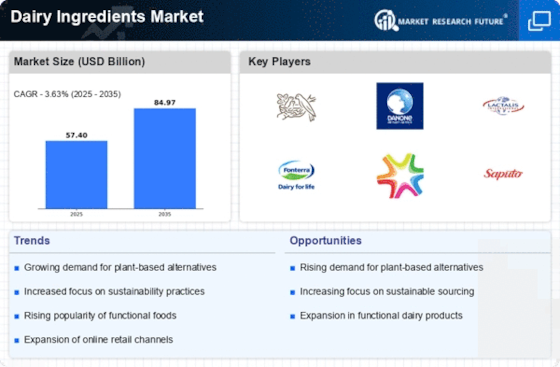
As per Market Research Future analysis, the Dairy Ingredients Market was estimated at 57.4 USD Billion in 2024. The Dairy Ingredients industry is projected to grow from 59.48 USD Billion in 2025 to 84.97 USD Billion by 2035, exhibiting a compound annual growth rate (CAGR) of 3.63% during the forecast period 2025 - 2035

Key Market Trends & Highlights

The Dairy Ingredients Market is experiencing a dynamic shift towards health-conscious and sustainable products.

  • The market is increasingly driven by a health and wellness focus, with consumers seeking nutritious dairy options.
  • Sustainability initiatives are gaining traction, influencing production practices across the industry.
  • Innovation in product development is evident, particularly in the expansion of plant-based alternatives and functional foods.
  • Rising demand for nutritional products and clean label preferences are key drivers propelling growth in North America and Asia-Pacific, particularly in the milk powder and nutritional products segments.

Market Size & Forecast

2024 Market Size 57.4 (USD Billion)
2035 Market Size 84.97 (USD Billion)
CAGR (2025 - 2035) 3.63%
Largest Regional Market Share in 2024 North America

Major Players

Nestle (CH), Danone (FR), Lactalis (FR), Fonterra (NZ), FrieslandCampina (NL), Saputo (CA), Arla Foods (DK), Dairy Farmers of America (US), Agropur (CA)

Market Trends

The Dairy Ingredients Market is currently experiencing a dynamic evolution, driven by shifting consumer preferences and increasing demand for health-oriented products. As consumers become more health-conscious, there is a noticeable inclination towards dairy ingredients that offer nutritional benefits, such as probiotics and high protein content. This trend is further fueled by the growing popularity of functional foods, which incorporate dairy ingredients to enhance their health attributes. Additionally, the rise of plant-based alternatives has prompted traditional dairy producers to innovate and diversify their offerings, ensuring they remain competitive in a rapidly changing landscape. Moreover, sustainability has emerged as a pivotal factor influencing the Dairy Ingredients Market. Consumers are increasingly aware of the environmental impact of their food choices, leading to a demand for sustainably sourced dairy products. This shift is prompting manufacturers to adopt eco-friendly practices and invest in sustainable sourcing methods. As a result, the market is likely to witness a surge in products that not only meet nutritional needs but also align with consumers' values regarding environmental stewardship. Overall, the Dairy Ingredients Market appears poised for continued growth, characterized by innovation and a focus on health and sustainability.

Health and Wellness Focus

There is a growing emphasis on health and wellness among consumers, leading to increased demand for dairy ingredients that provide nutritional benefits. Products enriched with probiotics, vitamins, and minerals are gaining traction as consumers seek to enhance their diets with functional foods.

Sustainability Initiatives

Sustainability is becoming a crucial consideration in the Dairy Ingredients Market. Manufacturers are increasingly adopting eco-friendly practices and sourcing methods to meet consumer demand for products that are not only nutritious but also environmentally responsible.

Innovation in Product Development

The Dairy Ingredients Market is witnessing a wave of innovation as companies strive to diversify their product offerings. This includes the development of new dairy-based ingredients that cater to evolving consumer preferences, such as lactose-free options and fortified products.

Dairy Ingredients Market Market Drivers

Expansion of Plant-Based Alternatives

The Dairy Ingredients Market is witnessing a significant shift towards plant-based alternatives, which, while seemingly contradictory, is influencing the dairy sector. As consumers explore non-dairy options, traditional dairy ingredients are adapting to incorporate plant-based components, creating hybrid products that appeal to a broader audience. This trend is underscored by the fact that the plant-based dairy market is expected to grow at a compound annual growth rate of over 11% through 2027. Consequently, dairy ingredient manufacturers are innovating to develop products that cater to both dairy and non-dairy consumers, thereby expanding their market reach and enhancing competitiveness in a rapidly evolving landscape.

Growing Popularity of Functional Foods

The Dairy Ingredients Market is benefiting from the growing popularity of functional foods, which are designed to provide health benefits beyond basic nutrition. Dairy ingredients such as probiotics and fortified dairy products are increasingly recognized for their potential health benefits, including improved gut health and enhanced immune function. Market data suggests that the functional food sector is projected to reach over 275 billion USD by 2025, indicating a substantial opportunity for dairy ingredient manufacturers. As consumers become more health-conscious, the demand for functional dairy products is likely to rise, prompting manufacturers to innovate and expand their offerings in this segment.

Rising Demand for Nutritional Products

The Dairy Ingredients Market is experiencing a notable increase in demand for nutritional products, driven by a growing awareness of health and wellness among consumers. This trend is reflected in the rising consumption of dairy ingredients such as whey protein and casein, which are integral to sports nutrition and dietary supplements. According to recent data, The Dairy Ingredients Market is projected to reach approximately 10 billion USD by 2026, indicating a robust growth trajectory. As consumers increasingly seek high-protein diets, dairy ingredients are positioned to meet these needs, thereby enhancing their market presence. This shift towards nutritional products is likely to continue, as more individuals prioritize health-conscious choices in their diets.

Increased Focus on Clean Label Products

The Dairy Ingredients Market is experiencing a heightened focus on clean label products, as consumers demand transparency and simplicity in food ingredients. This trend is prompting manufacturers to reformulate their products, reducing the number of additives and artificial ingredients. As a result, dairy ingredients that are perceived as natural and minimally processed are gaining traction. Market Research Future indicates that the clean label trend is influencing purchasing decisions, with a significant percentage of consumers willing to pay a premium for products that meet these criteria. This shift towards clean label dairy ingredients is likely to continue, as consumer preferences evolve towards healthier and more transparent food options.

Technological Advancements in Processing

Technological advancements in processing techniques are playing a pivotal role in the Dairy Ingredients Market. Innovations such as microfiltration and ultrafiltration are enhancing the quality and functionality of dairy ingredients, allowing for the production of higher-value products. These technologies not only improve the nutritional profile of dairy ingredients but also extend their shelf life, making them more appealing to manufacturers and consumers alike. The implementation of these advanced processing methods is expected to drive market growth, as they enable the creation of specialized dairy ingredients that meet diverse consumer needs. As a result, the industry is likely to see an increase in the availability of premium dairy products, further stimulating demand.

Market Segment Insights

By Type: Milk Powder (Largest) vs. Whey Protein (Fastest-Growing)

The Dairy Ingredients Market is primarily segmented into five main types: Milk Powder, Whey Protein, Cheese Powder, Casein, and Cream. Milk Powder holds the largest share in this segment, dominating the market due to its extensive usage in various food products and nutritional formulations. Meanwhile, Whey Protein is gaining rapid traction, driven by its growing popularity in health foods and sports nutrition products, making it a significant player in the market dynamics.

Milk Powder (Dominant) vs. Whey Protein (Emerging)

Milk Powder is recognized as the dominant segment in the Dairy Ingredients Market, primarily due to its versatility and extensive applications across different industries, including food and beverage, pharmaceuticals, and infant nutrition. It is favored for its long shelf life, nutritional benefits, and cost-effectiveness. In contrast, Whey Protein is classified as an emerging segment owing to the rising health consciousness among consumers and the growing trend of protein supplementation, especially among athletes and fitness enthusiasts. Its nutritional profile, coupled with applications in functional foods and supplements, positions it as a critical component of the market, with potential for significant growth in the coming years.

By Application: Food and Beverages (Largest) vs. Nutritional Products (Fastest-Growing)

The Dairy Ingredients Market exhibits a diverse application landscape, with the Food and Beverages segment commanding the largest share. This sector encompasses a wide array of products, including cheese, yogurt, and milk, making it a pivotal player in the market dynamics. On the other hand, the Nutritional Products segment is gaining momentum, driven by increasing health consciousness among consumers, which is shifting preferences towards fortified and functional foods. As the Dairy Ingredients Market evolves, growth trends reveal that the Nutritional Products segment is rising rapidly, supported by innovations in product formulations and the expansion of health-focused offerings. Consumers are seeking nutritious alternatives, propelling the demand for dairy-based nutritional supplements and functional dairy products. Additionally, awareness of the health benefits associated with dairy ingredients is contributing to this segment's growth.

Food and Beverages (Dominant) vs. Nutritional Products (Emerging)

The Food and Beverages segment remains a dominant force within the Dairy Ingredients Market, characterized by traditional dairy products such as milk, cheese, and yogurt, which are staples in many households. This segment benefits from established consumer habits and culinary traditions that incorporate dairy, thus ensuring its continual demand. Conversely, the Nutritional Products segment is emerging rapidly, focusing on products that cater to health-driven consumers. This includes protein powders, fortified yogurts, and functional dairy items that offer specific health benefits such as improved gut health or enhanced nutrition. As society becomes more health-conscious, the Nutritional Products segment is expected to witness accelerated growth, attracting investments and innovations aimed at meeting evolving consumer needs.

By Form: Liquid (Largest) vs. Powder (Fastest-Growing)

In the Dairy Ingredients Market, the distribution among the 'Form' segments shows that liquid dairy ingredients command the largest market share, largely due to their extensive application in various food and beverage products. Powdered dairy ingredients, while slightly lower in share, have been experiencing significant growth, driven by the increasing preference for convenience products and longer shelf life. The demand for powdered forms is prominent in the production of infant formulas, <a href="https://www.marketresearchfuture.com/reports/bakery-products-market-1985" target="_blank">bakery products</a>, and dietary supplements.

Liquid (Dominant) vs. Powder (Emerging)

Liquid dairy ingredients are recognized for their versatility and immediate use in a wide array of applications, making them a dominant choice among manufacturers. They are frequently utilized in fluid dairy products, cheese production, and beverage formulations, offering freshness and taste. In contrast, powdered dairy ingredients represent an emerging trend as they cater to the growing desire for convenience and portability. They are favored for their stability and ease of transportation, with applications in snacks, ready-to-eat meals, and health products, thus positioning themselves as a valuable alternative in the market.

By End-use: Industrial (Largest) vs. Retail (Fastest-Growing)

The Dairy Ingredients Market is segmented into Industrial, Retail, and Food Service, with the Industrial segment holding the largest market share. This segment caters primarily to manufacturers producing dairy products on a large scale, which drives substantial demand. In contrast, the Retail segment is carving out a significant portion of the market as consumer preferences shift towards convenient, ready-to-use dairy products, showcasing the growing importance of packaging that appeals to end-users directly. Growth within these segments is influenced by changing consumer lifestyles and an increasing trend towards health-conscious eating. The Industrial segment benefits from advancements in processing technology, allowing manufacturers to meet rising demand efficiently. Meanwhile, the Retail segment is experiencing rapid growth, fueled by the rising popularity of dairy-based snacks and ready-to-eat meals that cater to busy consumers seeking convenience without sacrificing health.

Retail (Dominant) vs. Food Service (Emerging)

The Retail segment of the Dairy Ingredients Market is currently dominant, driven by a robust increase in consumer demand for high-quality dairy products available in supermarkets and convenience stores. This segment includes products that cater directly to consumers, such as cheese, yogurt, and milk alternatives. Accessibility and branding play significant roles in this domain; retailers are investing in innovative packaging and marketing strategies to attract health-conscious shoppers. On the other hand, the Food Service segment is emerging as a pivotal area of growth as restaurants and catering services expand their offerings. This segment, while smaller in comparison, is capitalizing on trends such as gourmet dining experiences and the rising use of dairy ingredients in meal preparation, which appeals to a diverse range of clientele.

Get more detailed insights about Dairy Ingredients Market Research Report - Forecast till 2035

Regional Insights

North America led significantly with a valuation of 22.5 USD Billion, driven by high dairy consumption and demand for processed dairy products, indicating its majority holding in the industry. Europe followed closely, valued at 18.0 USD Billion, benefitting from a strong tradition of cheese production and a growing trend towards healthy dairy alternatives.

Meanwhile, Asia Pacific, worth 8.0 USD Billion, showed considerable potential due to rising urbanization and increasing consumer awareness regarding health and nutrition. South America and the Middle East and Africa were valued at 4.5 USD Billion and 4.4 USD Billion respectively in 2024, with these regions working to improve dairy production and distribution efficiency.

The anticipated growth in these regions is expected to enhance the overall Dairy Ingredients Market revenue, catering to the evolving dietary preferences and wellness trends among consumers globally. Market growth is catalyzed by innovations in dairy processing techniques and the expansion of product offerings to meet diverse consumer needs.

Key Players and Competitive Insights

butter

Key Companies in the Dairy Ingredients Market include

Industry Developments

Stretchy, cow-free cheese and yogurt products are now possible thanks to DairyX's June 2025 announcement of the successful production of precision-fermented casein proteins using modified yeast. According to the business, this approach may cut greenhouse gas emissions by up to 90% when compared to traditional dairy, and it anticipates regulatory clearance by 2027.

Business Insider reported a rebound in the dairy industry in June 2025, pointing out that the organic dairy market expanded by almost 10% in 2024 and that consumers' desire for high-protein, gut-healthy products like probiotic ice cream, kefir, and functional butters had surged, with companies like Fairlife reporting notable sales growth.

Major players in the dairy blends market, including Fonterra, Arla, Danone, Nestlé, Kerry, and Lactalis, are introducing clean-label, functional dairy blends, according to a report published in April 2025 by Research & Markets.Examples of these include Kerry's oat-dairy blend line in March 2024 and Danone's 60/40 dairy-plant infant formula, which was introduced in June 2022. ADM and Valio, two major ingredient suppliers, also took action.

In December 2023, ADM bought Revela Foods to expand its dairy flavor line, while in November 2023, Valio introduced their MPC-65 milk protein concentrate to satisfy the growing demand for high-protein dairy products. These advancements include innovative product creation, sustainable mixes, advanced fermentation, and calculated growth in the Dairy Ingredients Market.

Future Outlook

Dairy Ingredients Market Future Outlook

The Dairy Ingredients Market is projected to grow at a 3.63% CAGR from 2025 to 2035, driven by rising health consciousness, innovative product development, and increasing demand for dairy alternatives.

New opportunities lie in:

  • Expansion into plant-based dairy alternatives
  • Development of high-protein dairy snacks
  • Investment in sustainable dairy processing technologies

By 2035, the Dairy Ingredients Market is expected to achieve robust growth, reflecting evolving consumer preferences and innovation.

Market Segmentation

Dairy Ingredients Market Form Outlook

  • Liquid
  • Powder
  • Granular
  • Frozen

Dairy Ingredients Market Type Outlook

  • Milk Powder
  • Whey Protein
  • Cheese Powder
  • Casein
  • Cream

Dairy Ingredients Market End-use Outlook

  • Industrial
  • Retail
  • Food Service

Dairy Ingredients Market Application Outlook

  • Food and Beverages
  • Nutritional Products
  • Confectionery
  • Bakery
  • Dairy Products

Report Scope

MARKET SIZE 2024 57.4(USD Billion)
MARKET SIZE 2025 59.48(USD Billion)
MARKET SIZE 2035 84.97(USD Billion)
COMPOUND ANNUAL GROWTH RATE (CAGR) 3.63% (2025 - 2035)
REPORT COVERAGE Revenue Forecast, Competitive Landscape, Growth Factors, and Trends
BASE YEAR 2024
Market Forecast Period 2025 - 2035
Historical Data 2019 - 2024
Market Forecast Units USD Billion
Key Companies Profiled Nestle (CH), Danone (FR), Lactalis (FR), Fonterra (NZ), FrieslandCampina (NL), Saputo (CA), Arla Foods (DK), Dairy Farmers of America (US), Agropur (CA)
Segments Covered Type, Application, Form, End-use, Regional
Key Market Opportunities Growing demand for plant-based dairy alternatives drives innovation in the Dairy Ingredients Market.
Key Market Dynamics Rising demand for clean-label dairy ingredients drives innovation and competition among manufacturers in the market.
Countries Covered North America, Europe, APAC, South America, MEA

FAQs

What is the current valuation of the Dairy Ingredients Market in 2025?

<p>The Dairy Ingredients Market is valued at approximately 57.4 USD Billion in 2024, and it is expected to grow significantly in the coming years.</p>

What is the projected market size for the Dairy Ingredients Market by 2035?

<p>The market is projected to reach approximately 84.97 USD Billion by 2035, indicating robust growth.</p>

What is the expected CAGR for the Dairy Ingredients Market during the forecast period 2025 - 2035?

<p>The expected CAGR for the Dairy Ingredients Market during the forecast period 2025 - 2035 is 3.63%.</p>

Which companies are considered key players in the Dairy Ingredients Market?

<p>Key players in the Dairy Ingredients Market include Nestle, Danone, Lactalis, Fonterra, FrieslandCampina, Saputo, Arla Foods, Dairy Farmers of America, and Agropur.</p>

What are the main segments of the Dairy Ingredients Market?

<p>The main segments of the Dairy Ingredients Market include Type, Application, Form, and End-use.</p>

How much is the Milk Powder segment valued at in 2025?

<p>The Milk Powder segment is valued between 20.0 and 30.0 USD Billion, reflecting its importance in the market.</p>

What is the valuation range for the Food and Beverages application segment?

<p>The Food and Beverages application segment is valued between 20.0 and 30.0 USD Billion, highlighting its substantial contribution to the market.</p>

What is the projected valuation for the Powder form of dairy ingredients?

<p>The Powder form of dairy ingredients is projected to be valued between 15.0 and 25.0 USD Billion, indicating a strong demand.</p>

What is the expected valuation for the Food Service end-use segment?

<p>The Food Service end-use segment is expected to be valued between 22.4 and 29.97 USD Billion, showcasing its growth potential.</p>

How does the Dairy Ingredients Market's growth compare to other food sectors?

<p>The Dairy Ingredients Market's growth, with a projected CAGR of 3.63%, suggests a steady expansion compared to other food sectors, which may experience varying growth rates.</p>

  1. SECTION I: EXECUTIVE SUMMARY AND KEY HIGHLIGHTS
    1. | 1.1 EXECUTIVE SUMMARY
    2. | | 1.1.1 Market Overview
    3. | | 1.1.2 Key Findings
    4. | | 1.1.3 Market Segmentation
    5. | | 1.1.4 Competitive Landscape
    6. | | 1.1.5 Challenges and Opportunities
    7. | | 1.1.6 Future Outlook
  2. SECTION II: SCOPING, METHODOLOGY AND MARKET STRUCTURE
    1. | 2.1 MARKET INTRODUCTION
    2. | | 2.1.1 Definition
    3. | | 2.1.2 Scope of the study
    4. | | | 2.1.2.1 Research Objective
    5. | | | 2.1.2.2 Assumption
    6. | | | 2.1.2.3 Limitations
    7. | 2.2 RESEARCH METHODOLOGY
    8. | | 2.2.1 Overview
    9. | | 2.2.2 Data Mining
    10. | | 2.2.3 Secondary Research
    11. | | 2.2.4 Primary Research
    12. | | | 2.2.4.1 Primary Interviews and Information Gathering Process
    13. | | | 2.2.4.2 Breakdown of Primary Respondents
    14. | | 2.2.5 Forecasting Model
    15. | | 2.2.6 Market Size Estimation
    16. | | | 2.2.6.1 Bottom-Up Approach
    17. | | | 2.2.6.2 Top-Down Approach
    18. | | 2.2.7 Data Triangulation
    19. | | 2.2.8 Validation
  3. SECTION III: QUALITATIVE ANALYSIS
    1. | 3.1 MARKET DYNAMICS
    2. | | 3.1.1 Overview
    3. | | 3.1.2 Drivers
    4. | | 3.1.3 Restraints
    5. | | 3.1.4 Opportunities
    6. | 3.2 MARKET FACTOR ANALYSIS
    7. | | 3.2.1 Value chain Analysis
    8. | | 3.2.2 Porter's Five Forces Analysis
    9. | | | 3.2.2.1 Bargaining Power of Suppliers
    10. | | | 3.2.2.2 Bargaining Power of Buyers
    11. | | | 3.2.2.3 Threat of New Entrants
    12. | | | 3.2.2.4 Threat of Substitutes
    13. | | | 3.2.2.5 Intensity of Rivalry
    14. | | 3.2.3 COVID-19 Impact Analysis
    15. | | | 3.2.3.1 Market Impact Analysis
    16. | | | 3.2.3.2 Regional Impact
    17. | | | 3.2.3.3 Opportunity and Threat Analysis
  4. SECTION IV: QUANTITATIVE ANALYSIS
    1. | 4.1 Food, Beverages & Nutrition, BY Type (USD Billion)
    2. | | 4.1.1 Milk Powder
    3. | | 4.1.2 Whey Protein
    4. | | 4.1.3 Cheese Powder
    5. | | 4.1.4 Casein
    6. | | 4.1.5 Cream
    7. | 4.2 Food, Beverages & Nutrition, BY Application (USD Billion)
    8. | | 4.2.1 Food and Beverages
    9. | | 4.2.2 Nutritional Products
    10. | | 4.2.3 Confectionery
    11. | | 4.2.4 Bakery
    12. | | 4.2.5 Dairy Products
    13. | 4.3 Food, Beverages & Nutrition, BY Form (USD Billion)
    14. | | 4.3.1 Liquid
    15. | | 4.3.2 Powder
    16. | | 4.3.3 Granular
    17. | | 4.3.4 Frozen
    18. | 4.4 Food, Beverages & Nutrition, BY End-use (USD Billion)
    19. | | 4.4.1 Industrial
    20. | | 4.4.2 Retail
    21. | | 4.4.3 Food Service
    22. | 4.5 Food, Beverages & Nutrition, BY Region (USD Billion)
    23. | | 4.5.1 North America
    24. | | | 4.5.1.1 US
    25. | | | 4.5.1.2 Canada
    26. | | 4.5.2 Europe
    27. | | | 4.5.2.1 Germany
    28. | | | 4.5.2.2 UK
    29. | | | 4.5.2.3 France
    30. | | | 4.5.2.4 Russia
    31. | | | 4.5.2.5 Italy
    32. | | | 4.5.2.6 Spain
    33. | | | 4.5.2.7 Rest of Europe
    34. | | 4.5.3 APAC
    35. | | | 4.5.3.1 China
    36. | | | 4.5.3.2 India
    37. | | | 4.5.3.3 Japan
    38. | | | 4.5.3.4 South Korea
    39. | | | 4.5.3.5 Malaysia
    40. | | | 4.5.3.6 Thailand
    41. | | | 4.5.3.7 Indonesia
    42. | | | 4.5.3.8 Rest of APAC
    43. | | 4.5.4 South America
    44. | | | 4.5.4.1 Brazil
    45. | | | 4.5.4.2 Mexico
    46. | | | 4.5.4.3 Argentina
    47. | | | 4.5.4.4 Rest of South America
    48. | | 4.5.5 MEA
    49. | | | 4.5.5.1 GCC Countries
    50. | | | 4.5.5.2 South Africa
    51. | | | 4.5.5.3 Rest of MEA
  5. SECTION V: COMPETITIVE ANALYSIS
    1. | 5.1 Competitive Landscape
    2. | | 5.1.1 Overview
    3. | | 5.1.2 Competitive Analysis
    4. | | 5.1.3 Market share Analysis
    5. | | 5.1.4 Major Growth Strategy in the Food, Beverages & Nutrition
    6. | | 5.1.5 Competitive Benchmarking
    7. | | 5.1.6 Leading Players in Terms of Number of Developments in the Food, Beverages & Nutrition
    8. | | 5.1.7 Key developments and growth strategies
    9. | | | 5.1.7.1 New Product Launch/Service Deployment
    10. | | | 5.1.7.2 Merger & Acquisitions
    11. | | | 5.1.7.3 Joint Ventures
    12. | | 5.1.8 Major Players Financial Matrix
    13. | | | 5.1.8.1 Sales and Operating Income
    14. | | | 5.1.8.2 Major Players R&D Expenditure. 2023
    15. | 5.2 Company Profiles
    16. | | 5.2.1 Nestle (CH)
    17. | | | 5.2.1.1 Financial Overview
    18. | | | 5.2.1.2 Products Offered
    19. | | | 5.2.1.3 Key Developments
    20. | | | 5.2.1.4 SWOT Analysis
    21. | | | 5.2.1.5 Key Strategies
    22. | | 5.2.2 Danone (FR)
    23. | | | 5.2.2.1 Financial Overview
    24. | | | 5.2.2.2 Products Offered
    25. | | | 5.2.2.3 Key Developments
    26. | | | 5.2.2.4 SWOT Analysis
    27. | | | 5.2.2.5 Key Strategies
    28. | | 5.2.3 Lactalis (FR)
    29. | | | 5.2.3.1 Financial Overview
    30. | | | 5.2.3.2 Products Offered
    31. | | | 5.2.3.3 Key Developments
    32. | | | 5.2.3.4 SWOT Analysis
    33. | | | 5.2.3.5 Key Strategies
    34. | | 5.2.4 Fonterra (NZ)
    35. | | | 5.2.4.1 Financial Overview
    36. | | | 5.2.4.2 Products Offered
    37. | | | 5.2.4.3 Key Developments
    38. | | | 5.2.4.4 SWOT Analysis
    39. | | | 5.2.4.5 Key Strategies
    40. | | 5.2.5 FrieslandCampina (NL)
    41. | | | 5.2.5.1 Financial Overview
    42. | | | 5.2.5.2 Products Offered
    43. | | | 5.2.5.3 Key Developments
    44. | | | 5.2.5.4 SWOT Analysis
    45. | | | 5.2.5.5 Key Strategies
    46. | | 5.2.6 Saputo (CA)
    47. | | | 5.2.6.1 Financial Overview
    48. | | | 5.2.6.2 Products Offered
    49. | | | 5.2.6.3 Key Developments
    50. | | | 5.2.6.4 SWOT Analysis
    51. | | | 5.2.6.5 Key Strategies
    52. | | 5.2.7 Arla Foods (DK)
    53. | | | 5.2.7.1 Financial Overview
    54. | | | 5.2.7.2 Products Offered
    55. | | | 5.2.7.3 Key Developments
    56. | | | 5.2.7.4 SWOT Analysis
    57. | | | 5.2.7.5 Key Strategies
    58. | | 5.2.8 Dairy Farmers of America (US)
    59. | | | 5.2.8.1 Financial Overview
    60. | | | 5.2.8.2 Products Offered
    61. | | | 5.2.8.3 Key Developments
    62. | | | 5.2.8.4 SWOT Analysis
    63. | | | 5.2.8.5 Key Strategies
    64. | | 5.2.9 Agropur (CA)
    65. | | | 5.2.9.1 Financial Overview
    66. | | | 5.2.9.2 Products Offered
    67. | | | 5.2.9.3 Key Developments
    68. | | | 5.2.9.4 SWOT Analysis
    69. | | | 5.2.9.5 Key Strategies
    70. | 5.3 Appendix
    71. | | 5.3.1 References
    72. | | 5.3.2 Related Reports
  6. LIST OF FIGURES
    1. | 6.1 MARKET SYNOPSIS
    2. | 6.2 NORTH AMERICA MARKET ANALYSIS
    3. | 6.3 US MARKET ANALYSIS BY TYPE
    4. | 6.4 US MARKET ANALYSIS BY APPLICATION
    5. | 6.5 US MARKET ANALYSIS BY FORM
    6. | 6.6 US MARKET ANALYSIS BY END-USE
    7. | 6.7 CANADA MARKET ANALYSIS BY TYPE
    8. | 6.8 CANADA MARKET ANALYSIS BY APPLICATION
    9. | 6.9 CANADA MARKET ANALYSIS BY FORM
    10. | 6.10 CANADA MARKET ANALYSIS BY END-USE
    11. | 6.11 EUROPE MARKET ANALYSIS
    12. | 6.12 GERMANY MARKET ANALYSIS BY TYPE
    13. | 6.13 GERMANY MARKET ANALYSIS BY APPLICATION
    14. | 6.14 GERMANY MARKET ANALYSIS BY FORM
    15. | 6.15 GERMANY MARKET ANALYSIS BY END-USE
    16. | 6.16 UK MARKET ANALYSIS BY TYPE
    17. | 6.17 UK MARKET ANALYSIS BY APPLICATION
    18. | 6.18 UK MARKET ANALYSIS BY FORM
    19. | 6.19 UK MARKET ANALYSIS BY END-USE
    20. | 6.20 FRANCE MARKET ANALYSIS BY TYPE
    21. | 6.21 FRANCE MARKET ANALYSIS BY APPLICATION
    22. | 6.22 FRANCE MARKET ANALYSIS BY FORM
    23. | 6.23 FRANCE MARKET ANALYSIS BY END-USE
    24. | 6.24 RUSSIA MARKET ANALYSIS BY TYPE
    25. | 6.25 RUSSIA MARKET ANALYSIS BY APPLICATION
    26. | 6.26 RUSSIA MARKET ANALYSIS BY FORM
    27. | 6.27 RUSSIA MARKET ANALYSIS BY END-USE
    28. | 6.28 ITALY MARKET ANALYSIS BY TYPE
    29. | 6.29 ITALY MARKET ANALYSIS BY APPLICATION
    30. | 6.30 ITALY MARKET ANALYSIS BY FORM
    31. | 6.31 ITALY MARKET ANALYSIS BY END-USE
    32. | 6.32 SPAIN MARKET ANALYSIS BY TYPE
    33. | 6.33 SPAIN MARKET ANALYSIS BY APPLICATION
    34. | 6.34 SPAIN MARKET ANALYSIS BY FORM
    35. | 6.35 SPAIN MARKET ANALYSIS BY END-USE
    36. | 6.36 REST OF EUROPE MARKET ANALYSIS BY TYPE
    37. | 6.37 REST OF EUROPE MARKET ANALYSIS BY APPLICATION
    38. | 6.38 REST OF EUROPE MARKET ANALYSIS BY FORM
    39. | 6.39 REST OF EUROPE MARKET ANALYSIS BY END-USE
    40. | 6.40 APAC MARKET ANALYSIS
    41. | 6.41 CHINA MARKET ANALYSIS BY TYPE
    42. | 6.42 CHINA MARKET ANALYSIS BY APPLICATION
    43. | 6.43 CHINA MARKET ANALYSIS BY FORM
    44. | 6.44 CHINA MARKET ANALYSIS BY END-USE
    45. | 6.45 INDIA MARKET ANALYSIS BY TYPE
    46. | 6.46 INDIA MARKET ANALYSIS BY APPLICATION
    47. | 6.47 INDIA MARKET ANALYSIS BY FORM
    48. | 6.48 INDIA MARKET ANALYSIS BY END-USE
    49. | 6.49 JAPAN MARKET ANALYSIS BY TYPE
    50. | 6.50 JAPAN MARKET ANALYSIS BY APPLICATION
    51. | 6.51 JAPAN MARKET ANALYSIS BY FORM
    52. | 6.52 JAPAN MARKET ANALYSIS BY END-USE
    53. | 6.53 SOUTH KOREA MARKET ANALYSIS BY TYPE
    54. | 6.54 SOUTH KOREA MARKET ANALYSIS BY APPLICATION
    55. | 6.55 SOUTH KOREA MARKET ANALYSIS BY FORM
    56. | 6.56 SOUTH KOREA MARKET ANALYSIS BY END-USE
    57. | 6.57 MALAYSIA MARKET ANALYSIS BY TYPE
    58. | 6.58 MALAYSIA MARKET ANALYSIS BY APPLICATION
    59. | 6.59 MALAYSIA MARKET ANALYSIS BY FORM
    60. | 6.60 MALAYSIA MARKET ANALYSIS BY END-USE
    61. | 6.61 THAILAND MARKET ANALYSIS BY TYPE
    62. | 6.62 THAILAND MARKET ANALYSIS BY APPLICATION
    63. | 6.63 THAILAND MARKET ANALYSIS BY FORM
    64. | 6.64 THAILAND MARKET ANALYSIS BY END-USE
    65. | 6.65 INDONESIA MARKET ANALYSIS BY TYPE
    66. | 6.66 INDONESIA MARKET ANALYSIS BY APPLICATION
    67. | 6.67 INDONESIA MARKET ANALYSIS BY FORM
    68. | 6.68 INDONESIA MARKET ANALYSIS BY END-USE
    69. | 6.69 REST OF APAC MARKET ANALYSIS BY TYPE
    70. | 6.70 REST OF APAC MARKET ANALYSIS BY APPLICATION
    71. | 6.71 REST OF APAC MARKET ANALYSIS BY FORM
    72. | 6.72 REST OF APAC MARKET ANALYSIS BY END-USE
    73. | 6.73 SOUTH AMERICA MARKET ANALYSIS
    74. | 6.74 BRAZIL MARKET ANALYSIS BY TYPE
    75. | 6.75 BRAZIL MARKET ANALYSIS BY APPLICATION
    76. | 6.76 BRAZIL MARKET ANALYSIS BY FORM
    77. | 6.77 BRAZIL MARKET ANALYSIS BY END-USE
    78. | 6.78 MEXICO MARKET ANALYSIS BY TYPE
    79. | 6.79 MEXICO MARKET ANALYSIS BY APPLICATION
    80. | 6.80 MEXICO MARKET ANALYSIS BY FORM
    81. | 6.81 MEXICO MARKET ANALYSIS BY END-USE
    82. | 6.82 ARGENTINA MARKET ANALYSIS BY TYPE
    83. | 6.83 ARGENTINA MARKET ANALYSIS BY APPLICATION
    84. | 6.84 ARGENTINA MARKET ANALYSIS BY FORM
    85. | 6.85 ARGENTINA MARKET ANALYSIS BY END-USE
    86. | 6.86 REST OF SOUTH AMERICA MARKET ANALYSIS BY TYPE
    87. | 6.87 REST OF SOUTH AMERICA MARKET ANALYSIS BY APPLICATION
    88. | 6.88 REST OF SOUTH AMERICA MARKET ANALYSIS BY FORM
    89. | 6.89 REST OF SOUTH AMERICA MARKET ANALYSIS BY END-USE
    90. | 6.90 MEA MARKET ANALYSIS
    91. | 6.91 GCC COUNTRIES MARKET ANALYSIS BY TYPE
    92. | 6.92 GCC COUNTRIES MARKET ANALYSIS BY APPLICATION
    93. | 6.93 GCC COUNTRIES MARKET ANALYSIS BY FORM
    94. | 6.94 GCC COUNTRIES MARKET ANALYSIS BY END-USE
    95. | 6.95 SOUTH AFRICA MARKET ANALYSIS BY TYPE
    96. | 6.96 SOUTH AFRICA MARKET ANALYSIS BY APPLICATION
    97. | 6.97 SOUTH AFRICA MARKET ANALYSIS BY FORM
    98. | 6.98 SOUTH AFRICA MARKET ANALYSIS BY END-USE
    99. | 6.99 REST OF MEA MARKET ANALYSIS BY TYPE
    100. | 6.100 REST OF MEA MARKET ANALYSIS BY APPLICATION
    101. | 6.101 REST OF MEA MARKET ANALYSIS BY FORM
    102. | 6.102 REST OF MEA MARKET ANALYSIS BY END-USE
    103. | 6.103 KEY BUYING CRITERIA OF FOOD, BEVERAGES & NUTRITION
    104. | 6.104 RESEARCH PROCESS OF MRFR
    105. | 6.105 DRO ANALYSIS OF FOOD, BEVERAGES & NUTRITION
    106. | 6.106 DRIVERS IMPACT ANALYSIS: FOOD, BEVERAGES & NUTRITION
    107. | 6.107 RESTRAINTS IMPACT ANALYSIS: FOOD, BEVERAGES & NUTRITION
    108. | 6.108 SUPPLY / VALUE CHAIN: FOOD, BEVERAGES & NUTRITION
    109. | 6.109 FOOD, BEVERAGES & NUTRITION, BY TYPE, 2024 (% SHARE)
    110. | 6.110 FOOD, BEVERAGES & NUTRITION, BY TYPE, 2024 TO 2035 (USD Billion)
    111. | 6.111 FOOD, BEVERAGES & NUTRITION, BY APPLICATION, 2024 (% SHARE)
    112. | 6.112 FOOD, BEVERAGES & NUTRITION, BY APPLICATION, 2024 TO 2035 (USD Billion)
    113. | 6.113 FOOD, BEVERAGES & NUTRITION, BY FORM, 2024 (% SHARE)
    114. | 6.114 FOOD, BEVERAGES & NUTRITION, BY FORM, 2024 TO 2035 (USD Billion)
    115. | 6.115 FOOD, BEVERAGES & NUTRITION, BY END-USE, 2024 (% SHARE)
    116. | 6.116 FOOD, BEVERAGES & NUTRITION, BY END-USE, 2024 TO 2035 (USD Billion)
    117. | 6.117 BENCHMARKING OF MAJOR COMPETITORS
  7. LIST OF TABLES
    1. | 7.1 LIST OF ASSUMPTIONS
    2. | | 7.1.1
    3. | 7.2 North America MARKET SIZE ESTIMATES; FORECAST
    4. | | 7.2.1 BY TYPE, 2025-2035 (USD Billion)
    5. | | 7.2.2 BY APPLICATION, 2025-2035 (USD Billion)
    6. | | 7.2.3 BY FORM, 2025-2035 (USD Billion)
    7. | | 7.2.4 BY END-USE, 2025-2035 (USD Billion)
    8. | 7.3 US MARKET SIZE ESTIMATES; FORECAST
    9. | | 7.3.1 BY TYPE, 2025-2035 (USD Billion)
    10. | | 7.3.2 BY APPLICATION, 2025-2035 (USD Billion)
    11. | | 7.3.3 BY FORM, 2025-2035 (USD Billion)
    12. | | 7.3.4 BY END-USE, 2025-2035 (USD Billion)
    13. | 7.4 Canada MARKET SIZE ESTIMATES; FORECAST
    14. | | 7.4.1 BY TYPE, 2025-2035 (USD Billion)
    15. | | 7.4.2 BY APPLICATION, 2025-2035 (USD Billion)
    16. | | 7.4.3 BY FORM, 2025-2035 (USD Billion)
    17. | | 7.4.4 BY END-USE, 2025-2035 (USD Billion)
    18. | 7.5 Europe MARKET SIZE ESTIMATES; FORECAST
    19. | | 7.5.1 BY TYPE, 2025-2035 (USD Billion)
    20. | | 7.5.2 BY APPLICATION, 2025-2035 (USD Billion)
    21. | | 7.5.3 BY FORM, 2025-2035 (USD Billion)
    22. | | 7.5.4 BY END-USE, 2025-2035 (USD Billion)
    23. | 7.6 Germany MARKET SIZE ESTIMATES; FORECAST
    24. | | 7.6.1 BY TYPE, 2025-2035 (USD Billion)
    25. | | 7.6.2 BY APPLICATION, 2025-2035 (USD Billion)
    26. | | 7.6.3 BY FORM, 2025-2035 (USD Billion)
    27. | | 7.6.4 BY END-USE, 2025-2035 (USD Billion)
    28. | 7.7 UK MARKET SIZE ESTIMATES; FORECAST
    29. | | 7.7.1 BY TYPE, 2025-2035 (USD Billion)
    30. | | 7.7.2 BY APPLICATION, 2025-2035 (USD Billion)
    31. | | 7.7.3 BY FORM, 2025-2035 (USD Billion)
    32. | | 7.7.4 BY END-USE, 2025-2035 (USD Billion)
    33. | 7.8 France MARKET SIZE ESTIMATES; FORECAST
    34. | | 7.8.1 BY TYPE, 2025-2035 (USD Billion)
    35. | | 7.8.2 BY APPLICATION, 2025-2035 (USD Billion)
    36. | | 7.8.3 BY FORM, 2025-2035 (USD Billion)
    37. | | 7.8.4 BY END-USE, 2025-2035 (USD Billion)
    38. | 7.9 Russia MARKET SIZE ESTIMATES; FORECAST
    39. | | 7.9.1 BY TYPE, 2025-2035 (USD Billion)
    40. | | 7.9.2 BY APPLICATION, 2025-2035 (USD Billion)
    41. | | 7.9.3 BY FORM, 2025-2035 (USD Billion)
    42. | | 7.9.4 BY END-USE, 2025-2035 (USD Billion)
    43. | 7.10 Italy MARKET SIZE ESTIMATES; FORECAST
    44. | | 7.10.1 BY TYPE, 2025-2035 (USD Billion)
    45. | | 7.10.2 BY APPLICATION, 2025-2035 (USD Billion)
    46. | | 7.10.3 BY FORM, 2025-2035 (USD Billion)
    47. | | 7.10.4 BY END-USE, 2025-2035 (USD Billion)
    48. | 7.11 Spain MARKET SIZE ESTIMATES; FORECAST
    49. | | 7.11.1 BY TYPE, 2025-2035 (USD Billion)
    50. | | 7.11.2 BY APPLICATION, 2025-2035 (USD Billion)
    51. | | 7.11.3 BY FORM, 2025-2035 (USD Billion)
    52. | | 7.11.4 BY END-USE, 2025-2035 (USD Billion)
    53. | 7.12 Rest of Europe MARKET SIZE ESTIMATES; FORECAST
    54. | | 7.12.1 BY TYPE, 2025-2035 (USD Billion)
    55. | | 7.12.2 BY APPLICATION, 2025-2035 (USD Billion)
    56. | | 7.12.3 BY FORM, 2025-2035 (USD Billion)
    57. | | 7.12.4 BY END-USE, 2025-2035 (USD Billion)
    58. | 7.13 APAC MARKET SIZE ESTIMATES; FORECAST
    59. | | 7.13.1 BY TYPE, 2025-2035 (USD Billion)
    60. | | 7.13.2 BY APPLICATION, 2025-2035 (USD Billion)
    61. | | 7.13.3 BY FORM, 2025-2035 (USD Billion)
    62. | | 7.13.4 BY END-USE, 2025-2035 (USD Billion)
    63. | 7.14 China MARKET SIZE ESTIMATES; FORECAST
    64. | | 7.14.1 BY TYPE, 2025-2035 (USD Billion)
    65. | | 7.14.2 BY APPLICATION, 2025-2035 (USD Billion)
    66. | | 7.14.3 BY FORM, 2025-2035 (USD Billion)
    67. | | 7.14.4 BY END-USE, 2025-2035 (USD Billion)
    68. | 7.15 India MARKET SIZE ESTIMATES; FORECAST
    69. | | 7.15.1 BY TYPE, 2025-2035 (USD Billion)
    70. | | 7.15.2 BY APPLICATION, 2025-2035 (USD Billion)
    71. | | 7.15.3 BY FORM, 2025-2035 (USD Billion)
    72. | | 7.15.4 BY END-USE, 2025-2035 (USD Billion)
    73. | 7.16 Japan MARKET SIZE ESTIMATES; FORECAST
    74. | | 7.16.1 BY TYPE, 2025-2035 (USD Billion)
    75. | | 7.16.2 BY APPLICATION, 2025-2035 (USD Billion)
    76. | | 7.16.3 BY FORM, 2025-2035 (USD Billion)
    77. | | 7.16.4 BY END-USE, 2025-2035 (USD Billion)
    78. | 7.17 South Korea MARKET SIZE ESTIMATES; FORECAST
    79. | | 7.17.1 BY TYPE, 2025-2035 (USD Billion)
    80. | | 7.17.2 BY APPLICATION, 2025-2035 (USD Billion)
    81. | | 7.17.3 BY FORM, 2025-2035 (USD Billion)
    82. | | 7.17.4 BY END-USE, 2025-2035 (USD Billion)
    83. | 7.18 Malaysia MARKET SIZE ESTIMATES; FORECAST
    84. | | 7.18.1 BY TYPE, 2025-2035 (USD Billion)
    85. | | 7.18.2 BY APPLICATION, 2025-2035 (USD Billion)
    86. | | 7.18.3 BY FORM, 2025-2035 (USD Billion)
    87. | | 7.18.4 BY END-USE, 2025-2035 (USD Billion)
    88. | 7.19 Thailand MARKET SIZE ESTIMATES; FORECAST
    89. | | 7.19.1 BY TYPE, 2025-2035 (USD Billion)
    90. | | 7.19.2 BY APPLICATION, 2025-2035 (USD Billion)
    91. | | 7.19.3 BY FORM, 2025-2035 (USD Billion)
    92. | | 7.19.4 BY END-USE, 2025-2035 (USD Billion)
    93. | 7.20 Indonesia MARKET SIZE ESTIMATES; FORECAST
    94. | | 7.20.1 BY TYPE, 2025-2035 (USD Billion)
    95. | | 7.20.2 BY APPLICATION, 2025-2035 (USD Billion)
    96. | | 7.20.3 BY FORM, 2025-2035 (USD Billion)
    97. | | 7.20.4 BY END-USE, 2025-2035 (USD Billion)
    98. | 7.21 Rest of APAC MARKET SIZE ESTIMATES; FORECAST
    99. | | 7.21.1 BY TYPE, 2025-2035 (USD Billion)
    100. | | 7.21.2 BY APPLICATION, 2025-2035 (USD Billion)
    101. | | 7.21.3 BY FORM, 2025-2035 (USD Billion)
    102. | | 7.21.4 BY END-USE, 2025-2035 (USD Billion)
    103. | 7.22 South America MARKET SIZE ESTIMATES; FORECAST
    104. | | 7.22.1 BY TYPE, 2025-2035 (USD Billion)
    105. | | 7.22.2 BY APPLICATION, 2025-2035 (USD Billion)
    106. | | 7.22.3 BY FORM, 2025-2035 (USD Billion)
    107. | | 7.22.4 BY END-USE, 2025-2035 (USD Billion)
    108. | 7.23 Brazil MARKET SIZE ESTIMATES; FORECAST
    109. | | 7.23.1 BY TYPE, 2025-2035 (USD Billion)
    110. | | 7.23.2 BY APPLICATION, 2025-2035 (USD Billion)
    111. | | 7.23.3 BY FORM, 2025-2035 (USD Billion)
    112. | | 7.23.4 BY END-USE, 2025-2035 (USD Billion)
    113. | 7.24 Mexico MARKET SIZE ESTIMATES; FORECAST
    114. | | 7.24.1 BY TYPE, 2025-2035 (USD Billion)
    115. | | 7.24.2 BY APPLICATION, 2025-2035 (USD Billion)
    116. | | 7.24.3 BY FORM, 2025-2035 (USD Billion)
    117. | | 7.24.4 BY END-USE, 2025-2035 (USD Billion)
    118. | 7.25 Argentina MARKET SIZE ESTIMATES; FORECAST
    119. | | 7.25.1 BY TYPE, 2025-2035 (USD Billion)
    120. | | 7.25.2 BY APPLICATION, 2025-2035 (USD Billion)
    121. | | 7.25.3 BY FORM, 2025-2035 (USD Billion)
    122. | | 7.25.4 BY END-USE, 2025-2035 (USD Billion)
    123. | 7.26 Rest of South America MARKET SIZE ESTIMATES; FORECAST
    124. | | 7.26.1 BY TYPE, 2025-2035 (USD Billion)
    125. | | 7.26.2 BY APPLICATION, 2025-2035 (USD Billion)
    126. | | 7.26.3 BY FORM, 2025-2035 (USD Billion)
    127. | | 7.26.4 BY END-USE, 2025-2035 (USD Billion)
    128. | 7.27 MEA MARKET SIZE ESTIMATES; FORECAST
    129. | | 7.27.1 BY TYPE, 2025-2035 (USD Billion)
    130. | | 7.27.2 BY APPLICATION, 2025-2035 (USD Billion)
    131. | | 7.27.3 BY FORM, 2025-2035 (USD Billion)
    132. | | 7.27.4 BY END-USE, 2025-2035 (USD Billion)
    133. | 7.28 GCC Countries MARKET SIZE ESTIMATES; FORECAST
    134. | | 7.28.1 BY TYPE, 2025-2035 (USD Billion)
    135. | | 7.28.2 BY APPLICATION, 2025-2035 (USD Billion)
    136. | | 7.28.3 BY FORM, 2025-2035 (USD Billion)
    137. | | 7.28.4 BY END-USE, 2025-2035 (USD Billion)
    138. | 7.29 South Africa MARKET SIZE ESTIMATES; FORECAST
    139. | | 7.29.1 BY TYPE, 2025-2035 (USD Billion)
    140. | | 7.29.2 BY APPLICATION, 2025-2035 (USD Billion)
    141. | | 7.29.3 BY FORM, 2025-2035 (USD Billion)
    142. | | 7.29.4 BY END-USE, 2025-2035 (USD Billion)
    143. | 7.30 Rest of MEA MARKET SIZE ESTIMATES; FORECAST
    144. | | 7.30.1 BY TYPE, 2025-2035 (USD Billion)
    145. | | 7.30.2 BY APPLICATION, 2025-2035 (USD Billion)
    146. | | 7.30.3 BY FORM, 2025-2035 (USD Billion)
    147. | | 7.30.4 BY END-USE, 2025-2035 (USD Billion)
    148. | 7.31 PRODUCT LAUNCH/PRODUCT DEVELOPMENT/APPROVAL
    149. | | 7.31.1
    150. | 7.32 ACQUISITION/PARTNERSHIP
    151. | | 7.32.1

Food, Beverages & Nutrition Market Segmentation

Food, Beverages & Nutrition By Type (USD Billion, 2025-2035)

  • Milk Powder
  • Whey Protein
  • Cheese Powder
  • Casein
  • Cream

Food, Beverages & Nutrition By Application (USD Billion, 2025-2035)

  • Food and Beverages
  • Nutritional Products
  • Confectionery
  • Bakery
  • Dairy Products

Food, Beverages & Nutrition By Form (USD Billion, 2025-2035)

  • Liquid
  • Powder
  • Granular
  • Frozen

Food, Beverages & Nutrition By End-use (USD Billion, 2025-2035)

  • Industrial
  • Retail
  • Food Service
Infographic

Free Sample Request

Kindly complete the form below to receive a free sample of this Report

Get Free Sample

Customer Strories

Compare Licence

×
Features License Type
Single User Multiuser License Enterprise User
Price $4,950 $5,950 $7,250
Maximum User Access Limit 1 User Upto 10 Users Unrestricted Access Throughout the Organization
Free Customization
Direct Access to Analyst
Deliverable Format
Platform Access
Discount on Next Purchase 10% 15% 15%
Printable Versions