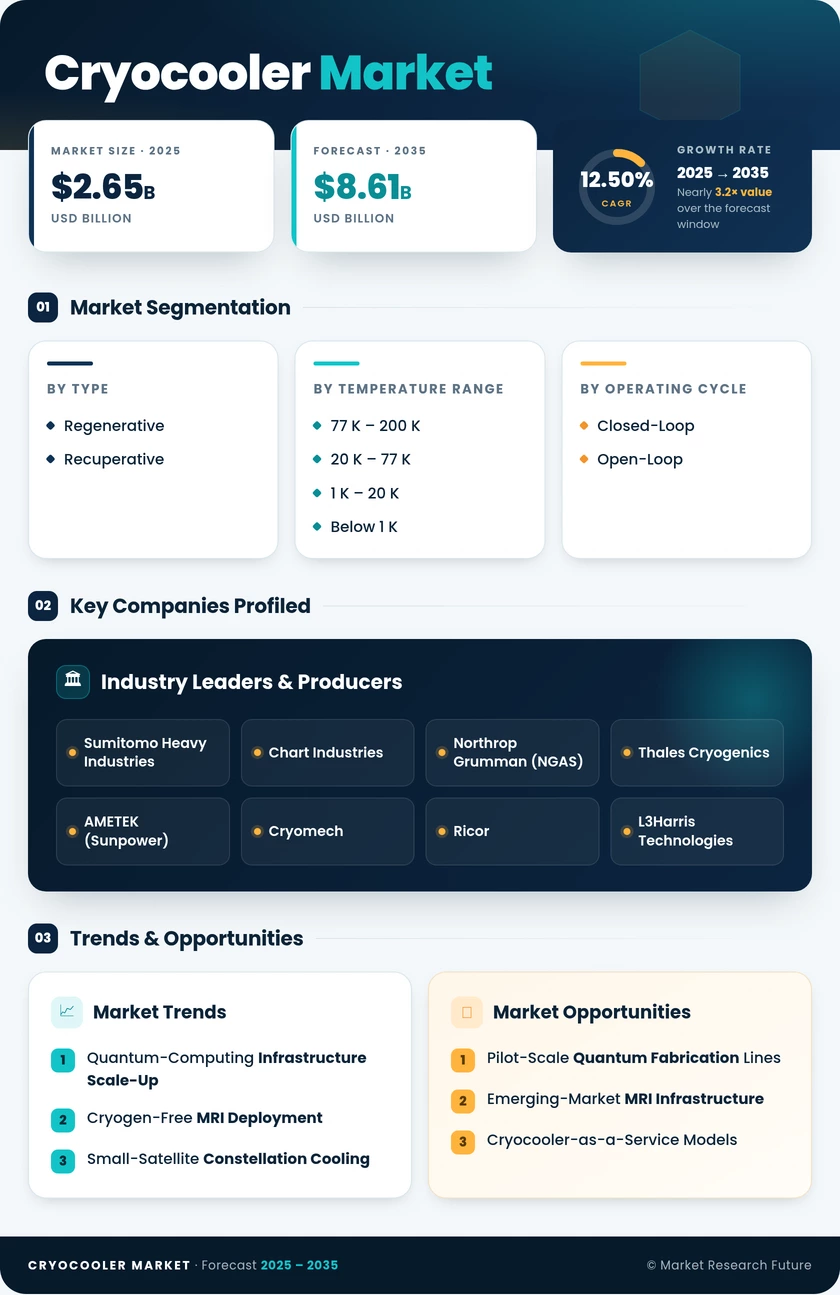
Cryocooler Market (2026 - 2035)

ID: MRFR/EnP/10163-HCR 128 Pages Chitranshi Jaiswal Last Updated: October 16, 2026
Cryocooler Market Research Report By Cryocooler Type (Stirling, Gifford-McMahon, Pulse Tube, Joule-Thomson, Others (Turbo-Brayton, Hybrid)), By Temperature Range (77 K – 200 K, 20 K – 77 K, 1 K – 20 K, Below 1 K), By Operating Cycle (Closed-Loop, Open-Loop), By Heat-Exchanger Type (Regenerative, Recuperative), By End-User Vertical (Healthcare, Space, Military & Defense, Quantum Technology, Industrial & Energy, Research & Academia) and By Regional (North America, Europe, South America, Asia Pacific, Middle East and Africa) - Forecast to 2035
Cryocooler Market
Market Size
Forecast Period2026-2035
CAGR (2026-2035)12.50%
2025 Market SizeUSD 2.65 Billion
2035 Market SizeUSD 8.61 Billion
Key Players
Sumitomo Heavy Industries
Chart Industries
Northrop Grumman
Thales Cryogenics
AMETEK
Cryomech
Opportunities
  • Pilot-Scale Quantum Fabrication Lines
  • Emerging-Market MRI Infrastructure
  • Cryocooler-as-a-Service Models
  1. 1 Market Overview |
    1. 1.1 Study Assumptions & Market Definition |
    2. 1.2 Scope of the Study |
    3. 1.3 Research Methodology
  2. 2 Market Summary & Key Takeaways
  3. 3 Market Dynamics |
    1. 3.1 Market Drivers Analysis | |
      1. 3.1.1 Quantum-Computing Infrastructure Scale-Up | |
      2. 3.1.2 Cryogen-Free MRI Expansion in Emerging Economies | |
      3. 3.1.3 Small-Satellite Constellation Cooling Requirements | |
      4. 3.1.4 LNG Peak-Shaving Terminal Proliferation | |
      5. 3.1.5 Defense IR-Sensor Modernization Programs | |
      6. 3.1.6 Superconducting-Cable Grid Pilot Deployments | |
      7. 3.1.7 Defense Offset Mandates Localizing Production |
    2. 3.2 Market Restraints Analysis | |
      1. 3.2.1 Global Helium Supply Constraints | |
      2. 3.2.2 High Unit Cost and Long Qualification Cycles | |
      3. 3.2.3 Export-Control Restrictions on Cryogenic Technology | |
      4. 3.2.4 Skilled-Workforce Shortage in Cryogenics | |
      5. 3.2.5 Vibration and Reliability Concerns in Fielded Units |
    3. 3.3 Market Opportunity Analysis | |
      1. 3.3.1 Pilot-Scale Quantum Fabrication Lines | |
      2. 3.3.2 Emerging-Market MRI Infrastructure | |
      3. 3.3.3 Cryocooler-as-a-Service Models | |
      4. 3.3.4 Superconducting-Cable Grid Pilots | |
      5. 3.3.5 Defense Electro-Optical Modernization |
    4. 3.4 Industry Value Chain Analysis |
    5. 3.5 Porter's Five Forces Analysis
  4. 4 Global Cryocooler Market Size & Forecast (2021–2035) |
    1. 4.1 Historical Market Size (2021–2025) |
    2. 4.2 Current & Forecast Market Size (2026–2035) |
    3. 4.3 Market Size by Revenue (USD Billion) |
    4. 4.4 Year-over-Year Growth Analysis
  5. 5 Segmentation Analysis |
    1. 5.1 By Cryocooler Type | |
      1. 5.1.1 Stirling | |
      2. 5.1.2 Gifford-McMahon | |
      3. 5.1.3 Pulse Tube | |
      4. 5.1.4 Joule-Thomson | |
      5. 5.1.5 Others (Turbo-Brayton, Hybrid) |
    2. 5.2 By Temperature Range | |
      1. 5.2.1 77 K – 200 K | |
      2. 5.2.2 20 K – 77 K | |
      3. 5.2.3 1 K – 20 K | |
      4. 5.2.4 Below 1 K |
    3. 5.3 By Operating Cycle | |
      1. 5.3.1 Closed-Loop | |
      2. 5.3.2 Open-Loop |
    4. 5.4 By Heat-Exchanger Type | |
      1. 5.4.1 Regenerative | |
      2. 5.4.2 Recuperative |
    5. 5.5 By End-User Vertical | |
      1. 5.5.1 Healthcare | |
      2. 5.5.2 Space | |
      3. 5.5.3 Military & Defense | |
      4. 5.5.4 Quantum Technology | |
      5. 5.5.5 Industrial & Energy | |
      6. 5.5.6 Research & Academia
  6. 6 Regional Analysis |
    1. 6.1 North America | |
      1. 6.1.1 United States | |
      2. 6.1.2 Canada | |
      3. 6.1.3 Mexico |
    2. 6.2 Europe | |
      1. 6.2.1 Germany | |
      2. 6.2.2 United Kingdom | |
      3. 6.2.3 France | |
      4. 6.2.4 Italy | |
      5. 6.2.5 Spain | |
      6. 6.2.6 Nordic Countries | |
      7. 6.2.7 Russia | |
      8. 6.2.8 Rest of Europe |
    3. 6.3 Asia-Pacific | |
      1. 6.3.1 China | |
      2. 6.3.2 India | |
      3. 6.3.3 Japan | |
      4. 6.3.4 South Korea | |
      5. 6.3.5 ASEAN | |
      6. 6.3.6 Rest of Asia-Pacific |
    4. 6.4 South America | |
      1. 6.4.1 Brazil | |
      2. 6.4.2 Argentina | |
      3. 6.4.3 Rest of South America |
    5. 6.5 Middle East & Africa | |
      1. 6.5.1 Saudi Arabia | |
      2. 6.5.2 UAE | |
      3. 6.5.3 South Africa | |
      4. 6.5.4 Egypt | |
      5. 6.5.5 Rest of MEA
  7. 7 Competitive Landscape |
    1. 7.1 Market Share Analysis (2025) |
    2. 7.2 Competitive Benchmarking Matrix |
    3. 7.3 Company Profiles | |
      1. 7.3.1 Sumitomo Heavy Industries | |
      2. 7.3.2 Chart Industries | |
      3. 7.3.3 Northrop Grumman | |
      4. 7.3.4 Thales Cryogenics | |
      5. 7.3.5 AMETEK (Sunpower) | |
      6. 7.3.6 Cryomech | |
      7. 7.3.7 Ricor | |
      8. 7.3.8 L3Harris Technologies | |
      9. 7.3.9 Honeywell Aerospace | |
      10. 7.3.10 Advanced Research Systems
  8. 8 Future Outlook & Strategic Recommendations (2026–2035) |
    1. 8.1 AI-Driven Cryogenic Process Optimization |
    2. 8.2 Quantum-Computing Industrialization Cycle |
    3. 8.3 Electrification and Superconducting Infrastructure |
    4. 8.4 ESG Reporting and Lifecycle-Carbon Accountability
  9. 9 Recent Developments & News
  10. 10 Frequently Asked Questions (FAQs)
  11. 11 Report Scope & Methodology |
    1. 11.1 Study Period & Base Year |
    2. 11.2 Data Sources & Citations |
    3. 11.3 Abbreviations
  12. 12 LIST OF TABLES |
  13. TABLE 1 Global Cryocooler Market Size & Forecast, by Revenue (USD Billion), 2021–2035 |
  14. TABLE 2 Global Cryocooler Market — Year-over-Year Growth Analysis, 2021–2035 |
  15. TABLE 3 Global Cryocooler Market — Driver Impact Analysis |
  16. TABLE 4 Global Cryocooler Market — Restraint Impact Analysis |
  17. TABLE 5 Global Cryocooler Market Size, by Cryocooler Type, 2021–2035 (USD Billion) |
  18. TABLE 6 Global Cryocooler Market Size, by Temperature Range, 2021–2035 (USD Billion) |
  19. TABLE 7 Global Cryocooler Market Size, by Operating Cycle, 2021–2035 (USD Billion) |
  20. TABLE 8 Global Cryocooler Market Size, by Heat-Exchanger Type, 2021–2035 (USD Billion) |
  21. TABLE 9 Global Cryocooler Market Size, by End-User Vertical, 2021–2035 (USD Billion) |
  22. TABLE 10 Global Cryocooler Market Size, by Region, 2021–2035 (USD Billion) |
  23. TABLE 11 North America Cryocooler Market Size, by Country, 2021–2035 (USD Billion) |
  24. TABLE 12 Europe Cryocooler Market Size, by Country, 2021–2035 (USD Billion) |
  25. TABLE 13 Asia-Pacific Cryocooler Market Size, by Country, 2021–2035 (USD Billion) |
  26. TABLE 14 South America Cryocooler Market Size, by Country, 2021–2035 (USD Billion) |
  27. TABLE 15 Middle East & Africa Cryocooler Market Size, by Country, 2021–2035 (USD Billion) |
  28. TABLE 16 Competitive Benchmarking Matrix — Global Cryocooler Market, 2025 |
  29. TABLE 17 Company Profiles — Key Players, Global Cryocooler Market |
  30. TABLE 18 Recent Developments & Strategic Announcements, 2023–2025 |
  31. TABLE 19 North America Cryocooler Market Size, by Cryocooler Type, 2021–2035 (USD Billion) |
  32. TABLE 20 North America Cryocooler Market Size, by Temperature Range, 2021–2035 (USD Billion) |
  33. TABLE 21 North America Cryocooler Market Size, by Operating Cycle, 2021–2035 (USD Billion) |
  34. TABLE 22 North America Cryocooler Market Size, by Heat-Exchanger Type, 2021–2035 (USD Billion) |
  35. TABLE 23 North America Cryocooler Market Size, by End-User Vertical, 2021–2035 (USD Billion) |
  36. TABLE 24 Europe Cryocooler Market Size, by Cryocooler Type, 2021–2035 (USD Billion) |
  37. TABLE 25 Europe Cryocooler Market Size, by Temperature Range, 2021–2035 (USD Billion) |
  38. TABLE 26 Europe Cryocooler Market Size, by Operating Cycle, 2021–2035 (USD Billion) |
  39. TABLE 27 Europe Cryocooler Market Size, by Heat-Exchanger Type, 2021–2035 (USD Billion) |
  40. TABLE 28 Europe Cryocooler Market Size, by End-User Vertical, 2021–2035 (USD Billion) |
  41. TABLE 29 Asia-Pacific Cryocooler Market Size, by Cryocooler Type, 2021–2035 (USD Billion) |
  42. TABLE 30 Asia-Pacific Cryocooler Market Size, by Temperature Range, 2021–2035 (USD Billion) |
  43. TABLE 31 Asia-Pacific Cryocooler Market Size, by Operating Cycle, 2021–2035 (USD Billion) |
  44. TABLE 32 Asia-Pacific Cryocooler Market Size, by Heat-Exchanger Type, 2021–2035 (USD Billion) |
  45. TABLE 33 Asia-Pacific Cryocooler Market Size, by End-User Vertical, 2021–2035 (USD Billion) |
  46. TABLE 34 South America Cryocooler Market Size, by Cryocooler Type, 2021–2035 (USD Billion) |
  47. TABLE 35 South America Cryocooler Market Size, by Temperature Range, 2021–2035 (USD Billion) |
  48. TABLE 36 South America Cryocooler Market Size, by Operating Cycle, 2021–2035 (USD Billion) |
  49. TABLE 37 South America Cryocooler Market Size, by Heat-Exchanger Type, 2021–2035 (USD Billion) |
  50. TABLE 38 South America Cryocooler Market Size, by End-User Vertical, 2021–2035 (USD Billion) |
  51. TABLE 39 Middle East & Africa Cryocooler Market Size, by Cryocooler Type, 2021–2035 (USD Billion) |
  52. TABLE 40 Middle East & Africa Cryocooler Market Size, by Temperature Range, 2021–2035 (USD Billion) |
  53. TABLE 41 Middle East & Africa Cryocooler Market Size, by Operating Cycle, 2021–2035 (USD Billion) |
  54. TABLE 42 Middle East & Africa Cryocooler Market Size, by Heat-Exchanger Type, 2021–2035 (USD Billion) |
  55. TABLE 43 Middle East & Africa Cryocooler Market Size, by End-User Vertical, 2021–2035 (USD Billion) |
  56. TABLE 44 United States Cryocooler Market Size, by Cryocooler Type, 2021–2035 (USD Billion) |
  57. TABLE 45 United States Cryocooler Market Size, by Temperature Range, 2021–2035 (USD Billion) |
  58. TABLE 46 United States Cryocooler Market Size, by End-User Vertical, 2021–2035 (USD Billion) |
  59. TABLE 47 China Cryocooler Market Size, by Cryocooler Type, 2021–2035 (USD Billion) |
  60. TABLE 48 China Cryocooler Market Size, by Temperature Range, 2021–2035 (USD Billion) |
  61. TABLE 49 China Cryocooler Market Size, by End-User Vertical, 2021–2035 (USD Billion) |
  62. TABLE 50 India Cryocooler Market Size, by Cryocooler Type, 2021–2035 (USD Billion) |
  63. TABLE 51 India Cryocooler Market Size, by Temperature Range, 2021–2035 (USD Billion) |
  64. TABLE 52 India Cryocooler Market Size, by End-User Vertical, 2021–2035 (USD Billion) |
  65. TABLE 53 Germany Cryocooler Market Size, by Cryocooler Type, 2021–2035 (USD Billion) |
  66. TABLE 54 Germany Cryocooler Market Size, by End-User Vertical, 2021–2035 (USD Billion) |
  67. TABLE 55 Japan Cryocooler Market Size, by Cryocooler Type, 2021–2035 (USD Billion) |
  68. TABLE 56 Japan Cryocooler Market Size, by End-User Vertical, 2021–2035 (USD Billion) |
  69. TABLE 57 Report Scope & Methodology Summary |
  70. TABLE 58 Detailed Sources and Citations
  71. 13 LIST OF FIGURES |
  72. FIGURE 1 Cryocooler Market Dynamics — Drivers, Restraints, and Opportunities |
  73. FIGURE 2 Industry Value Chain Analysis — Cryocooler Market |
  74. FIGURE 3 Porter's Five Forces Analysis — Cryocooler Market |
  75. FIGURE 4 Global Cryocooler Market Size Trend (USD Billion), 2021–2035 |
  76. FIGURE 5 Cryocooler Market Share, by Cryocooler Type, 2025 (%) |
  77. FIGURE 6 Cryocooler Market Share, by Temperature Range, 2025 (%) |
  78. FIGURE 7 Cryocooler Market Share, by Operating Cycle, 2025 (%) |
  79. FIGURE 8 Cryocooler Market Share, by Heat-Exchanger Type, 2025 (%) |
  80. FIGURE 9 Cryocooler Market Share, by End-User Vertical, 2025 (%) |
  81. FIGURE 10 Cryocooler Market Share, by Region, 2025 (%) |
  82. FIGURE 11 North America Cryocooler Market — Country Share (%) |
  83. FIGURE 12 Europe Cryocooler Market — Country Share (%) |
  84. FIGURE 13 Asia-Pacific Cryocooler Market — Country Share (%) |
  85. FIGURE 14 South America Cryocooler Market — Country Share (%) |
  86. FIGURE 15 Middle East & Africa Cryocooler Market — Country Share (%) |
  87. FIGURE 16 Competitive Landscape — Market Share of Top 10 Players, 2025

Segmentation Quick Reference

DimensionSub-SegmentsDominant SegmentFastest Growing Segment
By Cryocooler TypeStirling, Gifford-McMahon, Pulse Tube, Joule-Thomson, OthersStirlingPulse Tube
By Temperature Range77 K – 200 K, 20 K – 77 K, 1 K – 20 K, Below 1 K77 K – 200 KBelow 1 K
By Operating CycleClosed-Loop, Open-LoopClosed-LoopOpen-Loop
By Heat-Exchanger TypeRegenerative, RecuperativeRegenerativeRecuperative
By End-User VerticalHealthcare, Space, Military & Defense, Quantum Technology, Industrial & Energy, Research & AcademiaHealthcareQuantum Technology
By GeographyNorth America, Europe, Asia-Pacific, South America, Middle East & AfricaNorth AmericaAsia-Pacific


Market Segmentation Overview

By Cryocooler Type

Sub-SegmentKey Trend
StirlingRemains the high-volume standard for defense IR sensors; linear-drive efficiency improvements extending cold-head life.
Gifford-McMahonWorkhouse of MRI magnet cooling; transitioning to higher-capacity models for 7T clinical systems
Pulse TubeFastest adoption in quantum-computing pre-coolers and space instruments due to zero-vibration cold end
Joule-ThomsonRetained in single-use missile-seeker cool-down; open-loop helium logistics limit broader deployment.
Others (Turbo-Brayton, Hybrid)Gaining traction in LNG micro-liquefaction and hybrid aerospace cooling architectures


Stirling and Gifford-McMahon cryocoolers together account for over half of global unit shipments. Still, pulse-tube platforms are eroding that dominance in precision-sensitive verticals where exported vibration degrades instrument performance.

By Temperature Range

Sub-SegmentKey Trend
77 K – 200 KBroadest installed base spanning nitrogen-temperature industrial and standard IR-sensor cooling
20 K – 77 KGrowing with superconducting-magnet and cable-cooling applications in grid pilots
1 K – 20 KRapid expansion driven by quantum-computing and particle-physics detector cooling
Below 1 KSmallest absolute revenue but highest growth rate as dilution-refrigerator pre-cooling scales


Temperature-range segmentation reflects a clear split: the majority of installed units serve moderate-temperature applications. At the same time, the fastest growth is concentrated at the ultra-low end where quantum and high-energy-physics demand is surging.

By Operating Cycle

Sub-SegmentKey Trend
Closed-LoopDominant design philosophy; helium recirculation reduces operating cost and logistical complexity
Open-LoopGrowing in niche portable military and single-use missile-seeker applications


Closed-loop designs lead the market because they eliminate field-helium resupply requirements, a decisive advantage for continuous-duty healthcare and space deployments.

By Heat-Exchanger Type

Sub-SegmentKey Trend
RegenerativeCore to Stirling and GM architectures; benefits from advanced rare-earth matrix materials
RecuperativeExpanding with Joule-Thomson and turbo-Brayton growth in LNG and aerospace verticals


Regenerative exchangers dominate by installed base, but recuperative designs are closing the gap as turbo-Brayton and mixed-refrigerant systems find new deployment scenarios.

By End-User Vertical

Sub-SegmentKey Trend
HealthcareSteady growth via cryogen-free MRI proliferation in emerging and developed markets alike
SpaceRising satellite-launch cadence drives per-mission cryocooler demand.
Military & DefenseEO/IR modernization and missile-seeker programs sustain long-cycle procurement.
Quantum TechnologyFastest vertical growth as labs transition to pilot-scale quantum-processor fabrication
Industrial & EnergyLNG peak-shaving and superconducting-cable pilots add new volume
Research & AcademiaUniversity quantum labs and particle-accelerator upgrades maintain steady demand.


Healthcare and defense verticals provide revenue stability, while quantum technology and space represent the primary growth vectors that will reshape the market's revenue mix over the coming decade.




Download PDF ×

We do not share your information with anyone. However, we may send you emails based on your report interest from time to time. You may contact us at any time to opt-out.