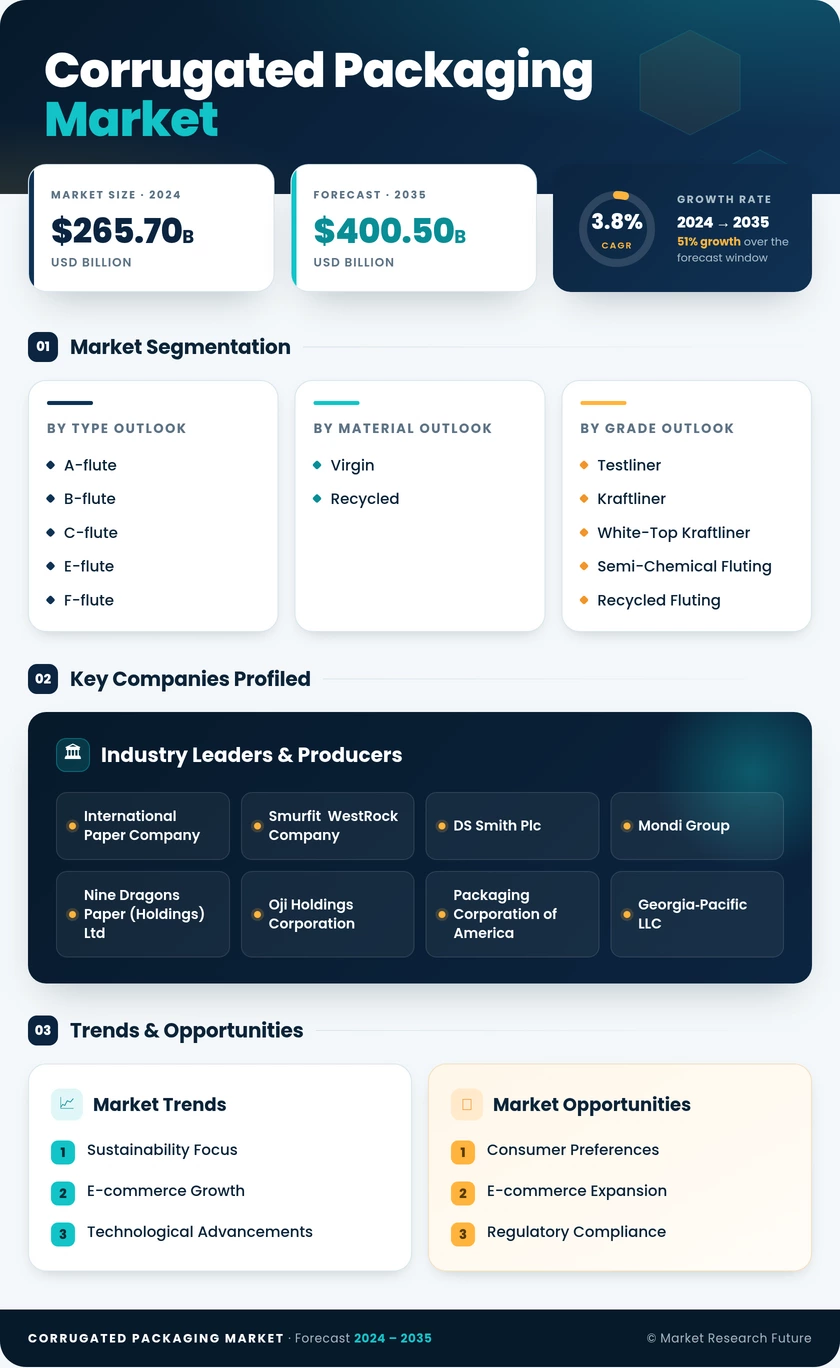
Segmentation Quick Reference
| Dimension | Sub-Segments | Dominant Segment | Fastest Growing Segment |
| By Material Type | Recycled containerboard; Virgin (kraft) containerboard; Agricultural-waste fibre grades | Recycled containerboard | Agricultural-waste fibre grades |
| By Box Style | Slotted boxes; Telescope boxes; Folder boxes; Rigid boxes; Ready-to-use / self-erecting; Interior fitments and others | Slotted boxes | Folder boxes |
| By Board Type | Single-wall; Double-wall; Triple-wall | Single-wall | Double-wall |
| By Printing Technology | Flexography; Lithography; Digital; Screen and others | Flexography | Digital |
| By End-User Industry | Food; Beverage; E-commerce fulfilment; Electrical and electronics; Personal care and household; Healthcare and pharmaceuticals; Paper products and other industrial | Food | E-commerce fulfilment |
| By Region | North America; Europe; Asia-Pacific; South America; Middle East & Africa | Asia-Pacific | South America |
Market Segmentation Overview
By Material Type
| Sub-Segment | Key Trend |
| Recycled containerboard | Majority grade position sustained by high recovery rates and cost advantage over virgin furnish |
| Virgin (kraft) containerboard | Retained in strength-critical export and heavy industrial applications |
| Agricultural-waste fibre grades | Fastest-expanding furnish, supported by residue-burning restrictions and collection subsidies |
Material choice is increasingly a compliance decision rather than a cost decision alone. Recycled grades dominate on economics, while agricultural residues attract policy support in South and Southeast Asia and North Africa. Virgin kraft holds a defensible niche where burst and stacking specifications are unforgiving.
By Box Style
| Sub-Segment | Key Trend |
| Slotted boxes | Universal transit standard with lowest tooling and unit cost |
| Telescope boxes | Preferred for heavy, irregular, and multi-component shipments |
| Folder boxes | Growing fastest on parcel dimensional-weight rules and returns handling |
| Rigid boxes | Premium retail and industrial protective applications |
| Ready-to-use / self-erecting | Adoption driven by automated packing line throughput requirements |
| Interior fitments and others | Direct beneficiary of plastic void-fill substitution |
Style mix is being reshaped by automation and parcel economics rather than by cost alone. Formats that machines can erect quickly and that ship without tape are gaining share, while traditional slotted designs remain the volume backbone.
By Board Type
| Sub-Segment | Key Trend |
| Single-wall | Continued lightweighting at maintained compression performance |
| Double-wall | Growth tied to cold-chain, agri-export and humid-condition lanes |
| Triple-wall | Competes with returnable plastic containers in bulk industrial shipping |
Structural specification is converging on data. As compression modelling and damage-return analytics mature, buyers are trimming overspecification in single-wall applications while upgrading selectively to double-wall where humidity and stacking height genuinely require it.
By Printing Technology
| Sub-Segment | Key Trend |
| Flexography | Retains scale economics above roughly 25,000 impressions |
| Lithography | Anchored in high-graphics point-of-sale and premium retail categories |
| Digital | Expanding on short-run versioning, seasonal and regional campaigns |
| Screen and others | Specialty industrial marking and low-volume niche work |
Print technology now segments by run length more than by end market. Hybrid installations let a single line serve both long transit runs and short versioned work, which is steadily blurring the historical boundary between analogue and digital capacity planning.
By End-User Industry
| Sub-Segment | Key Trend |
| Food | Least cyclical demand base; shelf-ready conversion lifts board per unit |
| Beverage | Plastic ring and shrink-film restrictions drive fibre multipack conversion |
| E-commerce fulfilment | Highest growth vertical; volume-led with minimal graphics content |
| Electrical and electronics | Protective specifications and export logistics requirements |
| Personal care and household | Retail-ready grocery formats and secondary display packing |
| Healthcare and pharmaceuticals | Highest specification premiums; serialisation and cold-chain outers |
| Paper products and other industrial | Broad general-manufacturing distribution demand |
End-use mix determines margin more than volume. Food and industrial verticals supply steady tonnage, e-commerce supplies growth at lower revenue density, and healthcare and premium retail supply the specification premiums that justify investment in digital decoration and functional coatings.
By Region
| Sub-Segment | Key Trend |
| North America | Extended Producer Responsibility rollout and integrated mill conversions |
| Europe | Regulation-led substitution and decarbonisation-driven capacity rationalisation |
| Asia-Pacific | Largest volume base; capacity oversupply pressuring realised prices |
| South America | Fastest growth on agri-export cold-chain specification upgrades |
| Middle East & Africa | Import substitution and food-manufacturing localisation programmes |
Geographic performance splits between volume markets and value markets. Asia-Pacific supplies the tonnage, Europe and North America supply the regulatory premium, and South America combines above-average growth with specification upgrades tied to export agriculture.

 Noah Malgeri
Co-Founder
Noah Malgeri
Co-Founder

 Peter Groot koerkamp
Account and Business Manager
Peter Groot koerkamp
Account and Business Manager

 Younghwan Choi
Senior Retail Manager
Younghwan Choi
Senior Retail Manager

 Mark Irwin
Management Consultant
Mark Irwin
Management Consultant

 Akif Moroglu
Strategy & Business Development Director
Akif Moroglu
Strategy & Business Development Director

 Guilherme Gomes Martins
Product Management Director
Guilherme Gomes Martins
Product Management Director

 Joseph Aguayo
Sales Operations & Pricing Manager
Joseph Aguayo
Sales Operations & Pricing Manager

 La Terria Dodd
Program Support Specialist
La Terria Dodd
Program Support Specialist

 Rob Kooiker
Group Product Manager HVAC & Fire Protection GMA
Rob Kooiker
Group Product Manager HVAC & Fire Protection GMA