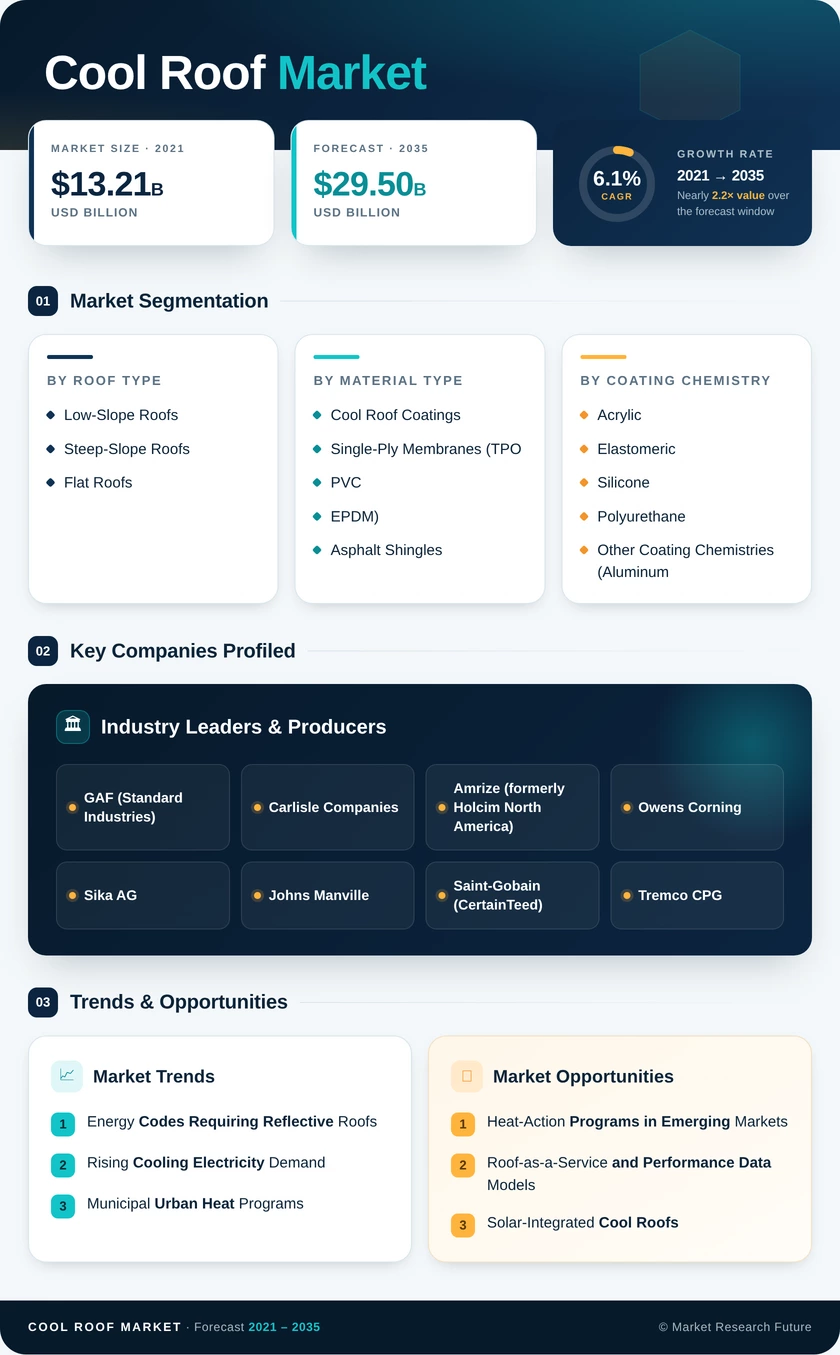
Cool Roof Market (2026 - 2035)

ID: MRFR/PCM/7175-HCR 111 Pages Snehal Singh Last Updated: November 13, 2026
Cool Roof Market Research Report Information By Roof Type (Low-Slope Roofs, Steep-Slope Roofs, and Flat Roofs), By Material Type (Cool Roof Coatings, Single-Ply Membranes, Asphalt Shingles, Metal Roofs, Tiles and Slates, Built-Up Roofs, Modified Bitumen, and Other Material Types), By Coating Chemistry (Acrylic, Elastomeric, Silicone, Polyurethane, and Other Coating Chemistries), By Build Phase (New Construction and Retrofit/Reroofing), By Application (Commercial Buildings, Residential Buildings, Industrial Facilities, Government and Public Infrastructure, Healthcare and Educational Campuses, and Other Applications), And By Region (North America, Europe, Asia-Pacific, and Rest of the World) – Market Forecast Till 2035.
Cool Roof Market
Market Size
Forecast Period2026-2035
CAGR (2026-2035)6.1%
2025 Market SizeUSD 16.34 Billion
2035 Market SizeUSD 29.50 Billion
Key Players
GAF
Carlisle Companies
Amrize
Owens Corning
Sika AG
Johns Manville
Opportunities
  • Heat-Action Programs in Emerging Markets
  • Roof-as-a-Service and Performance Data Models
  • Solar-Integrated Cool Roofs
  1. 1 Market Summary | |
  2. 2 Key Report Takeaways | |
    1. 2.1 By Roof Type | |
    2. 2.2 By Material Type | |
    3. 2.3 By Coating Chemistry | |
    4. 2.4 By Build Phase | |
    5. 2.5 By Application | |
    6. 2.6 By Region | |
  3. 3 Market Size and Forecast (2021–2035) | |
    1. 3.1 Historical Market Size (2021–2025) | |
    2. 3.2 Forecast Market Size (2026–2035) | |
    3. 3.3 Year-over-Year Growth Analysis | |
  4. 4 Driver Impact Analysis | |
    1. 4.1 Energy Codes Requiring Reflective Roofs | |
    2. 4.2 Rising Cooling Electricity Demand | |
    3. 4.3 Municipal Urban Heat Programs | |
    4. 4.4 Building Performance Standards and Penalties | |
    5. 4.5 Federal Tax Incentives for Efficient Buildings | |
    6. 4.6 EU Building Decarbonization Rules | |
    7. 4.7 Coating-Based Retrofit Economics | |
  5. 5 Restraints Impact Analysis | |
    1. 5.1 Reflectance Loss from Soiling and Weathering | |
    2. 5.2 Winter Heating Penalty in Cold Climates | |
    3. 5.3 Cost and Aesthetic Barriers on Steep-Slope Homes | |
    4. 5.4 Retirement of a National Residential Roof Label | |
    5. 5.5 Weak Enforcement in Emerging Markets | |
  6. 6 Opportunities | |
    1. 6.1 Heat-Action Programs in Emerging Markets | |
    2. 6.2 Roof-as-a-Service and Performance Data Models | |
    3. 6.3 Solar-Integrated Cool Roofs | |
    4. 6.4 Circular Take-Back and Recycling Programs | |
    5. 6.5 Next-Generation Coating Chemistries | |
  7. 7 Regional Market Share and Country-Level Analysis | |
    1. 7.1 North America | | |
      1. 7.1.1 US | | |
      2. 7.1.2 Canada | | |
      3. 7.1.3 Mexico | |
    2. 7.2 Europe | | |
      1. 7.2.1 Germany | | |
      2. 7.2.2 UK | | |
      3. 7.2.3 France | | |
      4. 7.2.4 Italy | | |
      5. 7.2.5 Spain | | |
      6. 7.2.6 Nordic Countries | | |
      7. 7.2.7 Russia | | |
      8. 7.2.8 Rest of Europe | |
    3. 7.3 Asia-Pacific | | |
      1. 7.3.1 China | | |
      2. 7.3.2 India | | |
      3. 7.3.3 Japan | | |
      4. 7.3.4 South Korea | | |
      5. 7.3.5 ASEAN | | |
      6. 7.3.6 Rest of Asia-Pacific | |
    4. 7.4 South America | | |
      1. 7.4.1 Brazil | | |
      2. 7.4.2 Argentina | | |
      3. 7.4.3 Rest of South America | |
    5. 7.5 Middle East & Africa | | |
      1. 7.5.1 Saudi Arabia | | |
      2. 7.5.2 UAE | | |
      3. 7.5.3 South Africa | | |
      4. 7.5.4 Egypt | | |
      5. 7.5.5 Rest of MEA | |
  8. 8 Future Outlook (2026–2035) | |
    1. 8.1 Heat Resilience Becomes Building Regulation | |
    2. 8.2 Solar and Electrification on the Same Roof | |
    3. 8.3 Advanced Materials and Digital Verification | |
    4. 8.4 ESG Disclosure and Embodied Carbon | |
  9. 9 Segmentation Analysis | |
    1. 9.1 By Roof Type | | |
      1. 9.1.1 Low-Slope Roofs | | |
      2. 9.1.2 Steep-Slope Roofs | | |
      3. 9.1.3 Flat Roofs | |
    2. 9.2 By Material Type | | |
      1. 9.2.1 Cool Roof Coatings | | |
      2. 9.2.2 Single-Ply Membranes | | |
      3. 9.2.3 Asphalt Shingles | | |
      4. 9.2.4 Metal Roofs | | |
      5. 9.2.5 Tiles and Slates | | |
      6. 9.2.6 Built-Up Roofs | | |
      7. 9.2.7 Modified Bitumen | | |
      8. 9.2.8 Other Material Types | |
    3. 9.3 By Coating Chemistry | | |
      1. 9.3.1 Acrylic | | |
      2. 9.3.2 Elastomeric | | |
      3. 9.3.3 Silicone | | |
      4. 9.3.4 Polyurethane | | |
      5. 9.3.5 Other Coating Chemistries | |
    4. 9.4 By Build Phase | | |
      1. 9.4.1 New Construction | | |
      2. 9.4.2 Retrofit/Reroofing | |
    5. 9.5 By Application | | |
      1. 9.5.1 Commercial Buildings | | |
      2. 9.5.2 Residential Buildings | | |
      3. 9.5.3 Industrial Facilities | | |
      4. 9.5.4 Government and Public Infrastructure | | |
      5. 9.5.5 Healthcare and Educational Campuses | | |
      6. 9.5.6 Other Applications | |
  10. 10 Competitive Landscape | |
    1. 10.1 Market Concentration Analysis | |
    2. 10.2 Competitive Benchmarking Matrix | |
    3. 10.3 Company Profiles | | |
      1. 10.3.1 GAF | | |
      2. 10.3.2 Carlisle Companies | | |
      3. 10.3.3 Amrize | | |
      4. 10.3.4 Owens Corning | | |
      5. 10.3.5 Sika AG | | |
      6. 10.3.6 Johns Manville | | |
      7. 10.3.7 Saint-Gobain | | |
      8. 10.3.8 Tremco CPG | | |
      9. 10.3.9 BASF | | |
      10. 10.3.10 PPG Industries | | |
      11. 10.3.11 Nationwide Protective Coating Manufacturers | |
  11. 11 Recent News & Developments | |
  12. 12 Report Scope and Methodology | |
  13. 13 Detailed Sources and Citations | |
  14. 14 Frequently Asked Questions (FAQs) | | LIST OF TABLES | |
  15. TABLE 1 Global Market Snapshot, 2025–2035 | |
  16. TABLE 2 Global Market Size & Forecast, by Revenue (USD Billion), 2021–2035 | |
  17. TABLE 3 Driver Impact Analysis | |
  18. TABLE 4 Restraints Impact Analysis | |
  19. TABLE 5 Global Market Size, by Region, 2025 (USD Billion) | |
  20. TABLE 6 North America Market Size, by Country, 2021–2035 (USD Billion) | |
  21. TABLE 7 Europe Market Size, by Country, 2021–2035 (USD Billion) | |
  22. TABLE 8 Asia-Pacific Market Size, by Country, 2021–2035 (USD Billion) | |
  23. TABLE 9 South America Market Size, by Country, 2021–2035 (USD Billion) | |
  24. TABLE 10 Middle East & Africa Market Size, by Country, 2021–2035 (USD Billion) | |
  25. TABLE 11 Global Market Size, by Roof Type, 2021–2035 (USD Billion) | |
  26. TABLE 12 Global Market Size, by Material Type, 2021–2035 (USD Billion) | |
  27. TABLE 13 Global Market Size, by Coating Chemistry, 2021–2035 (USD Billion) | |
  28. TABLE 14 Global Market Size, by Build Phase, 2021–2035 (USD Billion) | |
  29. TABLE 15 Global Market Size, by Application, 2021–2035 (USD Billion) | |
  30. TABLE 16 Competitive Benchmarking Matrix, 2025 | |
  31. TABLE 17 Report Scope and Methodology | |
  32. TABLE 18 Detailed Sources and Citations | | LIST OF FIGURES | |
  33. FIGURE 1 Market Dynamics Overview (Drivers, Restraints, Opportunities) | |
  34. FIGURE 2 Industry Value Chain Analysis | |
  35. FIGURE 3 Porter's Five Forces Analysis | |
  36. FIGURE 4 Global Market Size Trend, 2021–2035 (USD Billion) | |
  37. FIGURE 5 Market Share by Roof Type, 2025 (%) | |
  38. FIGURE 6 Market Share by Material Type, 2025 (%) | |
  39. FIGURE 7 Market Share by Coating Chemistry, 2025 (%) | |
  40. FIGURE 8 Market Share by Build Phase, 2025 (%) | |
  41. FIGURE 9 Market Share by Application, 2025 (%) | |
  42. FIGURE 10 Regional Market Share, 2025 (%) | |
  43. FIGURE 11 Country-Level Share within Each Region, 2025 (%) | |
  44. FIGURE 12 Competitive Landscape: Estimated Revenue Share Ranges, 2025 | |
  45. FIGURE 13 Company Positioning Matrix

Segmentation Quick Reference

DimensionSub-SegmentsDominant SegmentFastest Growing Segment
By Roof TypeLow-Slope Roofs; Steep-Slope Roofs; Flat RoofsLow-Slope Roofs (48.0% share)Flat Roofs (6.7% CAGR)
By Material TypeCool Roof Coatings; Single-Ply Membranes (TPO, PVC, EPDM); Asphalt Shingles; Metal Roofs; Tiles and Slates; Built-Up Roofs (BUR); Modified Bitumen; Other Material Types (Green Roofs, Wood Shingles)Cool Roof Coatings (32.1% share)Single-Ply Membranes (6.9% CAGR)
By Coating ChemistryAcrylic; Elastomeric; Silicone; Polyurethane; Other Coating Chemistries (Aluminum, Ceramic, Nano)Acrylic (43.0% share)Silicone (7.2% CAGR)
By Build PhaseNew Construction; Retrofit/ReroofingNew Construction (57.2% share)Retrofit/Reroofing (7.5% CAGR)
By ApplicationCommercial Buildings; Residential Buildings; Industrial Facilities; Government and Public Infrastructure; Healthcare and Educational Campuses; Other ApplicationsCommercial Buildings (40.2% share)Other Applications (7.2% CAGR)
By RegionNorth America; Europe; Asia-Pacific; South America; Middle East & AfricaNorth America (36.0% share)Asia-Pacific (7.4% CAGR)

Market Segmentation Overview

By Roof Type

Sub-SegmentKey Trend
Low-Slope RoofsLarge commercial roofs specified to meet energy code reflectance minimums
Steep-Slope RoofsReflective shingles adopted mainly where rebates offset the price premium
Flat RoofsBuilt-up roofs replaced with white single-ply membranes on logistics sites

Low-Slope Roofs lead because codes such as Title 24 target nonresidential low-slope surfaces first, and their wide spans deliver the largest cooling savings per project. Flat Roofs grow fastest as warehouse owners swap aging gravel-surfaced assemblies for reflective membranes that also support solar arrays. Steep-Slope Roofs trail because residential buyers weigh color and price ahead of energy savings.

By Material Type

Sub-SegmentKey Trend
Cool Roof CoatingsRestoration over existing roofs to avoid tear-off
Single-Ply MembranesTPO and PVC dominate new commercial construction
Asphalt ShinglesGranule technology improving reflectance at modest premiums
Metal RoofsFactory-applied reflective finishes gain in storm-prone areas
Tiles and SlatesLight-colored clay and concrete tiles in warm residential markets
Built-Up RoofsReflective coatings applied to extend legacy roof life
Modified BitumenWhite granulated cap sheets on multi-ply systems
Other Material TypesGreen roofs driven by urban stormwater regulations

Cool Roof Coatings lead because they let owners upgrade reflectance on a sound roof at a fraction of replacement cost. Single-Ply Membranes grow fastest, as TPO and PVC are the default specification on new distribution centers and data halls that need long warranties and heat-welded seams. Metal Roofs add steady volume where wind uplift resistance matters.

By Coating Chemistry

Sub-SegmentKey Trend
AcrylicLowest-cost option for dry climates
ElastomericFlexible films for metal and BUR movement
SiliconePreferred where ponding water and dirt pick-up are concerns
PolyurethaneAbrasion resistance on high-traffic roofs
Other Coating ChemistriesCeramic and nano additives targeting anti-soiling

Acrylic keeps the largest share because it is water-based, inexpensive and familiar to contractors. Silicone grows fastest as codes increasingly reference aged reflectance, favoring chemistries that shed dirt and tolerate standing water. Polyurethane holds a defined niche on roofs with heavy maintenance traffic.

By Build Phase

Sub-SegmentKey Trend
New ConstructionReflectance specified at design stage to satisfy energy codes
Retrofit/ReroofingEmission caps and incentives accelerate replacement decisions

New Construction leads because energy codes apply automatically at permitting and designers face no logistical hurdles. Retrofit/Reroofing grows faster as building performance standards like Local Law 97 penalize existing buildings, prompting owners to add reflectance during scheduled roof replacements.

By Application

Sub-SegmentKey Trend
Commercial BuildingsEnergy cost reduction tied to property valuation
Residential BuildingsRebate- and PACE-driven adoption in hot states
Industrial FacilitiesHeat stress reduction for workers and equipment
Government and Public InfrastructurePublic-sector decarbonization deadlines
Healthcare and Educational CampusesLong ownership horizons favor lifecycle savings
Other ApplicationsCold-chain, transport and agricultural buildings

Commercial Buildings lead because offices and retail owners see a direct link between lower cooling costs and net operating income. Other Applications grow fastest as cold-chain and agricultural operators use reflective roofs to defer mechanical cooling investment. Government and Public Infrastructure gain momentum from the EPBD's earlier deadline for public buildings.


Download PDF ×

We do not share your information with anyone. However, we may send you emails based on your report interest from time to time. You may contact us at any time to opt-out.