
Request Free Sample ×

Kindly complete the form below to receive a free sample of this Report

* Please use a valid business email

Leading companies partner with us for data-driven Insights

clients tt-cursor
Hero Background
English
Chinese
French
Japanese
Korean
German
Spanish

Converged Data Center Infrastructure Market Analysis

ID: MRFR/SEM/5571-HCR
100 Pages
Ankit Gupta
Last Updated: April 06, 2026

Converged Data Center Infrastructure Market Size, Share and Research Report By Deployment (Reference Architecture, Pre-Racked Configuration), By Component (Computational Devices, Storage Devices, Networking Devices), By Facility (On-Premise, Colocated Data Center), By End-User (BFSI, IT & Telecommunication, Retail & E-Commerce, Energy & Utilities, Transportation And Others), And By Region (North America, Europe, Asia-Pacific, And Rest Of The World) –Industry Forecast Till 2035

Share:
Download PDF ×

We do not share your information with anyone. However, we may send you emails based on your report interest from time to time. You may contact us at any time to opt-out.

Converged Data Center Infrastructure Market Infographic
Purchase Options

Market Analysis

In-depth Analysis of Converged Data Center Infrastructure Market Industry Landscape

One vital driver of market elements is the constant speed of mechanical development. The assembly of registering, storing, systems administration, and virtualization advances has led to incorporated arrangements that commitment upgraded execution, worked on management, and diminished functional details. This combination is a reaction to the intensifying requests put on data centers, with associations looking for arrangements that can adjust to changing responsibilities and convey agility in a quickly developing computerized scene. The rising volume of data produced and handled by organizations is another huge variable affecting market elements. As associations wrestle with the surge of data, they are looking for infrastructure arrangements that can proficiently deal with the deluge of data. Converged data center infrastructure, with its merged and improved approach, addresses this need by giving a brought together stage that smoothes out data management, speeds up handling, and supports the different activities of contemporary applications. Cost proficiency is a main impetus molding the market elements of converged data center infrastructure. Organizations are feeling the squeeze to streamline their IT spending while at the same time guaranteeing they have the dexterity to adjust to changing market conditions. Converged arrangements offer a financially savvy elective by wiping out storehouses, declining equipment, and programming intricacy, and further developing asset usage. This, thus, converts into lower capital and functional uses, making converged infrastructure an alluring suggestion for associations expecting to amplify their profit from venture Versatility is a basic perspective impacting market elements, particularly in a time where organizations experience flighty development designs. Converged data center infrastructure gives a versatile establishment that permits associations to flawlessly grow their IT capacities. This versatility is fundamental for adjusting to expanded jobs, accommodating new applications, and supporting the powerful idea of business tasks. The capacity to increase assets or down considering interest positions converged infrastructure as an essential decision for organizations holding back nothing adaptability.


Author
Author Profile
Ankit Gupta
Team Lead - Research

Ankit Gupta is a seasoned market intelligence and strategic research professional with over six plus years of experience in the ICT and Semiconductor industries. With academic roots in Telecom, Marketing, and Electronics, he blends technical insight with business strategy. Ankit has led 200+ projects, including work for Fortune 500 clients like Microsoft and Rio Tinto, covering market sizing, tech forecasting, and go-to-market strategies. Known for bridging engineering and enterprise decision-making, his insights support growth, innovation, and investment planning across diverse technology markets.

Leave a Comment

FAQs

What is the current valuation of the Converged Data Center Infrastructure Market as of 2024?

<p>The market valuation was 6.7 USD Billion in 2024.</p>

What is the projected market size for the Converged Data Center Infrastructure Market by 2035?

<p>The projected valuation for 2035 is 49.34 USD Billion.</p>

What is the expected CAGR for the Converged Data Center Infrastructure Market during the forecast period 2025 - 2035?

<p>The expected CAGR during this period is 19.9%.</p>

Which companies are considered key players in the Converged Data Center Infrastructure Market?

<p>Key players include Dell Technologies, Hewlett Packard Enterprise, Cisco Systems, and others.</p>

What are the primary segments of the Converged Data Center Infrastructure Market?

<p>The primary segments include By Deployment, By Component, By Facility, and By End-User.</p>

What was the valuation of the Reference Architecture segment in 2024?

<p>The Reference Architecture segment was valued at 2.68 USD Billion in 2024.</p>

How much is the Pre-Racked Configuration segment projected to be worth by 2035?

The Pre-Racked Configuration segment is projected to reach 29.34 USD Billion by 2035.

What is the valuation of the On-Premise facility segment in 2024?

The On-Premise facility segment was valued at 3.35 USD Billion in 2024.

Which end-user segment is expected to show the highest growth by 2035?

The IT &amp; Telecommunication segment is expected to grow to 15.0 USD Billion by 2035.

What is the projected valuation for Storage Devices in the Converged Data Center Infrastructure Market?

The Storage Devices segment is projected to reach 15.0 USD Billion by 2035.

Market Summary

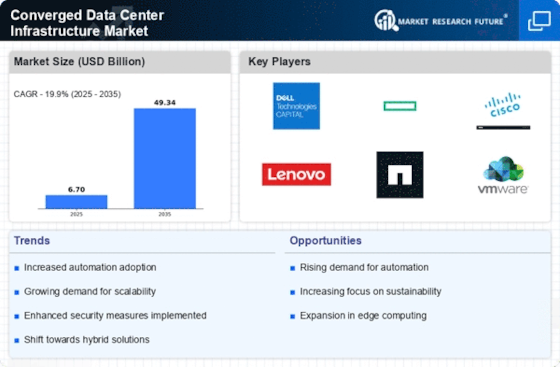
As per Market Research Future analysis, the Converged Data Center Infrastructure Market Size was estimated at 6.7 USD Billion in 2024. The Converged Data Center Infrastructure industry is projected to grow from 8.033 USD Billion in 2025 to 49.34 USD Billion by 2035, exhibiting a compound annual growth rate (CAGR) of 19.9% during the forecast period 2025 - 2035

Key Market Trends & Highlights

The Converged Data Center Infrastructure Market is poised for substantial growth driven by technological advancements and evolving business needs.

  • The integration of AI and automation is transforming operational efficiencies within the market. Sustainability initiatives are increasingly influencing purchasing decisions across North America and Asia-Pacific. Hybrid cloud solutions are gaining traction, particularly in the fastest-growing segments of pre-racked configurations and networking devices. The demand for scalability and cost efficiency is propelling market growth, as organizations shift towards hybrid IT environments.

Market Size & Forecast

2024 Market Size 6.7 (USD Billion)
2035 Market Size 49.34 (USD Billion)
CAGR (2025 - 2035) 19.9%
Largest Regional Market Share in 2024 North America

Major Players

Dell Technologies (US), Hewlett Packard Enterprise (US), Cisco Systems (US), Lenovo (CN), NetApp (US), VMware (US), IBM (US), Oracle (US), Hitachi Vantara (US)

Market Trends

The Converged Data Center Infrastructure Market is currently experiencing a transformative phase, characterized by the integration of various technologies aimed at enhancing operational efficiency and reducing costs. This market encompasses a range of solutions that combine storage, computing, and networking into a single framework, thereby simplifying management and improving scalability. As organizations increasingly seek to optimize their IT environments, the demand for converged infrastructure solutions appears to be on the rise. Factors such as the growing need for data center modernization and the shift towards cloud-based services are driving this trend. Furthermore, the emphasis on energy efficiency and sustainability is likely to influence purchasing decisions, as companies strive to reduce their carbon footprints while maintaining high performance. In addition, the Converged Data Center Infrastructure Market is witnessing a surge in innovation, with vendors continuously developing advanced solutions that cater to diverse business needs. The advent of artificial intelligence and machine learning technologies is expected to play a pivotal role in shaping future offerings, enabling organizations to leverage data analytics for better decision-making. Moreover, the increasing adoption of hybrid cloud environments suggests a potential shift in how businesses approach their IT strategies. As the market evolves, it is essential for stakeholders to remain agile and responsive to emerging trends, ensuring they can capitalize on new opportunities and address challenges effectively.

Integration of AI and Automation

The integration of artificial intelligence and automation technologies is becoming increasingly prevalent within the Converged Data Center Infrastructure Market. This trend suggests that organizations are seeking to enhance operational efficiency and reduce human error through intelligent systems that can manage workloads and optimize resource allocation.

Focus on Sustainability

A growing emphasis on sustainability is evident in the Converged Data Center Infrastructure Market. Companies are increasingly prioritizing energy-efficient solutions and environmentally friendly practices, indicating a shift towards greener technologies that not only reduce operational costs but also align with corporate social responsibility goals.

Rise of Hybrid Cloud Solutions

The rise of hybrid cloud solutions is reshaping the landscape of the Converged Data Center Infrastructure Market. This trend indicates that businesses are looking to combine the benefits of both public and private clouds, allowing for greater flexibility, scalability, and control over their data management strategies.

Converged Data Center Infrastructure Market Market Drivers

Increased Demand for Scalability

The Converged Data Center Infrastructure Market experiences heightened demand for scalable solutions as organizations seek to accommodate fluctuating workloads. This trend is driven by the necessity for businesses to adapt to rapid changes in data processing requirements. According to recent data, the market for converged infrastructure is projected to grow at a compound annual growth rate of approximately 25% over the next five years. Companies are increasingly investing in converged solutions that allow for seamless scaling of resources, thereby enhancing operational efficiency. This demand for scalability is particularly pronounced in sectors such as finance and healthcare, where data volumes are surging. As organizations prioritize agility and flexibility, the Converged Data Center Infrastructure Market is likely to witness sustained growth, reflecting the evolving needs of modern enterprises.

Growing Adoption of Edge Computing

The rise of edge computing is emerging as a transformative force within the Converged Data Center Infrastructure Market. As organizations increasingly deploy IoT devices and applications that require real-time data processing, the need for edge solutions becomes apparent. This shift necessitates the integration of converged infrastructure that can support distributed computing environments. Market forecasts suggest that the edge computing segment could account for a substantial portion of the overall data center market, with projections indicating a growth rate of over 30% in the coming years. By leveraging converged infrastructure at the edge, businesses can enhance data processing capabilities, reduce latency, and improve overall performance. This trend underscores the importance of adaptability in the Converged Data Center Infrastructure Market, as companies strive to meet the demands of a more connected world.

Shift Towards Hybrid IT Environments

The transition towards hybrid IT environments is a notable trend shaping the Converged Data Center Infrastructure Market. Organizations are increasingly adopting a mix of on-premises and cloud-based solutions to optimize their IT strategies. This hybrid approach allows businesses to leverage the benefits of both environments, enhancing flexibility and scalability. Recent studies indicate that nearly 70% of enterprises are expected to implement hybrid IT strategies by 2026. Converged infrastructure plays a crucial role in this transition, providing the necessary integration and management capabilities to support diverse workloads across various platforms. As organizations seek to balance performance with cost-effectiveness, the demand for converged solutions that facilitate hybrid IT environments is likely to grow, further influencing the dynamics of the Converged Data Center Infrastructure Market.

Cost Efficiency and Resource Optimization

Cost efficiency remains a pivotal driver within the Converged Data Center Infrastructure Market. Organizations are increasingly recognizing the financial benefits of adopting converged solutions, which streamline operations and reduce overhead costs. By consolidating storage, computing, and networking resources, businesses can achieve significant savings on both capital and operational expenditures. Recent analyses indicate that companies utilizing converged infrastructure can reduce their total cost of ownership by up to 30%. This optimization of resources not only enhances budgetary control but also allows for reinvestment in innovation and growth initiatives. As economic pressures mount, the emphasis on cost efficiency is expected to propel further adoption of converged solutions, solidifying their role in the Converged Data Center Infrastructure Market.

Enhanced Security and Compliance Requirements

Security and compliance considerations are increasingly influencing the Converged Data Center Infrastructure Market. As cyber threats become more sophisticated, organizations are compelled to adopt robust security measures within their data center environments. Converged infrastructure solutions often come equipped with advanced security features, including integrated firewalls and encryption capabilities, which help mitigate risks. Furthermore, regulatory compliance mandates, particularly in sectors such as finance and healthcare, necessitate stringent data protection measures. The market is witnessing a surge in demand for converged solutions that not only enhance security but also simplify compliance processes. Analysts predict that the emphasis on security will drive a significant portion of the growth in the Converged Data Center Infrastructure Market, as organizations prioritize safeguarding sensitive information.

Market Segment Insights

By Deployment: Reference Architecture (Largest) vs. Pre-Racked Configuration (Fastest-Growing)

<p>In the Converged Data Center Infrastructure Market, the deployment segment showcases Reference Architecture as the dominant force, holding the largest share due to its widespread adoption across organizations seeking standardized solutions. This architectural framework appeals to enterprises aiming to streamline their operations and facilitate integration, driving robust demand. On the other hand, Pre-Racked Configuration is emerging rapidly, resonating particularly with businesses focused on swift deployment and reduced setup time, contributing to its status as the fastest-growing segment.</p>

<p>Deployment: Reference Architecture (Dominant) vs. Pre-Racked Configuration (Emerging)</p>

<p>Reference Architecture serves as a robust framework for converged data centers, enabling organizations to implement reliable and standardized systems that ensure consistency and efficiency. This segment's dominance is attributed to its established presence in the market and the extensive support it receives from key vendors. Conversely, Pre-Racked Configuration is gaining traction, especially among enterprises demanding quick deployment solutions. Its ability to simplify installation processes and reduce overhead costs positions it as an emerging choice for businesses seeking agility and efficiency in data center operations. As both segments evolve, their interplay will shape the future landscape of data center infrastructure deployment.</p>

By Component: Computational Devices (Largest) vs. Networking Devices (Fastest-Growing)

<p>In the Converged Data Center Infrastructure Market, the Component segment is primarily dominated by Computational Devices, which hold the largest market share among the segment values. These devices are essential for processing and executing data operations within converged environments. Networking Devices, while smaller in share compared to Computational Devices, are rapidly gaining traction due to increased demand for high-speed connectivity and data transfer, critical for efficient data center operations.</p>

<p>Computational Devices (Dominant) vs. Storage Devices (Emerging)</p>

<p>Computational Devices are considered the dominant force within the Converged Data Center Infrastructure Market. These devices include servers and processors that are designed to handle extensive computational workloads effectively. Their architecture supports high performance, scalability, and energy efficiency, making them ideal for various applications in data centers. On the other hand, Storage Devices represent an emerging segment that is gaining importance as data continues to grow exponentially. Advances in storage technology and increasing demand for data analytics drive their market relevance, aiming to optimize data access and ensure compatibility with computational frameworks.</p>

By Facility: On-Premise (Largest) vs. Colocated Data Center (Fastest-Growing)

<p>The Facility segment within the Converged Data Center Infrastructure Market shows a prominent share distribution between On-Premise and Colocated Data Centers. On-Premise infrastructures remain the largest segment, reflecting the longstanding preference of enterprises for maintaining control over their hardware and data security. This preference translates to stable investments; however, the demand for agility and scalability is progressively shifting focus towards Colocated Data Centers, which cater to organizations seeking flexibility without the extensive capital costs associated with building their own facilities. Growth trends indicate a significant shift as Colocated Data Centers are experiencing robust expansion due to the rising adoption of cloud services and digital transformation initiatives among businesses. Factors such as the need for disaster recovery solutions, the drive for energy efficiency, and regulatory compliance are bolstering the attractiveness of colocated solutions. This shift reflects broader market dynamics, underscoring a transition towards more adaptable and service-oriented data center models.</p>

<p>On-Premise (Dominant) vs. Colocated Data Center (Emerging)</p>

<p>On-Premise data centers are viewed as dominant within the Facility segment due to their ability to provide organizations with unparalleled control over IT resources, data management, and security protocols. Businesses often prefer this model for sensitive workloads that require strict compliance and security measures. On the other hand, Colocated Data Centers represent an emerging trend as they offer businesses a viable alternative that combines cost efficiency with scalability. They enable organizations to benefit from shared infrastructure while reducing the overhead associated with maintenance and upgrades. As businesses increasingly migrate towards hybrid strategies, the appeal of colocation continues to grow, driven by the need to support rapid deployment, enhance connectivity, and optimize IT resource usage.</p>

By End-User: BFSI (Largest) vs. IT & Telecommunication (Fastest-Growing)

<p>The Converged Data Center Infrastructure Market is significantly influenced by its end-user segments. The Banking, Financial Services, and Insurance (BFSI) sector holds the largest market share, primarily due to the increasing demands for data security and compliance. IT & Telecommunication follows closely, reflecting a robust growth as these sectors expand their digital operations and infrastructure. Other notable segments include Retail & E-Commerce, Energy & Utilities, and Transportation, each contributing uniquely to the growing demand for data center solutions and infrastructure enhancements. As businesses adapt to digital transformations, the demand for converged infrastructures has surged, especially in sectors like IT & Telecommunication, which is emerging as the fastest-growing segment. This growth is driven by the need for agility, faster deployment of services, and cost efficiency. Likewise, the BFSI sector continues to invest heavily in technology to modernize operations, ensure seamless service delivery, and maintain competitive advantages. The interplay of these factors is expected to shape the market trajectory significantly over the next few years.</p>

<p>BFSI (Dominant) vs. Energy & Utilities (Emerging)</p>

<p>The BFSI sector is a dominant player in the Converged Data Center Infrastructure Market, characterized by its significant investment in technology and infrastructure to meet regulatory requirements and enhance data security. This sector prioritizes high availability and reliability in their data operations, resulting in strong demand for converged solutions that provide streamlined management and integration of resources. On the other hand, the Energy & Utilities segment is regarded as an emerging player, adapting to the changes in energy consumption practices and the integration of renewable energy technologies. This segment is capitalizing on the trend towards smart grid technologies, necessitating robust data infrastructures to handle real-time data analytics and secure connectivity, positioning it as a crucial area of growth within the broader market landscape.</p>

Get more detailed insights about Converged Data Center Infrastructure Market - Global Industry Forecast To 2035

Regional Insights

North America : Technology Leadership and Innovation

North America is the largest market for converged data center infrastructure, holding approximately 45% of the global market share. The region's growth is driven by increasing demand for cloud services, data analytics, and the need for efficient IT infrastructure. Regulatory support for data privacy and security, particularly from the Federal Trade Commission, further catalyzes market expansion. The United States leads the market, with significant contributions from Canada. Major players like Dell Technologies, Cisco Systems, and IBM are headquartered here, fostering a competitive landscape. The presence of advanced technology firms and a robust startup ecosystem enhances innovation, making North America a hub for cutting-edge data center solutions.

Europe : Regulatory Framework and Growth

Europe is the second-largest market for converged data center infrastructure, accounting for about 30% of the global share. The region's growth is propelled by stringent data protection regulations such as the General Data Protection Regulation (GDPR), which drives demand for secure and compliant data solutions. Additionally, the push for sustainability and energy efficiency in data centers is a significant trend. Leading countries include Germany, the UK, and France, with a competitive landscape featuring key players like Hewlett Packard Enterprise and Oracle. The European market is characterized by a mix of established firms and innovative startups, contributing to a dynamic environment. The European Commission emphasizes the importance of digital transformation, stating that "Digital technologies are essential for the future of Europe."

Asia-Pacific : Rapid Growth and Adoption

Asia-Pacific is witnessing rapid growth in the converged data center infrastructure market, holding approximately 20% of the global market share. The region's expansion is driven by increasing digitalization, cloud adoption, and investments in IT infrastructure. Countries like China and India are at the forefront, supported by government initiatives aimed at enhancing digital capabilities and infrastructure. China is the largest market in the region, followed by India, with significant contributions from Japan and Australia. The competitive landscape includes major players like Lenovo and VMware, which are expanding their offerings to meet the growing demand. The region's focus on innovation and technology adoption positions it as a key player in the global market.

Middle East and Africa : Emerging Markets and Opportunities

The Middle East and Africa region is emerging as a significant player in the converged data center infrastructure market, holding about 5% of the global share. The growth is driven by increasing investments in digital transformation and the establishment of smart cities. Governments are actively promoting initiatives to enhance IT infrastructure, which is crucial for economic diversification. Leading countries include the UAE and South Africa, where major investments are being made in data center facilities. The competitive landscape is evolving, with local and international players vying for market share. The region's strategic location and growing demand for cloud services position it as a promising market for future growth.

Key Players and Competitive Insights

Leading market players are investing heavily in research and development in order to expand their product lines, which will help the Converged Data Center Infrastructure Market, grow even more. Market participants are also undertaking a variety of strategic activities to expand their global footprint, with important market developments including new product launches, contractual agreements, mergers and acquisitions, higher investments, and collaboration with other organizations. To expand and survive in a more competitive and rising market climate, Converged Data Center Infrastructure industry must offer cost-effective items.Manufacturing locally to minimize operational costs is one of the key business tactics used by manufacturers in the global Converged Data Center Infrastructure industry to benefit clients and increase the market sector. In recent years, the Converged Data Center Infrastructure industry has offered some of the most significant advantages to medicine. Major players in the Converged Data Center Infrastructure Market, including Oracle Corporation (US), Mellanox Technologies Ltd (Israel), WS Atkins PLC (UK) MapR (US), SecureKey Technologies Inc (US), Kinetica DB Inc (US) and others, are attempting to increase market demand by investing in research and development operations.Nutanix, Inc. is a cloud computing firm based in the United States that sells software, cloud services (including desktops as a service, disaster recovery as a service, and cloud monitoring), and software-defined storage. Dheeraj Pandey, Mohit Aron, and Ajeet Singh started Nutanix on September 23, 2009. Aron departed Nutanix in early 2013 to launch Cohesity, a privately held computer data storage startup. In August 2020, Nutanix debuted AWS clusters for hyperconverged infrastructure in hybrid cloud. The ability to lift and relocate workloads to the public cloud, particularly in cloud explosion scenarios, and disaster recovery uses are the key targeted use cases.NEC firm, based in Minato, Tokyo, is a Japanese multinational information technology and electronics firm. Before rebranding as NEC in 1983, the corporation was known as the Nippon Electric corporation, Limited. It provides IT and network solutions to businesses, communications service providers, and government agencies, including cloud computing, artificial intelligence (AI), Internet of Things (IoT) platforms, and telecommunications equipment and software. It has also been Japan's largest PC vendor since the 1980s, when it launched the PC-8000 series.

In April NEC introduced a new hyperconverged infrastructure solution that is very efficient and simple to deploy.NEC Corporation of America and NEC Enterprise Solutions (EMEA) have announced the release of a new hyperconverged infrastructure (HCI) solution based on Scale Computing's HC3 software.

Key Companies in the Converged Data Center Infrastructure Market include

Industry Developments

  • Q2 2024: Dell Technologies launches new PowerFlex software-defined infrastructure platform Dell Technologies announced the launch of its new PowerFlex software-defined infrastructure platform, designed to simplify and accelerate deployment of converged data center solutions for enterprise customers.
  • Q2 2024: Cisco Systems unveils next-generation converged infrastructure for AI workloads Cisco Systems introduced a new converged infrastructure solution optimized for artificial intelligence and machine learning workloads, aiming to address the growing demand for high-performance data center capabilities.
  • Q3 2024: Nutanix announces partnership with Microsoft Azure for hybrid cloud converged infrastructure Nutanix revealed a strategic partnership with Microsoft Azure to deliver hybrid cloud converged infrastructure solutions, enabling seamless integration between on-premises and cloud environments.
  • Q3 2024: HPE launches GreenLake for Block Storage on converged infrastructure Hewlett Packard Enterprise announced the launch of GreenLake for Block Storage, expanding its converged infrastructure offerings to provide scalable, cloud-native storage solutions for enterprise data centers.
  • Q4 2024: IBM unveils new converged infrastructure platform for edge data centers IBM introduced a new converged infrastructure platform specifically designed for edge data centers, targeting industries with distributed computing needs such as telecommunications and manufacturing.
  • Q4 2024: Hitachi acquires data center infrastructure startup to expand converged solutions portfolio Hitachi announced the acquisition of a data center infrastructure startup, aiming to strengthen its portfolio of converged infrastructure solutions and accelerate innovation in the sector.
  • Q1 2025: Oracle launches integrated converged infrastructure for cloud-native applications Oracle launched a new integrated converged infrastructure platform designed to support cloud-native applications, enhancing scalability and performance for enterprise customers.
  • Q1 2025: NetApp announces partnership with NVIDIA for AI-optimized converged infrastructure NetApp announced a partnership with NVIDIA to deliver AI-optimized converged infrastructure solutions, combining NetApp's storage technology with NVIDIA's GPU acceleration for advanced data center workloads.
  • Q2 2025: Dell Technologies opens new converged data center facility in Singapore Dell Technologies opened a new converged data center facility in Singapore, expanding its global footprint and providing advanced infrastructure solutions to customers in the Asia-Pacific region.
  • Q2 2025: Cisco Systems wins major contract to deploy converged infrastructure for European telecom provider Cisco Systems secured a significant contract to deploy its converged infrastructure solutions for a leading European telecom provider, supporting the company's network modernization efforts.
  • Q3 2025: Nutanix raises $200 million in new funding to accelerate converged infrastructure innovation Nutanix raised $200 million in a new funding round, with proceeds earmarked for research and development of next-generation converged infrastructure technologies.
  • Q3 2025: HPE appoints new Chief Technology Officer to lead converged infrastructure strategy Hewlett Packard Enterprise announced the appointment of a new Chief Technology Officer, tasking the executive with driving the company's converged infrastructure strategy and innovation roadmap.

Future Outlook

Converged Data Center Infrastructure Market Future Outlook

The Converged Data Center Infrastructure Market is poised for growth at a 19.9% CAGR from 2025 to 2035, driven by increasing demand for efficiency, scalability, and cloud integration.

New opportunities lie in:

  • Development of AI-driven resource management tools</p><p>Expansion into edge computing solutions</p><p>Partnerships with cloud service providers for integrated offerings

By 2035, the market is expected to achieve substantial growth, reflecting evolving technological demands.

Market Segmentation

Converged Data Center Infrastructure Market End-User Outlook

  • BFSI
  • IT & Telecommunication
  • Retail & E-Commerce
  • Energy & Utilities
  • Transportation
  • Others

Converged Data Center Infrastructure Market Facility Outlook

  • On-Premise
  • Colocated Data Center

Converged Data Center Infrastructure Market Component Outlook

  • Computational Devices
  • Storage Devices
  • Networking Devices

Converged Data Center Infrastructure Market Deployment Outlook

  • Reference Architecture
  • Pre-Racked Configuration

Report Scope

MARKET SIZE 2024 6.7(USD Billion)
MARKET SIZE 2025 8.033(USD Billion)
MARKET SIZE 2035 49.34(USD Billion)
COMPOUND ANNUAL GROWTH RATE (CAGR) 19.9% (2025 - 2035)
REPORT COVERAGE Revenue Forecast, Competitive Landscape, Growth Factors, and Trends
BASE YEAR 2024
Market Forecast Period 2025 - 2035
Historical Data 2019 - 2024
Market Forecast Units USD Billion
Key Companies Profiled Dell Technologies (US), Hewlett Packard Enterprise (US), Cisco Systems (US), Lenovo (CN), NetApp (US), VMware (US), IBM (US), Oracle (US), Hitachi Vantara (US)
Segments Covered Deployment, Component, Facility, End-User, Region
Key Market Opportunities Integration of artificial intelligence and machine learning enhances efficiency in the Converged Data Center Infrastructure Market.
Key Market Dynamics Rising demand for integrated solutions drives innovation and competition in the Converged Data Center Infrastructure Market.
Countries Covered North America, Europe, APAC, South America, MEA

FAQs

What is the current valuation of the Converged Data Center Infrastructure Market as of 2024?

<p>The market valuation was 6.7 USD Billion in 2024.</p>

What is the projected market size for the Converged Data Center Infrastructure Market by 2035?

<p>The projected valuation for 2035 is 49.34 USD Billion.</p>

What is the expected CAGR for the Converged Data Center Infrastructure Market during the forecast period 2025 - 2035?

<p>The expected CAGR during this period is 19.9%.</p>

Which companies are considered key players in the Converged Data Center Infrastructure Market?

<p>Key players include Dell Technologies, Hewlett Packard Enterprise, Cisco Systems, and others.</p>

What are the primary segments of the Converged Data Center Infrastructure Market?

<p>The primary segments include By Deployment, By Component, By Facility, and By End-User.</p>

What was the valuation of the Reference Architecture segment in 2024?

<p>The Reference Architecture segment was valued at 2.68 USD Billion in 2024.</p>

How much is the Pre-Racked Configuration segment projected to be worth by 2035?

The Pre-Racked Configuration segment is projected to reach 29.34 USD Billion by 2035.

What is the valuation of the On-Premise facility segment in 2024?

The On-Premise facility segment was valued at 3.35 USD Billion in 2024.

Which end-user segment is expected to show the highest growth by 2035?

The IT &amp; Telecommunication segment is expected to grow to 15.0 USD Billion by 2035.

What is the projected valuation for Storage Devices in the Converged Data Center Infrastructure Market?

The Storage Devices segment is projected to reach 15.0 USD Billion by 2035.

  1. SECTION I: EXECUTIVE SUMMARY AND KEY HIGHLIGHTS
    1. | 1.1 EXECUTIVE SUMMARY
    2. | | 1.1.1 Market Overview
    3. | | 1.1.2 Key Findings
    4. | | 1.1.3 Market Segmentation
    5. | | 1.1.4 Competitive Landscape
    6. | | 1.1.5 Challenges and Opportunities
    7. | | 1.1.6 Future Outlook
  2. SECTION II: SCOPING, METHODOLOGY AND MARKET STRUCTURE
    1. | 2.1 MARKET INTRODUCTION
    2. | | 2.1.1 Definition
    3. | | 2.1.2 Scope of the study
    4. | | | 2.1.2.1 Research Objective
    5. | | | 2.1.2.2 Assumption
    6. | | | 2.1.2.3 Limitations
    7. | 2.2 RESEARCH METHODOLOGY
    8. | | 2.2.1 Overview
    9. | | 2.2.2 Data Mining
    10. | | 2.2.3 Secondary Research
    11. | | 2.2.4 Primary Research
    12. | | | 2.2.4.1 Primary Interviews and Information Gathering Process
    13. | | | 2.2.4.2 Breakdown of Primary Respondents
    14. | | 2.2.5 Forecasting Model
    15. | | 2.2.6 Market Size Estimation
    16. | | | 2.2.6.1 Bottom-Up Approach
    17. | | | 2.2.6.2 Top-Down Approach
    18. | | 2.2.7 Data Triangulation
    19. | | 2.2.8 Validation
  3. SECTION III: QUALITATIVE ANALYSIS
    1. | 3.1 MARKET DYNAMICS
    2. | | 3.1.1 Overview
    3. | | 3.1.2 Drivers
    4. | | 3.1.3 Restraints
    5. | | 3.1.4 Opportunities
    6. | 3.2 MARKET FACTOR ANALYSIS
    7. | | 3.2.1 Value chain Analysis
    8. | | 3.2.2 Porter's Five Forces Analysis
    9. | | | 3.2.2.1 Bargaining Power of Suppliers
    10. | | | 3.2.2.2 Bargaining Power of Buyers
    11. | | | 3.2.2.3 Threat of New Entrants
    12. | | | 3.2.2.4 Threat of Substitutes
    13. | | | 3.2.2.5 Intensity of Rivalry
    14. | | 3.2.3 COVID-19 Impact Analysis
    15. | | | 3.2.3.1 Market Impact Analysis
    16. | | | 3.2.3.2 Regional Impact
    17. | | | 3.2.3.3 Opportunity and Threat Analysis
  4. SECTION IV: QUANTITATIVE ANALYSIS
    1. | 4.1 Semiconductor & Electronics, BY Deployment (USD Billion)
    2. | | 4.1.1 Reference Architecture
    3. | | 4.1.2 Pre-Racked Configuration
    4. | 4.2 Semiconductor & Electronics, BY Component (USD Billion)
    5. | | 4.2.1 Computational Devices
    6. | | 4.2.2 Storage Devices
    7. | | 4.2.3 Networking Devices
    8. | 4.3 Semiconductor & Electronics, BY Facility (USD Billion)
    9. | | 4.3.1 On-Premise
    10. | | 4.3.2 Colocated Data Center
    11. | 4.4 Semiconductor & Electronics, BY End-User (USD Billion)
    12. | | 4.4.1 BFSI
    13. | | 4.4.2 IT & Telecommunication
    14. | | 4.4.3 Retail & E-Commerce
    15. | | 4.4.4 Energy & Utilities
    16. | | 4.4.5 Transportation
    17. | | 4.4.6 Others
    18. | 4.5 Semiconductor & Electronics, BY Region (USD Billion)
    19. | | 4.5.1 North America
    20. | | | 4.5.1.1 US
    21. | | | 4.5.1.2 Canada
    22. | | 4.5.2 Europe
    23. | | | 4.5.2.1 Germany
    24. | | | 4.5.2.2 UK
    25. | | | 4.5.2.3 France
    26. | | | 4.5.2.4 Russia
    27. | | | 4.5.2.5 Italy
    28. | | | 4.5.2.6 Spain
    29. | | | 4.5.2.7 Rest of Europe
    30. | | 4.5.3 APAC
    31. | | | 4.5.3.1 China
    32. | | | 4.5.3.2 India
    33. | | | 4.5.3.3 Japan
    34. | | | 4.5.3.4 South Korea
    35. | | | 4.5.3.5 Malaysia
    36. | | | 4.5.3.6 Thailand
    37. | | | 4.5.3.7 Indonesia
    38. | | | 4.5.3.8 Rest of APAC
    39. | | 4.5.4 South America
    40. | | | 4.5.4.1 Brazil
    41. | | | 4.5.4.2 Mexico
    42. | | | 4.5.4.3 Argentina
    43. | | | 4.5.4.4 Rest of South America
    44. | | 4.5.5 MEA
    45. | | | 4.5.5.1 GCC Countries
    46. | | | 4.5.5.2 South Africa
    47. | | | 4.5.5.3 Rest of MEA
  5. SECTION V: COMPETITIVE ANALYSIS
    1. | 5.1 Competitive Landscape
    2. | | 5.1.1 Overview
    3. | | 5.1.2 Competitive Analysis
    4. | | 5.1.3 Market share Analysis
    5. | | 5.1.4 Major Growth Strategy in the Semiconductor & Electronics
    6. | | 5.1.5 Competitive Benchmarking
    7. | | 5.1.6 Leading Players in Terms of Number of Developments in the Semiconductor & Electronics
    8. | | 5.1.7 Key developments and growth strategies
    9. | | | 5.1.7.1 New Product Launch/Service Deployment
    10. | | | 5.1.7.2 Merger & Acquisitions
    11. | | | 5.1.7.3 Joint Ventures
    12. | | 5.1.8 Major Players Financial Matrix
    13. | | | 5.1.8.1 Sales and Operating Income
    14. | | | 5.1.8.2 Major Players R&D Expenditure. 2023
    15. | 5.2 Company Profiles
    16. | | 5.2.1 Dell Technologies (US)
    17. | | | 5.2.1.1 Financial Overview
    18. | | | 5.2.1.2 Products Offered
    19. | | | 5.2.1.3 Key Developments
    20. | | | 5.2.1.4 SWOT Analysis
    21. | | | 5.2.1.5 Key Strategies
    22. | | 5.2.2 Hewlett Packard Enterprise (US)
    23. | | | 5.2.2.1 Financial Overview
    24. | | | 5.2.2.2 Products Offered
    25. | | | 5.2.2.3 Key Developments
    26. | | | 5.2.2.4 SWOT Analysis
    27. | | | 5.2.2.5 Key Strategies
    28. | | 5.2.3 Cisco Systems (US)
    29. | | | 5.2.3.1 Financial Overview
    30. | | | 5.2.3.2 Products Offered
    31. | | | 5.2.3.3 Key Developments
    32. | | | 5.2.3.4 SWOT Analysis
    33. | | | 5.2.3.5 Key Strategies
    34. | | 5.2.4 Lenovo (CN)
    35. | | | 5.2.4.1 Financial Overview
    36. | | | 5.2.4.2 Products Offered
    37. | | | 5.2.4.3 Key Developments
    38. | | | 5.2.4.4 SWOT Analysis
    39. | | | 5.2.4.5 Key Strategies
    40. | | 5.2.5 NetApp (US)
    41. | | | 5.2.5.1 Financial Overview
    42. | | | 5.2.5.2 Products Offered
    43. | | | 5.2.5.3 Key Developments
    44. | | | 5.2.5.4 SWOT Analysis
    45. | | | 5.2.5.5 Key Strategies
    46. | | 5.2.6 VMware (US)
    47. | | | 5.2.6.1 Financial Overview
    48. | | | 5.2.6.2 Products Offered
    49. | | | 5.2.6.3 Key Developments
    50. | | | 5.2.6.4 SWOT Analysis
    51. | | | 5.2.6.5 Key Strategies
    52. | | 5.2.7 IBM (US)
    53. | | | 5.2.7.1 Financial Overview
    54. | | | 5.2.7.2 Products Offered
    55. | | | 5.2.7.3 Key Developments
    56. | | | 5.2.7.4 SWOT Analysis
    57. | | | 5.2.7.5 Key Strategies
    58. | | 5.2.8 Oracle (US)
    59. | | | 5.2.8.1 Financial Overview
    60. | | | 5.2.8.2 Products Offered
    61. | | | 5.2.8.3 Key Developments
    62. | | | 5.2.8.4 SWOT Analysis
    63. | | | 5.2.8.5 Key Strategies
    64. | | 5.2.9 Hitachi Vantara (US)
    65. | | | 5.2.9.1 Financial Overview
    66. | | | 5.2.9.2 Products Offered
    67. | | | 5.2.9.3 Key Developments
    68. | | | 5.2.9.4 SWOT Analysis
    69. | | | 5.2.9.5 Key Strategies
    70. | 5.3 Appendix
    71. | | 5.3.1 References
    72. | | 5.3.2 Related Reports
  6. LIST OF FIGURES
    1. | 6.1 MARKET SYNOPSIS
    2. | 6.2 NORTH AMERICA MARKET ANALYSIS
    3. | 6.3 US MARKET ANALYSIS BY DEPLOYMENT
    4. | 6.4 US MARKET ANALYSIS BY COMPONENT
    5. | 6.5 US MARKET ANALYSIS BY FACILITY
    6. | 6.6 US MARKET ANALYSIS BY END-USER
    7. | 6.7 CANADA MARKET ANALYSIS BY DEPLOYMENT
    8. | 6.8 CANADA MARKET ANALYSIS BY COMPONENT
    9. | 6.9 CANADA MARKET ANALYSIS BY FACILITY
    10. | 6.10 CANADA MARKET ANALYSIS BY END-USER
    11. | 6.11 EUROPE MARKET ANALYSIS
    12. | 6.12 GERMANY MARKET ANALYSIS BY DEPLOYMENT
    13. | 6.13 GERMANY MARKET ANALYSIS BY COMPONENT
    14. | 6.14 GERMANY MARKET ANALYSIS BY FACILITY
    15. | 6.15 GERMANY MARKET ANALYSIS BY END-USER
    16. | 6.16 UK MARKET ANALYSIS BY DEPLOYMENT
    17. | 6.17 UK MARKET ANALYSIS BY COMPONENT
    18. | 6.18 UK MARKET ANALYSIS BY FACILITY
    19. | 6.19 UK MARKET ANALYSIS BY END-USER
    20. | 6.20 FRANCE MARKET ANALYSIS BY DEPLOYMENT
    21. | 6.21 FRANCE MARKET ANALYSIS BY COMPONENT
    22. | 6.22 FRANCE MARKET ANALYSIS BY FACILITY
    23. | 6.23 FRANCE MARKET ANALYSIS BY END-USER
    24. | 6.24 RUSSIA MARKET ANALYSIS BY DEPLOYMENT
    25. | 6.25 RUSSIA MARKET ANALYSIS BY COMPONENT
    26. | 6.26 RUSSIA MARKET ANALYSIS BY FACILITY
    27. | 6.27 RUSSIA MARKET ANALYSIS BY END-USER
    28. | 6.28 ITALY MARKET ANALYSIS BY DEPLOYMENT
    29. | 6.29 ITALY MARKET ANALYSIS BY COMPONENT
    30. | 6.30 ITALY MARKET ANALYSIS BY FACILITY
    31. | 6.31 ITALY MARKET ANALYSIS BY END-USER
    32. | 6.32 SPAIN MARKET ANALYSIS BY DEPLOYMENT
    33. | 6.33 SPAIN MARKET ANALYSIS BY COMPONENT
    34. | 6.34 SPAIN MARKET ANALYSIS BY FACILITY
    35. | 6.35 SPAIN MARKET ANALYSIS BY END-USER
    36. | 6.36 REST OF EUROPE MARKET ANALYSIS BY DEPLOYMENT
    37. | 6.37 REST OF EUROPE MARKET ANALYSIS BY COMPONENT
    38. | 6.38 REST OF EUROPE MARKET ANALYSIS BY FACILITY
    39. | 6.39 REST OF EUROPE MARKET ANALYSIS BY END-USER
    40. | 6.40 APAC MARKET ANALYSIS
    41. | 6.41 CHINA MARKET ANALYSIS BY DEPLOYMENT
    42. | 6.42 CHINA MARKET ANALYSIS BY COMPONENT
    43. | 6.43 CHINA MARKET ANALYSIS BY FACILITY
    44. | 6.44 CHINA MARKET ANALYSIS BY END-USER
    45. | 6.45 INDIA MARKET ANALYSIS BY DEPLOYMENT
    46. | 6.46 INDIA MARKET ANALYSIS BY COMPONENT
    47. | 6.47 INDIA MARKET ANALYSIS BY FACILITY
    48. | 6.48 INDIA MARKET ANALYSIS BY END-USER
    49. | 6.49 JAPAN MARKET ANALYSIS BY DEPLOYMENT
    50. | 6.50 JAPAN MARKET ANALYSIS BY COMPONENT
    51. | 6.51 JAPAN MARKET ANALYSIS BY FACILITY
    52. | 6.52 JAPAN MARKET ANALYSIS BY END-USER
    53. | 6.53 SOUTH KOREA MARKET ANALYSIS BY DEPLOYMENT
    54. | 6.54 SOUTH KOREA MARKET ANALYSIS BY COMPONENT
    55. | 6.55 SOUTH KOREA MARKET ANALYSIS BY FACILITY
    56. | 6.56 SOUTH KOREA MARKET ANALYSIS BY END-USER
    57. | 6.57 MALAYSIA MARKET ANALYSIS BY DEPLOYMENT
    58. | 6.58 MALAYSIA MARKET ANALYSIS BY COMPONENT
    59. | 6.59 MALAYSIA MARKET ANALYSIS BY FACILITY
    60. | 6.60 MALAYSIA MARKET ANALYSIS BY END-USER
    61. | 6.61 THAILAND MARKET ANALYSIS BY DEPLOYMENT
    62. | 6.62 THAILAND MARKET ANALYSIS BY COMPONENT
    63. | 6.63 THAILAND MARKET ANALYSIS BY FACILITY
    64. | 6.64 THAILAND MARKET ANALYSIS BY END-USER
    65. | 6.65 INDONESIA MARKET ANALYSIS BY DEPLOYMENT
    66. | 6.66 INDONESIA MARKET ANALYSIS BY COMPONENT
    67. | 6.67 INDONESIA MARKET ANALYSIS BY FACILITY
    68. | 6.68 INDONESIA MARKET ANALYSIS BY END-USER
    69. | 6.69 REST OF APAC MARKET ANALYSIS BY DEPLOYMENT
    70. | 6.70 REST OF APAC MARKET ANALYSIS BY COMPONENT
    71. | 6.71 REST OF APAC MARKET ANALYSIS BY FACILITY
    72. | 6.72 REST OF APAC MARKET ANALYSIS BY END-USER
    73. | 6.73 SOUTH AMERICA MARKET ANALYSIS
    74. | 6.74 BRAZIL MARKET ANALYSIS BY DEPLOYMENT
    75. | 6.75 BRAZIL MARKET ANALYSIS BY COMPONENT
    76. | 6.76 BRAZIL MARKET ANALYSIS BY FACILITY
    77. | 6.77 BRAZIL MARKET ANALYSIS BY END-USER
    78. | 6.78 MEXICO MARKET ANALYSIS BY DEPLOYMENT
    79. | 6.79 MEXICO MARKET ANALYSIS BY COMPONENT
    80. | 6.80 MEXICO MARKET ANALYSIS BY FACILITY
    81. | 6.81 MEXICO MARKET ANALYSIS BY END-USER
    82. | 6.82 ARGENTINA MARKET ANALYSIS BY DEPLOYMENT
    83. | 6.83 ARGENTINA MARKET ANALYSIS BY COMPONENT
    84. | 6.84 ARGENTINA MARKET ANALYSIS BY FACILITY
    85. | 6.85 ARGENTINA MARKET ANALYSIS BY END-USER
    86. | 6.86 REST OF SOUTH AMERICA MARKET ANALYSIS BY DEPLOYMENT
    87. | 6.87 REST OF SOUTH AMERICA MARKET ANALYSIS BY COMPONENT
    88. | 6.88 REST OF SOUTH AMERICA MARKET ANALYSIS BY FACILITY
    89. | 6.89 REST OF SOUTH AMERICA MARKET ANALYSIS BY END-USER
    90. | 6.90 MEA MARKET ANALYSIS
    91. | 6.91 GCC COUNTRIES MARKET ANALYSIS BY DEPLOYMENT
    92. | 6.92 GCC COUNTRIES MARKET ANALYSIS BY COMPONENT
    93. | 6.93 GCC COUNTRIES MARKET ANALYSIS BY FACILITY
    94. | 6.94 GCC COUNTRIES MARKET ANALYSIS BY END-USER
    95. | 6.95 SOUTH AFRICA MARKET ANALYSIS BY DEPLOYMENT
    96. | 6.96 SOUTH AFRICA MARKET ANALYSIS BY COMPONENT
    97. | 6.97 SOUTH AFRICA MARKET ANALYSIS BY FACILITY
    98. | 6.98 SOUTH AFRICA MARKET ANALYSIS BY END-USER
    99. | 6.99 REST OF MEA MARKET ANALYSIS BY DEPLOYMENT
    100. | 6.100 REST OF MEA MARKET ANALYSIS BY COMPONENT
    101. | 6.101 REST OF MEA MARKET ANALYSIS BY FACILITY
    102. | 6.102 REST OF MEA MARKET ANALYSIS BY END-USER
    103. | 6.103 KEY BUYING CRITERIA OF SEMICONDUCTOR & ELECTRONICS
    104. | 6.104 RESEARCH PROCESS OF MRFR
    105. | 6.105 DRO ANALYSIS OF SEMICONDUCTOR & ELECTRONICS
    106. | 6.106 DRIVERS IMPACT ANALYSIS: SEMICONDUCTOR & ELECTRONICS
    107. | 6.107 RESTRAINTS IMPACT ANALYSIS: SEMICONDUCTOR & ELECTRONICS
    108. | 6.108 SUPPLY / VALUE CHAIN: SEMICONDUCTOR & ELECTRONICS
    109. | 6.109 SEMICONDUCTOR & ELECTRONICS, BY DEPLOYMENT, 2024 (% SHARE)
    110. | 6.110 SEMICONDUCTOR & ELECTRONICS, BY DEPLOYMENT, 2024 TO 2035 (USD Billion)
    111. | 6.111 SEMICONDUCTOR & ELECTRONICS, BY COMPONENT, 2024 (% SHARE)
    112. | 6.112 SEMICONDUCTOR & ELECTRONICS, BY COMPONENT, 2024 TO 2035 (USD Billion)
    113. | 6.113 SEMICONDUCTOR & ELECTRONICS, BY FACILITY, 2024 (% SHARE)
    114. | 6.114 SEMICONDUCTOR & ELECTRONICS, BY FACILITY, 2024 TO 2035 (USD Billion)
    115. | 6.115 SEMICONDUCTOR & ELECTRONICS, BY END-USER, 2024 (% SHARE)
    116. | 6.116 SEMICONDUCTOR & ELECTRONICS, BY END-USER, 2024 TO 2035 (USD Billion)
    117. | 6.117 BENCHMARKING OF MAJOR COMPETITORS
  7. LIST OF TABLES
    1. | 7.1 LIST OF ASSUMPTIONS
    2. | | 7.1.1
    3. | 7.2 North America MARKET SIZE ESTIMATES; FORECAST
    4. | | 7.2.1 BY DEPLOYMENT, 2025-2035 (USD Billion)
    5. | | 7.2.2 BY COMPONENT, 2025-2035 (USD Billion)
    6. | | 7.2.3 BY FACILITY, 2025-2035 (USD Billion)
    7. | | 7.2.4 BY END-USER, 2025-2035 (USD Billion)
    8. | 7.3 US MARKET SIZE ESTIMATES; FORECAST
    9. | | 7.3.1 BY DEPLOYMENT, 2025-2035 (USD Billion)
    10. | | 7.3.2 BY COMPONENT, 2025-2035 (USD Billion)
    11. | | 7.3.3 BY FACILITY, 2025-2035 (USD Billion)
    12. | | 7.3.4 BY END-USER, 2025-2035 (USD Billion)
    13. | 7.4 Canada MARKET SIZE ESTIMATES; FORECAST
    14. | | 7.4.1 BY DEPLOYMENT, 2025-2035 (USD Billion)
    15. | | 7.4.2 BY COMPONENT, 2025-2035 (USD Billion)
    16. | | 7.4.3 BY FACILITY, 2025-2035 (USD Billion)
    17. | | 7.4.4 BY END-USER, 2025-2035 (USD Billion)
    18. | 7.5 Europe MARKET SIZE ESTIMATES; FORECAST
    19. | | 7.5.1 BY DEPLOYMENT, 2025-2035 (USD Billion)
    20. | | 7.5.2 BY COMPONENT, 2025-2035 (USD Billion)
    21. | | 7.5.3 BY FACILITY, 2025-2035 (USD Billion)
    22. | | 7.5.4 BY END-USER, 2025-2035 (USD Billion)
    23. | 7.6 Germany MARKET SIZE ESTIMATES; FORECAST
    24. | | 7.6.1 BY DEPLOYMENT, 2025-2035 (USD Billion)
    25. | | 7.6.2 BY COMPONENT, 2025-2035 (USD Billion)
    26. | | 7.6.3 BY FACILITY, 2025-2035 (USD Billion)
    27. | | 7.6.4 BY END-USER, 2025-2035 (USD Billion)
    28. | 7.7 UK MARKET SIZE ESTIMATES; FORECAST
    29. | | 7.7.1 BY DEPLOYMENT, 2025-2035 (USD Billion)
    30. | | 7.7.2 BY COMPONENT, 2025-2035 (USD Billion)
    31. | | 7.7.3 BY FACILITY, 2025-2035 (USD Billion)
    32. | | 7.7.4 BY END-USER, 2025-2035 (USD Billion)
    33. | 7.8 France MARKET SIZE ESTIMATES; FORECAST
    34. | | 7.8.1 BY DEPLOYMENT, 2025-2035 (USD Billion)
    35. | | 7.8.2 BY COMPONENT, 2025-2035 (USD Billion)
    36. | | 7.8.3 BY FACILITY, 2025-2035 (USD Billion)
    37. | | 7.8.4 BY END-USER, 2025-2035 (USD Billion)
    38. | 7.9 Russia MARKET SIZE ESTIMATES; FORECAST
    39. | | 7.9.1 BY DEPLOYMENT, 2025-2035 (USD Billion)
    40. | | 7.9.2 BY COMPONENT, 2025-2035 (USD Billion)
    41. | | 7.9.3 BY FACILITY, 2025-2035 (USD Billion)
    42. | | 7.9.4 BY END-USER, 2025-2035 (USD Billion)
    43. | 7.10 Italy MARKET SIZE ESTIMATES; FORECAST
    44. | | 7.10.1 BY DEPLOYMENT, 2025-2035 (USD Billion)
    45. | | 7.10.2 BY COMPONENT, 2025-2035 (USD Billion)
    46. | | 7.10.3 BY FACILITY, 2025-2035 (USD Billion)
    47. | | 7.10.4 BY END-USER, 2025-2035 (USD Billion)
    48. | 7.11 Spain MARKET SIZE ESTIMATES; FORECAST
    49. | | 7.11.1 BY DEPLOYMENT, 2025-2035 (USD Billion)
    50. | | 7.11.2 BY COMPONENT, 2025-2035 (USD Billion)
    51. | | 7.11.3 BY FACILITY, 2025-2035 (USD Billion)
    52. | | 7.11.4 BY END-USER, 2025-2035 (USD Billion)
    53. | 7.12 Rest of Europe MARKET SIZE ESTIMATES; FORECAST
    54. | | 7.12.1 BY DEPLOYMENT, 2025-2035 (USD Billion)
    55. | | 7.12.2 BY COMPONENT, 2025-2035 (USD Billion)
    56. | | 7.12.3 BY FACILITY, 2025-2035 (USD Billion)
    57. | | 7.12.4 BY END-USER, 2025-2035 (USD Billion)
    58. | 7.13 APAC MARKET SIZE ESTIMATES; FORECAST
    59. | | 7.13.1 BY DEPLOYMENT, 2025-2035 (USD Billion)
    60. | | 7.13.2 BY COMPONENT, 2025-2035 (USD Billion)
    61. | | 7.13.3 BY FACILITY, 2025-2035 (USD Billion)
    62. | | 7.13.4 BY END-USER, 2025-2035 (USD Billion)
    63. | 7.14 China MARKET SIZE ESTIMATES; FORECAST
    64. | | 7.14.1 BY DEPLOYMENT, 2025-2035 (USD Billion)
    65. | | 7.14.2 BY COMPONENT, 2025-2035 (USD Billion)
    66. | | 7.14.3 BY FACILITY, 2025-2035 (USD Billion)
    67. | | 7.14.4 BY END-USER, 2025-2035 (USD Billion)
    68. | 7.15 India MARKET SIZE ESTIMATES; FORECAST
    69. | | 7.15.1 BY DEPLOYMENT, 2025-2035 (USD Billion)
    70. | | 7.15.2 BY COMPONENT, 2025-2035 (USD Billion)
    71. | | 7.15.3 BY FACILITY, 2025-2035 (USD Billion)
    72. | | 7.15.4 BY END-USER, 2025-2035 (USD Billion)
    73. | 7.16 Japan MARKET SIZE ESTIMATES; FORECAST
    74. | | 7.16.1 BY DEPLOYMENT, 2025-2035 (USD Billion)
    75. | | 7.16.2 BY COMPONENT, 2025-2035 (USD Billion)
    76. | | 7.16.3 BY FACILITY, 2025-2035 (USD Billion)
    77. | | 7.16.4 BY END-USER, 2025-2035 (USD Billion)
    78. | 7.17 South Korea MARKET SIZE ESTIMATES; FORECAST
    79. | | 7.17.1 BY DEPLOYMENT, 2025-2035 (USD Billion)
    80. | | 7.17.2 BY COMPONENT, 2025-2035 (USD Billion)
    81. | | 7.17.3 BY FACILITY, 2025-2035 (USD Billion)
    82. | | 7.17.4 BY END-USER, 2025-2035 (USD Billion)
    83. | 7.18 Malaysia MARKET SIZE ESTIMATES; FORECAST
    84. | | 7.18.1 BY DEPLOYMENT, 2025-2035 (USD Billion)
    85. | | 7.18.2 BY COMPONENT, 2025-2035 (USD Billion)
    86. | | 7.18.3 BY FACILITY, 2025-2035 (USD Billion)
    87. | | 7.18.4 BY END-USER, 2025-2035 (USD Billion)
    88. | 7.19 Thailand MARKET SIZE ESTIMATES; FORECAST
    89. | | 7.19.1 BY DEPLOYMENT, 2025-2035 (USD Billion)
    90. | | 7.19.2 BY COMPONENT, 2025-2035 (USD Billion)
    91. | | 7.19.3 BY FACILITY, 2025-2035 (USD Billion)
    92. | | 7.19.4 BY END-USER, 2025-2035 (USD Billion)
    93. | 7.20 Indonesia MARKET SIZE ESTIMATES; FORECAST
    94. | | 7.20.1 BY DEPLOYMENT, 2025-2035 (USD Billion)
    95. | | 7.20.2 BY COMPONENT, 2025-2035 (USD Billion)
    96. | | 7.20.3 BY FACILITY, 2025-2035 (USD Billion)
    97. | | 7.20.4 BY END-USER, 2025-2035 (USD Billion)
    98. | 7.21 Rest of APAC MARKET SIZE ESTIMATES; FORECAST
    99. | | 7.21.1 BY DEPLOYMENT, 2025-2035 (USD Billion)
    100. | | 7.21.2 BY COMPONENT, 2025-2035 (USD Billion)
    101. | | 7.21.3 BY FACILITY, 2025-2035 (USD Billion)
    102. | | 7.21.4 BY END-USER, 2025-2035 (USD Billion)
    103. | 7.22 South America MARKET SIZE ESTIMATES; FORECAST
    104. | | 7.22.1 BY DEPLOYMENT, 2025-2035 (USD Billion)
    105. | | 7.22.2 BY COMPONENT, 2025-2035 (USD Billion)
    106. | | 7.22.3 BY FACILITY, 2025-2035 (USD Billion)
    107. | | 7.22.4 BY END-USER, 2025-2035 (USD Billion)
    108. | 7.23 Brazil MARKET SIZE ESTIMATES; FORECAST
    109. | | 7.23.1 BY DEPLOYMENT, 2025-2035 (USD Billion)
    110. | | 7.23.2 BY COMPONENT, 2025-2035 (USD Billion)
    111. | | 7.23.3 BY FACILITY, 2025-2035 (USD Billion)
    112. | | 7.23.4 BY END-USER, 2025-2035 (USD Billion)
    113. | 7.24 Mexico MARKET SIZE ESTIMATES; FORECAST
    114. | | 7.24.1 BY DEPLOYMENT, 2025-2035 (USD Billion)
    115. | | 7.24.2 BY COMPONENT, 2025-2035 (USD Billion)
    116. | | 7.24.3 BY FACILITY, 2025-2035 (USD Billion)
    117. | | 7.24.4 BY END-USER, 2025-2035 (USD Billion)
    118. | 7.25 Argentina MARKET SIZE ESTIMATES; FORECAST
    119. | | 7.25.1 BY DEPLOYMENT, 2025-2035 (USD Billion)
    120. | | 7.25.2 BY COMPONENT, 2025-2035 (USD Billion)
    121. | | 7.25.3 BY FACILITY, 2025-2035 (USD Billion)
    122. | | 7.25.4 BY END-USER, 2025-2035 (USD Billion)
    123. | 7.26 Rest of South America MARKET SIZE ESTIMATES; FORECAST
    124. | | 7.26.1 BY DEPLOYMENT, 2025-2035 (USD Billion)
    125. | | 7.26.2 BY COMPONENT, 2025-2035 (USD Billion)
    126. | | 7.26.3 BY FACILITY, 2025-2035 (USD Billion)
    127. | | 7.26.4 BY END-USER, 2025-2035 (USD Billion)
    128. | 7.27 MEA MARKET SIZE ESTIMATES; FORECAST
    129. | | 7.27.1 BY DEPLOYMENT, 2025-2035 (USD Billion)
    130. | | 7.27.2 BY COMPONENT, 2025-2035 (USD Billion)
    131. | | 7.27.3 BY FACILITY, 2025-2035 (USD Billion)
    132. | | 7.27.4 BY END-USER, 2025-2035 (USD Billion)
    133. | 7.28 GCC Countries MARKET SIZE ESTIMATES; FORECAST
    134. | | 7.28.1 BY DEPLOYMENT, 2025-2035 (USD Billion)
    135. | | 7.28.2 BY COMPONENT, 2025-2035 (USD Billion)
    136. | | 7.28.3 BY FACILITY, 2025-2035 (USD Billion)
    137. | | 7.28.4 BY END-USER, 2025-2035 (USD Billion)
    138. | 7.29 South Africa MARKET SIZE ESTIMATES; FORECAST
    139. | | 7.29.1 BY DEPLOYMENT, 2025-2035 (USD Billion)
    140. | | 7.29.2 BY COMPONENT, 2025-2035 (USD Billion)
    141. | | 7.29.3 BY FACILITY, 2025-2035 (USD Billion)
    142. | | 7.29.4 BY END-USER, 2025-2035 (USD Billion)
    143. | 7.30 Rest of MEA MARKET SIZE ESTIMATES; FORECAST
    144. | | 7.30.1 BY DEPLOYMENT, 2025-2035 (USD Billion)
    145. | | 7.30.2 BY COMPONENT, 2025-2035 (USD Billion)
    146. | | 7.30.3 BY FACILITY, 2025-2035 (USD Billion)
    147. | | 7.30.4 BY END-USER, 2025-2035 (USD Billion)
    148. | 7.31 PRODUCT LAUNCH/PRODUCT DEVELOPMENT/APPROVAL
    149. | | 7.31.1
    150. | 7.32 ACQUISITION/PARTNERSHIP
    151. | | 7.32.1

Semiconductor & Electronics Market Segmentation

Semiconductor & Electronics By Deployment (USD Billion, 2025-2035)

  • Reference Architecture
  • Pre-Racked Configuration

Semiconductor & Electronics By Component (USD Billion, 2025-2035)

  • Computational Devices
  • Storage Devices
  • Networking Devices

Semiconductor & Electronics By Facility (USD Billion, 2025-2035)

  • On-Premise
  • Colocated Data Center

Semiconductor & Electronics By End-User (USD Billion, 2025-2035)

  • BFSI
  • IT & Telecommunication
  • Retail & E-Commerce
  • Energy & Utilities
  • Transportation
  • Others
Infographic

Free Sample Request

Kindly complete the form below to receive a free sample of this Report

Get Free Sample

Customer Strories

Compare Licence

×
Features License Type
Single User Multiuser License Enterprise User
Price $4,950 $5,950 $7,250
Maximum User Access Limit 1 User Upto 10 Users Unrestricted Access Throughout the Organization
Free Customization
Direct Access to Analyst
Deliverable Format
Platform Access
Discount on Next Purchase 10% 15% 15%
Printable Versions