Request Free Sample ×

Kindly complete the form below to receive a free sample of this Report

* Please use a valid business email

Leading companies partner with us for data-driven Insights

clients tt-cursor
Hero Background
English
Chinese
French
Japanese
Korean
German
Spanish

Construction Materials Testing Equipment Market Trends

ID: MRFR/PCM/11073-HCR
128 Pages
Sakshi Gupta
March 2026

Construction Materials Testing Equipment Market Research Report Information By Location (On-site, R&D Laboratories, and Educational Institutes), By Application (Residential, Commercial, Transport, And Other Application), By Product Type (Soil Testing Equipment, Aggregate Testing Equipment, Concrete Testing Equipment, And Others), And By Region (North America, Europe, Asia-Pacific, And Rest Of The World) –Market Forecast Till 2035

Share:
Download PDF ×

We do not share your information with anyone. However, we may send you emails based on your report interest from time to time. You may contact us at any time to opt-out.

Construction Materials Testing Equipment Market Infographic
Purchase Options

Market Trends

Key Emerging Trends in the Construction Materials Testing Equipment Market

The construction materials testing equipment (CMTE) market has recently seen significant changes and shifts, illustrating the dynamism that characterizes building activities today. The most recent assessments indicate that there is an ongoing rise in demand for testing devices with advanced features globally due to the focus on quality and durability in construction projects across nations. One key trend observed in CMTE is the increased adoption of technology-based solutions. For example, the inclusion of digital advancements like sensors, automation, and data analytics has resulted in more efficiency and accuracy during tests done on construction materials. This shift towards technology is not only streamlining testing processes but is also enhancing the overall reliability of results. Modern construction companies are shifting their attention to modern equipment that can provide real-time information, enabling quick decision-making while minimizing mistakes during building exercises. Further, CMTE market trends are still influenced by sustainability. There is a growing global need for testing mechanisms that determine whether a particular substance used in the building is environmentally friendly as the world tries to reduce its carbon footprint through the use of eco-friendly gadgets or green buildings whose effect on nature has been minimized through various ways, including recycling energy consumption etcetera. Another major driving force behind market trends within CMTE is the greater emphasis placed by the construction industry on infrastructure development, mainly in developing markets. These areas experience rapid urbanization coupled with new infrastructure developments; thus, there arises a high demand for reliable and efficient materials used during their construction, which leads to big business opportunities, especially among firms engaged in CMTE. Governments, as well as private players pumping money into large-scale projects, are now focusing on quality materials for these infrastructural developments, hence the need to have sophisticated testing solutions that will ensure their longevity and safety. Industry collaborations and partnerships have also emerged as key drivers of market trends. Manufacturers of construction materials testing equipment are increasingly engaging strategic alliances with construction companies, research institutions, and regulatory bodies in order to promote innovation, share expertise, and address common challenges in this area. It is through such partnerships that cutting-edge technologies are developed within a common platform, with standardized ways of carrying out tests throughout the entire building industry so that everyone benefits from them.


Author
Author Profile
Sakshi Gupta
Team Lead - Research

Currently a Team Lead in consumer goods, FMCG, and F&B, she translates rigorous research into decisive strategy. She develops GTM roadmaps, pricing architectures, and competitive benchmarks for companies across Europe, the US, and APAC. She synthesize insights, align cross-functional teams, and drive execution from brief to measurable outcomes. She leads end-to-end engagements with crisp analysis, compelling storytelling, and a strong command of Power BI, Tableau, SQL, and advanced research platforms.

Leave a Comment

FAQs

What is the projected market valuation for the Construction Materials Testing Equipment Market in 2035?

<p>The projected market valuation for the Construction Materials Testing Equipment Market in 2035 is 6.668 USD Billion.</p>

What was the market valuation for the Construction Materials Testing Equipment Market in 2024?

<p>The market valuation for the Construction Materials Testing Equipment Market in 2024 was 3.587 USD Billion.</p>

What is the expected CAGR for the Construction Materials Testing Equipment Market from 2025 to 2035?

<p>The expected CAGR for the Construction Materials Testing Equipment Market during the forecast period 2025 - 2035 is 5.8%.</p>

Which companies are considered key players in the Construction Materials Testing Equipment Market?

<p>Key players in the market include Gilson Company Inc, TestMark, Matest S.p.A., and others.</p>

What are the main segments of the Construction Materials Testing Equipment Market?

<p>The main segments of the market include location, application, and product type.</p>

How much is the Construction Materials Testing Equipment Market expected to grow in the On-site segment by 2035?

<p>The On-site segment is expected to grow from 1.5 USD Billion in 2024 to 2.8 USD Billion by 2035.</p>

What is the projected growth for Concrete Testing Equipment by 2035?

Concrete Testing Equipment is projected to grow from 1.793 USD Billion in 2024 to 3.227 USD Billion by 2035.

What is the expected market size for the Residential application segment in 2035?

The Residential application segment is expected to reach 1.623 USD Billion by 2035.

How does the market valuation for Aggregate Testing Equipment change from 2024 to 2035?

The market valuation for Aggregate Testing Equipment is expected to increase from 0.716 USD Billion in 2024 to 1.295 USD Billion by 2035.

What is the anticipated growth in the Other applications segment by 2035?

The Other applications segment is anticipated to grow from 1.255 USD Billion in 2024 to 2.437 USD Billion by 2035.

Market Summary

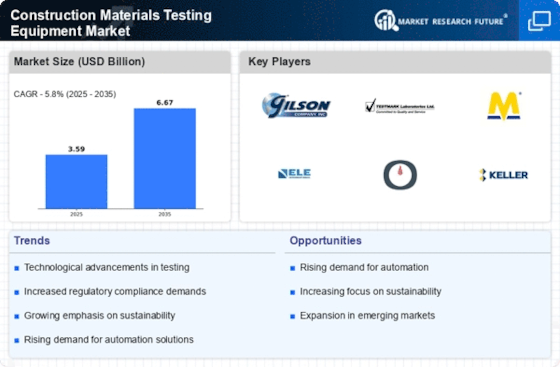
As per Market Research Future analysis, the Construction Materials Testing Equipment Market was estimated at 3.587 USD Billion in 2024. The Construction Materials Testing Equipment industry is projected to grow from 3.795 USD Billion in 2025 to 6.668 USD Billion by 2035, exhibiting a compound annual growth rate (CAGR) of 5.8% during the forecast period 2025 - 2035

Key Market Trends & Highlights

The Construction Materials Testing Equipment Market is poised for growth driven by technological advancements and sustainability initiatives.

  • Technological advancements are reshaping the construction materials testing landscape, enhancing efficiency and accuracy.
  • The North American region remains the largest market, while the Asia-Pacific region is recognized as the fastest-growing area.
  • On-site testing equipment dominates the market, whereas R&D laboratories are experiencing the most rapid growth.
  • Rising infrastructure development and increased quality assurance standards are key drivers propelling market expansion.

Market Size & Forecast

2024 Market Size 3.587 (USD Billion)
2035 Market Size 6.668 (USD Billion)
CAGR (2025 - 2035) 5.8%
Largest Regional Market Share in 2024 North America

Major Players

Gilson Company Inc (US), TestMark (US), Matest S.p.A. (IT), ELE International (GB), Controls Group (IT), Keller Group plc (GB), Tinius Olsen (US), Soiltest (US), Civicon (IN)

Market Trends

The Construction Materials Testing Equipment Market is currently experiencing a dynamic evolution, driven by the increasing demand for quality assurance in construction projects. As infrastructure development accelerates globally, the necessity for reliable testing equipment becomes paramount. This market encompasses a wide array of devices designed to assess the properties and performance of various construction materials, including concrete, soil, and asphalt. The emphasis on safety and compliance with regulatory standards further propels the growth of this sector, as stakeholders seek to mitigate risks associated with material failures. Moreover, advancements in technology are fostering innovation, leading to the introduction of more sophisticated testing solutions that enhance accuracy and efficiency. In addition to technological advancements, the Construction Materials Testing Equipment Market is influenced by the rising awareness of sustainable construction practices. As environmental concerns gain prominence, there is a growing inclination towards materials that are not only durable but also eco-friendly. This shift is prompting manufacturers to develop testing equipment that can evaluate the sustainability of materials, thereby aligning with global sustainability goals. Furthermore, the integration of automation and digitalization in testing processes is likely to streamline operations, reduce human error, and improve overall productivity. As the market continues to evolve, it appears poised for substantial growth, driven by these multifaceted trends and the ongoing need for high-quality construction materials.

Technological Advancements

The Construction Materials Testing Equipment Market is witnessing a surge in technological innovations. Enhanced automation and digital solutions are being integrated into testing processes, which may lead to improved accuracy and efficiency. These advancements could potentially reduce human error and streamline operations, making testing more reliable.

Sustainability Focus

There is an increasing emphasis on sustainable construction practices within the Construction Materials Testing Equipment Market. Stakeholders are seeking materials that not only meet performance standards but also align with environmental goals. This trend is prompting the development of testing equipment that evaluates the sustainability of various materials.

Regulatory Compliance

The necessity for compliance with stringent regulatory standards is shaping the Construction Materials Testing Equipment Market. As safety concerns rise, construction stakeholders are prioritizing quality assurance. This focus on compliance is driving demand for reliable testing equipment that ensures materials meet required specifications.

Construction Materials Testing Equipment Market Market Drivers

Technological Innovations

Technological advancements are reshaping the Construction Materials Testing Equipment Market, introducing innovative solutions that enhance testing accuracy and efficiency. The integration of automation and digital technologies, such as IoT and AI, is streamlining testing processes and providing real-time data analysis. This evolution is likely to attract investments, as companies seek to improve their testing capabilities. The market is projected to witness a growth rate of around 6% annually, driven by these innovations. As testing equipment becomes more sophisticated, it may lead to better material performance and compliance with international standards.

Expansion of Emerging Markets

Emerging markets are becoming a focal point for the Construction Materials Testing Equipment Market, as rapid urbanization and industrialization create new opportunities. Countries in Asia and Africa are experiencing significant growth in construction activities, leading to an increased need for reliable testing equipment. The market in these regions is anticipated to grow at a rate of approximately 7% annually, driven by infrastructure development and foreign investments. This expansion presents a lucrative opportunity for manufacturers to cater to the unique needs of these markets, thereby enhancing their market presence and driving overall growth.

Growing Environmental Concerns

The increasing awareness of environmental issues is influencing the Construction Materials Testing Equipment Market. There is a growing emphasis on sustainable construction practices, which necessitate the testing of materials for environmental impact. This trend is prompting manufacturers to develop eco-friendly testing equipment and methodologies. The market is expected to see a shift towards sustainable practices, with a projected growth rate of 5.5% in the coming years. As construction companies strive to meet environmental regulations, the demand for specialized testing equipment that assesses sustainability will likely rise, further driving market growth.

Rising Infrastructure Development

The ongoing expansion of infrastructure projects worldwide appears to be a primary driver for the Construction Materials Testing Equipment Market. Governments and private sectors are investing heavily in roads, bridges, and buildings, necessitating rigorous testing of materials to ensure safety and compliance. For instance, the construction sector is projected to grow at a compound annual growth rate of approximately 5.4% over the next several years, which could lead to increased demand for testing equipment. This growth is likely to be fueled by urbanization and the need for modernized infrastructure, thereby creating a robust market for construction materials testing equipment.

Increased Quality Assurance Standards

The Construction Materials Testing Equipment Market is significantly influenced by the rising standards for quality assurance in construction. As projects become more complex, the need for precise testing of materials has intensified. Regulatory bodies are enforcing stricter guidelines, which necessitate the use of advanced testing equipment. The market for construction materials testing equipment is expected to reach a valuation of over USD 5 billion by 2026, driven by these stringent quality requirements. This trend indicates a shift towards more reliable and accurate testing methods, which could enhance the overall safety and durability of construction projects.

Market Segment Insights

By Location: On-site (Largest) vs. R&D Laboratories (Fastest-Growing)

The <a href="https://www.marketresearchfuture.com/reports/construction-materials-market-12121" target="_blank" title="construction materials">Construction Materials</a> Testing Equipment Market is significantly influenced by the location of testing activities. On-site testing holds the largest share, as it allows for immediate results and efficient project management. This segment is essential for construction projects where timely decision-making is crucial. In contrast, R&D laboratories, while smaller in share, are the fastest-growing segment due to the increasing emphasis on material innovation and safety standards. This shift is driven by regulatory demands and a need for advanced testing methodologies that align with modern construction practices. Growth trends within the location segment reveal a dynamic landscape. On-site testing is becoming more sophisticated with the integration of digital technology, enhancing data collection and analysis. Meanwhile, R&D laboratories are expanding rapidly, fueled by investment in research and development for new materials and sustainable practices. The competitive landscape is evolving, with an increasing collaboration between educational institutions and laboratories, underscoring the importance of research-driven approaches in the construction sector.

On-site Testing: Dominant vs. R&D Laboratories: Emerging

On-site testing stands as a dominant force within the Construction Materials Testing Equipment Market, characterized by its direct impact on project efficiency and safety compliance. This testing method facilitates immediate adjustment to construction processes, ensuring that materials meet necessary standards before usage. In contrast, R&D laboratories represent an emerging market segment, growing swiftly due to their crucial role in advancing material technology. These laboratories focus on innovative testing methods and the exploration of new materials designed for enhanced durability and eco-friendliness. Their growth is further accelerated by an increasing demand for sophisticated testing solutions that meet stringent industry regulations, positioning R&D as a key player in the future of construction material development.

By Application: Residential (Largest) vs. Commercial (Fastest-Growing)

In the Construction Materials Testing Equipment Market, the application segment is prominently led by the residential sector, which captures the largest share. This is attributed to rising residential construction projects and a growing emphasis on construction quality. Following closely is the commercial application, which has shown significant growth potential as infrastructure development accelerates in urban areas.

Residential (Dominant) vs. Commercial (Emerging)

The residential application in the Construction Materials Testing Equipment Market remains dominant, driven by consistent demand for housing and infrastructure upgrades. This segment benefits from local and national government initiatives aimed at promoting housing affordability and sustainability. Conversely, the commercial application is emerging as a key area of growth, driven by trends like urbanization and the increasing complexity of <a href="https://www.marketresearchfuture.com/reports/commercial-construction-market-41389" target="_blank" title="commercial construction">commercial construction</a> projects. As safety regulations tighten, the demand for specialized testing equipment in commercial applications is growing, making this segment increasingly integral to the overall market.

By Product Type: Concrete Testing Equipment (Largest) vs. Soil Testing Equipment (Fastest-Growing)

The Construction Materials Testing Equipment Market showcases a varied distribution among its product types, primarily led by Concrete Testing Equipment. This segment commands a significant share, reflecting its critical role in ensuring the integrity and durability of construction projects. In contrast, Soil Testing Equipment is gaining momentum rapidly, driven by increasing construction activities and the need for proper soil assessment to prevent structural failures. Meanwhile, Aggregate Testing Equipment and other categories contribute to the overall diversity, meeting specialized demands in different construction applications.

Concrete Testing Equipment (Dominant) vs. Soil Testing Equipment (Emerging)

Concrete Testing Equipment stands out as the dominant product in the market, underpinned by stringent regulations and standards that necessitate thorough testing to guarantee quality and safety in construction. This dominance is characterized by a broad range of instruments such as slump testers, compression testing machines, and curing tanks that cater to diverse testing needs. In contrast, Soil Testing Equipment is emerging as a vital player, spurred by the rising recognition of geotechnical factors in construction projects. Innovation in portable testing devices and increased investment in infrastructure projects are enhancing its appeal, making it a key competitor as it adapts to meet the dynamic demands of the industry.

Get more detailed insights about Construction Materials Testing Equipment Market Research Report—Global Forecast till 2035

Regional Insights

By region, the study provides the market insights into North America, Europe, Asia-Pacific and Rest of the World. The North American Construction Materials Testing Equipment Market area will dominate this market, because of intense building operations and strict quality control guidelines, and growing investments from government institutes.

Further, the major countries studied in the market report are The US, German, France, the UK, Canada, Italy, Spain, India, Australia, South Korea, China, Japan, and Brazil.

Figure2: CONSTRUCTION MATERIALS TESTING EQUIPMENT MARKET SHARE BY REGION 2022 (USD Billion)

Europe Construction Materials Testing Equipment Market has the second-largest portion of the market as a result of intense construction activity and strict quality control guidelines. Further, the German Construction Materials Testing Equipment Market maintained the most market share, and the UK Construction Materials Testing Equipment Market was the European market with the quickest rate of growth.

The Asia-Pacific Construction Materials Testing Equipment Market is anticipated to expand between 2023 and 2032 at the quickest CAGR. This is a result of growing infrastructure, urbanization, and expenditures in building projects. Moreover, China’s Construction Materials Testing Equipment Market maintained the most market share, and the Indian Construction Materials Testing Equipment Market was the Asia-Pacific market with the quickest rate of growth.

Key Players and Competitive Insights

Leading market players are making significant investments in R&D to broaden their product lines, which will fuel further growth in the market for Construction Materials Testing Equipment Market. Additionally, market players are engaging in a range of calculated initiatives to increase their worldwide presence, with important market developments involving the introduction of new products, contracts, M&A transactions, increased investment, and cooperation with other enterprises. To grow and endure in an increasingly cutthroat and dynamic market, Construction Materials Testing Equipment industry must provide reasonably priced goods.

One of the main business strategies employed by manufacturers is to manufacture locally in order to reduce operating expenses in the global Construction Materials Testing Equipment industry to help customers and expand the market segment. In recent years, the Construction Materials Testing Equipment industry has provided some of the biggest benefits to medicine. Major players in the Construction Materials Testing Equipment Market, including Aimil Ltd., Applied Test Systems, Canopus Instruments, CMT Equipment, Controls S.p.A., ELE International, Humboldt Mfg. Co. and others, are engaging in research and development activities in an effort to boost market demand.

Aimil has been in the forefront of the Indian instrumentation sector, offering cutting-edge instruments and related services. Modern instruments in the domains of civil engineering, electronics, analytical & industrial, hygea healthcare, and consulting in civil engineering, as well as services related to noise and vibration engineering and condition monitoring, are provided by Aimil.

In September ABD is pleased to report that, since its September 2022 launch, ICONiQ Whisky has sold one million cases by September 2023.

Since its founding in 1965, the company has expanded significantly, and it currently manufactures eleven main product lines, which include heating elements, furnaces, ovens, industrial furnaces, universal testing machines, creep testing systems, testing accessories, ultrasonic reference standards, pressure testing systems, asphalt testing equipment, and sealant testers. With a range of furnaces and ovens that are made for easy interaction with both our creep testing systems and universal testing machines as well as testing equipment from other manufacturers, ATS has established itself as a leader in high-temperature testing.

In February 2023, Given that HGI is an expert in the field of pipe testing, ATS announced its collaboration with them for the impending construction material testing projects.

Key Companies in the Construction Materials Testing Equipment Market include

Industry Developments

July 2019: ELE International introduced the ELE Soiltest 10. It is a key advancement in the construction sector, allowing for enhanced soil testing capabilities.

In 2018: The Humboldt Rapid Moisture Meter was introduced by Humboldt Mfg. Co. This unique instrument measures the moisture content of various construction materials quickly and accurately. Its efficiency and dependability have been well regarded in the industry.

October 2018: TestAmerica will be acquired by Eurofins Scientific, a bioanalytic testing player that also sells building material testing equipment.

Future Outlook

Construction Materials Testing Equipment Market Future Outlook

The Construction Materials Testing Equipment Market is projected to grow at a 5.8% CAGR from 2025 to 2035, driven by technological advancements, increased infrastructure investments, and stringent quality regulations.

New opportunities lie in:

  • Development of automated testing solutions for enhanced efficiency.
  • Expansion into emerging markets with tailored product offerings.
  • Integration of IoT technology for real-time data analytics in testing.

By 2035, the market is expected to be robust, driven by innovation and global demand.

Market Segmentation

Construction Materials Testing Equipment Market Location Outlook

  • On-site
  • R&D laboratories
  • Educational institutes

Construction Materials Testing Equipment Market Application Outlook

  • Residential
  • Commercial
  • Transport
  • Other applications

Construction Materials Testing Equipment Market Product Type Outlook

  • Soil Testing Equipment
  • Aggregate Testing Equipment
  • Concrete Testing Equipment
  • Others

Report Scope

MARKET SIZE 2024 3.587(USD Billion)
MARKET SIZE 2025 3.795(USD Billion)
MARKET SIZE 2035 6.668(USD Billion)
COMPOUND ANNUAL GROWTH RATE (CAGR) 5.8% (2025 - 2035)
REPORT COVERAGE Revenue Forecast, Competitive Landscape, Growth Factors, and Trends
BASE YEAR 2024
Market Forecast Period 2025 - 2035
Historical Data 2019 - 2024
Market Forecast Units USD Billion
Key Companies Profiled Gilson Company Inc (US), TestMark (US), Matest S.p.A. (IT), ELE International (GB), Controls Group (IT), Keller Group plc (GB), Tinius Olsen (US), Soiltest (US), Civicon (IN)
Segments Covered Location, Application, Product Type, Region
Key Market Opportunities Integration of advanced automation and digital technologies enhances efficiency in the Construction Materials Testing Equipment Market.
Key Market Dynamics Technological advancements and stringent regulations drive innovation in construction materials testing equipment, enhancing quality assurance processes.
Countries Covered North America, Europe, APAC, South America, MEA

FAQs

What is the projected market valuation for the Construction Materials Testing Equipment Market in 2035?

<p>The projected market valuation for the Construction Materials Testing Equipment Market in 2035 is 6.668 USD Billion.</p>

What was the market valuation for the Construction Materials Testing Equipment Market in 2024?

<p>The market valuation for the Construction Materials Testing Equipment Market in 2024 was 3.587 USD Billion.</p>

What is the expected CAGR for the Construction Materials Testing Equipment Market from 2025 to 2035?

<p>The expected CAGR for the Construction Materials Testing Equipment Market during the forecast period 2025 - 2035 is 5.8%.</p>

Which companies are considered key players in the Construction Materials Testing Equipment Market?

<p>Key players in the market include Gilson Company Inc, TestMark, Matest S.p.A., and others.</p>

What are the main segments of the Construction Materials Testing Equipment Market?

<p>The main segments of the market include location, application, and product type.</p>

How much is the Construction Materials Testing Equipment Market expected to grow in the On-site segment by 2035?

<p>The On-site segment is expected to grow from 1.5 USD Billion in 2024 to 2.8 USD Billion by 2035.</p>

What is the projected growth for Concrete Testing Equipment by 2035?

Concrete Testing Equipment is projected to grow from 1.793 USD Billion in 2024 to 3.227 USD Billion by 2035.

What is the expected market size for the Residential application segment in 2035?

The Residential application segment is expected to reach 1.623 USD Billion by 2035.

How does the market valuation for Aggregate Testing Equipment change from 2024 to 2035?

The market valuation for Aggregate Testing Equipment is expected to increase from 0.716 USD Billion in 2024 to 1.295 USD Billion by 2035.

What is the anticipated growth in the Other applications segment by 2035?

The Other applications segment is anticipated to grow from 1.255 USD Billion in 2024 to 2.437 USD Billion by 2035.

  1. SECTION I: EXECUTIVE SUMMARY AND KEY HIGHLIGHTS
    1. | 1.1 EXECUTIVE SUMMARY
    2. | | 1.1.1 Market Overview
    3. | | 1.1.2 Key Findings
    4. | | 1.1.3 Market Segmentation
    5. | | 1.1.4 Competitive Landscape
    6. | | 1.1.5 Challenges and Opportunities
    7. | | 1.1.6 Future Outlook
  2. SECTION II: SCOPING, METHODOLOGY AND MARKET STRUCTURE
    1. | 2.1 MARKET INTRODUCTION
    2. | | 2.1.1 Definition
    3. | | 2.1.2 Scope of the study
    4. | | | 2.1.2.1 Research Objective
    5. | | | 2.1.2.2 Assumption
    6. | | | 2.1.2.3 Limitations
    7. | 2.2 RESEARCH METHODOLOGY
    8. | | 2.2.1 Overview
    9. | | 2.2.2 Data Mining
    10. | | 2.2.3 Secondary Research
    11. | | 2.2.4 Primary Research
    12. | | | 2.2.4.1 Primary Interviews and Information Gathering Process
    13. | | | 2.2.4.2 Breakdown of Primary Respondents
    14. | | 2.2.5 Forecasting Model
    15. | | 2.2.6 Market Size Estimation
    16. | | | 2.2.6.1 Bottom-Up Approach
    17. | | | 2.2.6.2 Top-Down Approach
    18. | | 2.2.7 Data Triangulation
    19. | | 2.2.8 Validation
  3. SECTION III: QUALITATIVE ANALYSIS
    1. | 3.1 MARKET DYNAMICS
    2. | | 3.1.1 Overview
    3. | | 3.1.2 Drivers
    4. | | 3.1.3 Restraints
    5. | | 3.1.4 Opportunities
    6. | 3.2 MARKET FACTOR ANALYSIS
    7. | | 3.2.1 Value chain Analysis
    8. | | 3.2.2 Porter's Five Forces Analysis
    9. | | | 3.2.2.1 Bargaining Power of Suppliers
    10. | | | 3.2.2.2 Bargaining Power of Buyers
    11. | | | 3.2.2.3 Threat of New Entrants
    12. | | | 3.2.2.4 Threat of Substitutes
    13. | | | 3.2.2.5 Intensity of Rivalry
    14. | | 3.2.3 COVID-19 Impact Analysis
    15. | | | 3.2.3.1 Market Impact Analysis
    16. | | | 3.2.3.2 Regional Impact
    17. | | | 3.2.3.3 Opportunity and Threat Analysis
  4. SECTION IV: QUANTITATIVE ANALYSIS
    1. | 4.1 Packaging & Transport, BY Location (USD Billion)
    2. | | 4.1.1 On-site
    3. | | 4.1.2 R&D laboratories
    4. | | 4.1.3 Educational institutes
    5. | 4.2 Packaging & Transport, BY Application (USD Billion)
    6. | | 4.2.1 Residential
    7. | | 4.2.2 Commercial
    8. | | 4.2.3 Transport
    9. | | 4.2.4 Other applications
    10. | 4.3 Packaging & Transport, BY Product Type (USD Billion)
    11. | | 4.3.1 Soil Testing Equipment
    12. | | 4.3.2 Aggregate Testing Equipment
    13. | | 4.3.3 Concrete Testing Equipment
    14. | | 4.3.4 Others
    15. | 4.4 Packaging & Transport, BY Region (USD Billion)
    16. | | 4.4.1 North America
    17. | | | 4.4.1.1 US
    18. | | | 4.4.1.2 Canada
    19. | | 4.4.2 Europe
    20. | | | 4.4.2.1 Germany
    21. | | | 4.4.2.2 UK
    22. | | | 4.4.2.3 France
    23. | | | 4.4.2.4 Russia
    24. | | | 4.4.2.5 Italy
    25. | | | 4.4.2.6 Spain
    26. | | | 4.4.2.7 Rest of Europe
    27. | | 4.4.3 APAC
    28. | | | 4.4.3.1 China
    29. | | | 4.4.3.2 India
    30. | | | 4.4.3.3 Japan
    31. | | | 4.4.3.4 South Korea
    32. | | | 4.4.3.5 Malaysia
    33. | | | 4.4.3.6 Thailand
    34. | | | 4.4.3.7 Indonesia
    35. | | | 4.4.3.8 Rest of APAC
    36. | | 4.4.4 South America
    37. | | | 4.4.4.1 Brazil
    38. | | | 4.4.4.2 Mexico
    39. | | | 4.4.4.3 Argentina
    40. | | | 4.4.4.4 Rest of South America
    41. | | 4.4.5 MEA
    42. | | | 4.4.5.1 GCC Countries
    43. | | | 4.4.5.2 South Africa
    44. | | | 4.4.5.3 Rest of MEA
  5. SECTION V: COMPETITIVE ANALYSIS
    1. | 5.1 Competitive Landscape
    2. | | 5.1.1 Overview
    3. | | 5.1.2 Competitive Analysis
    4. | | 5.1.3 Market share Analysis
    5. | | 5.1.4 Major Growth Strategy in the Packaging & Transport
    6. | | 5.1.5 Competitive Benchmarking
    7. | | 5.1.6 Leading Players in Terms of Number of Developments in the Packaging & Transport
    8. | | 5.1.7 Key developments and growth strategies
    9. | | | 5.1.7.1 New Product Launch/Service Deployment
    10. | | | 5.1.7.2 Merger & Acquisitions
    11. | | | 5.1.7.3 Joint Ventures
    12. | | 5.1.8 Major Players Financial Matrix
    13. | | | 5.1.8.1 Sales and Operating Income
    14. | | | 5.1.8.2 Major Players R&D Expenditure. 2023
    15. | 5.2 Company Profiles
    16. | | 5.2.1 Gilson Company Inc (US)
    17. | | | 5.2.1.1 Financial Overview
    18. | | | 5.2.1.2 Products Offered
    19. | | | 5.2.1.3 Key Developments
    20. | | | 5.2.1.4 SWOT Analysis
    21. | | | 5.2.1.5 Key Strategies
    22. | | 5.2.2 TestMark (US)
    23. | | | 5.2.2.1 Financial Overview
    24. | | | 5.2.2.2 Products Offered
    25. | | | 5.2.2.3 Key Developments
    26. | | | 5.2.2.4 SWOT Analysis
    27. | | | 5.2.2.5 Key Strategies
    28. | | 5.2.3 Matest S.p.A. (IT)
    29. | | | 5.2.3.1 Financial Overview
    30. | | | 5.2.3.2 Products Offered
    31. | | | 5.2.3.3 Key Developments
    32. | | | 5.2.3.4 SWOT Analysis
    33. | | | 5.2.3.5 Key Strategies
    34. | | 5.2.4 ELE International (GB)
    35. | | | 5.2.4.1 Financial Overview
    36. | | | 5.2.4.2 Products Offered
    37. | | | 5.2.4.3 Key Developments
    38. | | | 5.2.4.4 SWOT Analysis
    39. | | | 5.2.4.5 Key Strategies
    40. | | 5.2.5 Controls Group (IT)
    41. | | | 5.2.5.1 Financial Overview
    42. | | | 5.2.5.2 Products Offered
    43. | | | 5.2.5.3 Key Developments
    44. | | | 5.2.5.4 SWOT Analysis
    45. | | | 5.2.5.5 Key Strategies
    46. | | 5.2.6 Keller Group plc (GB)
    47. | | | 5.2.6.1 Financial Overview
    48. | | | 5.2.6.2 Products Offered
    49. | | | 5.2.6.3 Key Developments
    50. | | | 5.2.6.4 SWOT Analysis
    51. | | | 5.2.6.5 Key Strategies
    52. | | 5.2.7 Tinius Olsen (US)
    53. | | | 5.2.7.1 Financial Overview
    54. | | | 5.2.7.2 Products Offered
    55. | | | 5.2.7.3 Key Developments
    56. | | | 5.2.7.4 SWOT Analysis
    57. | | | 5.2.7.5 Key Strategies
    58. | | 5.2.8 Soiltest (US)
    59. | | | 5.2.8.1 Financial Overview
    60. | | | 5.2.8.2 Products Offered
    61. | | | 5.2.8.3 Key Developments
    62. | | | 5.2.8.4 SWOT Analysis
    63. | | | 5.2.8.5 Key Strategies
    64. | | 5.2.9 Civicon (IN)
    65. | | | 5.2.9.1 Financial Overview
    66. | | | 5.2.9.2 Products Offered
    67. | | | 5.2.9.3 Key Developments
    68. | | | 5.2.9.4 SWOT Analysis
    69. | | | 5.2.9.5 Key Strategies
    70. | 5.3 Appendix
    71. | | 5.3.1 References
    72. | | 5.3.2 Related Reports
  6. LIST OF FIGURES
    1. | 6.1 MARKET SYNOPSIS
    2. | 6.2 NORTH AMERICA MARKET ANALYSIS
    3. | 6.3 US MARKET ANALYSIS BY LOCATION
    4. | 6.4 US MARKET ANALYSIS BY APPLICATION
    5. | 6.5 US MARKET ANALYSIS BY PRODUCT TYPE
    6. | 6.6 CANADA MARKET ANALYSIS BY LOCATION
    7. | 6.7 CANADA MARKET ANALYSIS BY APPLICATION
    8. | 6.8 CANADA MARKET ANALYSIS BY PRODUCT TYPE
    9. | 6.9 EUROPE MARKET ANALYSIS
    10. | 6.10 GERMANY MARKET ANALYSIS BY LOCATION
    11. | 6.11 GERMANY MARKET ANALYSIS BY APPLICATION
    12. | 6.12 GERMANY MARKET ANALYSIS BY PRODUCT TYPE
    13. | 6.13 UK MARKET ANALYSIS BY LOCATION
    14. | 6.14 UK MARKET ANALYSIS BY APPLICATION
    15. | 6.15 UK MARKET ANALYSIS BY PRODUCT TYPE
    16. | 6.16 FRANCE MARKET ANALYSIS BY LOCATION
    17. | 6.17 FRANCE MARKET ANALYSIS BY APPLICATION
    18. | 6.18 FRANCE MARKET ANALYSIS BY PRODUCT TYPE
    19. | 6.19 RUSSIA MARKET ANALYSIS BY LOCATION
    20. | 6.20 RUSSIA MARKET ANALYSIS BY APPLICATION
    21. | 6.21 RUSSIA MARKET ANALYSIS BY PRODUCT TYPE
    22. | 6.22 ITALY MARKET ANALYSIS BY LOCATION
    23. | 6.23 ITALY MARKET ANALYSIS BY APPLICATION
    24. | 6.24 ITALY MARKET ANALYSIS BY PRODUCT TYPE
    25. | 6.25 SPAIN MARKET ANALYSIS BY LOCATION
    26. | 6.26 SPAIN MARKET ANALYSIS BY APPLICATION
    27. | 6.27 SPAIN MARKET ANALYSIS BY PRODUCT TYPE
    28. | 6.28 REST OF EUROPE MARKET ANALYSIS BY LOCATION
    29. | 6.29 REST OF EUROPE MARKET ANALYSIS BY APPLICATION
    30. | 6.30 REST OF EUROPE MARKET ANALYSIS BY PRODUCT TYPE
    31. | 6.31 APAC MARKET ANALYSIS
    32. | 6.32 CHINA MARKET ANALYSIS BY LOCATION
    33. | 6.33 CHINA MARKET ANALYSIS BY APPLICATION
    34. | 6.34 CHINA MARKET ANALYSIS BY PRODUCT TYPE
    35. | 6.35 INDIA MARKET ANALYSIS BY LOCATION
    36. | 6.36 INDIA MARKET ANALYSIS BY APPLICATION
    37. | 6.37 INDIA MARKET ANALYSIS BY PRODUCT TYPE
    38. | 6.38 JAPAN MARKET ANALYSIS BY LOCATION
    39. | 6.39 JAPAN MARKET ANALYSIS BY APPLICATION
    40. | 6.40 JAPAN MARKET ANALYSIS BY PRODUCT TYPE
    41. | 6.41 SOUTH KOREA MARKET ANALYSIS BY LOCATION
    42. | 6.42 SOUTH KOREA MARKET ANALYSIS BY APPLICATION
    43. | 6.43 SOUTH KOREA MARKET ANALYSIS BY PRODUCT TYPE
    44. | 6.44 MALAYSIA MARKET ANALYSIS BY LOCATION
    45. | 6.45 MALAYSIA MARKET ANALYSIS BY APPLICATION
    46. | 6.46 MALAYSIA MARKET ANALYSIS BY PRODUCT TYPE
    47. | 6.47 THAILAND MARKET ANALYSIS BY LOCATION
    48. | 6.48 THAILAND MARKET ANALYSIS BY APPLICATION
    49. | 6.49 THAILAND MARKET ANALYSIS BY PRODUCT TYPE
    50. | 6.50 INDONESIA MARKET ANALYSIS BY LOCATION
    51. | 6.51 INDONESIA MARKET ANALYSIS BY APPLICATION
    52. | 6.52 INDONESIA MARKET ANALYSIS BY PRODUCT TYPE
    53. | 6.53 REST OF APAC MARKET ANALYSIS BY LOCATION
    54. | 6.54 REST OF APAC MARKET ANALYSIS BY APPLICATION
    55. | 6.55 REST OF APAC MARKET ANALYSIS BY PRODUCT TYPE
    56. | 6.56 SOUTH AMERICA MARKET ANALYSIS
    57. | 6.57 BRAZIL MARKET ANALYSIS BY LOCATION
    58. | 6.58 BRAZIL MARKET ANALYSIS BY APPLICATION
    59. | 6.59 BRAZIL MARKET ANALYSIS BY PRODUCT TYPE
    60. | 6.60 MEXICO MARKET ANALYSIS BY LOCATION
    61. | 6.61 MEXICO MARKET ANALYSIS BY APPLICATION
    62. | 6.62 MEXICO MARKET ANALYSIS BY PRODUCT TYPE
    63. | 6.63 ARGENTINA MARKET ANALYSIS BY LOCATION
    64. | 6.64 ARGENTINA MARKET ANALYSIS BY APPLICATION
    65. | 6.65 ARGENTINA MARKET ANALYSIS BY PRODUCT TYPE
    66. | 6.66 REST OF SOUTH AMERICA MARKET ANALYSIS BY LOCATION
    67. | 6.67 REST OF SOUTH AMERICA MARKET ANALYSIS BY APPLICATION
    68. | 6.68 REST OF SOUTH AMERICA MARKET ANALYSIS BY PRODUCT TYPE
    69. | 6.69 MEA MARKET ANALYSIS
    70. | 6.70 GCC COUNTRIES MARKET ANALYSIS BY LOCATION
    71. | 6.71 GCC COUNTRIES MARKET ANALYSIS BY APPLICATION
    72. | 6.72 GCC COUNTRIES MARKET ANALYSIS BY PRODUCT TYPE
    73. | 6.73 SOUTH AFRICA MARKET ANALYSIS BY LOCATION
    74. | 6.74 SOUTH AFRICA MARKET ANALYSIS BY APPLICATION
    75. | 6.75 SOUTH AFRICA MARKET ANALYSIS BY PRODUCT TYPE
    76. | 6.76 REST OF MEA MARKET ANALYSIS BY LOCATION
    77. | 6.77 REST OF MEA MARKET ANALYSIS BY APPLICATION
    78. | 6.78 REST OF MEA MARKET ANALYSIS BY PRODUCT TYPE
    79. | 6.79 KEY BUYING CRITERIA OF PACKAGING & TRANSPORT
    80. | 6.80 RESEARCH PROCESS OF MRFR
    81. | 6.81 DRO ANALYSIS OF PACKAGING & TRANSPORT
    82. | 6.82 DRIVERS IMPACT ANALYSIS: PACKAGING & TRANSPORT
    83. | 6.83 RESTRAINTS IMPACT ANALYSIS: PACKAGING & TRANSPORT
    84. | 6.84 SUPPLY / VALUE CHAIN: PACKAGING & TRANSPORT
    85. | 6.85 PACKAGING & TRANSPORT, BY LOCATION, 2024 (% SHARE)
    86. | 6.86 PACKAGING & TRANSPORT, BY LOCATION, 2024 TO 2035 (USD Billion)
    87. | 6.87 PACKAGING & TRANSPORT, BY APPLICATION, 2024 (% SHARE)
    88. | 6.88 PACKAGING & TRANSPORT, BY APPLICATION, 2024 TO 2035 (USD Billion)
    89. | 6.89 PACKAGING & TRANSPORT, BY PRODUCT TYPE, 2024 (% SHARE)
    90. | 6.90 PACKAGING & TRANSPORT, BY PRODUCT TYPE, 2024 TO 2035 (USD Billion)
    91. | 6.91 BENCHMARKING OF MAJOR COMPETITORS
  7. LIST OF TABLES
    1. | 7.1 LIST OF ASSUMPTIONS
    2. | | 7.1.1
    3. | 7.2 North America MARKET SIZE ESTIMATES; FORECAST
    4. | | 7.2.1 BY LOCATION, 2025-2035 (USD Billion)
    5. | | 7.2.2 BY APPLICATION, 2025-2035 (USD Billion)
    6. | | 7.2.3 BY PRODUCT TYPE, 2025-2035 (USD Billion)
    7. | 7.3 US MARKET SIZE ESTIMATES; FORECAST
    8. | | 7.3.1 BY LOCATION, 2025-2035 (USD Billion)
    9. | | 7.3.2 BY APPLICATION, 2025-2035 (USD Billion)
    10. | | 7.3.3 BY PRODUCT TYPE, 2025-2035 (USD Billion)
    11. | 7.4 Canada MARKET SIZE ESTIMATES; FORECAST
    12. | | 7.4.1 BY LOCATION, 2025-2035 (USD Billion)
    13. | | 7.4.2 BY APPLICATION, 2025-2035 (USD Billion)
    14. | | 7.4.3 BY PRODUCT TYPE, 2025-2035 (USD Billion)
    15. | 7.5 Europe MARKET SIZE ESTIMATES; FORECAST
    16. | | 7.5.1 BY LOCATION, 2025-2035 (USD Billion)
    17. | | 7.5.2 BY APPLICATION, 2025-2035 (USD Billion)
    18. | | 7.5.3 BY PRODUCT TYPE, 2025-2035 (USD Billion)
    19. | 7.6 Germany MARKET SIZE ESTIMATES; FORECAST
    20. | | 7.6.1 BY LOCATION, 2025-2035 (USD Billion)
    21. | | 7.6.2 BY APPLICATION, 2025-2035 (USD Billion)
    22. | | 7.6.3 BY PRODUCT TYPE, 2025-2035 (USD Billion)
    23. | 7.7 UK MARKET SIZE ESTIMATES; FORECAST
    24. | | 7.7.1 BY LOCATION, 2025-2035 (USD Billion)
    25. | | 7.7.2 BY APPLICATION, 2025-2035 (USD Billion)
    26. | | 7.7.3 BY PRODUCT TYPE, 2025-2035 (USD Billion)
    27. | 7.8 France MARKET SIZE ESTIMATES; FORECAST
    28. | | 7.8.1 BY LOCATION, 2025-2035 (USD Billion)
    29. | | 7.8.2 BY APPLICATION, 2025-2035 (USD Billion)
    30. | | 7.8.3 BY PRODUCT TYPE, 2025-2035 (USD Billion)
    31. | 7.9 Russia MARKET SIZE ESTIMATES; FORECAST
    32. | | 7.9.1 BY LOCATION, 2025-2035 (USD Billion)
    33. | | 7.9.2 BY APPLICATION, 2025-2035 (USD Billion)
    34. | | 7.9.3 BY PRODUCT TYPE, 2025-2035 (USD Billion)
    35. | 7.10 Italy MARKET SIZE ESTIMATES; FORECAST
    36. | | 7.10.1 BY LOCATION, 2025-2035 (USD Billion)
    37. | | 7.10.2 BY APPLICATION, 2025-2035 (USD Billion)
    38. | | 7.10.3 BY PRODUCT TYPE, 2025-2035 (USD Billion)
    39. | 7.11 Spain MARKET SIZE ESTIMATES; FORECAST
    40. | | 7.11.1 BY LOCATION, 2025-2035 (USD Billion)
    41. | | 7.11.2 BY APPLICATION, 2025-2035 (USD Billion)
    42. | | 7.11.3 BY PRODUCT TYPE, 2025-2035 (USD Billion)
    43. | 7.12 Rest of Europe MARKET SIZE ESTIMATES; FORECAST
    44. | | 7.12.1 BY LOCATION, 2025-2035 (USD Billion)
    45. | | 7.12.2 BY APPLICATION, 2025-2035 (USD Billion)
    46. | | 7.12.3 BY PRODUCT TYPE, 2025-2035 (USD Billion)
    47. | 7.13 APAC MARKET SIZE ESTIMATES; FORECAST
    48. | | 7.13.1 BY LOCATION, 2025-2035 (USD Billion)
    49. | | 7.13.2 BY APPLICATION, 2025-2035 (USD Billion)
    50. | | 7.13.3 BY PRODUCT TYPE, 2025-2035 (USD Billion)
    51. | 7.14 China MARKET SIZE ESTIMATES; FORECAST
    52. | | 7.14.1 BY LOCATION, 2025-2035 (USD Billion)
    53. | | 7.14.2 BY APPLICATION, 2025-2035 (USD Billion)
    54. | | 7.14.3 BY PRODUCT TYPE, 2025-2035 (USD Billion)
    55. | 7.15 India MARKET SIZE ESTIMATES; FORECAST
    56. | | 7.15.1 BY LOCATION, 2025-2035 (USD Billion)
    57. | | 7.15.2 BY APPLICATION, 2025-2035 (USD Billion)
    58. | | 7.15.3 BY PRODUCT TYPE, 2025-2035 (USD Billion)
    59. | 7.16 Japan MARKET SIZE ESTIMATES; FORECAST
    60. | | 7.16.1 BY LOCATION, 2025-2035 (USD Billion)
    61. | | 7.16.2 BY APPLICATION, 2025-2035 (USD Billion)
    62. | | 7.16.3 BY PRODUCT TYPE, 2025-2035 (USD Billion)
    63. | 7.17 South Korea MARKET SIZE ESTIMATES; FORECAST
    64. | | 7.17.1 BY LOCATION, 2025-2035 (USD Billion)
    65. | | 7.17.2 BY APPLICATION, 2025-2035 (USD Billion)
    66. | | 7.17.3 BY PRODUCT TYPE, 2025-2035 (USD Billion)
    67. | 7.18 Malaysia MARKET SIZE ESTIMATES; FORECAST
    68. | | 7.18.1 BY LOCATION, 2025-2035 (USD Billion)
    69. | | 7.18.2 BY APPLICATION, 2025-2035 (USD Billion)
    70. | | 7.18.3 BY PRODUCT TYPE, 2025-2035 (USD Billion)
    71. | 7.19 Thailand MARKET SIZE ESTIMATES; FORECAST
    72. | | 7.19.1 BY LOCATION, 2025-2035 (USD Billion)
    73. | | 7.19.2 BY APPLICATION, 2025-2035 (USD Billion)
    74. | | 7.19.3 BY PRODUCT TYPE, 2025-2035 (USD Billion)
    75. | 7.20 Indonesia MARKET SIZE ESTIMATES; FORECAST
    76. | | 7.20.1 BY LOCATION, 2025-2035 (USD Billion)
    77. | | 7.20.2 BY APPLICATION, 2025-2035 (USD Billion)
    78. | | 7.20.3 BY PRODUCT TYPE, 2025-2035 (USD Billion)
    79. | 7.21 Rest of APAC MARKET SIZE ESTIMATES; FORECAST
    80. | | 7.21.1 BY LOCATION, 2025-2035 (USD Billion)
    81. | | 7.21.2 BY APPLICATION, 2025-2035 (USD Billion)
    82. | | 7.21.3 BY PRODUCT TYPE, 2025-2035 (USD Billion)
    83. | 7.22 South America MARKET SIZE ESTIMATES; FORECAST
    84. | | 7.22.1 BY LOCATION, 2025-2035 (USD Billion)
    85. | | 7.22.2 BY APPLICATION, 2025-2035 (USD Billion)
    86. | | 7.22.3 BY PRODUCT TYPE, 2025-2035 (USD Billion)
    87. | 7.23 Brazil MARKET SIZE ESTIMATES; FORECAST
    88. | | 7.23.1 BY LOCATION, 2025-2035 (USD Billion)
    89. | | 7.23.2 BY APPLICATION, 2025-2035 (USD Billion)
    90. | | 7.23.3 BY PRODUCT TYPE, 2025-2035 (USD Billion)
    91. | 7.24 Mexico MARKET SIZE ESTIMATES; FORECAST
    92. | | 7.24.1 BY LOCATION, 2025-2035 (USD Billion)
    93. | | 7.24.2 BY APPLICATION, 2025-2035 (USD Billion)
    94. | | 7.24.3 BY PRODUCT TYPE, 2025-2035 (USD Billion)
    95. | 7.25 Argentina MARKET SIZE ESTIMATES; FORECAST
    96. | | 7.25.1 BY LOCATION, 2025-2035 (USD Billion)
    97. | | 7.25.2 BY APPLICATION, 2025-2035 (USD Billion)
    98. | | 7.25.3 BY PRODUCT TYPE, 2025-2035 (USD Billion)
    99. | 7.26 Rest of South America MARKET SIZE ESTIMATES; FORECAST
    100. | | 7.26.1 BY LOCATION, 2025-2035 (USD Billion)
    101. | | 7.26.2 BY APPLICATION, 2025-2035 (USD Billion)
    102. | | 7.26.3 BY PRODUCT TYPE, 2025-2035 (USD Billion)
    103. | 7.27 MEA MARKET SIZE ESTIMATES; FORECAST
    104. | | 7.27.1 BY LOCATION, 2025-2035 (USD Billion)
    105. | | 7.27.2 BY APPLICATION, 2025-2035 (USD Billion)
    106. | | 7.27.3 BY PRODUCT TYPE, 2025-2035 (USD Billion)
    107. | 7.28 GCC Countries MARKET SIZE ESTIMATES; FORECAST
    108. | | 7.28.1 BY LOCATION, 2025-2035 (USD Billion)
    109. | | 7.28.2 BY APPLICATION, 2025-2035 (USD Billion)
    110. | | 7.28.3 BY PRODUCT TYPE, 2025-2035 (USD Billion)
    111. | 7.29 South Africa MARKET SIZE ESTIMATES; FORECAST
    112. | | 7.29.1 BY LOCATION, 2025-2035 (USD Billion)
    113. | | 7.29.2 BY APPLICATION, 2025-2035 (USD Billion)
    114. | | 7.29.3 BY PRODUCT TYPE, 2025-2035 (USD Billion)
    115. | 7.30 Rest of MEA MARKET SIZE ESTIMATES; FORECAST
    116. | | 7.30.1 BY LOCATION, 2025-2035 (USD Billion)
    117. | | 7.30.2 BY APPLICATION, 2025-2035 (USD Billion)
    118. | | 7.30.3 BY PRODUCT TYPE, 2025-2035 (USD Billion)
    119. | 7.31 PRODUCT LAUNCH/PRODUCT DEVELOPMENT/APPROVAL
    120. | | 7.31.1
    121. | 7.32 ACQUISITION/PARTNERSHIP
    122. | | 7.32.1

Packaging & Transport Market Segmentation

Packaging & Transport By Location (USD Billion, 2025-2035)

  • On-site
  • R&D laboratories
  • Educational institutes

Packaging & Transport By Application (USD Billion, 2025-2035)

  • Residential
  • Commercial
  • Transport
  • Other applications

Packaging & Transport By Product Type (USD Billion, 2025-2035)

  • Soil Testing Equipment
  • Aggregate Testing Equipment
  • Concrete Testing Equipment
  • Others
Infographic

Free Sample Request

Kindly complete the form below to receive a free sample of this Report

Get Free Sample

Customer Strories

Compare Licence

×
Features License Type
Single User Multiuser License Enterprise User
Price $4,950 $5,950 $7,250
Maximum User Access Limit 1 User Upto 10 Users Unrestricted Access Throughout the Organization
Free Customization
Direct Access to Analyst
Deliverable Format
Platform Access
Discount on Next Purchase 10% 15% 15%
Printable Versions