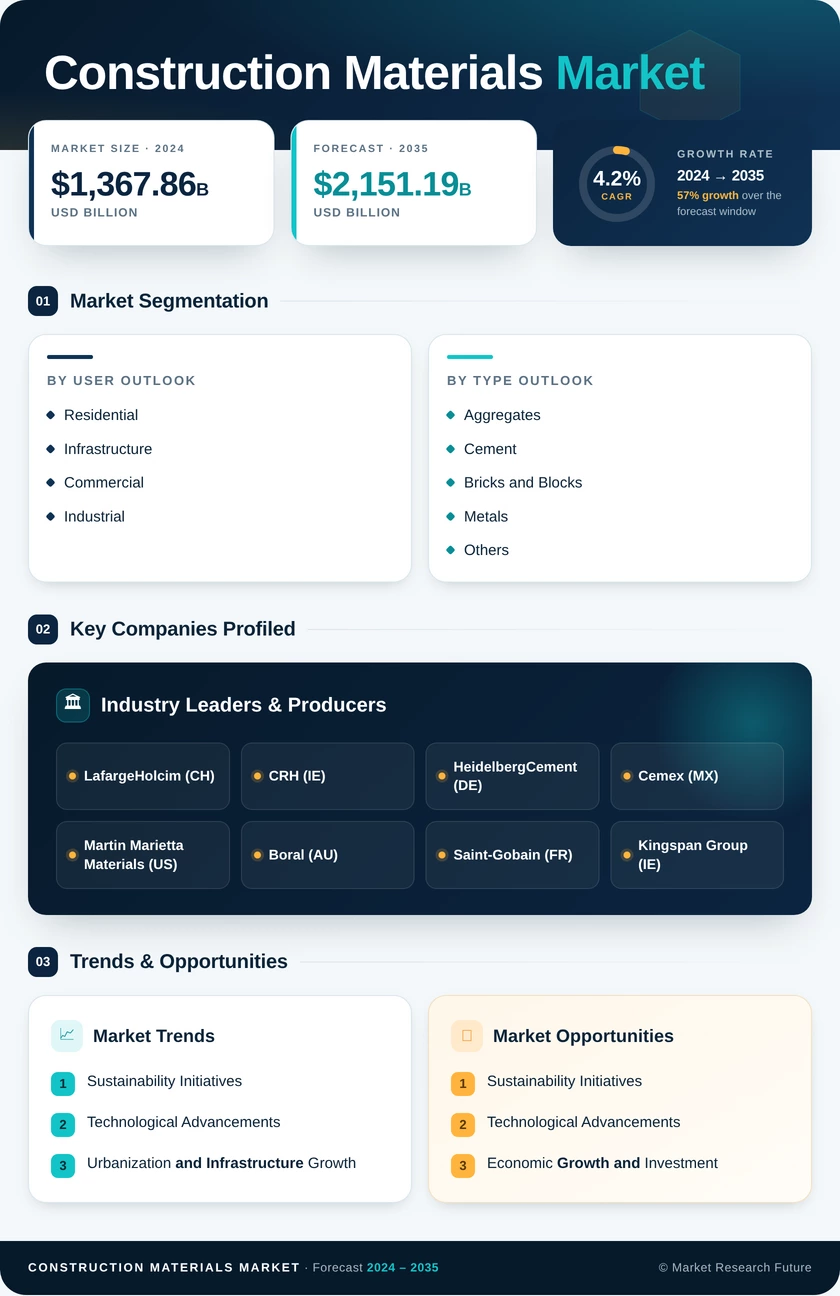
Construction Materials Market (2026 - 2035)

ID: MRFR/CnM/10600-HCR 111 Pages Chitranshi Jaiswal Last Updated: November 11, 2026
Construction Materials Market Research Report Information By Material Type (Aggregates, Cement, Bricks and Blocks, Metals, and Others (Insulation, Coatings, Sealants, and Composites)), By Construction Type (New Construction and Renovation and Repairs), By End-user Industry (Residential, Infrastructure, Commercial, and Industrial), and By Region (North America, Europe, Asia-Pacific, and Rest of the World) – Market Forecast Till 2035.
Construction Materials Market
Market Size
Forecast Period2026-2035
CAGR (2026-2035)5.4%
2025 Market SizeUSD 1,640.0 Billion
2035 Market SizeUSD 2,765.2 Billion
Key Players
CRH
Saint-Gobain
Heidelberg Materials AG
HOLCIM
Cemex S.A.B DE C.V.
Owens Corning
Opportunities
  • Carbon-Captured and Lower-Clinker Cement
  • Emerging-Market Housing and Infrastructure
  • Product Data and Digital Product Passports
  1. 1 Market Summary | |
  2. 2 Key Report Takeaways | |
    1. 2.1 By Material Type | |
    2. 2.2 By Construction Type | |
    3. 2.3 By End-user Industry | |
    4. 2.4 By Region | |
  3. 3 Market Size and Forecast (2021–2035) | |
  4. 4 Driver Impact Analysis | |
    1. 4.1 Public Infrastructure Capital Programs | |
    2. 4.2 Urban Housing Deficits | |
    3. 4.3 Data Center, Energy and Advanced-Manufacturing Build-Out | |
    4. 4.4 Lifecycle Carbon Disclosure and Low-Carbon Specifications | |
    5. 4.5 Renovation and Energy-Retrofit Mandates | |
    6. 4.6 Gulf Giga-Projects and Diversification Programs | |
  5. 5 Restraints Impact Analysis | |
    1. 5.1 Decarbonization Capex and Carbon Pricing | |
    2. 5.2 China Property Contraction | |
    3. 5.3 Quarry Permitting and Reserve Constraints | |
    4. 5.4 Skilled Construction Labor Shortage | |
    5. 5.5 High Financing Costs for Residential Projects | |
  6. 6 Opportunities | |
    1. 6.1 Carbon-Captured and Lower-Clinker Cement | |
    2. 6.2 Emerging-Market Housing and Infrastructure | |
    3. 6.3 Product Data and Digital Product Passports | |
    4. 6.4 Recycled Aggregates and Circular Construction | |
    5. 6.5 Construction Chemicals for Repair and Retrofit | |
  7. 7 Regional Market Share and Country-Level Analysis | |
    1. 7.1 North America | | |
      1. 7.1.1 US | | |
      2. 7.1.2 Canada | | |
      3. 7.1.3 Mexico | |
    2. 7.2 Europe | | |
      1. 7.2.1 Germany | | |
      2. 7.2.2 UK | | |
      3. 7.2.3 France | | |
      4. 7.2.4 Italy | | |
      5. 7.2.5 Spain | | |
      6. 7.2.6 Nordic Countries | | |
      7. 7.2.7 Russia | | |
      8. 7.2.8 Rest of Europe | |
    3. 7.3 Asia-Pacific | | |
      1. 7.3.1 China | | |
      2. 7.3.2 India | | |
      3. 7.3.3 Japan | | |
      4. 7.3.4 South Korea | | |
      5. 7.3.5 ASEAN | | |
      6. 7.3.6 Rest of Asia-Pacific | |
    4. 7.4 South America | | |
      1. 7.4.1 Brazil | | |
      2. 7.4.2 Argentina | | |
      3. 7.4.3 Rest of South America | |
    5. 7.5 Middle East & Africa | | |
      1. 7.5.1 Saudi Arabia | | |
      2. 7.5.2 UAE | | |
      3. 7.5.3 South Africa | | |
      4. 7.5.4 Egypt | | |
      5. 7.5.5 Rest of MEA | |
  8. 8 Future Outlook (2026–2035) | |
    1. 8.1 Decarbonized Cement Moves From Pilot to Portfolio | |
    2. 8.2 Data-Driven Procurement and Traceability | |
    3. 8.3 Electrification and Digital Infrastructure Supercycle | |
    4. 8.4 Portfolio Reshaping and Consolidation | |
  9. 9 Segmentation Analysis | |
    1. 9.1 By Material Type | | |
      1. 9.1.1 Aggregates | | |
      2. 9.1.2 Cement | | |
      3. 9.1.3 Bricks and Blocks | | |
      4. 9.1.4 Metals | | |
      5. 9.1.5 Others | |
    2. 9.2 By Construction Type | | |
      1. 9.2.1 New Construction | | |
      2. 9.2.2 Renovation and Repairs | |
    3. 9.3 By End-user Industry | | |
      1. 9.3.1 Residential | | |
      2. 9.3.2 Infrastructure | | |
      3. 9.3.3 Commercial | | |
      4. 9.3.4 Industrial | |
  10. 10 Competitive Landscape | |
    1. 10.1 Market Concentration Analysis | |
    2. 10.2 Competitive Benchmarking Table | |
  11. 11 Recent News & Developments | |
  12. 12 Report Scope and Methodology | |
  13. 13 Detailed Sources and Citations | |
  14. 14 Frequently Asked Questions (FAQs) | | LIST OF TABLES | |
  15. TABLE 1 Global Construction Materials Market Summary Snapshot, 2025–2035 | |
  16. TABLE 2 Global Construction Materials Market Size & Forecast, by Revenue (USD Billion), 2021–2035 | |
  17. TABLE 3 Driver Impact Analysis, 2026–2035 | |
  18. TABLE 4 Restraints Impact Analysis, 2026–2035 | |
  19. TABLE 5 Global Construction Materials Market, by Region, 2025 | |
  20. TABLE 6 North America Construction Materials Market, by Country, 2025 | |
  21. TABLE 7 Europe Construction Materials Market, by Country, 2025 | |
  22. TABLE 8 Asia-Pacific Construction Materials Market, by Country, 2025 | |
  23. TABLE 9 South America Construction Materials Market, by Country, 2025 | |
  24. TABLE 10 Middle East & Africa Construction Materials Market, by Country, 2025 | |
  25. TABLE 11 Global Construction Materials Market, by Material Type, 2025 | |
  26. TABLE 12 Global Construction Materials Market, by Construction Type, 2025 | |
  27. TABLE 13 Global Construction Materials Market, by End-user Industry, 2025 | |
  28. TABLE 14 Competitive Benchmarking Table – Key Players, 2025 | |
  29. TABLE 15 Report Scope and Methodology | |
  30. TABLE 16 Detailed Sources and Citations | |
  31. TABLE 17 Segmentation Quick Reference | | LIST OF FIGURES | |
  32. FIGURE 1 Market Dynamics Overview – Drivers, Restraints and Opportunities | |
  33. FIGURE 2 Construction Materials Value Chain Analysis | |
  34. FIGURE 3 Porter's Five Forces Analysis | |
  35. FIGURE 4 Global Construction Materials Market Size Trend, 2021–2035 (USD Billion) | |
  36. FIGURE 5 Market Share by Material Type, 2025 | |
  37. FIGURE 6 Market Share by Construction Type, 2025 | |
  38. FIGURE 7 Market Share by End-user Industry, 2025 | |
  39. FIGURE 8 Regional Market Share, 2025 | |
  40. FIGURE 9 Country-Level Share by Region, 2025 | |
  41. FIGURE 10 Competitive Landscape – Revenue Share Range Positioning, 2025

Segmentation Quick Reference

DimensionSub-SegmentsDominant SegmentFastest Growing Segment
By Material TypeAggregates, Cement, Bricks and Blocks, Metals, OthersAggregates (40.5% share)Metals (6.2% CAGR)
By Construction TypeNew Construction, Renovation and RepairsNew Construction (68.0% share)Renovation and Repairs (6.6% CAGR)
By End-user IndustryResidential, Infrastructure, Commercial, IndustrialResidential (42.4% share)Infrastructure (6.9% CAGR)
By RegionNorth America, Europe, Asia-Pacific, South America, Middle East & AfricaAsia-Pacific (47.5% share)Asia-Pacific (47.5% share)

Market Segmentation Overview

By Material Type

Sub-SegmentKey Trend
AggregatesReserve depth and local haul economics protect incumbent quarries
CementBlended and lower-clinker grades gain specification share
Bricks and BlocksPrefabricated panels compete in markets with off-site construction
MetalsHigher-grade structural steel for grid and data center projects
OthersInsulation, coatings and sealants win on performance criteria

Aggregates lead by share because every tonne of concrete and road base needs them, and permitted reserves are slow to replicate. Metals grow fastest as grid, renewable and data center projects specify structural steel grades above standard carbon steel. Cement keeps its second-place value position while blended formulations take share from ordinary Portland cement under lifecycle carbon rules.

By Construction Type

Sub-SegmentKey Trend
New ConstructionLarge housing, industrial and public-works pipelines in Asia, the Gulf and North America
Renovation and RepairsEnergy-retrofit mandates and maintenance of aging building stock

New Construction leads because large housing programs in India and Southeast Asia, Gulf infrastructure and North American industrial projects all consume bulk materials at scale. Renovation and Repairs grows faster as EU zero-emission building rules and retrofit targets pull demand toward insulation, plasterboard and repair mortars. The renovation mix also proves steadier when new-building starts fall with higher interest rates.

By End-user Industry

Sub-SegmentKey Trend
ResidentialAffordable-housing schemes in fast-urbanizing economies
InfrastructurePublic capital programs for roads, rail, water and energy networks
CommercialData centers and logistics offset weaker office and retail demand
IndustrialSemiconductor, battery and LNG plants require certified materials

Residential holds the largest share because housing deficits in Asia, Africa and parts of Europe translate directly into cement, block and finishing-product demand. Infrastructure grows fastest as India's central capex, U.S. federal funding and Gulf diversification programs move from budget to construction. Commercial and Industrial buyers increasingly pay for certified, high-performance products rather than commodity grades.


Download PDF ×

We do not share your information with anyone. However, we may send you emails based on your report interest from time to time. You may contact us at any time to opt-out.