×
Request Free Sample ×

Kindly complete the form below to receive a free sample of this Report

* Please use a valid business email

Leading companies partner with us for data-driven Insights

clients tt-cursor
Hero Background
English
Chinese
French
Japanese
Korean
German
Spanish

Concrete Admixtures Market Trends

ID: MRFR/CnM/1462-HCR
111 Pages
Chitranshi Jaiswal
February 2026

Concrete Admixtures Market Research Report Information By Function (Plasticizers, Super Plasticizers, Air Entrainers, Accelerators, Retarders, Waterproofing Admixtures and others), by Application (Residential, Non-Residential and Infrastructure) And By Region (North America, Europe, Asia-Pacific, And Rest Of The World) - Forecast Till 2035

Share:
Download PDF ×

We do not share your information with anyone. However, we may send you emails based on your report interest from time to time. You may contact us at any time to opt-out.

Concrete Admixtures Market Infographic
Purchase Options

Market Trends

Key Emerging Trends in the Concrete Admixtures Market

Notably, significant trends are currently affecting the dynamics of the construction industry through the Concrete Admixtures Market. The demand for durable, high-performance concrete continues to rise due to increased global urbanization, leading to growth in the Concrete Admixtures sector. In addition, sustainability is one of the most prominent trends observed lately in this market segment for concrete additives: with a better understanding of environmental issues involved, do builders nowadays prefer ecologically friendly solutions that decrease carbon footprint during the construction process? In response to these needs, manufacturers are developing new types of admixtures that not only enhance workability and durability but promote sustainable construction practices as well. These sustainable admixtures aim to minimize the pollution resulting from the production of cement while satisfying all modern strength requirements that are set on it. Growing acceptance levels towards high-performance concrete admixtures can characterize another key trend. The complexity associated with infrastructure projects calls for stronger concretes that are able to resist different environmental factors, hence requiring greater strength or longevity than they currently do. There is also an increase in the market of high-performance admixtures aimed at addressing such requirements by improving the compressive strength, durability and workability of concrete. Thus, it is possible to build constructions that will be able to serve for a long time under harsh weather conditions. Additionally, there has been a surge in research and development, with the introduction of advanced admixtures being one major factor responsible for this trend. These research efforts have enabled manufacturers to produce state-of-the-art formulations that solve specific construction problems such as fast setting times, early strength enhancement, or corrosion protection, among others. Such innovations are driven by the goal of offering architects well-rounded solutions that could suit many projects. Geographically, developing countries are driving the growth of the concrete admixtures market. Urbanization and industrialization are on the rapid rise, witnessing most parts of Asia continent, Africa continent, and a large part of South America continent, thus catalyzing demand for better building materials. Consequently, are governments investing heavily in infrastructure development in these regions, thereby creating an environment that is enabling the adoption of concrete admixtures? Moreover, there is also increased partnership between manufacturers and other players in the construction industry within the same marketplace right now. Their partnerships aim at sharing knowledge so as to develop tailor made admixture solutions appropriate for various applications while properly incorporating them into any construction project they deal with. Through fostering such alliances, therefore, enhances overall expansion and evolution in the realm relating to the Concrete Admixtures Market by promoting a more collaborative approach toward addressing ever-emerging requirements from the construction industry.

Author
Chitranshi Jaiswal
Team Lead - Research

Chitranshi is a Team Leader in the Chemicals & Materials (CnM) and Energy & Power (EnP) domains, with 6+ years of experience in market research. She leads and mentors teams to deliver cross-domain projects that equip clients with actionable insights and growth strategies. She is skilled in market estimation, forecasting, competitive benchmarking, and both primary & secondary research, enabling her to turn complex data into decision-ready insights. An engineer and MBA professional, she combines technical expertise with strategic acumen to solve dynamic market challenges. Chitranshi has successfully managed projects that support market entry, investment planning, and competitive positioning, while building strong client relationships. Certified in Advanced Excel & Power BI she leverages data-driven approaches to ensure accuracy, clarity, and impactful outcomes.

Leave a Comment

FAQs

What is the current valuation of the Concrete Admixtures Market as of 2024?

<p>The Concrete Admixtures Market was valued at 21.16 USD Billion in 2024.</p>

What is the projected market size for the Concrete Admixtures Market in 2035?

<p>The market is projected to reach 42.52 USD Billion by 2035.</p>

What is the expected CAGR for the Concrete Admixtures Market during the forecast period 2025 - 2035?

<p>The expected CAGR for the Concrete Admixtures Market during 2025 - 2035 is 6.55%.</p>

Which segments are included in the Concrete Admixtures Market based on function?

<p>The market segments based on function include Plasticizers, Super Plasticizers, Air Entrainers, Accelerators, Retarders, Waterproofing Admixtures, and Others.</p>

What are the projected valuations for Plasticizers in the Concrete Admixtures Market by 2035?

<p>Plasticizers are projected to reach a valuation between 7.0 and 10.0 USD Billion by 2035.</p>

How does the Non-Residential application segment perform in the Concrete Admixtures Market?

<p>The Non-Residential application segment is expected to grow to a valuation between 16.0 and 16.52 USD Billion by 2035.</p>

What role do key players like BASF and Sika play in the Concrete Admixtures Market?

<p>Key players such as BASF and Sika are instrumental in driving innovation and market growth within the Concrete Admixtures sector.</p>

What is the expected growth for the Infrastructure application segment by 2035?

<p>The Infrastructure application segment is anticipated to grow to a valuation between 16.0 and 16.52 USD Billion by 2035.</p>

What is the projected valuation for Waterproofing Admixtures in 2035?

<p>Waterproofing Admixtures are projected to reach a valuation between 6.0 and 6.52 USD Billion by 2035.</p>

How do the growth rates of different segments compare in the Concrete Admixtures Market?

<p>Segments such as Super Plasticizers and Waterproofing Admixtures are likely to experience substantial growth, reflecting the overall market trend.</p>

Market Summary

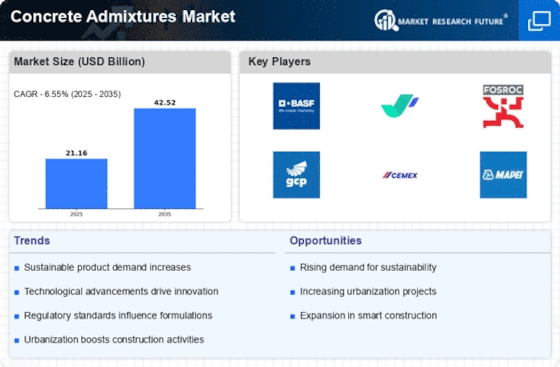
As per Market Research Future analysis, the Concrete Admixtures Market Size was estimated at 21.16 USD Billion in 2024. The Concrete Admixtures industry is projected to grow from 22.55 USD Billion in 2025 to 42.52 USD Billion by 2035, exhibiting a compound annual growth rate (CAGR) of 6.55% during the forecast period 2025 - 2035

Key Market Trends & Highlights

The Concrete Admixtures Market is poised for robust growth driven by sustainability and technological advancements.

  • The market is witnessing a pronounced shift towards sustainability, influencing product development and consumer preferences. North America remains the largest market for concrete admixtures, while Asia-Pacific is emerging as the fastest-growing region. Plasticizers dominate the market, yet super plasticizers are rapidly gaining traction due to their performance benefits. Key drivers include the rising demand for high-performance concrete and government initiatives promoting sustainable construction practices.

Market Size & Forecast

2024 Market Size 21.16 (USD Billion)
2035 Market Size 42.52 (USD Billion)
CAGR (2025 - 2035) 6.55%
Largest Regional Market Share in 2024 Asia Pacific

Major Players

BASF (DE), Sika (CH), Fosroc (GB), GCP Applied Technologies (US), CEMEX (MX), Mapei (IT), RPM International (US), Kryton (CA), Chryso (FR)

Market Trends

The Concrete Admixtures Market is currently experiencing a dynamic evolution, driven by various factors that influence construction practices globally. The increasing demand for high-performance concrete, which offers enhanced durability and strength, appears to be a primary catalyst for the growth of this market. Additionally, the rising emphasis on sustainable construction practices suggests a shift towards eco-friendly admixtures, which may include recycled materials and innovative formulations. This trend aligns with the broader industry movement towards reducing carbon footprints and promoting environmental responsibility. Furthermore, advancements in technology and the development of smart concrete solutions indicate a potential for increased efficiency and performance in construction projects. In the present landscape, the Concrete Admixtures Market is also witnessing a surge in urbanization and infrastructure development, particularly in emerging economies. This urban expansion necessitates the use of specialized concrete mixtures that can withstand varying environmental conditions. As a result, manufacturers are likely to focus on research and development to create tailored solutions that meet specific regional requirements. Overall, the market appears poised for continued growth, driven by a combination of technological innovation, sustainability initiatives, and the ongoing demand for high-quality construction materials.

Sustainability Focus

The Concrete Admixtures Market is increasingly oriented towards sustainable practices. Manufacturers are exploring eco-friendly formulations that utilize recycled materials and reduce environmental impact. This trend reflects a broader commitment to sustainability within the construction sector.

Technological Advancements

Innovations in technology are reshaping the Concrete Admixtures Market. The emergence of smart concrete solutions, which incorporate advanced materials and monitoring systems, indicates a potential for enhanced performance and efficiency in construction applications.

Urbanization and Infrastructure Growth

Rapid urbanization and infrastructure development in emerging markets are driving demand for specialized concrete mixtures. This trend necessitates the creation of tailored admixtures that can address specific environmental challenges and performance requirements.

Concrete Admixtures Market Market Drivers

Growth in the Construction Sector

The growth in the construction sector is a primary driver of the Concrete Admixtures Market. As urbanization accelerates and infrastructure projects expand, the demand for concrete and its associated admixtures is on the rise. Recent statistics indicate that the construction industry is expected to grow at a rate of 5% annually, leading to increased consumption of concrete admixtures. This growth is particularly pronounced in emerging markets, where rapid urban development is necessitating the use of advanced concrete solutions. The Concrete Admixtures Market is likely to benefit from this trend, as construction companies seek to enhance the quality and performance of their projects through the use of innovative admixtures.

Increased Focus on Sustainability

The increased focus on sustainability is reshaping the Concrete Admixtures Market. As environmental concerns become more prominent, there is a growing demand for eco-friendly concrete solutions. Admixtures that reduce the carbon footprint of concrete production and enhance the recyclability of materials are gaining popularity. This shift is driven by both consumer preferences and regulatory pressures aimed at promoting sustainable construction practices. The market for sustainable concrete admixtures is projected to expand significantly, with estimates suggesting a growth rate of around 7% in the coming years. Consequently, manufacturers in the Concrete Admixtures Market are increasingly investing in research and development to create products that align with sustainability goals.

Government Initiatives and Regulations

Government initiatives and regulations play a crucial role in shaping the Concrete Admixtures Market. Many countries are implementing stringent building codes and sustainability standards that necessitate the use of advanced concrete admixtures. These regulations often aim to reduce carbon emissions and promote environmentally friendly construction practices. For instance, the introduction of incentives for using eco-friendly materials has led to a surge in demand for admixtures that enhance the sustainability of concrete. Furthermore, government-funded infrastructure projects are increasingly incorporating innovative admixtures to ensure compliance with modern standards. This regulatory landscape is expected to drive growth in the Concrete Admixtures Market, as manufacturers adapt their offerings to meet these evolving requirements.

Rising Demand for High-Performance Concrete

The Concrete Admixtures Market is experiencing a notable increase in demand for high-performance concrete, driven by the need for enhanced durability and strength in construction projects. This trend is particularly evident in sectors such as commercial and residential construction, where the emphasis on longevity and structural integrity is paramount. According to recent data, the market for high-performance concrete is projected to grow at a compound annual growth rate of approximately 6% over the next few years. This growth is likely to be fueled by the increasing adoption of advanced concrete admixtures that improve workability, reduce water content, and enhance overall performance. As construction standards evolve, the Concrete Admixtures Market is poised to benefit from this shift towards high-performance materials.

Technological Innovations in Admixture Formulations

Technological innovations in admixture formulations are significantly influencing the Concrete Admixtures Market. The development of new chemical formulations and additives has led to the creation of advanced admixtures that offer superior performance characteristics. Innovations such as self-healing concrete and ultra-high-performance concrete are gaining traction, providing solutions to common challenges faced in construction. These advancements not only improve the mechanical properties of concrete but also enhance its resistance to environmental factors. As a result, the market is witnessing a shift towards more specialized and tailored admixture solutions. The increasing focus on research and development in this area suggests that the Concrete Admixtures Market will continue to evolve, with new products emerging to meet the diverse needs of the construction sector.

Market Segment Insights

By Function: Plasticizers (Largest) vs. Super Plasticizers (Fastest-Growing)

<p>In the Concrete Admixtures Market, the 'Function' segment is characterized by a diverse range of admixtures, each serving specific purposes to enhance concrete performance. Plasticizers hold the largest market share, being widely used to improve workability and reduce water content without compromising strength. Super plasticizers are emerging rapidly, appealing to the demand for high-performance concrete used in complex constructions, as they provide superior fluidity and strength without adding excess water. The growth of the function segment is driven by increasing urbanization and infrastructure development. As construction projects demand more durable and efficient materials, the application of super plasticizers is witnessing a significant rise. Additionally, innovations in admixture formulations tailored to meet specific project requirements are fostering an environment conducive to growth. Developers and contractors are increasingly opting for these advanced solutions ensuring quality and longevity in concrete applications.</p>

<p>Plasticizers (Dominant) vs. Super Plasticizers (Emerging)</p>

<p>Plasticizers are currently the dominant choice in the Concrete Admixtures Market, primarily due to their proven performance in improving the workability of concrete mixtures while reducing water content. These additives enhance the flow properties of concrete, making them ideal for projects requiring intricate detailing or complex designs. On the other hand, super plasticizers are emerging as a preferred option for high-performance concrete applications. They provide greater fluidity and extend workability, especially in challenging environmental conditions. As the construction industry evolves, both plasticizers and super plasticizers are adapting, with manufacturers focusing on developing formulations that meet specific environmental and performance standards, thereby catering to a broad spectrum of construction needs.</p>

By Application: Residential (Largest) vs. Non-Residential (Fastest-Growing)

<p>In the Concrete Admixtures Market, the application segments are primarily categorized into Residential, Non-Residential, and Infrastructure. Among these, the Residential segment holds the largest share, driven by the continual demand for housing and associated construction projects. This segment encompasses a wide range of applications, from single-family homes to large residential complexes, contributing significantly to market stability. In contrast, the Non-Residential sector is the fastest growing, fueled by commercial development, renovations, and an increasing need for specialized construction solutions in areas such as retail, education, and healthcare facilities.</p>

<p>Residential (Dominant) vs. Non-Residential (Emerging)</p>

<p>The Residential segment is characterized by a steady demand for concrete admixtures that enhance the durability and performance of building materials. It benefits from a robust pipeline of new housing projects and sustainable construction practices. Meanwhile, the Non-Residential sector is emerging rapidly, driven by innovative construction methods and increased private and public sector investments. This segment focuses on advanced admixture formulations that cater to the unique requirements of commercial buildings, offering features like improved workability and reduced environmental impact. As urbanization continues, both segments showcase their unique characteristics, with Residential dominating in volume while Non-Residential is recognized for its growth potential.</p>

Get more detailed insights about Concrete Admixtures Market Research Report - Forecast to 2035

Regional Insights

North America : Construction Innovation Leader

North America is witnessing robust growth in the concrete admixtures market, driven by increasing infrastructure projects and stringent regulations promoting sustainable construction practices. The U.S. holds the largest market share at approximately 70%, followed by Canada at around 15%. The demand for high-performance concrete is further fueled by urbanization and the need for durable construction materials. Leading countries in this region include the United States and Canada, with major players like BASF, Sika, and GCP Applied Technologies dominating the market. The competitive landscape is characterized by continuous innovation and the introduction of eco-friendly products. The presence of established companies ensures a steady supply of advanced admixtures, catering to the growing construction sector.

Europe : Sustainable Construction Focus

Europe is emerging as a key player in the concrete admixtures market, driven by stringent environmental regulations and a strong emphasis on sustainable construction practices. Germany and France are the largest markets, holding approximately 30% and 20% of the market share, respectively. The European Union's Green Deal and various national initiatives are catalyzing the demand for innovative and eco-friendly admixtures. Countries like Germany, France, and Italy are at the forefront of this market, with key players such as Mapei and Chryso leading the way. The competitive landscape is marked by a focus on research and development, with companies investing in new technologies to enhance product performance. The presence of established firms ensures a diverse range of products to meet the evolving needs of the construction industry.

Asia-Pacific : Emerging Market Potential

Asia-Pacific is witnessing significant growth in the concrete admixtures market, driven by rapid urbanization and increasing infrastructure investments. China and India are the largest markets, accounting for approximately 40% and 20% of the market share, respectively. Government initiatives aimed at enhancing infrastructure are propelling the demand for advanced concrete solutions, making this region a focal point for market expansion. China, India, and Japan are leading the charge, with major players like Sika and BASF establishing a strong presence. The competitive landscape is characterized by a mix of local and international companies, fostering innovation and product diversification. The growing construction sector, coupled with rising disposable incomes, is expected to further boost the demand for concrete admixtures in this region.

Middle East and Africa : Resource-Rich Opportunities

The Middle East and Africa region is experiencing a burgeoning demand for concrete admixtures, driven by rapid urbanization and significant investments in infrastructure projects. The UAE and South Africa are the largest markets, holding approximately 25% and 15% of the market share, respectively. Government initiatives aimed at enhancing construction quality and sustainability are key drivers of this growth, creating opportunities for innovative admixture solutions. Countries like the UAE, South Africa, and Saudi Arabia are at the forefront, with key players such as GCP Applied Technologies and Kryton making significant inroads. The competitive landscape is evolving, with a focus on local production and partnerships to meet the growing demand. The region's unique challenges and opportunities present a dynamic environment for the concrete admixtures market.

Key Players and Competitive Insights

The Concrete Admixtures Market is characterized by the presence of , regional, and local players. The market is highly consolidated, with all the players competing to gain significant market share. The key market players of Concrete Admixtures Market compete based on cost, product quality, availability of raw materials, and durability of the product. They are engaged in expanding their production capacity and investing in R&D activities to gain an edge over competitors. Furthermore, the growing popularity of Concrete Admixtures Market in residential construction is expected to offer lucrative opportunities to manufacturers in the coming years. However, scarcity of raw materials is expected to hinder the growth of the market studied significantly. Additionally, the adoption of various strategies by Concrete Admixtures industry such as expansion, R&D, agreements, acquisitions, collaborations, and investments is expected to help these players to gain maximum revenue and long-term growth during the review period. The key participants in the Concrete Admixtures Market Fosroc International, Dow Chemical Company, Chryso SAS, BASF SE, Ashland Inc, Sika AG, CICO Technologies Ltd, W.R. Grace & Co, RPM International, and Pidilite Industries. BASF SE (BASF) is one of the largest chemical producers in the world. The company has divided its business segments into six divisions, namely, materials, industrial solutions, chemicals, surface technologies, agricultural solutions, and nutrition & care. The company operates through 12 divisions that manage 54 and regional business units and develops strategies for the 86 strategic business. BASF has a presence in 80 countries and operates through six Verbund sites, which interlink the working of production plants, energy flows, and infrastructure in different regions. BASF primarily operates in Europe and has an active presence in the Americas, Asia-Pacific, and the Middle East & Africa. Also, Sika is a specialty chemicals firm that is a market leader in the research and manufacture of systems and solutions for bonding, sealing, damping, strengthening, and protecting in the construction and automotive industries. Sika has operations in 101 countries and manufactures in over 300 plants worldwide.

Key Companies in the Concrete Admixtures Market include

Industry Developments

November 2021: Sika has agreed to purchase MBCC Group, the former BASF Construction Chemicals, from a subsidiary of Lone Star Funds, a worldwide private equity company, for EUR 5.2 billion. The merged company will be a critical accelerator in allowing Sika and MBCC Group clients to drive the sustainable transformation farther and quicker. The MBCC Group offers a ly recognized product range of and local brands with a solid reputation for quality and dependability. MBCC Group engages in all phases of the building life cycle with its balanced product offering and is a vital contributor to the construction industry's decarbonization.

Future Outlook

Concrete Admixtures Market Future Outlook

The Concrete Admixtures Market is projected to grow at a 6.55% CAGR from 2025 to 2035, driven by urbanization, infrastructure development, and sustainability initiatives.

New opportunities lie in:

  • <p>Development of eco-friendly admixtures to meet regulatory standards. Integration of smart technology in admixture production for efficiency. Expansion into emerging markets with tailored product offerings.</p>

By 2035, the market is expected to achieve robust growth, positioning itself as a leader in construction innovation.

Market Segmentation

Concrete Admixtures Market Function Outlook

  • Plasticizers
  • Super Plasticizers
  • Air Entrainers
  • Accelerators
  • Retarders
  • Waterproofing Admixtures
  • Others

Concrete Admixtures Market Application Outlook

  • Residential
  • Non-Residential
  • Infrastructure

Report Scope

MARKET SIZE 2024 21.16(USD Billion)
MARKET SIZE 2025 22.55(USD Billion)
MARKET SIZE 2035 42.52(USD Billion)
COMPOUND ANNUAL GROWTH RATE (CAGR) 6.55% (2025 - 2035)
REPORT COVERAGE Revenue Forecast, Competitive Landscape, Growth Factors, and Trends
BASE YEAR 2024
Market Forecast Period 2025 - 2035
Historical Data 2019 - 2024
Market Forecast Units USD Billion
Key Companies Profiled BASF (DE), Sika (CH), Fosroc (GB), GCP Applied Technologies (US), CEMEX (MX), Mapei (IT), RPM International (US), Kryton (CA), Chryso (FR)
Segments Covered Function, Application, Region
Key Market Opportunities Integration of sustainable materials in Concrete Admixtures Market enhances performance and meets regulatory demands.
Key Market Dynamics Rising demand for sustainable construction practices drives innovation in concrete admixtures and enhances competitive dynamics.
Countries Covered North America, Europe, APAC, South America, MEA

FAQs

What is the current valuation of the Concrete Admixtures Market as of 2024?

<p>The Concrete Admixtures Market was valued at 21.16 USD Billion in 2024.</p>

What is the projected market size for the Concrete Admixtures Market in 2035?

<p>The market is projected to reach 42.52 USD Billion by 2035.</p>

What is the expected CAGR for the Concrete Admixtures Market during the forecast period 2025 - 2035?

<p>The expected CAGR for the Concrete Admixtures Market during 2025 - 2035 is 6.55%.</p>

Which segments are included in the Concrete Admixtures Market based on function?

<p>The market segments based on function include Plasticizers, Super Plasticizers, Air Entrainers, Accelerators, Retarders, Waterproofing Admixtures, and Others.</p>

What are the projected valuations for Plasticizers in the Concrete Admixtures Market by 2035?

<p>Plasticizers are projected to reach a valuation between 7.0 and 10.0 USD Billion by 2035.</p>

How does the Non-Residential application segment perform in the Concrete Admixtures Market?

<p>The Non-Residential application segment is expected to grow to a valuation between 16.0 and 16.52 USD Billion by 2035.</p>

What role do key players like BASF and Sika play in the Concrete Admixtures Market?

<p>Key players such as BASF and Sika are instrumental in driving innovation and market growth within the Concrete Admixtures sector.</p>

What is the expected growth for the Infrastructure application segment by 2035?

<p>The Infrastructure application segment is anticipated to grow to a valuation between 16.0 and 16.52 USD Billion by 2035.</p>

What is the projected valuation for Waterproofing Admixtures in 2035?

<p>Waterproofing Admixtures are projected to reach a valuation between 6.0 and 6.52 USD Billion by 2035.</p>

How do the growth rates of different segments compare in the Concrete Admixtures Market?

<p>Segments such as Super Plasticizers and Waterproofing Admixtures are likely to experience substantial growth, reflecting the overall market trend.</p>

  1. SECTION I: EXECUTIVE SUMMARY AND KEY HIGHLIGHTS
    1. | 1.1 EXECUTIVE SUMMARY
    2. | | 1.1.1 Market Overview
    3. | | 1.1.2 Key Findings
    4. | | 1.1.3 Market Segmentation
    5. | | 1.1.4 Competitive Landscape
    6. | | 1.1.5 Challenges and Opportunities
    7. | | 1.1.6 Future Outlook
  2. SECTION II: SCOPING, METHODOLOGY AND MARKET STRUCTURE
    1. | 2.1 MARKET INTRODUCTION
    2. | | 2.1.1 Definition
    3. | | 2.1.2 Scope of the study
    4. | | | 2.1.2.1 Research Objective
    5. | | | 2.1.2.2 Assumption
    6. | | | 2.1.2.3 Limitations
    7. | 2.2 RESEARCH METHODOLOGY
    8. | | 2.2.1 Overview
    9. | | 2.2.2 Data Mining
    10. | | 2.2.3 Secondary Research
    11. | | 2.2.4 Primary Research
    12. | | | 2.2.4.1 Primary Interviews and Information Gathering Process
    13. | | | 2.2.4.2 Breakdown of Primary Respondents
    14. | | 2.2.5 Forecasting Model
    15. | | 2.2.6 Market Size Estimation
    16. | | | 2.2.6.1 Bottom-Up Approach
    17. | | | 2.2.6.2 Top-Down Approach
    18. | | 2.2.7 Data Triangulation
    19. | | 2.2.8 Validation
  3. SECTION III: QUALITATIVE ANALYSIS
    1. | 3.1 MARKET DYNAMICS
    2. | | 3.1.1 Overview
    3. | | 3.1.2 Drivers
    4. | | 3.1.3 Restraints
    5. | | 3.1.4 Opportunities
    6. | 3.2 MARKET FACTOR ANALYSIS
    7. | | 3.2.1 Value chain Analysis
    8. | | 3.2.2 Porter's Five Forces Analysis
    9. | | | 3.2.2.1 Bargaining Power of Suppliers
    10. | | | 3.2.2.2 Bargaining Power of Buyers
    11. | | | 3.2.2.3 Threat of New Entrants
    12. | | | 3.2.2.4 Threat of Substitutes
    13. | | | 3.2.2.5 Intensity of Rivalry
    14. | | 3.2.3 COVID-19 Impact Analysis
    15. | | | 3.2.3.1 Market Impact Analysis
    16. | | | 3.2.3.2 Regional Impact
    17. | | | 3.2.3.3 Opportunity and Threat Analysis
  4. SECTION IV: QUANTITATIVE ANALYSIS
    1. | 4.1 Chemicals and Materials, BY Function (USD Billion)
    2. | | 4.1.1 Plasticizers
    3. | | 4.1.2 Super Plasticizers
    4. | | 4.1.3 Air Entrainers
    5. | | 4.1.4 Accelerators
    6. | | 4.1.5 Retarders
    7. | | 4.1.6 Waterproofing Admixtures
    8. | | 4.1.7 Others
    9. | 4.2 Chemicals and Materials, BY Application (USD Billion)
    10. | | 4.2.1 Residential
    11. | | 4.2.2 Non-Residential
    12. | | 4.2.3 Infrastructure
    13. | 4.3 Chemicals and Materials, BY Region (USD Billion)
    14. | | 4.3.1 North America
    15. | | | 4.3.1.1 US
    16. | | | 4.3.1.2 Canada
    17. | | 4.3.2 Europe
    18. | | | 4.3.2.1 Germany
    19. | | | 4.3.2.2 UK
    20. | | | 4.3.2.3 France
    21. | | | 4.3.2.4 Russia
    22. | | | 4.3.2.5 Italy
    23. | | | 4.3.2.6 Spain
    24. | | | 4.3.2.7 Rest of Europe
    25. | | 4.3.3 APAC
    26. | | | 4.3.3.1 China
    27. | | | 4.3.3.2 India
    28. | | | 4.3.3.3 Japan
    29. | | | 4.3.3.4 South Korea
    30. | | | 4.3.3.5 Malaysia
    31. | | | 4.3.3.6 Thailand
    32. | | | 4.3.3.7 Indonesia
    33. | | | 4.3.3.8 Rest of APAC
    34. | | 4.3.4 South America
    35. | | | 4.3.4.1 Brazil
    36. | | | 4.3.4.2 Mexico
    37. | | | 4.3.4.3 Argentina
    38. | | | 4.3.4.4 Rest of South America
    39. | | 4.3.5 MEA
    40. | | | 4.3.5.1 GCC Countries
    41. | | | 4.3.5.2 South Africa
    42. | | | 4.3.5.3 Rest of MEA
  5. SECTION V: COMPETITIVE ANALYSIS
    1. | 5.1 Competitive Landscape
    2. | | 5.1.1 Overview
    3. | | 5.1.2 Competitive Analysis
    4. | | 5.1.3 Market share Analysis
    5. | | 5.1.4 Major Growth Strategy in the Chemicals and Materials
    6. | | 5.1.5 Competitive Benchmarking
    7. | | 5.1.6 Leading Players in Terms of Number of Developments in the Chemicals and Materials
    8. | | 5.1.7 Key developments and growth strategies
    9. | | | 5.1.7.1 New Product Launch/Service Deployment
    10. | | | 5.1.7.2 Merger & Acquisitions
    11. | | | 5.1.7.3 Joint Ventures
    12. | | 5.1.8 Major Players Financial Matrix
    13. | | | 5.1.8.1 Sales and Operating Income
    14. | | | 5.1.8.2 Major Players R&D Expenditure. 2023
    15. | 5.2 Company Profiles
    16. | | 5.2.1 BASF (DE)
    17. | | | 5.2.1.1 Financial Overview
    18. | | | 5.2.1.2 Products Offered
    19. | | | 5.2.1.3 Key Developments
    20. | | | 5.2.1.4 SWOT Analysis
    21. | | | 5.2.1.5 Key Strategies
    22. | | 5.2.2 Sika (CH)
    23. | | | 5.2.2.1 Financial Overview
    24. | | | 5.2.2.2 Products Offered
    25. | | | 5.2.2.3 Key Developments
    26. | | | 5.2.2.4 SWOT Analysis
    27. | | | 5.2.2.5 Key Strategies
    28. | | 5.2.3 Fosroc (GB)
    29. | | | 5.2.3.1 Financial Overview
    30. | | | 5.2.3.2 Products Offered
    31. | | | 5.2.3.3 Key Developments
    32. | | | 5.2.3.4 SWOT Analysis
    33. | | | 5.2.3.5 Key Strategies
    34. | | 5.2.4 GCP Applied Technologies (US)
    35. | | | 5.2.4.1 Financial Overview
    36. | | | 5.2.4.2 Products Offered
    37. | | | 5.2.4.3 Key Developments
    38. | | | 5.2.4.4 SWOT Analysis
    39. | | | 5.2.4.5 Key Strategies
    40. | | 5.2.5 CEMEX (MX)
    41. | | | 5.2.5.1 Financial Overview
    42. | | | 5.2.5.2 Products Offered
    43. | | | 5.2.5.3 Key Developments
    44. | | | 5.2.5.4 SWOT Analysis
    45. | | | 5.2.5.5 Key Strategies
    46. | | 5.2.6 Mapei (IT)
    47. | | | 5.2.6.1 Financial Overview
    48. | | | 5.2.6.2 Products Offered
    49. | | | 5.2.6.3 Key Developments
    50. | | | 5.2.6.4 SWOT Analysis
    51. | | | 5.2.6.5 Key Strategies
    52. | | 5.2.7 RPM International (US)
    53. | | | 5.2.7.1 Financial Overview
    54. | | | 5.2.7.2 Products Offered
    55. | | | 5.2.7.3 Key Developments
    56. | | | 5.2.7.4 SWOT Analysis
    57. | | | 5.2.7.5 Key Strategies
    58. | | 5.2.8 Kryton (CA)
    59. | | | 5.2.8.1 Financial Overview
    60. | | | 5.2.8.2 Products Offered
    61. | | | 5.2.8.3 Key Developments
    62. | | | 5.2.8.4 SWOT Analysis
    63. | | | 5.2.8.5 Key Strategies
    64. | | 5.2.9 Chryso (FR)
    65. | | | 5.2.9.1 Financial Overview
    66. | | | 5.2.9.2 Products Offered
    67. | | | 5.2.9.3 Key Developments
    68. | | | 5.2.9.4 SWOT Analysis
    69. | | | 5.2.9.5 Key Strategies
    70. | 5.3 Appendix
    71. | | 5.3.1 References
    72. | | 5.3.2 Related Reports
  6. LIST OF FIGURES
    1. | 6.1 MARKET SYNOPSIS
    2. | 6.2 NORTH AMERICA MARKET ANALYSIS
    3. | 6.3 US MARKET ANALYSIS BY FUNCTION
    4. | 6.4 US MARKET ANALYSIS BY APPLICATION
    5. | 6.5 CANADA MARKET ANALYSIS BY FUNCTION
    6. | 6.6 CANADA MARKET ANALYSIS BY APPLICATION
    7. | 6.7 EUROPE MARKET ANALYSIS
    8. | 6.8 GERMANY MARKET ANALYSIS BY FUNCTION
    9. | 6.9 GERMANY MARKET ANALYSIS BY APPLICATION
    10. | 6.10 UK MARKET ANALYSIS BY FUNCTION
    11. | 6.11 UK MARKET ANALYSIS BY APPLICATION
    12. | 6.12 FRANCE MARKET ANALYSIS BY FUNCTION
    13. | 6.13 FRANCE MARKET ANALYSIS BY APPLICATION
    14. | 6.14 RUSSIA MARKET ANALYSIS BY FUNCTION
    15. | 6.15 RUSSIA MARKET ANALYSIS BY APPLICATION
    16. | 6.16 ITALY MARKET ANALYSIS BY FUNCTION
    17. | 6.17 ITALY MARKET ANALYSIS BY APPLICATION
    18. | 6.18 SPAIN MARKET ANALYSIS BY FUNCTION
    19. | 6.19 SPAIN MARKET ANALYSIS BY APPLICATION
    20. | 6.20 REST OF EUROPE MARKET ANALYSIS BY FUNCTION
    21. | 6.21 REST OF EUROPE MARKET ANALYSIS BY APPLICATION
    22. | 6.22 APAC MARKET ANALYSIS
    23. | 6.23 CHINA MARKET ANALYSIS BY FUNCTION
    24. | 6.24 CHINA MARKET ANALYSIS BY APPLICATION
    25. | 6.25 INDIA MARKET ANALYSIS BY FUNCTION
    26. | 6.26 INDIA MARKET ANALYSIS BY APPLICATION
    27. | 6.27 JAPAN MARKET ANALYSIS BY FUNCTION
    28. | 6.28 JAPAN MARKET ANALYSIS BY APPLICATION
    29. | 6.29 SOUTH KOREA MARKET ANALYSIS BY FUNCTION
    30. | 6.30 SOUTH KOREA MARKET ANALYSIS BY APPLICATION
    31. | 6.31 MALAYSIA MARKET ANALYSIS BY FUNCTION
    32. | 6.32 MALAYSIA MARKET ANALYSIS BY APPLICATION
    33. | 6.33 THAILAND MARKET ANALYSIS BY FUNCTION
    34. | 6.34 THAILAND MARKET ANALYSIS BY APPLICATION
    35. | 6.35 INDONESIA MARKET ANALYSIS BY FUNCTION
    36. | 6.36 INDONESIA MARKET ANALYSIS BY APPLICATION
    37. | 6.37 REST OF APAC MARKET ANALYSIS BY FUNCTION
    38. | 6.38 REST OF APAC MARKET ANALYSIS BY APPLICATION
    39. | 6.39 SOUTH AMERICA MARKET ANALYSIS
    40. | 6.40 BRAZIL MARKET ANALYSIS BY FUNCTION
    41. | 6.41 BRAZIL MARKET ANALYSIS BY APPLICATION
    42. | 6.42 MEXICO MARKET ANALYSIS BY FUNCTION
    43. | 6.43 MEXICO MARKET ANALYSIS BY APPLICATION
    44. | 6.44 ARGENTINA MARKET ANALYSIS BY FUNCTION
    45. | 6.45 ARGENTINA MARKET ANALYSIS BY APPLICATION
    46. | 6.46 REST OF SOUTH AMERICA MARKET ANALYSIS BY FUNCTION
    47. | 6.47 REST OF SOUTH AMERICA MARKET ANALYSIS BY APPLICATION
    48. | 6.48 MEA MARKET ANALYSIS
    49. | 6.49 GCC COUNTRIES MARKET ANALYSIS BY FUNCTION
    50. | 6.50 GCC COUNTRIES MARKET ANALYSIS BY APPLICATION
    51. | 6.51 SOUTH AFRICA MARKET ANALYSIS BY FUNCTION
    52. | 6.52 SOUTH AFRICA MARKET ANALYSIS BY APPLICATION
    53. | 6.53 REST OF MEA MARKET ANALYSIS BY FUNCTION
    54. | 6.54 REST OF MEA MARKET ANALYSIS BY APPLICATION
    55. | 6.55 KEY BUYING CRITERIA OF CHEMICALS AND MATERIALS
    56. | 6.56 RESEARCH PROCESS OF MRFR
    57. | 6.57 DRO ANALYSIS OF CHEMICALS AND MATERIALS
    58. | 6.58 DRIVERS IMPACT ANALYSIS: CHEMICALS AND MATERIALS
    59. | 6.59 RESTRAINTS IMPACT ANALYSIS: CHEMICALS AND MATERIALS
    60. | 6.60 SUPPLY / VALUE CHAIN: CHEMICALS AND MATERIALS
    61. | 6.61 CHEMICALS AND MATERIALS, BY FUNCTION, 2024 (% SHARE)
    62. | 6.62 CHEMICALS AND MATERIALS, BY FUNCTION, 2024 TO 2035 (USD Billion)
    63. | 6.63 CHEMICALS AND MATERIALS, BY APPLICATION, 2024 (% SHARE)
    64. | 6.64 CHEMICALS AND MATERIALS, BY APPLICATION, 2024 TO 2035 (USD Billion)
    65. | 6.65 BENCHMARKING OF MAJOR COMPETITORS
  7. LIST OF TABLES
    1. | 7.1 LIST OF ASSUMPTIONS
    2. | | 7.1.1
    3. | 7.2 North America MARKET SIZE ESTIMATES; FORECAST
    4. | | 7.2.1 BY FUNCTION, 2025-2035 (USD Billion)
    5. | | 7.2.2 BY APPLICATION, 2025-2035 (USD Billion)
    6. | 7.3 US MARKET SIZE ESTIMATES; FORECAST
    7. | | 7.3.1 BY FUNCTION, 2025-2035 (USD Billion)
    8. | | 7.3.2 BY APPLICATION, 2025-2035 (USD Billion)
    9. | 7.4 Canada MARKET SIZE ESTIMATES; FORECAST
    10. | | 7.4.1 BY FUNCTION, 2025-2035 (USD Billion)
    11. | | 7.4.2 BY APPLICATION, 2025-2035 (USD Billion)
    12. | 7.5 Europe MARKET SIZE ESTIMATES; FORECAST
    13. | | 7.5.1 BY FUNCTION, 2025-2035 (USD Billion)
    14. | | 7.5.2 BY APPLICATION, 2025-2035 (USD Billion)
    15. | 7.6 Germany MARKET SIZE ESTIMATES; FORECAST
    16. | | 7.6.1 BY FUNCTION, 2025-2035 (USD Billion)
    17. | | 7.6.2 BY APPLICATION, 2025-2035 (USD Billion)
    18. | 7.7 UK MARKET SIZE ESTIMATES; FORECAST
    19. | | 7.7.1 BY FUNCTION, 2025-2035 (USD Billion)
    20. | | 7.7.2 BY APPLICATION, 2025-2035 (USD Billion)
    21. | 7.8 France MARKET SIZE ESTIMATES; FORECAST
    22. | | 7.8.1 BY FUNCTION, 2025-2035 (USD Billion)
    23. | | 7.8.2 BY APPLICATION, 2025-2035 (USD Billion)
    24. | 7.9 Russia MARKET SIZE ESTIMATES; FORECAST
    25. | | 7.9.1 BY FUNCTION, 2025-2035 (USD Billion)
    26. | | 7.9.2 BY APPLICATION, 2025-2035 (USD Billion)
    27. | 7.10 Italy MARKET SIZE ESTIMATES; FORECAST
    28. | | 7.10.1 BY FUNCTION, 2025-2035 (USD Billion)
    29. | | 7.10.2 BY APPLICATION, 2025-2035 (USD Billion)
    30. | 7.11 Spain MARKET SIZE ESTIMATES; FORECAST
    31. | | 7.11.1 BY FUNCTION, 2025-2035 (USD Billion)
    32. | | 7.11.2 BY APPLICATION, 2025-2035 (USD Billion)
    33. | 7.12 Rest of Europe MARKET SIZE ESTIMATES; FORECAST
    34. | | 7.12.1 BY FUNCTION, 2025-2035 (USD Billion)
    35. | | 7.12.2 BY APPLICATION, 2025-2035 (USD Billion)
    36. | 7.13 APAC MARKET SIZE ESTIMATES; FORECAST
    37. | | 7.13.1 BY FUNCTION, 2025-2035 (USD Billion)
    38. | | 7.13.2 BY APPLICATION, 2025-2035 (USD Billion)
    39. | 7.14 China MARKET SIZE ESTIMATES; FORECAST
    40. | | 7.14.1 BY FUNCTION, 2025-2035 (USD Billion)
    41. | | 7.14.2 BY APPLICATION, 2025-2035 (USD Billion)
    42. | 7.15 India MARKET SIZE ESTIMATES; FORECAST
    43. | | 7.15.1 BY FUNCTION, 2025-2035 (USD Billion)
    44. | | 7.15.2 BY APPLICATION, 2025-2035 (USD Billion)
    45. | 7.16 Japan MARKET SIZE ESTIMATES; FORECAST
    46. | | 7.16.1 BY FUNCTION, 2025-2035 (USD Billion)
    47. | | 7.16.2 BY APPLICATION, 2025-2035 (USD Billion)
    48. | 7.17 South Korea MARKET SIZE ESTIMATES; FORECAST
    49. | | 7.17.1 BY FUNCTION, 2025-2035 (USD Billion)
    50. | | 7.17.2 BY APPLICATION, 2025-2035 (USD Billion)
    51. | 7.18 Malaysia MARKET SIZE ESTIMATES; FORECAST
    52. | | 7.18.1 BY FUNCTION, 2025-2035 (USD Billion)
    53. | | 7.18.2 BY APPLICATION, 2025-2035 (USD Billion)
    54. | 7.19 Thailand MARKET SIZE ESTIMATES; FORECAST
    55. | | 7.19.1 BY FUNCTION, 2025-2035 (USD Billion)
    56. | | 7.19.2 BY APPLICATION, 2025-2035 (USD Billion)
    57. | 7.20 Indonesia MARKET SIZE ESTIMATES; FORECAST
    58. | | 7.20.1 BY FUNCTION, 2025-2035 (USD Billion)
    59. | | 7.20.2 BY APPLICATION, 2025-2035 (USD Billion)
    60. | 7.21 Rest of APAC MARKET SIZE ESTIMATES; FORECAST
    61. | | 7.21.1 BY FUNCTION, 2025-2035 (USD Billion)
    62. | | 7.21.2 BY APPLICATION, 2025-2035 (USD Billion)
    63. | 7.22 South America MARKET SIZE ESTIMATES; FORECAST
    64. | | 7.22.1 BY FUNCTION, 2025-2035 (USD Billion)
    65. | | 7.22.2 BY APPLICATION, 2025-2035 (USD Billion)
    66. | 7.23 Brazil MARKET SIZE ESTIMATES; FORECAST
    67. | | 7.23.1 BY FUNCTION, 2025-2035 (USD Billion)
    68. | | 7.23.2 BY APPLICATION, 2025-2035 (USD Billion)
    69. | 7.24 Mexico MARKET SIZE ESTIMATES; FORECAST
    70. | | 7.24.1 BY FUNCTION, 2025-2035 (USD Billion)
    71. | | 7.24.2 BY APPLICATION, 2025-2035 (USD Billion)
    72. | 7.25 Argentina MARKET SIZE ESTIMATES; FORECAST
    73. | | 7.25.1 BY FUNCTION, 2025-2035 (USD Billion)
    74. | | 7.25.2 BY APPLICATION, 2025-2035 (USD Billion)
    75. | 7.26 Rest of South America MARKET SIZE ESTIMATES; FORECAST
    76. | | 7.26.1 BY FUNCTION, 2025-2035 (USD Billion)
    77. | | 7.26.2 BY APPLICATION, 2025-2035 (USD Billion)
    78. | 7.27 MEA MARKET SIZE ESTIMATES; FORECAST
    79. | | 7.27.1 BY FUNCTION, 2025-2035 (USD Billion)
    80. | | 7.27.2 BY APPLICATION, 2025-2035 (USD Billion)
    81. | 7.28 GCC Countries MARKET SIZE ESTIMATES; FORECAST
    82. | | 7.28.1 BY FUNCTION, 2025-2035 (USD Billion)
    83. | | 7.28.2 BY APPLICATION, 2025-2035 (USD Billion)
    84. | 7.29 South Africa MARKET SIZE ESTIMATES; FORECAST
    85. | | 7.29.1 BY FUNCTION, 2025-2035 (USD Billion)
    86. | | 7.29.2 BY APPLICATION, 2025-2035 (USD Billion)
    87. | 7.30 Rest of MEA MARKET SIZE ESTIMATES; FORECAST
    88. | | 7.30.1 BY FUNCTION, 2025-2035 (USD Billion)
    89. | | 7.30.2 BY APPLICATION, 2025-2035 (USD Billion)
    90. | 7.31 PRODUCT LAUNCH/PRODUCT DEVELOPMENT/APPROVAL
    91. | | 7.31.1
    92. | 7.32 ACQUISITION/PARTNERSHIP
    93. | | 7.32.1

Chemicals and Materials Market Segmentation

Chemicals and Materials By Function (USD Billion, 2025-2035)

  • Plasticizers
  • Super Plasticizers
  • Air Entrainers
  • Accelerators
  • Retarders
  • Waterproofing Admixtures
  • Others

Chemicals and Materials By Application (USD Billion, 2025-2035)

  • Residential
  • Non-Residential
  • Infrastructure
Infographic

Free Sample Request

Kindly complete the form below to receive a free sample of this Report

Get Free Sample

Customer Strories

Compare Licence

×
Features License Type
Single User Multiuser License Enterprise User
Price $4,950 $5,950 $7,250
Maximum User Access Limit 1 User Upto 10 Users Unrestricted Access Throughout the Organization
Free Customization
Direct Access to Analyst
Deliverable Format
Platform Access
Discount on Next Purchase 10% 15% 15%
Printable Versions