
×
Hero Background
English
Chinese
French
Japanese
Korean
German
Spanish

Composite Repair Market Trends

ID: MRFR/CnM/10513-HCR
111 Pages
Anshula Mandaokar
October 2025

Composite Repair Market Research Report Information By Type (Structural, Semi-Structural, Cosmetic), By Process (Hand Lay-Up, Vacuum Infusion, Autoclave, Others), By End User (Aerospace & Defense, Wind Energy, Automotive & Transportation, Marine, Construction, Pipes & Tanks, Others) And By Region (North America, Europe, Asia-Pacific, And Rest Of The World) –Market Forecast Till 2035

Share:
Download PDF ×

We do not share your information with anyone. However, we may send you emails based on your report interest from time to time. You may contact us at any time to opt-out.

Composite Repair Market Infographic
Purchase Options

Market Trends

Key Emerging Trends in the Composite Repair Market

The market trends of the composite repair market have been experiencing significant growth in recent years. Composite repair involves the use of advanced materials to repair damaged structures or components, offering numerous advantages such as lightweight, high strength, and corrosion resistance. One of the key drivers contributing to the growth of this market is the increasing demand for composite repair solutions across various industries such as aerospace, automotive, wind energy, marine, and construction.

In the aerospace sector, composite materials are widely used in aircraft manufacturing due to their lightweight properties, which help improve fuel efficiency and reduce emissions. However, these materials are also susceptible to damage from impacts, fatigue, and environmental factors. As a result, there is a growing need for composite repair solutions to maintain the structural integrity and safety of aircraft. Additionally, the increasing adoption of composites in the automotive industry for lightweighting purposes is driving the demand for composite repair technologies to address issues such as impact damage and delamination.

The wind energy sector is another significant contributor to the growth of the composite repair market. With the rapid expansion of wind farms worldwide, there is a growing installed base of wind turbines, many of which are made from composite materials. These turbines are exposed to harsh environmental conditions, leading to wear and damage over time. As a result, there is a need for composite repair solutions to extend the service life of wind turbines and ensure their continued operation.

In the marine industry, composite materials are used in the construction of boats, ships, and offshore structures due to their high strength-to-weight ratio and corrosion resistance. However, these structures are constantly exposed to corrosive seawater, leading to degradation and damage. Composite repair technologies offer cost-effective solutions for repairing and maintaining marine structures, thereby reducing downtime and extending their service life.

The construction industry is also driving demand for composite repair solutions, particularly in infrastructure applications such as bridges, buildings, and pipelines. Composite materials offer advantages such as durability, corrosion resistance, and ease of installation, making them an attractive choice for repair and rehabilitation projects. As aging infrastructure becomes a growing concern globally, there is a significant opportunity for composite repair technologies to address maintenance and repair needs.

Another key trend in the composite repair market is the development of advanced repair materials and techniques. Manufacturers are investing in research and development to innovate new materials that offer improved performance, durability, and ease of application. Additionally, there is a growing focus on developing automated repair processes to enhance efficiency and accuracy, particularly in industries such as aerospace where precision is critical.

Furthermore, the increasing adoption of composites in emerging applications such as additive manufacturing and 3D printing is expected to drive demand for composite repair solutions in the coming years. As these technologies become more widespread, there will be a need for repair and maintenance services to support the growing installed base of composite components and structures.

Overall, the composite repair market is poised for continued growth driven by increasing demand across various industries, advancements in repair technologies, and the expanding application of composites in new and existing markets. With the ongoing emphasis on sustainability, lightweighting, and infrastructure investment, composite repair solutions are expected to play a crucial role in ensuring the reliability and longevity of composite structures for years to come.


Author
Anshula Mandaokar
Team Lead - Research

Anshula Mandaokar holds an academic degree in Chemical Engineering and has been contributing to the field for more than 5 years. She has expertise in Market Research and Business Consulting and serves as a Team Lead for a reputed Market Research firm under the Chemicals and Materials domain spectrum. She has worked on multiple projects, generating explicit results in a quick turnaround time. Her understanding of data interpretation justifies her role as a leader.

Leave a Comment

FAQs

What is the current valuation of the Composite Repair Market?

The Composite Repair Market was valued at 22.91 USD Billion in 2024.

What is the projected market size for the Composite Repair Market by 2035?

The market is projected to reach 83.7 USD Billion by 2035.

What is the expected CAGR for the Composite Repair Market during the forecast period 2025 - 2035?

The expected CAGR for the Composite Repair Market during this period is 12.5%.

Which segments are included in the Composite Repair Market?

The market segments include Structural, Semi-Structural, and Cosmetic types.

What are the projected valuations for the Structural segment by 2035?

The Structural segment is projected to reach 30.0 USD Billion by 2035.

How does the Vacuum Infusion process perform in the Composite Repair Market?

The Vacuum Infusion process is expected to grow to 25.0 USD Billion by 2035.

Market Summary

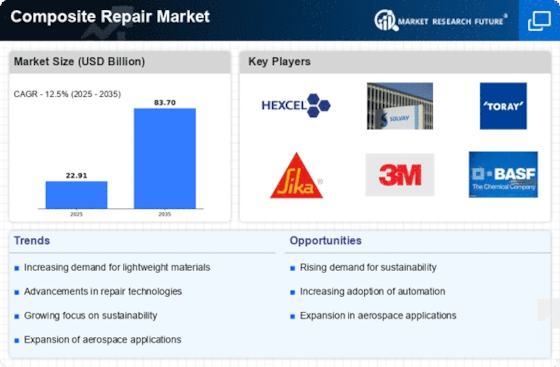
As per Market Research Future analysis, the Composite Repair Market Size was estimated at 22.91 USD Billion in 2024. The Composite Repair industry is projected to grow from 25.77 USD Billion in 2025 to 83.7 USD Billion by 2035, exhibiting a compound annual growth rate (CAGR) of 12.5% during the forecast period 2025 - 2035

Key Market Trends & Highlights

The Composite Repair Market is poised for substantial growth driven by sustainability and technological advancements.

  • The market is increasingly characterized by a strong focus on sustainability, reflecting a broader environmental consciousness.
  • Technological advancements are enhancing repair methodologies, particularly in the structural segment, which remains the largest.
  • The Asia-Pacific region is emerging as the fastest-growing market, driven by rising infrastructure investments and industrial expansion.
  • Key market drivers include the increasing demand for lightweight materials and advancements in repair technologies, which are shaping the industry's future.

Market Size & Forecast

2024 Market Size 22.91 (USD Billion)
2035 Market Size 83.7 (USD Billion)
CAGR (2025 - 2035) 12.5%
Largest Regional Market Share in 2024 North America

Major Players

<p>Hexcel Corporation (US), Solvay S.A. (BE), Toray Industries, Inc. (JP), Sika AG (CH), 3M Company (US), BASF SE (DE), Huntsman Corporation (US), Aerospace Composite Products (US)</p>

Market Trends

The Composite Repair Market is currently experiencing a notable evolution, driven by advancements in materials technology and increasing demand for sustainable solutions. As industries seek to enhance the longevity and performance of their assets, composite repair methods are gaining traction. This shift is largely attributed to the ability of composite materials to provide superior strength-to-weight ratios and resistance to environmental factors. Furthermore, the growing emphasis on reducing maintenance costs and downtime is propelling organizations to adopt innovative repair techniques that utilize composites. In addition, the Composite Repair Market is witnessing a surge in applications across various sectors, including aerospace, automotive, and marine. These industries are increasingly recognizing the benefits of composite repairs, which not only extend the life of components but also contribute to overall efficiency. The integration of smart technologies and automation in repair processes is also anticipated to enhance the effectiveness of composite solutions. As the market continues to evolve, stakeholders are likely to focus on developing new materials and methods that align with environmental regulations and performance standards, ensuring a sustainable future for composite repairs.

Sustainability Focus

The Composite Repair Market is increasingly oriented towards sustainable practices. Companies are prioritizing eco-friendly materials and processes, reflecting a broader industry trend towards environmental responsibility. This shift not only meets regulatory demands but also appeals to consumers who favor sustainable products.

Technological Advancements

Innovations in technology are reshaping the Composite Repair Market. Enhanced materials and repair techniques are emerging, allowing for more efficient and effective solutions. These advancements are likely to improve the performance and durability of repairs, making them more appealing to various industries.

Diverse Applications

The range of applications for composite repairs is expanding across multiple sectors. Industries such as aerospace, automotive, and marine are increasingly adopting composite solutions to address specific challenges. This diversification indicates a growing recognition of the benefits that composite repairs can offer.

Composite Repair Market Market Drivers

Expansion of End-User Industries

The Composite Repair Market is experiencing growth due to the expansion of end-user industries such as aerospace, automotive, and marine. As these sectors evolve, the need for effective repair solutions for composite materials becomes increasingly critical. The aerospace industry, for instance, is projected to see a rise in the use of composite materials, leading to a corresponding increase in repair requirements. In 2025, the automotive sector is also expected to contribute significantly to the composite repair market, with estimates suggesting a growth rate of approximately 5% annually. This expansion across various industries highlights the versatility and necessity of composite repair solutions.

Rising Infrastructure Investments

The Composite Repair Market is poised to benefit from increasing investments in infrastructure development. Governments and private entities are allocating substantial resources towards the maintenance and repair of aging infrastructure, particularly in sectors such as transportation and energy. The use of composite materials for repair applications offers advantages such as corrosion resistance and durability, making them an attractive option for infrastructure projects. In 2025, the infrastructure sector is anticipated to contribute significantly to the composite repair market, with projections indicating a growth rate of approximately 5% annually. This trend underscores the importance of composite materials in extending the lifespan of critical infrastructure.

Advancements in Repair Technologies

Technological innovations play a pivotal role in shaping the Composite Repair Market. The introduction of advanced repair techniques, such as automated fiber placement and 3D printing, enhances the efficiency and effectiveness of composite repairs. These technologies enable quicker turnaround times and improved repair quality, which are essential in industries like aerospace and marine. In 2025, the market for composite repair technologies is expected to expand significantly, with a projected compound annual growth rate of around 7%. This growth is indicative of the industry's commitment to adopting cutting-edge solutions that not only streamline repair processes but also ensure compliance with safety standards.

Growing Awareness of Environmental Impact

There is a rising consciousness regarding the environmental impact of materials used in various industries, which significantly influences the Composite Repair Market. As organizations seek to minimize their carbon footprint, the demand for eco-friendly composite materials is on the rise. This shift is particularly evident in sectors such as construction and automotive, where sustainable practices are becoming a priority. In 2025, the market for environmentally friendly composite repairs is expected to grow at a rate of around 6%, reflecting a broader trend towards sustainability. This awareness not only drives innovation in composite materials but also encourages companies to adopt more responsible repair practices.

Increasing Demand for Lightweight Materials

The Composite Repair Market experiences a notable surge in demand for lightweight materials across various sectors, particularly in aerospace and automotive. As industries strive for enhanced fuel efficiency and reduced emissions, the adoption of composite materials becomes increasingly prevalent. This shift is driven by the need to meet stringent regulatory standards and consumer preferences for sustainable practices. In 2025, the aerospace sector alone is projected to account for a significant share of the composite repair market, with estimates suggesting a growth rate of approximately 6% annually. The emphasis on lightweight solutions not only improves performance but also reduces operational costs, thereby propelling the composite repair market forward.

Market Segment Insights

By Type: Structural (Largest) vs. Semi-Structural (Fastest-Growing)

<p>In the Composite Repair Market, the distribution of market share is significantly tilted towards the Structural segment, which dominates due to its extensive applications in safety-critical industries such as aerospace and automotive. The Semi-Structural segment, while smaller in comparison, is rapidly gaining traction as manufacturers increasingly adopt lighter-weight composites that require less intensive repair solutions, leading to improved operational efficiency and reduced downtime.</p>

<p>Structural (Dominant) vs. Semi-Structural (Emerging)</p>

<p>The Structural segment remains the dominant force within the Composite Repair Market, characterized by its use of high-strength composites that ensure durability and safety in critical applications. This segment is prominent in sectors where structural integrity is paramount, such as aircraft and major infrastructure. On the other hand, the Semi-Structural segment is emerging, focusing on applications that require effective, lightweight repair solutions without compromising on performance. This growth is primarily driven by advancements in composite materials and the increasing need for effective repair methods that optimize resource use and reduce overall lifecycle costs.</p>

By Process: Hand Lay-Up (Largest) vs. Vacuum Infusion (Fastest-Growing)

<p>The composite repair market presents a diverse range of processes, with the Hand Lay-Up method holding the largest market share. This traditional technique continues to be favored due to its simplicity, cost-effectiveness, and suitability for a variety of applications, particularly in the aerospace and automotive industries. In contrast, Vacuum Infusion is rapidly gaining traction as the fastest-growing process, celebrated for its ability to produce high-quality parts with a more environmentally friendly approach.</p>

<p>Process: Hand Lay-Up (Dominant) vs. Vacuum Infusion (Emerging)</p>

<p>Hand Lay-Up remains the dominant process in the composite repair market due to its widespread adoption and versatility across various applications. Its ease of use allows for intricate designs, making it a preferred choice for bespoke projects. Meanwhile, Vacuum Infusion is emerging as a strong competitor as it enhances product performance and reduces waste, aligning with industry trends towards sustainability. This method not only improves part quality but also speeds up production times, making it increasingly attractive to manufacturers looking to optimize efficiency. Both processes cater to distinct market needs, showcasing the dynamic nature of composite repair solutions.</p>

By End User: Aerospace & Defense (Largest) vs. Wind Energy (Fastest-Growing)

<p>In the Composite Repair Market, the distribution of market share among the end user segments reveals that Aerospace & Defense occupies the largest portion due to its reliance on advanced materials to ensure safety and efficiency. This is closely followed by the Wind Energy sector, which is rapidly gaining traction as demand for renewable energy sources increases globally. Other segments like Automotive & Transportation and Marine are also notable contributors, yet they lag in share compared to these two segments.</p>

<p>Aerospace & Defense: Dominant vs. Wind Energy: Emerging</p>

<p>Aerospace & Defense remains the dominant end user in the Composite Repair Market, driven by stringent safety regulations and a continuous push for lightweight materials to improve fuel efficiency. The sector utilizes composites extensively to maintain structural integrity in aircraft and military vehicles. On the other hand, Wind Energy represents a rapidly emerging segment, propelled by the global shift towards sustainable energy solutions. Innovations in composite materials are enhancing the durability and efficiency of wind turbines, making this sector attractive for investments and growth. As wind energy adoption accelerates, the use of composite repairs will continue to expand, providing sustainable and cost-effective solutions.</p>

Get more detailed insights about Composite Repair Market Research Report—Global Forecast till 2035

Regional Insights

North America : Innovation and Demand Surge

North America is the largest market for composite repair, holding approximately 40% of the global share. The region's growth is driven by increasing demand in aerospace and automotive sectors, alongside stringent regulations promoting lightweight materials. The U.S. leads this market, followed closely by Canada, as companies seek to enhance fuel efficiency and reduce emissions through advanced composite materials. The competitive landscape is robust, featuring key players like Hexcel Corporation and 3M Company. The presence of established manufacturers and ongoing investments in R&D are pivotal for market expansion. Additionally, government initiatives supporting aerospace innovation further bolster the market, ensuring North America remains at the forefront of composite repair technologies.

Europe : Sustainable Growth and Innovation

Europe is the second-largest market for composite repair, accounting for around 30% of the global share. The region's growth is fueled by increasing regulations aimed at sustainability and the adoption of lightweight materials in various industries, particularly aerospace and automotive. Countries like Germany and France are at the forefront, driving innovation and demand for advanced composite solutions. The competitive landscape in Europe is characterized by the presence of major players such as Solvay S.A. and BASF SE. The region benefits from strong governmental support for research and development in composite technologies. Furthermore, initiatives aimed at reducing carbon footprints are pushing industries to adopt composite materials, enhancing the market's growth potential.

Asia-Pacific : Rapid Growth and Adoption

Asia-Pacific is witnessing rapid growth in the composite repair market, holding approximately 20% of the global share. The region's expansion is driven by increasing industrialization, particularly in countries like China and Japan, where demand for lightweight materials in automotive and aerospace sectors is surging. Regulatory support for advanced manufacturing technologies is also a significant catalyst for growth. China is the leading country in this region, with a burgeoning aerospace sector that is increasingly adopting composite materials. The competitive landscape includes key players like Toray Industries, Inc. and Sika AG, who are investing heavily in R&D to meet the growing demand. The region's focus on innovation and sustainability is expected to further enhance its market position in the coming years.

Middle East and Africa : Emerging Market with Potential

The Middle East and Africa region is gradually emerging in the composite repair market, holding about 10% of the global share. The growth is primarily driven by increasing investments in infrastructure and aerospace sectors, particularly in the Gulf Cooperation Council (GCC) countries. Regulatory frameworks are evolving to support the adoption of advanced materials, which is expected to catalyze market growth. Countries like the UAE and South Africa are leading the charge, with a growing number of projects focusing on composite materials. The competitive landscape is still developing, with opportunities for both local and international players. As the region continues to invest in technology and innovation, the composite repair market is poised for significant growth in the coming years.

Key Players and Competitive Insights

The Composite Repair Market is currently characterized by a dynamic competitive landscape, driven by increasing demand for lightweight materials and the need for sustainable repair solutions across various industries, including aerospace, automotive, and marine. Key players such as Hexcel Corporation (US), Solvay S.A. (BE), and 3M Company (US) are strategically positioned to leverage their technological expertise and innovative capabilities. Hexcel Corporation (US) focuses on advanced composite materials, emphasizing research and development to enhance product performance. Meanwhile, Solvay S.A. (BE) is actively pursuing partnerships to expand its composite repair offerings, particularly in the aerospace sector. 3M Company (US) is integrating digital solutions into its repair processes, aiming to streamline operations and improve customer engagement. Collectively, these strategies contribute to a competitive environment that prioritizes innovation and operational efficiency.

In terms of business tactics, companies are increasingly localizing manufacturing to reduce lead times and enhance supply chain resilience. This approach is particularly relevant in a moderately fragmented market where regional players also exert influence. The competitive structure is shaped by the collective actions of major players, who are optimizing their supply chains and investing in localized production facilities to meet the growing demand for composite repair solutions.

In August 2025, Hexcel Corporation (US) announced a strategic partnership with a leading aerospace manufacturer to develop next-generation composite repair technologies. This collaboration is expected to enhance Hexcel's product portfolio and strengthen its position in the aerospace sector, where the demand for lightweight and durable materials is surging. The partnership signifies a commitment to innovation and positions Hexcel to capitalize on emerging market opportunities.

In September 2025, Solvay S.A. (BE) launched a new line of eco-friendly composite repair products aimed at reducing environmental impact. This initiative aligns with the growing trend towards sustainability in manufacturing and repair processes. By introducing these products, Solvay not only addresses regulatory pressures but also appeals to environmentally conscious consumers, thereby enhancing its market competitiveness.

In July 2025, 3M Company (US) unveiled a digital platform designed to optimize composite repair workflows for its clients. This platform integrates AI-driven analytics to predict maintenance needs and streamline repair processes. The introduction of this technology reflects 3M's commitment to digital transformation, which is increasingly becoming a differentiating factor in the composite repair market.

As of October 2025, the competitive trends in the Composite Repair Market are heavily influenced by digitalization, sustainability, and the integration of advanced technologies such as AI. Strategic alliances are becoming more prevalent, as companies recognize the value of collaboration in enhancing their product offerings and market reach. Looking ahead, competitive differentiation is likely to evolve from traditional price-based competition to a focus on innovation, technological advancements, and supply chain reliability, underscoring the importance of adaptability in a rapidly changing market.

Key Companies in the Composite Repair Market market include

Industry Developments

2022: The FutureWrap Bio eco-friendly composite repair solution was developed by Aberdeen-based Engineered Composite Solution to help pipe operators undertake pipe repairing operations more sustainably.

2021: A new composite material from CompPair Technologies may be quickly and easily repaired using heat if it sustains damage during manufacture, impact, or fatigue.

Future Outlook

Composite Repair Market Future Outlook

<p>The Composite Repair Market is projected to grow at a 12.5% CAGR from 2024 to 2035, driven by advancements in materials technology and increasing demand for sustainable solutions.</p>

New opportunities lie in:

  • <p>Development of advanced composite repair kits for aerospace applications.</p>
  • <p>Expansion of mobile repair services for on-site industrial maintenance.</p>
  • <p>Integration of IoT technology for real-time monitoring of composite structures.</p>

<p>By 2035, the Composite Repair Market is expected to achieve substantial growth, reflecting evolving industry needs.</p>

Market Segmentation

Composite Repair Market Type Outlook

  • Structural
  • Semi-Structural
  • Cosmetic

Composite Repair Market Process Outlook

  • Hand Lay-Up
  • Vacuum Infusion
  • Autoclave
  • Others

Composite Repair Market End User Outlook

  • Aerospace & Defense
  • Wind Energy
  • Automotive & Transportation
  • Marine
  • Construction
  • Pipes & Tanks
  • Others

Report Scope

MARKET SIZE 202422.91(USD Billion)
MARKET SIZE 202525.77(USD Billion)
MARKET SIZE 203583.7(USD Billion)
COMPOUND ANNUAL GROWTH RATE (CAGR)12.5% (2024 - 2035)
REPORT COVERAGERevenue Forecast, Competitive Landscape, Growth Factors, and Trends
BASE YEAR2024
Market Forecast Period2025 - 2035
Historical Data2019 - 2024
Market Forecast UnitsUSD Billion
Key Companies ProfiledHexcel Corporation (US), Solvay S.A. (BE), Toray Industries, Inc. (JP), Sika AG (CH), 3M Company (US), BASF SE (DE), Huntsman Corporation (US), Aerospace Composite Products (US)
Segments CoveredType, Process, End User, Region
Key Market OpportunitiesAdvancements in sustainable materials drive growth in the Composite Repair Market.
Key Market DynamicsRising demand for lightweight materials drives innovation in composite repair technologies and competitive market dynamics.
Countries CoveredNorth America, Europe, APAC, South America, MEA

FAQs

What is the current valuation of the Composite Repair Market?

The Composite Repair Market was valued at 22.91 USD Billion in 2024.

What is the projected market size for the Composite Repair Market by 2035?

The market is projected to reach 83.7 USD Billion by 2035.

What is the expected CAGR for the Composite Repair Market during the forecast period 2025 - 2035?

The expected CAGR for the Composite Repair Market during this period is 12.5%.

Which segments are included in the Composite Repair Market?

The market segments include Structural, Semi-Structural, and Cosmetic types.

What are the projected valuations for the Structural segment by 2035?

The Structural segment is projected to reach 30.0 USD Billion by 2035.

How does the Vacuum Infusion process perform in the Composite Repair Market?

The Vacuum Infusion process is expected to grow to 25.0 USD Billion by 2035.

  1. SECTION I: EXECUTIVE SUMMARY AND KEY HIGHLIGHTS
    1. EXECUTIVE SUMMARY
      1. Market Overview
      2. Key Findings
      3. Market Segmentation
      4. Competitive Landscape
      5. Challenges and Opportunities
      6. Future Outlook
  2. SECTION II: SCOPING, METHODOLOGY AND MARKET STRUCTURE
    1. MARKET INTRODUCTION
      1. Definition
      2. Scope of the study
    2. RESEARCH METHODOLOGY
      1. Overview
      2. Data Mining
      3. Secondary Research
      4. Primary Research
      5. Forecasting Model
      6. Market Size Estimation
      7. Data Triangulation
      8. Validation
  3. SECTION III: QUALITATIVE ANALYSIS
    1. MARKET DYNAMICS
      1. Overview
      2. Drivers
      3. Restraints
      4. Opportunities
    2. MARKET FACTOR ANALYSIS
      1. Value chain Analysis
      2. Porter's Five Forces Analysis
      3. COVID-19 Impact Analysis
  4. SECTION IV: QUANTITATIVE ANALYSIS
    1. Chemicals and Materials, BY Type (USD Billion)
      1. Structural
      2. Semi-Structural
      3. Cosmetic
    2. Chemicals and Materials, BY Process (USD Billion)
      1. Hand Lay-Up
      2. Vacuum Infusion
      3. Autoclave
      4. Others
    3. Chemicals and Materials, BY End User (USD Billion)
      1. Aerospace & Defense
      2. Wind Energy
      3. Automotive & Transportation
      4. Marine
      5. Construction
      6. Pipes & Tanks
      7. Others
    4. Chemicals and Materials, BY Region (USD Billion)
      1. North America
      2. Europe
      3. APAC
      4. South America
      5. MEA
  5. SECTION V: COMPETITIVE ANALYSIS
    1. Competitive Landscape
      1. Overview
      2. Competitive Analysis
      3. Market share Analysis
      4. Major Growth Strategy in the Chemicals and Materials
      5. Competitive Benchmarking
      6. Leading Players in Terms of Number of Developments in the Chemicals and Materials
      7. Key developments and growth strategies
      8. Major Players Financial Matrix
    2. Company Profiles
      1. Hexcel Corporation (US)
      2. Solvay S.A. (BE)
      3. Toray Industries, Inc. (JP)
      4. Sika AG (CH)
      5. 3M Company (US)
      6. BASF SE (DE)
      7. Huntsman Corporation (US)
      8. Aerospace Composite Products (US)
    3. Appendix
      1. References
      2. Related Reports
  6. LIST OF FIGURES
    1. MARKET SYNOPSIS
    2. NORTH AMERICA MARKET ANALYSIS
    3. US MARKET ANALYSIS BY TYPE
    4. US MARKET ANALYSIS BY PROCESS
    5. US MARKET ANALYSIS BY END USER
    6. CANADA MARKET ANALYSIS BY TYPE
    7. CANADA MARKET ANALYSIS BY PROCESS
    8. CANADA MARKET ANALYSIS BY END USER
    9. EUROPE MARKET ANALYSIS
    10. GERMANY MARKET ANALYSIS BY TYPE
    11. GERMANY MARKET ANALYSIS BY PROCESS
    12. GERMANY MARKET ANALYSIS BY END USER
    13. UK MARKET ANALYSIS BY TYPE
    14. UK MARKET ANALYSIS BY PROCESS
    15. UK MARKET ANALYSIS BY END USER
    16. FRANCE MARKET ANALYSIS BY TYPE
    17. FRANCE MARKET ANALYSIS BY PROCESS
    18. FRANCE MARKET ANALYSIS BY END USER
    19. RUSSIA MARKET ANALYSIS BY TYPE
    20. RUSSIA MARKET ANALYSIS BY PROCESS
    21. RUSSIA MARKET ANALYSIS BY END USER
    22. ITALY MARKET ANALYSIS BY TYPE
    23. ITALY MARKET ANALYSIS BY PROCESS
    24. ITALY MARKET ANALYSIS BY END USER
    25. SPAIN MARKET ANALYSIS BY TYPE
    26. SPAIN MARKET ANALYSIS BY PROCESS
    27. SPAIN MARKET ANALYSIS BY END USER
    28. REST OF EUROPE MARKET ANALYSIS BY TYPE
    29. REST OF EUROPE MARKET ANALYSIS BY PROCESS
    30. REST OF EUROPE MARKET ANALYSIS BY END USER
    31. APAC MARKET ANALYSIS
    32. CHINA MARKET ANALYSIS BY TYPE
    33. CHINA MARKET ANALYSIS BY PROCESS
    34. CHINA MARKET ANALYSIS BY END USER
    35. INDIA MARKET ANALYSIS BY TYPE
    36. INDIA MARKET ANALYSIS BY PROCESS
    37. INDIA MARKET ANALYSIS BY END USER
    38. JAPAN MARKET ANALYSIS BY TYPE
    39. JAPAN MARKET ANALYSIS BY PROCESS
    40. JAPAN MARKET ANALYSIS BY END USER
    41. SOUTH KOREA MARKET ANALYSIS BY TYPE
    42. SOUTH KOREA MARKET ANALYSIS BY PROCESS
    43. SOUTH KOREA MARKET ANALYSIS BY END USER
    44. MALAYSIA MARKET ANALYSIS BY TYPE
    45. MALAYSIA MARKET ANALYSIS BY PROCESS
    46. MALAYSIA MARKET ANALYSIS BY END USER
    47. THAILAND MARKET ANALYSIS BY TYPE
    48. THAILAND MARKET ANALYSIS BY PROCESS
    49. THAILAND MARKET ANALYSIS BY END USER
    50. INDONESIA MARKET ANALYSIS BY TYPE
    51. INDONESIA MARKET ANALYSIS BY PROCESS
    52. INDONESIA MARKET ANALYSIS BY END USER
    53. REST OF APAC MARKET ANALYSIS BY TYPE
    54. REST OF APAC MARKET ANALYSIS BY PROCESS
    55. REST OF APAC MARKET ANALYSIS BY END USER
    56. SOUTH AMERICA MARKET ANALYSIS
    57. BRAZIL MARKET ANALYSIS BY TYPE
    58. BRAZIL MARKET ANALYSIS BY PROCESS
    59. BRAZIL MARKET ANALYSIS BY END USER
    60. MEXICO MARKET ANALYSIS BY TYPE
    61. MEXICO MARKET ANALYSIS BY PROCESS
    62. MEXICO MARKET ANALYSIS BY END USER
    63. ARGENTINA MARKET ANALYSIS BY TYPE
    64. ARGENTINA MARKET ANALYSIS BY PROCESS
    65. ARGENTINA MARKET ANALYSIS BY END USER
    66. REST OF SOUTH AMERICA MARKET ANALYSIS BY TYPE
    67. REST OF SOUTH AMERICA MARKET ANALYSIS BY PROCESS
    68. REST OF SOUTH AMERICA MARKET ANALYSIS BY END USER
    69. MEA MARKET ANALYSIS
    70. GCC COUNTRIES MARKET ANALYSIS BY TYPE
    71. GCC COUNTRIES MARKET ANALYSIS BY PROCESS
    72. GCC COUNTRIES MARKET ANALYSIS BY END USER
    73. SOUTH AFRICA MARKET ANALYSIS BY TYPE
    74. SOUTH AFRICA MARKET ANALYSIS BY PROCESS
    75. SOUTH AFRICA MARKET ANALYSIS BY END USER
    76. REST OF MEA MARKET ANALYSIS BY TYPE
    77. REST OF MEA MARKET ANALYSIS BY PROCESS
    78. REST OF MEA MARKET ANALYSIS BY END USER
    79. KEY BUYING CRITERIA OF CHEMICALS AND MATERIALS
    80. RESEARCH PROCESS OF MRFR
    81. DRO ANALYSIS OF CHEMICALS AND MATERIALS
    82. DRIVERS IMPACT ANALYSIS: CHEMICALS AND MATERIALS
    83. RESTRAINTS IMPACT ANALYSIS: CHEMICALS AND MATERIALS
    84. SUPPLY / VALUE CHAIN: CHEMICALS AND MATERIALS
    85. CHEMICALS AND MATERIALS, BY TYPE, 2024 (% SHARE)
    86. CHEMICALS AND MATERIALS, BY TYPE, 2024 TO 2035 (USD Billion)
    87. CHEMICALS AND MATERIALS, BY PROCESS, 2024 (% SHARE)
    88. CHEMICALS AND MATERIALS, BY PROCESS, 2024 TO 2035 (USD Billion)
    89. CHEMICALS AND MATERIALS, BY END USER, 2024 (% SHARE)
    90. CHEMICALS AND MATERIALS, BY END USER, 2024 TO 2035 (USD Billion)
    91. BENCHMARKING OF MAJOR COMPETITORS
  7. LIST OF TABLES
    1. LIST OF ASSUMPTIONS
    2. North America MARKET SIZE ESTIMATES; FORECAST
      1. BY TYPE, 2025-2035 (USD Billion)
      2. BY PROCESS, 2025-2035 (USD Billion)
      3. BY END USER, 2025-2035 (USD Billion)
    3. US MARKET SIZE ESTIMATES; FORECAST
      1. BY TYPE, 2025-2035 (USD Billion)
      2. BY PROCESS, 2025-2035 (USD Billion)
      3. BY END USER, 2025-2035 (USD Billion)
    4. Canada MARKET SIZE ESTIMATES; FORECAST
      1. BY TYPE, 2025-2035 (USD Billion)
      2. BY PROCESS, 2025-2035 (USD Billion)
      3. BY END USER, 2025-2035 (USD Billion)
    5. Europe MARKET SIZE ESTIMATES; FORECAST
      1. BY TYPE, 2025-2035 (USD Billion)
      2. BY PROCESS, 2025-2035 (USD Billion)
      3. BY END USER, 2025-2035 (USD Billion)
    6. Germany MARKET SIZE ESTIMATES; FORECAST
      1. BY TYPE, 2025-2035 (USD Billion)
      2. BY PROCESS, 2025-2035 (USD Billion)
      3. BY END USER, 2025-2035 (USD Billion)
    7. UK MARKET SIZE ESTIMATES; FORECAST
      1. BY TYPE, 2025-2035 (USD Billion)
      2. BY PROCESS, 2025-2035 (USD Billion)
      3. BY END USER, 2025-2035 (USD Billion)
    8. France MARKET SIZE ESTIMATES; FORECAST
      1. BY TYPE, 2025-2035 (USD Billion)
      2. BY PROCESS, 2025-2035 (USD Billion)
      3. BY END USER, 2025-2035 (USD Billion)
    9. Russia MARKET SIZE ESTIMATES; FORECAST
      1. BY TYPE, 2025-2035 (USD Billion)
      2. BY PROCESS, 2025-2035 (USD Billion)
      3. BY END USER, 2025-2035 (USD Billion)
    10. Italy MARKET SIZE ESTIMATES; FORECAST
      1. BY TYPE, 2025-2035 (USD Billion)
      2. BY PROCESS, 2025-2035 (USD Billion)
      3. BY END USER, 2025-2035 (USD Billion)
    11. Spain MARKET SIZE ESTIMATES; FORECAST
      1. BY TYPE, 2025-2035 (USD Billion)
      2. BY PROCESS, 2025-2035 (USD Billion)
      3. BY END USER, 2025-2035 (USD Billion)
    12. Rest of Europe MARKET SIZE ESTIMATES; FORECAST
      1. BY TYPE, 2025-2035 (USD Billion)
      2. BY PROCESS, 2025-2035 (USD Billion)
      3. BY END USER, 2025-2035 (USD Billion)
    13. APAC MARKET SIZE ESTIMATES; FORECAST
      1. BY TYPE, 2025-2035 (USD Billion)
      2. BY PROCESS, 2025-2035 (USD Billion)
      3. BY END USER, 2025-2035 (USD Billion)
    14. China MARKET SIZE ESTIMATES; FORECAST
      1. BY TYPE, 2025-2035 (USD Billion)
      2. BY PROCESS, 2025-2035 (USD Billion)
      3. BY END USER, 2025-2035 (USD Billion)
    15. India MARKET SIZE ESTIMATES; FORECAST
      1. BY TYPE, 2025-2035 (USD Billion)
      2. BY PROCESS, 2025-2035 (USD Billion)
      3. BY END USER, 2025-2035 (USD Billion)
    16. Japan MARKET SIZE ESTIMATES; FORECAST
      1. BY TYPE, 2025-2035 (USD Billion)
      2. BY PROCESS, 2025-2035 (USD Billion)
      3. BY END USER, 2025-2035 (USD Billion)
    17. South Korea MARKET SIZE ESTIMATES; FORECAST
      1. BY TYPE, 2025-2035 (USD Billion)
      2. BY PROCESS, 2025-2035 (USD Billion)
      3. BY END USER, 2025-2035 (USD Billion)
    18. Malaysia MARKET SIZE ESTIMATES; FORECAST
      1. BY TYPE, 2025-2035 (USD Billion)
      2. BY PROCESS, 2025-2035 (USD Billion)
      3. BY END USER, 2025-2035 (USD Billion)
    19. Thailand MARKET SIZE ESTIMATES; FORECAST
      1. BY TYPE, 2025-2035 (USD Billion)
      2. BY PROCESS, 2025-2035 (USD Billion)
      3. BY END USER, 2025-2035 (USD Billion)
    20. Indonesia MARKET SIZE ESTIMATES; FORECAST
      1. BY TYPE, 2025-2035 (USD Billion)
      2. BY PROCESS, 2025-2035 (USD Billion)
      3. BY END USER, 2025-2035 (USD Billion)
    21. Rest of APAC MARKET SIZE ESTIMATES; FORECAST
      1. BY TYPE, 2025-2035 (USD Billion)
      2. BY PROCESS, 2025-2035 (USD Billion)
      3. BY END USER, 2025-2035 (USD Billion)
    22. South America MARKET SIZE ESTIMATES; FORECAST
      1. BY TYPE, 2025-2035 (USD Billion)
      2. BY PROCESS, 2025-2035 (USD Billion)
      3. BY END USER, 2025-2035 (USD Billion)
    23. Brazil MARKET SIZE ESTIMATES; FORECAST
      1. BY TYPE, 2025-2035 (USD Billion)
      2. BY PROCESS, 2025-2035 (USD Billion)
      3. BY END USER, 2025-2035 (USD Billion)
    24. Mexico MARKET SIZE ESTIMATES; FORECAST
      1. BY TYPE, 2025-2035 (USD Billion)
      2. BY PROCESS, 2025-2035 (USD Billion)
      3. BY END USER, 2025-2035 (USD Billion)
    25. Argentina MARKET SIZE ESTIMATES; FORECAST
      1. BY TYPE, 2025-2035 (USD Billion)
      2. BY PROCESS, 2025-2035 (USD Billion)
      3. BY END USER, 2025-2035 (USD Billion)
    26. Rest of South America MARKET SIZE ESTIMATES; FORECAST
      1. BY TYPE, 2025-2035 (USD Billion)
      2. BY PROCESS, 2025-2035 (USD Billion)
      3. BY END USER, 2025-2035 (USD Billion)
    27. MEA MARKET SIZE ESTIMATES; FORECAST
      1. BY TYPE, 2025-2035 (USD Billion)
      2. BY PROCESS, 2025-2035 (USD Billion)
      3. BY END USER, 2025-2035 (USD Billion)
    28. GCC Countries MARKET SIZE ESTIMATES; FORECAST
      1. BY TYPE, 2025-2035 (USD Billion)
      2. BY PROCESS, 2025-2035 (USD Billion)
      3. BY END USER, 2025-2035 (USD Billion)
    29. South Africa MARKET SIZE ESTIMATES; FORECAST
      1. BY TYPE, 2025-2035 (USD Billion)
      2. BY PROCESS, 2025-2035 (USD Billion)
      3. BY END USER, 2025-2035 (USD Billion)
    30. Rest of MEA MARKET SIZE ESTIMATES; FORECAST
      1. BY TYPE, 2025-2035 (USD Billion)
      2. BY PROCESS, 2025-2035 (USD Billion)
      3. BY END USER, 2025-2035 (USD Billion)
    31. PRODUCT LAUNCH/PRODUCT DEVELOPMENT/APPROVAL
    32. ACQUISITION/PARTNERSHIP

Composite Repair Market Segmentation

Composite Repair Market Type Outlook (USD Billion, 2018-2032)

  • Structural
  • Semi-Structural
  • Cosmetic

Composite Repair Market Process Outlook (USD Billion, 2018-2032)

  • Hand Lay-Up
  • Vacuum Infusion
  • Autoclave
  • Others

Composite Repair Market End User Outlook (USD Billion, 2018-2032)

  • Aerospace & Defense
  • Wind Energy
  • Automotive & Transportation
  • Marine
  • Construction
  • Pipes & Tanks
  • Others

Composite Repair Market Regional Outlook (USD Billion, 2018-2032)

  • North America Outlook (USD Billion, 2018-2032)
    • Composite Repair Market by Type
      • Structural
      • Semi-Structural
      • Cosmetic
    • Composite Repair Market by Process
      • Hand Lay-Up
      • Vacuum Infusion
      • Autoclave
      • Others
    • Composite Repair Market by End User
      • Aerospace & Defense
      • Wind Energy
      • Automotive & Transportation
      • Marine
      • Construction
      • Pipes & Tanks
      • Others
    • US Outlook (USD Billion, 2018-2032)
    • Composite Repair Market by Type
      • Structural
      • Semi-Structural
      • Cosmetic
    • Composite Repair Market by Process
      • Hand Lay-Up
      • Vacuum Infusion
      • Autoclave
      • Others
    • Composite Repair Market by End User
      • Aerospace & Defense
      • Wind Energy
      • Automotive & Transportation
      • Marine
      • Construction
      • Pipes & Tanks
      • Others
    • Canada Outlook (USD Billion, 2018-2032)
    • Composite Repair Market by Type
      • Structural
      • Semi-Structural
      • Cosmetic
    • Composite Repair Market by Process
      • Hand Lay-Up
      • Vacuum Infusion
      • Autoclave
      • Others
    • Composite Repair Market by End User
      • Aerospace & Defense
      • Wind Energy
      • Automotive & Transportation
      • Marine
      • Construction
      • Pipes & Tanks
      • Others
    • Europe Outlook (USD Billion, 2018-2032)
      • Composite Repair Market by Type
        • Structural
        • Semi-Structural
        • Cosmetic
      • Composite Repair Market by Process
        • Hand Lay-Up
        • Vacuum Infusion
        • Autoclave
        • Others
      • Composite Repair Market by End User
        • Aerospace & Defense
        • Wind Energy
        • Automotive & Transportation
        • Marine
        • Construction
        • Pipes & Tanks
        • Others
      • Germany Outlook (USD Billion, 2018-2032)
      • Composite Repair Market by Type
        • Structural
        • Semi-Structural
        • Cosmetic
      • Composite Repair Market by Process
        • Hand Lay-Up
        • Vacuum Infusion
        • Autoclave
        • Others
      • Composite Repair Market by End User
        • Aerospace & Defense
        • Wind Energy
        • Automotive & Transportation
        • Marine
        • Construction
        • Pipes & Tanks
        • Others
      • France Outlook (USD Billion, 2018-2032)
      • Composite Repair Market by Type
        • Structural
        • Semi-Structural
        • Cosmetic
      • Composite Repair Market by Process
        • Hand Lay-Up
        • Vacuum Infusion
        • Autoclave
        • Others
      • Composite Repair Market by End User
        • Aerospace & Defense
        • Wind Energy
        • Automotive & Transportation
        • Marine
        • Construction
        • Pipes & Tanks
        • Others
      • UK Outlook (USD Billion, 2018-2032)
      • Composite Repair Market by Type
        • Structural
        • Semi-Structural
        • Cosmetic
      • Composite Repair Market by Process
        • Hand Lay-Up
        • Vacuum Infusion
        • Autoclave
        • Others
      • Composite Repair Market by End User
        • Aerospace & Defense
        • Wind Energy
        • Automotive & Transportation
        • Marine
        • Construction
        • Pipes & Tanks
        • Others
      • Italy Outlook (USD Billion, 2018-2032)
      • Composite Repair Market by Type
        • Structural
        • Semi-Structural
        • Cosmetic
      • Composite Repair Market by Process
        • Hand Lay-Up
        • Vacuum Infusion
        • Autoclave
        • Others
      • Composite Repair Market by End User
        • Aerospace & Defense
        • Wind Energy
        • Automotive & Transportation
        • Marine
        • Construction
        • Pipes & Tanks
        • Others
      • Spain Outlook (USD Billion, 2018-2032)
      • Composite Repair Market by Type
        • Structural
        • Semi-Structural
        • Cosmetic
      • Composite Repair Market by Process
        • Hand Lay-Up
        • Vacuum Infusion
        • Autoclave
        • Others
      • Composite Repair Market by End User
        • Aerospace & Defense
        • Wind Energy
        • Automotive & Transportation
        • Marine
        • Construction
        • Pipes & Tanks
        • Others
      • Rest Of Europe Outlook (USD Billion, 2018-2032)
      • Composite Repair Market by Type
        • Structural
        • Semi-Structural
        • Cosmetic
      • Composite Repair Market by Process
        • Hand Lay-Up
        • Vacuum Infusion
        • Autoclave
        • Others
      • Composite Repair Market by End User
        • Aerospace & Defense
        • Wind Energy
        • Automotive & Transportation
        • Marine
        • Construction
        • Pipes & Tanks
        • Others
      • Asia-Pacific Outlook (USD Billion, 2018-2032)
        • Composite Repair Market by Type
          • Structural
          • Semi-Structural
          • Cosmetic
        • Composite Repair Market by Process
          • Hand Lay-Up
          • Vacuum Infusion
          • Autoclave
          • Others
        • Composite Repair Market by End User
          • Aerospace & Defense
          • Wind Energy
          • Automotive & Transportation
          • Marine
          • Construction
          • Pipes & Tanks
          • Others
        • China Outlook (USD Billion, 2018-2032)
        • Composite Repair Market by Type
          • Structural
          • Semi-Structural
          • Cosmetic
        • Composite Repair Market by Process
          • Hand Lay-Up
          • Vacuum Infusion
          • Autoclave
          • Others
        • Composite Repair Market by End User
          • Aerospace & Defense
          • Wind Energy
          • Automotive & Transportation
          • Marine
          • Construction
          • Pipes & Tanks
          • Others
        • Japan Outlook (USD Billion, 2018-2032)
        • Composite Repair Market by Type
          • Structural
          • Semi-Structural
          • Cosmetic
        • Composite Repair Market by Process
          • Hand Lay-Up
          • Vacuum Infusion
          • Autoclave
          • Others
        • Composite Repair Market by End User
          • Aerospace & Defense
          • Wind Energy
          • Automotive & Transportation
          • Marine
          • Construction
          • Pipes & Tanks
          • Others
        • India Outlook (USD Billion, 2018-2032)
        • Composite Repair Market by Type
          • Structural
          • Semi-Structural
          • Cosmetic
        • Composite Repair Market by Process
          • Hand Lay-Up
          • Vacuum Infusion
          • Autoclave
          • Others
        • Composite Repair Market by End User
          • Aerospace & Defense
          • Wind Energy
          • Automotive & Transportation
          • Marine
          • Construction
          • Pipes & Tanks
          • Others
        • Australia Outlook (USD Billion, 2018-2032)
        • Composite Repair Market by Type
          • Structural
          • Semi-Structural
          • Cosmetic
        • Composite Repair Market by Process
          • Hand Lay-Up
          • Vacuum Infusion
          • Autoclave
          • Others
        • Composite Repair Market by End User
          • Aerospace & Defense
          • Wind Energy
          • Automotive & Transportation
          • Marine
          • Construction
          • Pipes & Tanks
          • Others
        • Rest of Asia-Pacific Outlook (USD Billion, 2018-2032)
        • Composite Repair Market by Type
          • Structural
          • Semi-Structural
          • Cosmetic
        • Composite Repair Market by Process
          • Hand Lay-Up
          • Vacuum Infusion
          • Autoclave
          • Others
        • Composite Repair Market by End User
          • Aerospace & Defense
          • Wind Energy
          • Automotive & Transportation
          • Marine
          • Construction
          • Pipes & Tanks
          • Others
        • Rest of the World Outlook (USD Billion, 2018-2032)
          • Composite Repair Market by Type
            • Structural
            • Semi-Structural
            • Cosmetic
          • Composite Repair Market by Process
            • Hand Lay-Up
            • Vacuum Infusion
            • Autoclave
            • Others
          • Composite Repair Market by End User
            • Aerospace & Defense
            • Wind Energy
            • Automotive & Transportation
            • Marine
            • Construction
            • Pipes & Tanks
            • Others
          • Middle East Outlook (USD Billion, 2018-2032)
          • Composite Repair Market by Type
            • Structural
            • Semi-Structural
            • Cosmetic
          • Composite Repair Market by Process
            • Hand Lay-Up
            • Vacuum Infusion
            • Autoclave
            • Others
          • Composite Repair Market by End User
            • Aerospace & Defense
            • Wind Energy
            • Automotive & Transportation
            • Marine
            • Construction
            • Pipes & Tanks
            • Others
          • Africa Outlook (USD Billion, 2018-2032)
          • Composite Repair Market by Type
            • Structural
            • Semi-Structural
            • Cosmetic
          • Composite Repair Market by Process
            • Hand Lay-Up
            • Vacuum Infusion
            • Autoclave
            • Others
          • Composite Repair Market by End User
            • Aerospace & Defense
            • Wind Energy
            • Automotive & Transportation
            • Marine
            • Construction
            • Pipes & Tanks
            • Others
          • Latin America Outlook (USD Billion, 2018-2032)
          • Composite Repair Market by Type
            • Structural
            • Semi-Structural
            • Cosmetic
          • Composite Repair Market by Process
            • Hand Lay-Up
            • Vacuum Infusion
            • Autoclave
            • Others
          • Composite Repair Market by End User
            • Aerospace & Defense
            • Wind Energy
            • Automotive & Transportation
            • Marine
            • Construction
            • Pipes & Tanks
            • Others


Infographic

Free Sample Request

Kindly complete the form below to receive a free sample of this Report

Get Free Sample

Customer Strories

Compare Licence

×
Features License Type
Single User Multiuser License Enterprise User
Price $4,950 $5,950 $7,250
Maximum User Access Limit 1 User Upto 10 Users Unrestricted Access Throughout the Organization
Free Customization
Direct Access to Analyst
Deliverable Format
Platform Access
Discount on Next Purchase 10% 15% 15%
Printable Versions