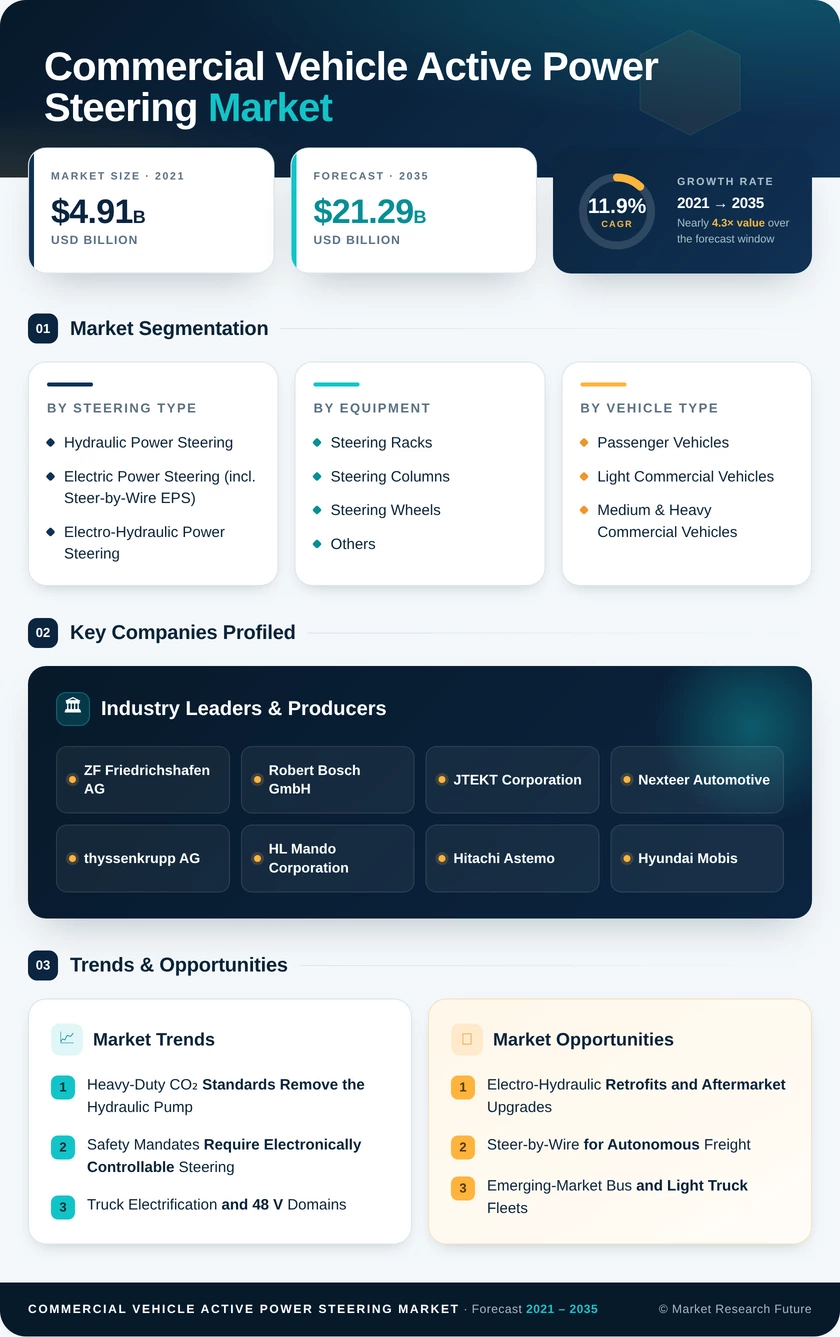
Commercial Vehicle Active Power Steering Market (2026 - 2035)

ID: MRFR/AT/5439-HCR 100 Pages Shubham Munde Last Updated: October 16, 2026
Commercial Vehicle Active Power Steering Market Research Report By Steering Type (Hydraulic Power Steering, Electric Power Steering, Electro-Hydraulic Power Steering), By Equipment (Steering Racks, Steering Columns, Steering Wheels, Others), By Vehicle Type (Passenger Vehicles, Light Commercial Vehicles, Medium & Heavy Commercial Vehicles), By Application (Logistics, Construction & Mining, Public Transport, Others), By Distribution Channel (OEM, Aftermarket) - Forecast to 2035
Commercial Vehicle Active Power Steering Market
Market Size
Forecast Period2026-2035
CAGR (2026-2035)4.04%
2025 Market SizeUSD 6.21 Billion
2035 Market SizeUSD 9.232 Billion
Key Players
ZF Friedrichshafen AG
Robert Bosch GmbH
JTEKT Corporation
Nexteer Automotive
thyssenkrupp AG
HL Mando Corporation
Opportunities
  • Electro-Hydraulic Retrofits and Aftermarket Upgrades
  • Steer-by-Wire for Autonomous Freight
  • Emerging-Market Bus and Light Truck Fleets
  1. 1 Market Summary | |
  2. 2 Key Report Takeaways | |
    1. 2.1 By Steering Type | |
    2. 2.2 By Equipment | |
    3. 2.3 By Vehicle Type | |
    4. 2.4 By Application | |
    5. 2.5 By Distribution Channel | |
    6. 2.6 By Region | |
  3. 3 Market Size and Forecast (2021–2035) | |
  4. 4 Driver Impact Analysis | |
    1. 4.1 Heavy-Duty CO₂ Standards Remove the Hydraulic Pump | |
    2. 4.2 Safety Mandates Require Electronically Controllable Steering | |
    3. 4.3 Truck Electrification and 48 V Domains | |
    4. 4.4 Driver Shortage Elevates Fatigue Reduction | |
    5. 4.5 Autonomous Freight Demands Redundant Actuation | |
    6. 4.6 Electric Bus Procurement Creates Visible Volume | |
    7. 4.7 Public R&D Lowers Validation Risk | |
  5. 5 Restraints Impact Analysis | |
    1. 5.1 System Cost Premium Over Hydraulic Gear | |
    2. 5.2 Power Limits on Heavy Front Axles | |
    3. 5.3 Semiconductor Supply Volatility | |
    4. 5.4 Functional Safety and Cybersecurity Validation Burden | |
    5. 5.5 Service Skills Gap in Emerging Markets | |
  6. 6 Opportunities | |
    1. 6.1 Electro-Hydraulic Retrofits and Aftermarket Upgrades | |
    2. 6.2 Steer-by-Wire for Autonomous Freight | |
    3. 6.3 Emerging-Market Bus and Light Truck Fleets | |
    4. 6.4 Steering Data and Predictive-Maintenance Subscriptions | |
  7. 7 Regional Market Share and Country-Level Analysis | |
    1. 7.1 North America | | |
      1. 7.1.1 US | | |
      2. 7.1.2 Canada | | |
      3. 7.1.3 Mexico | |
    2. 7.2 Europe | | |
      1. 7.2.1 Germany | | |
      2. 7.2.2 UK | | |
      3. 7.2.3 France | | |
      4. 7.2.4 Italy | | |
      5. 7.2.5 Spain | | |
      6. 7.2.6 Nordic Countries | | |
      7. 7.2.7 Russia | | |
      8. 7.2.8 Rest of Europe | |
    3. 7.3 Asia-Pacific | | |
      1. 7.3.1 China | | |
      2. 7.3.2 India | | |
      3. 7.3.3 Japan | | |
      4. 7.3.4 South Korea | | |
      5. 7.3.5 ASEAN | | |
      6. 7.3.6 Rest of Asia-Pacific | |
    4. 7.4 South America | | |
      1. 7.4.1 Brazil | | |
      2. 7.4.2 Argentina | | |
      3. 7.4.3 Rest of South America | |
    5. 7.5 Middle East & Africa | | |
      1. 7.5.1 Saudi Arabia | | |
      2. 7.5.2 UAE | | |
      3. 7.5.3 South Africa | | |
      4. 7.5.4 Egypt | | |
      5. 7.5.5 Rest of MEA | |
  8. 8 Future Outlook (2026–2035) | |
    1. 8.1 Software-Defined Steering and Autonomy | |
    2. 8.2 Electrification and 48 V Power Domains | |
    3. 8.3 Supplier Consolidation and Platform Economics | |
    4. 8.4 Sustainability Reporting and Circularity | |
  9. 9 Segmentation Analysis | |
    1. 9.1 By Steering Type | | |
      1. 9.1.1 Hydraulic Power Steering | | |
      2. 9.1.2 Electric Power Steering | | |
      3. 9.1.3 Electro-Hydraulic Power Steering | |
    2. 9.2 By Equipment | | |
      1. 9.2.1 Steering Racks | | |
      2. 9.2.2 Steering Columns | | |
      3. 9.2.3 Steering Wheels | | |
      4. 9.2.4 Others | |
    3. 9.3 By Vehicle Type | | |
      1. 9.3.1 Passenger Vehicles | | |
      2. 9.3.2 Light Commercial Vehicles | | |
      3. 9.3.3 Medium & Heavy Commercial Vehicles | |
    4. 9.4 By Application | | |
      1. 9.4.1 Logistics | | |
      2. 9.4.2 Construction & Mining | | |
      3. 9.4.3 Public Transport | | |
      4. 9.4.4 Others | |
    5. 9.5 By Distribution Channel | | |
      1. 9.5.1 OEM | | |
      2. 9.5.2 Aftermarket | |
  10. 10 Competitive Landscape | |
    1. 10.1 Market Concentration Analysis | |
    2. 10.2 Competitive Benchmarking Matrix | |
    3. 10.3 Company Profiles | | |
      1. 10.3.1 ZF Friedrichshafen AG | | |
      2. 10.3.2 Robert Bosch GmbH | | |
      3. 10.3.3 JTEKT Corporation | | |
      4. 10.3.4 Nexteer Automotive | | |
      5. 10.3.5 thyssenkrupp AG | | |
      6. 10.3.6 HL Mando Corporation | | |
      7. 10.3.7 Hitachi Astemo | | |
      8. 10.3.8 Hyundai Mobis | | |
      9. 10.3.9 China Automotive Systems, Inc. | | |
      10. 10.3.10 Rane Group | |
  11. 11 Recent News & Developments | |
  12. 12 Report Scope and Methodology | |
  13. 13 Detailed Sources and Citations | |
  14. 14 Frequently Asked Questions (FAQs) | | LIST OF TABLES | |
  15. TABLE 1 Market Snapshot – Study Period, Market Size, CAGR, and Regional Leadership | |
  16. TABLE 2 Global Market Size & Forecast, by Revenue (USD Billion), 2021–2035 | |
  17. TABLE 3 Driver Impact Analysis – Directional CAGR Influence | |
  18. TABLE 4 Restraints Impact Analysis – Directional CAGR Influence | |
  19. TABLE 5 Regional Summary – Key Metric and Investment Themes, 2025 | |
  20. TABLE 6 North America – Country-Level Analysis, 2025 | |
  21. TABLE 7 Europe – Country-Level Analysis, 2025 | |
  22. TABLE 8 Asia-Pacific – Country-Level Analysis, 2025 | |
  23. TABLE 9 South America – Country-Level Analysis, 2025 | |
  24. TABLE 10 Middle East & Africa – Country-Level Analysis, 2025 | |
  25. TABLE 11 Market Segmentation, by Steering Type, 2025 | |
  26. TABLE 12 Market Segmentation, by Equipment, 2025 | |
  27. TABLE 13 Market Segmentation, by Vehicle Type, 2025 | |
  28. TABLE 14 Market Segmentation, by Application, 2025 | |
  29. TABLE 15 Market Segmentation, by Distribution Channel, 2025 | |
  30. TABLE 16 Competitive Benchmarking Matrix – Key Players | |
  31. TABLE 17 Report Scope and Methodology | |
  32. TABLE 18 Detailed Sources and Citations | |
  33. TABLE 19 Segmentation Quick Reference | | LIST OF FIGURES | |
  34. FIGURE 1 Market Dynamics Overview – Drivers, Restraints, and Opportunities | |
  35. FIGURE 2 Industry Value Chain Analysis | |
  36. FIGURE 3 Porter's Five Forces Analysis | |
  37. FIGURE 4 Global Market Size Trend, 2021–2035 (USD Billion) | |
  38. FIGURE 5 Market Share, by Steering Type, 2025 | |
  39. FIGURE 6 Market Share, by Equipment, 2025 | |
  40. FIGURE 7 Market Share, by Vehicle Type, 2025 | |
  41. FIGURE 8 Market Share, by Application, 2025 | |
  42. FIGURE 9 Market Share, by Distribution Channel, 2025 | |
  43. FIGURE 10 Regional Market Share, 2025 | |
  44. FIGURE 11 Competitive Positioning Matrix – Key Players | |
  45. FIGURE 12 Estimated Revenue Share Ranges – Top Ten Suppliers

Segmentation Quick Reference

DimensionSub-SegmentsDominant SegmentFastest Growing Segment
By Steering TypeHydraulic Power Steering, Electric Power Steering (incl. Steer-by-Wire EPS), Electro-Hydraulic Power SteeringElectric Power Steering (57.9% share)Steer-by-Wire EPS (17.4% CAGR)
By EquipmentSteering Racks, Steering Columns, Steering Wheels, OthersSteering Racks (32.8% share)Others (12.3% CAGR)
By Vehicle TypePassenger Vehicles, Light Commercial Vehicles, Medium & Heavy Commercial VehiclesPassenger Vehicles (49.2% share)Medium & Heavy Commercial Vehicles (USD 1.56 Billion)
By ApplicationLogistics, Construction & Mining, Public Transport, OthersLogistics (39.2% share)Public Transport (USD 1.29 Billion)
By Distribution ChannelOEM, AftermarketOEM (69.0% share)Aftermarket (USD 2.15 Billion)
By RegionNorth America, Europe, Asia-Pacific, South America, Middle East & AfricaAsia-Pacific (41.6% share)Asia-Pacific (41.6% share)


Market Segmentation Overview

By Steering Type

Sub-SegmentKey Trend
Hydraulic Power SteeringRetained on the heaviest front axles where torque exceeds 24 V electric limits
Electric Power SteeringDefault choice on battery-electric and light-to-medium platforms; Steer-by-Wire EPS variant entering series production
Electro-Hydraulic Power SteeringBridge technology adding electronic control to existing hydraulic gear


Electric Power Steering leads because it removes the parasitic pump load and supports the lane-keeping functions required by the EU General Safety Regulation. Its Steer-by-Wire EPS variant grows fastest as autonomous freight programs require column-free, fully redundant actuation. Hydraulic Power Steering and Electro-Hydraulic Power Steering stay relevant on diesel Class 8 tractors until 48 V power domains become standard.

By Equipment

Sub-SegmentKey Trend
Steering RacksHigher-force electric racks developed for heavier axles
Steering ColumnsColumn-assist EPS rated above 100 Nm reaching medium trucks
Steering WheelsIntegration of driver-monitoring sensors and haptic alerts
OthersRapid growth in torque sensors, angle sensors, ECUs, and assist motors


Steering Racks hold the largest equipment share because every system, whether hydraulic or electric, needs a rack or gear to move the wheels. Others grows fastest because redundant steer-by-wire and ADAS-ready designs require two or more torque and angle sensors per vehicle, plus dedicated ECUs. Steering Columns benefit from high-output column-assist units that let OEMs electrify medium trucks without redesigning the rack.

By Vehicle Type

Sub-SegmentKey Trend
Passenger VehiclesMature EPS adoption with high penetration
Light Commercial VehiclesDelivery van electrification adapting passenger EPS to commercial duty
Medium & Heavy Commercial VehiclesAccelerating adoption under CO₂ standards and direct-vision rules


Passenger Vehicles lead because electric assistance was validated there years before commercial duty cycles. Medium & Heavy Commercial Vehicles grow fastest as the EU and EPA CO₂ curves, combined with London's Direct Vision Standard, make electronically controllable steering a compliance requirement rather than an option. Light Commercial Vehicles adopt passenger technology but need longer service intervals for high-mileage delivery routes.

By Application

Sub-SegmentKey Trend
LogisticsFuel savings and driver retention on long-haul and regional routes
Construction & MiningLow-speed maneuverability with ruggedized electronics
Public TransportElectric bus tenders specifying electric steering by default
OthersMunicipal, refuse, and utility fleets adopting electric chassis


Logistics leads because freight fleets are the largest vehicle pool and quickly adopt technology that lowers per-mile cost. Public Transport grows fastest because e-bus programs such as India's PM E-DRIVE and Chinese new-energy mandates bundle electric steering into every procured vehicle. Construction & Mining trails because dust, vibration, and heavy impacts slow validation of electronic steering.

By Distribution Channel

Sub-SegmentKey Trend
OEMSteering engineered into platforms at launch under multi-year contracts
AftermarketRetrofit electric assist and replacement of sensors and ECUs


OEM supply dominates because active steering is integrated with chassis electronics and safety validation during vehicle development. The Aftermarket grows faster as fleets retrofit column-mounted electric assist onto in-service hydraulic trucks and as the installed base of electronic steering needs replacement sensors, motors, and control units.




Download PDF ×

We do not share your information with anyone. However, we may send you emails based on your report interest from time to time. You may contact us at any time to opt-out.